One Pixel Attack for Fooling Deep Neural Networks
Jiawei SuDanilo Vasconcellos VargasSakurai Kouichi
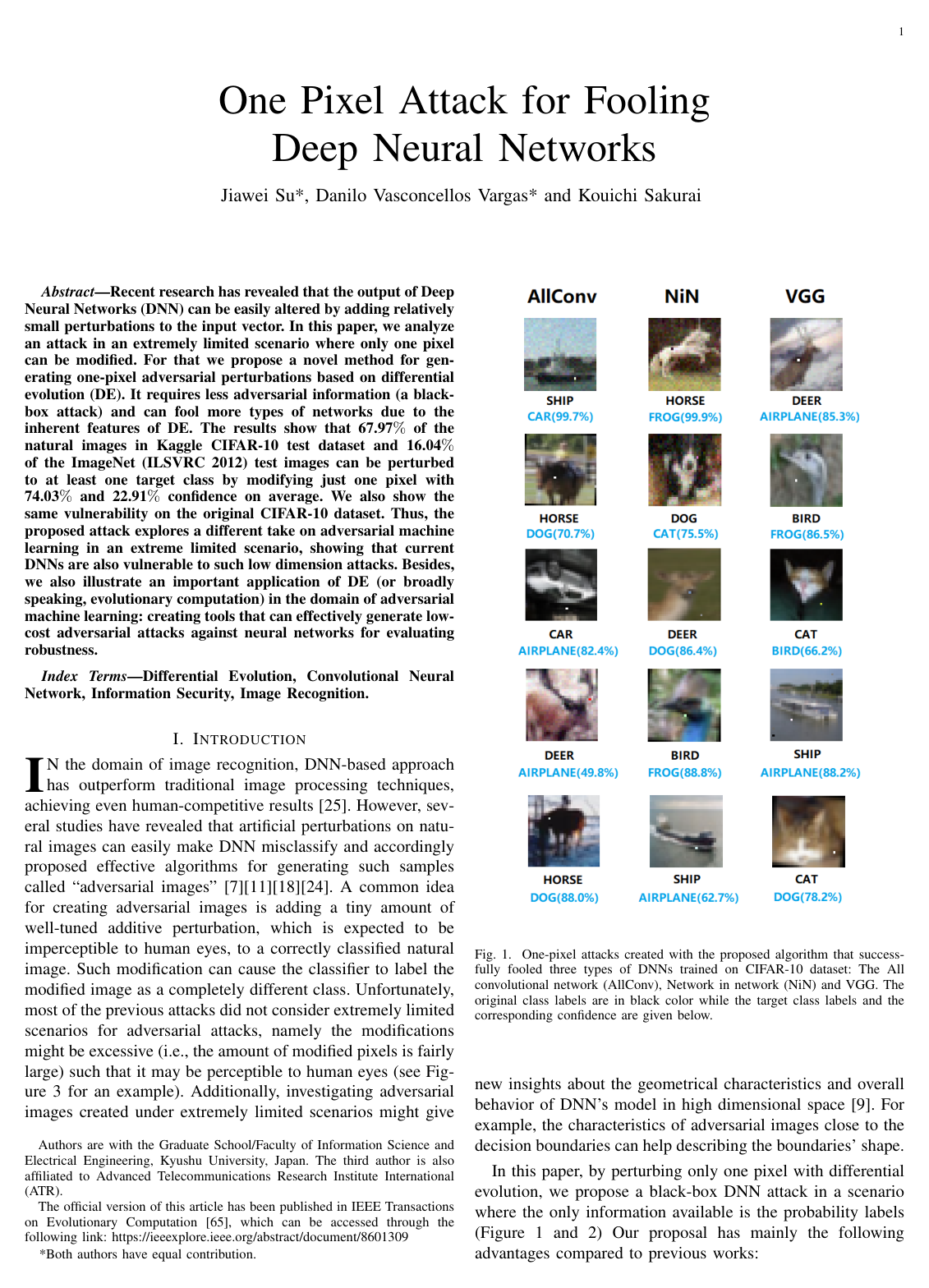
Demonstrates that modifying just a single pixel through differential evolution can reliably fool deep neural networks in black-box settings, exposing extreme blind spots in standard image classifiers.
The article examines the vulnerability of deep neural networks to adversarial attacks in an extremely constrained setting where only a single pixel in an input image can be altered. This matters because prior work on such attacks typically modified many pixels, potentially making changes visible to humans, while the security of image recognition systems used in applications like autonomous vehicles or security cameras depends on understanding even minimal perturbations.
The article set out to determine whether one-pixel modifications could reliably fool common deep neural networks on standard image classification benchmarks and to demonstrate a practical method for generating such attacks.
Researchers applied differential evolution, a population-based optimization technique that requires only the model's output probability labels and no internal details such as gradients, to search for effective single-pixel changes. Experiments used three widely studied network architectures on the Kaggle CIFAR-10 test set of 500 images, the original CIFAR-10 test set, and the BVLC AlexNet on 105 randomly selected ImageNet images.
The analysis shows that one-pixel changes succeeded in 68.71 percent, 71.66 percent, and 63.53 percent of non-targeted attacks on the three CIFAR-10 networks, with average confidence around 74 percent; each image could be shifted to roughly two other classes on average. On ImageNet the success rate reached 16.04 percent with 22.91 percent average confidence. Increasing the limit to three or five pixels raised both success rates and the number of reachable classes, while random single-pixel changes performed substantially worse than the evolutionary search.
These results indicate that current networks remain sensitive to very low-dimensional perturbations, implying that defenses based solely on detecting larger distortions may miss simple attacks and that robustness testing should include such minimal-change scenarios. The approach also illustrates how evolutionary algorithms can efficiently probe model weaknesses without requiring white-box access.
The article recommends using the generated adversarial examples to augment training data for more robust models and extending the method to other domains such as speech or text. Further work is needed to test larger image resolutions, evaluate detection methods against this attack, and explore more advanced evolutionary variants for higher efficiency.
The findings rest on specific datasets and a fixed number of optimization evaluations; success rates could vary with different preprocessing, network training, or larger search budgets, so caution is warranted when generalizing beyond the tested conditions.
- Paper: Intriguing properties of neural networks, Christian Szegedy et al. (2014). This foundational paper first identified the surprising vulnerability of deep neural networks to tiny, imperceptible adversarial input perturbations.
- Paper: Explaining and Harnessing Adversarial Examples, Ian J. Goodfellow et al. (2015). It provides crucial theoretical intuition regarding the linear behavior of neural networks in high dimensions and introduces the Fast Gradient Sign Method for creating adversarial perturbations.
- Paper: The Limitations of Deep Learning in Adversarial Settings, Nicolas Papernot et al. (2015). It establishes the Jacobian-based Saliency Map Attack (JSMA) targeting sparse, feature-constrained perturbations that directly motivated extreme single-pixel attacks.
- Paper: Towards Evaluating the Robustness of Neural Networks, Nicholas Carlini et al. (2016). It defines standard optimization-based attack formulations across L0, L2, and L-infinity norms against which subsequent sparse and black-box attacks are benchmarked.
- Paper: DeepFool: A Simple and Accurate Method to Fool Deep Neural Networks, Seyed-Mohsen Moosavi-Dezfooli et al. (2015). It presents DeepFool, an efficient iterative method to find minimal adversarial perturbations by estimating distances to decision boundaries.
- Paper: Universal Adversarial Perturbations, Seyed-Mohsen Moosavi-Dezfooli et al. (2016). It reveals the existence of image-agnostic universal perturbations, illustrating global geometric properties of network decision boundaries.
- Paper: Deep neural networks are easily fooled: High confidence predictions for unrecognizable images, Anh Nguyen et al. (2014). It demonstrates how evolutionary algorithms can effectively probe neural network weaknesses and find high-confidence fooling patterns.
- Paper: ZOO: Zeroth Order Optimization Based Black-box Attacks to Deep Neural Networks without Training Substitute Models, Pin-Yu Chen et al. (2017). It advances black-box adversarial generation via zeroth-order optimization, providing a gradient-free attack framework without requiring substitute models.
- Paper: Towards Deep Learning Models Resistant to Adversarial Attacks, A. Ma̧dry et al. (2017). It formalizes adversarial robustness through minimax robust optimization and establishes Projected Gradient Descent as a universal first-order defense and benchmark.
- Paper: Obfuscated Gradients Give a False Sense of Security: Circumventing Defenses to Adversarial Examples, Anish Athalye et al. (2018). It uncovers the phenomenon of obfuscated gradients, explaining why black-box and optimization-based attacks often succeed when gradient-based attacks fail.
- Paper: Adversarial Examples Are Not Bugs, They Are Features, Andrew Ilyas et al. (2019). It provides a conceptual explanation for adversarial vulnerability by demonstrating that neural networks naturally learn non-robust, human-imperceptible features from data.
- Paper: Reliable evaluation of adversarial robustness with an ensemble of diverse parameter-free attacks, Francesco Croce et al. (2020). It develops AutoAttack, an ensemble of parameter-free attacks designed to provide reliable, standardized robustness evaluations across models.
- Paper: Threat of Adversarial Attacks on Deep Learning in Computer Vision: A Survey, Naveed Akhtar et al. (2018). It provides a comprehensive survey systematizing adversarial attack paradigms, threat models, and defenses in computer vision.
- Paper: Theoretically Principled Trade-off between Robustness and Accuracy, Hongyang Zhang et al. (2019). It analyzes the fundamental trade-off between standard classification accuracy and robustness against adversarial perturbations.
- Paper: Certified Adversarial Robustness via Randomized Smoothing, Jeremy M Cohen et al. (2019). It introduces randomized smoothing to deliver provable, certified robustness guarantees against adversarial perturbations in large networks.