Certified Adversarial Robustness via Randomized Smoothing
Jeremy M CohenElan RosenfeldJ. Zico Kolter
Proves a tight mathematical guarantee for Gaussian randomized smoothing, providing the first certified defense against L2-norm adversarial attacks that scales effectively to ImageNet.
Modern image classifiers achieve high accuracy on standard test sets but remain vulnerable to small adversarial perturbations that can change their predictions while remaining imperceptible to humans. Existing methods for training robust classifiers often fail against stronger attacks, and certified defenses that provide formal guarantees have struggled to scale to large networks needed for challenging tasks like ImageNet classification.
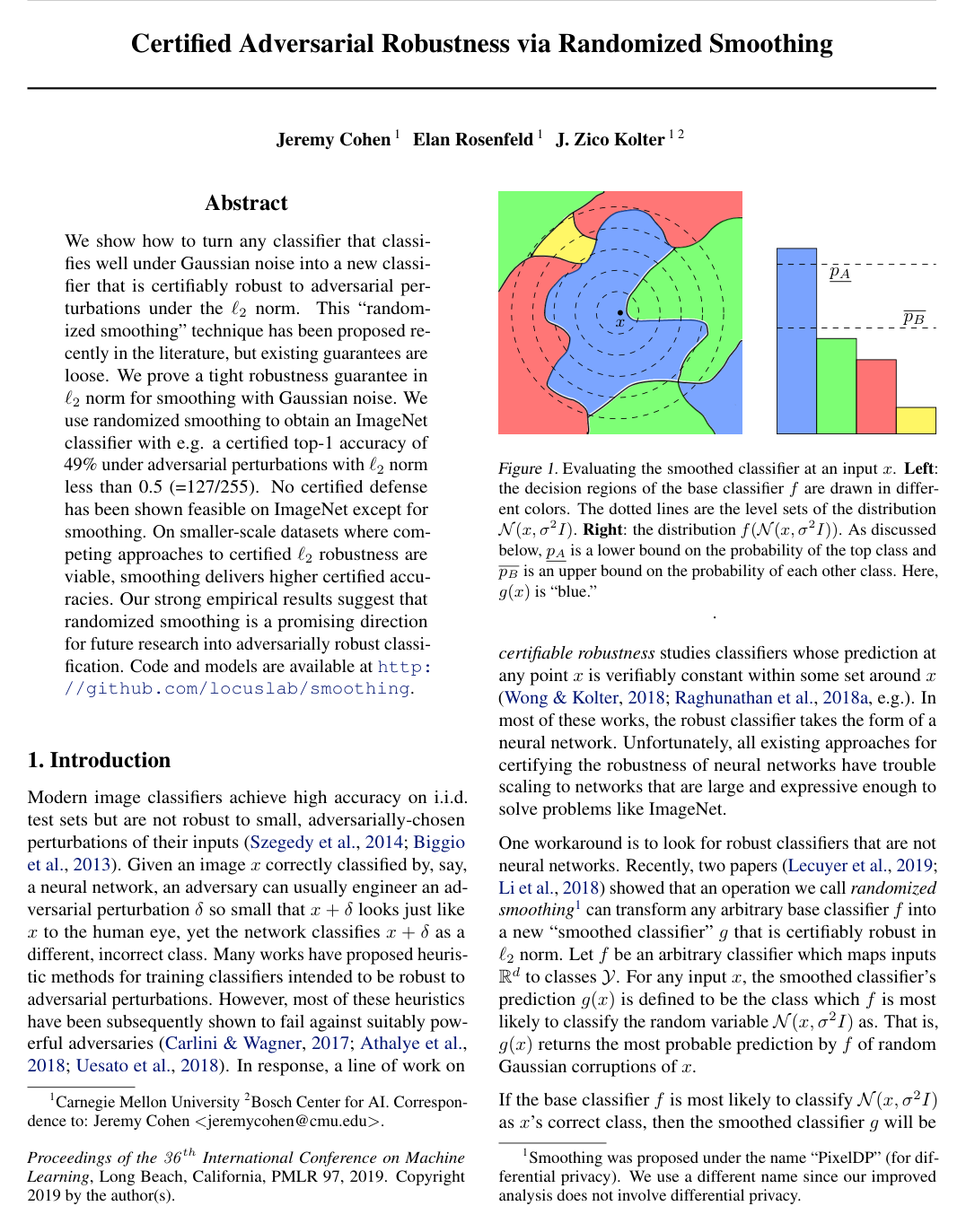
The article develops randomized smoothing as a technique to convert any base classifier into a new smoothed classifier that is certifiably robust to adversarial perturbations measured in the ℓ2 norm. The smoothed classifier outputs the class that the base classifier returns most often when its input is corrupted by isotropic Gaussian noise. The authors derive a tight robustness guarantee showing that the prediction remains constant inside an ℓ2 ball whose radius depends on the noise level and the base classifier's class probabilities under that noise; they also supply Monte Carlo algorithms that evaluate the smoothed classifier and certify its robustness with arbitrarily high probability.
On ImageNet, smoothed classifiers achieve, for example, 49 percent certified top-1 accuracy against perturbations of ℓ2 norm 0.5 and remain the only certified defense demonstrated at full scale on this dataset. On smaller datasets such as CIFAR-10 where competing certified methods are feasible, smoothing yields higher certified accuracies, largely because it places no restrictions on the architecture or training of the base classifier. Experiments further confirm that the derived bound is substantially tighter than previous analyses of randomized smoothing.
These results indicate that randomized smoothing offers a practical and scalable route to certified robustness. Because the approach reduces the adversarial-robustness problem to ordinary supervised learning under noise, it can leverage the largest available networks without custom verification procedures. Practitioners can therefore obtain meaningful robustness guarantees on large-scale tasks by training a base classifier with Gaussian data augmentation and then applying the provided certification procedure.
The main limitations are that certification remains probabilistic and that certifying large radii requires many Monte Carlo samples. The authors recommend exploring other noise distributions that might induce natural robustness guarantees for additional perturbation sets such as general ℓp balls, and they note that further gains may come from training the base classifier explicitly to maximize the smoothed classifier's certified accuracy at chosen radii.
- Paper: Intriguing properties of neural networks, Christian Szegedy et al. (2014). This seminal paper introduces the fundamental vulnerability of deep neural networks to tiny adversarial perturbations, providing the primary phenomenon and motivation that randomized smoothing aims to provably defend against.
- Paper: Explaining and Harnessing Adversarial Examples, Ian J. Goodfellow et al. (2015). This foundational work formalizes adversarial examples and early empirical defenses like adversarial training, establishing the core challenge of securing models against bounded norm attacks.
- Paper: Towards Deep Learning Models Resistant to Adversarial Attacks, A. Ma̧dry et al. (2017). This paper establishes the standard minimax robust optimization framework and projected gradient descent defense, representing the benchmark empirical defense compared against certified defenses.
- Paper: Obfuscated Gradients Give a False Sense of Security: Circumventing Defenses to Adversarial Examples, Anish Athalye et al. (2018). This study demonstrates how heuristic and empirical defenses often provide a false sense of security via gradient obfuscation, directly highlighting the necessity for scalable, certified defense guarantees like randomized smoothing.
- Paper: Towards Evaluating the Robustness of Neural Networks, Nicholas Carlini et al. (2016). This work introduces standard L2 and L-infinity optimization-based attacks, providing the threat models and evaluation metrics underpinning the certified L2 robustness radii in randomized smoothing.
- Paper: SmoothGrad: removing noise by adding noise, Daniel Smilkov et al. (2017). This paper demonstrates how convolving input spaces with Gaussian noise effectively stabilizes model gradients and outputs, providing direct methodological intuition for smoothing deep neural networks.
- Paper: Reliable evaluation of adversarial robustness with an ensemble of diverse parameter-free attacks, Francesco Croce et al. (2020). This work develops AutoAttack, providing a rigorous and standardized benchmark ensemble to evaluate whether empirical and certified defenses genuinely withstand diverse adversarial attacks.
- Paper: The Many Faces of Robustness: A Critical Analysis of Out-of-Distribution Generalization, Dan Hendrycks et al. (2021). This paper expands the evaluation of model robustness beyond formal norm-bounded adversarial perturbations to comprehensive real-world distribution shifts and natural corruptions.