Learning to Prompt for Continual Learning

Zifeng WangZizhao ZhangChen-Yu LeeHan ZhangRuoxi SunXiaoqi RenGuolong SuVincent PerotJennifer DyTomas Pfister

article2021CVPR1,401 citations

Introduces a prompt-based continual learning framework that dynamically selects learnable prompts to guide pre-trained models across sequential tasks, matching rehearsal-based performance without storing past data or requiring task identities at test time.

Listen

Modern artificial intelligence models struggle to learn new tasks sequentially because training on new information typically overwrites previously acquired knowledge, a phenomenon known as catastrophic forgetting. Conventional solutions mitigate this by storing past user data in memory buffers to periodically retrain the system or by relying on explicit task indicators during testing to select task-specific components. However, retaining historical data introduces significant data privacy risks and memory costs, while requiring explicit task labels at test time makes systems impractical for real-world scenarios where incoming data streams lack predefined boundaries.

The article evaluates a new continual learning framework called Learning to Prompt (L2P). The primary objective is to demonstrate that a pre-trained vision model can sequentially learn diverse tasks without updating its core weights, without relying on stored past examples, and without needing task identity labels at test time.

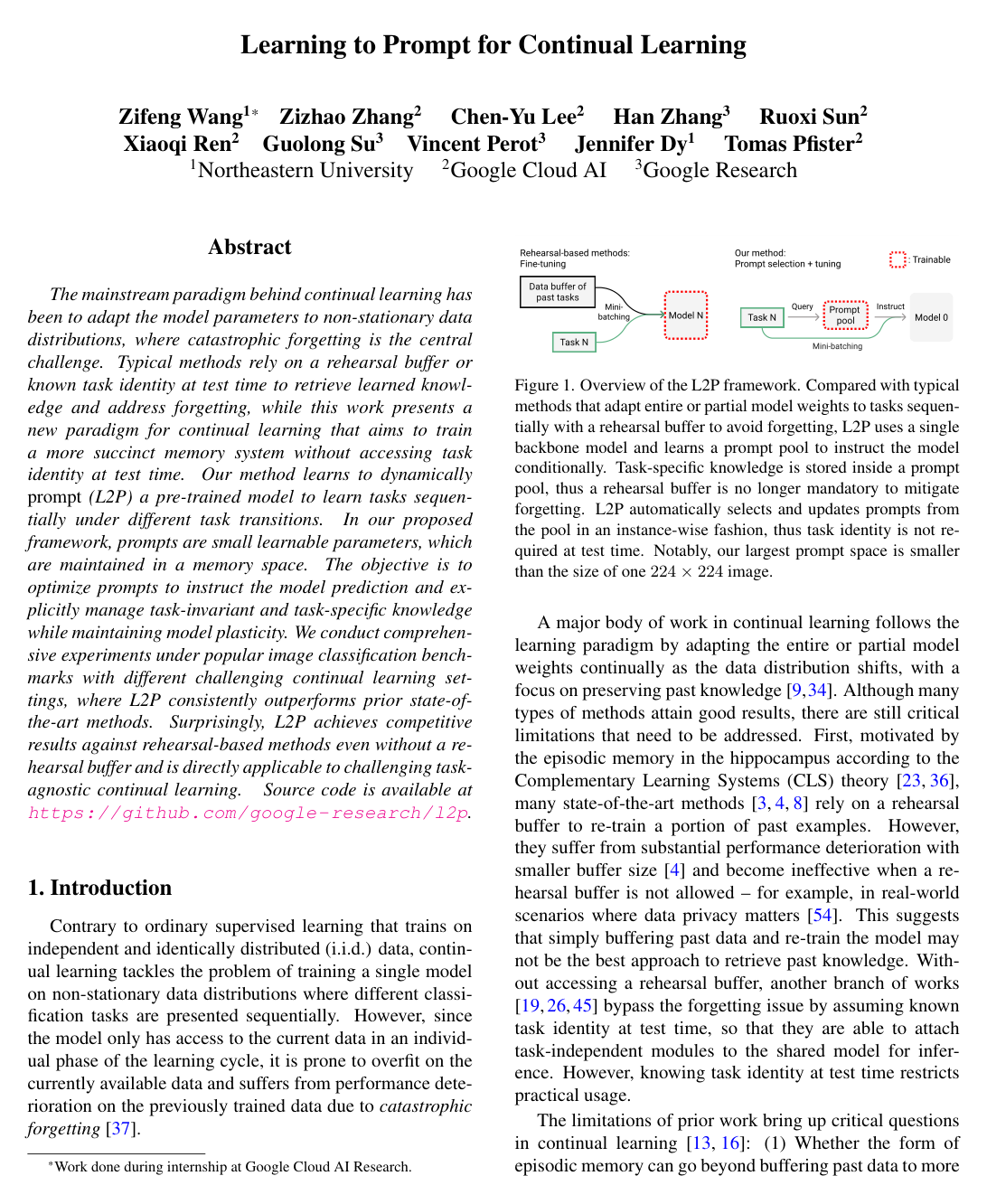
To achieve this, the article establishes a method that keeps a large pre-trained transformer model completely frozen and instead trains a small external memory space termed a prompt pool. Prompts act as compact, learnable instructions that guide the frozen model to perform specific tasks. Using an automated query-key matching mechanism, the system dynamically retrieves the most relevant prompt instructions for each input image. The framework was evaluated across standard image classification benchmarks covering class-incremental, domain-shifting, and boundary-free streaming environments, comparing performance against leading regularization, memory buffer, and architecture-expanding methods.

The evaluation revealed several key findings. First, L2P achieved state-of-the-art results across all evaluated benchmarks without retaining any past training data, reaching an average accuracy of 83.83% on Split CIFAR-100 and 81.14% on a diverse 5-dataset benchmark. Second, the system maintained low forgetting rates between 4.64% and 7.63%, vastly outperforming baseline methods without replay buffers, which suffered from severe forgetting rates between 27.77% and 94.63%. Third, in buffer-free settings, L2P performed competitively against or outperformed sophisticated rehearsal-based methods that required storing up to 50 samples per class. Fourth, prompt memory required minimal overhead, adding between 0.05% and 0.11% in additional parameters relative to the original model. Finally, the framework succeeded in continuous, task-agnostic streaming settings where task boundaries were entirely absent, achieving 88.34% accuracy.

These findings indicate that continual learning can be effectively achieved by learning dynamic instructions rather than continually retraining large model weights. For organizations deploying machine learning, this approach offers substantial reductions in computational training costs and eliminates the compliance and security liabilities associated with storing sensitive historical user data. Furthermore, decoupling shared and task-specific instructions enables fine-grained knowledge transfer across related tasks while preserving model flexibility.

Organizations seeking to maintain adaptable computer vision models in privacy-sensitive or resource-constrained environments should consider adopting prompt-pool architectures over traditional data-replay buffers. Before broad operational deployment, teams should conduct internal pilots to calibrate hyperparameter settings, particularly prompt pool capacity and selection sizes, based on task diversity. Future work should expand validation to non-transformer architectures, test modalities outside of vision such as natural language or audio, and evaluate the robustness of the system against adversarial security threats.

Cover for Learning to Prompt for Continual Learning

Abstract

The mainstream paradigm behind continual learning has been to adapt the model parameters to non-stationary data distributions, where catastrophic forgetting is the central challenge. Typical methods rely on a rehearsal buffer or known task identity at test time to retrieve learned knowledge and address forgetting, while this work presents a new paradigm for continual learning that aims to train a more succinct memory system without accessing task identity at test time. Our method learns to dynamically prompt (L2P) a pre-trained model to learn tasks sequentially under different task transitions. In our proposed framework, prompts are small learnable parameters, which are maintained in a memory space. The objective is to optimize prompts to instruct the model prediction and explicitly manage task-invariant and task-specific knowledge while maintaining model plasticity. We conduct comprehensive experiments under popular image classification benchmarks with different challenging continual learning settings, where L2P consistently outperforms prior state-of-the-art methods. Surprisingly, L2P achieves competitive results against rehearsal-based methods even without a rehearsal buffer and is directly applicable to challenging task-agnostic continual learning. Source code is available at this https URL.

Table of Contents

  • 1 Introduction
  • 2 Related Work
  • 3 Prerequisites
  • 3.1 Continual learning protocols
  • 3.2 Prompt-based learning and baselines
  • 4 Learning to Prompt (L2P)
  • 4.1 From prompt to prompt pool
  • 4.2 Instance-wise prompt query
  • 4.3 Optimization objective for L2P
  • 5 Experiments
  • 5.1 Comparing methods
  • 5.2 Datasets and experimental details
  • 5.3 Main results
  • 5.4 Effectiveness of core designs
  • 6 Conclusion
  • References
  • Potential negative societal impact
  • Limitations
  • Dataset details and licensing information
  • Algorithm details

Knowls

  1. Knowl 1 — Learning to Prompt (L2P) Framework and Prompt Pool

    model/method

    Learning to Prompt (L2P) is a continual learning framework that keeps a pre-trained sequence backbone model frozen and instead adapts to sequential tasks by learning a memory space of prompt parameters, termed a prompt pool.

    Let the pre-trained vision transformer model be f=fr∘fef = f_r \circ f_e, where fe:RL×(S2⋅C)→RL×Df_e : \mathbb{R}^{L \times (S^2 \cdot C)} \to \mathbb{R}^{L \times D} is the input patch embedding layer (LL is the number of token patches, SS is the patch spatial size, CC is the channel count, and DD is the embedding dimension) and frf_r denotes the sequence of self-attention Transformer blocks. Given an input image x∈RH×W×Cx \in \mathbb{R}^{H \times W \times C}, its patch embedding sequence is xe=fe(x)∈RL×Dx_e = f_e(x) \in \mathbb{R}^{L \times D}, which includes the pre-trained [class] token.

    A prompt pool P\mathcal{P} consists of MM learnable prompt tensors: P={P1,P2,…,PM},Pj∈RLp×D\mathcal{P} = \{P_1, P_2, \dots, P_M\}, \quad P_j \in \mathbb{R}^{L_p \times D} where LpL_p is the token length of an individual prompt and DD matches the embedding dimension of xex_e.

    For an input sample, a subset of NN prompt indices {si}i=1N⊆{1,…,M}\{s_i\}_{i=1}^N \subseteq \{1, \dots, M\} (with 1≤N≤M1 \le N \le M) is selected dynamically. The extended token sequence xpx_p is constructed by concatenating the selected prompt tokens with the input embeddings along the sequence length dimension: xp=[Ps1;Ps2;… ;PsN;xe]∈R(NLp+L)×Dx_p = [P_{s_1}; P_{s_2}; \dots; P_{s_N}; x_e] \in \mathbb{R}^{(N L_p + L) \times D}

    This parameterization adds negligible learnable parameters (approximately 0.05%0.05\% to 0.11%0.11\% of the backbone size) and allows parameter sharing across similar tasks while assigning dedicated prompt parameters to dissimilar inputs, eliminating the need for a rehearsal memory buffer.

  2. Knowl 2 — Instance-Wise Prompt Query and Key-Value Memory Lookup

    model/method

    To dynamically retrieve relevant prompts without requiring task identity at training or test time, L2P structures the prompt pool as a key-value memory {(k1,P1),(k2,P2),…,(kM,PM)}\{(k_1, P_1), (k_2, P_2), \dots, (k_M, P_M)\}, where each prompt Pj∈RLp×DP_j \in \mathbb{R}^{L_p \times D} is paired with a learnable key vector kj∈RDkk_j \in \mathbb{R}^{D_k}, and K={kj}j=1M\mathcal{K} = \{k_j\}_{j=1}^M.

    An input instance xx is mapped to query feature space via a deterministic, parameter-frozen query function q(x)=f(x)[0,:]∈RDkq(x) = f(x)[0, :] \in \mathbb{R}^{D_k}, using the [class] token feature produced by the pre-trained backbone ff. The match between the query q(x)q(x) and a key kik_i is scored using a distance function γ(q(x),ki)\gamma(q(x), k_i), implemented as cosine distance: γ(u,v)=1−u⋅v∥u∥2∥v∥2\gamma(u, v) = 1 - \frac{u \cdot v}{\|u\|_2 \|v\|_2}

    The subset of top-NN keys Kx={ks1,…,ksN}\mathcal{K}_x = \{k_{s_1}, \dots, k_{s_N}\} for instance xx is selected by minimizing the matching distance: Kx=argmin⁡{si}i=1N⊆{1,…,M}∑i=1Nγ(q(x),ksi)\mathcal{K}_x = \underset{\{s_i\}_{i=1}^N \subseteq \{1, \dots, M\}}{\operatorname{argmin}} \sum_{i=1}^N \gamma(q(x), k_{s_i})

    Diversifying Prompt Selection with Task Boundary Prior (Optional): When discrete task boundaries are known during training, prompt selection can be encouraged to diversify across tasks. A selection frequency vector Ht=[h1,h2,…,hM]H_t = [h_1, h_2, \dots, h_M] tracks the normalized selection frequency of each prompt up to task t−1t - 1. During training of task tt, the lookup objective penalizes frequently chosen prompts: Kx=argmin⁡{si}i=1N⊆{1,…,M}∑i=1Nγ(q(x),ksi)⋅hsi\mathcal{K}_x = \underset{\{s_i\}_{i=1}^N \subseteq \{1, \dots, M\}}{\operatorname{argmin}} \sum_{i=1}^N \gamma(q(x), k_{s_i}) \cdot h_{s_i} At test time, prompt lookup strictly reverts to the unpenalized formulation.

  3. Knowl 3 — L2P Optimization Objective

    equation

    The prompt pool tensors P={Pj}j=1M\mathcal{P} = \{P_j\}_{j=1}^M, prompt keys K={kj}j=1M\mathcal{K} = \{k_j\}_{j=1}^M, and classification head parameters ϕ\phi of model gϕg_\phi are trained end-to-end by minimizing the loss function:

    min⁡P,K,ϕL(gϕ(fravg(xp)),y)+λ∑ksi∈Kxγ(q(x),ksi)s.t.Kx=argmin⁡{si}i=1N⊆[1,M]∑i=1Nγ(q(x),ksi)\min_{\mathcal{P}, \mathcal{K}, \phi} \mathcal{L}\left(g_\phi\left(f_r^{\text{avg}}(x_p)\right), y\right) + \lambda \sum_{k_{s_i} \in \mathcal{K}_x} \gamma\left(q(x), k_{s_i}\right) \quad \text{s.t.} \quad \mathcal{K}_x = \underset{\{s_i\}_{i=1}^N \subseteq [1, M]}{\operatorname{argmin}} \sum_{i=1}^N \gamma\left(q(x), k_{s_i}\right)

    where:

    • xp=[Ps1;… ;PsN;xe]x_p = [P_{s_1}; \dots; P_{s_N}; x_e] is the prompt-prepended token sequence for input xx.
    • fravg(xp)=AvgPool⁡(fr(xp)[0:NLp,:])∈RDf_r^{\text{avg}}(x_p) = \operatorname{AvgPool}\left(f_r(x_p)[0 : N L_p, :]\right) \in \mathbb{R}^D is the average-pooled representation of the output hidden vectors corresponding exclusively to the N⋅LpN \cdot L_p prompt token positions from Transformer layers frf_r.
    • L(⋅,y)\mathcal{L}(\cdot, y) is the standard softmax cross-entropy classification loss against target class label yy.
    • γ(q(x),ksi)\gamma(q(x), k_{s_i}) is the cosine distance between the frozen input query q(x)q(x) and the selected prompt key ksik_{s_i}. This surrogate loss pulls selected keys closer to the query features of inputs that use them.
    • λ>0\lambda > 0 is a scalar balancing weight (empirically set to λ=0.5\lambda = 0.5).
  4. Knowl 4 — L2P Training Algorithm

    algorithm

    The complete training procedure for Learning to Prompt (L2P) across a sequence of TT continual tasks is defined below:

    Input: Pre-trained embedding layer fef_e, pre-trained Transformer layers frf_r, classification layer gϕg_\phi, prompt pool P={Pj}j=1M\mathcal{P} = \{P_j\}_{j=1}^M, prompt keys K={kj}j=1M\mathcal{K} = \{k_j\}_{j=1}^M, task training sets {Dt}t=1T\{\mathcal{D}_t\}_{t=1}^T with Dt={(xit,yit)}i=1nt\mathcal{D}_t = \{(x_i^t, y_i^t)\}_{i=1}^{n_t}, epochs per task EtE_t, learning rate η\eta, balance parameter λ\lambda.
    Initialize: Head parameters ϕ\phi, prompt pool P\mathcal{P}, prompt keys K\mathcal{K}.
    for t=1,…,Tt = 1, \dots, T do
        for e=1,…,Ete = 1, \dots, E_t do
            for each mini-batch B={(xi,yi)}i=1B⊂Dt\mathcal{B} = \{(x_i, y_i)\}_{i=1}^B \subset \mathcal{D}_t do
                Initialize batch chosen keys KB=∅\mathcal{K}_\mathcal{B} = \emptyset, batch chosen prompts PB=∅\mathcal{P}_\mathcal{B} = \emptyset
                Initialize batch loss LB=0\mathcal{L}_\mathcal{B} = 0
                for (x,y)∈B(x, y) \in \mathcal{B} do
                    Compute frozen query feature q(x)=f(x)[0,:]q(x) = f(x)[0, :]
                    Find top-NN keys Kx=argmin⁡{si}i=1N⊆[1,M]∑i=1Nγ(q(x),ksi)\mathcal{K}_x = \operatorname{argmin}_{\{s_i\}_{i=1}^N \subseteq [1, M]} \sum_{i=1}^N \gamma(q(x), k_{s_i})
                    Retrieve corresponding prompts Px={Ps1,…,PsN}\mathcal{P}_x = \{P_{s_1}, \dots, P_{s_N}\}
                    Compute embedding tokens xe=fe(x)x_e = f_e(x)
                    Concatenate prompt and input tokens xp=[Ps1;… ;PsN;xe]x_p = [P_{s_1}; \dots; P_{s_N}; x_e]
                    Compute pooled prompt features fravg(xp)=AvgPool⁡(fr(xp)[0:NLp,:])f_r^{\text{avg}}(x_p) = \operatorname{AvgPool}(f_r(x_p)[0 : N L_p, :])
                    Compute sample loss Lx=L(gϕ(fravg(xp)),y)+λ∑k∈Kxγ(q(x),k)\mathcal{L}_x = \mathcal{L}(g_\phi(f_r^{\text{avg}}(x_p)), y) + \lambda \sum_{k \in \mathcal{K}_x} \gamma(q(x), k)
                    Accumulate batch loss LB←LB+Lx\mathcal{L}_\mathcal{B} \leftarrow \mathcal{L}_\mathcal{B} + \mathcal{L}_x
                    Update tracking sets KB←KB∪Kx\mathcal{K}_\mathcal{B} \leftarrow \mathcal{K}_\mathcal{B} \cup \mathcal{K}_x, PB←PB∪Px\mathcal{P}_\mathcal{B} \leftarrow \mathcal{P}_\mathcal{B} \cup \mathcal{P}_x
                end for
                for (k,P)∈zip⁡(KB,PB)(k, P) \in \operatorname{zip}(\mathcal{K}_\mathcal{B}, \mathcal{P}_\mathcal{B}) do
                    k←k−η∇kLBk \leftarrow k - \eta \nabla_k \mathcal{L}_\mathcal{B}
                    P←P−η∇PLBP \leftarrow P - \eta \nabla_P \mathcal{L}_\mathcal{B}
                end for
                ϕ←ϕ−η∇ϕLB\phi \leftarrow \phi - \eta \nabla_\phi \mathcal{L}_\mathcal{B}
            end for
        end for
    end for
  5. Knowl 5 — Class-Incremental Performance on Split CIFAR-100 and 5-Datasets

    data/table

    Evaluation of L2P and L2P-R (L2P with rehearsal buffer) against fine-tuning, regularization, and rehearsal baselines on class-incremental benchmarks using a pre-trained ViT-B/16 backbone. Split CIFAR-100 contains 10 tasks (10 classes each). 5-datasets contains CIFAR-10, MNIST, Fashion-MNIST, SVHN, and notMNIST sequentially.

    Method Buffer Size Split CIFAR-100 5-datasets
    Average Acc (%) ↑\uparrow Forgetting (%) ↓\downarrow Average Acc (%) ↑\uparrow Forgetting (%) ↓\downarrow
    FT-seq-frozen 0 17.72±0.3417.72 \pm 0.34 59.09±0.2559.09 \pm 0.25 39.49±0.1239.49 \pm 0.12 42.62±0.2042.62 \pm 0.20
    FT-seq 0 33.61±0.8533.61 \pm 0.85 86.87±0.2086.87 \pm 0.20 20.12±0.4220.12 \pm 0.42 94.63±0.6894.63 \pm 0.68
    EWC 0 47.01±0.2947.01 \pm 0.29 33.27±1.1733.27 \pm 1.17 50.93±0.0950.93 \pm 0.09 34.94±0.0734.94 \pm 0.07
    LwF 0 60.69±0.6360.69 \pm 0.63 27.77±2.1727.77 \pm 2.17 47.91±0.3347.91 \pm 0.33 38.01±0.2838.01 \pm 0.28
    L2P (ours) 0 83.83±0.04\mathbf{83.83 \pm 0.04} 7.63±0.30\mathbf{7.63 \pm 0.30} 81.14±0.93\mathbf{81.14 \pm 0.93} 4.64±0.52\mathbf{4.64 \pm 0.52}
    ER 10/class 67.87±0.5767.87 \pm 0.57 33.33±1.2833.33 \pm 1.28 80.32±0.5580.32 \pm 0.55 (5/class) 15.69±0.8915.69 \pm 0.89 (5/class)
    GDumb 10/class 67.14±0.3767.14 \pm 0.37 – 56.99±0.0656.99 \pm 0.06 (5/class) –
    BiC 10/class 66.11±1.7666.11 \pm 1.76 35.24±1.6435.24 \pm 1.64 78.74±1.4178.74 \pm 1.41 (5/class) 21.15±1.0021.15 \pm 1.00 (5/class)
    DER++ 10/class 61.06±0.8761.06 \pm 0.87 39.87±0.9939.87 \pm 0.99 80.81±0.0780.81 \pm 0.07 (5/class) 14.38±0.3514.38 \pm 0.35 (5/class)
    Co2L 10/class 72.15±1.3272.15 \pm 1.32 28.55±1.5628.55 \pm 1.56 82.25±1.1782.25 \pm 1.17 (5/class) 17.52±1.3517.52 \pm 1.35 (5/class)
    L2P-R (ours) 10/class 84.21±0.53\mathbf{84.21 \pm 0.53} 7.72±0.77\mathbf{7.72 \pm 0.77} 85.56±0.95\mathbf{85.56 \pm 0.95} (5/class) 4.22±0.03\mathbf{4.22 \pm 0.03} (5/class)
    ER 50/class 82.53±0.1782.53 \pm 0.17 16.46±0.2516.46 \pm 0.25 84.26±0.8484.26 \pm 0.84 (10/class) 12.85±0.6212.85 \pm 0.62 (10/class)
    GDumb 50/class 81.67±0.0281.67 \pm 0.02 – 70.76±0.1270.76 \pm 0.12 (10/class) –
    BiC 50/class 81.42±0.8581.42 \pm 0.85 17.31±1.0217.31 \pm 1.02 85.53±2.0685.53 \pm 2.06 (10/class) 10.27±1.3210.27 \pm 1.32 (10/class)
    DER++ 50/class 83.94±0.3483.94 \pm 0.34 14.55±0.7314.55 \pm 0.73 84.88±0.5784.88 \pm 0.57 (10/class) 10.46±1.0210.46 \pm 1.02 (10/class)
    Co2L 50/class 82.49±0.8982.49 \pm 0.89 17.48±1.8017.48 \pm 1.80 86.05±1.0386.05 \pm 1.03 (10/class) 12.28±1.4412.28 \pm 1.44 (10/class)
    L2P-R (ours) 50/class 86.31±0.59\mathbf{86.31 \pm 0.59} 5.83±0.61\mathbf{5.83 \pm 0.61} 88.95±0.78\mathbf{88.95 \pm 0.78} (10/class) 4.92±0.71\mathbf{4.92 \pm 0.71} (10/class)
    Upper-bound – 90.85±0.1290.85 \pm 0.12 – 93.93±0.1893.93 \pm 0.18 –

    Without any rehearsal buffer (buffer size 0), L2P achieves 83.83%83.83\% average accuracy on Split CIFAR-100 and 81.14%81.14\% on 5-datasets, substantially exceeding non-rehearsal methods (EWC at 47.01%47.01\%, LwF at 60.69%60.69\%) and surpassing 10/class rehearsal baselines (Co2L at 72.15%72.15\%).

  6. Knowl 6 — Comparison with Architecture-Based Continual Learning Methods

    data/table

    Performance comparison on Split CIFAR-100 against architecture-based continual learning methods that operate without test-time task identity. Performance is evaluated by the absolute average accuracy and the difference metric Diff=Upper-bound Acc−Method Acc\text{Diff} = \text{Upper-bound Acc} - \text{Method Acc} (where lower difference is better) to account for differing backbone architectures.

    Method Backbone Avg. Acc (%) ↑\uparrow Diff (%) ↓\downarrow
    Upper-bound ResNet18 80.41 –
    SupSup ResNet18 28.34±2.4528.34 \pm 2.45 52.07
    DualNet ResNet18 40.14±1.6440.14 \pm 1.64 40.27
    Upper-bound ViT-B/16 90.85 –
    L2P (ours) ViT-B/16 83.83±0.04\mathbf{83.83 \pm 0.04} 7.02\mathbf{7.02}

    L2P reduces the gap to the multi-task upper-bound from >40%>40\% (in DualNet and SupSup) down to 7.02%7.02\%, while adding only ∼0.1%\sim 0.1\% parameters compared to architecture expansion methods that add substantial parameters or sub-networks per task.

  7. Knowl 7 — Domain-Incremental and Task-Agnostic Continual Learning Benchmark Results

    data/table

    Evaluation on domain-incremental continual learning (CORe50 dataset across 8 training domains) and task-agnostic continual learning (Gaussian scheduled CIFAR-100, where class distributions drift continuously without explicit task switches).

    Method CORe50 (Domain-Incremental) Gaussian CIFAR-100 (Task-Agnostic)
    Buffer Size Test Acc (%) ↑\uparrow Buffer Size Test Acc (%) ↑\uparrow
    EWC 0 74.82±0.6074.82 \pm 0.60 0 63.04±0.4263.04 \pm 0.42
    LwF 0 75.45±0.4075.45 \pm 0.40 – –
    L2P (ours) 0 78.33±0.06\mathbf{78.33 \pm 0.06} 0 88.34±0.14\mathbf{88.34 \pm 0.14}
    ER 50/class 80.10±0.5680.10 \pm 0.56 50/class 82.63±0.2782.63 \pm 0.27
    GDumb 50/class 74.92±0.2574.92 \pm 0.25 50/class 81.67±0.0281.67 \pm 0.02
    BiC 50/class 79.28±0.3079.28 \pm 0.30 – –
    DER++ 50/class 79.70±0.4479.70 \pm 0.44 50/class 85.24±0.7185.24 \pm 0.71
    Co2L 50/class 79.75±0.8479.75 \pm 0.84 – –
    L2P-R (ours) 50/class 81.07±0.13\mathbf{81.07 \pm 0.13} 50/class 88.92±0.39\mathbf{88.92 \pm 0.39}
    Upper-bound – 82.15±0.3782.15 \pm 0.37 – 90.85±0.1290.85 \pm 0.12

    In the task-agnostic Gaussian scheduled setting, L2P without a buffer (88.34%88.34\%) outperforms all baseline methods even when they are equipped with a 50/class replay buffer (DER++ at 85.24%85.24\%, ER at 82.63%82.63\%).

  8. Knowl 8 — Ablation of L2P Core Architectural Components

    data/table

    Ablation study on the 5-datasets continual learning benchmark measuring the necessity of each core mechanism in L2P:

    Ablated Component Average Acc (%) ↑\uparrow Forgetting (%) ↓\downarrow
    w/o prompt pool (single prompt trained sequentially) 51.96 26.60
    w/o key-value pair (using mean of prompt as key) 58.33 20.45
    w/o diversified selection (free selection across tasks) 62.26 17.84
    None (full L2P framework) 81.14 4.64
    • Prompt pool: Replacing the pool with a single shared prompt causes average accuracy to collapse from 81.14%81.14\% to 51.96%51.96\% and forgetting to increase from 4.64%4.64\% to 26.60%26.60\%, demonstrating that a single prompt suffers catastrophic interference.
    • Key-value decoupling: Removing separate learnable keys and using prompt mean embeddings as keys drops performance to 58.33%58.33\%, showing the necessity of decoupling prompt content learning from query matching.
    • Diversified selection: Omitting the task-frequency penalty on diverse multi-domain datasets decreases accuracy to 62.26%62.26\%, indicating that frequency penalization prevents negative transfer between unrelated distributions.
  9. Knowl 9 — Prompt Hyperparameter Sensitivity and Sharing Dynamics

    empirical result

    The performance of L2P depends on three primary hyperparameters:

    1. Prompt pool size MM: On datasets with high domain diversity (e.g., 5-datasets), increasing MM from 5 to 30 steadily improves average accuracy from ≈67%\approx 67\% to over 81%81\%. On datasets with high intra-task similarity (e.g., Split CIFAR-100), increasing MM beyond 10 provides diminishing returns (accuracy remains plateaued around 83.5%83.5\% to 83.8%83.8\%), indicating that diverse tasks require a larger prompt capacity to allocate task-specific prompts.
    2. Prompt token length LpL_p: An extremely short prompt length (Lp=1L_p = 1) reduces accuracy across datasets (e.g., drops to 77.01%77.01\% on Split CIFAR-100 and 70.87%70.87\% on 5-datasets for N=1N=1). Increasing length to Lp=5L_p = 5 or 1010 delivers optimal capacity, whereas oversized prompts (Lp=20L_p = 20) degrade accuracy due to underfitting.
    3. Selection count NN: Selecting N=4N = 4 or 55 prompts per sample achieves optimal performance across benchmarks. When NN matches MM (all prompts selected for every instance), performance degrades to 79.65%79.65\% on Split CIFAR-100.

    Empirical prompt selection histograms reveal that tasks with high semantic similarity (CIFAR-100) automatically share the majority of prompt indices across tasks, whereas distinct task domains (5-datasets) recruit non-overlapping prompt subsets.

  10. Knowl 10 — Limitations of L2P

    limitation

    The L2P framework has several documented constraints and open challenges:

    1. Pre-trained sequence model dependency: L2P relies on pre-trained sequence-based architectures (such as Vision Transformers) where continuous prompt tokens can be prepended directly to token embeddings. It is not directly compatible with standard convolutional neural network (ConvNet) architectures without structural modification.
    2. Modalities evaluated: Experimental validation is conducted exclusively on computer vision classification benchmarks; application to other modalities (e.g., speech or multi-modal domains) remains unverified within the work.
    3. Synthetic task-agnostic evaluation: Benchmarking in the task-agnostic setting relies on synthetic datasets (Gaussian scheduled CIFAR-100) that do not capture the complexity of real-world non-stationary streaming distributions.
    4. Inherited pre-training biases and robustness: Pre-trained backbones risk propagating representation biases to downstream continual tasks, and the robustness of prompt-guided representations against adversarial perturbations in safety-critical settings is not assessed.

Coverage note — None was omitted; all key methodology components (prompt pool, key-value query mechanism, loss objective, algorithm), experimental results (class-incremental, domain-incremental, task-agnostic, architecture baselines), component ablations, hyperparameter sensitivity, and limitations are fully covered.

References

  1. 1.Rahaf Aljundi, Francesca Babiloni, Mohamed Elhoseiny, Marcus Rohrbach, and Tinne Tuytelaars. Memory aware synapses: Learning what (not) to forget. In ECCV, 2018. 2
  2. 2.Yaroslav Bulatov. notmnist dataset, 2011. 12
  3. 3.Pietro Buzzega, Matteo Boschini, Angelo Porrello, Davide Abati, and Simone Calderara. Dark experience for general continual learning: a strong, simple baseline. In NeurIPS, 2020. 1, 2, 5, 6, 7
  4. 4.Hyuntak Cha, Jaeho Lee, and Jinwoo Shin. Co2l: Contrastive continual learning. In ICCV, 2021. 1, 3, 5, 6
  5. 5.Arslan Chaudhry, Puneet K Dokania, Thalaiyasingam Ajanthan, and Philip HS Torr. Riemannian walk for incremental learning: Understanding forgetting and intransigence. In ECCV, pages 532–547, 2018. 8
  6. 6.Arslan Chaudhry, Albert Gordo, Puneet Kumar Dokania, Philip Torr, and David Lopez-Paz. Using hindsight to anchor past knowledge in continual learning. arXiv preprint arXiv:2002.08165, 2(7), 2020. 2
  7. 7.Arslan Chaudhry, Marc’Aurelio Ranzato, Marcus Rohrbach, and Mohamed Elhoseiny. Efficient lifelong learning with a-gem. arXiv preprint arXiv:1812.00420, 2018. 2, 7
  8. 8.Arslan Chaudhry, Marcus Rohrbach, Mohamed Elhoseiny, Thalaiyasingam Ajanthan, Puneet K Dokania, Philip HS Torr, and Marc’Aurelio Ranzato. On tiny episodic memories in continual learning. arXiv preprint arXiv:1902.10486, 2019. 1, 2, 6, 7
  9. 9.Matthias Delange, Rahaf Aljundi, Marc Masana, Sarah Parisot, Xu Jia, Ales Leonardis, Greg Slabaugh, and Tinne Tuytelaars. A continual learning survey: Defying forgetting in classification tasks. TPAMI, 2021. 5
  10. 10.Alexey Dosovitskiy, Lucas Beyer, Alexander Kolesnikov, Dirk Weissenborn, Xiaohua Zhai, Thomas Unterthiner, Mostafa Dehghani, Matthias Minderer, Georg Heigold, Sylvain Gelly, et al. An image is worth 16x16 words: Transformers for image recognition at scale. ICLR, 2021. 4
  11. 11.Alexey Dosovitskiy, Lucas Beyer, Alexander Kolesnikov, Dirk Weissenborn, Xiaohua Zhai, Thomas Unterthiner, Mostafa Dehghani, Matthias Minderer, Georg Heigold, Sylvain Gelly, Jakob Uszkoreit, and Neil Houlsby. An image is worth 16x16 words: Transformers for image recognition at scale. In ICLR. OpenReview.net, 2021. 5
  12. 12.Sayna Ebrahimi, Franziska Meier, Roberto Calandra, Trevor Darrell, and Marcus Rohrbach. Adversarial continual learning. In ECCV, 2020. 6, 12
  13. 13.Sebastian Farquhar and Yarin Gal. Towards robust evaluations of continual learning. arXiv preprint arXiv:1805.09733, 2018. 1
  14. 14.Alex Graves, Greg Wayne, Malcolm Reynolds, Tim Harley, Ivo Danihelka, Agnieszka Grabska-Barwinska, Sergio G ´ omez Colmenarejo, Edward ´ Grefenstette, Tiago Ramalho, John Agapiou, et al. Hybrid computing using a neural network with dynamic external memory. Nature, 538(7626):471–476, 2016. 5
  15. 15.Sorin Grigorescu, Bogdan Trasnea, Tiberiu Cocias, and Gigel Macesanu. A survey of deep learning techniques for autonomous driving. Journal of Field Robotics, 37(3):362–386, 2020. 12
  16. 16.Raia Hadsell, Dushyant Rao, Andrei A Rusu, and Razvan Pascanu. Embracing change: Continual learning in deep neural networks. Trends in cognitive sciences, 2020. 1, 4
  17. 17.Tyler L Hayes, Nathan D Cahill, and Christopher Kanan. Memory efficient experience replay for streaming learning. In ICRA, 2019. 2, 6
  18. 18.Edward J Hu, Yelong Shen, Phillip Wallis, Zeyuan Allen-Zhu, Yuanzhi Li, Shean Wang, Lu Wang, and Weizhu Chen. Lora: Low-rank adaptation of large language models. arXiv preprint arXiv:2106.09685, 2021. 3
  19. 19.Zixuan Ke, Bing Liu, and Xingchang Huang. Continual learning of a mixed sequence of similar and dissimilar tasks. NeurIPS, 33, 2020. 1, 3, 5
  20. 20.Diederik P Kingma and Jimmy Ba. Adam: A method for stochastic optimization. arXiv preprint arXiv:1412.6980, 2014. 7
  21. 21.James Kirkpatrick, Razvan Pascanu, Neil Rabinowitz, Joel Veness, Guillaume Desjardins, Andrei A Rusu, Kieran Milan, John Quan, Tiago Ramalho, Agnieszka Grabska-Barwinska, et al. Overcoming catastrophic forgetting in neural networks. PNAS, 114(13):3521–3526, 2017. 2, 6, 7
  22. 22.Alex Krizhevsky, Geoffrey Hinton, et al. Learning multiple layers of features from tiny images. 2009. 6, 12
  23. 23.Dharshan Kumaran, Demis Hassabis, and James L McClelland. What learning systems do intelligent agents need? complementary learning systems theory updated. Trends in cognitive sciences, 20(7):512–534, 2016. 1
  24. 24.Yann LeCun. The mnist database of handwritten digits. http://yann. lecun. com/exdb/mnist/, 1998. 12
  25. 25.Brian Lester, Rami Al-Rfou, and Noah Constant. The power of scale for parameter-efficient prompt tuning. arXiv preprint arXiv:2104.08691, 2021. 2, 3, 4
  26. 26.Xilai Li, Yingbo Zhou, Tianfu Wu, Richard Socher, and Caiming Xiong. Learn to grow: A continual structure learning framework for overcoming catastrophic forgetting. In ICML, pages 3925–3934. PMLR, 2019. 1, 3
  27. 27.Xiang Lisa Li and Percy Liang. Prefix-tuning: Optimizing continuous prompts for generation. arXiv preprint arXiv:2101.00190, 2021. 2, 3
  28. 28.Zhizhong Li and Derek Hoiem. Learning without forgetting. TPAMI, 40(12):2935–2947, 2017. 2, 6
  29. 29.Pengfei Liu, Weizhe Yuan, Jinlan Fu, Zhengbao Jiang, Hiroaki Hayashi, and Graham Neubig. Pre-train, prompt, and predict: A systematic survey of prompting methods in natural language processing. arXiv preprint arXiv:2107.13586, 2021. 2, 3, 4
  30. 30.Vincenzo Lomonaco and Davide Maltoni. Core50: a new dataset and benchmark for continuous object recognition. In Conference on Robot Learning, 2017. 6, 7, 12
  31. 31.Noel Loo, Siddharth Swaroop, and Richard E Turner. Generalized variational continual learning. arXiv preprint arXiv:2011.12328, 2020. 3
  32. 32.David Lopez-Paz and Marc’Aurelio Ranzato. Gradient episodic memory for continual learning. NeurIPS, 2017. 5, 7
  33. 33.Aleksander Madry, Aleksandar Makelov, Ludwig Schmidt, Dimitris Tsipras, and Adrian Vladu. Towards deep learning models resistant to adversarial attacks. arXiv preprint arXiv:1706.06083, 2017. 12
  34. 34.Zheda Mai, Ruiwen Li, Jihwan Jeong, David Quispe, Hyunwoo Kim, and Scott Sanner. Online continual learning in image classification: An empirical survey. arXiv preprint arXiv:2101.10423, 2021. 1, 2, 3, 5, 6, 7, 12
  35. 35.Arun Mallya and Svetlana Lazebnik. Packnet: Adding multiple tasks to a single network by iterative pruning. In CVPR, 2018. 3
  36. 36.James L McClelland, Bruce L McNaughton, and Randall C O’Reilly. Why there are complementary learning systems in the hippocampus and neocortex: insights from the successes and failures of connectionist models of learning and memory. Psychological review, 102(3):419, 1995. 1
  37. 37.Michael McCloskey and Neal J Cohen. Catastrophic interference in connectionist networks: The sequential learning problem. In Psychology of learning and motivation, volume 24, pages 109–165. Elsevier, 1989. 1
  38. 38.Ninareh Mehrabi, Fred Morstatter, Nripsuta Saxena, Kristina Lerman, and Aram Galstyan. A survey on bias and fairness in machine learning. ACM Computing Surveys (CSUR), 54(6):1–35, 2021. 3, 12
  39. 39.Sanket Vaibhav Mehta, Darshan Patil, Sarath Chandar, and Emma Strubell. An empirical investigation of the role of pre-training in lifelong learning. ICML Workshop on Theory and Foundation of Continual Learning, 2021. 12
  40. 40.Yuval Netzer, Tao Wang, Adam Coates, Alessandro Bissacco, Bo Wu, and Andrew Y Ng. Reading digits in natural images with unsupervised feature learning. In NIPS, 2011. 12
  41. 41.Aaron van den Oord, Oriol Vinyals, and Koray Kavukcuoglu. Neural discrete representation learning. arXiv preprint arXiv:1711.00937, 2017. 5
  42. 42.German I Parisi, Ronald Kemker, Jose L Part, Christopher Kanan, and Stefan Wermter. Continual lifelong learning with neural networks: A review. Neural Networks, 113:54–71, 2019. 3
  43. 43.Jonas Pfeiffer, Aishwarya Kamath, Andreas Ruckl ¨ e,´ Kyunghyun Cho, and Iryna Gurevych. Adapterfusion: Non-destructive task composition for transfer learning. arXiv preprint arXiv:2005.00247, 2020. 3
  44. 44.Quang Pham, Chenghao Liu, and Steven Hoi. Dualnet: Continual learning, fast and slow. NeurIPS, 2021. 3, 6
  45. 45.Quang Pham, Chenghao Liu, Doyen Sahoo, et al. Contextual transformation networks for online continual learning. In ICLR, 2020. 1, 3, 5
  46. 46.Ameya Prabhu, Philip HS Torr, and Puneet K Dokania. Gdumb: A simple approach that questions our progress in continual learning. In ECCV, 2020. 5, 6, 7
  47. 47.Colin Raffel, Noam Shazeer, Adam Roberts, Katherine Lee, Sharan Narang, Michael Matena, Yanqi Zhou, Wei Li, and Peter J Liu. Exploring the limits of transfer learning with a unified text-to-text transformer. JMLR, 21:1–67, 2020. 2, 3
  48. 48.Dushyant Rao, Francesco Visin, Andrei Rusu, Razvan Pascanu, Yee Whye Teh, and Raia Hadsell. Continual unsupervised representation learning. NeurIPS, 32, 2019. 3
  49. 49.Sylvestre-Alvise Rebuffi, Alexander Kolesnikov, Georg Sperl, and Christoph H Lampert. icarl: Incremental classifier and representation learning. In CVPR, pages 2001–2010, 2017. 2
  50. 50.Andrei A Rusu, Neil C Rabinowitz, Guillaume Desjardins, Hubert Soyer, James Kirkpatrick, Koray Kavukcuoglu, Razvan Pascanu, and Raia Hadsell. Progressive neural networks. arXiv preprint arXiv:1606.04671, 2016. 3
  51. 51.Joan Serra, Didac Suris, Marius Miron, and Alexandros Karatzoglou. Overcoming catastrophic forgetting with hard attention to the task. In ICML, pages 4548–4557. PMLR, 2018. 3
  52. 52.Murray Shanahan, Christos Kaplanis, and Jovana Mitrovic. Encoders and ensembles for task-free con- ´ tinual learning. arXiv preprint arXiv:2105.13327, 2021. 6, 7, 8, 12
  53. 53.Taylor Shin, Yasaman Razeghi, Robert L Logan IV, Eric Wallace, and Sameer Singh. Autoprompt: Eliciting knowledge from language models with automatically generated prompts. arXiv preprint arXiv:2010.15980, 2020. 2
  54. 54.Reza Shokri and Vitaly Shmatikov. Privacy-preserving deep learning. In Proc SIGSAC conference on computer and communications security, 2015. 1, 3
  55. 55.Gido M Van de Ven and Andreas S Tolias. Three scenarios for continual learning. arXiv preprint arXiv:1904.07734, 2019. 5
  56. 56.Ashish Vaswani, Noam Shazeer, Niki Parmar, Jakob Uszkoreit, Llion Jones, Aidan N Gomez, Lukasz Kaiser, and Illia Polosukhin. Attention is all you need. NeurIPS, 2017. 4
  57. 57.Tom Veniat, Ludovic Denoyer, and Marc’Aurelio Ranzato. Efficient continual learning with modular networks and task-driven priors. arXiv preprint arXiv:2012.12631, 2020. 5
  58. 58.Ruize Wang, Duyu Tang, Nan Duan, Zhongyu Wei, Xuanjing Huang, Guihong Cao, Daxin Jiang, Ming Zhou, et al. K-adapter: Infusing knowledge into pre-trained models with adapters. arXiv preprint arXiv:2002.01808, 2020. 3
  59. 59.Zifeng Wang, Tong Jian, Kaushik Chowdhury, Yanzhi Wang, Jennifer Dy, and Stratis Ioannidis. Learn-prune-share for lifelong learning. In ICDM, 2020. 3
  60. 60.Mitchell Wortsman, Vivek Ramanujan, Rosanne Liu, Aniruddha Kembhavi, Mohammad Rastegari, Jason Yosinski, and Ali Farhadi. Supermasks in superposition. NeurIPS, 33:15173–15184, 2020. 3, 6
  61. 61.Yue Wu, Yinpeng Chen, Lijuan Wang, Yuancheng Ye, Zicheng Liu, Yandong Guo, and Yun Fu. Large scale incremental learning. In CVPR, pages 374–382, 2019. 2, 6
  62. 62.Han Xiao, Kashif Rasul, and Roland Vollgraf. Fashion-mnist: a novel image dataset for benchmarking machine learning algorithms. arXiv preprint arXiv:1708.07747, 2017. 12
  63. 63.Shipeng Yan, Jiangwei Xie, and Xuming He. Der: Dynamically expandable representation for class incremental learning. In CVPR, pages 3014–3023, 2021. 3
  64. 64.Jaehong Yoon, Eunho Yang, Jeongtae Lee, and Sung Ju Hwang. Lifelong learning with dynamically expandable networks. arXiv preprint arXiv:1708.01547, 2017. 3
  65. 65.Friedemann Zenke, Ben Poole, and Surya Ganguli. Continual learning through synaptic intelligence. In ICML, 2017. 2
  66. 66.Chen Zeno, Itay Golan, Elad Hoffer, and Daniel Soudry. Task agnostic continual learning using online variational bayes. arXiv preprint arXiv:1803.10123, 2018. 5
  67. 67.Zizhao Zhang, Han Zhang, Long Zhao, Ting Chen, , Sercan O. Arık, and Tomas Pfister. Nested hierarchical transformer: Towards accurate, data-efficient and interpretable visual understanding. In AAAI, 2022. 5
  68. 68.Tingting Zhao, Zifeng Wang, Aria Masoomi, and Jennifer Dy. Deep bayesian unsupervised lifelong learning. Neural Networks, 2022. 3

Citation

MLA
Wang, Z., et al. “Learning to Prompt for Continual Learning”. arXiv, 2021, http://arxiv.org/abs/2112.08654v2.
APA
Wang, Z., Zhang, Z., Lee, C.-Y., Zhang, H., Sun, R., Ren, X., Su, G., Perot, V., Dy, J., & Pfister, T. (2021). Learning to Prompt for Continual Learning. arXiv. http://arxiv.org/abs/2112.08654v2
Chicago
Wang, Z., Z. Zhang, C.-Y. Lee, et al. 2021. “Learning to Prompt for Continual Learning”. arXiv. http://arxiv.org/abs/2112.08654v2.
Harvard
Wang, Z. et al. (2021) “Learning to Prompt for Continual Learning”, arXiv [Preprint]. Available at: http://arxiv.org/abs/2112.08654v2.
Vancouver
1. Wang Z, Zhang Z, Lee C-Y, Zhang H, Sun R, Ren X, Su G, Perot V, Dy J, Pfister T (2021) Learning to Prompt for Continual Learning. arXiv

BibTeX

@article{wang2021learning,
  title = {Learning to Prompt for Continual Learning},
  author = {Wang, Zifeng and Zhang, Zizhao and Lee, Chen-Yu and Zhang, Han and Sun, Ruoxi and Ren, Xiaoqi and Su, Guolong and Perot, Vincent and Dy, Jennifer and Pfister, Tomas},
  year = {2021},
  journal = {arXiv},
  url = {http://arxiv.org/abs/2112.08654v2},
  eprint = {2112.08654}
}
Metadata:arXiv

Source Code

This paper has an official code repository available. Click below to access the source code.

View Repository

Access the Paper

This paper is available from its original source. Click below to access the PDF.

Open PDF