Theoretical guarantees on the best-of-n alignment policy

Ahmad BeiramiAlekh AgarwalJonathan BerantAlexander Nicholas D'AmourJacob EisensteinChirag NagpalAnanda Theertha Suresh

article2025ICML130 citations

Establishes rigorous theoretical guarantees for best-of-n alignment sampling by disproving a widely used closed-form KL divergence formula, bounding policy drift and win rates, and introducing a tighter KL estimator to guide test-time compute scaling.

Listen

Deploying generative artificial intelligence models safely requires alignment techniques that improve output quality and adhere to safety rules without degrading baseline capabilities. A widely adopted method is best-of-n sampling, where a system generates multiple candidate responses, scores them using a reward function, and selects the highest-scoring candidate. To monitor that the model does not drift too far from its original behavior, practitioners track statistical distance using Kullback-Leibler (KL) divergence, which measures distribution drift. Historically, the field relied on an analytical formula to estimate this drift as sample size grows. The article evaluates the theoretical foundations of best-of-n sampling to determine the mathematical accuracy of this formula and establish rigorous guarantees on distribution drift and win rates against the base model.

To conduct this evaluation, the article develops a closed-form probability mass function for the best-of-n policy under standard assumptions of finite outcomes and unique rewards. The authors derive theoretical upper and lower bounds for distribution drift and win rates, introducing a practical estimator for drift. They also compare best-of-n sampling against alternative rejection sampling mechanisms, such as rewind-and-repeat thresholding, and evaluate their findings through numerical simulations and empirical tests on language tasks using an instruction-tuned model.

The article demonstrates that the standard analytical formula used across the literature is not an exact equality but an upper bound on true distribution drift. When candidate outputs have low probabilities and sample sizes are small, the formula is reasonably close to reality; however, when the sample size is large or specific high-reward outputs have substantial probability mass, the formula drastically overestimates drift by an unbounded margin. Additionally, the article proves that the win rate of best-of-n sampling over the base model is strictly upper-bounded by the ratio of the sample size to the sample size plus one. The proposed drift estimator closely tracks actual behavior across tested regimes, and the analysis confirms that best-of-n sampling achieves near-optimal win rate versus drift tradeoffs at practical sample sizes below 1,000.

These findings have direct operational and governance implications for deploying generative models. Because existing literature relied on an overly conservative upper bound, best-of-n sampling actually preserves base model capabilities and safety guardrails significantly better than previously reported. Decision-makers can achieve competitive performance without the costly retraining required by complex reinforcement learning pipelines. However, this high alignment efficiency also implies that malicious actors can effectively repurpose best-of-n sampling to bypass safety guardrails if reward signals are unconstrained.

Organizations should adopt the article's proposed estimator to track distribution drift more accurately in deployment pipelines and leverage blockwise or standard best-of-n sampling within sample sizes below 1,000 for efficient inference-time alignment. For future research and development, teams should design hybrid approaches that balance compute cost, target reward, and capability preservation, while simultaneously engineering safeguards against adversarial test-time jailbreaking.

The findings carry high confidence due to formal mathematical proofs validated by extensive empirical simulations. Users should note the minor limitation that exact drift estimates can exhibit sample variance across individual draws, which requires averaging across small batches of prompts for reliable point estimates in production monitoring.

arXiv: 2401.01879
Cover for Theoretical guarantees on the best-of-n alignment policy

Abstract

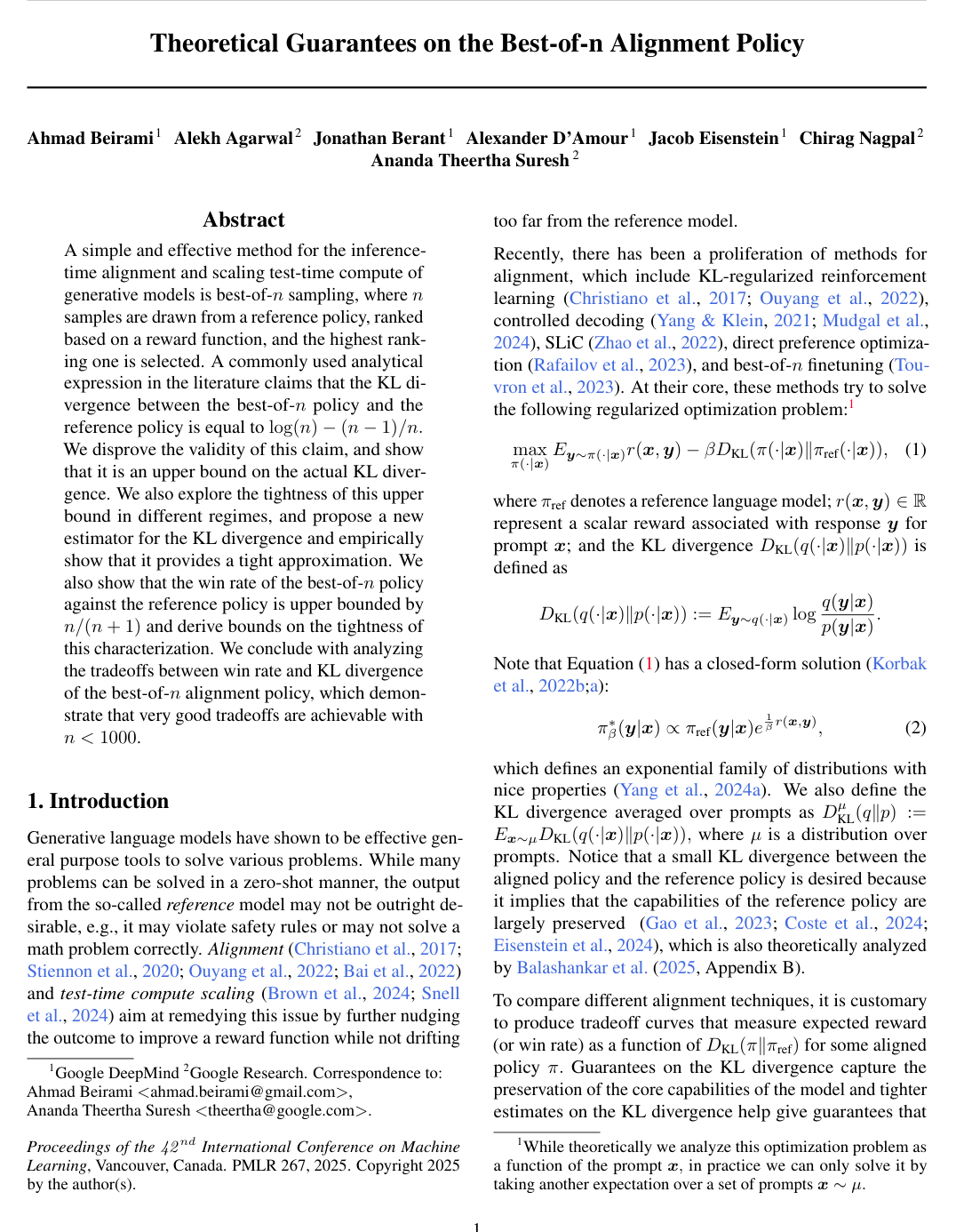
A simple and effective method for the inference-time alignment and scaling test-time compute of generative models is best-of-n sampling, where n samples are drawn from a reference policy, ranked based on a reward function, and the highest ranking one is selected. A commonly used analytical expression in the literature claims that the KL divergence between the best-of-n policy and the reference policy is equal to log(n) − (n − 1)/n. We disprove the validity of this claim, and show that it is an upper bound on the actual KL divergence. We also explore the tightness of this upper bound in different regimes, and propose a new estimator for the KL divergence and empirically show that it provides a tight approximation. We also show that the win rate of the best-of-n policy against the reference policy is upper bounded by n/(n + 1) and derive bounds on the tightness of this characterization. We conclude with analyzing the tradeoffs between win rate and KL divergence of the best-of-n alignment policy, which demonstrate that very good tradeoffs are achievable with n < 1000.

Table of Contents

  • 1. Introduction
  • 2. Derivation of the Best-of-n Policy
  • 3. Relations Between the KL Divergence and the Analytical Formula
  • 3.1. Upper Bounds on the Gap
  • 3.2. Lower Bounds on the Gap
  • 4. Proposed Estimator for KL Divergence
  • 5. Win Rate of the Best-of-n Policy
  • 5.1. Upper Bounds on the Win Rate Gap
  • 5.2. Lower Bounds on the Win Rate Gap
  • 6. Rewind-and-Repeat: Rejection Sampling Beyond Best-of-n
  • 7. Win rate vs KL Divergence Tradeoffs
  • 8. Conclusion
  • Impact Statement
  • References
  • A. Proofs of the main results of the paper
  • A.1. Proofs of Section 3
  • A.2. Proofs of Section 4
  • A.3. Proofs of Section 5
  • A.4. Proofs of Section 6
  • A.5. Proofs of Section 7
  • B. KL divergence of blockwise best-of-n
  • C. Experiments
  • C.1. Details of experiments on Alpaca dataset
  • C.2. Computation of tilted min/max
  • C.3. Experiments with machine translation prompts

Knowls

  1. Knowl 1 — Probability Mass Function of the Best-of-n Policy

    theoretical result

    Let πref(⋅∣x)\pi_{\mathrm{ref}}(\cdot|x) be a reference language model distribution over a finite set of discrete responses Yx\mathcal{Y}_x for a given context or prompt xx, and let r(x,y)∈Rr(x, y) \in \mathbb{R} be a unique reward assigned to each candidate response yy. The best-of-nn alignment policy π(n)(⋅∣x)\pi^{(n)}(\cdot|x) draws nn independent and identically distributed responses y1,…,yn∼πref(⋅∣x)y_1, \dots, y_n \sim \pi_{\mathrm{ref}}(\cdot|x) and selects response y=yk∗y = y_{k^*} where k∗=arg⁡max⁡k∈{1,…,n}r(x,yk)k^* = \arg\max_{k \in \{1, \dots, n\}} r(x, y_k).

    The probability mass function (PMF) of the best-of-nn policy is given in closed form by:

    π(n)(y∣x)=Fπref(y∣x)n−Fπref−(y∣x)n\pi^{(n)}(y|x) = F_{\pi_{\mathrm{ref}}}(y|x)^n - F_{\pi_{\mathrm{ref}}}^-(y|x)^n

    where for any policy π\pi, the cumulative distribution functions with respect to reward are defined as:

    Fπ(y∣x):=Pz∼π(⋅∣x)[r(x,z)≤r(x,y)]F_\pi(y|x) := \mathbb{P}_{z \sim \pi(\cdot|x)}[r(x, z) \le r(x, y)]

    Fπ−(y∣x):=Pz∼π(⋅∣x)[r(x,z)<r(x,y)]F_\pi^-(y|x) := \mathbb{P}_{z \sim \pi(\cdot|x)}[r(x, z) < r(x, y)]

  2. Knowl 2 — Upper Bound on the KL Divergence of the Best-of-n Policy

    theoretical result

    For any sample size n∈Nn \in \mathbb{N}, context xx, and reference policy πref\pi_{\mathrm{ref}}, the Kullback-Leibler (KL) divergence between the best-of-nn policy π(n)\pi^{(n)} and the reference policy πref\pi_{\mathrm{ref}} is upper bounded by:

    DKL(π(n)(⋅∣x) ∥ πref(⋅∣x))≤KL‾n:=log⁡(n)−n−1nD_{\mathrm{KL}}(\pi^{(n)}(\cdot|x) \,\|\, \pi_{\mathrm{ref}}(\cdot|x)) \le \overline{\mathrm{KL}}_n := \log(n) - \frac{n - 1}{n}

    Furthermore, averaging over any prompt distribution μ\mu, the expected KL divergence satisfies:

    DKLμ(π(n) ∥ πref):=Ex∼μ[DKL(π(n)(⋅∣x) ∥ πref(⋅∣x))]≤log⁡(n)−n−1nD_{\mathrm{KL}}^\mu(\pi^{(n)} \,\|\, \pi_{\mathrm{ref}}) := \mathbb{E}_{x \sim \mu}\left[ D_{\mathrm{KL}}(\pi^{(n)}(\cdot|x) \,\|\, \pi_{\mathrm{ref}}(\cdot|x)) \right] \le \log(n) - \frac{n - 1}{n}

    This result disproves the common claim in existing literature that DKL(π(n) ∥ πref)=log⁡(n)−(n−1)/nD_{\mathrm{KL}}(\pi^{(n)} \,\|\, \pi_{\mathrm{ref}}) = \log(n) - (n - 1)/n, establishing instead that this analytical formula is an upper bound on the true KL divergence.

  3. Knowl 3 — Bounds on the Best-of-n KL Divergence Approximation Gap

    theoretical result

    Let the gap between the analytical formula KL‾n=log⁡(n)−(n−1)/n\overline{\mathrm{KL}}_n = \log(n) - (n - 1)/n and the true KL divergence of the best-of-nn policy be defined as:

    GKL(n)(x):=KL‾n−DKL(π(n)(⋅∣x) ∥ πref(⋅∣x))≥0G_{\mathrm{KL}}^{(n)}(x) := \overline{\mathrm{KL}}_n - D_{\mathrm{KL}}(\pi^{(n)}(\cdot|x) \,\|\, \pi_{\mathrm{ref}}(\cdot|x)) \ge 0

    Let H2(πref∣x):=−log⁡∑y∈Y∗(πref(y∣x))2H_2(\pi_{\mathrm{ref}}|x) := -\log \sum_{y \in \mathcal{Y}^*} (\pi_{\mathrm{ref}}(y|x))^2 denote the conditional Rényi entropy of order 2 of the reference model. The gap satisfies the upper bound:

    GKL(n)(x)≤2n(n−1)e−H2(πref∣x)G_{\mathrm{KL}}^{(n)}(x) \le 2n(n - 1)e^{-H_2(\pi_{\mathrm{ref}}|x)}

    If the reference model is δ\delta-bound (i.e., πref(y∣x)≤δ\pi_{\mathrm{ref}}(y|x) \le \delta for all yy), then GKL(n)(x)≤2n(n−1)δG_{\mathrm{KL}}^{(n)}(x) \le 2n(n - 1)\delta, showing that the analytical formula is tight when n2δ≪1n^2\delta \ll 1.

    Conversely, defining ε∞:=πref(ymax⁡(x)∣x)\varepsilon_\infty := \pi_{\mathrm{ref}}(y_{\max}(x)|x) where ymax⁡(x):=arg⁡max⁡yr(x,y)y_{\max}(x) := \arg\max_y r(x, y), the gap is lower bounded for any nn by:

    GKL(n)(x)≥(1−(1−ε∞)n)[log⁡(nε∞1−(1−ε∞)n)−n−1n]−(n−1)(1−ε∞)nlog⁡(1−ε∞)>0G_{\mathrm{KL}}^{(n)}(x) \ge \left(1 - (1 - \varepsilon_\infty)^n\right) \left[ \log\left(\frac{n\varepsilon_\infty}{1 - (1 - \varepsilon_\infty)^n}\right) - \frac{n - 1}{n} \right] - (n - 1)(1 - \varepsilon_\infty)^n \log(1 - \varepsilon_\infty) > 0

    In the asymptotic regime n→∞n \to \infty, the lower bound scales as GKL(n)(x)≥log⁡(nε∞)+on(log⁡n)G_{\mathrm{KL}}^{(n)}(x) \ge \log(n\varepsilon_\infty) + o_n(\log n), which grows unbounded whenever nε∞≫1n\varepsilon_\infty \gg 1.

  4. Knowl 4 — Estimator for Best-of-n Policy KL Divergence

    model/method

    Let y∼π(n)(⋅∣x)y \sim \pi^{(n)}(\cdot|x) be an outcome generated by selecting the highest-reward response from nn samples drawn from πref(⋅∣x)\pi_{\mathrm{ref}}(\cdot|x), and let εn:=πref(y∣x)\varepsilon_n := \pi_{\mathrm{ref}}(y|x) denote the likelihood of the chosen response under the reference policy.

    The single-sample estimator for the KL divergence between π(n)\pi^{(n)} and πref\pi_{\mathrm{ref}} is defined as:

    D^KL(εn):=dn(εn)\widehat{D}_{\mathrm{KL}}(\varepsilon_n) := d_n(\varepsilon_n)

    where the function dn(ε)d_n(\varepsilon) is given by:

    dn(ε):=(1−ε)n[log⁡n+(n−1)log⁡(1−ε)−n−1n]+(1−(1−ε)n)log⁡(1−(1−ε)nε)d_n(\varepsilon) := (1 - \varepsilon)^n \left[ \log n + (n - 1)\log(1 - \varepsilon) - \frac{n - 1}{n} \right] + \left(1 - (1 - \varepsilon)^n\right) \log\left( \frac{1 - (1 - \varepsilon)^n}{\varepsilon} \right)

    For any realization of εn\varepsilon_n, the estimator satisfies deterministic bounds:

    0≤D^KL(εn)≤log⁡(n)−n−1n0 \le \widehat{D}_{\mathrm{KL}}(\varepsilon_n) \le \log(n) - \frac{n - 1}{n}

    Because the standard deviation of D^KL(εn)\widehat{D}_{\mathrm{KL}}(\varepsilon_n) on a single run is at most log⁡n\log n, averaging over M=O(log⁡nlog⁡(1/δ))M = O(\log n \log(1/\delta)) independent draws from the best-of-nn policy guarantees a standard deviation smaller than δ\delta.

  5. Knowl 5 — Calibrated Reward and General Win Rate Representation

    definition

    For a context xx and reference policy πref\pi_{\mathrm{ref}}, let Fπref(y∣x):=Pz∼πref(⋅∣x)[r(x,z)≤r(x,y)]F_{\pi_{\mathrm{ref}}}(y|x) := \mathbb{P}_{z \sim \pi_{\mathrm{ref}}(\cdot|x)}[r(x, z) \le r(x, y)] and Fπref−(y∣x):=Pz∼πref(⋅∣x)[r(x,z)<r(x,y)]F_{\pi_{\mathrm{ref}}}^-(y|x) := \mathbb{P}_{z \sim \pi_{\mathrm{ref}}(\cdot|x)}[r(x, z) < r(x, y)]. The calibrated reward function is defined as:

    Cπref(x,y):=Fπref(y∣x)+Fπref−(y∣x)2C_{\pi_{\mathrm{ref}}}(x, y) := \frac{F_{\pi_{\mathrm{ref}}}(y|x) + F_{\pi_{\mathrm{ref}}}^-(y|x)}{2}

    For any policy π\pi, its win rate against πref\pi_{\mathrm{ref}} under reward rr, accounting for ties via wr(y≻z∣x):=I(r(x,y)>r(x,z))+12I(r(x,y)=r(x,z))w_r(y \succ z | x) := \mathbb{I}(r(x, y) > r(x, z)) + \frac{1}{2}\mathbb{I}(r(x, y) = r(x, z)), is defined as:

    Wr(π(⋅∣x) ∥ πref(⋅∣x)):=Ey∼π(⋅∣x),z∼πref(⋅∣x)[wr(y≻z∣x)]W_r(\pi(\cdot|x) \,\|\, \pi_{\mathrm{ref}}(\cdot|x)) := \mathbb{E}_{y \sim \pi(\cdot|x), z \sim \pi_{\mathrm{ref}}(\cdot|x)}[w_r(y \succ z | x)]

    The win rate of any policy π\pi against the reference policy can be equivalently expressed as the expected calibrated reward:

    Wr(π(⋅∣x) ∥ πref(⋅∣x))=Ey∼π(⋅∣x)[Cπref(x,y)]W_r(\pi(\cdot|x) \,\|\, \pi_{\mathrm{ref}}(\cdot|x)) = \mathbb{E}_{y \sim \pi(\cdot|x)}\left[ C_{\pi_{\mathrm{ref}}}(x, y) \right]

  6. Knowl 6 — Theoretical Bounds on the Best-of-n Win Rate

    theoretical result

    For any sample size n∈Nn \in \mathbb{N} and context xx, the win rate of the best-of-nn policy π(n)\pi^{(n)} against the reference policy πref\pi_{\mathrm{ref}} satisfies the upper bound:

    Wr(π(n)(⋅∣x) ∥ πref(⋅∣x))≤nn+1W_r(\pi^{(n)}(\cdot|x) \,\|\, \pi_{\mathrm{ref}}(\cdot|x)) \le \frac{n}{n + 1}

    The gap GW(n)(x):=nn+1−Wr(π(n)(⋅∣x) ∥ πref(⋅∣x))≥0G_W^{(n)}(x) := \frac{n}{n + 1} - W_r(\pi^{(n)}(\cdot|x) \,\|\, \pi_{\mathrm{ref}}(\cdot|x)) \ge 0 is upper bounded in terms of the conditional Rényi entropy of order 2, H2(πref∣x)H_2(\pi_{\mathrm{ref}}|x), by:

    GW(n)(x)≤n−12e−H2(πref∣x)G_W^{(n)}(x) \le \frac{n - 1}{2} e^{-H_2(\pi_{\mathrm{ref}}|x)}

    If πref\pi_{\mathrm{ref}} is δ\delta-bound (πref(y∣x)≤δ\pi_{\mathrm{ref}}(y|x) \le \delta for all yy), then GW(n)(x)≤n−12δG_W^{(n)}(x) \le \frac{n - 1}{2}\delta, establishing that Wr(π(n)(⋅∣x) ∥ πref(⋅∣x))≈nn+1W_r(\pi^{(n)}(\cdot|x) \,\|\, \pi_{\mathrm{ref}}(\cdot|x)) \approx \frac{n}{n + 1} when nδ≪1n\delta \ll 1.

    Moreover, with ε∞:=πref(arg⁡max⁡yr(x,y)∣x)\varepsilon_\infty := \pi_{\mathrm{ref}}(\arg\max_y r(x, y)|x), the gap is lower bounded by:

    GW(n)(x)≥nn+1(1−(1−ε∞)n+1)−(1−(1−ε∞)n)(1−ε∞2)>0G_W^{(n)}(x) \ge \frac{n}{n + 1}\left(1 - (1 - \varepsilon_\infty)^{n+1}\right) - \left(1 - (1 - \varepsilon_\infty)^n\right)\left(1 - \frac{\varepsilon_\infty}{2}\right) > 0

    As n→∞n \to \infty, GW(n)(x)≥ε∞2(1+on(1))G_W^{(n)}(x) \ge \frac{\varepsilon_\infty}{2}(1 + o_n(1)), demonstrating that whenever ε∞>0\varepsilon_\infty > 0, the gap remains strictly bounded away from zero.

  7. Knowl 7 — Rewind-and-Repeat Policy and its Win Rate vs KL Divergence

    theoretical result

    The rewind-and-repeat rejection sampling policy πΦ\pi_\Phi draws independent samples y1,y2,⋯∼πref(⋅∣x)y_1, y_2, \dots \sim \pi_{\mathrm{ref}}(\cdot|x) sequentially and outputs the first sample yMy_M whose reward meets a threshold Φ∈R\Phi \in \mathbb{R} (i.e., r(x,yM)≥Φr(x, y_M) \ge \Phi and r(x,yk)<Φr(x, y_k) < \Phi for all k<Mk < M).

    Let wΦ(x):=Ey∼πref(⋅∣x)[I(r(x,y)≥Φ)]w_\Phi(x) := \mathbb{E}_{y \sim \pi_{\mathrm{ref}}(\cdot|x)}[\mathbb{I}(r(x, y) \ge \Phi)] denote the per-trial acceptance probability. The probability mass function of πΦ\pi_\Phi is:

    πΦ(y∣x)={πref(y∣x)wΦ(x)if r(x,y)≥Φ0if r(x,y)<Φ\pi_\Phi(y|x) = \begin{cases} \frac{\pi_{\mathrm{ref}}(y|x)}{w_\Phi(x)} & \text{if } r(x, y) \ge \Phi \\ 0 & \text{if } r(x, y) < \Phi \end{cases}

    The exact KL divergence and win rate of the rewind-and-repeat policy against πref\pi_{\mathrm{ref}} are given in closed form by:

    DKL(πΦ(⋅∣x) ∥ πref(⋅∣x))=log⁡(1wΦ(x))D_{\mathrm{KL}}(\pi_\Phi(\cdot|x) \,\|\, \pi_{\mathrm{ref}}(\cdot|x)) = \log\left( \frac{1}{w_\Phi(x)} \right)

    Wr(πΦ(⋅∣x) ∥ πref(⋅∣x))=1−12wΦ(x)W_r(\pi_\Phi(\cdot|x) \,\|\, \pi_{\mathrm{ref}}(\cdot|x)) = 1 - \frac{1}{2} w_\Phi(x)

  8. Knowl 8 — Unbiased KL Divergence Estimator for Rewind-and-Repeat

    theoretical result

    Let MM be the number of trials until acceptance in the rewind-and-repeat sampling policy with acceptance probability wΦ(x)w_\Phi(x) (such that MM follows a geometric distribution with parameter wΦ(x)w_\Phi(x), P(M=k)=(1−wΦ(x))k−1wΦ(x)\mathbb{P}(M = k) = (1 - w_\Phi(x))^{k-1}w_\Phi(x)). Let Hk:=∑i=1k1iH_k := \sum_{i=1}^k \frac{1}{i} denote the kk-th Harmonic number, with H0:=0H_0 := 0.

    The exact KL divergence between the rewind-and-repeat policy πΦ\pi_\Phi and the reference policy πref\pi_{\mathrm{ref}} satisfies:

    DKL(πΦ(⋅∣x) ∥ πref(⋅∣x))=E[HM−1]D_{\mathrm{KL}}(\pi_\Phi(\cdot|x) \,\|\, \pi_{\mathrm{ref}}(\cdot|x)) = \mathbb{E}[H_{M-1}]

    Consequently, HM−1H_{M-1} is an unbiased, single-trajectory sample estimator for the KL divergence of the rewind-and-repeat procedure.

  9. Knowl 9 — KL Divergence Upper Bound for Blockwise Best-of-n Decoding

    theoretical result

    In blockwise best-of-nn decoding πB(n)\pi_B^{(n)}, responses are generated in sequential blocks of length BB tokens. Given a partially decoded sequence yty^t, nn candidate block continuations z(1)B,…,z(n)B∼πref(⋅∣x,yt)z_{(1)}^B, \dots, z_{(n)}^B \sim \pi_{\mathrm{ref}}(\cdot|x, y^t) of length BB are sampled from the reference model, and the continuation maximizing a reward function r(x,yt,z(k)B)r(x, y^t, z_{(k)}^B) is selected. Decoding repeats until the end-of-sequence token is generated.

    For a decoded sequence yy of total length ∣y∣|y| steps, the KL divergence of the resulting policy πB(n)\pi_B^{(n)} relative to the reference policy πref\pi_{\mathrm{ref}} satisfies:

    DKL(πB(n)(⋅∣x) ∥ πref(⋅∣x))≤Ey∼πB(n)(⋅∣x)[⌈∣y∣B⌉](log⁡(n)−n−1n)D_{\mathrm{KL}}(\pi_B^{(n)}(\cdot|x) \,\|\, \pi_{\mathrm{ref}}(\cdot|x)) \le \mathbb{E}_{y \sim \pi_B^{(n)}(\cdot|x)}\left[ \left\lceil \frac{|y|}{B} \right\rceil \right] \left( \log(n) - \frac{n - 1}{n} \right)

    where ⌈⋅⌉\lceil \cdot \rceil is the ceiling operator. As block length B→∞B \to \infty, this recovers the sequence-level best-of-nn upper bound.

  10. Knowl 10 — Conjectured Upper Bound on Best-of-n Win Rate vs KL Divergence Tradeoff

    theoretical result

    Let Dn:=DKL(π(n)(⋅∣x) ∥ πref(⋅∣x))D_n := D_{\mathrm{KL}}(\pi^{(n)}(\cdot|x) \,\|\, \pi_{\mathrm{ref}}(\cdot|x)) denote the KL divergence of the best-of-nn policy. The tradeoff between the win rate Wr(π(n)(⋅∣x) ∥ πref(⋅∣x))W_r(\pi^{(n)}(\cdot|x) \,\|\, \pi_{\mathrm{ref}}(\cdot|x)) and DnD_n is conjectured to be upper bounded for all nn by:

    Wr(π(n)(⋅∣x) ∥ πref(⋅∣x))≤W0(Dn)W_r(\pi^{(n)}(\cdot|x) \,\|\, \pi_{\mathrm{ref}}(\cdot|x)) \le W_0(D_n)

    where W0(D):=ℓ−1(D)W_0(D) := \ell^{-1}(D) is the functional inverse of ℓ:[0.5,1)→[0,∞)\ell : [0.5, 1) \to [0, \infty) defined as:

    ℓ(τ):=log⁡(τ1−τ)+1τ−2\ell(\tau) := \log\left(\frac{\tau}{1 - \tau}\right) + \frac{1}{\tau} - 2

    This function characterizes the continuous Pareto frontier bounding the achievable win rate for a given KL divergence under best-of-nn sampling.

Coverage note — Omitted material includes the implicit parametric tradeoff curves in Appendix A.5 (Theorems A.6 and A.7, which directly combine the stated KL and win rate bounds) and specific empirical prompt listings from the Alpaca and translation experiments.

References

  1. 1.Amini, A., Vieira, T., and Cotterell, R. Variational best-of-n alignment. International Conference on Learning Representations (ICLR), 2025.
  2. 2.Azar, M. G., Guo, Z. D., Piot, B., Munos, R., Rowland, M., Valko, M., and Calandriello, D. A general theoretical paradigm to understand learning from human preferences. In International Conference on Artificial Intelligence and Statistics, pp. 4447–4455. PMLR, 2024.
  3. 3.Bai, Y., Jones, A., Ndousse, K., Askell, A., Chen, A., DasSarma, N., Drain, D., Fort, S., Ganguli, D., Henighan, T., et al. Training a helpful and harmless assistant with reinforcement learning from human feedback. arXiv preprint arXiv:2204.05862, 2022.
  4. 4.Balashankar, A., Sun, Z., Berant, J., Eisenstein, J., Collins, M., Hutter, A., Lee, J., Nagpal, C., Prost, F., Sinha, A., Suresh, A. T., and Beirami, A. InfAlign: Inference-aware language model alignment. International Conference on Machine Learning (ICML), 2025.
  5. 5.Beetham, J., Chakraborty, S., Wang, M., Huang, F., Bedi, A. S., and Shah, M. Liar: Leveraging alignment (best-of-n) to jailbreak llms in seconds. arXiv preprint arXiv:2412.05232, 2024.
  6. 6.Brown, B., Juravsky, J., Ehrlich, R., Clark, R., Le, Q. V., Ré, C., and Mirhoseini, A. Large language monkeys: Scaling inference compute with repeated sampling. arXiv preprint arXiv:2407.21787, 2024.
  7. 7.Christiano, P. F., Leike, J., Brown, T., Martic, M., Legg, S., and Amodei, D. Deep reinforcement learning from human preferences. Advances in neural information processing systems, 30, 2017.
  8. 8.Coste, T., Anwar, U., Kirk, R., and Krueger, D. Reward model ensembles help mitigate overoptimization. International Conference on Learning Representations (ICLR), 2024.
  9. 9.Eisenstein, J., Nagpal, C., Agarwal, A., Beirami, A., D’Amour, A., Dvijotham, D., Fisch, A., Heller, K., Pfohl, S., Ramachandran, D., Shaw, P., and Berant, J. Helping or herding? reward model ensembles mitigate but do not eliminate reward hacking. Conference on Language Modeling (COLM), 2024.
  10. 10.Gao, L., Schulman, J., and Hilton, J. Scaling laws for reward model overoptimization. In International Conference on Machine Learning, pp. 10835–10866. PMLR, 2023.
  11. 11.Gemma, Riviere, M., Pathak, S., Sessa, P. G., Hardin, C., Bhupatiraju, S., Hussenot, L., Mesnard, T., Shahriari, B., Ramé, A., et al. Gemma 2: Improving open language models at a practical size. arXiv preprint arXiv:2408.00118, 2024.
  12. 12.Go, D., Korbak, T., Kruszewski, G., Rozen, J., and Dymetman, M. Compositional preference models for aligning LMs. arXiv preprint arXiv:2310.13011, 2023.
  13. 13.Gui, L., Gârbacea, C., and Veitch, V. BoNBoN alignment for large language models and the sweetness of best-of-n sampling. Neural Information Processing Systems (NeurIPS), December 2024.
  14. 14.Hilton, J. and Gao, L. Measuring Goodhart’s law, April 2022. URL https://openai.com/research/measuring-goodharts-law. Accessed: 2024-01-03.
  15. 15.Hughes, J., Price, S., Lynch, A., Schaeffer, R., Barez, F., Koyejo, S., Sleight, H., Jones, E., Perez, E., and Sharma, M. Best-of-n jailbreaking. arXiv preprint arXiv:2412.03556, 2024.
  16. 16.Kim, M., Thonet, T., Rozen, J., Lee, H., Jung, K., and Dymetman, M. Guaranteed generation from large language models. International Conference on Learning Representations (ICLR), 2025.
  17. 17.Korbak, T., Elsahar, H., Kruszewski, G., and Dymetman, M. On reinforcement learning and distribution matching for fine-tuning language models with no catastrophic forgetting. Advances in Neural Information Processing Systems, 35:16203–16220, 2022a.
  18. 18.Korbak, T., Perez, E., and Buckley, C. RL with KL penalties is better viewed as Bayesian inference. In Findings of the Association for Computational Linguistics: EMNLP 2022, pp. 1083–1091, 2022b.
  19. 19.Li, T., Beirami, A., Sanjabi, M., and Smith, V. On tilted losses in machine learning: Theory and applications. Journal of Machine Learning Research, 24(142):1–79, 2023.
  20. 20.Li, Y., Wei, F., Zhao, J., Zhang, C., and Zhang, H. Rain: Your language models can align themselves without finetuning. In The Twelfth International Conference on Learning Representations, 2024.
  21. 21.Mroueh, Y. Information theoretic guarantees for policy alignment in large language models. arXiv preprint arXiv:2406.05883, 2024.
  22. 22.Mudgal, S., Lee, J., Ganapathy, H., Li, Y., Wang, T., Huang, Y., Chen, Z., Cheng, H.-T., Collins, M., Strohman, T., Chen, J., Beutel, A., and Beirami, A. Controlled decoding from language models. International Conference on Machine Learning (ICML), 2024.
  23. 23.Nakano, R., Hilton, J., Balaji, S., Wu, J., Ouyang, L., Kim, C., Hesse, C., Jain, S., Kosaraju, V., Saunders, W., et al. WebGPT: Browser-assisted question-answering with human feedback. arXiv preprint arXiv:2112.09332, 2021.
  24. 24.Ouyang, L., Wu, J., Jiang, X., Almeida, D., Wainwright, C. L., Mishkin, P., Zhang, C., Agarwal, S., Slama, K., Ray, A., et al. Training language models to follow instructions with human feedback. arXiv preprint arXiv:2203.02155, 2022.
  25. 25.Qiu, J., Lu, Y., Zeng, Y., Guo, J., Geng, J., Wang, H., Huang, K., Wu, Y., and Wang, M. Treebon: Enhancing inference-time alignment with speculative tree-search and best-of-n sampling. arXiv preprint arXiv:2410.16033, 2024.
  26. 26.Rafailov, R., Sharma, A., Mitchell, E., Ermon, S., Manning, C. D., and Finn, C. Direct preference optimization: Your language model is secretly a reward model. arXiv preprint arXiv:2305.18290, 2023.
  27. 27.Scheurer, J., Campos, J. A., Korbak, T., Chan, J. S., Chen, A., Cho, K., and Perez, E. Training language models with language feedback at scale. arXiv preprint arXiv:2303.16755, 2023.
  28. 28.Sessa, P. G., Dadashi, R., Hussenot, L., Ferret, J., Vieillard, N., Ramé, A., Shariari, B., Perrin, S., Friesen, A., Cideron, G., et al. Bond: Aligning llms with best-of-n distillation. International Conference on Learning Representations (ICLR), 2025.
  29. 29.Snell, C., Lee, J., Xu, K., and Kumar, A. Scaling llm test-time compute optimally can be more effective than scaling model parameters. arXiv preprint arXiv:2408.03314, 2024.
  30. 30.Stiennon, N., Ouyang, L., Wu, J., Ziegler, D., Lowe, R., Voss, C., Radford, A., Amodei, D., and Christiano, P. F. Learning to summarize with human feedback. Advances in Neural Information Processing Systems, 33: 3008–3021, 2020.
  31. 31.Sun, H., Haider, M., Zhang, R., Yang, H., Qiu, J., Yin, M., Wang, M., Bartlett, P., and Zanette, A. Fast best-of-n decoding via speculative rejection. In The Thirty-eighth Annual Conference on Neural Information Processing Systems, 2024.
  32. 32.Taori, R., Gulrajani, I., Zhang, T., Dubois, Y., Li, X., Guestrin, C., Liang, P., and Hashimoto, T. B. Stanford alpaca: An instruction-following llama model, 2023.
  33. 33.Touvron, H., Martin, L., Stone, K., Albert, P., Almahairi, A., Babaei, Y., Bashlykov, N., Batra, S., Bhargava, P., Bhosale, S., et al. Llama 2: Open foundation and fine-tuned chat models. arXiv preprint arXiv:2307.09288, 2023.
  34. 34.Yang, J. Q., Salamatian, S., Sun, Z., Suresh, A. T., and Beirami, A. Asymptotics of language model alignment. International Symposium on Information Theory (ISIT), July 2024a.
  35. 35.Yang, K. and Klein, D. FUDGE: Controlled text generation with future discriminators. In Proceedings of the 2021 Conference of the North American Chapter of the Association for Computational Linguistics: Human Language Technologies, pp. 3511–3535, Online, June 2021. Association for Computational Linguistics. doi: 10.18653/v1/2021.naacl-main.276. URL https://aclanthology.org/2021.naacl-main.276.
  36. 36.Yang, T., Mei, J., Dai, H., Wen, Z., Cen, S., Schuurmans, D., Chi, Y., and Dai, B. Faster wind: Accelerating iterative best-of-n distillation for llm alignment. arXiv preprint arXiv:2410.20727, 2024b.
  37. 37.Zhao, Y., Khalman, M., Joshi, R., Narayan, S., Saleh, M., and Liu, P. J. Calibrating sequence likelihood improves conditional language generation. In The Eleventh International Conference on Learning Representations, 2022.

Citation

MLA
Beirami, A., et al. “Theoretical Guarantees on the Best-of-n Alignment Policy”. arXiv, 2024, http://arxiv.org/abs/2401.01879v3.
APA
Beirami, A., Agarwal, A., Berant, J., D'Amour, A., Eisenstein, J., Nagpal, C., & Suresh, A. T. (2024). Theoretical guarantees on the best-of-n alignment policy. arXiv. http://arxiv.org/abs/2401.01879v3
Chicago
Beirami, A., A. Agarwal, J. Berant, et al. 2024. “Theoretical Guarantees on the Best-of-n Alignment Policy”. arXiv. http://arxiv.org/abs/2401.01879v3.
Harvard
Beirami, A. et al. (2024) “Theoretical guarantees on the best-of-n alignment policy”, arXiv [Preprint]. Available at: http://arxiv.org/abs/2401.01879v3.
Vancouver
1. Beirami A, Agarwal A, Berant J, D'Amour A, Eisenstein J, Nagpal C, Suresh AT (2024) Theoretical guarantees on the best-of-n alignment policy. arXiv

BibTeX

@article{beirami2024theoretical,
  title = {Theoretical guarantees on the best-of-n alignment policy},
  author = {Beirami, Ahmad and Agarwal, Alekh and Berant, Jonathan and D'Amour, Alexander and Eisenstein, Jacob and Nagpal, Chirag and Suresh, Ananda Theertha},
  year = {2024},
  journal = {arXiv},
  url = {http://arxiv.org/abs/2401.01879v3},
  eprint = {2401.01879}
}
Metadata:arXiv

Access the Paper

This paper is available from its original source. Click below to access the PDF.

Open PDF
License: https://creativecommons.org/licenses/by/4.0/