Local Similarity Pattern and Cost Self-Reassembling for Deep Stereo Matching Networks
Biyang LiuHuimin YuYangqi Long
Proposes a pairwise Local Similarity Pattern to inject structural information into deep features alongside a dynamic self-reassembling refinement strategy that prevents over-smoothing in stereo matching disparity estimation.
Stereo matching is a core computer vision technology that estimates depth from paired camera images, providing a low-cost visual foundation for critical systems such as autonomous vehicles and augmented reality. While modern deep learning architectures have significantly advanced stereo matching performance, they suffer from two key shortcomings: standard convolutional features focus heavily on visual appearance while overlooking essential geometric structures, and standard post-processing refinement filters cause excessive smoothing that blurs sharp object boundaries and distorts occluded areas.
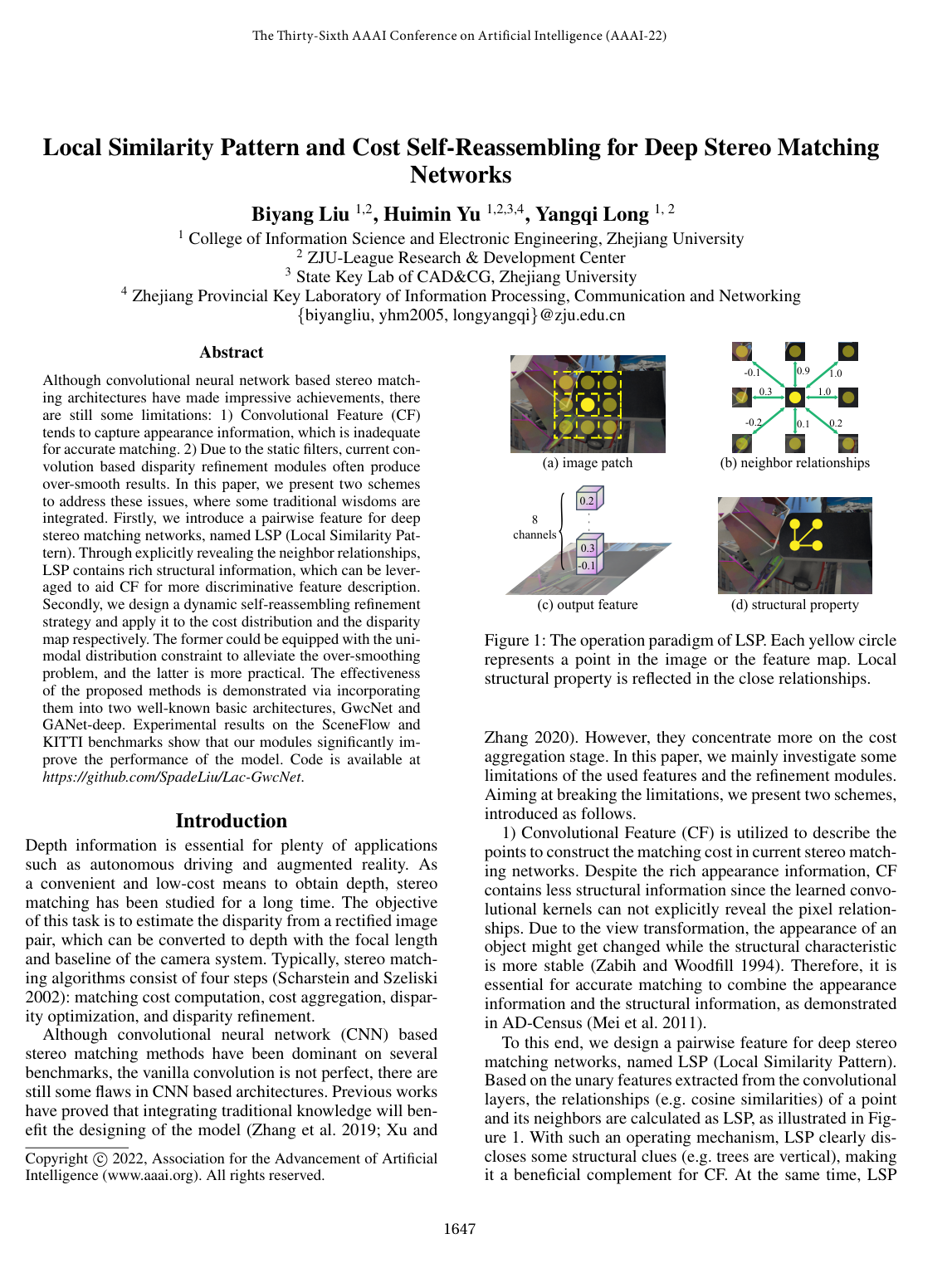
The article designs and evaluates two modular enhancements to address these flaws: the Local Similarity Pattern (LSP), which injects explicit geometric structure into feature extraction, and Cost Self-Reassembling (CSR), an adaptive refinement strategy that sharpens depth estimates by dynamically propagating reliable measurements from neighboring pixels.
To demonstrate the effectiveness and credibility of these modules, the authors integrated them into leading baseline architectures, including GwcNet and GANet-deep. They evaluated the systems across major standard benchmarks, including the large-scale synthetic SceneFlow dataset (over 39,000 image pairs), the real-world KITTI autonomous driving benchmarks, and cross-domain generalization datasets such as Middlebury and ETH3D.
The findings confirm clear, practical improvements across all tested configurations. First, integrating the full multi-scale and multi-level Local Similarity Pattern consistently boosted accuracy over standard convolutional features alone by making matching robust across different object scales. Second, applying dynamic refinement via Cost Self-Reassembling substantially reduced errors and avoided the over-smoothing seen in conventional convolutional post-processing, dropping outlier percentages significantly. Third, combining both modules on the baseline GwcNet model improved endpoint error on SceneFlow from 1.04 to 0.75 pixels (an improvement of nearly 28%) and reduced outlier rates on the KITTI 2015 validation set from 1.65% to 1.30%. Finally, the modules demonstrated strong cross-domain transferability under varying lighting conditions, with minimal parameter overhead.
These results demonstrate that blending classical geometric principles with deep learning architectures delivers sharper, more reliable depth maps. This enhancement directly improves downstream safety, reliability, and obstacle detection in autonomous navigation. The article also provides a practical alternative, Disparity Self-Reassembling (DSR), which achieves competitive accuracy gains with negligible memory overhead compared to the higher memory footprint of Cost Self-Reassembling.
For engineering and operational deployment, teams building real-time or resource-constrained embedded systems should pair lightweight baseline backbones with the Disparity Self-Reassembling variant to balance throughput, memory, and precision. Organizations focusing on high-accuracy offline 3D modeling or safety-critical perception pipelines can deploy the full Cost Self-Reassembling model. Next development steps should focus on extending this dynamic neighbor-reassembling strategy to broader pixel-level tasks such as semantic segmentation and testing performance under severe weather or extreme illumination shifts.
While confidence in the reported results is high due to comprehensive testing across standard synthetic and real-world benchmarks, operational teams should note that real-world benchmarks like KITTI provide relatively sparse ground truth for evaluation. Practitioners must carefully weigh the memory demands of the full cost-level refinement against target embedded hardware limits before deploying at scale.
- Paper: Pyramid Stereo Matching Network, Jia-Ren Chang et al. (2018). It introduces PSMNet, establishing the core 3D convolutional cost volume regularization architecture upon which modern deep stereo matching networks and subsequent refinements build.
- Paper: Non-parametric Local Transforms for Computing Visual Correspondence, Ramin Zabih et al. (1994). It details non-parametric local transforms like the Census transform that encode structural pixel-neighborhood relationships, providing the foundational rationale behind the Local Similarity Pattern representation.
- Paper: Stereo Matching by Training a Convolutional Neural Network to Compare Image Patches, Jure Zbontar et al. (2015). It demonstrates how convolutional neural networks can replace handcrafted matching costs in stereo vision, forming the baseline framework for modern deep stereo estimation.
- Paper: A Large Dataset to Train Convolutional Networks for Disparity, Optical Flow, and Scene Flow Estimation, Nikolaus Mayer et al. (2016). It introduces the large-scale synthetic Scene Flow benchmark dataset used extensively to train and evaluate end-to-end stereo matching networks.
- Paper: Learning to compare image patches via convolutional neural networks, Sergey Zagoruyko et al. (2015). It explores learning pairwise image patch similarity with deep architectures, motivating modern pairwise and contextual feature representations in stereo correspondence.
- Paper: DEFOM-Stereo: Depth Foundation Model Based Stereo Matching, Hualie Jiang et al. (2025). It advances beyond purely local pattern matching and traditional stereo architectures by integrating monocular depth foundation models into recurrent stereo-matching frameworks.
- Paper: Dynamic Spatial Propagation Network for Depth Completion, Yuankai Lin et al. (2022). It develops dynamic, attention-based neighborhood affinity propagation to tackle the over-smoothing and static filter limitations common in dense depth refinement.
- Paper: Time Will Tell: New Outlooks and A Baseline for Temporal Multi-View 3D Object Detection, Jinhyung Park et al. (2023). It leverages deep multi-view stereo matching formulations across temporal sequences to substantially boost multi-camera 3D object detection accuracy.
- Paper: BEVNeXt: Reviving Dense BEV Frameworks for 3D Object Detection, Zhenxin Li et al. (2024). It incorporates advanced depth modeling and geometric consistency constraints into dense bird's-eye-view frameworks for 3D perception.