Task Discrepancy Maximization for Fine-grained Few-Shot Classification
Su Been LeeWonJun MoonJae-Pil Heo
Proposes Task Discrepancy Maximization, a plug-and-play module that combines support and query attention mechanisms to reweight feature channels for capturing subtle, class-discriminative regions in fine-grained few-shot classification.
Modern computer vision models achieve remarkable accuracy but traditionally require massive amounts of labeled training data. In specialized, fine-grained tasks—such as distinguishing visually similar bird species, aircraft models, or animal breeds—collecting vast labeled datasets is prohibitively expensive and time-consuming. While few-shot learning aims to recognize novel categories from only a handful of labeled examples, existing feature alignment techniques struggle in fine-grained settings because they treat all visual features broadly rather than isolating the subtle, distinct details necessary to differentiate look-alike classes.
The article introduces and evaluates Task Discrepancy Maximization (TDM), a modular plug-in designed to enhance fine-grained few-shot image classification. The primary objective is to demonstrate that dynamically weighting feature channels based on their class-specific distinctiveness allows vision models to focus on critical discriminative regions and significantly boost classification performance.
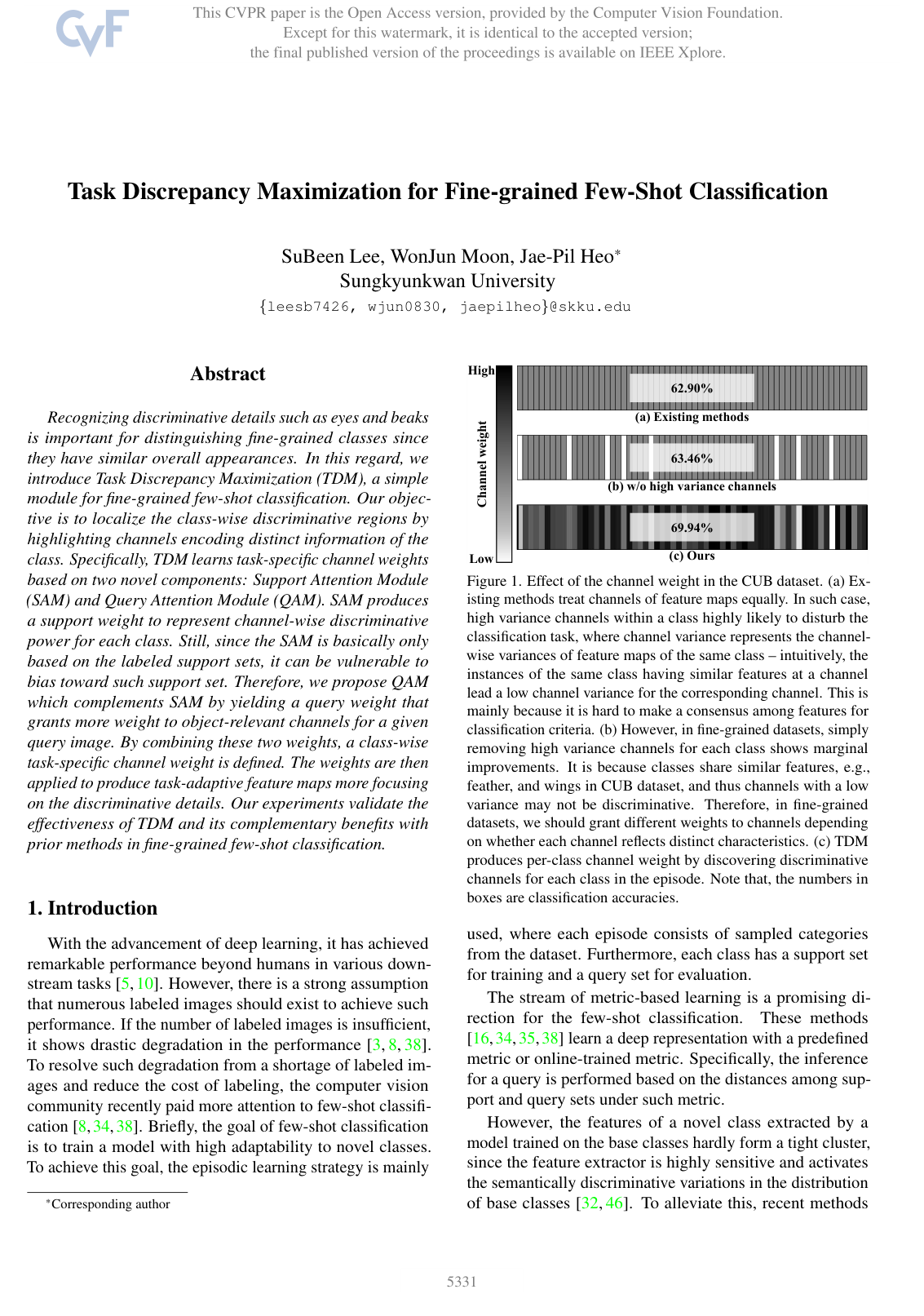
To achieve this, the authors designed a lightweight mechanism comprising two complementary components: a Support Attention Module (SAM) and a Query Attention Module (QAM). SAM assesses labeled support images to highlight channels that exhibit distinct properties for a specific class while suppressing shared, generic features. QAM analyzes the unlabeled query image to emphasize object-relevant regions, counteracting potential bias from small labeled sample sizes. Combining these two modules yields adaptive, task-specific channel weights. The framework was evaluated across seven fine-grained benchmark datasets (including CUB-200-2011, Aircraft, meta-iNat, Stanford Cars, Stanford Dogs, and Oxford Pets) integrated into four established metric-based few-shot architectures (ProtoNet, DSN, CTX, and FRN) using both standard 4-layer convolutional and 12-layer residual network backbones.
The experimental findings show that TDM consistently improves classification accuracy across all baseline models and datasets, setting new state-of-the-art benchmarks in nearly every evaluated setting. On benchmark bird classification (CUB), TDM increased baseline 1-shot accuracy by over 7 percentage points on simple backbones and reached up to 84.36% on raw images with standard ResNet architectures. In aircraft identification, TDM boosted baseline models by up to 7 percentage points. Furthermore, on challenging datasets with severe domain shifts between training and test distributions (such as tiered meta-iNat), TDM demonstrated strong generalization and resistance to overfitting, confirming that both the support and query attention submodules provide complementary benefits.
These results indicate that automated, fine-grained visual recognition can be effectively deployed even when training data is extremely scarce, directly reducing the cost and operational risk associated with manual data labeling. Rather than requiring complex end-to-end model redesigns, the findings show that existing metric-based computer vision pipelines can achieve significant performance gains simply by appending lightweight channel-weighting modules.
Organizations seeking to deploy few-shot vision systems in specialized domains should integrate task-adaptive channel weighting into their existing metric-based architectures. Technical teams should also test spatial pooling options during implementation, as average pooling proved more robust to visual noise than maximum pooling. Researchers and developers should next explore extending the core dynamic channel-weighting mechanism to other computer vision domains, such as object detection and fine-grained retrieval.
Confidence in these findings is high given the extensive validation across seven benchmarks, two neural network backbones, and 10,000 evaluation episodes with tight confidence intervals. However, a primary limitation noted in the article is that TDM is specifically tailored to localize subtle, fine-grained details; its performance advantages may be more limited in coarse-grained classification tasks where broad global features are sufficient to distinguish widely different object categories.
- Paper: TADAM: Task dependent adaptive metric for improved few-shot learning, Boris N. Oreshkin et al. (2018). TADAM establishes the foundational framework for dynamic, task-dependent feature conditioning and metric scaling in few-shot learning that informs task-adaptive representations.
- Paper: Matching Networks for One Shot Learning, Oriol Vinyals et al. (2016). Matching Networks introduces episodic support-set to query-set attention mechanisms that form the standard baseline architecture and formulation for few-shot classification.
- Paper: A Closer Look at Few-shot Classification, Wei-Yu Chen et al. (2019). This benchmark study rigorously characterizes few-shot classification architectures and evaluation protocols, providing essential context for fine-grained few-shot benchmarks like CUB.
- Paper: CBAM: Convolutional Block Attention Module, Sanghyun Woo et al. (2018). CBAM establishes the standard channel-attention and spatial-attention formulations used to refine discriminative intermediate feature maps in convolutional neural networks.
- Paper: Maximum Classifier Discrepancy for Unsupervised Domain Adaptation, Kuniaki Saito et al. (2017). This work introduces the principle of classifier and task discrepancy maximization to align representations and emphasize decision boundaries.
- Paper: Part-Based R-CNNs for Fine-Grained Category Detection, Ning Zhang et al. (2014). This foundational paper outlines the central challenge of fine-grained recognition by emphasizing the necessity of localizing subtle, discriminative object parts.
- Paper: Matching Feature Sets for Few-Shot Image Classification, Arman Afrasiyabi et al. (2022). SetFeat extends few-shot classification on fine-grained benchmarks by replacing global representations with multi-scale set-based feature matching across shallow attention modules.
- Paper: Class Attention Transfer Based Knowledge Distillation, Ziyao Guo et al. (2023). This paper builds on class-discriminative channel attention by formulating class attention transfer mechanisms for knowledge distillation.
- Paper: EASE: Unsupervised Discriminant Subspace Learning for Transductive Few-Shot Learning, Hao Zhu et al. (2022). EASE advances transductive few-shot learning by optimizing discriminant subspace projections and cluster assignments at test time without extensive parameter adaptation.