Neural Sheaf Diffusion: A Topological Perspective on Heterophily and Oversmoothing in GNNs
Cristian BodnarFrancesco Di GiovanniBenjamin Paul ChamberlainPietro LióMichael M. Bronstein
Proves that heterophily and oversmoothing in graph neural networks stem from an implicit trivial sheaf assumption, proposing neural sheaf diffusion models that learn custom edge-node linear maps from data to achieve superior node classification on non-homophilic graphs.
Graph Neural Networks are widely used to analyze networked and relational data across biology, chemistry, and the social sciences. However, standard models suffer from two major performance bottlenecks: severe degradation on heterophilic networks (where connected nodes possess different labels or attributes) and oversmoothing in deeper architectures (where repeated feature aggregation makes node representations indistinguishable). The article addresses these core challenges by demonstrating that both issues stem from a shared root cause: the implicit assumption of an overly simplistic, trivial geometry across graph connections.
The article's main objective is to establish a rigorous mathematical foundation using cellular sheaf theory—a branch of algebraic topology—to explain why standard graph networks fail under heterophily and oversmoothing, and to develop practical neural network models that overcome these constraints by dynamically learning the underlying graph geometry from data.
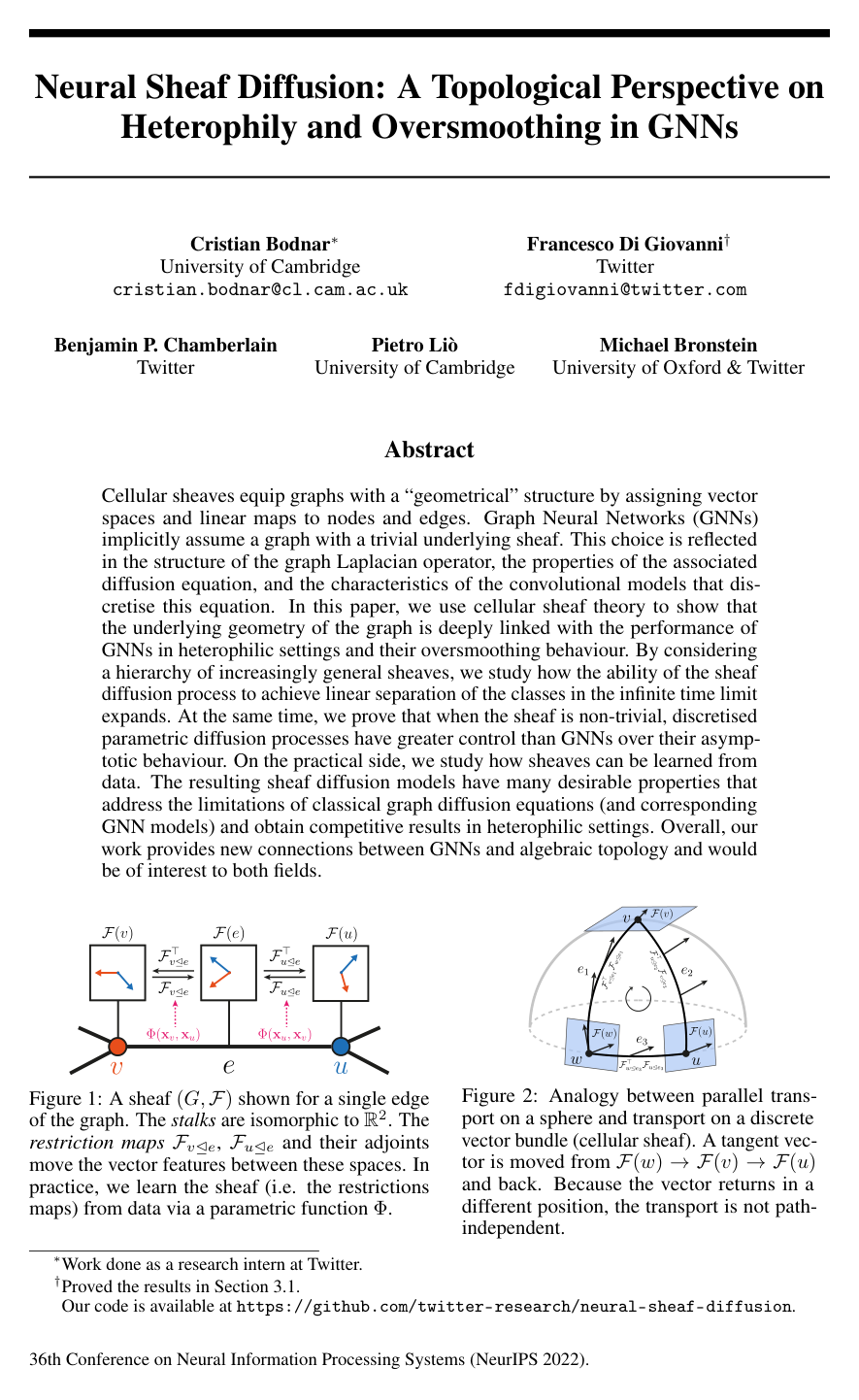
To achieve this, the authors model graphs using cellular sheaves, which assign dedicated vector spaces (stalks) to nodes and edges and directional linear maps (restriction maps) between them. This construction replaces standard graph diffusion with sheaf diffusion governed by a generalized sheaf Laplacian operator. The researchers established theoretical guarantees regarding the expressive power and asymptotic classification behavior of sheaf diffusion across increasingly expressive sheaf classes (symmetric, non-symmetric, diagonal, and orthogonal). They then designed Neural Sheaf Diffusion models, which parameterize and learn edge transformation matrices end-to-end via neural networks, and evaluated them against extensive baselines on synthetic benchmarks and nine real-world datasets spanning high heterophily to high homophily across standardized evaluation splits.
The theoretical and empirical analyses yielded several key findings. First, standard graph models implicitly rely on trivial, symmetric sheaves, which mathematically guarantees that inter-class node features collapse into indistinguishable representations in heterophilic or multi-class settings. Second, incorporating asymmetric or negative transformation maps enables diffusion processes to linearly separate opposing classes in the infinite time limit, directly preventing oversmoothing. Third, solving classification problems with three or more classes fundamentally requires stalk dimensions greater than one, with diagonal and orthogonal sheaves offering linear separation across multiple classes. Fourth, unlike standard graph convolutions that contract energy and force feature smoothing, non-symmetric sheaf networks retain the mathematical flexibility to increase energy and escape degenerate kernel states. Finally, across real-world benchmarks, the proposed Neural Sheaf Diffusion architectures achieved top performance on five out of six highly heterophilic datasets and ranked among the top three models on eight of the nine evaluated benchmarks, all while remaining within approximately 1% of the top-performing models on homophilic graphs.
These findings carry important operational and architectural implications. Rather than relying on specialized heuristics, ad hoc negative edge weight adjustments, or structural workarounds to counter heterophily, organizations can adopt unified sheaf-based architectures that dynamically discover the proper relational geometry. By tuning the stalk dimension to modest sizes between 1 and 5, sheaf diffusion introduces only a small constant computational overhead relative to standard graph convolutions, avoiding substantial training cost increases while offering superior predictive reliability.
Based on these results, engineering teams deploying graph learning on complex, heterophilic relational data should prioritize adopting neural sheaf architectures—particularly orthogonal bundles, which provide the best balance of regularized parameter complexity, numerical stability, and representational capacity. When implementing these models, practitioners should adjust stalk dimensions according to the expected number of target classes. Future work should focus on exploring how higher-order sheaf Laplacians and advanced topological message-passing frameworks can further improve model expressiveness and scaling on massive enterprise graphs.
The findings are supported by solid mathematical proofs and reproducible empirical benchmarks across multiple random seeds. Nonetheless, users should consider key limitations: the formal separation theorems analyze infinite-time diffusion limits rather than non-asymptotic finite-layer regimes, the general unrestricted matrix parameterization can introduce numerical instabilities during matrix normalizations, and deep learning generalization bounds for learned sheaves remain an open theoretical challenge. Overall, confidence in the demonstrated performance advantages on heterophilic networks remains very high.
- Paper: Beyond Homophily in Graph Neural Networks: Current Limitations and Effective Designs, Jiong Zhu et al. (2020). This paper establishes the foundational analysis of why standard GNNs fail under network heterophily and provides the standardized benchmark datasets used to evaluate neural sheaf diffusion.
- Paper: Geom-GCN: Geometric Graph Convolutional Networks, Hongbin Pei et al. (2020). It introduces geometric aggregation mechanisms to address disassortative and heterophilic graphs, providing key conceptual motivation and benchmark datasets for sheaf-based geometric learning.
- Paper: Deeper Insights into Graph Convolutional Networks for Semi-Supervised Learning, Qimai Li et al. (2018). This study rigorously characterizes the graph convolution operation as Laplacian smoothing, mathematically framing the oversmoothing problem that neural sheaf diffusion is designed to solve.
- Paper: Measuring and Relieving the Over-smoothing Problem for Graph Neural Networks from the Topological View, Deli Chen et al. (2019). It provides a topological perspective and quantitative distance metrics (MAD/MADGap) for analyzing how network structure induces oversmoothing in deep GNNs.
- Paper: Simple and Deep Graph Convolutional Networks, Ming Chen et al. (2020). This work analyzes the depth constraints of graph convolutions and proposes residual architectures to overcome oversmoothing, serving as a primary deep learning baseline.
- Paper: Geometric Deep Learning: Going beyond Euclidean data, Michael M. Bronstein et al. (2016). It formalizes the geometric deep learning paradigm that unifies spectral and spatial graph convolutions, which sheaf diffusion extends via algebraic topology.
- Paper: Semi-Supervised Classification with Graph Convolutional Networks, Thomas N. Kipf et al. (2017). This foundational text introduces the standard Graph Convolutional Network and its implicit diffusion operator, whose trivial geometry neural sheaf diffusion generalizes.
- Paper: Graph-Coupled Oscillator Networks, T. Konstantin Rusch et al. (2022). This paper extends dynamic continuous-time approaches to deep graph learning by formulating GNNs as systems of coupled oscillators to prevent oversmoothing and gradient collapse.
- Paper: Finding Global Homophily in Graph Neural Networks When Meeting Heterophily, Xiang Li et al. (2022). It offers an alternative global aggregation framework for tackling severe heterophily by finding distant homophilous nodes across the network in linear time.
- Paper: A Generalization of ViT/MLP-Mixer to Graphs, Xiaoxin He et al. (2023). This work tackles over-squashing and long-range interactions on complex graphs by scaling patch-based Mixer architectures with linear computational complexity.
- Paper: Benchmarking Graph Neural Networks, Vijay Prakash Dwivedi et al. (2023). It establishes a standardized medium-scale benchmarking suite to evaluate advanced anisotropic and topological message-passing frameworks under controlled parameter budgets.