Randaugment: Practical automated data augmentation with a reduced search space
Ekin D. CubukBarret ZophJonathon ShlensQuoc V. Le
Proposes RandAugment, an automated data augmentation strategy that eliminates computationally expensive proxy searches by reducing the search space to two tunable parameters, matching or exceeding prior state-of-the-art methods across standard computer vision benchmarks.
Recent automated data augmentation methods have delivered large gains in image classification and object detection accuracy, yet they require a costly separate search phase on small proxy tasks. This approach raises training complexity, inflates compute cost, and produces policies that cannot adapt to different model or dataset sizes.
The document introduces RandAugment, a method that removes the separate search entirely by collapsing the augmentation policy into two simple, interpretable hyperparameters: the number of transformations applied per image (N) and a single global distortion magnitude (M). The approach was tested through direct grid search on the target datasets and models, covering CIFAR-10/100, SVHN, ImageNet classification, and COCO object detection with architectures ranging from Wide-ResNet to EfficientNet-B7 and RetinaNet.
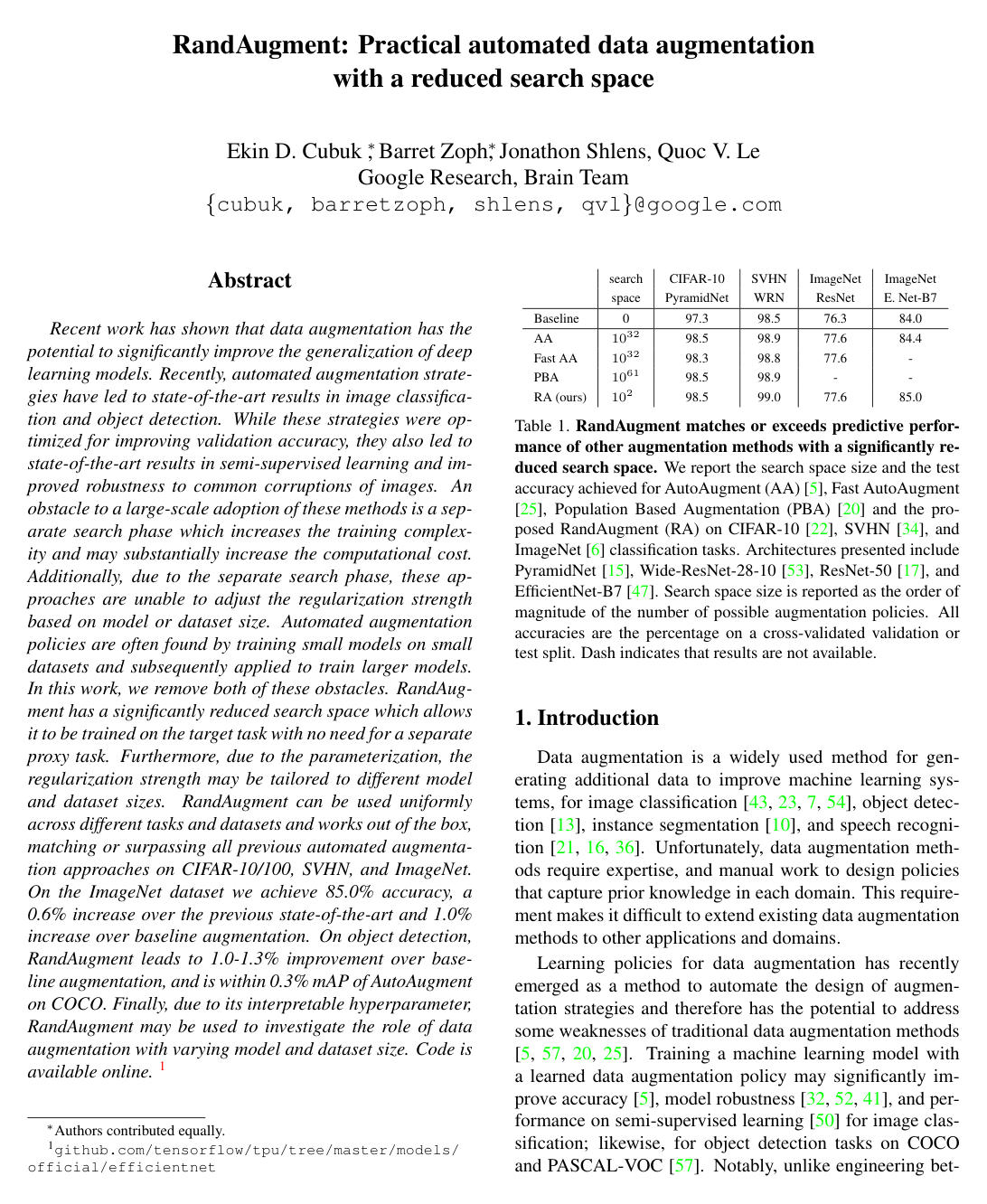
Experiments show that optimal augmentation strength increases systematically with both model size and training-set size, confirming that policies learned on proxy tasks are often suboptimal. RandAugment matches or exceeds the accuracy of prior methods such as AutoAugment, Fast AutoAugment, and Population Based Augmentation while reducing the search space by roughly ten orders of magnitude. On ImageNet it reaches 85.0 % top-1 accuracy, a 0.6 % gain over the previous state of the art and a 1.0 % gain over standard baseline augmentation. On COCO it improves mean average precision by 1.0–1.3 % over baseline and stays within 0.3 % of AutoAugment despite using a smaller transformation library and no separate search.
These results indicate that data-augmentation strength can be tuned directly to the model and data at hand, eliminating the computational overhead and transfer assumptions of earlier techniques. The gains incur no extra inference cost and appear consistently across classification and detection tasks.
The method can be applied immediately to new image-classification and detection pipelines by performing a small grid search over N and M. Further gains may come from expanding the transformation set for specialized tasks such as bounding-box augmentation, and from testing the approach in domains such as segmentation, speech, and audio. The primary limitation is that the current transformation list was not optimized per task; results on very different data modalities therefore remain to be verified. Overall the empirical evidence across multiple benchmarks supports high confidence in the reported accuracy improvements.
- Paper: The Effectiveness of Data Augmentation in Image Classification using Deep Learning, Luis Perez et al. (2017). Perez and Wang establish foundational evidence that targeted image augmentations improve convolutional neural network generalization under data constraints.
- Paper: Random Erasing Data Augmentation, Zhun Zhong et al. (2017). Zhong et al. introduce Random Erasing, a targeted spatial augmentation strategy that directly influences later parameter-reduced search approaches.
- Paper: Improved Regularization of Convolutional Neural Networks with Cutout, Terrance Devries et al. (2017). Devries and Taylor introduce Cutout, demonstrating how input-space masking regularizes deep networks and shapes subsequent combinatorial augmentation policies.
- Paper: CutMix: Regularization Strategy to Train Strong Classifiers With Localizable Features, Sangdoo Yun et al. (2019). Yun et al. propose CutMix to combine regional dropout with label mixing, establishing key baseline improvements for modern data augmentation research.
- Paper: mixup: Beyond Empirical Risk Minimization, Hongyi Zhang et al. (2017). Zhang et al. introduce mixup training, establishing linear interpolation between image pairs as a core regularization technique for deep learning.
- Paper: FixMatch: Simplifying Semi-Supervised Learning with Consistency and Confidence, Kihyuk Sohn et al. (2020). FixMatch builds directly upon RandAugment by integrating its reduced-space strong augmentations into a simplified semi-supervised learning framework.