Interventional Causal Representation Learning
Kartik AhujaDivyat MahajanYixin WangYoshua Bengio
Proves that interventional data enables provable identification of latent causal factors without parametric distribution or graph structure assumptions by exploiting the geometric support shifts induced by perfect and imperfect interventions.
Modern deep learning models excel at representation learning but frequently struggle to adapt when faced with distribution shifts or novel tasks. A critical objective in causal representation learning is provable representation identification: recovering the true high-level latent causal factors (such as the position, color, or shape of objects) from high-dimensional sensory data. Most existing frameworks rely solely on observational data paired with restrictive structural or distributional assumptions about the underlying causal graph. The article addresses this limitation by investigating whether and how interventional data—which is naturally available in domains like robotics and genomics—can facilitate the provable identification of latent representations without strong parametric assumptions.
The main objective of the article is to establish theoretical identification guarantees for latent causal factors using interventional data and to demonstrate practical algorithms that leverage these guarantees across synthetic and image-based data environments.
To evaluate this objective, the authors conducted mathematical analyses grounded in the geometric properties of data supports (the domains over which variables take non-zero values) and validated their findings using controlled empirical simulations. The computational setup evaluated autoencoder models across varying latent dimensions (six and ten variables) and polynomial decoder structures (degrees two and three), as well as complex visual scenes generated by a rendering engine (64×64 pixel images of interacting objects). The empirical workflow followed a two-step framework: first fitting a standard autoencoder to reconstruct data, and second, applying linear or non-linear transformations to enforce geometric constraints corresponding to interventions or support independence.
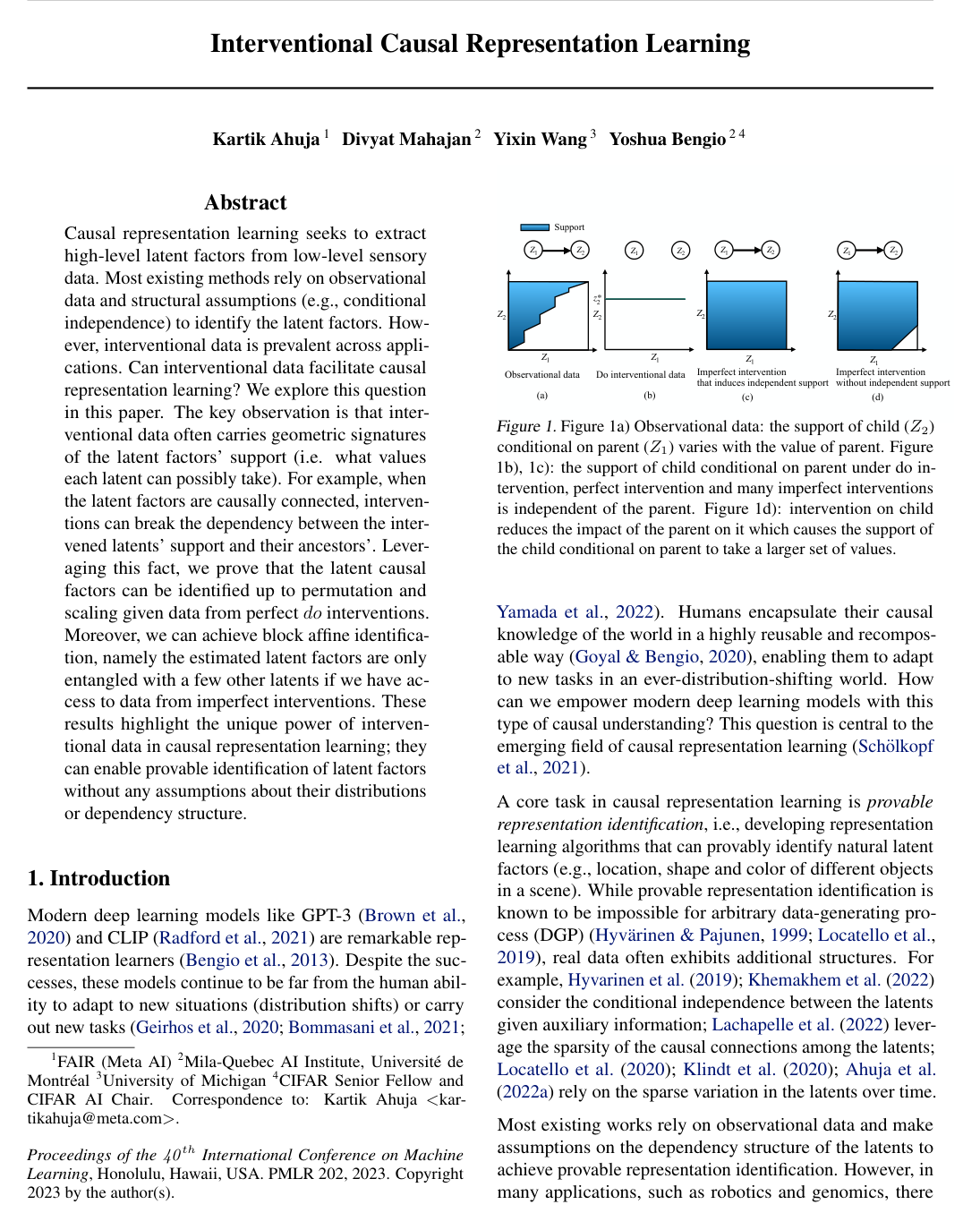
The article establishes several key findings. First, solving the autoencoder reconstruction task with a polynomial decoder provably isolates the true latent variables up to an invertible affine transformation. Second, incorporating data from hard interventions (which fix a latent variable to a set value) strengthens identification of the targeted latent up to coordinate permutation, shift, and scaling, achieving mean correlation coefficient (MCC) recovery scores near 100% across all tested distributions. Third, when latents undergo imperfect interventions that disconnect the latent support from its ancestors, representations achieve block affine identification, restricting entanglement to isolated subsets of variables. Fourth, in purely observational settings where latents exhibit pairwise independent support, the true latents can be recovered up to permutation and scaling even if the variables are statistically dependent, extending classical independent component analysis. Finally, on image tasks, latent recovery accuracy grew progressively with the number of interventional distributions per dimension, rising from baseline scores below 35% with a single intervention up to 71–86% with nine interventions.
These findings indicate that real-world interventional experiments provide a mathematically principled shortcut for learning robust representations. Organizations deploying deep learning models in safety-critical or non-stationary environments can significantly reduce the risk of shortcut learning and distribution collapse by leveraging interventional data, eliminating the need to guess underlying causal graphs or enforce artificial statistical independence.
Decision-makers should consider integrating perturbation and experimental datasets (such as genetic knockout screens or active robotic interactions) into representation learning pipelines. For practical implementations, teams should adopt a two-stage training approach: first ensuring accurate reconstruction, followed by alignment to the geometric signatures of interventions. When transitioning from polynomial approximations to complex neural network mappings, practitioners must plan for collecting multiple interventional distributions per latent factor to achieve high recovery precision.
The findings are theoretically robust within the defined conditions, but several practical limitations remain. Theoretical guarantees for single-intervention settings depend on polynomial mixing decoders or bounded approximations; general non-linear diffeomorphisms require multiple interventional distributions per latent factor. In addition, real-world measurement noise and incomplete experimental control over interventions may introduce variance. Further empirical validation on large-scale, real-world biological and robotic benchmarks is recommended before deploying the method in autonomous decision-making systems.
- Paper: Weakly supervised causal representation learning, Johann Brehmer et al. (2022). Its identifiability results for weakly supervised causal representations establish how intervention-paired observations can reveal latent causes, providing a direct foundation for this paper’s analysis of intervention data.
- Paper: Challenging Common Assumptions in the Unsupervised Learning of Disentangled Representations, Francesco Locatello et al. (2018). Its impossibility result shows why observational data alone cannot identify disentangled factors without additional assumptions, motivating the intervention-based identifiability guarantees developed here.
- Paper: Nonparametric Identifiability of Causal Representations from Unknown Interventions, Julius von Kügelgen et al. (2023). It carries intervention-based latent identification into a more general nonparametric setting, asking whether unknown isolated interventions can also recover causal variables and their graph.