
keyword
causal discovery
Causal discovery is the process of identifying cause-and-effect relationships and inferring the underlying causal structure among a system of variables from empirical data. Unlike standard statistical methods that only detect correlations or associations, causal discovery aims to learn the directed graphical models or structural equation models that describe how changes or interventions on one variable influence others. Causal discovery methods operate on observational data, experimental interventional data, or combinations of both. Common approaches include constraint-based methods that evaluate conditional independence relationships, score-based methods that search and optimize over candidate graph structures, and functional causal models that leverage distributional or structural properties, such as non-Gaussian noise or non-linearities, to distinguish causal directions and address potential unobserved confounding.
15 items
Causal Discovery with Unobserved Confounding and Non-Gaussian Data
Y. Samuel Wang, Mathias Drton
Why you should read this
Proves that the exact causal structure of bow-free acyclic path diagrams can be uniquely identified from non-Gaussian observational data without prior knowledge of the number of latent confounders, providing a moment-based discovery method that works beyond Markov equivalence classes.
We consider recovering causal structure from multivariate observational data. We assume the data arise from a linear structural equation model (SEM) in which the idiosyncratic errors are allowed to be dependent in order to capture possible latent confounding. Each SEM can be represented by a graph where vertices represent observed variables, directed edges represent direct causal effects, and bidirected edges represent dependence among error terms. Specifically, we assume that the true model corresponds to a bow-free acyclic path diagram; i.e., a graph that has at most one edge between any pair of nodes and is acyclic in the directed part. We show that when the errors are non-Gaussian, the exact causal structure encoded by such a graph, and not merely an equivalence class, can be recovered from observational data. The method we propose for this purpose uses estimates of suitable moments, but, in contrast to previous results, does not require specifying the number of latent variables a priori. We also characterize the output of our procedure when the assumptions are violated and the true graph is acyclic, but not bow-free. We illustrate the effectiveness of our procedure in simulations and an application to an ecology data set.
Added
2026-10-05
DoWhy-GCM: An Extension of DoWhy for Causal Inference in Graphical Causal Models
Patrick Blöbaum, Peter Götz, Kailash Budhathoki, Atalanti-Anastasia Mastakouri, Dominik Janzing
Why you should read this
Extends the DoWhy Python library with graphical causal models to perform complex causal tasks beyond standard effect estimation, including root cause analysis of outliers, distributional change attribution, and counterfactual estimation.
Added
2026-10-02
Score Matching Enables Causal Discovery of Nonlinear Additive Noise Models
Paul Rolland, Volkan Cevher, Matthäus Kleindessner, Chris Russell, Dominik Janzing, Bernhard Schölkopf, Francesco Locatello
Why you should read this
Demonstrates how to identify causal directed acyclic graphs in nonlinear additive noise models using data score functions, introducing an efficient Jacobian approximation method that achieves competitive discovery accuracy with linear complexity in the number of nodes.
This paper demonstrates how to recover causal graphs from the score of the data distribution in non-linear additive (Gaussian) noise models. Using score matching algorithms as a building block, we show how to design a new generation of scalable causal discovery methods. To showcase our approach, we also propose a new efficient method for approximating the score’s Jacobian, enabling to recover the causal graph. Empirically, we find that the new algorithm, called SCORE, is competitive with state-of-the-art causal discovery methods while being significantly faster.
Added
2026-10-01
Causal-learn: Causal Discovery in Python
Yujia Zheng, Biwei Huang, Wei Chen, Joseph D. Ramsey, Mingming Gong, Ruichu Cai, Shohei Shimizu, Peter Spirtes, Kun Zhang
Why you should read this
Presents causal-learn, a native Python open-source library that unifies major constraint-based, score-based, and functional causal discovery algorithms alongside modular independence tests and evaluation metrics without relying on R or Java dependencies.
Causal discovery aims at revealing causal relations from observational data, which is a fundamental task in science and engineering. We describe causal-learn, an open-source Python library for causal discovery. This library focuses on bringing a comprehensive collection of causal discovery methods to both practitioners and researchers. It provides easy-to-use APIs for non-specialists, modular building blocks for developers, detailed documentation for learners, and comprehensive methods for all. Different from previous packages in R or Java, causal-learn is fully developed in Python, which could be more in tune with the recent preference shift in programming languages within related communities. The library is available at https://github.com/py-why/causal-learn.
Added
2026-10-01
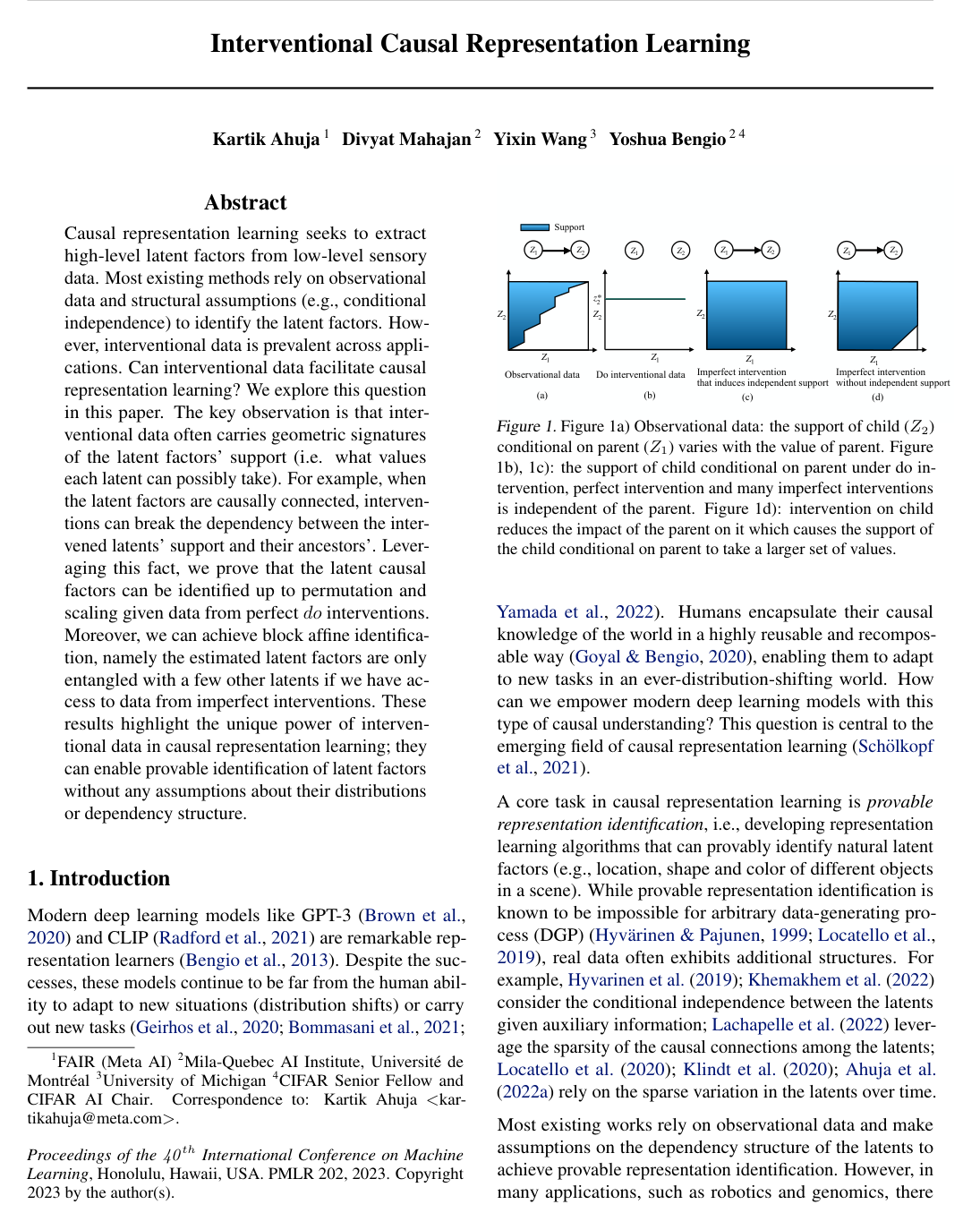
Interventional Causal Representation Learning
Kartik Ahuja, Divyat Mahajan, Yixin Wang, Yoshua Bengio
Why you should read this
Proves that interventional data enables provable identification of latent causal factors without parametric distribution or graph structure assumptions by exploiting the geometric support shifts induced by perfect and imperfect interventions.
Causal representation learning seeks to extract high-level latent factors from low-level sensory data. Most existing methods rely on observational data and structural assumptions (e.g., conditional independence) to identify the latent factors. However, interventional data is prevalent across applications. Can interventional data facilitate causal representation learning? We explore this question in this paper. The key observation is that interventional data often carries geometric signatures of the latent factors’ support (i.e. what values each latent can possibly take). For example, when the latent factors are causally connected, interventions can break the dependency between the intervened latents’ support and their ancestors’. Leveraging this fact, we prove that the latent causal factors can be identified up to permutation and scaling given data from perfect do interventions. Moreover, we can achieve block affine identification, namely the estimated latent factors are only entangled with a few other latents if we have access to data from imperfect interventions. These results highlight the unique power of interventional data in causal representation learning; they can enable provable identification of latent factors without any assumptions about their distributions or dependency structure.
Added
2026-10-01
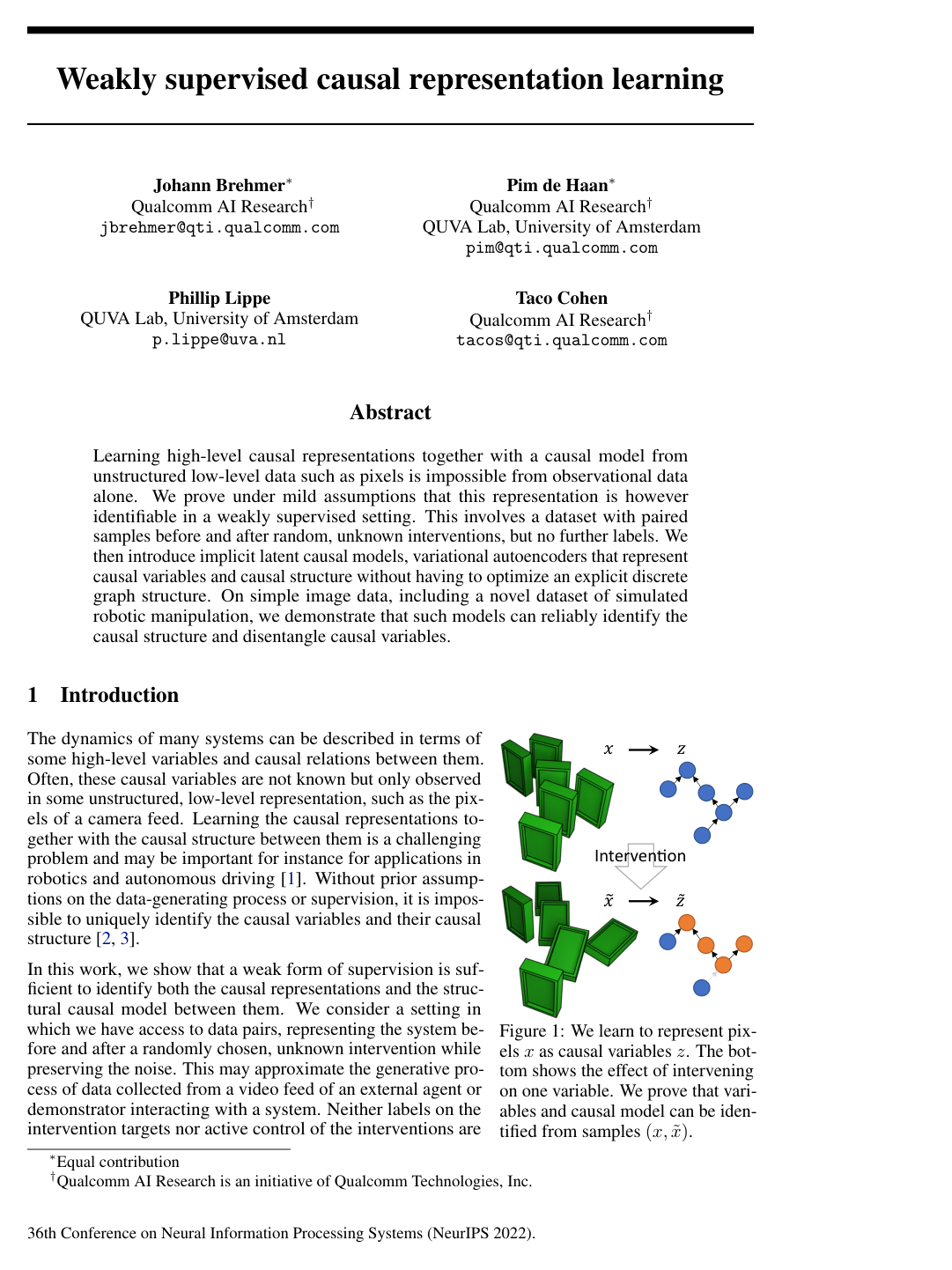
Weakly supervised causal representation learning
Johann Brehmer, Pim de Haan, Phillip Lippe, Taco S. Cohen
Why you should read this
Proves that high-level causal variables and mechanisms can be identified from pixel-level data paired across unknown interventions, and introduces implicit latent causal models to learn these structures without optimizing discrete graphs.
Learning high-level causal representations together with a causal model from unstructured low-level data such as pixels is impossible from observational data alone. We prove under mild assumptions that this representation is however identifiable in a weakly supervised setting. This involves a dataset with paired samples before and after random, unknown interventions, but no further labels. We then introduce implicit latent causal models, variational autoencoders that represent causal variables and causal structure without having to optimize an explicit discrete graph structure. On simple image data, including a novel dataset of simulated robotic manipulation, we demonstrate that such models can reliably identify the causal structure and disentangle causal variables.
Added
2026-09-30
Learning Temporally Causal Latent Processes from General Temporal Data
Weiran Yao, Yuewen Sun, Alex Ho, Changyin Sun, Kun Zhang
Why you should read this
Establishes theoretical identifiability conditions and introduces LEAP, a variational framework that reliably recovers time-delayed latent causal variables and their relations from general nonlinear temporal mixtures without sparsity constraints.
Our goal is to recover time-delayed latent causal variables and identify their relations from measured temporal data. Estimating causally-related latent variables from observations is particularly challenging as the latent variables are not uniquely recoverable in the most general case. In this work, we consider both a nonparametric, nonstationary setting and a parametric setting for the latent processes and propose two provable conditions under which temporally causal latent processes can be identified from their nonlinear mixtures. We propose LEAP, a theoretically-grounded framework that extends Variational AutoEncoders (VAEs) by enforcing our conditions through proper constraints in causal process prior. Experimental results on various datasets demonstrate that temporally causal latent processes are reliably identified from observed variables under different dependency structures and that our approach considerably outperforms baselines that do not properly leverage history or nonstationarity information. This demonstrates that using temporal information to learn latent processes from their invertible nonlinear mixtures in an unsupervised manner, for which we believe our work is one of the first, seems promising even without sparsity or minimality assumptions.
Added
2026-09-26
Generalizing Goal-Conditioned Reinforcement Learning with Variational Causal Reasoning
Wenhao Ding, Haohong Lin, Bo Li, Ding Zhao
Why you should read this
Proposes GRADER, a goal-conditioned reinforcement learning framework that treats causal graphs as latent variables to jointly discover environment causal structure and train generalizable, interpretable policies with theoretical performance guarantees.
As a pivotal component to attaining generalizable solutions in human intelligence, reasoning provides great potential for reinforcement learning (RL) agents’ generalization towards varied goals by summarizing part-to-whole arguments and discovering cause-and-effect relations. However, how to discover and represent causalities remains a huge gap that hinders the development of causal RL. In this paper, we augment Goal-Conditioned RL (GCRL) with Causal Graph (CG), a structure built upon the relation between objects and events. We novelly formulate the GCRL problem into variational likelihood maximization with CG as latent variables. To optimize the derived objective, we propose a framework with theoretical performance guarantees that alternates between two steps: using interventional data to estimate the posterior of CG; using CG to learn generalizable models and interpretable policies. Due to the lack of public benchmarks that verify generalization capability under reasoning, we design nine tasks and then empirically show the effectiveness of the proposed method against five baselines on these tasks. Further theoretical analysis shows that our performance improvement is attributed to the virtuous cycle of causal discovery, transition modeling, and policy training, which aligns with the experimental evidence in extensive ablation studies. Code is available on https://github.com/GilgameshD/GRADER.
Added
2026-09-26
Joint Bayesian Inference of Graphical Structure and Parameters with a Single Generative Flow Network
Tristan Deleu, Mizu Nishikawa-Toomey, Jithendaraa Subramanian, Nikolay Malkin, Laurent Charlin, Yoshua Bengio
Why you should read this
Presents JSP-GFN, a single Generative Flow Network that jointly infers both the graph structure and continuous parameters of Bayesian networks through a two-phase sampling process, enabling tractable posterior inference for expressive non-linear models without intractable marginalizations.
Generative Flow Networks (GFlowNets), a class of generative models over discrete and structured sample spaces, have been previously applied to the problem of inferring the marginal posterior distribution over the directed acyclic graph (DAG) of a Bayesian Network, given a dataset of observations. Based on recent advances extending this framework to non-discrete sample spaces, we propose in this paper to approximate the joint posterior over not only the structure of a Bayesian Network, but also the parameters of its conditional probability distributions. We use a single GFlowNet whose sampling policy follows a two-phase process: the DAG is first generated sequentially one edge at a time, and then the corresponding parameters are picked once the full structure is known. Since the parameters are included in the posterior distribution, this leaves more flexibility for the local probability models of the Bayesian Network, making our approach applicable even to non-linear models parametrized by neural networks. We show that our method, called JSP-GFN, offers an accurate approximation of the joint posterior, while comparing favorably against existing methods on both simulated and real data.
Added
2026-09-26
Identification of Linear Non-Gaussian Latent Hierarchical Structure
Feng Xie, Biwei Huang, Zhengming Chen, Yangbo He, Zhi Geng, Kun Zhang
Why you should read this
Establishes the identifiability of multi-layer causal hierarchies among hidden variables from observed data alone and introduces a Generalized Independent Noise-based algorithm to recover the full latent structure without needing to know the number of hidden factors in advance.
Traditional causal discovery methods mainly focus on estimating causal relations among measured variables, but in many real-world problems, such as questionnaire-based psychometric studies, measured variables are generated by latent variables that are causally related. Accordingly, this paper investigates the problem of discovering the hidden causal variables and estimating the causal structure, including both the causal relations among latent variables and those between latent and measured variables. We relax the frequently-used measurement assumption and allow the children of latent variables to be latent as well, and hence deal with a specific type of latent hierarchical causal structure. In particular, we define a minimal latent hierarchical structure and show that for linear non-Gaussian models with the minimal latent hierarchical structure, the whole structure is identifiable from only the measured variables. Moreover, we develop a principled method to identify the structure by testing for Generalized Independent Noise (GIN) conditions in specific ways. Experimental results on both synthetic and real-world data show the effectiveness of the proposed approach.
Added
2026-09-26
Causal Representation Learning from Multiple Distributions: A General Setting
Kun Zhang, Shaoan Xie, Ignavier Ng, Yujia Zheng
Why you should read this
Establishes theoretical guarantees for completely nonparametric causal representation learning from multiple distributions without requiring hard interventions, demonstrating that latent variables and the underlying moralized causal graph can be recovered under graph sparsity and sufficient mechanism variation conditions.
In many problems, the measured variables (e.g., image pixels) are just mathematical functions of the latent causal variables (e.g., the underlying concepts or objects). For the purpose of making predictions in changing environments or making proper changes to the system, it is helpful to recover the latent causal variables Z_i and their causal relations represented by graph G_Z. This problem has recently been known as causal representation learning. This paper is concerned with a general, completely nonparametric setting of causal representation learning from multiple distributions (arising from heterogeneous data or nonstationary time series), without assuming hard interventions behind distribution changes. We aim to develop general solutions in this fundamental case; as a by product, this helps see the unique benefit offered by other assumptions such as parametric causal models or hard interventions. We show that under the sparsity constraint on the recovered graph over the latent variables and suitable sufficient change conditions on the causal influences, interestingly, one can recover the moralized graph of the underlying directed acyclic graph, and the recovered latent variables and their relations are related to the underlying causal model in a specific, nontrivial way. In some cases, most latent variables can even be recovered up to component-wise transformations. Experimental results verify our theoretical claims.
Added
2026-09-26
Nonparametric Identifiability of Causal Representations from Unknown Interventions
Julius von Kügelgen, Michel Besserve, Wendong Liang, Luigi Gresele, Armin Kekic, Elias Bareinboim, David M. Blei, Bernhard Schölkopf
Why you should read this
Establishes the first nonparametric identifiability guarantees for learning latent causal variables and their directed graphs from multi-environment data with unknown interventions, showing that minimal interventional diversity suffices to recover the underlying causal structure without parametric assumptions.
We study causal representation learning, the task of inferring latent causal variables and their causal relations from high-dimensional functions (“mixtures”) of the variables. Prior work relies on weak supervision, in the form of counterfactual pre- and post-intervention views or temporal structure; places restrictive assumptions, such as linearity, on the mixing function or latent causal model; or requires partial knowledge of the generative process, such as the causal graph or intervention targets. We instead consider the general setting in which both the causal model and the mixing function are nonparametric. The learning signal takes the form of multiple datasets, or environments, arising from unknown interventions in the underlying causal model. Our goal is to identify both the ground truth latents and their causal graph up to a set of ambiguities which we show to be irresolvable from interventional data. We study the fundamental setting of two causal variables and prove that the observational distribution and one perfect intervention per node suffice for identifiability, subject to a genericity condition. This condition rules out spurious solutions that involve fine-tuning of the intervened and observational distributions, mirroring similar conditions for nonlinear cause-effect inference. For an arbitrary number of variables, we show that at least one pair of distinct perfect interventional domains per node guarantees identifiability. Further, we demonstrate that the strengths of causal influences among the latent variables are preserved by all equivalent solutions, rendering the inferred representation appropriate for drawing causal conclusions from new data. Our study provides the first identifiability results for the general nonparametric setting with unknown interventions, and elucidates what is possible and impossible for causal representation learning without more direct supervision.
Added
2026-09-26
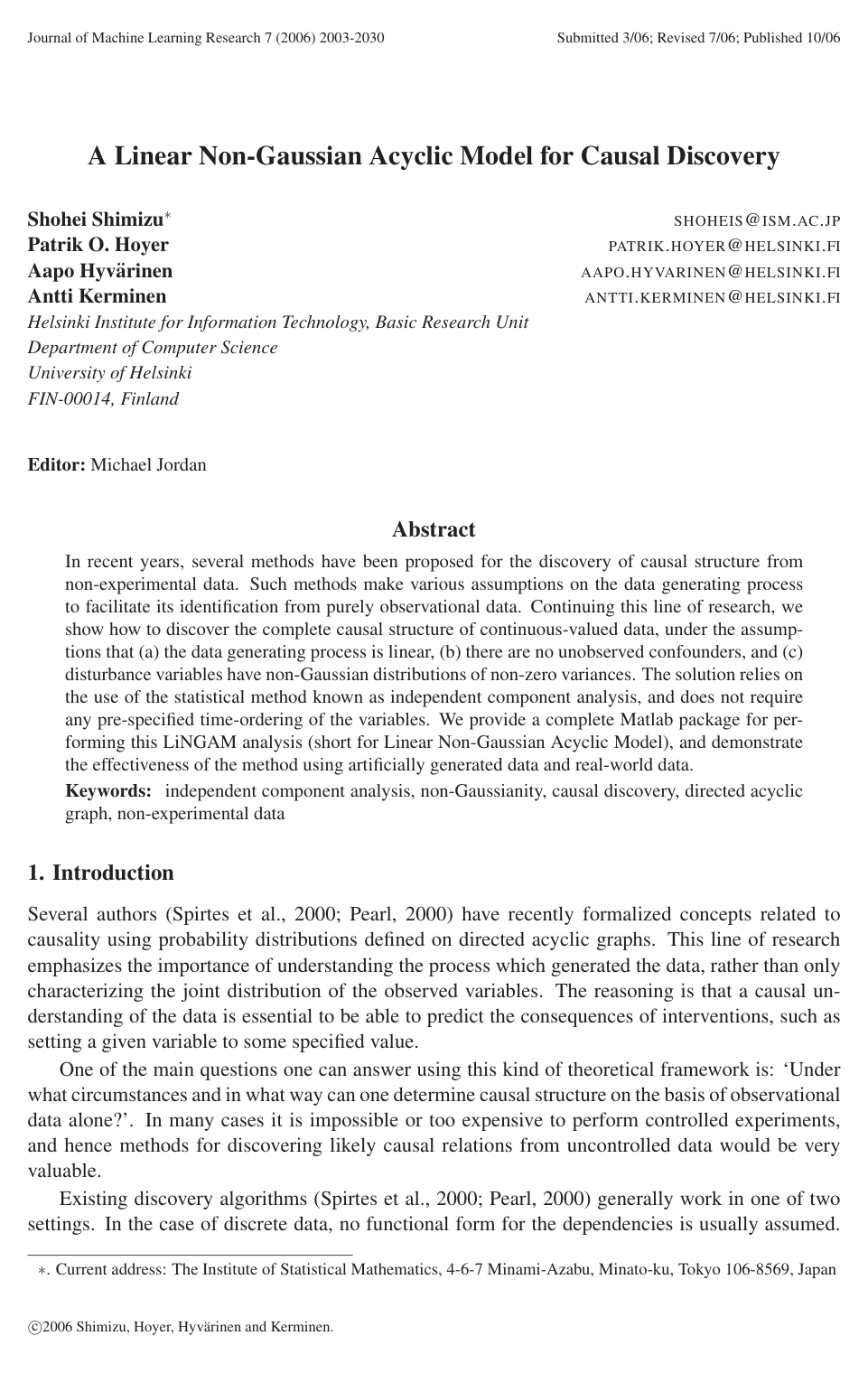
A Linear Non-Gaussian Acyclic Model for Causal Discovery
Shohei Shimizu, Patrik O. Hoyer, Aapo Hyvärinen, Antti Kerminen
Why you should read this
Introduces the LiNGAM framework, which uses independent component analysis and non-Gaussian error distributions to identify the complete, directed causal structure of continuous observational data without requiring prior variable ordering.
In recent years, several methods have been proposed for the discovery of causal structure from non-experimental data. Such methods make various assumptions on the data generating process to facilitate its identification from purely observational data. Continuing this line of research, we show how to discover the complete causal structure of continuous-valued data, under the assumptions that (a) the data generating process is linear, (b) there are no unobserved confounders, and (c) disturbance variables have non-Gaussian distributions of non-zero variances. The solution relies on the use of the statistical method known as independent component analysis, and does not require any pre-specified time-ordering of the variables. We provide a complete Matlab package for performing this LiNGAM analysis (short for Linear Non-Gaussian Acyclic Model), and demonstrate the effectiveness of the method using artificially generated data and real-world data.
Added
2026-09-16
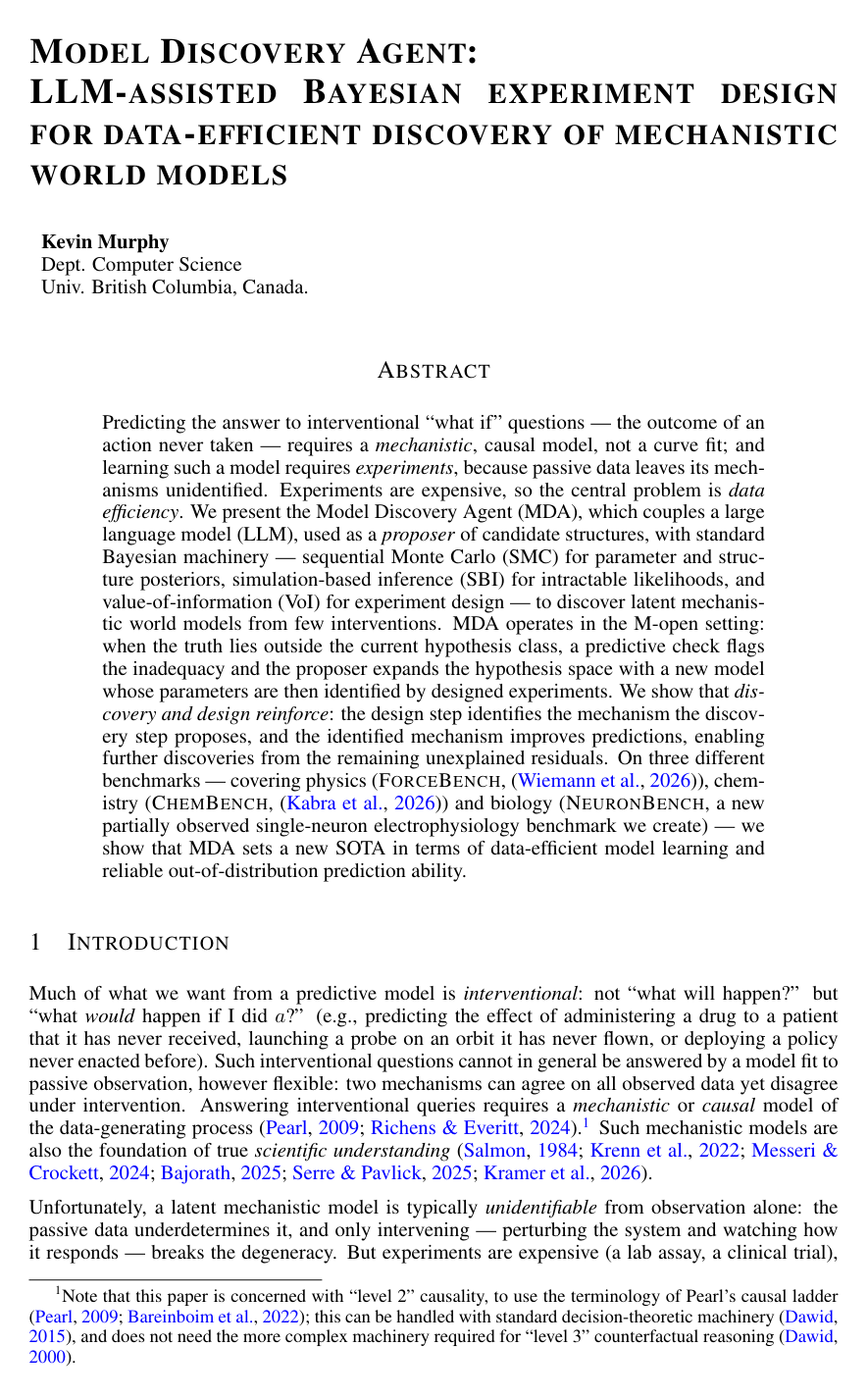
Model Discovery Agent: LLM-assisted Bayesian experiment design for data-efficient discovery of mechanistic world models
Kevin Murphy
Why you should read this
Introduces the Model Discovery Agent, a framework that combines large language model hypothesis generation with Bayesian experimental design to iteratively identify latent causal mechanisms from minimal interventions across physics, chemistry, and biology.
Predicting the answer to interventional ``what if'' questions --- the outcome of an action never taken --- requires a \emph{mechanistic}, causal model, not a curve fit; and learning such a model requires \emph{experiments}, because passive data leaves its mechanisms unidentified. Experiments are expensive, so the central problem is \emph{data efficiency}. We present the Model Discovery Agent (MDA), which couples a large language model (LLM), used as a \emph{proposer} of candidate structures, with standard Bayesian machinery --- sequential Monte Carlo (SMC) for parameter and structure posteriors, simulation-based inference (SBI) for intractable likelihoods, and value-of-information (VoI) for experiment design --- to discover latent mechanistic world models from few interventions. MDA operates in the M-open setting: when the truth lies outside the current hypothesis class, a predictive check flags the inadequacy and the proposer expands the hypothesis space with a new model whose parameters are then identified by designed experiments. We show that \emph{discovery and design reinforce}: the design step identifies the mechanism the discovery step proposes, and the identified mechanism improves predictions, enabling further discoveries from the remaining unexplained residuals. On three different benchmarks --- covering physics (\DPbench, \citep{wiemann2026discoverphysics}), chemistry (\CHEMbench, \citep{kabra2026autoscilab}) and biology (\HHbench, a new partially observed single-neuron electrophysiology benchmark we create) --- we show that MDA sets a new SOTA in terms of data-efficient model learning and reliable interventional prediction ability.
Added
2026-08-15

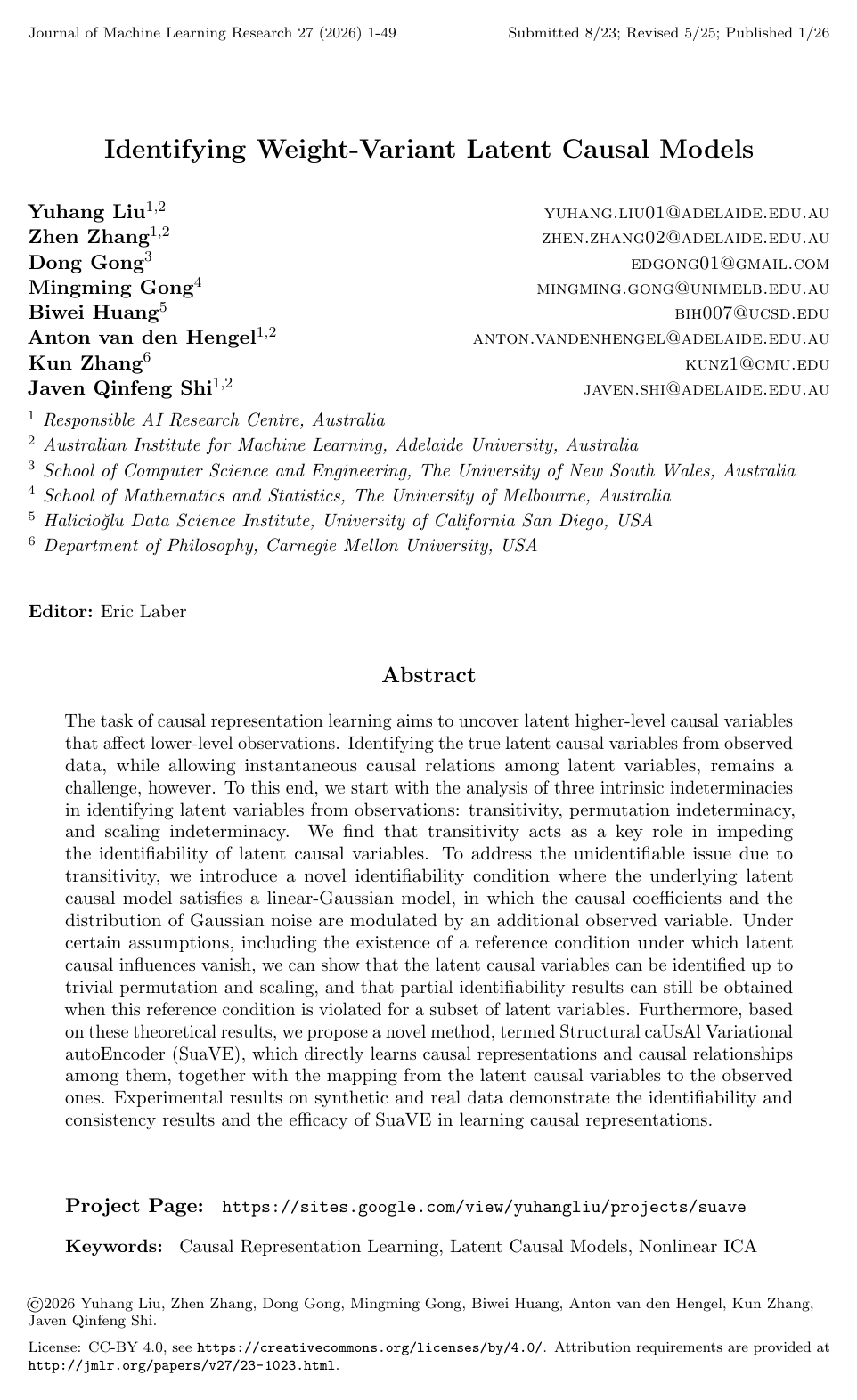
Identifying Weight-Variant Latent Causal Models
Yuhang Liu, Zhen Zhang, Dong Gong, Mingming Gong, Biwei Huang, Anton van den Hengel, Kun Zhang, Javen Qinfeng Shi
Why you should read this
Establishes a formal identifiability framework for latent causal models by leveraging variations in causal influences across environments and introduces the SuaVE method to learn both causal representations and their underlying structures from high-dimensional data.
The task of causal representation learning aims to uncover latent higher-level causal variables that affect lower-level observations. Identifying the true latent causal variables from observed data, while allowing instantaneous causal relations among latent variables, remains a challenge, however. To this end, we start with the analysis of three intrinsic indeterminacies in identifying latent variables from observations: transitivity, permutation indeterminacy, and scaling indeterminacy. We find that transitivity acts as a key role in impeding the identifiability of latent causal variables. To address the unidentifiable issue due to transitivity, we introduce a novel identifiability condition where the underlying latent causal model satisfies a linear-Gaussian model, in which the causal coefficients and the distribution of Gaussian noise are modulated by an additional observed variable. Under certain assumptions, including the existence of a reference condition under which latent causal influences vanish, we can show that the latent causal variables can be identified up to trivial permutation and scaling, and that partial identifiability results can still be obtained when this reference condition is violated for a subset of latent variables. Furthermore, based on these theoretical results, we propose a novel method, termed Structural caUsAl Variational autoEncoder (SuaVE), which directly learns causal representations and causal relationships among them, together with the mapping from the latent causal variables to the observed ones. Experimental results on synthetic and real data demonstrate the identifiability and consistency results and the efficacy of SuaVE in learning causal representations.
Added
2026-05-16