PatchNet: A Simple Face Anti-Spoofing Framework via Fine-Grained Patch Recognition
Chien-Yi WangYu-Ding LuShang-Ta YangShang-Hong Lai
Proposes PatchNet, a face anti-spoofing framework that reformulates presentation attack detection as fine-grained patch recognition across capture devices and materials, using asymmetric margin and self-supervised losses to achieve superior generalization on unseen spoof types without auxiliary pixel-wise supervision.
Facial recognition systems are widely deployed for biometric security, but they remain vulnerable to physical presentation attacks, such as printed photos or digital video replays. Existing face anti-spoofing techniques often suffer from poor generalization when confronted with unseen spoof mediums or varying camera sensors. Current models typically rely on whole-face binary classification or complex auxiliary supervision—like synthetic depth or reflection maps—which are computationally expensive and prone to overfitting to dataset collection biases.
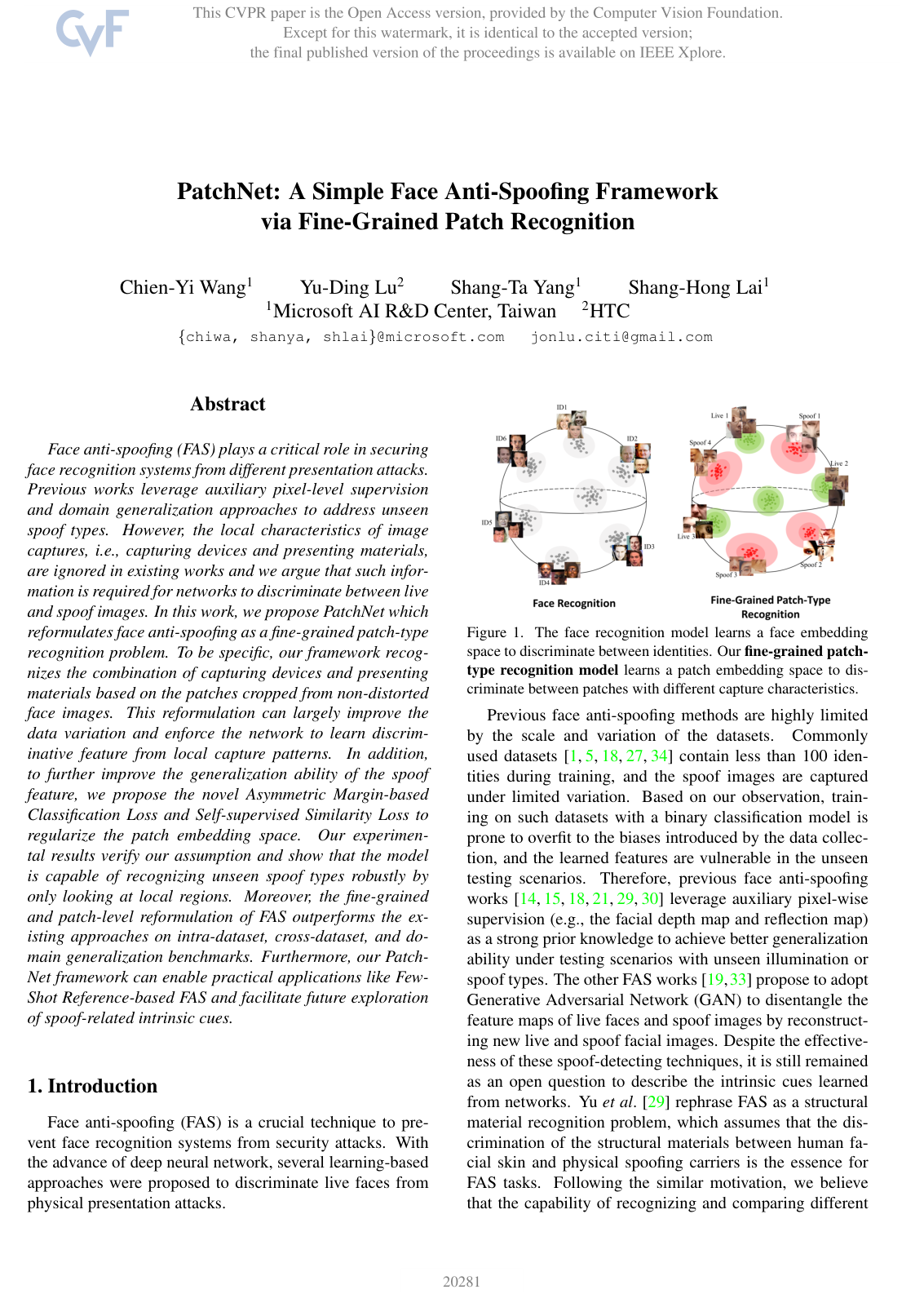
The article introduces PatchNet, a streamlined framework designed to evaluate and demonstrate whether reformulating face anti-spoofing into a fine-grained local patch recognition task improves detection accuracy and model generalization. Rather than evaluating an entire resized face, PatchNet trains a model to classify specific combinations of camera capture devices and spoofing materials directly from undistorted local image patches.
To establish this framework, the authors evaluated image inputs using fixed-size patches cropped directly from raw, uncompressed frames across five public benchmark datasets (OULU-NPU, SiW, CASIA-FASD, Replay-Attack, and MSU-MFSD). The model employs a ResNet-18 feature encoder trained with two specialized loss functions: an asymmetric angular margin loss that enforces tight clustering for live samples while accommodating broad spoof diversity, and a self-supervised similarity loss to ensure feature consistency across different patch views of the same capture. Performance was assessed through standard intra-dataset, cross-dataset, and domain generalization protocols.
The experimental findings show significant performance advantages. First, moving from a standard binary classification baseline to fine-grained patch cropping reduced the average classification error rate on the OULU-NPU benchmark from 6.25% to 1.88%, ultimately reaching a 0.0% error rate with full loss regularization. Second, PatchNet matched or outperformed state-of-the-art methods across standard intra-dataset protocols, achieving a 0.0% error rate across multiple sub-protocols on OULU-NPU and SiW. Third, in domain generalization benchmarks where models were trained on three datasets and tested on an unseen fourth, PatchNet achieved top-tier competitive results, including an area under the curve of up to 98.46%. Finally, the resulting embedding space enabled practical few-shot reference adaptation, boosting performance on specific low-quality sensors from 88.49% to 90.7% with only ten live sample references.
These results indicate that spoofing cues are inherently local and material-specific rather than global facial features. By eliminating the need for pseudo-ground-truth auxiliary maps or complex adversarial domain adaptation, PatchNet substantially lowers implementation complexity and training overhead. This approach reduces security risks in biometric deployments by offering robust cross-environment reliability without demanding high-capacity neural network architectures.
Organizations deploying facial biometric systems should consider patch-level material classification strategies and test security performance on individual camera sensors rather than aggregate dataset averages. Where feasible, teams can implement few-shot live reference enrollment to quickly adapt deployed security systems to new camera hardware. For future development, additional work is recommended to test the framework on broader variations of unconstrained capture environments and explore cross-domain material perception datasets.
The authors note limitations regarding extreme sensor noise and heavy image compression, which degraded feature discrimination on certain low-quality devices. Furthermore, patch cropping requires sufficient spatial resolution, as very small patches (e.g., 64 pixels) degrade accuracy. Nevertheless, the extensive multi-benchmark validation supports high confidence in PatchNet’s efficacy as an efficient and generalizable face anti-spoofing framework.
- Paper: ArcFace: Additive Angular Margin Loss for Deep Face Recognition, Jiankang Deng et al. (2018). ArcFace establishes angular margin-based loss functions on the hypersphere manifold that directly inform the asymmetric margin-based classification loss adapted in PatchNet.
- Paper: SphereFace: Deep Hypersphere Embedding for Face Recognition, Weiyang Liu et al. (2017). SphereFace introduces angular margin penalties for metric learning in facial feature embeddings, providing the foundational principles for margin-based classification losses in face analysis.
- Paper: Learning to compare image patches via convolutional neural networks, Sergey Zagoruyko et al. (2015). This work establishes how deep convolutional neural networks can learn discriminative similarity metrics and representations directly from localized image patches.
- Paper: Learning Robust Global Representations by Penalizing Local Predictive Power, Haohan Wang et al. (2019). This paper analyzes how relying on localized image patches versus global representations affects domain generalization and feature robustness in computer vision models.
- Paper: Deep Face Recognition: A Survey, Mei Wang et al. (2018). This survey provides essential background on deep face recognition architectures, metric learning losses, and feature representations that face anti-spoofing frameworks aim to secure.
- Paper: Rethinking Domain Generalization for Face Anti-spoofing: Separability and Alignment, Yiyou Sun et al. (2023). This paper rethinks domain generalization in face anti-spoofing by analyzing sensor and acquisition domain shifts, offering a complementary perspective on generalizing across unseen spoof domains.
- Paper: Hierarchical Fine-Grained Image Forgery Detection and Localization, Xiao Guo et al. (2023). This work advances beyond patch-level spoof categorization by introducing a hierarchical multi-branch architecture for simultaneous detection, pixel-level localization, and fine-grained classification of visual manipulations.
- Paper: Implicit Identity Driven Deepfake Face Swapping Detection, Baojin Huang et al. (2023). This paper extends face security and forgery detection across unseen manipulations by contrasting explicit facial representations with implicit identity traits.
- Paper: Rethinking the Up-Sampling Operations in CNN-Based Generative Network for Generalizable Deepfake Detection, Chuangchuang Tan et al. (2024). This research builds on the idea of capturing localized capture artifacts by examining neighboring pixel differences within small patches to generalize deepfake detection.
- Paper: Frequency-Aware Deepfake Detection: Improving Generalizability through Frequency Space Domain Learning, Chuangchuang Tan et al. (2024). This work continues the exploration of domain-agnostic facial manipulation detection by analyzing high-frequency and multi-scale spectral representations across image patches.