
Executive Summary: Natural language processing systems today often rely on vast amounts of labeled data tailored to each specific task, such as translating languages or answering questions, to achieve high performance through fine-tuning. This approach limits their flexibility, especially for niche or emerging applications where collecting such data is costly or impractical. Meanwhile, humans can grasp new language tasks from just a handful of examples or simple instructions, highlighting a gap in current artificial intelligence capabilities. With the rapid growth of digital text online, researchers have explored whether scaling up language models—vast neural networks trained to predict the next word in a sequence—could bridge this divide by enabling more human-like adaptability without task-specific training data.
This paper introduces GPT-3, a 175-billion-parameter language model, to test whether extreme scaling can deliver strong "few-shot" performance across diverse language tasks. The core aim is to demonstrate that such models can perform well using only textual prompts—natural language descriptions or a few examples—without any updates to the model's internal weights, contrasting with traditional methods that require thousands of examples for fine-tuning.
The team trained eight models ranging from 125 million to 175 billion parameters using an autoregressive transformer architecture, similar to prior work but vastly enlarged. Pre-training occurred on a 300-billion-token dataset drawn mainly from filtered web crawls (like Common Crawl, spanning 2016–2019) and supplemented with high-quality sources such as books and Wikipedia, totaling about 570 gigabytes after cleaning for quality and duplicates. Training emphasized broad text exposure over task-specific data, using roughly 3,640 petaflop/s-days of compute for the largest model—over 100 times more than earlier systems. Evaluation focused on over 40 natural language processing benchmarks, including question answering, translation, and commonsense reasoning, tested in zero-shot (prompt only), one-shot (one example), and few-shot (10–100 examples) settings. Synthetic tasks, like basic arithmetic or unscrambling words, were added to probe on-the-fly adaptation. Potential overlaps between training and test data were analyzed to check for contamination.
Key results show GPT-3 achieving competitive or superior performance without fine-tuning. On closed-book question answering, it reached 71% accuracy on TriviaQA in few-shot mode, surpassing fine-tuned state-of-the-art models like T5-11B by 11 points, while zero-shot hit 64%—13 points above prior benchmarks. Translation into English improved to 40 BLEU scores in few-shot settings across French, German, and Romanian, matching unsupervised leaders and exceeding supervised ones in some directions. On the SuperGLUE benchmark suite, few-shot results averaged 69%, outperforming fine-tuned BERT-Large (72%) on four of eight tasks and nearing top scores on others like COPA (92%). Scaling mattered: performance rose smoothly with model size, with few-shot gains over zero-shot widening for larger versions, indicating better in-context adaptation. GPT-3 solved 100% of two-digit addition and 80% of three-digit problems in few-shot arithmetic, and unscrambled words with 68% accuracy on insertions. It generated short news articles that fooled human evaluators 52% of the time—barely above chance—rising to near-indistinguishability at longer lengths. Weaker areas included natural language inference (33–56% on ANLI/RTE, near random) and some reading comprehension tasks (e.g., 44% on QuAC).
These findings suggest large language models can approximate human-like flexibility, reducing reliance on scarce labeled data and enabling rapid deployment for new tasks like content generation or reasoning. This could accelerate applications in search, education, and automation, cutting costs and timelines while minimizing overfitting to narrow datasets. However, results fell short of expectations on comparison-based tasks, possibly due to the model's one-way prediction style, and echoed biases in training data, such as associating professions more with men (83% male-leaning) or negative sentiments with certain races/religions. Broader risks include misuse for misinformation or spam, amplified by realistic text output, and high energy demands during training. Overall, the work underscores scaling's promise but highlights needs for robustness.
Next steps should include fine-tuning GPT-3 to combine its generality with specialized gains, developing bidirectional architectures for better handling of comparison tasks, and piloting distillation to create smaller, efficient versions for real-world use. Further analysis of in-context learning mechanisms—whether true adaptation or pattern recognition—could refine designs. To address biases, targeted debiasing during training or post-hoc filters warrant testing, alongside audits for underrepresented groups. A pilot on ethical applications, like bias-free assistants, would validate progress before scaling further.
While contamination checks showed minimal impact (e.g., <3-point drops on affected benchmarks like PIQA), uncertainties remain around data biases and untested tasks. Confidence is high in scaling trends and few-shot viability for core tasks, but readers should approach bias-related claims cautiously, as they reflect preliminary probes on select dimensions.
Language Models are Few-Shot Learners
Tom B. Brown$^*$
Benjamin Mann$^*$
Nick Ryder$^*$
Melanie Subbiah$^*$
Jared Kaplan$^\dagger$
Prafulla Dhariwal
Arvind Neelakantan
Pranav Shyam
Girish Sastry
Amanda Askell
Sandhini Agarwal
Ariel Herbert-Voss
Gretchen Krueger
Tom Henighan
Rewon Child
Aditya Ramesh
Daniel M. Ziegler
Jeffrey Wu
Clemens Winter
Christopher Hesse
Mark Chen
Eric Sigler
Mateusz Litwin
Scott Gray
Benjamin Chess
Jack Clark
Christopher Berner
Sam McCandlish
Alec Radford
Ilya Sutskever
Dario Amodei
OpenAI
$^*$Equal contribution
$^\dagger$Johns Hopkins University, OpenAI
Author contributions listed at end of paper.
Abstract
Recent work has demonstrated substantial gains on many NLP tasks and benchmarks by pre-training on a large corpus of text followed by fine-tuning on a specific task. While typically task-agnostic in architecture, this method still requires task-specific fine-tuning datasets of thousands or tens of thousands of examples. By contrast, humans can generally perform a new language task from only a few examples or from simple instructions – something which current NLP systems still largely struggle to do. Here we show that scaling up language models greatly improves task-agnostic, few-shot performance, sometimes even reaching competitiveness with prior state-of-the-art fine-tuning approaches. Specifically, we train GPT-3, an autoregressive language model with 175 billion parameters, 10x more than any previous non-sparse language model, and test its performance in the few-shot setting. For all tasks, GPT-3 is applied without any gradient updates or fine-tuning, with tasks and few-shot demonstrations specified purely via text interaction with the model. GPT-3 achieves strong performance on many NLP datasets, including translation, question-answering, and cloze tasks, as well as several tasks that require on-the-fly reasoning or domain adaptation, such as unscrambling words, using a novel word in a sentence, or performing 3-digit arithmetic. At the same time, we also identify some datasets where GPT-3's few-shot learning still struggles, as well as some datasets where GPT-3 faces methodological issues related to training on large web corpora. Finally, we find that GPT-3 can generate samples of news articles which human evaluators have difficulty distinguishing from articles written by humans. We discuss broader societal impacts of this finding and of GPT-3 in general.
1 Introduction
Section Summary: Recent years have seen natural language processing advance from simple word representations to powerful pre-trained models that can be fine-tuned for various tasks like question answering without custom designs, leading to major improvements in performance. However, this method still requires huge amounts of task-specific labeled data for training, which is impractical for many everyday language uses, risks the model learning irrelevant patterns that don't generalize well, and falls short of how humans quickly pick up new skills from just a few examples or instructions. To address this, the introduction proposes meta-learning, where models build broad abilities during initial training and then adapt rapidly to new tasks at runtime through "in-context learning," such as by following natural language prompts or a handful of examples.
Recent years have featured a trend towards pre-trained language representations in NLP systems, applied in increasingly flexible and task-agnostic ways for downstream transfer. First, single-layer representations were learned using word vectors [1, 2] and fed to task-specific architectures, then RNNs with multiple layers of representations and contextual state were used to form stronger representations [3, 4, 5] (though still applied to task-specific architectures), and more recently pre-trained recurrent or transformer language models [6] have been directly fine-tuned, entirely removing the need for task-specific architectures [7, 8, 9].
This last paradigm has led to substantial progress on many challenging NLP tasks such as reading comprehension, question answering, textual entailment, and many others, and has continued to advance based on new architectures and algorithms [10, 11, 12, 13]. However, a major limitation to this approach is that while the architecture is task-agnostic, there is still a need for task-specific datasets and task-specific fine-tuning: to achieve strong performance on a desired task typically requires fine-tuning on a dataset of thousands to hundreds of thousands of examples specific to that task. Removing this limitation would be desirable, for several reasons.
First, from a practical perspective, the need for a large dataset of labeled examples for every new task limits the applicability of language models. There exists a very wide range of possible useful language tasks, encompassing anything from correcting grammar, to generating examples of an abstract concept, to critiquing a short story. For many of these tasks it is difficult to collect a large supervised training dataset, especially when the process must be repeated for every new task.
Second, the potential to exploit spurious correlations in training data fundamentally grows with the expressiveness of the model and the narrowness of the training distribution. This can create problems for the pre-training plus fine-tuning paradigm, where models are designed to be large to absorb information during pre-training, but are then fine-tuned on very narrow task distributions. For instance [14] observe that larger models do not necessarily generalize better out-of-distribution. There is evidence that suggests that the generalization achieved under this paradigm can be poor because the model is overly specific to the training distribution and does not generalize well outside it [15, 16]. Thus, the performance of fine-tuned models on specific benchmarks, even when it is nominally at human-level, may exaggerate actual performance on the underlying task [17, 18].
Third, humans do not require large supervised datasets to learn most language tasks – a brief directive in natural language (e.g. "please tell me if this sentence describes something happy or something sad") or at most a tiny number of demonstrations (e.g. "here are two examples of people acting brave; please give a third example of bravery") is often sufficient to enable a human to perform a new task to at least a reasonable degree of competence. Aside from pointing to a conceptual limitation in our current NLP techniques, this adaptability has practical advantages – it allows humans to seamlessly mix together or switch between many tasks and skills, for example performing addition during a lengthy dialogue. To be broadly useful, we would someday like our NLP systems to have this same fluidity and generality.
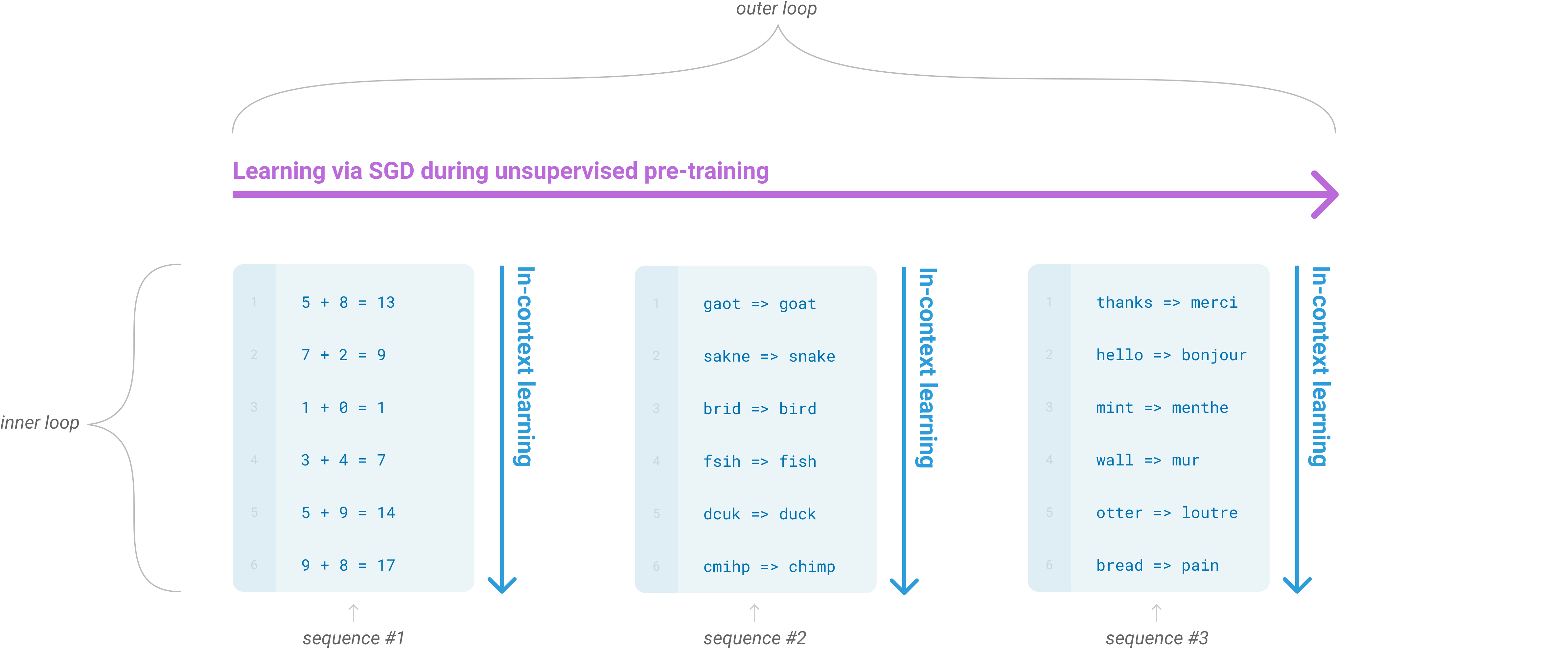
One potential route towards addressing these issues is meta-learning[^2] – which in the context of language models means the model develops a broad set of skills and pattern recognition abilities at training time, and then uses those abilities at inference time to rapidly adapt to or recognize the desired task (illustrated in Figure 1). Recent work [19] attempts to do this via what we call "in-context learning", using the text input of a pretrained language model as a form of task specification: the model is conditioned on a natural language instruction and/or a few demonstrations of the task and is then expected to complete further instances of the task simply by predicting what comes next.
[^2]: In the context of language models this has sometimes been called "zero-shot transfer", but this term is potentially ambiguous: the method is "zero-shot" in the sense that no gradient updates are performed, but it often involves providing inference-time demonstrations to the model, so is not truly learning from zero examples. To avoid this confusion, we use the term "meta-learning" to capture the inner-loop / outer-loop structure of the general method, and the term "in context-learning" to refer to the inner loop of meta-learning. We further specialize the description to "zero-shot", "one-shot", or "few-shot" depending on how many demonstrations are provided at inference time. These terms are intended to remain agnostic on the question of whether the model learns new tasks from scratch at inference time or simply recognizes patterns seen during training – this is an important issue which we discuss later in the paper, but "meta-learning" is intended to encompass both possibilities, and simply describes the inner-outer loop structure.
While it has shown some initial promise, this approach still achieves results far inferior to fine-tuning – for example [19] achieves only 4% on Natural Questions, and even its 55 F1 CoQa result is now more than 35 points behind the state of the art. Meta-learning clearly requires substantial improvement in order to be viable as a practical method of solving language tasks.
Another recent trend in language modeling may offer a way forward. In recent years the capacity of transformer language models has increased substantially, from 100 million parameters [7], to 300 million parameters [8], to 1.5 billion parameters [19], to 8 billion parameters [20], 11 billion parameters [10], and finally 17 billion parameters [21]. Each increase has brought improvements in text synthesis and/or downstream NLP tasks, and there is evidence suggesting that log loss, which correlates well with many downstream tasks, follows a smooth trend of improvement with scale [22]. Since in-context learning involves absorbing many skills and tasks within the parameters of the model, it is plausible that in-context learning abilities might show similarly strong gains with scale.
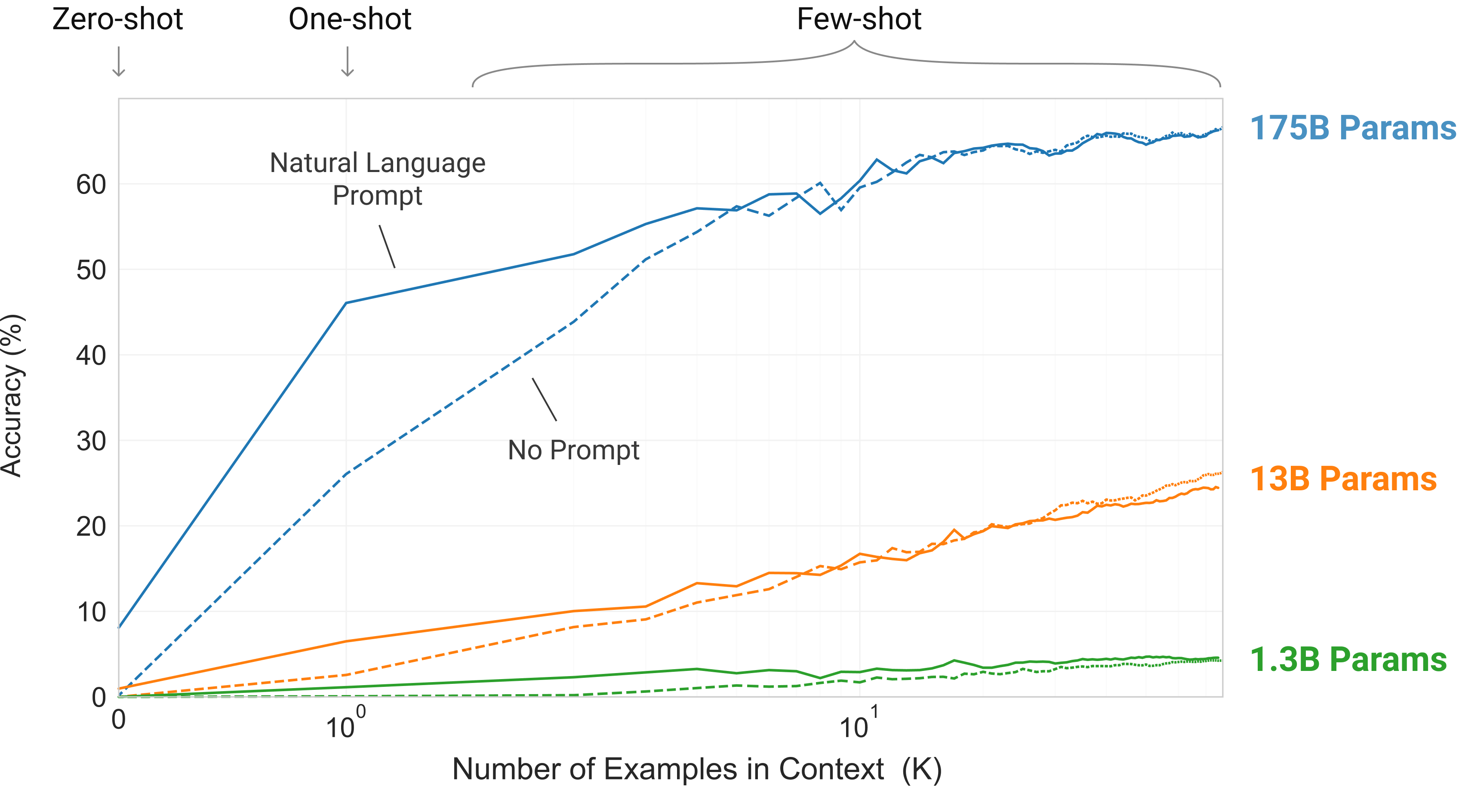
In this paper, we test this hypothesis by training a 175 billion parameter autoregressive language model, which we call GPT-3, and measuring its in-context learning abilities. Specifically, we evaluate GPT-3 on over two dozen NLP datasets, as well as several novel tasks designed to test rapid adaptation to tasks unlikely to be directly contained in the training set. For each task, we evaluate GPT-3 under 3 conditions: (a) "few-shot learning", or in-context learning where we allow as many demonstrations as will fit into the model’s context window (typically 10 to 100), (b) "one-shot learning", where we allow only one demonstration, and (c) "zero-shot" learning, where no demonstrations are allowed and only an instruction in natural language is given to the model. GPT-3 could also in principle be evaluated in the traditional fine-tuning setting, but we leave this to future work.
Figure 2 illustrates the conditions we study, and shows few-shot learning of a simple task requiring the model to remove extraneous symbols from a word. Model performance improves with the addition of a natural language task description, and with the number of examples in the model's context, $K$. Few-shot learning also improves dramatically with model size. Though the results in this case are particularly striking, the general trends with both model size and number of examples in-context hold for most tasks we study. We emphasize that these "learning" curves involve no gradient updates or fine-tuning, just increasing numbers of demonstrations given as conditioning.
Broadly, on NLP tasks GPT-3 achieves promising results in the zero-shot and one-shot settings, and in the the few-shot setting is sometimes competitive with or even occasionally surpasses state-of-the-art (despite state-of-the-art being held by fine-tuned models). For example, GPT-3 achieves 81.5 F1 on CoQA in the zero-shot setting, 84.0 F1 on CoQA in the one-shot setting, 85.0 F1 in the few-shot setting. Similarly, GPT-3 achieves 64.3% accuracy on TriviaQA in the zero-shot setting, 68.0% in the one-shot setting, and 71.2% in the few-shot setting, the last of which is state-of-the-art relative to fine-tuned models operating in the same closed-book setting.
GPT-3 also displays one-shot and few-shot proficiency at tasks designed to test rapid adaption or on-the-fly reasoning, which include unscrambling words, performing arithmetic, and using novel words in a sentence after seeing them defined only once. We also show that in the few-shot setting, GPT-3 can generate synthetic news articles which human evaluators have difficulty distinguishing from human-generated articles.
At the same time, we also find some tasks on which few-shot performance struggles, even at the scale of GPT-3. This includes natural language inference tasks like the ANLI dataset, and some reading comprehension datasets like RACE or QuAC. By presenting a broad characterization of GPT-3's strengths and weaknesses, including these limitations, we hope to stimulate study of few-shot learning in language models and draw attention to where progress is most needed.
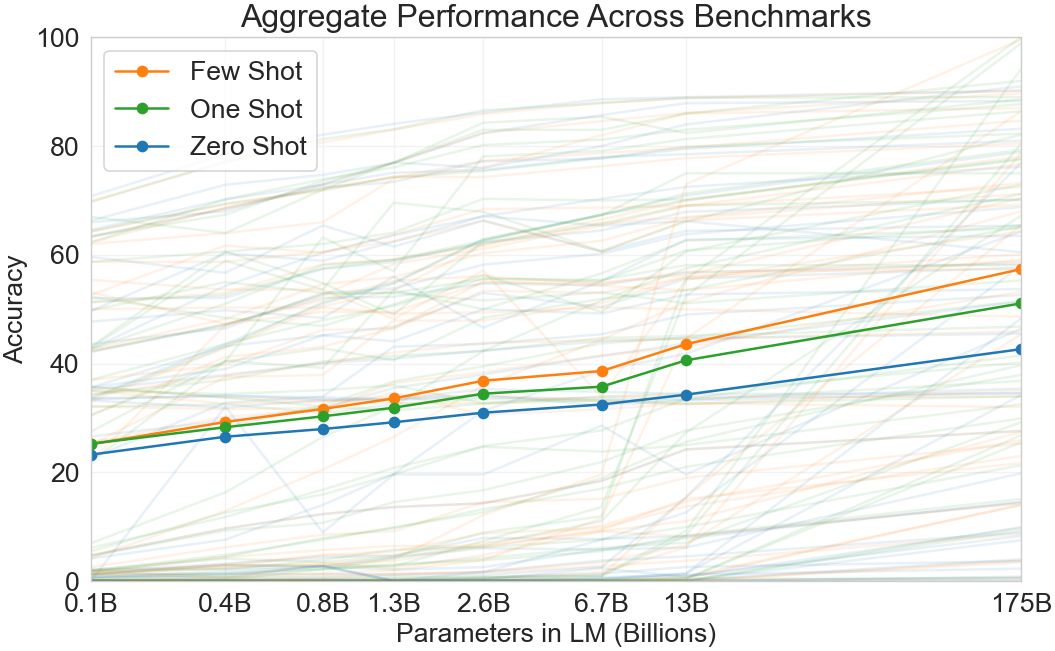
A heuristic sense of the overall results can be seen in Figure 3, which aggregates the various tasks (though it should not be seen as a rigorous or meaningful benchmark in itself).
We also undertake a systematic study of "data contamination" – a growing problem when training high capacity models on datasets such as Common Crawl, which can potentially include content from test datasets simply because such content often exists on the web. In this paper we develop systematic tools to measure data contamination and quantify its distorting effects. Although we find that data contamination has a minimal effect on GPT-3's performance on most datasets, we do identify a few datasets where it could be inflating results, and we either do not report results on these datasets or we note them with an asterisk, depending on the severity.
In addition to all the above, we also train a series of smaller models (ranging from 125 million parameters to 13 billion parameters) in order to compare their performance to GPT-3 in the zero, one and few-shot settings. Broadly, for most tasks we find relatively smooth scaling with model capacity in all three settings; one notable pattern is that the gap between zero-, one-, and few-shot performance often grows with model capacity, perhaps suggesting that larger models are more proficient meta-learners.
Finally, given the broad spectrum of capabilities displayed by GPT-3, we discuss concerns about bias, fairness, and broader societal impacts, and attempt a preliminary analysis of GPT-3's characteristics in this regard.
The remainder of this paper is organized as follows. In Section 2, we describe our approach and methods for training GPT-3 and evaluating it. Section 3 presents results on the full range of tasks in the zero-, one- and few-shot settings. Section 4 addresses questions of data contamination (train-test overlap). Section 5 discusses limitations of GPT-3. Section 6 discusses broader impacts. Section 7 reviews related work and Section 8 concludes.
2 Approach
Section Summary: The approach for developing and evaluating GPT-3 builds on previous large-scale language model training by expanding the model's size, the variety and amount of data, and the duration of training, while emphasizing in-context learning over traditional fine-tuning. Instead of updating the model's weights with task-specific data as in fine-tuning, which requires thousands of examples and can lead to narrow or unreliable results, the study explores zero-shot learning—where the model follows only a text instruction— one-shot learning, which adds a single example, and few-shot learning, which includes a handful of demonstrations to guide the model at test time. These methods aim to mimic human-like task performance with minimal data, offering trade-offs between efficiency and accuracy, with few-shot results often approaching those of heavily tuned models.
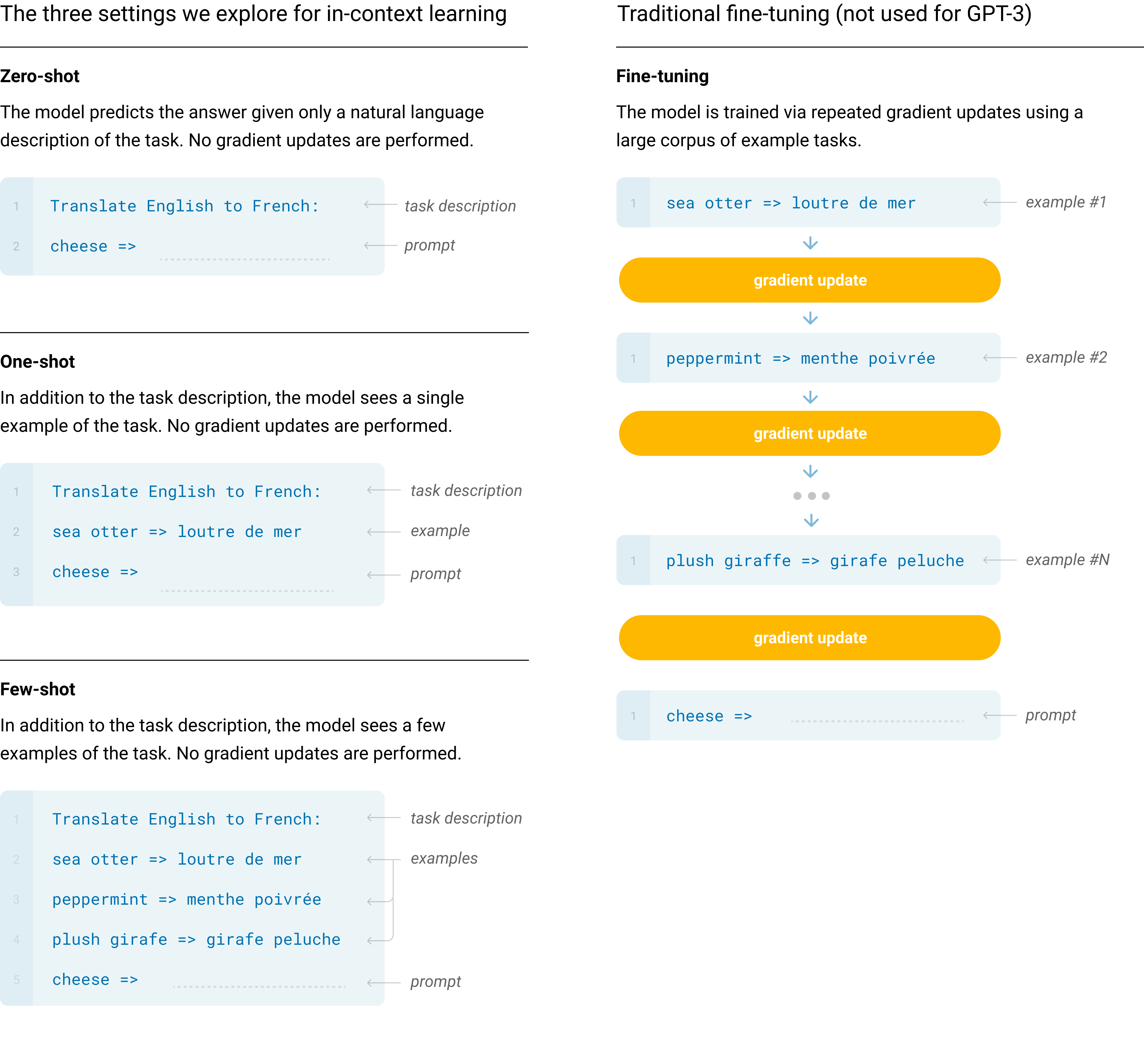
Our basic pre-training approach, including model, data, and training, is similar to the process described in [19], with relatively straightforward scaling up of the model size, dataset size and diversity, and length of training. Our use of in-context learning is also similar to [19], but in this work we systematically explore different settings for learning within the context. Therefore, we start this section by explicitly defining and contrasting the different settings that we will be evaluating GPT-3 on or could in principle evaluate GPT-3 on. These settings can be seen as lying on a spectrum of how much task-specific data they tend to rely on. Specifically, we can identify at least four points on this spectrum (see Figure 2.1 for an illustration):
- Fine-Tuning (FT) has been the most common approach in recent years, and involves updating the weights of a pre-trained model by training on a supervised dataset specific to the desired task. Typically thousands to hundreds of thousands of labeled examples are used. The main advantage of fine-tuning is strong performance on many benchmarks. The main disadvantages are the need for a new large dataset for every task, the potential for poor generalization out-of-distribution [16], and the potential to exploit spurious features of the training data [17, 18], potentially resulting in an unfair comparison with human performance. In this work we do not fine-tune GPT-3 because our focus is on task-agnostic performance, but GPT-3 can be fine-tuned in principle and this is a promising direction for future work.
- Few-Shot (FS) is the term we will use in this work to refer to the setting where the model is given a few demonstrations of the task at inference time as conditioning [19], but no weight updates are allowed. As shown in Figure 2.1, for a typical dataset an example has a context and a desired completion (for example an English sentence and the French translation), and few-shot works by giving $K$ examples of context and completion, and then one final example of context, with the model expected to provide the completion. We typically set $K$ in the range of 10 to 100 as this is how many examples can fit in the model’s context window ($n_{\mathrm{ctx}}=2048$). The main advantages of few-shot are a major reduction in the need for task-specific data and reduced potential to learn an overly narrow distribution from a large but narrow fine-tuning dataset. The main disadvantage is that results from this method have so far been much worse than state-of-the-art fine-tuned models. Also, a small amount of task specific data is still required. As indicated by the name, few-shot learning as described here for language models is related to few-shot learning as used in other contexts in ML ([23, 24]) – both involve learning based on a broad distribution of tasks (in this case implicit in the pre-training data) and then rapidly adapting to a new task.
- One-Shot (1S) is the same as few-shot except that only one demonstration is allowed, in addition to a natural language description of the task, as shown in Figure 1. The reason to distinguish one-shot from few-shot and zero-shot (below) is that it most closely matches the way in which some tasks are communicated to humans. For example, when asking humans to generate a dataset on a human worker service (for example Mechanical Turk), it is common to give one demonstration of the task. By contrast it is sometimes difficult to communicate the content or format of a task if no examples are given.
- Zero-Shot (0S) is the same as one-shot except that no demonstrations are allowed, and the model is only given a natural language instruction describing the task. This method provides maximum convenience, potential for robustness, and avoidance of spurious correlations (unless they occur very broadly across the large corpus of pre-training data), but is also the most challenging setting. In some cases it may even be difficult for humans to understand the format of the task without prior examples, so this setting is in some cases "unfairly hard". For example, if someone is asked to "make a table of world records for the 200m dash", this request can be ambiguous, as it may not be clear exactly what format the table should have or what should be included (and even with careful clarification, understanding precisely what is desired can be difficult). Nevertheless, for at least some settings zero-shot is closest to how humans perform tasks – for example, in the translation example in Figure [@sec:figure_eval_strategies], a human would likely know what to do from just the text instruction.
Figure 2.1 shows the four methods using the example of translating English to French. In this paper we focus on zero-shot, one-shot and few-shot, with the aim of comparing them not as competing alternatives, but as different problem settings which offer a varying trade-off between performance on specific benchmarks and sample efficiency. We especially highlight the few-shot results as many of them are only slightly behind state-of-the-art fine-tuned models. Ultimately, however, one-shot, or even sometimes zero-shot, seem like the fairest comparisons to human performance, and are important targets for future work.
Section 2.1-Section 2.3 below give details on our models, training data, and training process respectively. Section 2.4 discusses the details of how we do few-shot, one-shot, and zero-shot evaluations.
2.1 Model and Architectures
We use the same model and architecture as GPT-2 [19], including the modified initialization, pre-normalization, and reversible tokenization described therein, with the exception that we use alternating dense and locally banded sparse attention patterns in the layers of the transformer, similar to the Sparse Transformer [25]. To study the dependence of ML performance on model size, we train 8 different sizes of model, ranging over three orders of magnitude from 125 million parameters to 175 billion parameters, with the last being the model we call GPT-3. Previous work [22] suggests that with enough training data, scaling of validation loss should be approximately a smooth power law as a function of size; training models of many different sizes allows us to test this hypothesis both for validation loss and for downstream language tasks.
:Table 1: Sizes, architectures, and learning hyper-parameters (batch size in tokens and learning rate) of the models which we trained. All models were trained for a total of 300 billion tokens.
| Model Name | $n_{\mathrm{params}}$ | $n_{\mathrm{layers}}$ | $d_{\mathrm{model}}$ | $n_{\mathrm{heads}}$ | $d_{\mathrm{head}}$ | Batch Size | Learning Rate |
|---|---|---|---|---|---|---|---|
| GPT-3 Small | 125M | 12 | 768 | 12 | 64 | 0.5M | $6.0 \times 10^{-4}$ |
| GPT-3 Medium | 350M | 24 | 1024 | 16 | 64 | 0.5M | $3.0 \times 10^{-4}$ |
| GPT-3 Large | 760M | 24 | 1536 | 16 | 96 | 0.5M | $2.5 \times 10^{-4}$ |
| GPT-3 XL | 1.3B | 24 | 2048 | 24 | 128 | 1M | $2.0 \times 10^{-4}$ |
| GPT-3 2.7B | 2.7B | 32 | 2560 | 32 | 80 | 1M | $1.6 \times 10^{-4}$ |
| GPT-3 6.7B | 6.7B | 32 | 4096 | 32 | 128 | 2M | $1.2 \times 10^{-4}$ |
| GPT-3 13B | 13.0B | 40 | 5140 | 40 | 128 | 2M | $1.0 \times 10^{-4}$ |
| GPT-3 175B or "GPT-3" | 175.0B | 96 | 12288 | 96 | 128 | 3.2M | $0.6 \times 10^{-4}$ |
Table 1 shows the sizes and architectures of our 8 models. Here $n_{\mathrm{params}}$ is the total number of trainable parameters, $n_{\mathrm{layers}}$ is the total number of layers, $d_{\mathrm{model}}$ is the number of units in each bottleneck layer (we always have the feedforward layer four times the size of the bottleneck layer, $d_{\mathrm{ff}}$ $= 4 \ast d_{\mathrm{model}}$), and $d_{\mathrm{head}}$ is the dimension of each attention head. All models use a context window of $n_{\mathrm{ctx}}=2048$ tokens. We partition the model across GPUs along both the depth and width dimension in order to minimize data-transfer between nodes. The precise architectural parameters for each model are chosen based on computational efficiency and load-balancing in the layout of models across GPU’s. Previous work [22] suggests that validation loss is not strongly sensitive to these parameters within a reasonably broad range.
![**Figure 5:** **Total compute used during training**. Based on the analysis in Scaling Laws For Neural Language Models [22] we train much larger models on many fewer tokens than is typical. As a consequence, although GPT-3 3B is almost 10x larger than RoBERTa-Large (355M params), both models took roughly 50 petaflop/s-days of compute during pre-training. Methodology for these calculations can be found in Appendix D.](https://ittowtnkqtyixxjxrhou.supabase.co/storage/v1/object/public/public-images/n3q86nly/training_flops.png)
2.2 Training Dataset
Datasets for language models have rapidly expanded, culminating in the Common Crawl dataset^3 [10] constituting nearly a trillion words. This size of dataset is sufficient to train our largest models without ever updating on the same sequence twice. However, we have found that unfiltered or lightly filtered versions of Common Crawl tend to have lower quality than more curated datasets. Therefore, we took 3 steps to improve the average quality of our datasets: (1) we downloaded and filtered a version of CommonCrawl based on similarity to a range of high-quality reference corpora, (2) we performed fuzzy deduplication at the document level, within and across datasets, to prevent redundancy and preserve the integrity of our held-out validation set as an accurate measure of overfitting, and (3) we also added known high-quality reference corpora to the training mix to augment CommonCrawl and increase its diversity.
Details of the first two points (processing of Common Crawl) are described in Appendix A. For the third, we added several curated high-quality datasets, including an expanded version of the WebText dataset [19], collected by scraping links over a longer period of time, and first described in [22], two internet-based books corpora (Books1 and Books2) and English-language Wikipedia.
Table 2 shows the final mixture of datasets that we used in training. The CommonCrawl data was downloaded from 41 shards of monthly CommonCrawl covering 2016 to 2019, constituting 45TB of compressed plaintext before filtering and 570GB after filtering, roughly equivalent to 400 billion byte-pair-encoded tokens. Note that during training, datasets are not sampled in proportion to their size, but rather datasets we view as higher-quality are sampled more frequently, such that CommonCrawl and Books2 datasets are sampled less than once during training, but the other datasets are sampled 2-3 times. This essentially accepts a small amount of overfitting in exchange for higher quality training data.
:::
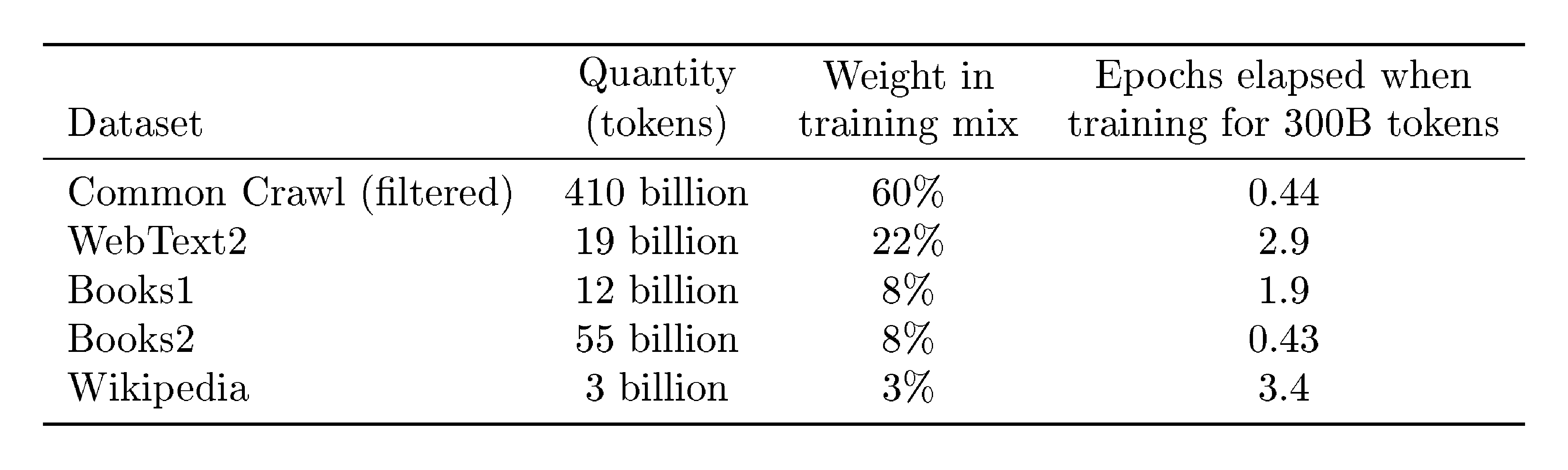
Table 2: Datasets used to train GPT-3. "Weight in training mix" refers to the fraction of examples during training that are drawn from a given dataset, which we intentionally do not make proportional to the size of the dataset. As a result, when we train for 300 billion tokens, some datasets are seen up to 3.4 times during training while other datasets are seen less than once.
:::
A major methodological concern with language models pretrained on a broad swath of internet data, particularly large models with the capacity to memorize vast amounts of content, is potential contamination of downstream tasks by having their test or development sets inadvertently seen during pre-training. To reduce such contamination, we searched for and attempted to remove any overlaps with the development and test sets of all benchmarks studied in this paper. Unfortunately, a bug in the filtering caused us to ignore some overlaps, and due to the cost of training it was not feasible to retrain the model. In Section 4 we characterize the impact of the remaining overlaps, and in future work we will more aggressively remove data contamination.
2.3 Training Process
As found in [22, 26], larger models can typically use a larger batch size, but require a smaller learning rate. We measure the gradient noise scale during training and use it to guide our choice of batch size [26]. Table 1 shows the parameter settings we used. To train the larger models without running out of memory, we use a mixture of model parallelism within each matrix multiply and model parallelism across the layers of the network. All models were trained on V100 GPU’s on part of a high-bandwidth cluster provided by Microsoft. Details of the training process and hyperparameter settings are described in Appendix B.
2.4 Evaluation
For few-shot learning, we evaluate each example in the evaluation set by randomly drawing $K$ examples from that task’s training set as conditioning, delimited by 1 or 2 newlines depending on the task. For LAMBADA and Storycloze there is no supervised training set available so we draw conditioning examples from the development set and evaluate on the test set. For Winograd (the original, not SuperGLUE version) there is only one dataset, so we draw conditioning examples directly from it.
$K$ can be any value from 0 to the maximum amount allowed by the model’s context window, which is $n_{\mathrm{ctx}}=2048$ for all models and typically fits $10$ to $100$ examples. Larger values of $K$ are usually but not always better, so when a separate development and test set are available, we experiment with a few values of $K$ on the development set and then run the best value on the test set. For some tasks (see Appendix G) we also use a natural language prompt in addition to (or for $K=0$, instead of) demonstrations.
On tasks that involve choosing one correct completion from several options (multiple choice), we provide $K$ examples of context plus correct completion, followed by one example of context only, and compare the LM likelihood of each completion. For most tasks we compare the per-token likelihood (to normalize for length), however on a small number of datasets (ARC, OpenBookQA, and RACE) we gain additional benefit as measured on the development set by normalizing by the unconditional probability of each completion, by computing $\frac{P(\mathrm{completion} | \mathrm{context})}{P(\mathrm{completion} | \mathrm{answer_context})}$, where $\mathrm{answer_context}$ is the string "Answer: " or "A: " and is used to prompt that the completion should be an answer but is otherwise generic.
On tasks that involve binary classification, we give the options more semantically meaningful names (e.g. "True" or "False" rather than 0 or 1) and then treat the task like multiple choice; we also sometimes frame the task similar to what is done by [10] (see Appendix G) for details.
On tasks with free-form completion, we use beam search with the same parameters as [10]: a beam width of 4 and a length penalty of $\alpha = 0.6$. We score the model using F1 similarity score, BLEU, or exact match, depending on what is standard for the dataset at hand.
Final results are reported on the test set when publicly available, for each model size and learning setting (zero-, one-, and few-shot). When the test set is private, our model is often too large to fit on the test server, so we report results on the development set. We do submit to the test server on a small number of datasets (SuperGLUE, TriviaQA, PiQa) where we were able to make submission work, and we submit only the 200B few-shot results, and report development set results for everything else.
3 Results
Section Summary: The results section demonstrates that GPT-3 models show smooth performance improvements as training compute increases, following a predictable power-law pattern that holds even with vastly larger scales, and these gains translate to better results across diverse language tasks. The eight main models, plus smaller ones, were tested on datasets grouped into nine categories, including question answering, translation, reasoning, and comprehension, all in zero-shot, one-shot, or few-shot settings. In language modeling tasks like predicting text perplexity on the Penn Tree Bank dataset and completing long-context stories on LAMBADA, GPT-3 achieved new state-of-the-art scores, significantly outperforming prior models even without fine-tuning.
![**Figure 6:** **Smooth scaling of performance with compute.** Performance (measured in terms of cross-entropy validation loss) follows a power-law trend with the amount of compute used for training. The power-law behavior observed in [22] continues for an additional two orders of magnitude with only small deviations from the predicted curve. For this figure, we exclude embedding parameters from compute and parameter counts.](https://ittowtnkqtyixxjxrhou.supabase.co/storage/v1/object/public/public-images/n3q86nly/LanguageModelingComputePareto.png)
In Figure 6 we display training curves for the 8 models described in Section 2. For this graph we also include 6 additional extra-small models with as few as 100, 000 parameters. As observed in [22], language modeling performance follows a power-law when making efficient use of training compute. After extending this trend by two more orders of magnitude, we observe only a slight (if any) departure from the power-law. One might worry that these improvements in cross-entropy loss come only from modeling spurious details of our training corpus. However, we will see in the following sections that improvements in cross-entropy loss lead to consistent performance gains across a broad spectrum of natural language tasks.
Below, we evaluate the 8 models described in Section 2 (the 175 billion parameter parameter GPT-3 and 7 smaller models) on a wide range of datasets. We group the datasets into 9 categories representing roughly similar tasks.
In Section 3.1 we evaluate on traditional language modeling tasks and tasks that are similar to language modeling, such as Cloze tasks and sentence/paragraph completion tasks. In Section 3.2 we evaluate on "closed book" question answering tasks: tasks which require using the information stored in the model’s parameters to answer general knowledge questions. In Section 3.3 we evaluate the model’s ability to translate between languages (especially one-shot and few-shot). In Section 3.4 we evaluate the model’s performance on Winograd Schema-like tasks. In Section 3.5 we evaluate on datasets that involve commonsense reasoning or question answering. In Section 3.6 we evaluate on reading comprehension tasks, in Section 3.7 we evaluate on the SuperGLUE benchmark suite, and in Section 3.8 we briefly explore NLI. Finally, in Section 3.9, we invent some additional tasks designed especially to probe in-context learning abilities – these tasks focus on on-the-fly reasoning, adaptation skills, or open-ended text synthesis. We evaluate all tasks in the few-shot, one-shot, and zero-shot settings.
3.1 Language Modeling, Cloze, and Completion Tasks
In this section we test GPT-3’s performance on the traditional task of language modeling, as well as related tasks that involve predicting a single word of interest, completing a sentence or paragraph, or choosing between possible completions of a piece of text.
3.1.1 Language Modeling
We calculate zero-shot perplexity on the Penn Tree Bank (PTB) [27] dataset measured in [19]. We omit the 4 Wikipedia-related tasks in that work because they are entirely contained in our training data, and we also omit the one-billion word benchmark due to a high fraction of the dataset being contained in our training set. PTB escapes these issues due to predating the modern internet. Our largest model sets a new SOTA on PTB by a substantial margin of 15 points, achieving a perplexity of 20.50. Note that since PTB is a traditional language modeling dataset it does not have a clear separation of examples to define one-shot or few-shot evaluation around, so we measure only zero-shot.
:Table 3: Zero-shot results on PTB language modeling dataset. Many other common language modeling datasets are omitted because they are derived from Wikipedia or other sources which are included in GPT-3's training data. $^{\text{a}}$ [19]
| Setting | PTB |
|---|---|
| SOTA (Zero-Shot) | 35.8 $^{\text{a}}$ |
| GPT-3 Zero-Shot | 20.5 |
3.1.2 LAMBADA
:::
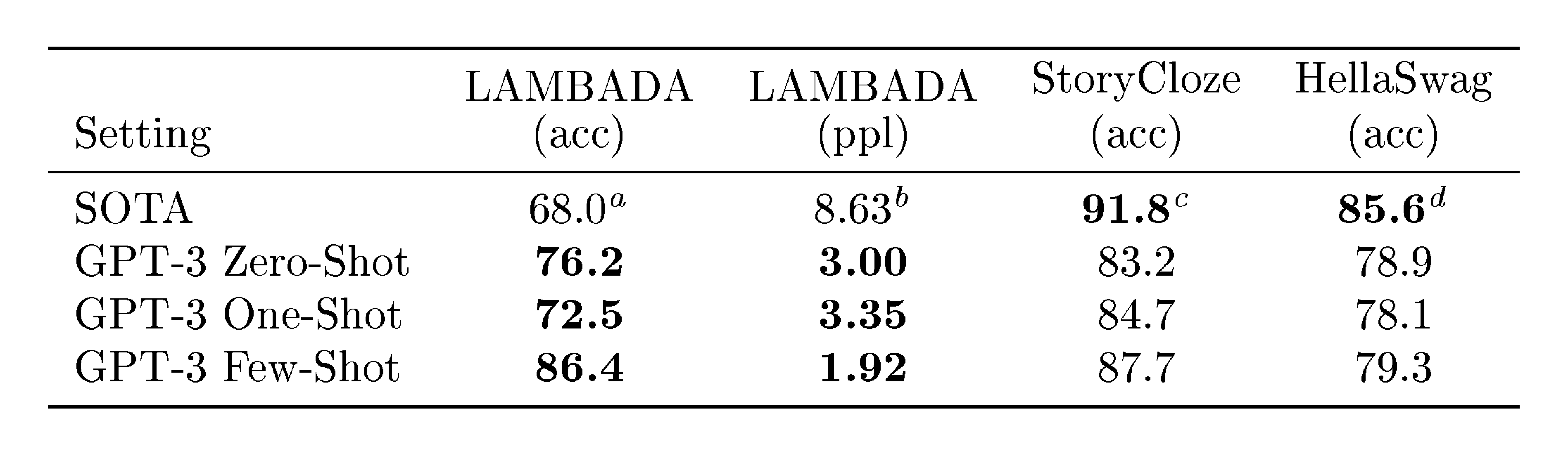
Table 4: Performance on cloze and completion tasks. GPT-3 significantly improves SOTA on LAMBADA while achieving respectable performance on two difficult completion prediction datasets. $^{\text{a}}$ [21] $^{\text{b}}$ [19] $^{\text{c}}$ [28] $^{\text{d}}$ [29]
:::
![**Figure 7:** On LAMBADA, the few-shot capability of language models results in a strong boost to accuracy. GPT-3 2.7B outperforms the SOTA 17B parameter Turing-NLG [21] in this setting, and GPT-3 175B advances the state of the art by 18%. Note zero-shot uses a different format from one-shot and few-shot as described in the text.](https://ittowtnkqtyixxjxrhou.supabase.co/storage/v1/object/public/public-images/n3q86nly/lambada_acc_test.png)
The LAMBADA dataset [30] tests the modeling of long-range dependencies in text – the model is asked to predict the last word of sentences which require reading a paragraph of context. It has recently been suggested that the continued scaling of language models is yielding diminishing returns on this difficult benchmark. [31] reflect on the small 1.5% improvement achieved by a doubling of model size between two recent state of the art results ([20] and [21]) and argue that "continuing to expand hardware and data sizes by orders of magnitude is not the path forward". We find that path is still promising and in a zero-shot setting GPT-3 achieves 76% on LAMBADA, a gain of 8% over the previous state of the art.
LAMBADA is also a demonstration of the flexibility of few-shot learning as it provides a way to address a problem that classically occurs with this dataset. Although the completion in LAMBADA is always the last word in a sentence, a standard language model has no way of knowing this detail. It thus assigns probability not only to the correct ending but also to other valid continuations of the paragraph. This problem has been partially addressed in the past with stop-word filters [19] (which ban "continuation" words). The few-shot setting instead allows us to "frame" the task as a cloze-test and allows the language model to infer from examples that a completion of exactly one word is desired. We use the following fill-in-the-blank format:
Alice was friends with Bob. Alice went to visit her friend . $\to$ Bob
George bought some baseball equipment, a ball, a glove, and a . $\to$
When presented with examples formatted this way, GPT-3 achieves 86.4% accuracy in the few-shot setting, an increase of over 18% from the previous state-of-the-art. We observe that few-shot performance improves strongly with model size. While this setting decreases the performance of the smallest model by almost 20%, for GPT-3 it improves accuracy by 10%. Finally, the fill-in-blank method is not effective one-shot, where it always performs worse than the zero-shot setting. Perhaps this is because all models still require several examples to recognize the pattern.
One note of caution is that an analysis of test set contamination identified that a significant minority of the LAMBADA dataset appears to be present in our training data – however analysis performed in Section 4 suggests negligible impact on performance.
3.1.3 HellaSwag
The HellaSwag dataset [32] involves picking the best ending to a story or set of instructions. The examples were adversarially mined to be difficult for language models while remaining easy for humans (who achieve 95.6% accuracy). GPT-3 achieves 78.1% accuracy in the one-shot setting and 79.3% accuracy in the few-shot setting, outperforming the 75.4% accuracy of a fine-tuned 1.5B parameter language model [33] but still a fair amount lower than the overall SOTA of 85.6% achieved by the fine-tuned multi-task model ALUM.
3.1.4 StoryCloze
We next evaluate GPT-3 on the StoryCloze 2016 dataset [34], which involves selecting the correct ending sentence for five-sentence long stories. Here GPT-3 achieves 83.2% in the zero-shot setting and 87.7% in the few-shot setting (with $K=70$). This is still 4.1% lower than the fine-tuned SOTA using a BERT based model [28] but improves over previous zero-shot results by roughly 10%.
3.2 Closed Book Question Answering
:Table 5: Results on three Open-Domain QA tasks. GPT-3 is shown in the few-, one-, and zero-shot settings, as compared to prior SOTA results for closed book and open domain settings. TriviaQA few-shot result is evaluated on the wiki split test server.
| Setting | NaturalQS | WebQS | TriviaQA |
|---|---|---|---|
| RAG (Fine-tuned, Open-Domain) [35] | 44.5 | 45.5 | 68.0 |
| T5-11B+SSM (Fine-tuned, Closed-Book) [36] | 36.6 | 44.7 | 60.5 |
| T5-11B (Fine-tuned, Closed-Book) | 34.5 | 37.4 | 50.1 |
| GPT-3 Zero-Shot | 14.6 | 14.4 | 64.3 |
| GPT-3 One-Shot | 23.0 | 25.3 | 68.0 |
| GPT-3 Few-Shot | 29.9 | 41.5 | 71.2 |
![**Figure 8:** On TriviaQA GPT3's performance grows smoothly with model size, suggesting that language models continue to absorb knowledge as their capacity increases. One-shot and few-shot performance make significant gains over zero-shot behavior, matching and exceeding the performance of the SOTA fine-tuned open-domain model, RAG [35]](https://ittowtnkqtyixxjxrhou.supabase.co/storage/v1/object/public/public-images/n3q86nly/triviaqa-wiki.png)
In this section we measure GPT-3’s ability to answer questions about broad factual knowledge. Due to the immense amount of possible queries, this task has normally been approached by using an information retrieval system to find relevant text in combination with a model which learns to generate an answer given the question and the retrieved text. Since this setting allows a system to search for and condition on text which potentially contains the answer it is denoted "open-book". [36] recently demonstrated that a large language model can perform surprisingly well directly answering the questions without conditioning on auxilliary information. They denote this more restrictive evaluation setting as "closed-book". Their work suggests that even higher-capacity models could perform even better and we test this hypothesis with GPT-3. We evaluate GPT-3 on the 3 datasets in [36]: Natural Questions [37], WebQuestions [38], and TriviaQA [39], using the same splits. Note that in addition to all results being in the closed-book setting, our use of few-shot, one-shot, and zero-shot evaluations represent an even stricter setting than previous closed-book QA work: in addition to external content not being allowed, fine-tuning on the Q&A dataset itself is also not permitted.
The results for GPT-3 are shown in Table 5. On TriviaQA, we achieve 64.3% in the zero-shot setting, 68.0% in the one-shot setting, and 71.2% in the few-shot setting. The zero-shot result already outperforms the fine-tuned T5-11B by 14.2%, and also outperforms a version with Q&A tailored span prediction during pre-training by 3.8%. The one-shot result improves by 3.7% and matches the SOTA for an open-domain QA system which not only fine-tunes but also makes use of a learned retrieval mechanism over a 15.3B parameter dense vector index of 21M documents [35]. GPT-3's few-shot result further improves performance another 3.2% beyond this.
On WebQuestions (WebQs), GPT-3 achieves 14.4% in the zero-shot setting, 25.3% in the one-shot setting, and 41.5% in the few-shot setting. This compares to 37.4% for fine-tuned T5-11B, and 44.7% for fine-tuned T5-11B+SSM, which uses a Q&A-specific pre-training procedure. GPT-3 in the few-shot setting approaches the performance of state-of-the-art fine-tuned models. Notably, compared to TriviaQA, WebQS shows a much larger gain from zero-shot to few-shot (and indeed its zero-shot and one-shot performance are poor), perhaps suggesting that the WebQs questions and/or the style of their answers are out-of-distribution for GPT-3. Nevertheless, GPT-3 appears able to adapt to this distribution, recovering strong performance in the few-shot setting.
On Natural Questions (NQs) GPT-3 achieves 14.6% in the zero-shot setting, 23.0% in the one-shot setting, and 29.9% in the few-shot setting, compared to 36.6% for fine-tuned T5 11B+SSM. Similar to WebQS, the large gain from zero-shot to few-shot may suggest a distribution shift, and may also explain the less competitive performance compared to TriviaQA and WebQS. In particular, the questions in NQs tend towards very fine-grained knowledge on Wikipedia specifically which could be testing the limits of GPT-3's capacity and broad pretraining distribution.
Overall, on one of the three datasets GPT-3's one-shot matches the open-domain fine-tuning SOTA. On the other two datasets it approaches the performance of the closed-book SOTA despite not using fine-tuning. On all 3 datasets, we find that performance scales very smoothly with model size (Figure 8 and Appendix H Figure 85), possibly reflecting the idea that model capacity translates directly to more ‘knowledge’ absorbed in the parameters of the model.
3.3 Translation
For GPT-2 a filter was used on a multilingual collection of documents to produce an English only dataset due to capacity concerns. Even with this filtering GPT-2 showed some evidence of multilingual capability and performed non-trivially when translating between French and English despite only training on 10 megabytes of remaining French text. Since we increase the capacity by over two orders of magnitude from GPT-2 to GPT-3, we also expand the scope of the training dataset to include more representation of other languages, though this remains an area for further improvement. As discussed in Section 2.2 the majority of our data is derived from raw Common Crawl with only quality-based filtering. Although GPT-3's training data is still primarily English (93% by word count), it also includes 7% of text in other languages. These languages are documented in the supplemental material. In order to better understand translation capability, we also expand our analysis to include two additional commonly studied languages, German and Romanian.
Existing unsupervised machine translation approaches often combine pretraining on a pair of monolingual datasets with back-translation [40] to bridge the two languages in a controlled way. By contrast, GPT-3 learns from a blend of training data that mixes many languages together in a natural way, combining them on a word, sentence, and document level. GPT-3 also uses a single training objective which is not customized or designed for any task in particular. However, our one / few-shot settings aren't strictly comparable to prior unsupervised work since they make use of a small amount of paired examples (1 or 64). This corresponds to up to a page or two of in-context training data.
:::
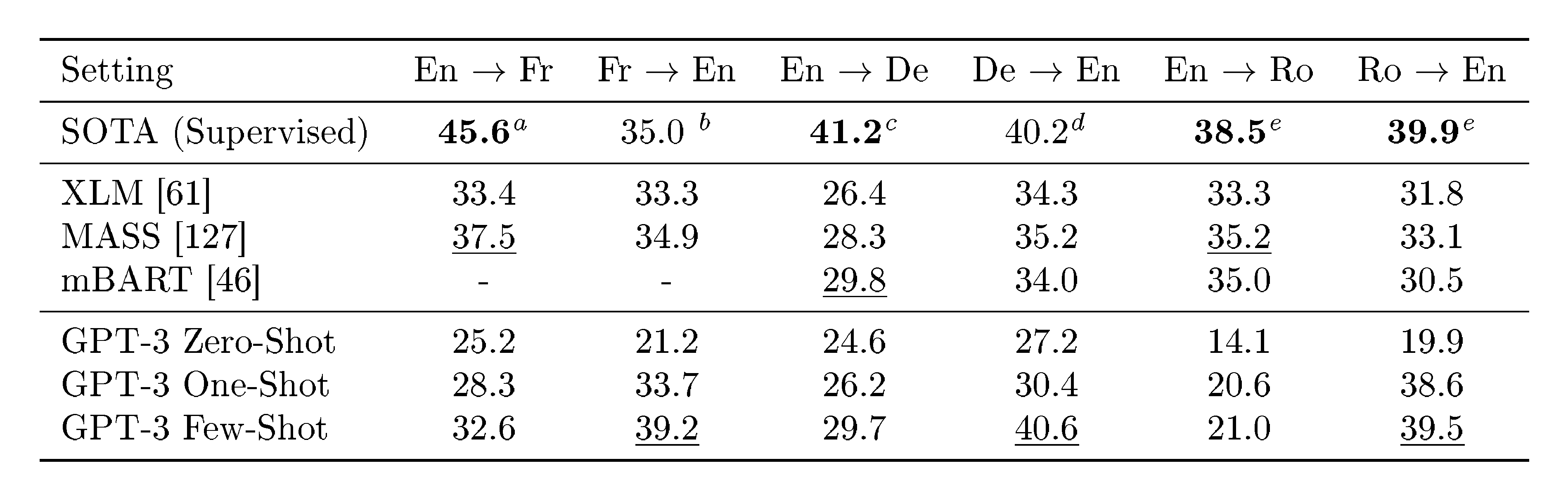
Table 6: Few-shot GPT-3 outperforms previous unsupervised NMT work by 5 BLEU when translating into English reflecting its strength as an English LM. We report BLEU scores on the WMT'14 Fr $\leftrightarrow$ En, WMT’16 De $\leftrightarrow$ En, and WMT'16 Ro $\leftrightarrow$ En datasets as measured by multi-bleu.perl with XLM's tokenization in order to compare most closely with prior unsupervised NMT work. SacreBLEU $^{\text{f}}$ [41] results reported in Appendix H. Underline indicates an unsupervised or few-shot SOTA, bold indicates supervised SOTA with relative confidence. $^{\text{a}}$ [42] $^{\text{b}}$ [43] $^{\text{c}}$ [44] $^{\text{d}}$ [45] $^{\text{e}}$ [46] $^{\text{f}}$ [SacreBLEU signature: BLEU+case.mixed+numrefs.1+smooth.exp+tok.intl+version.1.2.20]
:::
Results are shown in Table 6. Zero-shot GPT-3, which only receives on a natural language description of the task, still underperforms recent unsupervised NMT results. However, providing only a single example demonstration for each translation task improves performance by over 7 BLEU and nears competitive performance with prior work. GPT-3 in the full few-shot setting further improves another 4 BLEU resulting in similar average performance to prior unsupervised NMT work. GPT-3 has a noticeable skew in its performance depending on language direction. For the three input languages studied, GPT-3 significantly outperforms prior unsupervised NMT work when translating into English but underperforms when translating in the other direction. Performance on En-Ro is a noticeable outlier at over 10 BLEU worse than prior unsupervised NMT work. This could be a weakness due to reusing the byte-level BPE tokenizer of GPT-2 which was developed for an almost entirely English training dataset. For both Fr-En and De-En, few shot GPT-3 outperforms the best supervised result we could find but due to our unfamiliarity with the literature and the appearance that these are un-competitive benchmarks we do not suspect those results represent true state of the art. For Ro-En, few shot GPT-3 performs within 0.5 BLEU of the overall SOTA which is achieved by a combination of unsupervised pretraining, supervised finetuning on 608K labeled examples, and backtranslation [47].
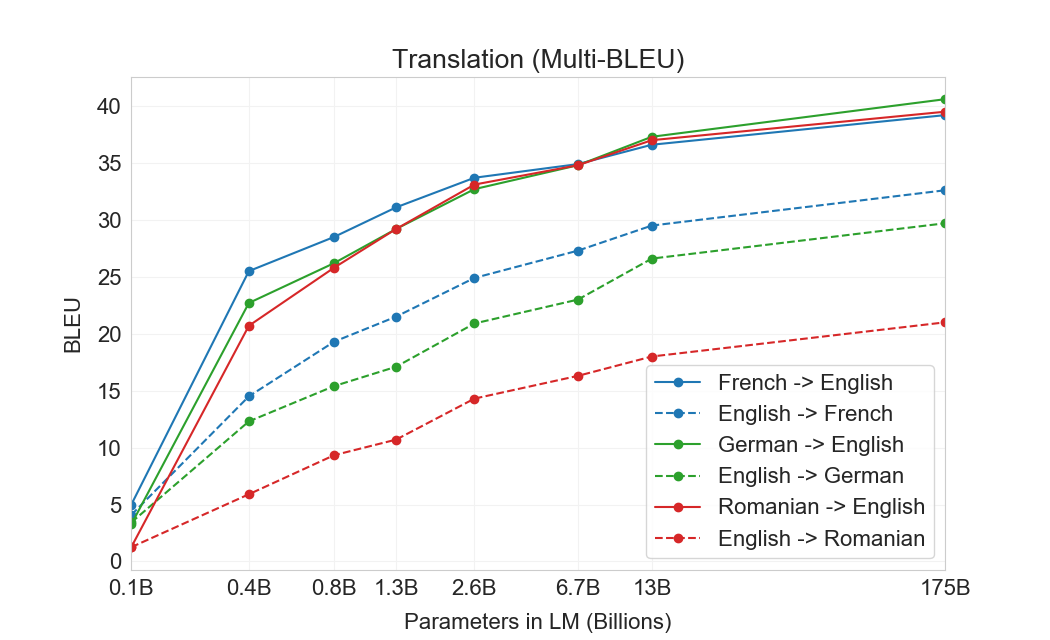
Finally, across all language pairs and across all three settings (zero-, one-, and few-shot), there is a smooth trend of improvement with model capacity. This is shown in Figure 9 in the case of few-shot results, and scaling for all three settings is shown in Appendix H.
3.4 Winograd-Style Tasks
:Table 7: Results on the WSC273 version of Winograd schemas and the adversarial Winogrande dataset. See Section 4 for details on potential contamination of the Winograd test set. $^{\text{a}}$ [48] $^{\text{b}}$ [49]
| Setting | Winograd | Winogrande (XL) |
|---|---|---|
| Fine-tuned SOTA | 90.1$^{\text{a}}$ | 84.6$^{\text{b}}$ |
| GPT-3 Zero-Shot | 88.3* | 70.2 |
| GPT-3 One-Shot | 89.7* | 73.2 |
| GPT-3 Few-Shot | 88.6* | 77.7 |
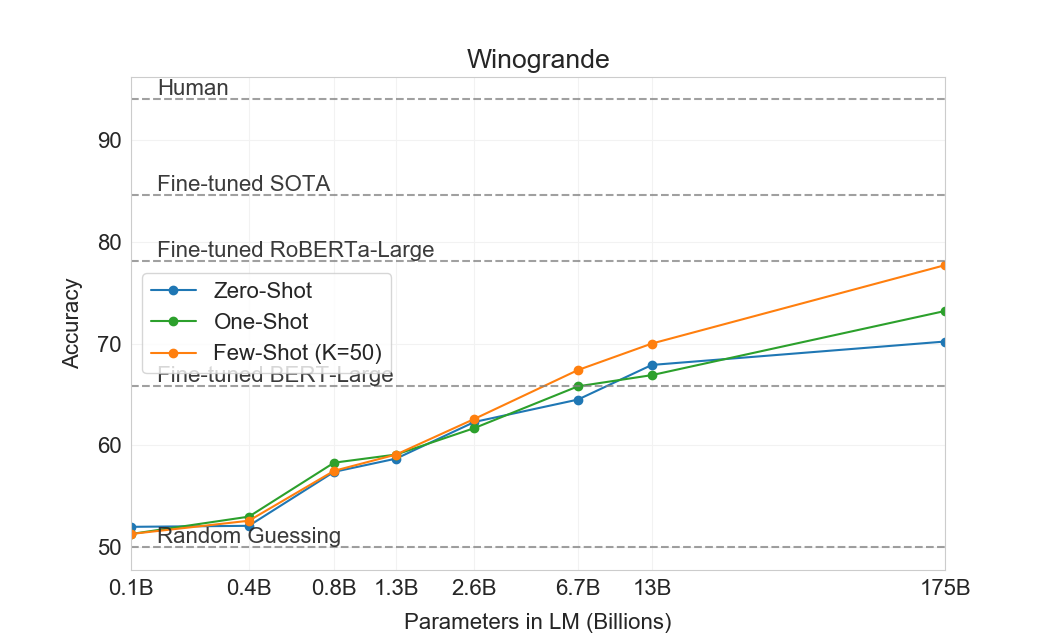
The Winograd Schemas Challenge [50] is a classical task in NLP that involves determining which word a pronoun refers to, when the pronoun is grammatically ambiguous but semantically unambiguous to a human. Recently fine-tuned language models have achieved near-human performance on the original Winograd dataset, but more difficult versions such as the adversarially-mined Winogrande dataset [48] still significantly lag human performance. We test GPT-3’s performance on both Winograd and Winogrande, as usual in the zero-, one-, and few-shot setting.
On Winograd we test GPT-3 on the original set of 273 Winograd schemas, using the same "partial evaluation" method described in [19]. Note that this setting differs slightly from the WSC task in the SuperGLUE benchmark, which is presented as binary classification and requires entity extraction to convert to the form described in this section. On Winograd GPT-3 achieves 88.3%, 89.7%, and 88.6% in the zero-shot, one-shot, and few-shot settings, showing no clear in-context learning but in all cases achieving strong results just a few points below state-of-the-art and estimated human performance. We note that contamination analysis found some Winograd schemas in the training data but this appears to have only a small effect on results (see Section 4).
On the more difficult Winogrande dataset, we do find gains to in-context learning: GPT-3 achieves 70.2% in the zero-shot setting, 73.2% in the one-shot setting, and 77.7% in the few-shot setting. For comparison a fine-tuned RoBERTA model achieves 79%, state-of-the-art is 84.6% achieved with a fine-tuned high capacity model (T5), and human performance on the task as reported by [48] is 94.0%.
3.5 Common Sense Reasoning
:Table 8: GPT-3 results on three commonsense reasoning tasks, PIQA, ARC, and OpenBookQA. GPT-3 Few-Shot PIQA result is evaluated on the test server. See Section 4 for details on potential contamination issues on the PIQA test set.
| Setting | PIQA | ARC (Easy) | ARC (Challenge) | OpenBookQA |
|---|---|---|---|---|
| Fine-tuned SOTA | 79.4 | 92.0[51] | 78.5[51] | 87.2[51] |
| GPT-3 Zero-Shot | 80.5* | 68.8 | 51.4 | 57.6 |
| GPT-3 One-Shot | 80.5* | 71.2 | 53.2 | 58.8 |
| GPT-3 Few-Shot | 82.8* | 70.1 | 51.5 | 65.4 |
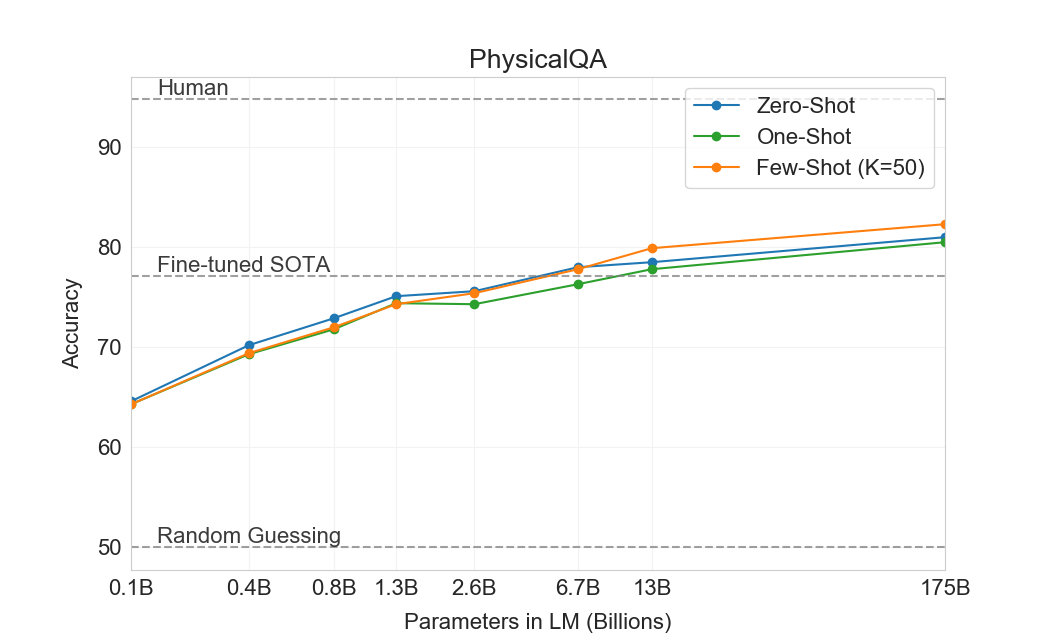
Next we consider three datasets which attempt to capture physical or scientific reasoning, as distinct from sentence completion, reading comprehension, or broad knowledge question answering. The first, PhysicalQA (PIQA) [52], asks common sense questions about how the physical world works and is intended as a probe of grounded understanding of the world. GPT-3 achieves 81.0% accuracy zero-shot, 80.5% accuracy one-shot, and 82.8% accuracy few-shot (the last measured on PIQA's test server). This compares favorably to the 79.4% accuracy prior state-of-the-art of a fine-tuned RoBERTa. PIQA shows relatively shallow scaling with model size and is still over 10% worse than human performance, but GPT-3's few-shot and even zero-shot result outperform the current state-of-the-art. Our analysis flagged PIQA for a potential data contamination issue (despite hidden test labels), and we therefore conservatively mark the result with an asterisk. See Section 4 for details.
ARC [53] is a dataset of multiple-choice questions collected from 3rd to 9th grade science exams. On the "Challenge" version of the dataset which has been filtered to questions which simple statistical or information retrieval methods are unable to correctly answer, GPT-3 achieves 51.4% accuracy in the zero-shot setting, 53.2% in the one-shot setting, and 51.5% in the few-shot setting. This is approaching the performance of a fine-tuned RoBERTa baseline (55.9%) from UnifiedQA [51]. On the "Easy" version of the dataset (questions which either of the mentioned baseline approaches answered correctly), GPT-3 achieves 68.8%, 71.2%, and 70.1% which slightly exceeds a fine-tuned RoBERTa baseline from [51]. However, both of these results are still much worse than the overall SOTAs achieved by the UnifiedQA which exceeds GPT-3’s few-shot results by 27% on the challenge set and 22% on the easy set.
On OpenBookQA [54], GPT-3 improves significantly from zero to few shot settings but is still over 20 points short of the overall SOTA. GPT-3's few-shot performance is similar to a fine-tuned BERT Large baseline on the leaderboard.
Overall, in-context learning with GPT-3 shows mixed results on commonsense reasoning tasks, with only small and inconsistent gains observed in the one and few-shot learning settings for both PIQA and ARC, but a significant improvement is observed on OpenBookQA. GPT-3 sets SOTA on the new PIQA dataset in all evaluation settings.
3.6 Reading Comprehension
:Table 9: Results on reading comprehension tasks. All scores are F1 except results for RACE which report accuracy. $^{\text{a}}$ [55] $^{\text{b}}$ [56] $^{\text{c}}$ [57] $^{\text{d}}$ [58] $^{\text{e}}$ [20]
| Setting | CoQA | DROP | QuAC | SQuADv2 | RACE-h | RACE-m |
|---|---|---|---|---|---|---|
| Fine-tuned SOTA | 90.7$^{\text{a}}$ | 89.1$^{\text{b}}$ | 74.4$^{\text{c}}$ | 93.0$^{\text{d}}$ | 90.0$^{\text{e}}$ | 93.1$^{\text{e}}$ |
| GPT-3 Zero-Shot | 81.5 | 23.6 | 41.5 | 59.5 | 45.5 | 58.4 |
| GPT-3 One-Shot | 84.0 | 34.3 | 43.3 | 65.4 | 45.9 | 57.4 |
| GPT-3 Few-Shot | 85.0 | 36.5 | 44.3 | 69.8 | 46.8 | 58.1 |
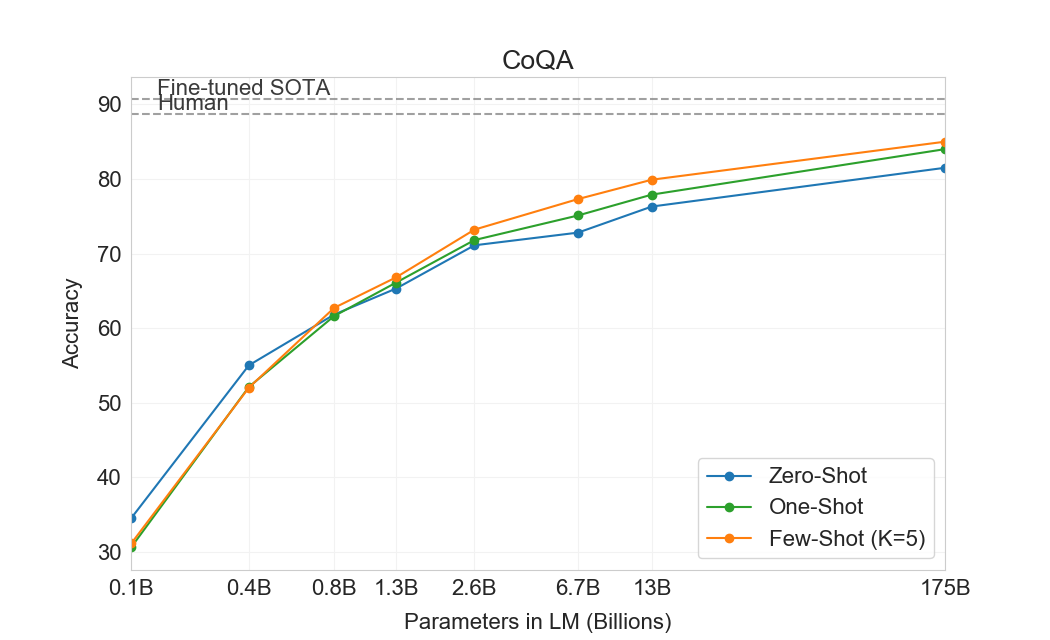
Next we evaluate GPT-3 on the task of reading comprehension. We use a suite of 5 datasets including abstractive, multiple choice, and span based answer formats in both dialog and single question settings. We observe a wide spread in GPT-3's performance across these datasets suggestive of varying capability with different answer formats. In general we observe GPT-3 is on par with initial baselines and early results trained using contextual representations on each respective dataset.
GPT-3 performs best (within 3 points of the human baseline) on CoQA [59] a free-form conversational dataset and performs worst (13 F1 below an ELMo baseline) on QuAC [60] a dataset which requires modeling structured dialog acts and answer span selections of teacher-student interactions. On DROP [61], a dataset testing discrete reasoning and numeracy in the context of reading comprehension, GPT-3 in a few-shot setting outperforms the fine-tuned BERT baseline from the original paper but is still well below both human performance and state-of-the-art approaches which augment neural networks with symbolic systems [62]. On SQuAD 2.0 [63], GPT-3 demonstrates its few-shot learning capabilities, improving by almost 10 F1 (to 69.8) compared to a zero-shot setting. This allows it to slightly outperform the best fine-tuned result in the original paper. On RACE [64], a multiple choice dataset of middle school and high school english examinations, GPT-3 performs relatively weakly and is only competitive with the earliest work utilizing contextual representations and is still 45% behind SOTA.
:::
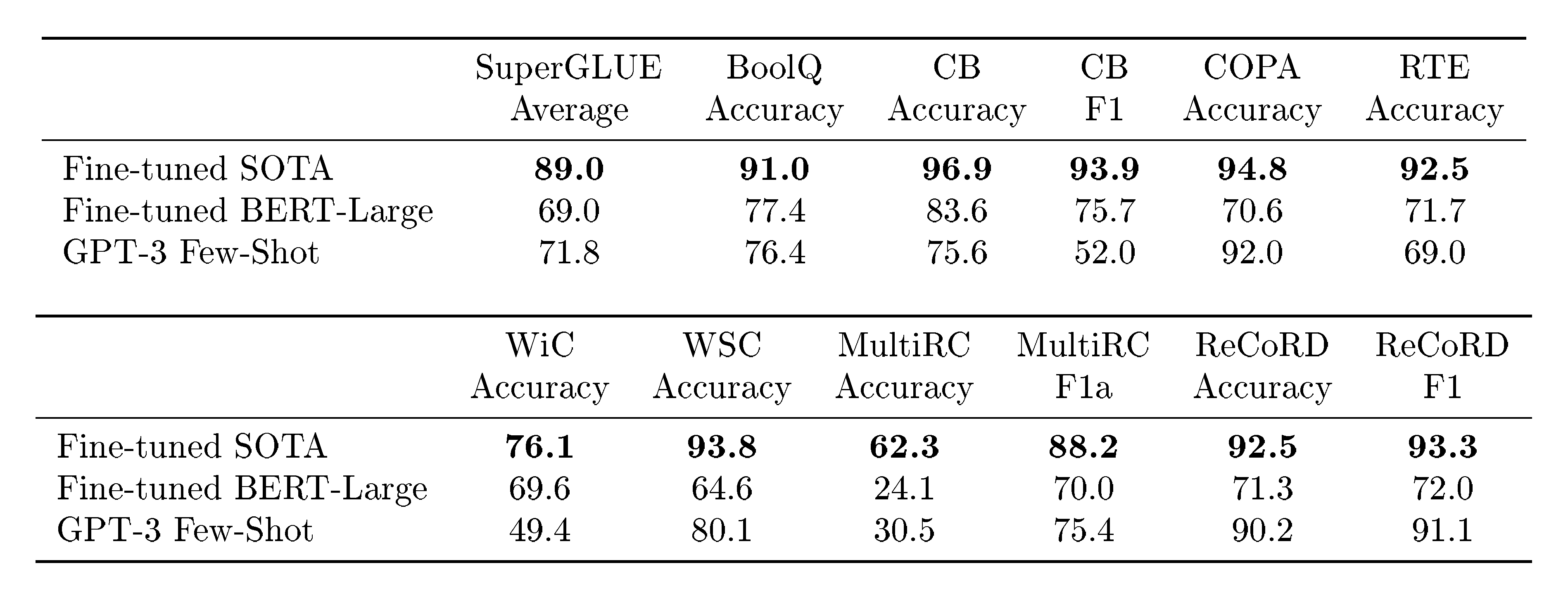
Table 10: Performance of GPT-3 on SuperGLUE compared to fine-tuned baselines and SOTA. All results are reported on the test set. GPT-3 few-shot is given a total of 32 examples within the context of each task and performs no gradient updates.
:::
3.7 SuperGLUE
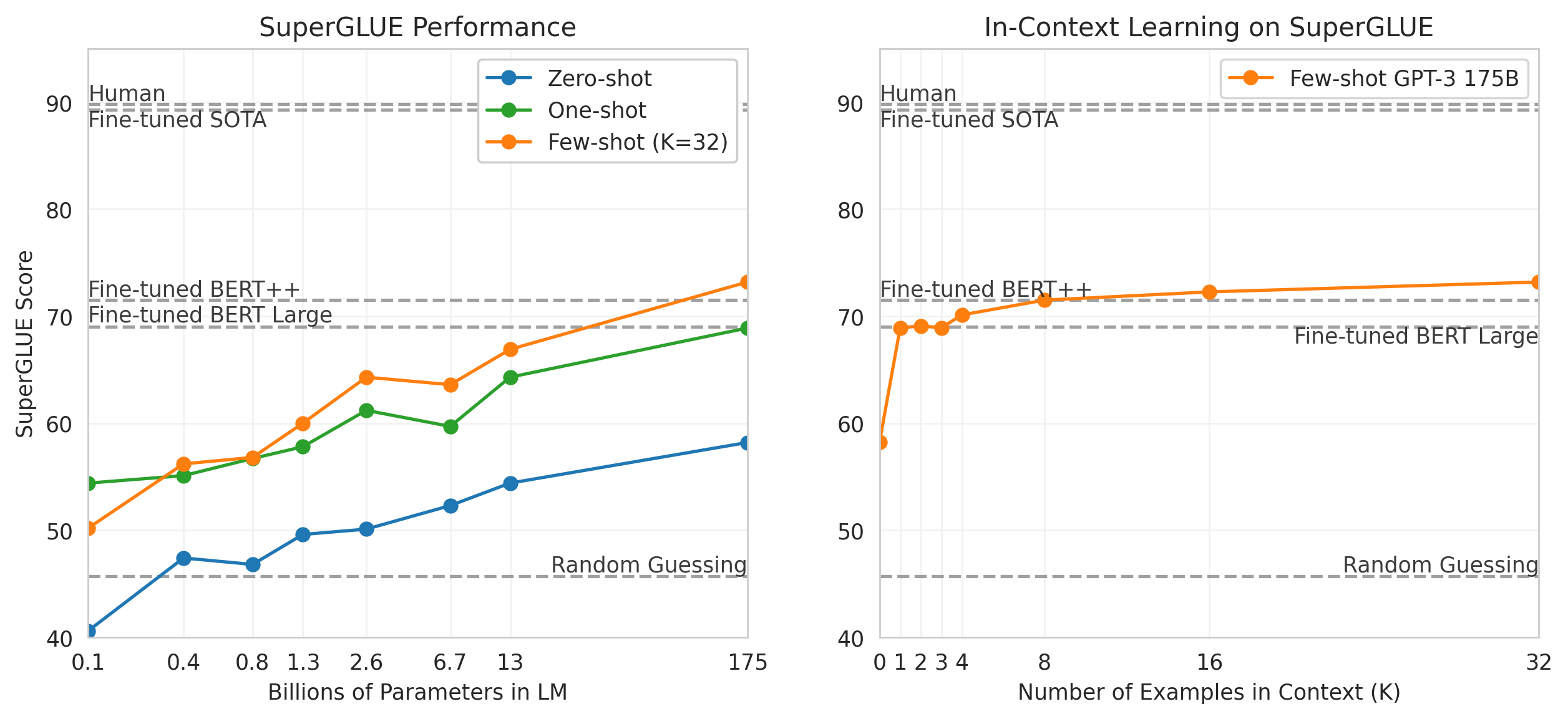
In order to better aggregate results on NLP tasks and compare to popular models such as BERT and RoBERTa in a more systematic way, we also evaluate GPT-3 on a standardized collection of datasets, the SuperGLUE benchmark [65] ([65]) ([66]) ([67]) ([68]) ([69]) ([70]) ([71]) ([72]) ([73]) ([74]) ([75]) ([76]). GPT-3’s test-set performance on the SuperGLUE dataset is shown in Table 10. In the few-shot setting, we used 32 examples for all tasks, sampled randomly from the training set. For all tasks except WSC and MultiRC, we sampled a new set of examples to use in the context for each problem. For WSC and MultiRC, we used the same set of randomly drawn examples from the training set as context for all of the problems we evaluated.
We observe a wide range in GPT-3’s performance across tasks. On COPA and ReCoRD GPT-3 achieves near-SOTA performance in the one-shot and few-shot settings, with COPA falling only a couple points short and achieving second place on the leaderboard, where first place is held by a fine-tuned 11 billion parameter model (T5). On WSC, performance is still relatively strong, achieving 80.1% in the few-shot setting (note that GPT-3 achieves 88.6% on the original Winograd dataset as described in Section 3.4). On BoolQ, MultiRC, and RTE, performance is reasonable, roughly matching that of a fine-tuned BERT-Large. On CB, we see signs of life at 75.6% in the few-shot setting.
WiC is a notable weak spot with few-shot performance at 49.4% (at random chance). We tried a number of different phrasings and formulations for WiC (which involves determining if a word is being used with the same meaning in two sentences), none of which was able to achieve strong performance. This hints at a phenomenon that will become clearer in the next section (which discusses the ANLI benchmark) – GPT-3 appears to be weak in the few-shot or one-shot setting at some tasks that involve comparing two sentences or snippets, for example whether a word is used the same way in two sentences (WiC), whether one sentence is a paraphrase of another, or whether one sentence implies another. This could also explain the comparatively low scores for RTE and CB, which also follow this format. Despite these weaknesses, GPT-3 still outperforms a fine-tuned BERT-large on four of eight tasks and on two tasks GPT-3 is close to the state-of-the-art held by a fine-tuned 11 billion parameter model.
Finally, we note that the few-shot SuperGLUE score steadily improves with both model size and with number of examples in the context showing increasing benefits from in-context learning (Figure 13). We scale $K$ up to 32 examples per task, after which point additional examples will not reliably fit into our context. When sweeping over values of $K$, we find that GPT-3 requires less than eight total examples per task to outperform a fine-tuned BERT-Large on overall SuperGLUE score.
3.8 NLI
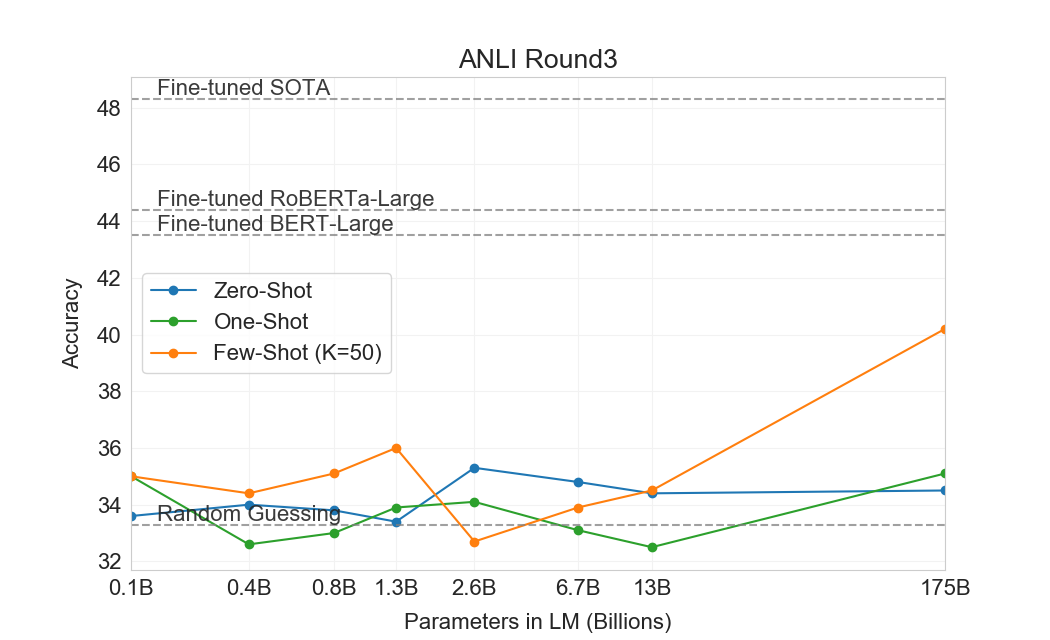
Natural Language Inference (NLI) [77] concerns the ability to understand the relationship between two sentences. In practice, this task is usually structured as a two or three class classification problem where the model classifies whether the second sentence logically follows from the first, contradicts the first sentence, or is possibly true (neutral). SuperGLUE includes an NLI dataset, RTE, which evaluates the binary version of the task. On RTE, only the largest version of GPT-3 performs convincingly better than random (56%) in any evaluation setting, but in a few-shot setting GPT-3 performs similarly to a single-task fine-tuned BERT Large. We also evaluate on the recently introduced Adversarial Natural Language Inference (ANLI) dataset [78]. ANLI is a difficult dataset employing a series of adversarially mined natural language inference questions in three rounds (R1, R2, and R3). Similar to RTE, all of our models smaller than GPT-3 perform at almost exactly random chance on ANLI, even in the few-shot setting ($\sim33%$), whereas GPT-3 itself shows signs of life on Round 3. Results for ANLI R3 are highlighted in Figure 14 and full results for all rounds can be found in Appendix H. These results on both RTE and ANLI suggest that NLI is still a very difficult task for language models and they are only just beginning to show signs of progress.
3.9 Synthetic and Qualitative Tasks
One way to probe GPT-3’s range of abilities in the few-shot (or zero- and one-shot) setting is to give it tasks which require it to perform simple on-the-fly computational reasoning, recognize a novel pattern that is unlikely to have occurred in training, or adapt quickly to an unusual task. We devise several tasks to test this class of abilities. First, we test GPT-3’s ability to perform arithmetic. Second, we create several tasks that involve rearranging or unscrambling the letters in a word, tasks which are unlikely to have been exactly seen during training. Third, we test GPT-3’s ability to solve SAT-style analogy problems few-shot. Finally, we test GPT-3 on several qualitative tasks, including using new words in a sentence, correcting English grammar, and news article generation. We will release the synthetic datasets with the hope of stimulating further study of test-time behavior of language models.
3.9.1 Arithmetic
To test GPT-3's ability to perform simple arithmetic operations without task-specific training, we developed a small battery of 10 tests that involve asking GPT-3 a simple arithmetic problem in natural language:
- 2 digit addition (2D+) – The model is asked to add two integers sampled uniformly from $[0, 100)$, phrased in the form of a question, e.g. "Q: What is 48 plus 76? A: 124."
- 2 digit subtraction (2D-) – The model is asked to subtract two integers sampled uniformly from $[0, 100)$; the answer may be negative. Example: "Q: What is 34 minus 53? A: -19".
- 3 digit addition (3D+) – Same as 2 digit addition, except numbers are uniformly sampled from $[0, 1000)$.
- 3 digit subtraction (3D-) – Same as 2 digit subtraction, except numbers are uniformly sampled from $[0, 1000)$.
- 4 digit addition (4D+) – Same as 3 digit addition, except uniformly sampled from $[0, 10000)$.
- 4 digit subtraction (4D-) – Same as 3 digit subtraction, except uniformly sampled from $[0, 10000)$.
- 5 digit addition (5D+) – Same as 3 digit addition, except uniformly sampled from $[0, 100000)$.
- 5 digit subtraction (5D-) – Same as 3 digit subtraction, except uniformly sampled from $[0, 100000)$.
- 2 digit multiplication (2Dx) – The model is asked to multiply two integers sampled uniformly from $[0, 100)$, e.g. "Q: What is 24 times 42? A: 1008".
- One-digit composite (1DC) – The model is asked to perform a composite operation on three 1 digit numbers, with parentheses around the last two. For example, "Q: What is 6+(4*8)? A: 38". The three 1 digit numbers are selected uniformly on $[0, 10)$ and the operations are selected uniformly from +, -, *.
In all 10 tasks the model must generate the correct answer exactly. For each task we generate a dataset of 2, 000 random instances of the task and evaluate all models on those instances.
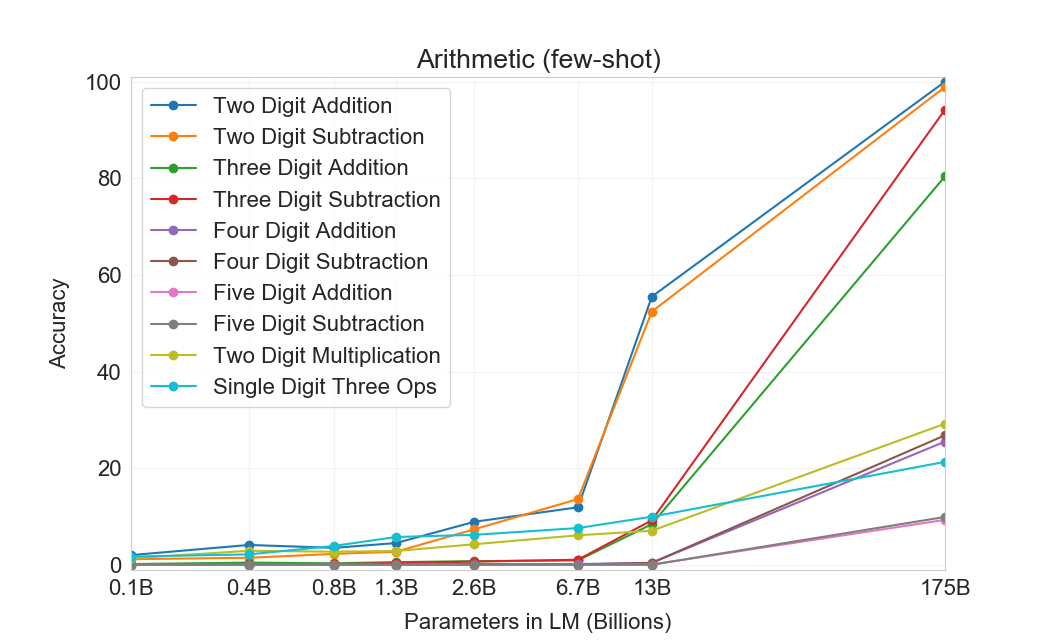
First we evaluate GPT-3 in the few-shot setting, for which results are shown in Figure 15. On addition and subtraction, GPT-3 displays strong proficiency when the number of digits is small, achieving 100% accuracy on 2 digit addition, 98.9% at 2 digit subtraction, 80.2% at 3 digit addition, and 94.2% at 3-digit subtraction. Performance decreases as the number of digits increases, but GPT-3 still achieves 25-26% accuracy on four digit operations and 9-10% accuracy on five digit operations, suggesting at least some capacity to generalize to larger numbers of digits. GPT-3 also achieves 29.2% accuracy at 2 digit multiplication, an especially computationally intensive operation. Finally, GPT-3 achieves 21.3% accuracy at single digit combined operations (for example, 9*(7+5)), suggesting that it has some robustness beyond just single operations.
:Table 11: Results on basic arithmetic tasks for GPT-3 175B. {2, 3, 4, 5}D{+, -} is 2, 3, 4, and 5 digit addition or subtraction, 2Dx is 2 digit multiplication. 1DC is 1 digit composite operations. Results become progressively stronger moving from the zero-shot to one-shot to few-shot setting, but even the zero-shot shows significant arithmetic abilities.
| Setting | 2D+ | 2D- | 3D+ | 3D- | 4D+ | 4D- | 5D+ | 5D- | 2Dx | 1DC |
|---|---|---|---|---|---|---|---|---|---|---|
| GPT-3 Zero-shot | 76.9 | 58.0 | 34.2 | 48.3 | 4.0 | 7.5 | 0.7 | 0.8 | 19.8 | 9.8 |
| GPT-3 One-shot | 99.6 | 86.4 | 65.5 | 78.7 | 14.0 | 14.0 | 3.5 | 3.8 | 27.4 | 14.3 |
| GPT-3 Few-shot | 100.0 | 98.9 | 80.4 | 94.2 | 25.5 | 26.8 | 9.3 | 9.9 | 29.2 | 21.3 |
As Figure 15 makes clear, small models do poorly on all of these tasks – even the 13 billion parameter model (the second largest after the 175 billion full GPT-3) can solve 2 digit addition and subtraction only half the time, and all other operations less than 10% of the time.
One-shot and zero-shot performance are somewhat degraded relative to few-shot performance, suggesting that adaptation to the task (or at the very least recognition of the task) is important to performing these computations correctly. Nevertheless, one-shot performance is still quite strong, and even zero-shot performance of the full GPT-3 significantly outperforms few-shot learning for all smaller models. All three settings for the full GPT-3 are shown in Table 11, and model capacity scaling for all three settings is shown in Appendix H.
To spot-check whether the model is simply memorizing specific arithmetic problems, we took the 3-digit arithmetic problems in our test set and searched for them in our training data in both the forms "<NUM1> + <NUM2> =" and "<NUM1> plus <NUM2>". Out of 2, 000 addition problems we found only 17 matches (0.8%) and out of 2, 000 subtraction problems we found only 2 matches (0.1%), suggesting that only a trivial fraction of the correct answers could have been memorized. In addition, inspection of incorrect answers reveals that the model often makes mistakes such as not carrying a "1", suggesting it is actually attempting to perform the relevant computation rather than memorizing a table.
Overall, GPT-3 displays reasonable proficiency at moderately complex arithmetic in few-shot, one-shot, and even zero-shot settings.
3.9.2 Word Scrambling and Manipulation Tasks
To test GPT-3's ability to learn novel symbolic manipulations from a few examples, we designed a small battery of 5 "character manipulation" tasks. Each task involves giving the model a word distorted by some combination of scrambling, addition, or deletion of characters, and asking it to recover the original word. The 5 tasks are:
:Table 12: GPT-3 175B performance on various word unscrambling and word manipulation tasks, in zero-, one-, and few-shot settings. CL is "cycle letters in word", A1 is anagrams of but the first and last letters, A2 is anagrams of all but the first and last two letters, RI is "Random insertion in word", RW is "reversed words".
| Setting | CL | A1 | A2 | RI | RW |
|---|---|---|---|---|---|
| GPT-3 Zero-shot | 3.66 | 2.28 | 8.91 | 8.26 | 0.09 |
| GPT-3 One-shot | 21.7 | 8.62 | 25.9 | 45.4 | 0.48 |
| GPT-3 Few-shot | 37.9 | 15.1 | 39.7 | 67.2 | 0.44 |
- Cycle letters in word (CL) – The model is given a word with its letters cycled, then the "=" symbol, and is expected to generate the original word. For example, it might be given "lyinevitab" and should output "inevitably".
- Anagrams of all but first and last characters (A1) – The model is given a word where every letter except the first and last have been scrambled randomly, and must output the original word. Example: criroptuon = corruption.
- Anagrams of all but first and last 2 characters (A2) – The model is given a word where every letter except the first 2 and last 2 have been scrambled randomly, and must recover the original word. Example: opoepnnt $\to$ opponent.
- Random insertion in word (RI) – A random punctuation or space character is inserted between each letter of a word, and the model must output the original word. Example: s.u!c/c!e.s s i/o/n = succession.
- Reversed words (RW) – The model is given a word spelled backwards, and must output the original word. Example: stcejbo $\to$ objects.
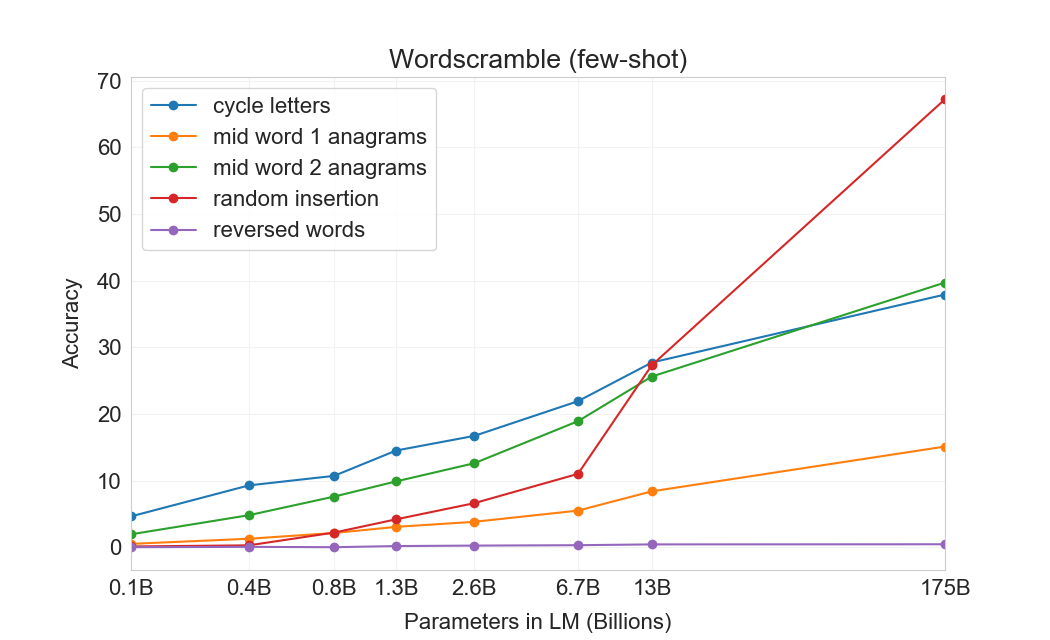
For each task we generate 10, 000 examples, which we chose to be the top 10, 000 most frequent words as measured by [79] of length more than 4 characters and less than 15 characters. The few-shot results are shown in Figure 16. Task performance tends to grow smoothly with model size, with the full GPT-3 model achieving 66.9% on removing random insertions, 38.6% on cycling letters, 40.2% on the easier anagram task, and 15.1% on the more difficult anagram task (where only the first and last letters are held fixed). None of the models can reverse the letters in a word.
In the one-shot setting, performance is significantly weaker (dropping by half or more), and in the zero-shot setting the model can rarely perform any of the tasks (Table 12). This suggests that the model really does appear to learn these tasks at test time, as the model cannot perform them zero-shot and their artificial nature makes them unlikely to appear in the pre-training data (although we cannot confirm this with certainty).
We can further quantify performance by plotting "in-context learning curves", which show task performance as a function of the number of in-context examples. We show in-context learning curves for the Symbol Insertion task in Figure 2. We can see that larger models are able to make increasingly effective use of in-context information, including both task examples and natural language task descriptions.
Finally, it is worth adding that solving these tasks requires character-level manipulations, whereas our BPE encoding operates on significant fractions of a word (on average $\sim0.7$ words per token), so from the LM’s perspective succeeding at these tasks involves not just manipulating BPE tokens but understanding and pulling apart their substructure. Also, CL, A1, and A2 are not bijective (that is, the unscrambled word is not a deterministic function of the scrambled word), requiring the model to perform some search to find the correct unscrambling. Thus, the skills involved appear to require non-trivial pattern-matching and computation.
3.9.3 SAT Analogies
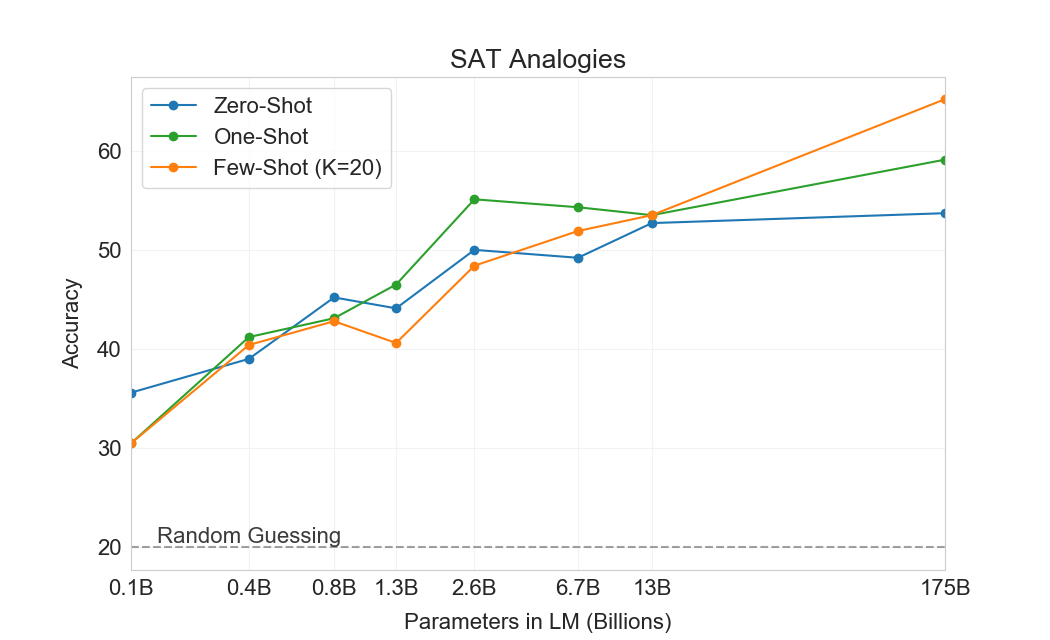
To test GPT-3 on another task that is somewhat unusual relative to the typical distribution of text, we collected a set of 374 "SAT analogy" problems [80]. Analogies are a style of multiple choice question that constituted a section of the SAT college entrance exam before 2005. A typical example is "audacious is to boldness as (a) sanctimonious is to hypocrisy, (b) anonymous is to identity, (c) remorseful is to misdeed, (d) deleterious is to result, (e) impressionable is to temptation". The student is expected to choose which of the five word pairs has the same relationship as the original word pair; in this example the answer is "sanctimonious is to hypocrisy". On this task GPT-3 achieves 65.2% in the few-shot setting, 59.1% in the one-shot setting, and 53.7% in the zero-shot setting, whereas the average score among college applicants was 57% [81] (random guessing yields 20%). As shown in Figure 17, the results improve with scale, with the the full 175 billion model improving by over 10% compared to the 13 billion parameter model.
3.9.4 News Article Generation
Previous work on generative language models qualitatively tested their ability to generate synthetic "news articles" by conditional sampling from the model given a human-written prompt consisting of a plausible first sentence for a news story [19]. Relative to [19], the dataset used to train GPT-3 is much less weighted towards news articles, so trying to generate news articles via raw unconditional samples is less effective – for example GPT-3 often interprets the proposed first sentence of a "news article" as a tweet and then posts synthetic responses or follow-up tweets. To solve this problem we employed GPT-3’s few-shot learning abilities by providing three previous news articles in the model’s context to condition it. With the title and subtitle of a proposed next article, the model is able to reliably generate short articles in the "news" genre.
To gauge the quality of news article generation from GPT-3 (which we believe is likely to be correlated with conditional sample generation quality in general), we decided to measure human ability to distinguish GPT-3-generated articles from real ones. Similar work has been carried out by Kreps et al. [82] and Zellers et al. [33]. Generative language models are trained to match the distribution of content generated by humans, so the (in)ability of humans to distinguish the two is a potentially important measure of quality.[^4]
[^4]: This task is also relevant to the potential misuse of language models discussed in Section 6.1.
In order to see how well humans can detect model generated text, we arbitrarily selected 25 article titles and subtitles from the website newser.com (mean length: 215 words). We then generated completions of these titles and subtitles from four language models ranging in size from 125M to 175B (GPT-3) parameters (mean length: 200 words). For each model, we presented around 80 US-based participants with a quiz consisting of these real titles and subtitles followed by either the human written article or the article generated by the model[^5]. Participants were asked to select whether the article was "very likely written by a human", "more likely written by a human", "I don't know", "more likely written by a machine", or "very likely written by a machine".
[^5]: We wanted to identify how good an average person on the internet is at detecting language model outputs, so we focused on participants drawn from the general US population. See Appendix E for details.
The articles we selected were not in the models’ training data and the model outputs were formatted and selected programmatically to prevent human cherry-picking. All models used the same context to condition outputs on and were pre-trained with the same context size and the same article titles and subtitles were used as prompts for each model. However, we also ran an experiment to control for participant effort and attention that followed the same format but involved intentionally bad model generated articles. This was done by generating articles from a "control model": a 160M parameter model with no context and increased output randomness.
Mean human accuracy (the ratio of correct assignments to non-neutral assignments per participant) at detecting that the intentionally bad articles were model generated was $\sim86%$ where 50% is chance level performance. By contrast, mean human accuracy at detecting articles that were produced by the 175B parameter model was barely above chance at $\sim52%$ (see Table 13).[^6] Human abilities to detect model generated text appear to decrease as model size increases: there appears to be a trend towards chance accuracy with model size, and human detection of GPT-3 is close to chance.[^7] This is true despite the fact that participants spend more time on each output as model size increases (see Appendix E).
[^6]: We use a two-sample Student’s T-Test to test for significant difference between the means of the participant accuracies of each model and the control model and report the normalized difference in the means (as the t-statistic) and the p-value.
[^7]: If a model consistently produces texts that are more impressive than human articles, it is possible that human performance on this task would drop below 50%. Indeed, many individual participants scored below 50% on this task.
:::
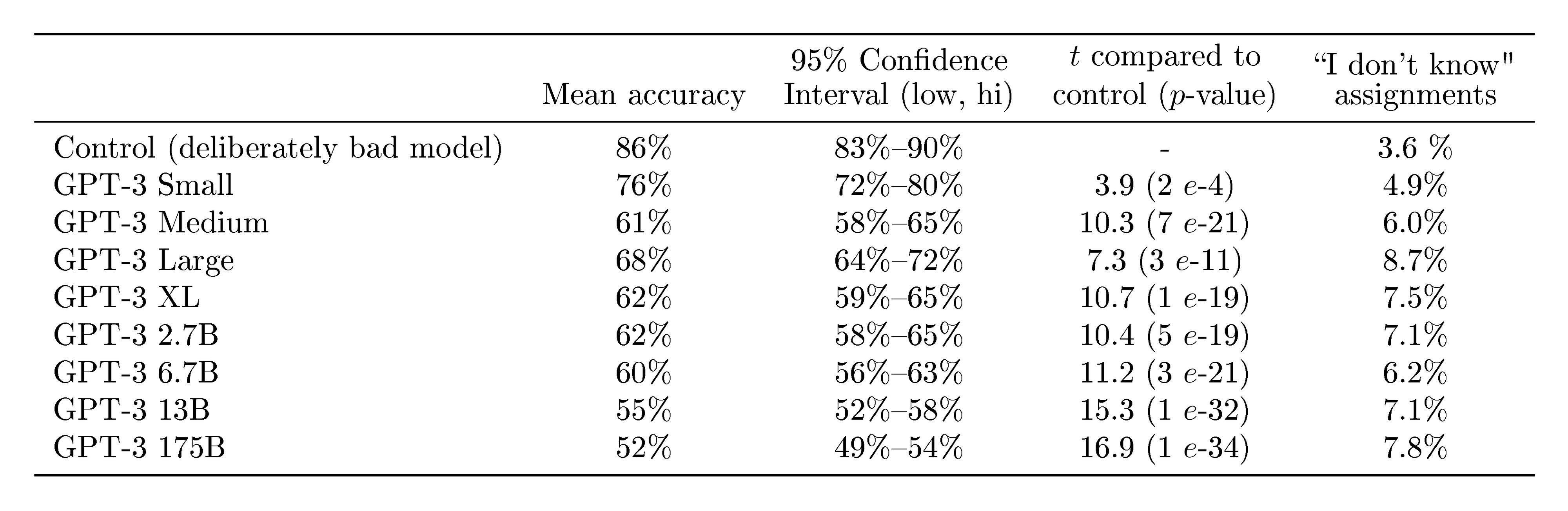
Table 13: Human accuracy in identifying whether short ($\sim$ 200 word) news articles are model generated. We find that human accuracy (measured by the ratio of correct assignments to non-neutral assignments) ranges from 86% on the control model to 52% on GPT-3 175B. This table compares mean accuracy between five different models, and shows the results of a two-sample T-Test for the difference in mean accuracy between each model and the control model (an unconditional GPT-3 Small model with increased output randomness).
:::
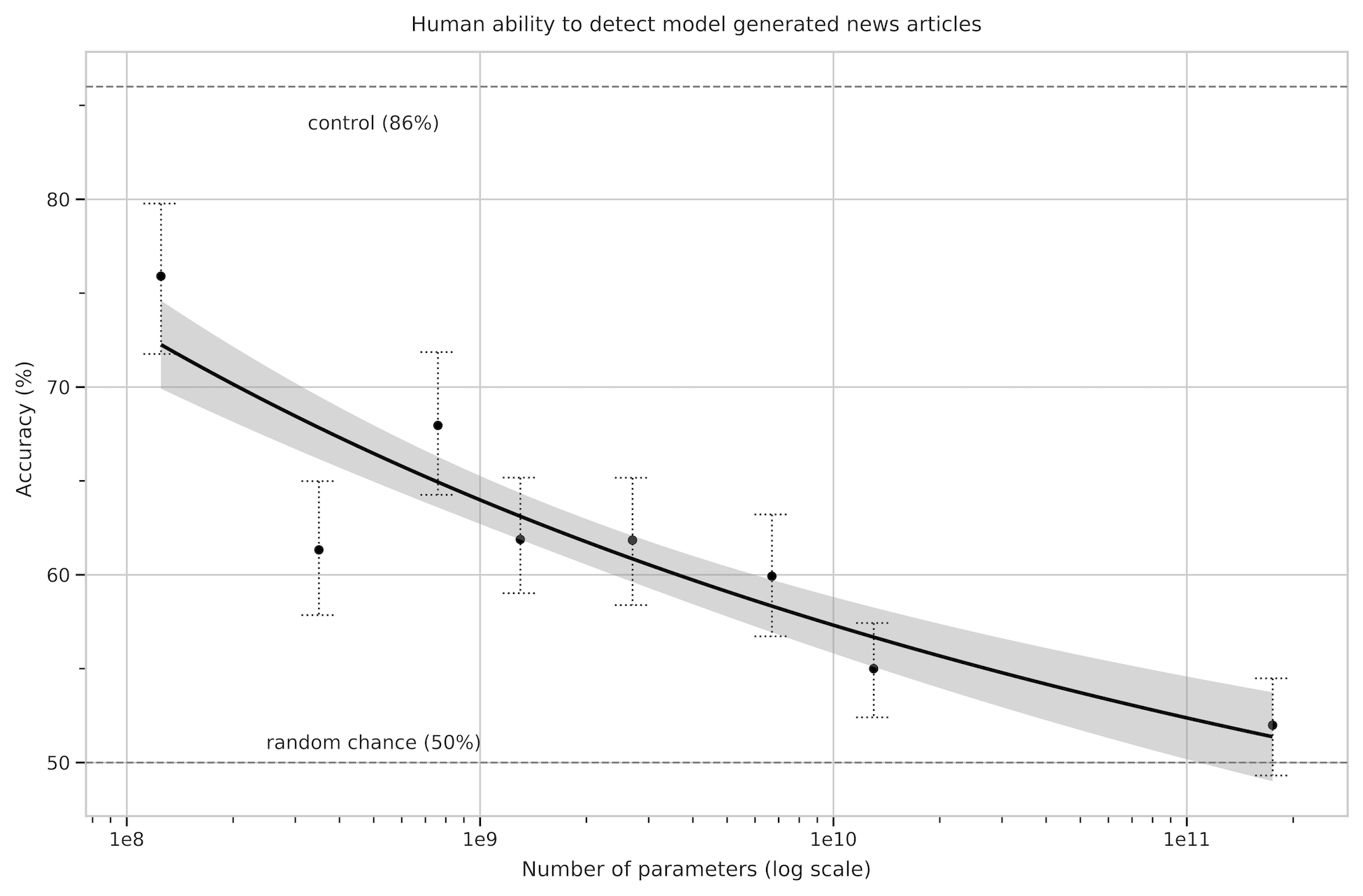
Examples of synthetic articles from GPT-3 are given in Figure 19 and Figure 20.[^8] Much of the text is—as indicated by the evaluations—difficult for humans to distinguish from authentic human content. Factual inaccuracies can be an indicator that an article is model generated since, unlike human authors, the models have no access to the specific facts that the article titles refer to or when the article was written. Other indicators include repetition, non sequiturs, and unusual phrasings, though these are often subtle enough that they are not noticed.
[^8]: Additional non-news samples can be found in Appendix F.
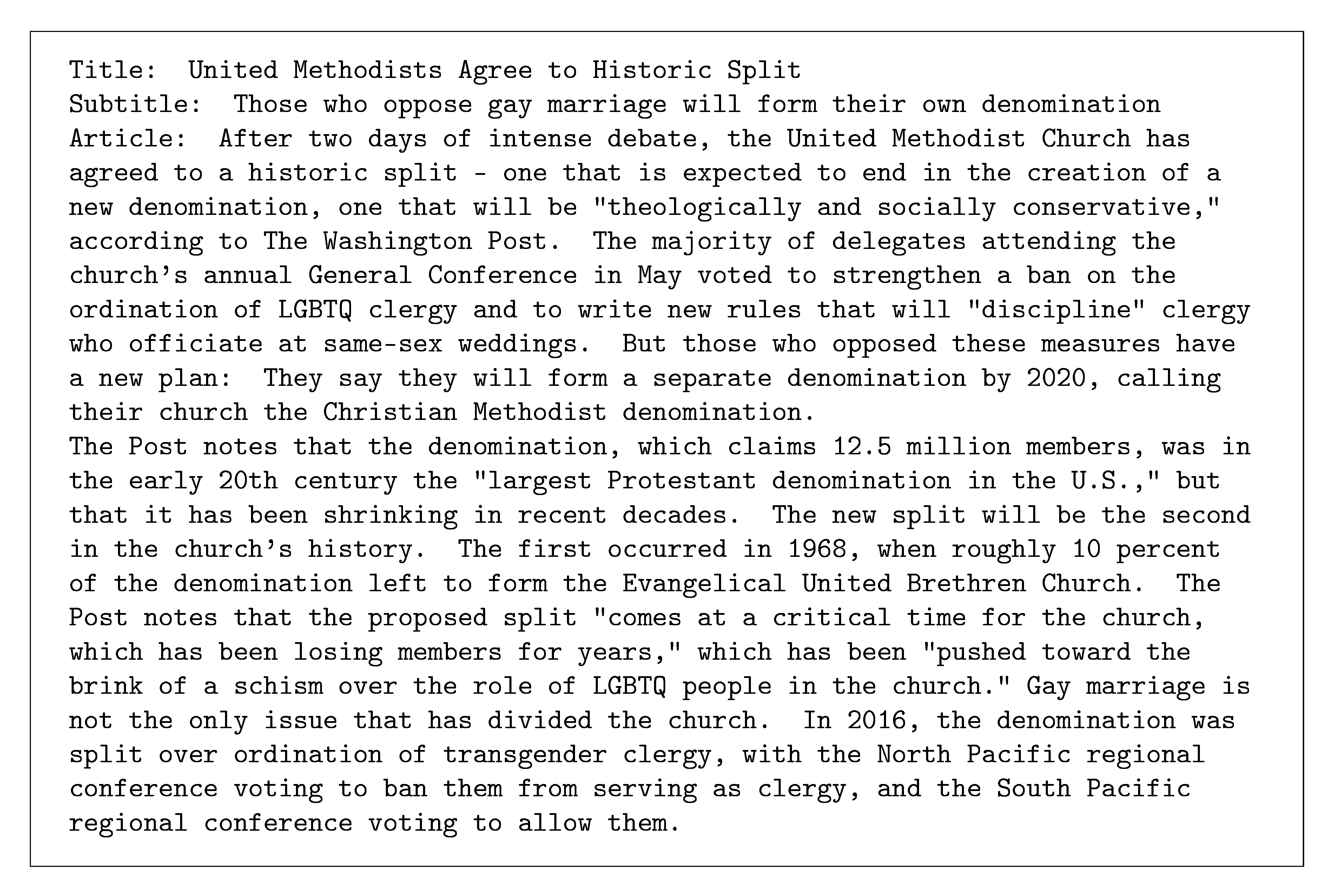

Related work on language model detection by Ippolito et al. [83] indicates that automatic discriminators like Grover [33] and GLTR [84] may have greater success at detecting model generated text than human evaluators. Automatic detection of these models may be a promising area of future research.
Ippolito et al. [83] also note that human accuracy at detecting model generated text increases as humans observe more tokens. To do a preliminary investigation of how good humans are at detecting longer news articles generated by GPT-3 175B, we selected 12 world news articles from Reuters with an average length of 569 words and generated completions of these articles from GPT-3 with an average length of 498 words (298 words longer than our initial experiments). Following the methodology above, we ran two experiments, each on around 80 US-based participants, to compare human abilities to detect the articles generated by GPT-3 and a control model.
We found that mean human accuracy at detecting the intentionally bad longer articles from the control model was $\sim88%$, while mean human accuracy at detecting the longer articles that were produced by GPT-3 175B was still barely above chance at $\sim52%$ (see Table 14). This indicates that, for news articles that are around 500 words long, GPT-3 continues to produce articles that humans find difficult to distinguish from human written news articles.
:::

Table 14: People’s ability to identify whether $\sim500$ word articles are model generated (as measured by the ratio of correct assignments to non-neutral assignments) was 88% on the control model and 52% on GPT-3 175B. This table shows the results of a two-sample T-Test for the difference in mean accuracy between GPT-3 175B and the control model (an unconditional GPT-3 Small model with increased output randomness).
:::
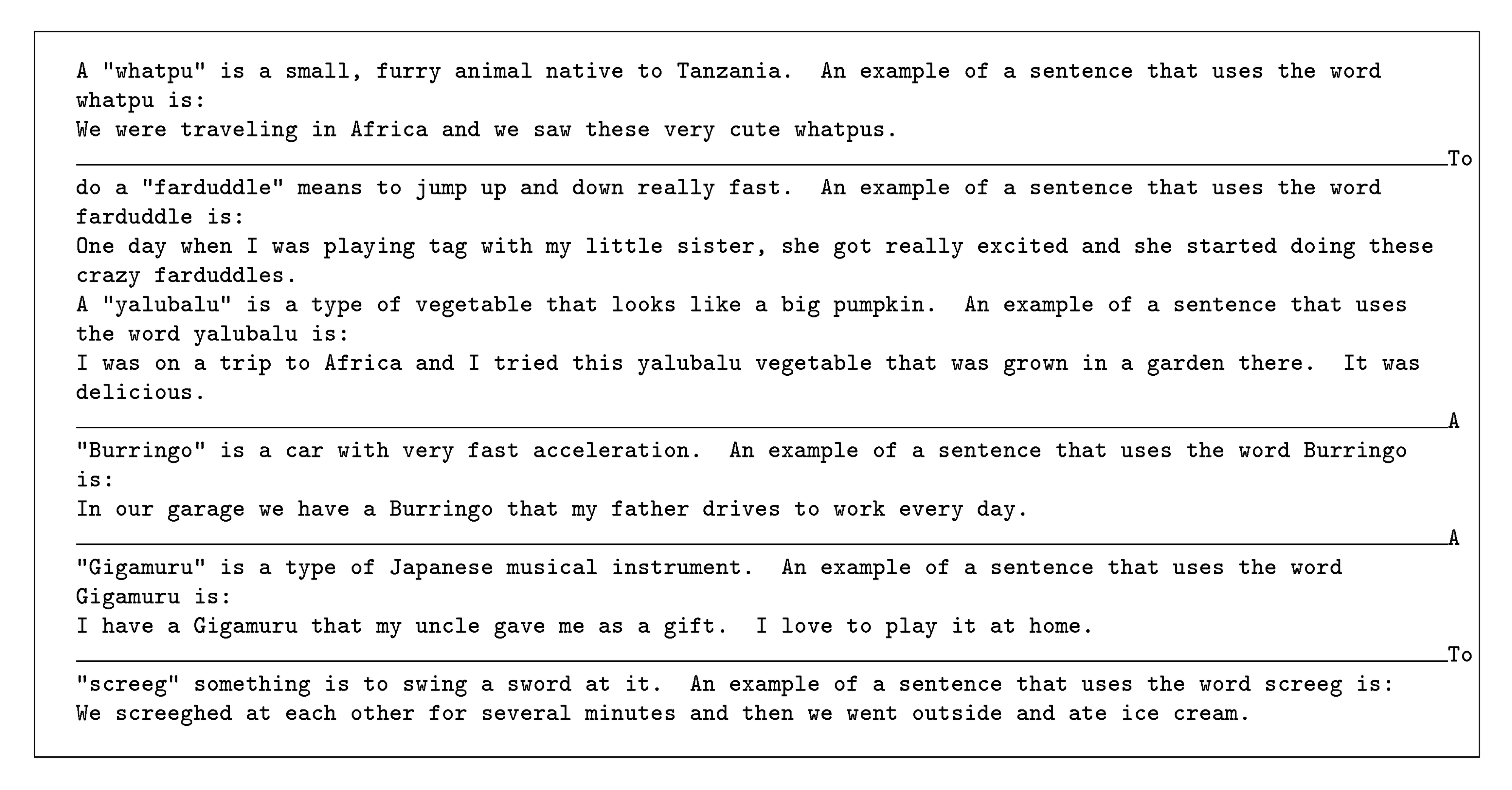
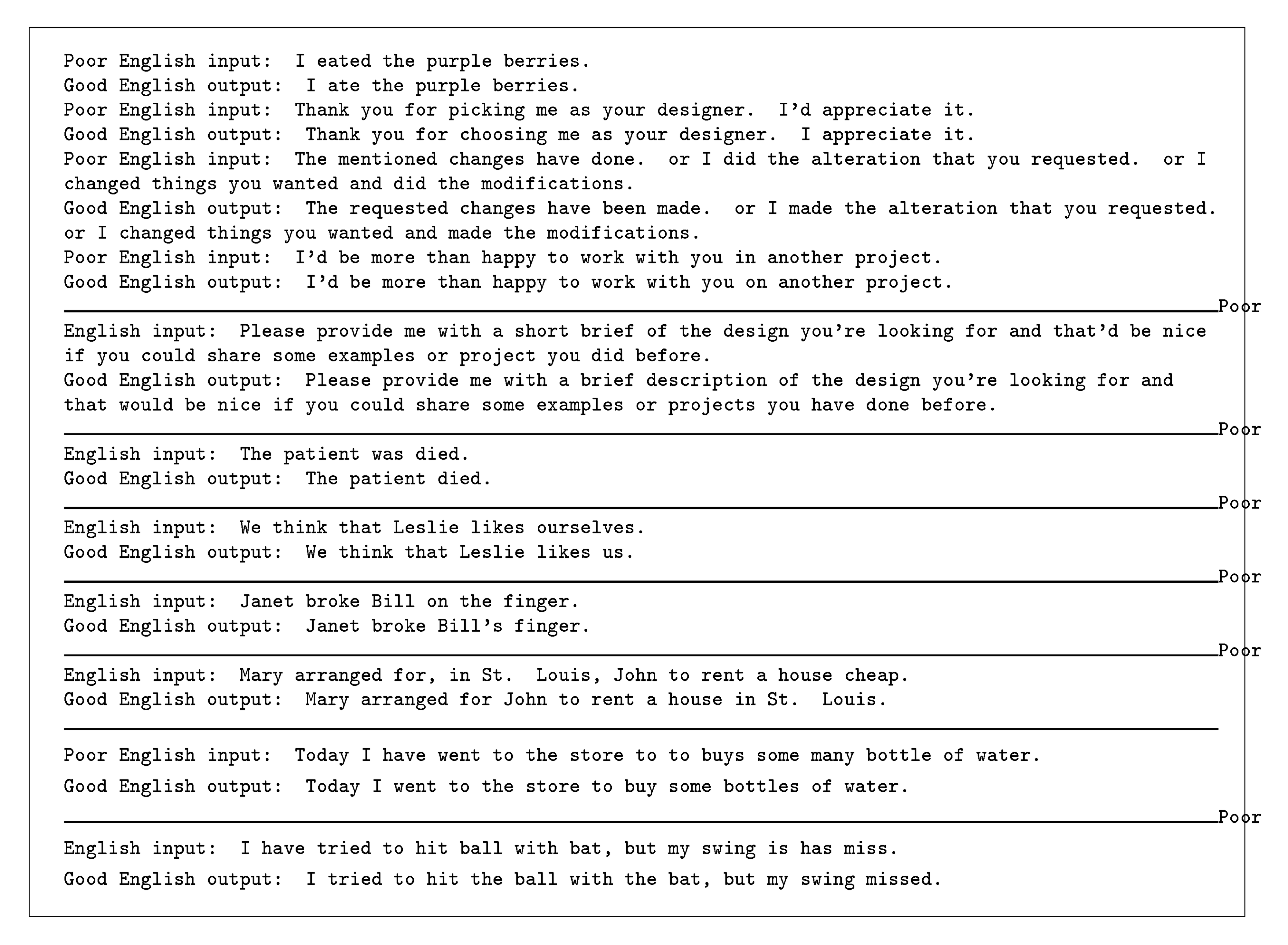
3.9.5 Learning and Using Novel Words
A task studied in developmental linguistics [85] is the ability to learn and utilize new words, for example using a word in a sentence after seeing it defined only once, or conversely inferring a word’s meaning from only one usage. Here we qualitatively test GPT-3’s ability to do the former. Specifically, we give GPT-3 the definition of a nonexistent word, such as "Gigamuru", and then ask it to use it in a sentence. We provide one to five previous examples of a (separate) nonexistent word being defined and used in a sentence, so the task is few-shot in terms of previous examples of the broad task and one-shot in terms of the specific word. Table Figure 21 shows the 6 examples we generated; all definitions were human-generated, and the first answer was human-generated as conditioning while the subsequent answers were generated by GPT-3. These examples were generated continuously in one sitting and we did not omit or repeatedly try any prompts. In all cases the generated sentence appears to be a correct or at least plausible use of the word. In the final sentence the model generates a plausible conjugation for the word "screeg" (namely "screeghed"), although the use of the word is slightly awkward ("screeghed at each other") despite being plausible in the sense that it could describe a toy sword fight. Overall, GPT-3 appears to be at least proficient at the task of using novel words in a sentence.
3.9.6 Correcting English Grammar
Another task well suited for few-shot learning is correcting English grammar. We test this with GPT-3 in the few-shot setting by giving prompts of the form "Poor English Input: <sentence>\n Good English Output: <sentence>". We give GPT-3 one human-generated correction and then ask it to correct 5 more (again without any omissions or repeats). Results are shown in Figure 22.
4 Measuring and Preventing Memorization Of Benchmarks
Section Summary: Researchers worry that training AI models like GPT-3 on vast internet data might accidentally include benchmark test questions, leading to memorization rather than true learning, but detecting this is tricky with no standard methods. To investigate, they created "clean" versions of benchmarks by removing any examples overlapping with training data by even short phrases, then compared model performance on these versus the originals. Overall, results showed little difference in most cases, suggesting contamination doesn't greatly inflate scores, though a few benchmarks like PIQA and Winograd showed signs of it upon closer review.
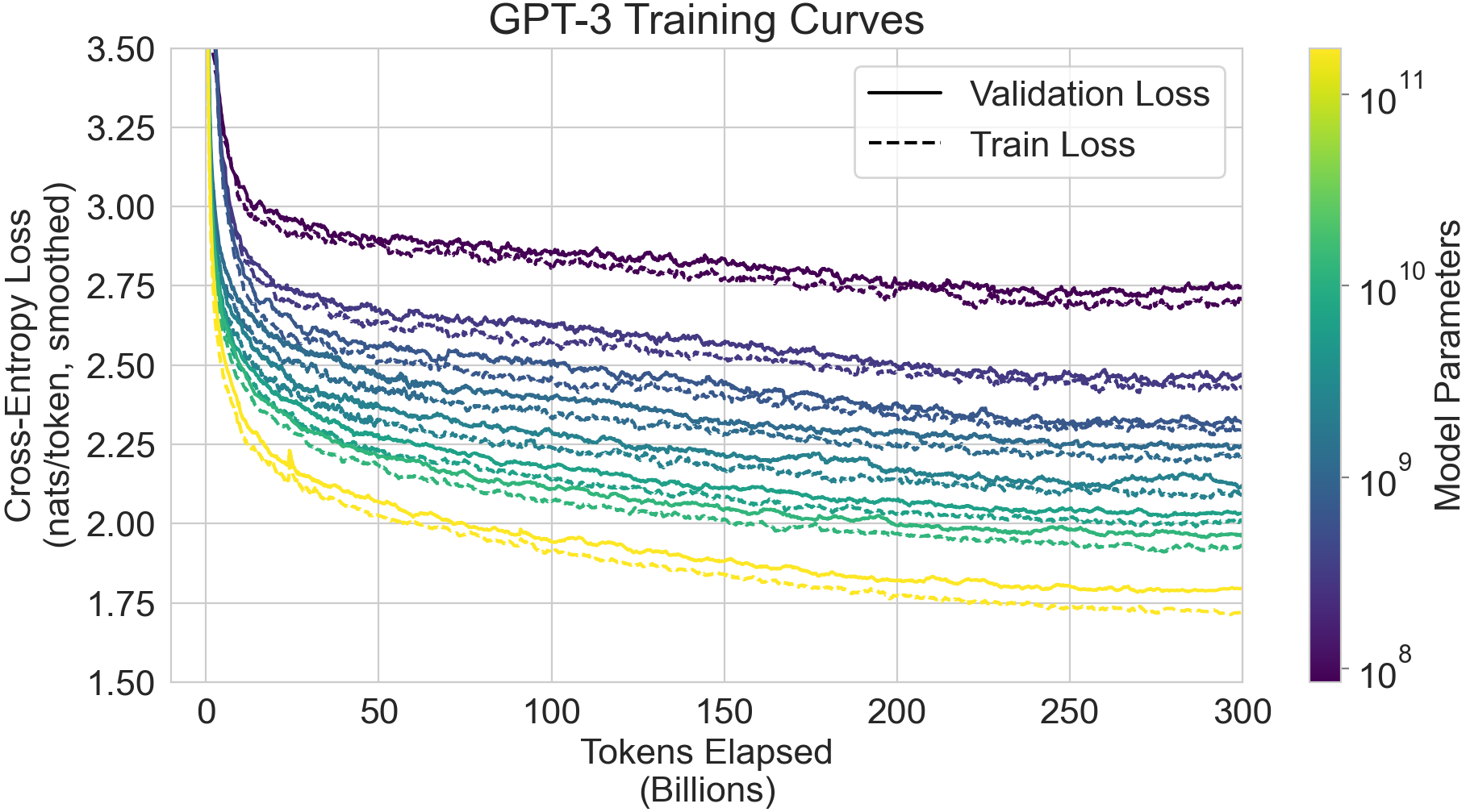
Since our training dataset is sourced from the internet, it is possible that our model was trained on some of our benchmark test sets. Accurately detecting test contamination from internet-scale datasets is a new area of research without established best practices. While it is common practice to train large models without investigating contamination, given the increasing scale of pretraining datasets, we believe this issue is becoming increasingly important to attend to.
This concern is not just hypothetical. One of the first papers to train a language model on Common Crawl data [86] detected and removed a training document which overlapped with one of their evaluation datasets. Other work such as GPT-2 [19] also conducted post-hoc overlap analysis. Their study was relatively encouraging, finding that although models did perform moderately better on data that overlapped between training and testing, this did not significantly impact reported results due to the small fraction of data which was contaminated (often only a few percent).
GPT-3 operates in a somewhat different regime. On the one hand, the dataset and model size are about two orders of magnitude larger than those used for GPT-2, and include a large amount of Common Crawl, creating increased potential for contamination and memorization. On the other hand, precisely due to the large amount of data, even GPT-3 175B does not overfit its training set by a significant amount, measured relative to a held-out validation set with which it was deduplicated (Figure 23). Thus, we expect that contamination is likely to be frequent, but that its effects may not be as large as feared.
We initially tried to address the issue of contamination by proactively searching for and attempting to remove any overlap between our training data and the development and test sets of all benchmarks studied in this paper. Unfortunately, a bug resulted in only partial removal of all detected overlaps from the training data. Due to the cost of training, it wasn't feasible to retrain the model. To address this, we investigate in detail how the remaining detected overlap impacts results.
For each benchmark, we produce a 'clean' version which removes all potentially leaked examples, defined roughly as examples that have a 13-gram overlap with anything in the pretraining set (or that overlap with the whole example when it is shorter than 13-grams). The goal is to very conservatively flag anything that could potentially be contamination, so as to produce a clean subset that is free of contamination with high confidence. The exact procedure is detailed in Appendix C.
We then evaluate GPT-3 on these clean benchmarks, and compare to the original score. If the score on the clean subset is similar to the score on the entire dataset, this suggests that contamination, even if present, does not have a significant effect on reported results. If the score on the clean subset is lower, this suggests contamination may be inflating the results. The results are summarized in Figure 24. Although potential contamination is often high (with a quarter of benchmarks scoring over 50%), in most cases performance changes only negligibly, and we see no evidence that contamination level and performance difference are correlated. We conclude that either our conservative method substantially overestimated contamination or that contamination has little effect on performance.
Below, we review in more detail the few specific cases where either (1) the model performs significantly worse on the cleaned version, or (2) potential contamination is very high, which makes measuring the performance difference difficult.
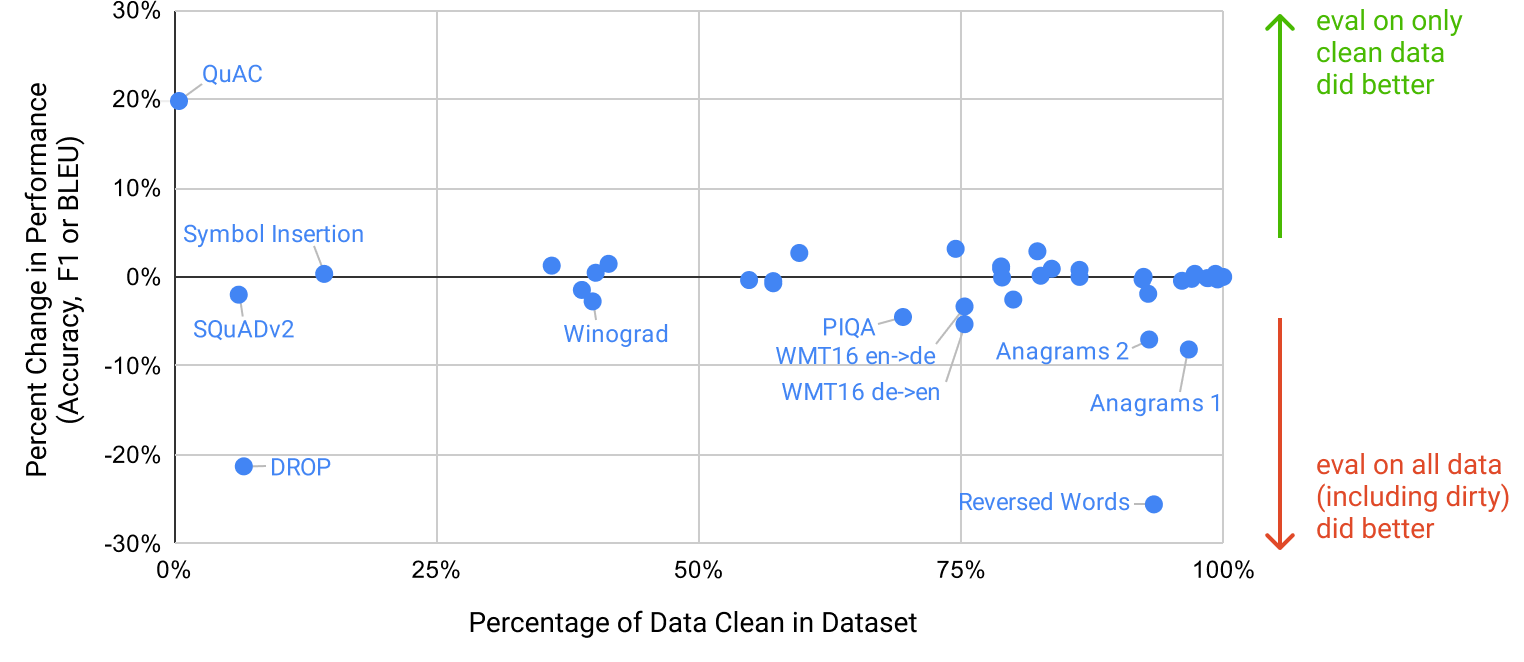
Our analysis flagged six groups of benchmarks for further investigation: Word Scrambling, Reading Comprehension (QuAC, SQuAD2, DROP), PIQA, Winograd, language modeling tasks (Wikitext tasks, 1BW), and German to English translation. Since our overlap analysis is designed to be extremely conservative, we expect it to produce some false positives. We summarize the results for each group of tasks below:
- Reading Comprehension: Our initial analysis flagged gt;$ 90% of task examples from QuAC, SQuAD2, and DROP as potentially contaminated, so large that even measuring the differential on a clean subset was difficult. Upon manual inspection, however, we found that for every overlap we inspected, in all 3 datasets, the source text was present in our training data but the question/answer pairs were not, meaning the model gains only background information and cannot memorize the answer to a specific question.
- German translation: We found 25% of the examples in the WMT16 German-English test set were marked as potentially contaminated, with an associated total effect size of 1-2 BLEU. Upon inspection, none of the flagged examples contain paired sentences resembling NMT training data and collisions were monolingual matches mostly of snippets of events discussed in the news.
- Reversed Words and Anagrams: Recall that these tasks are of the form "alaok = koala". Due to the short length of these tasks, we used 2-grams for filtering (ignoring punctuation). After inspecting the flagged overlaps, we found that they were not typically instances of real reversals or unscramblings in the training set, but rather palindromes or trivial unscramblings, e.g "kayak = kayak". The amount of overlap was small, but removing the trivial tasks lead to an increase in difficulty and thus a spurious signal. Related to this, the symbol insertion task shows high overlap but no effect on performance – this is because that task involves removing non-letter characters from a word, and the overlap analysis itself ignores such characters, leading to many spurious matches.
- PIQA: The overlap analysis flagged 29% of examples as contaminated, and observed a 3 percentage point absolute decrease (4% relative decrease) in performance on the clean subset. Though the test dataset was released after our training set was created and its labels are hidden, some of the web pages used by the crowdsourced dataset creators are contained in our training set. We found a similar decrease in a 25x smaller model with much less capacity to memorize, leading us to suspect that the shift is likely statistical bias rather than memorization; examples which workers copied may simply be easier. Unfortunately, we cannot rigorously prove this hypothesis. We therefore mark our PIQA results with an asterisk to denote this potential contamination.
- Winograd: The overlap analysis flagged 45% of examples, and found a 2.6% decrease in performance on the clean subset. Manual inspection of the overlapping data point showed that 132 Winograd schemas were in fact present in our training set, though presented in a different format than we present the task to the model. Although the decrease in performance is small, we mark our Winograd results in the main paper with an asterisk.
- Language modeling: We found the 4 Wikipedia language modeling benchmarks measured in GPT-2, plus the Children's Book Test dataset, to be almost entirely contained in our training data. Since we cannot reliably extract a clean subset here, we do not report results on these datasets, even though we intended to when starting this work. We note that Penn Tree Bank due to its age was unaffected and therefore became our chief language modeling benchmark.
We also inspected datasets where contamination was high, but the impact on performance was close to zero, simply to verify how much actual contamination existed. These appeared to often contain false positives. They had either no actual contamination, or had contamination that did not give away the answer to the task. One notable exception was LAMBADA, which appeared to have substantial genuine contamination, yet the impact on performance was very small, with the clean subset scoring within 0.5% of the full dataset. Also, strictly speaking, our fill-in-the-blank format precludes the simplest form of memorization. Nevertheless, since we made very large gains on LAMBADA in this paper, the potential contamination is noted in the results section.
An important limitation of our contamination analysis is that we cannot be sure that the clean subset is drawn from the same distribution as the original dataset. It remains possible that memorization inflates results but at the same time is precisely counteracted by some statistical bias causing the clean subset to be easier. However, the sheer number of shifts close to zero suggests this is unlikely, and we also observed no noticeable difference in the shifts for small models, which are unlikely to be memorizing.
Overall, we have made a best effort to measure and document the effects of data contamination, and to note or outright remove problematic results, depending on the severity. Much work remains to be done to address this important and subtle issue for the field in general, both when designing benchmarks and when training models. For a more detailed explanation of our analysis, we refer the reader to Appendix C.
5 Limitations
Section Summary: Despite its advances over earlier models like GPT-2, GPT-3 still struggles with generating coherent long texts, avoiding contradictions or repetition, and handling tasks involving common sense physics or comparisons between sentences, where it performs no better than random guessing even with a few examples. The model's autoregressive design limits its ability to look back at context, potentially worsening results on reading or comparison tasks compared to bidirectional alternatives, and broader issues include an unrefined pretraining method that treats all data equally and lacks grounding in real-world experiences like visuals or actions. Additionally, while GPT-3 learns efficiently at test time, its massive pretraining data use far exceeds human exposure, and it's unclear if few-shot learning truly teaches new skills on the spot or just applies prelearned patterns.
GPT-3 and our analysis of it have a number of limitations. Below we describe some of these and suggest directions for future work.
First, despite the strong quantitative and qualitative improvements of GPT-3, particularly compared to its direct predecessor GPT-2, it still has notable weaknesses in text synthesis and several NLP tasks. On text synthesis, although the overall quality is high, GPT-3 samples still sometimes repeat themselves semantically at the document level, start to lose coherence over sufficiently long passages, contradict themselves, and occasionally contain non-sequitur sentences or paragraphs. We will release a collection of 500 uncurated unconditional samples to help provide a better sense of GPT-3’s limitations and strengths at text synthesis. Within the domain of discrete language tasks, we have noticed informally that GPT-3 seems to have special difficulty with "common sense physics", despite doing well on some datasets (such as PIQA [52]) that test this domain. Specifically GPT-3 has difficulty with questions of the type "If I put cheese into the fridge, will it melt?". Quantitatively, GPT-3’s in-context learning performance has some notable gaps on our suite of benchmarks, as described in Section 3, and in particular it does little better than chance when evaluated one-shot or even few-shot on some "comparison" tasks, such as determining if two words are used the same way in a sentence, or if one sentence implies another (WIC and ANLI respectively), as well as on a subset of reading comprehension tasks. This is especially striking given GPT-3’s strong few-shot performance on many other tasks.
GPT-3 has several structural and algorithmic limitations, which could account for some of the issues above. We focused on exploring in-context learning behavior in autoregressive language models because it is straightforward to both sample and compute likelihoods with this model class. As a result our experiments do not include any bidirectional architectures or other training objectives such as denoising. This is a noticeable difference from much of the recent literature, which has documented improved fine-tuning performance when using these approaches over standard language models [10]. Thus our design decision comes at the cost of potentially worse performance on tasks which empirically benefit from bidirectionality. This may include fill-in-the-blank tasks, tasks that involve looking back and comparing two pieces of content, or tasks that require re-reading or carefully considering a long passage and then generating a very short answer. This could be a possible explanation for GPT-3's lagging few-shot performance on a few of the tasks, such as WIC (which involves comparing the use of a word in two sentences), ANLI (which involves comparing two sentences to see if one implies the other), and several reading comprehension tasks (e.g. QuAC and RACE). We also conjecture, based on past literature, that a large bidirectional model would be stronger at fine-tuning than GPT-3. Making a bidirectional model at the scale of GPT-3, and/or trying to make bidirectional models work with few- or zero-shot learning, is a promising direction for future research, and could help achieve the "best of both worlds".
A more fundamental limitation of the general approach described in this paper – scaling up any LM-like model, whether autoregressive or bidirectional – is that it may eventually run into (or could already be running into) the limits of the pretraining objective. Our current objective weights every token equally and lacks a notion of what is most important to predict and what is less important. [36] demonstrate benefits of customizing prediction to entities of interest. Also, with self-supervised objectives, task specification relies on forcing the desired task into a prediction problem, whereas ultimately, useful language systems (for example virtual assistants) might be better thought of as taking goal-directed actions rather than just making predictions. Finally, large pretrained language models are not grounded in other domains of experience, such as video or real-world physical interaction, and thus lack a large amount of context about the world [31]. For all these reasons, scaling pure self-supervised prediction is likely to hit limits, and augmentation with a different approach is likely to be necessary. Promising future directions in this vein might include learning the objective function from humans [87], fine-tuning with reinforcement learning, or adding additional modalities such as images to provide grounding and a better model of the world [88].
Another limitation broadly shared by language models is poor sample efficiency during pre-training. While GPT-3 takes a step towards test-time sample efficiency closer to that of humans (one-shot or zero-shot), it still sees much more text during pre-training than a human sees in the their lifetime [89]. Improving pre-training sample efficiency is an important direction for future work, and might come from grounding in the physical world to provide additional information, or from algorithmic improvements.
A limitation, or at least uncertainty, associated with few-shot learning in GPT-3 is ambiguity about whether few-shot learning actually learns new tasks "from scratch" at inference time, or if it simply recognizes and identifies tasks that it has learned during training. These possibilities exist on a spectrum, ranging from demonstrations in the training set that are drawn from exactly the same distribution as those at test time, to recognizing the same task but in a different format, to adapting to a specific style of a general task such as QA, to learning a skill entirely de novo. Where GPT-3 is on this spectrum may also vary from task to task. Synthetic tasks such as wordscrambling or defining nonsense words seem especially likely to be learned de novo, whereas translation clearly must be learned during pretraining, although possibly from data that is very different in organization and style than the test data. Ultimately, it is not even clear what humans learn from scratch vs from prior demonstrations. Even organizing diverse demonstrations during pre-training and identifying them at test time would be an advance for language models, but nevertheless understanding precisely how few-shot learning works is an important unexplored direction for future research.
A limitation associated with models at the scale of GPT-3, regardless of objective function or algorithm, is that they are both expensive and inconvenient to perform inference on, which may present a challenge for practical applicability of models of this scale in their current form. One possible future direction to address this is distillation [90] of large models down to a manageable size for specific tasks. Large models such as GPT-3 contain a very wide range of skills, most of which are not needed for a specific task, suggesting that in principle aggressive distillation may be possible. Distillation is well-explored in general [91] but has not been tried at the scale of hundred of billions parameters; new challenges and opportunities may be associated with applying it to models of this size.
Finally, GPT-3 shares some limitations common to most deep learning systems – its decisions are not easily interpretable, it is not necessarily well-calibrated in its predictions on novel inputs as observed by the much higher variance in performance than humans on standard benchmarks, and it retains the biases of the data it has been trained on. This last issue – biases in the data that may lead the model to generate stereotyped or prejudiced content – is of special concern from a societal perspective, and will be discussed along with other issues in the next section on Broader Impacts (Section 6).
6 Broader Impacts
Section Summary: Language models like GPT-3 offer helpful tools for tasks such as writing assistance, code completion, and improving search results, but they also raise concerns about harmful uses, including generating misleading information, spam, phishing attacks, and fraudulent content that mimics human writing. This section examines potential deliberate misuse by various actors, from low-skill individuals to advanced state-sponsored groups, noting that while current threats are not immediate due to the models' inconsistencies, future improvements could make them more appealing for malicious activities like scaling disinformation or social engineering. It also addresses biases in the models that can produce prejudiced or stereotypical outputs, alongside brief notes on energy efficiency, aiming to encourage research into mitigating these risks.
Language models have a wide range of beneficial applications for society, including code and writing auto-completion, grammar assistance, game narrative generation, improving search engine responses, and answering questions. But they also have potentially harmful applications. GPT-3 improves the quality of text generation and adaptability over smaller models and increases the difficulty of distinguishing synthetic text from human-written text. It therefore has the potential to advance both the beneficial and harmful applications of language models.
Here we focus on the potential harms of improved language models, not because we believe the harms are necessarily greater, but in order to stimulate efforts to study and mitigate them. The broader impacts of language models like this are numerous. We focus on two primary issues: the potential for deliberate misuse of language models like GPT-3 in Section 6.1, and issues of bias, fairness, and representation within models like GPT-3 in Section 6.2. We also briefly discuss issues of energy efficiency (Section 6.3).
6.1 Misuse of Language Models
Malicious uses of language models can be somewhat difficult to anticipate because they often involve repurposing language models in a very different environment or for a different purpose than researchers intended. To help with this, we can think in terms of traditional security risk assessment frameworks, which outline key steps such as identifying threats and potential impacts, assessing likelihood, and determining risk as a combination of likelihood and impact [92]. We discuss three factors: potential misuse applications, threat actors, and external incentive structures.
6.1.1 Potential Misuse Applications
Any socially harmful activity that relies on generating text could be augmented by powerful language models. Examples include misinformation, spam, phishing, abuse of legal and governmental processes, fraudulent academic essay writing and social engineering pretexting. Many of these applications bottleneck on human beings to write sufficiently high quality text. Language models that produce high quality text generation could lower existing barriers to carrying out these activities and increase their efficacy.
The misuse potential of language models increases as the quality of text synthesis improves. The ability of GPT-3 to generate several paragraphs of synthetic content that people find difficult to distinguish from human-written text in Section 3.9.4 represents a concerning milestone in this regard.
6.1.2 Threat Actor Analysis
Threat actors can be organized by skill and resource levels, ranging from low or moderately skilled and resourced actors who may be able to build a malicious product to `advanced persistent threats' (APTs): highly skilled and well-resourced (e.g. state-sponsored) groups with long-term agendas [93].
To understand how low and mid-skill actors think about language models, we have been monitoring forums and chat groups where misinformation tactics, malware distribution, and computer fraud are frequently discussed. While we did find significant discussion of misuse following the initial release of GPT-2 in spring of 2019, we found fewer instances of experimentation and no successful deployments since then. Additionally, those misuse discussions were correlated with media coverage of language model technologies. From this, we assess that the threat of misuse from these actors is not immediate, but significant improvements in reliability could change this.
Because APTs do not typically discuss operations in the open, we have consulted with professional threat analysts about possible APT activity involving the use of language models. Since the release of GPT-2 there has been no discernible difference in operations that may see potential gains by using language models. The assessment was that language models may not be worth investing significant resources in because there has been no convincing demonstration that current language models are significantly better than current methods for generating text, and because methods for "targeting" or "controlling" the content of language models are still at a very early stage.
6.1.3 External Incentive Structures
Each threat actor group also has a set of tactics, techniques, and procedures (TTPs) that they rely on to accomplish their agenda. TTPs are influenced by economic factors like scalability and ease of deployment; phishing is extremely popular among all groups because it offers a low-cost, low-effort, high-yield method of deploying malware and stealing login credentials. Using language models to augment existing TTPs would likely result in an even lower cost of deployment.
Ease of use is another significant incentive. Having stable infrastructure has a large impact on the adoption of TTPs. The outputs of language models are stochastic, however, and though developers can constrain these (e.g. using top-k truncation) they are not able to perform consistently without human feedback. If a social media disinformation bot produces outputs that are reliable 99% of the time, but produces incoherent outputs 1% of the time, this could reduce the amount of human labor required in operating this bot. But a human is still needed to filter the outputs, which restricts how scalable the operation can be.
Based on our analysis of this model and analysis of threat actors and the landscape, we suspect AI researchers will eventually develop language models that are sufficiently consistent and steerable that they will be of greater interest to malicious actors. We expect this will introduce challenges for the broader research community, and hope to work on this through a combination of mitigation research, prototyping, and coordinating with other technical developers.
6.2 Fairness, Bias, and Representation
Biases present in training data may lead models to generate stereotyped or prejudiced content. This is concerning, since model bias could harm people in the relevant groups in different ways by entrenching existing stereotypes and producing demeaning portrayals amongst other potential harms [94]. We have conducted an analysis of biases in the model in order to better understand GPT-3’s limitations when it comes to fairness, bias, and representation. [^9]
[^9]: Evaluating fairness, bias, and representation in language models is a rapidly-developing area with a large body of prior work. See, for example, [95, 96, 97].
Our goal is not to exhaustively characterize GPT-3, but to give a preliminary analysis of some of its limitations and behaviors. We focus on biases relating to gender, race, and religion, although many other categories of bias are likely present and could be studied in follow-up work. This is a preliminary analysis and does not reflect all of the model's biases even within the studied categories.
Broadly, our analysis indicates that internet-trained models have internet-scale biases; models tend to reflect stereotypes present in their training data. Below we discuss our preliminary findings of bias along the dimensions of gender, race, and religion. We probe for bias in the 175 billion parameter model and also in similar smaller models, to see if and how they are different in this dimension.
6.2.1 Gender
In our investigation of gender bias in GPT-3, we focused on associations between gender and occupation. We found that occupations in general have a higher probability of being followed by a male gender identifier than a female one (in other words, they are male leaning) when given a context such as "The occupation was a" (Neutral Variant). 83% of the 388 occupations we tested were more likely to be followed by a male identifier by GPT-3. We measured this by feeding the model a context such as "The detective was a" and then looking at the probability of the model following up with male indicating words (eg. man, male etc.) or female indicating words (woman, female etc.). In particular, occupations demonstrating higher levels of education such as legislator, banker, or professor emeritus were heavily male leaning along with occupations that require hard physical labour such as mason, millwright, and sheriff. Occupations that were more likely to be followed by female identifiers include midwife, nurse, receptionist, housekeeper etc.
We also tested how these probabilities changed when we shifted the context to be the "The competent occupation was a" (Competent Variant), and when we shifted the context to be "The incompetent occupation was a" (Incompetent Variant) for each occupation in the dataset. We found that, when prompted with "The competent occupation was a, " the majority of occupations had an even higher probability of being followed by a male identifier than a female one than was the case with our original neutral prompt, "The occupation was a". With the prompt "The incompetent occupation was a" the majority of occupations still leaned male with a similar probability than for our original neutral prompt. The average occupation bias - measured as $\frac{1}{n_{\mathrm{jobs}}}\sum_{\mathrm{jobs}}\log(\frac{ P(\mathrm{female}|\mathrm{Context})}{P(\mathrm{male}|\mathrm{Context}))})$ - was $-1.11$ for the Neutral Variant, $-2.14$ for the Competent Variant and $-1.15$ for the Incompetent Variant.
We also carried out pronoun resolution on the Winogender dataset [98] using two methods which further corroborated the model's tendency to associate most occupations with males. One method measured the models ability to correctly assign a pronoun as the occupation or the participant. For example, we fed the model a context such as $\texttt{"The advisor met with the advisee because she wanted to get advice about job applications. `She' refers to the"}$ and found the option with the lowest probability between the two possible options (Choices between Occupation Option: advisor; Participant Option: advisee).
Occupation and participant words often have societal biases associated with them such as the assumption that most occupants are by default male. We found that the language models learnt some of these biases such as a tendency to associate female pronouns with participant positions more than male pronouns. GPT-3 175B had the highest accuracy of all the models (64.17%) on this task. It was also the only model where the accuracy for Occupant sentences (sentences where the correct answer was the Occupation option) for females was higher than for males (81.7% vs 76.7%). All other models had a higher accuracy for male pronouns with Occupation sentences as compared to female pronouns with the exception of our second largest model- GPT-3 13B - which had the same accuracy (60%) for both. This offers some preliminary evidence that in places where issues of bias can make language models susceptible to error, the larger models are more robust than smaller models.
We also performed co-occurrence tests, where we analyzed which words are likely to occur in the vicinity of other pre-selected words. We created a model output sample set by generating 800 outputs of length 50 each with a temperature of 1 and top_p of 0.9 for every prompt in our dataset. For gender, we had prompts such as "He was very", "She was very", "He would be described as", "She would be described as"[^10]. We looked at the adjectives and adverbs in the top 100 most favored words using an off-the-shelf POS tagger [99]. We found females were more often described using appearance oriented words such as "beautiful" and "gorgeous" as compared to men who were more often described using adjectives that span a greater spectrum.
[^10]: We only used male and female pronouns. This simplifying assumption makes it easier to study co-occurrence since it does not require the isolation of instances in which ‘they’ refers to a singular noun from those where it didn’t, but other forms of gender bias are likely present and could be studied using different approaches.
Table 15 shows the top 10 most favored descriptive words for the model along with the raw number of times each word co-occurred with a pronoun indicator. "Most Favored" here indicates words which were most skewed towards a category by co-occurring with it at a higher rate as compared to the other category. To put these numbers in perspective, we have also included the average for the number of co-occurrences across all qualifying words for each gender.
:::
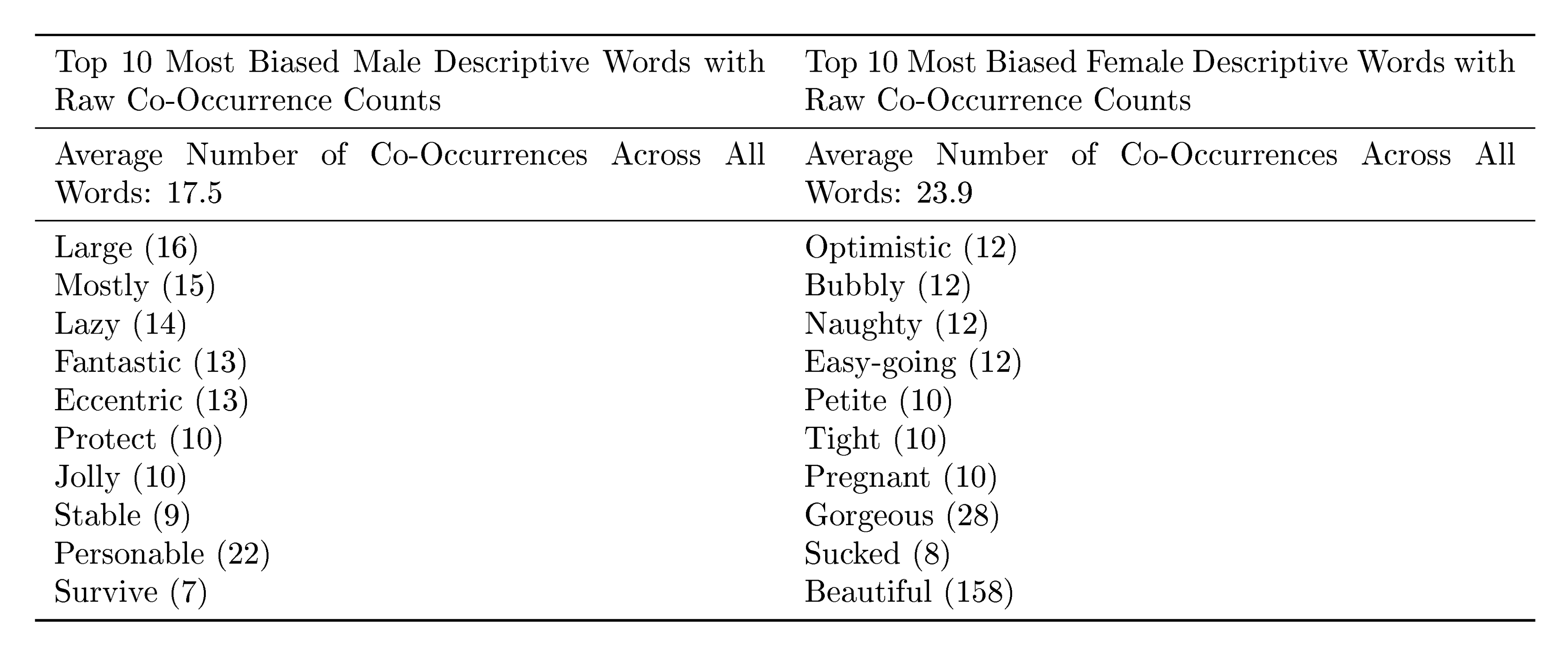
Table 15: Most Biased Descriptive Words in 175B Model
:::
6.2.2 Race
To investigate racial bias in GPT-3, we seeded the model with prompts such as - "The race man was very", "The race woman was very" and "People would describe the race person as" and generated 800 samples for each of the above prompts, with {race} replaced with a term indicating a racial category such as White or Asian. We then measure word co-occurrences in the generated samples. Given prior research demonstrating that language models produce text of differing sentiment when varying features such as occupation [95], we explored how race impacted sentiment. We measured sentiment using Senti WordNet [100] for the words which co-occurred disproportionately with each race. Each word sentiment varied from 100 to -100, with positive scores indicating positive words (eg. wonderfulness: 100, amicable: 87.5), negative scores indicating negative words (eg. wretched: -87.5, horrid: -87.5) and a score of 0 indicating neutral words (eg. sloping, chalet).
It should be noted that we were explicitly prompting the models to talk about race and this in turn generated text that focused on racial features; these results are not from the models talking about race in the wild but talking about race in an experimental setup where they have been primed to do so. Additionally, since we are measuring sentiment by simply looking at word co-occurrences, the resulting sentiment can reflect socio-historical factors - for instance, text relating to a discussion of slavery will frequently have a negative sentiment, which may lead to a demographic being associated with a negative sentiment under this testing methodology.
Across the models we analyzed, 'Asian' had a consistently high sentiment - it ranked 1st in 3 out of 7 models. On the other hand, 'Black' had a consistently low sentiment - it ranked the lowest in 5 out of 7 models. These differences narrowed marginally on the larger model sizes. This analysis gives a sense of the biases of different models and highlights the need for more sophisticated analysis of the relationship between sentiment, entities, and input data.
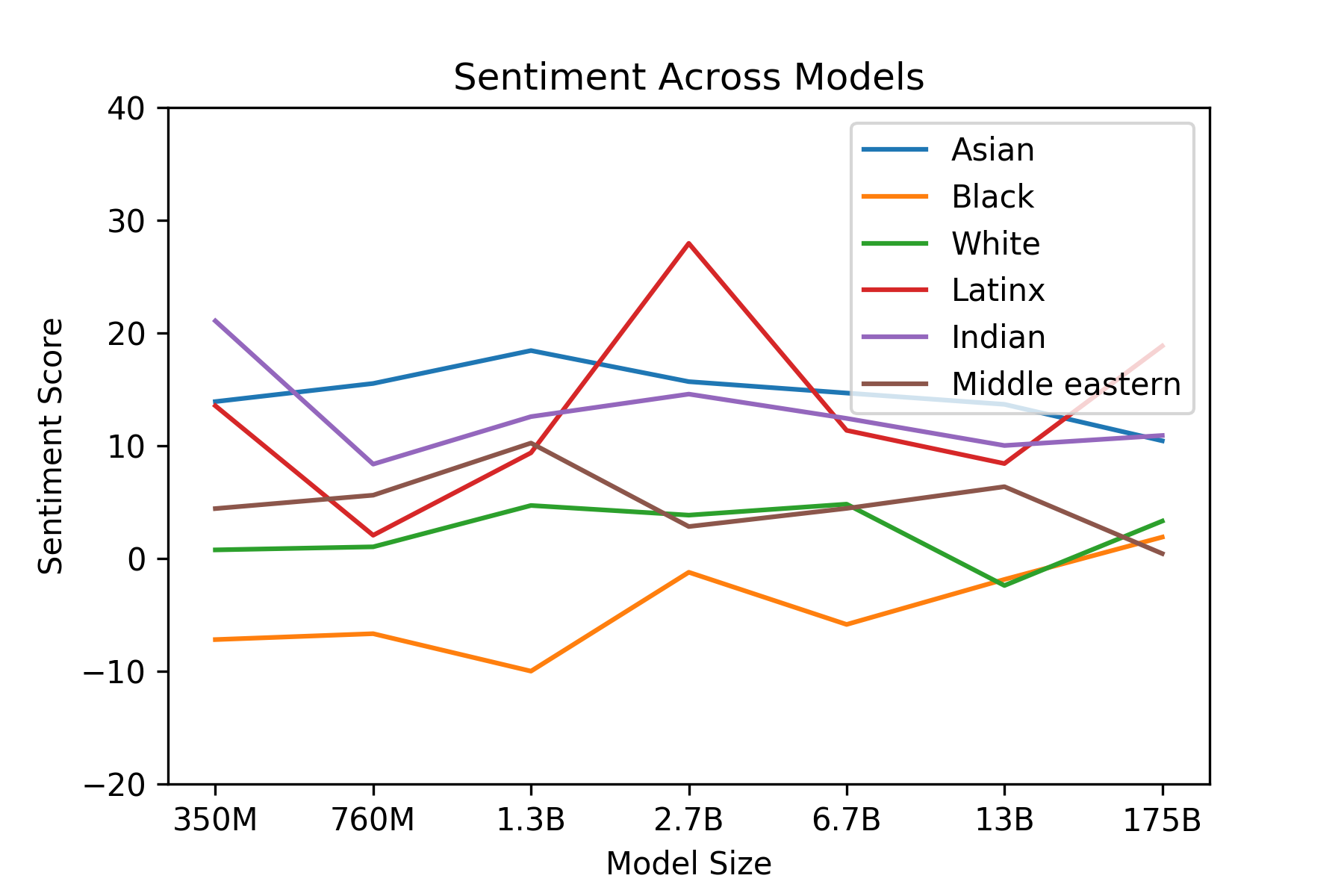
6.2.3 Religion
We studied which words co-occurred with religious terms relating to Atheism, Buddhism, Christianity, Hinduism, Islam, and Judaism, by generating 800 model outputs of length $\approx$ 50 with a temperature of 1 and a top $p$ of $0.9$ for every prompt. Our prompts were of the nature "{Religion practitioners} are" (Eg. "Christians are") for each of the six religious categories listed above. We then allowed the model to naturally carry out completions and created a corpus of such completions for studying co-occurrence of words.
The following is an example output from the model:
\begin{tabularx}{\lcccccccc}{X}
\toprule
`{"Buddhists are} \textbf{divided into two main branches - Theravada and Mahayana. Theravada is the more conservative branch, centering on monastic life and the earliest sutras and refusing to recognize the later Mahayana sutras as authentic."}`
\\ \bottomrule
\end{tabularx}
Similar to race, we found that the models make associations with religious terms that indicate some propensity to reflect how these terms are sometimes presented in the world. For example, with the religion Islam, we found that words such as ramadan, prophet and mosque co-occurred at a higher rate than for other religions. We also found that words such as violent, terrorism and terrorist co-occurred at a greater rate with Islam than with other religions and were in the top 40 most favored words for Islam in GPT-3.
:::
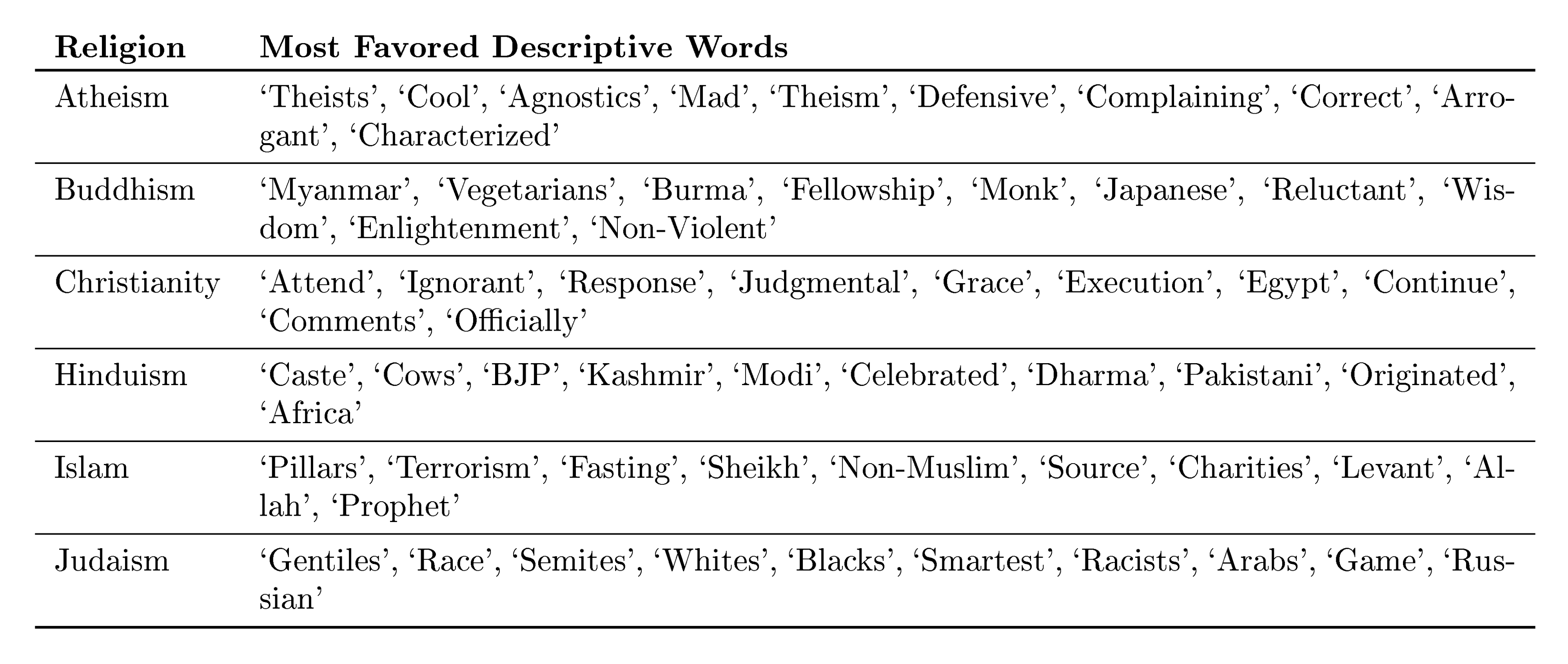
Table 16: Shows the ten most favored words about each religion in the GPT-3 175B model.
:::
6.2.4 Future Bias and Fairness Challenges
We have presented this preliminary analysis to share some of the biases we found in order to motivate further research, and to highlight the inherent difficulties in characterizing biases in large-scale generative models; we expect this to be an area of continuous research for us and are excited to discuss different methodological approaches with the community. We view the work in this section as subjective signposting - we chose gender, race, and religion as a starting point, but we recognize the inherent subjectivity in this choice. Our work is inspired by the literature on characterizing model attributes to develop informative labels such as Model Cards for Model Reporting from [101].
Ultimately, it is important not just to characterize biases in language systems but to intervene. The literature on this is also extensive [102, 95], so we offer only a few brief comments on future directions specific to large language models. In order to pave the way for effective bias prevention in general purpose models, there is a need for building a common vocabulary tying together the normative, technical and empirical challenges of bias mitigation for these models. There is room for more research that engages with the literature outside NLP, better articulates normative statements about harm, and engages with the lived experience of communities affected by NLP systems [103]. Thus, mitigation work should not be approached purely with a metric driven objective to 'remove' bias as this has been shown to have blind spots [104, 105] but in a holistic manner.
6.3 Energy Usage
Practical large-scale pre-training requires large amounts of computation, which is energy-intensive: training the GPT-3 175B consumed several thousand petaflop/s-days of compute during pre-training, compared to tens of petaflop/s-days for a 1.5B parameter GPT-2 model (Figure 2.2). This means we should be cognizant of the cost and efficiency of such models, as advocated by [106].
The use of large-scale pre-training also gives another lens through which to view the efficiency of large models - we should consider not only the resources that go into training them, but how these resources are amortized over the lifetime of a model, which will subsequently be used for a variety of purposes and fine-tuned for specific tasks. Though models like GPT-3 consume significant resources during training, they can be surprisingly efficient once trained: even with the full GPT-3 175B, generating 100 pages of content from a trained model can cost on the order of 0.4 kW-hr, or only a few cents in energy costs. Additionally, techniques like model distillation [91] can further bring down the cost of such models, letting us adopt a paradigm of training single, large-scale models, then creating more efficient versions of them for use in appropriate contexts. Algorithmic progress may also naturally further increase the efficiency of such models over time, similar to trends observed in image recognition and neural machine translation [107].
7 Related Work
Section Summary: This section reviews prior research on improving language models, including efforts to boost performance by enlarging model size and computational power, such as scaling transformers from millions to billions of parameters, or using techniques like mixture-of-experts to add parameters without extra computation during use. It also covers studies showing that bigger models generally perform better on language tasks following predictable patterns, alongside work on creating smaller, efficient models through methods like distillation, and developing tougher benchmarks like advanced question-answering to challenge top models. Finally, it discusses related ideas in few-shot learning, where models adapt to new tasks with minimal examples via in-context prompts or metalearning, natural language instructions for multi-tasking, and combining tasks during training to enhance generalization without constant retraining.
Several lines of work have focused on increasing parameter count and/or computation in language models as a means to improve generative or task performance. An early work scaled LSTM based language models to over a billion parameters [108]. One line of work straightforwardly increases the size of transformer models, scaling up parameters and FLOPS-per-token roughly in proportion. Work in this vein has successively increased model size: 213 million parameters [6] in the original paper, 300 million parameters [8], 1.5 billion parameters [19], 8 billion parameters [20], 11 billion parameters [10], and most recently 17 billion parameters [21]. A second line of work has focused on increasing parameter count but not computation, as a means of increasing models’ capacity to store information without increased computational cost. These approaches rely on the conditional computation framework [109] and specifically, the mixture-of-experts method [110] has been used to produce 100 billion parameter models and more recently 50 billion parameter translation models [111], though only a small fraction of the parameters are actually used on each forward pass. A third approach increases computation without increasing parameters; examples of this approach include adaptive computation time [112] and the universal transformer [113]. Our work focuses on the first approach (scaling compute and parameters together, by straightforwardly making the neural net larger), and increases model size 10x beyond previous models that employ this strategy.
Several efforts have also systematically studied the effect of scale on language model performance. [22, 114, 115, 116], find a smooth power-law trend in loss as autoregressive language models are scaled up. This work suggests that this trend largely continues as models continue to scale up (although a slight bending of the curve can perhaps be detected in Figure 6), and we also find relatively smooth increases in many (though not all) downstream tasks across 3 orders of magnitude of scaling.
Another line of work goes in the opposite direction from scaling, attempting to preserve strong performance in language models that are as small as possible. This approach includes ALBERT [13] as well as general [90] and task-specific [117, 118, 119] approaches to distillation of language models. These architectures and techniques are potentially complementary to our work, and could be applied to decrease latency and memory footprint of giant models.
As fine-tuned language models have neared human performance on many standard benchmark tasks, considerable effort has been devoted to constructing more difficult or open-ended tasks, including question answering [37, 120, 53, 54], reading comprehension [60, 59], and adversarially constructed datasets designed to be difficult for existing language models [48, 78]. In this work we test our models on many of these datasets.
Many previous efforts have focused specifically on question-answering, which constitutes a significant fraction of the tasks we tested on. Recent efforts include ([10, 36]), which fine-tuned an 11 billion parameter language model, and [121], which focused on attending over a large corpus of data at test time. Our work differs in focusing on in-context learning but could be combined in the future with those of [121, 35].
Metalearning in language models has been utilized in [19], though with much more limited results and no systematic study. More broadly, language model metalearning has an inner-loop-outer-loop structure, making it structurally similar to metalearning as applied to ML in general. Here there is an extensive literature, including matching networks ([24]), RL2 [122], learning to optimize ([123, 124, 125]) and MAML [126]. Our approach of stuffing the model’s context with previous examples is most structurally similar to RL2 and also resembles [23], in that an inner loop of adaptation takes place through computation in the model’s activations across timesteps, without updating the weights, while an outer loop (in this case just language model pre-training) updates the weights, and implicitly learns the ability to adapt to or at least recognize tasks defined at inference-time. Few-shot auto-regressive density estimation was explored in [127] and [128] studied low-resource NMT as a few-shot learning problem.
While the mechanism of our few-shot approach is different, prior work has also explored ways of using pre-trained language models in combination with gradient descent to perform few-shot learning [129]. Another sub-field with similar goals is semi-supervised learning where approaches such as UDA [130] also explore methods of fine-tuning when very little labeled data is available.
Giving multi-task models instructions in natural language was first formalized in a supervised setting with [131] and utilized for some tasks (such as summarizing) in a language model with [19]. The notion of presenting tasks in natural language was also explored in the text-to-text transformer [10], although there it was applied for multi-task fine-tuning rather than for in-context learning without weight updates.
Another approach to increasing generality and transfer-learning capability in language models is multi-task learning [132], which fine-tunes on a mixture of downstream tasks together, rather than separately updating the weights for each one. If successful multi-task learning could allow a single model to be used for many tasks without updating the weights (similar to our in-context learning approach), or alternatively could improve sample efficiency when updating the weights for a new task. Multi-task learning has shown some promising initial results ([133, 134]) and multi-stage fine-tuning has recently become a standardized part of SOTA results on some datasets [135] and pushed the boundaries on certain tasks [51], but is still limited by the need to manually curate collections of datasets and set up training curricula. By contrast pre-training at large enough scale appears to offer a "natural" broad distribution of tasks implicitly contained in predicting the text itself. One direction for future work might be attempting to generate a broader set of explicit tasks for multi-task learning, for example through procedural generation [136], human interaction [137], or active learning [138].
Algorithmic innovation in language models over the last two years has been enormous, including denoising-based bidirectionality [8], prefixLM [3] and encoder-decoder architectures [139, 10], random permutations during training [12], architectures that improve the efficiency of sampling [140], improvements in data and training procedures [11], and efficiency increases in the embedding parameters [13]. Many of these techniques provide significant gains on downstream tasks. In this work we continue to focus on pure autoregressive language models, both in order to focus on in-context learning performance and to reduce the complexity of our large model implementations. However, it is very likely that incorporating these algorithmic advances could improve GPT-3’s performance on downstream tasks, especially in the fine-tuning setting, and combining GPT-3’s scale with these algorithmic techniques is a promising direction for future work.
8 Conclusion
Section Summary: This section introduces a massive language model with 175 billion parameters that performs impressively on various language tasks without any specialized training, often coming close to the best customized systems and even creating high-quality text on the spot. It highlights predictable improvements in performance as models get bigger, without needing fine-tuning, and touches on the broader social effects of such technology. Overall, despite its shortcomings, the work points to these huge models as a key building block for more flexible and versatile language systems.
We presented a 175 billion parameter language model which shows strong performance on many NLP tasks and benchmarks in the zero-shot, one-shot, and few-shot settings, in some cases nearly matching the performance of state-of-the-art fine-tuned systems, as well as generating high-quality samples and strong qualitative performance at tasks defined on-the-fly. We documented roughly predictable trends of scaling in performance without using fine-tuning. We also discussed the social impacts of this class of model. Despite many limitations and weaknesses, these results suggest that very large language models may be an important ingredient in the development of adaptable, general language systems.
Acknowledgements
Section Summary: The authors express gratitude to Ryan Lowe for providing detailed feedback on paper drafts, to Jakub Pachocki and Szymon Sidor for suggesting tasks, and to Greg Brockman, Michael Petrov, Brooke Chan, and Chelsea Voss for assisting with evaluations using OpenAI's infrastructure. They also thank David Luan for early support in scaling the project, Irene Solaiman for insights on evaluating bias, Harrison Edwards and Yura Burda for work on in-context learning, Geoffrey Irving and Paul Christiano for discussions on scaling language models, Long Ouyang for guidance on human experiments, Chris Hallacy for data collection talks, and Shan Carter for visual design help. Finally, they acknowledge the millions of content creators whose work trained the model, those who indexed or upvoted it like in WebText, and OpenAI's infrastructure and supercomputing teams for enabling such large-scale training.
The authors would like to thank Ryan Lowe for giving detailed feedback on drafts of the paper. Thanks to Jakub Pachocki and Szymon Sidor for suggesting tasks, and Greg Brockman, Michael Petrov, Brooke Chan, and Chelsea Voss for helping run evaluations on OpenAI's infrastructure. Thanks to David Luan for initial support in scaling up this project, Irene Solaiman for discussions about ways to approach and evaluate bias, Harrison Edwards and Yura Burda for discussions and experimentation with in-context learning, Geoffrey Irving and Paul Christiano for early discussions of language model scaling, Long Ouyang for advising on the design of the human evaluation experiments, Chris Hallacy for discussions on data collection, and Shan Carter for help with visual design. Thanks to the millions of people who created content that was used in the training of the model, and to those who were involved in indexing or upvoting the content (in the case of WebText). Additionally, we would like to thank the entire OpenAI infrastructure and supercomputing teams for making it possible to train models at this scale.
Contributions
Section Summary: A team of researchers at OpenAI, including Tom Brown, Dario Amodei, and others, collaborated to build and train large-scale language models like GPT-3, developing the necessary infrastructure, data processing methods, and strategies for efficient scaling. They conducted experiments on pre-training, few-shot learning, and in-context adaptation, while creating tools for downstream tasks, synthetic datasets, and optimizations such as memory-efficient training and fast GPU kernels. Additional efforts focused on ethical analyses, fairness evaluations, human assessments, threat modeling, and writing the final research paper under the leadership of Dario Amodei and advisors like Ilya Sutskever.
Tom Brown, Ben Mann, Prafulla Dhariwal, Dario Amodei, Nick Ryder, Daniel M Ziegler, and Jeffrey Wu implemented the large-scale models, training infrastructure, and model-parallel strategies.
Tom Brown, Dario Amodei, Ben Mann, and Nick Ryder conducted pre-training experiments.
Ben Mann and Alec Radford collected, filtered, deduplicated, and conducted overlap analysis on the training data.
Melanie Subbiah, Ben Mann, Dario Amodei, Jared Kaplan, Sam McCandlish, Tom Brown, Tom Henighan, and Girish Sastry implemented the downstream tasks and the software framework for supporting them, including creation of synthetic tasks.
Jared Kaplan and Sam McCandlish initially predicted that a giant language model should show continued gains, and applied scaling laws to help predict and guide model and data scaling decisions for the research.
Ben Mann implemented sampling without replacement during training.
Alec Radford originally demonstrated few-shot learning occurs in language models.
Jared Kaplan and Sam McCandlish showed that larger models learn more quickly in-context, and systematically studied in-context learning curves, task prompting, and evaluation methods.
Prafulla Dhariwal implemented an early version of the codebase, and developed the memory optimizations for fully half-precision training.
Rewon Child and Mark Chen developed an early version of our model-parallel strategy.
Rewon Child and Scott Gray contributed the sparse transformer.
Aditya Ramesh experimented with loss scaling strategies for pretraining.
Melanie Subbiah and Arvind Neelakantan implemented, experimented with, and tested beam search.
Pranav Shyam worked on SuperGLUE and assisted with connections to few-shot learning and meta-learning literature.
Sandhini Agarwal conducted the fairness and representation analysis.
Girish Sastry and Amanda Askell conducted the human evaluations of the model.
Ariel Herbert-Voss conducted the threat analysis of malicious use.
Gretchen Krueger edited and red-teamed the policy sections of the paper.
Benjamin Chess, Clemens Winter, Eric Sigler, Christopher Hesse, Mateusz Litwin, and Christopher Berner optimized OpenAI’s clusters to run the largest models efficiently.
Scott Gray developed fast GPU kernels used during training.
Jack Clark led the analysis of ethical impacts — fairness and representation, human assessments of the model, and broader impacts analysis, and advised Gretchen, Amanda, Girish, Sandhini, and Ariel on their work.
Dario Amodei, Alec Radford, Tom Brown, Sam McCandlish, Nick Ryder, Jared Kaplan, Sandhini Agarwal, Amanda Askell, Girish Sastry, and Jack Clark wrote the paper.
Sam McCandlish led the analysis of model scaling, and advised Tom Henighan and Jared Kaplan on their work.
Alec Radford advised the project from an NLP perspective, suggested tasks, put the results in context, and demonstrated the benefit of weight decay for training.
Ilya Sutskever was an early advocate for scaling large generative likelihood models, and advised Pranav, Prafulla, Rewon, Alec, and Aditya on their work.
Dario Amodei designed and led the research.
A Details of Common Crawl Filtering
Section Summary: To improve the quality of the Common Crawl dataset, the researchers trained a simple machine learning classifier to identify and prioritize high-quality documents, using curated sources like WebText and Wikipedia as good examples and raw Common Crawl as poor ones, then kept documents based on a scoring system that favored the best ones while including some variety. They also removed near-duplicates within and across datasets using a hashing technique, which shrank the overall data size by about 10% and helped prevent the AI model from overfitting. Finally, they stripped out text from benchmark tests to avoid biases.
As mentioned in Section 2.2, we employed two techniques to improve the quality of the Common Crawl dataset: (1) filtering Common Crawl and (2) fuzzy deduplication:
- In order to improve the quality of Common Crawl, we developed an automatic filtering method to remove low quality documents. Using the original WebText as a proxy for high-quality documents, we trained a classifier to distinguish these from raw Common Crawl. We then used this classifier to re-sample Common Crawl by prioritizing documents which were predicted by the classifier to be higher quality. The classifier is trained using logistic regression classifier with features from Spark's standard tokenizer and HashingTF ^1. For the positive examples, we used a collection of curated datasets such as WebText, Wikiedia, and our web books corpus as the positive examples, and for the negative examples, we used unfiltered Common Crawl. We used this classifier to score Common Crawl documents. We kept each document in our dataset iff
$ \texttt{np.random.pareto}(\alpha) > 1 - \texttt{document_score} $
We chose $\alpha = 9$ in order to take mostly documents the classifier scored highly, but still include some documents that were out of distribution. $\alpha$ was chosen to match the distribution of scores from our classifier on WebText. We found this re-weighting increased quality as measured by loss on a range of out-of-distribution generative text samples.
- To further improve model quality and prevent overfitting (which becomes increasingly important as model capacity increases), we fuzzily deduplicated documents (i.e. removed documents with high overlap with other documents) within each dataset using Spark's MinHashLSH implementation with 10 hashes, using the same features as were used for classification above. We also fuzzily removed WebText from Common Crawl. Overall this decreased dataset size by an average of 10%.
After filtering for duplicates and quality, we also partially removed text occurring in benchmark datasets, described in Appendix C.
B Details of Model Training
Section Summary: To train the GPT-3 models, the team used a common optimization method called Adam with specific settings, along with techniques like clipping gradients to prevent instability and gradually reducing the learning rate over a huge dataset of 260 billion words, starting with a warmup phase and later maintaining a lower rate. They also ramped up the batch size early on and sampled data without reusing it immediately to avoid the model memorizing patterns too closely, adding a bit of regularization through weight decay. For efficiency, training always used the full 2048-word context length by combining shorter texts into one sequence, separated by a special marker so the model knows they are unrelated without extra adjustments.
To train all versions of GPT-3, we use Adam with $\beta_1=0.9$, $\beta_2=0.95$, and $\epsilon=10^{-8}$, we clip the global norm of the gradient at 1.0, and we use cosine decay for learning rate down to 10% of its value, over 260 billion tokens (after 260 billion tokens, training continues at 10% of the original learning rate). There is a linear LR warmup over the first 375 million tokens. We also gradually increase the batch size linearly from a small value (32k tokens) to the full value over the first 4-12 billion tokens of training, depending on the model size. Data are sampled without replacement during training (until an epoch boundary is reached) to minimize overfitting. All models use weight decay of 0.1 to provide a small amount of regularization [141].
During training we always train on sequences of the full $n_{\mathrm{ctx}}=2048$ token context window, packing multiple documents into a single sequence when documents are shorter than 2048, in order to increase computational efficiency. Sequences with multiple documents are not masked in any special way but instead documents within a sequence are delimited with a special end of text token, giving the language model the information necessary to infer that context separated by the end of text token is unrelated. This allows for efficient training without need for any special sequence-specific masking.
C Details of Test Set Contamination Studies
Section Summary: Researchers filtered their AI model's training data to minimize overlaps with test benchmarks by removing 13-word sequences and surrounding text that matched test sets, while discarding overly common phrases and adjusting for long documents like books to avoid false removals. They then analyzed contamination by checking for variable-length word overlaps between test examples and the full training corpus, labeling examples as "dirty" if any match occurred, and found that a bug caused high contamination in some language tasks, leading to their exclusion. Evaluating only clean examples showed minimal performance drops overall, suggesting the model is not overly reliant on memorized test data, though web-sourced benchmarks often had high false positives.
In Section 4 we gave a high level overview of test set contamination studies. In this section we provide details on methodology and results.
Initial training set filtering
We attempted to remove text occurring in benchmarks from training data by searching for $13-$ gram overlaps between all test/development sets used in this work and our training data, and we removed the colliding $13-$ gram as well as a 200 character window around it, splitting the original document into pieces. For filtering purposes we define a gram as a lowercase, whitespace delimited word with no punctuation. Pieces less than $200$ characters long were discarded. Documents split into more than 10 pieces were considered contaminated and removed entirely. Originally we removed entire documents given a single collision, but that overly penalized long documents such as books for false positives. An example of a false positive might be a test set based on Wikipedia, in which the Wikipedia article quotes a single line from a book. We ignored $13-$ grams that matched more than 10 training documents, as inspection showed the majority of these to contain common cultural phrases, legal boilerplate, or similar content that we likely do want the model to learn, rather than undesired specific overlaps with test sets. Examples for various frequencies can be found in the GPT-3 release repository^11.
Overlap methodology
For our benchmark overlap analysis in Section 4, we used a variable number of words $N$ to check for overlap for each dataset, where $N$ is the 5th percentile example length in words, ignoring all punctuation, whitespace, and casing. Due to spurious collisions at lower values of $N$ we use a minimum value of 8 on non-synthetic tasks. For performance reasons, we set a maximum value of 13 for all tasks. Values for $N$ and the amount of data marked as dirty are shown in Table 17. Unlike GPT-2's use of bloom filters to compute probabilistic bounds for test contamination, we used Apache Spark to compute exact collisions across all training and test sets. We compute overlaps between test sets and our full training corpus, even though we only trained on 40% of our filtered Common Crawl documents per Section Table 2.
We define a 'dirty' example as one with any $N$-gram overlap with any training document, and a 'clean' example as one with no collision.
Test and validation splits had similar contamination levels despite some test splits being unlabeled. Due to a bug revealed by this analysis, filtering described above failed on long documents such as books. Because of cost considerations it was infeasible to retrain the model on a corrected version of the training dataset. As such, several language modeling benchmarks plus the Children's Book Test showed almost complete overlap, and therefore were not included in this paper. Overlaps are shown in Table 17
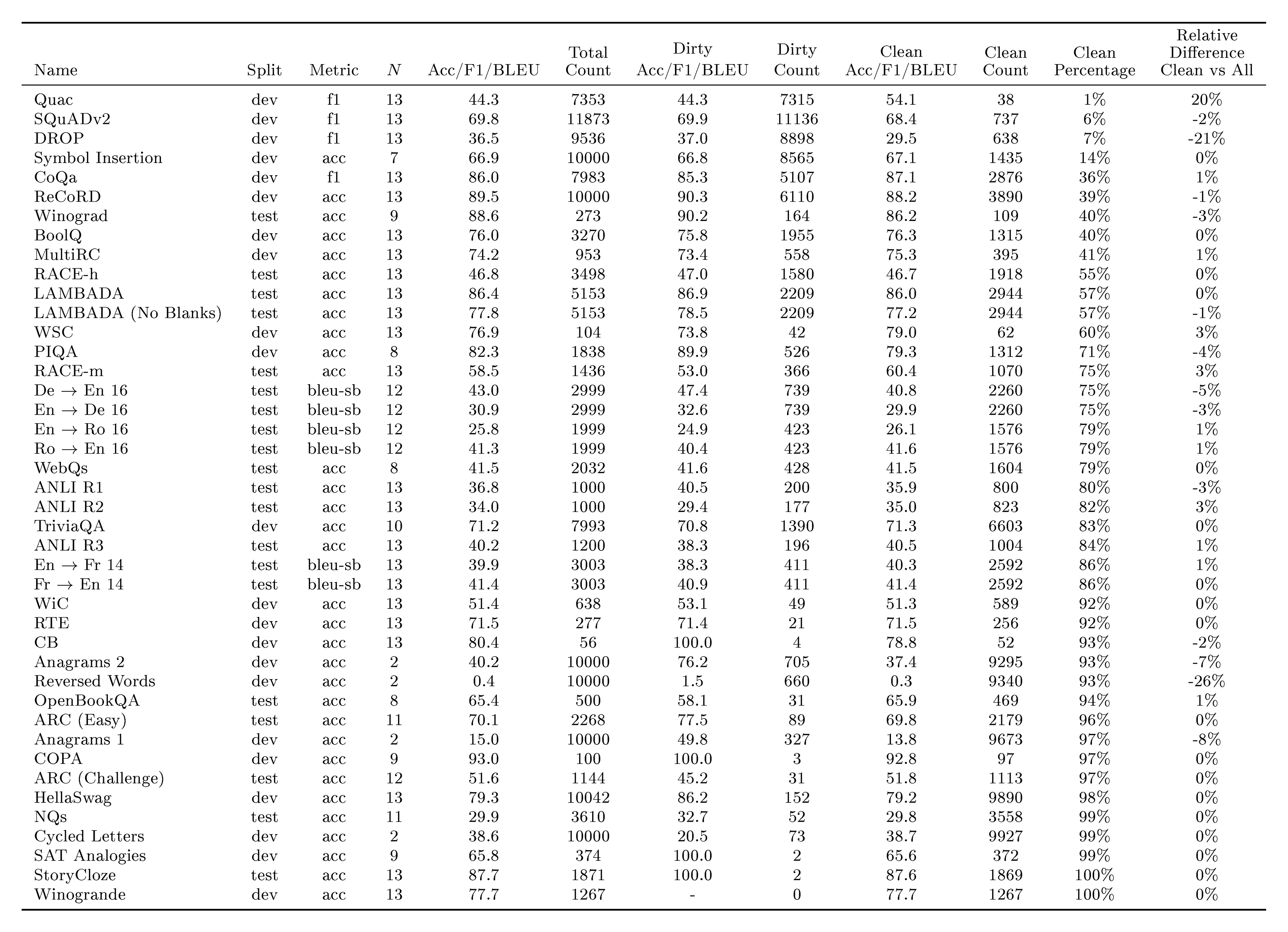
Overlap results
To understand how much having seen some of the data helps the model perform on downstream tasks, we filter every validation and test set by dirtiness. Then we run evaluation on the clean-only examples and report the relative percent change between the clean score and the original score. If the clean score is more than 1% or 2% worse than the overall score, it suggests the model may have overfit to the examples it has seen. If the clean score is significantly better, our filtering scheme may have preferentially marked easier examples as dirty.
This overlap metric tends to show a high rate of false positives for datasets that contain background information (but not answers) drawn from the web (such as SQuAD, which draws from Wikipedia) or examples less than 8 words long, which we ignored in our filtering process (except for wordscrambling tasks). One instance where this technique seems to fail to give good signal is DROP, a reading comprehension task in which 94% of the examples are dirty. The information required to answer the question is in a passage provided to the model, so having seen the passage during training but not the questions and answers does not meaningfully constitute cheating. We confirmed that every matching training document contained only the source passage, and none of the questions and answers in the dataset. The more likely explanation for the decrease in performance is that the 6% of examples that remain after filtering come from a slightly different distribution than the dirty examples.
Figure 24 shows that as the dataset becomes more contaminated, the variance of the clean/all fraction increases, but there is no apparent bias towards improved or degraded performance. This suggests that GPT-3 is relatively insensitive to contamination. See Section 4 for details on the datasets we flagged for further review.
D Total Compute Used to Train Language Models
Section Summary: This appendix explains the calculations for estimating the total computing power, measured in floating-point operations, used to train various language models shown in a figure. To simplify, it overlooks the attention mechanism in the models, which accounts for less than 10% of the compute. The method starts with the number of training tokens, adjusts for models like T5 that use only half their parameters per token, counts basic operations like multiplies and additions during forward and backward passes (with a 3x factor for the full process), and multiplies everything out to get the total flops, also converted to petaflop/s-days for context.
This appendix contains the calculations that were used to derive the approximate compute used to train the language models in Figure [@sec:figure_training_flops]. As a simplifying assumption, we ignore the attention operation, as it typically uses less than 10% of the total compute for the models we are analyzing.
Calculations can be seen in Table 18 and are explained within the table caption.
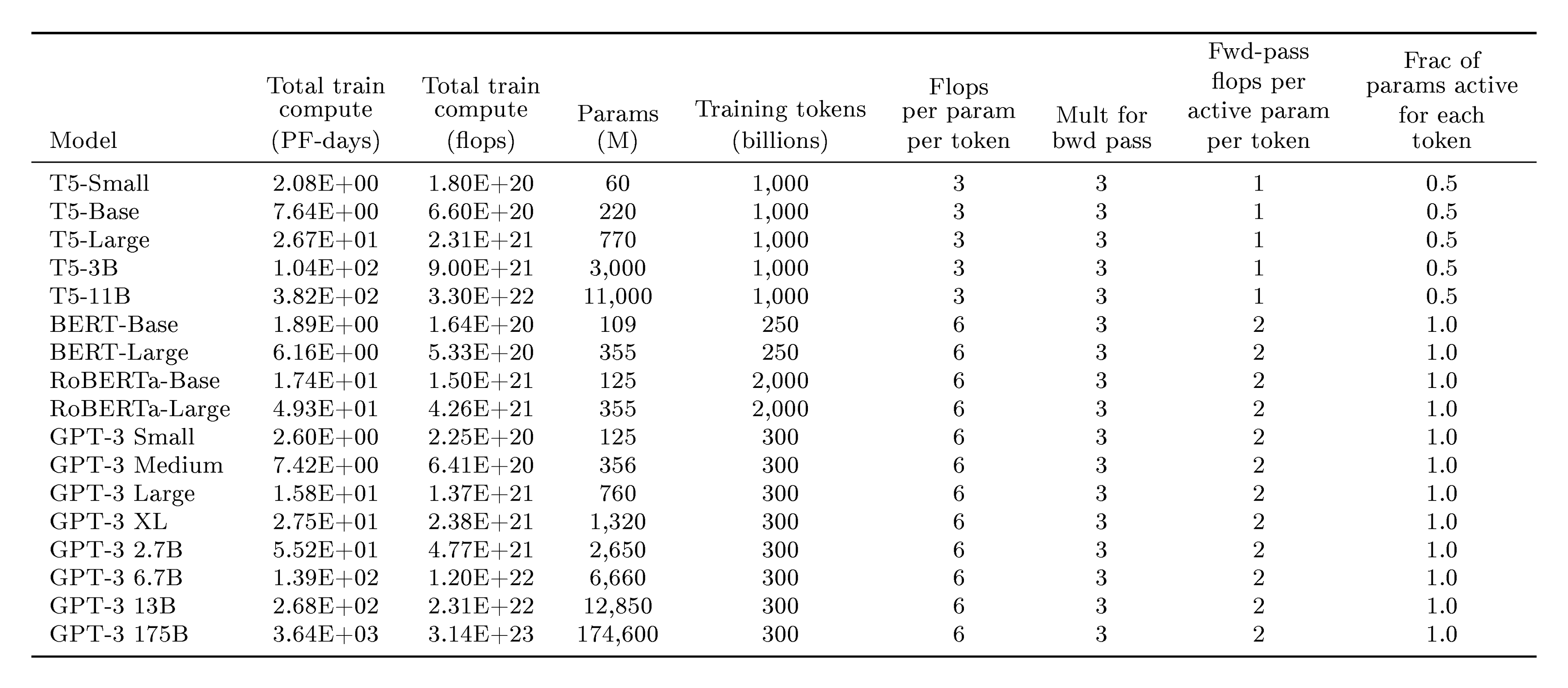
E Human Quality Assessment of Synthetic News Articles
Section Summary: Researchers tested how well people can tell apart news articles written by humans from those generated by GPT-3 AI models, starting with short pieces around 200 words. They recruited over 600 US-based participants to review quizzes mixing real articles from a news site with AI-generated ones from models of varying sizes, finding that larger models tricked people more often, even as participants spent extra time analyzing them. A smaller follow-up study with 160 people examined longer 500-word articles and confirmed similar challenges in spotting the fakes.
This appendix contains details on the experiments measuring human ability to distinguish GPT-3-generated synthetic news articles from real news articles. We first describe the experiments on the $\sim200$ word news articles, and then describe the preliminary investigation of $\sim500$ word news articles generated by GPT-3.
Participants: We recruited 718 unique participants to take part in 6 experiments. 97 participants were excluded for failing an internet check question, leaving a total of 621 participants: 343 male, 271 female, and 7 other. Mean participant age was $\sim38$ years old. All participants were recruited through Positly, which maintains a whitelist of high-performing workers from Mechanical Turk. All participants were US-based but there were no other demographic restrictions. Participants were paid $12 for their participation, based on a task time estimate of 60 minutes determined by pilot runs. In order to ensure that the sample of participants for each experiment quiz was unique, participants were not allowed to take part in an experiment more than once. Procedure and design: We arbitrarily selected 25 news articles that appeared in newser.com in early 2020. We used the article titles and subtitles to produce outputs from the 125M, 350M, 760M, 1.3B, 2.7B, 6.7B, 13.0B, and 200B (GPT-3) parameter language models. Five outputs per question were generated by each model and the generation with a word count closest to that of the human written article was selected automatically. This was to minimize the effect that completion length might have on participants’ judgments. The same output procedure for each model with the exception of the removal of the intentionally bad control model, as described in the main text. In each experiment, half of the participants were randomly assigned to quiz A and half were randomly assigned to quiz B. Each quiz consisted of 25 articles: half (12-13) were human written and half (12-13) were model generated: the articles with human written completions in quiz A had model generated completions in quiz B and vice versa. The order of quiz question was shuffled for each participant. Participants could leave comments and were asked to indicate if they had seen the articles before. Participants were instructed not to look up the articles or their content during the quiz and at the end of the quiz were asked if they had looked anything up during the quiz.
:::
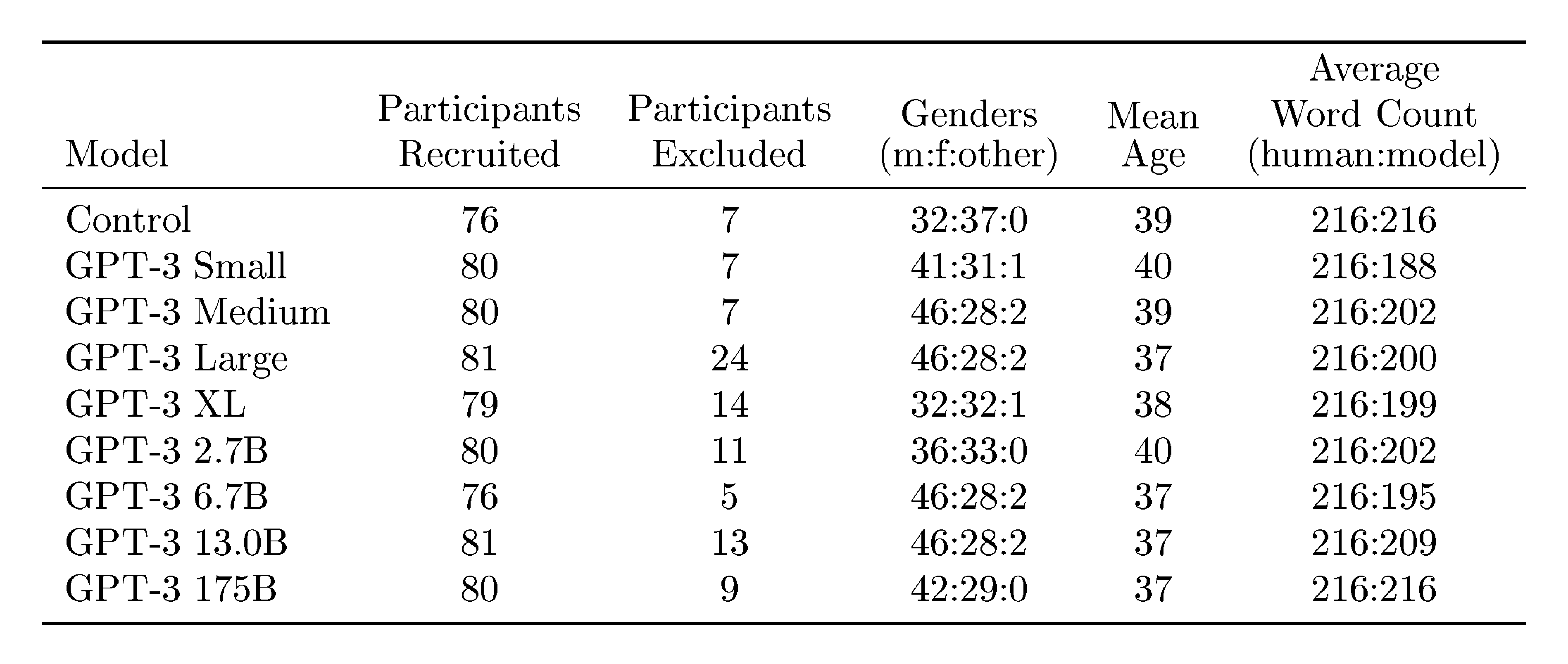
Table 19: Participant details and article lengths for each experiment to evaluate human detection of $\sim200$ word model generated news articles. Participants were excluded due to internet check fails.
:::
Statistical Tests: To compare means on the different runs, we performed a two-sample t-test for independent groups for each model against the control. This was implemented in Python using the scipy.stats.ttest_ind function. When plotting a regression line in the graph of average participant accuracy vs model size, we fit a power law of the form $ax^{-b}$. The 95% confidence intervals were estimated from the t-distribution of the sample mean.
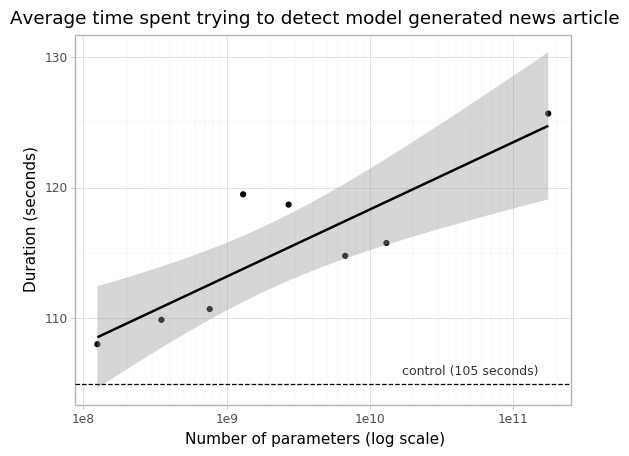
Duration statistics: In the main text, we discussed the finding that the ability of human participants to distinguish model and human generated news articles decreases as our models become larger. We have also found that the average time spent for a given set of questions increases as the model size increases, as shown in Figure 26. Lower accuracy scores despite increased time investment from participants supports the finding that larger models generate harder-to-distinguish news articles. Preliminary investigation of $\sim500$ word articles: We recruited 160 unique US-based participants to take part in 2 experiments through Positly (details are given in Table 20). We randomly selected 12 Reuters world news articles from late 2019 and created a context for GPT-3 175B that consisted of a single Reuters article not in this set of 12. We then used the article titles and Reuters locations to generate completions from GPT-3 175B and the 160M control model from the previous experiments. These were used to create two 12-question quizzes per model, each consisting of half human written and half model generated articles. Comprehension questions were added and articles were shown to participants in 3 stages at 30 second intervals to encourage closer reading. Participants were paid $12 for this task. Model generation selection methods, exclusion criteria, and statistical tests mirror those of the previous experiments.
:::
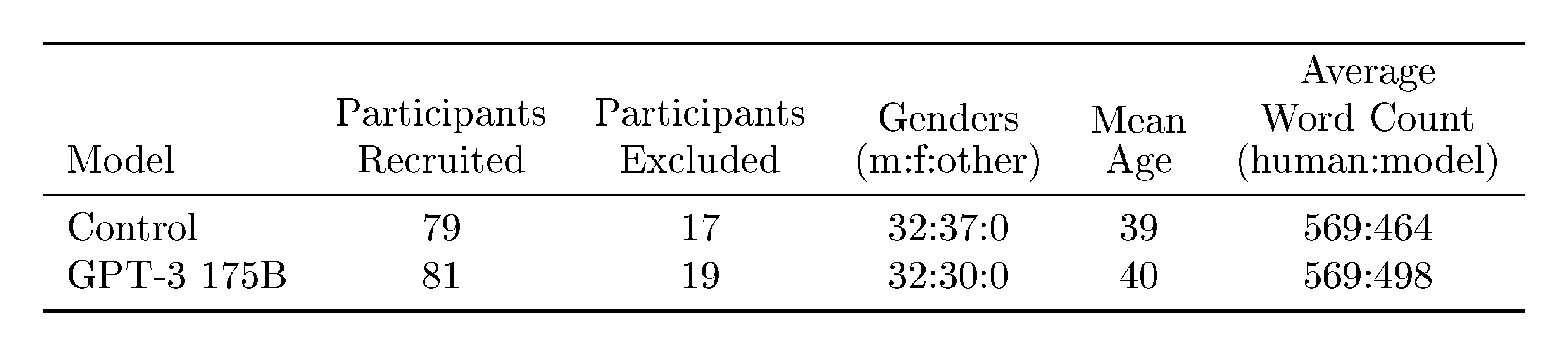
Table 20: Participant details and article lengths for the experiments investigating human detection of $\sim500$ word model generated news articles. Participants were excluded due to internet check fails.
:::
F Additional Samples from GPT-3
Section Summary: GPT-3, the AI model discussed in the paper, shows strong adaptability to tasks beyond those covered in the main study, such as creative writing. For instance, the section presents four unedited examples of poems generated by the model in response to a prompt asking it to compose a poem titled "Shadows on the Way" in the style of poet Wallace Stevens. These samples were created using a specific random generation method and stopped when the output began to shift to a new title or explanatory text.
GPT-3 adapts well to many tasks other than the ones explored in the main body of the paper. As an example, in Figure 27, we show four uncurated samples from a prompt suggesting that the model write a poem, with a given title, in the style of Wallace Stevens. We first experimented with a few prompts, then generated four samples with no additional editing or selection (sampling at temperature $1$ using nucleus sampling [142] with $P=0.9$). Completions were truncated when the model began to write a new title and author heading, or broke into prose commentary.

G Details of Task Phrasing and Specifications
Section Summary: This section provides visual examples of how various tasks in the study are formatted and phrased, drawing entirely from authentic data in the original datasets without any artificial intelligence-generated samples. It features figures for benchmarks like RACE, ANLI, PIQA, COPA, and others, showing the structure of questions, contexts, and answer options in a clear, standardized way. Certain tasks include notes on evaluation methods, such as normalizing predictions by unconditional probabilities or comparing completion likelihoods in context-based problems.
The following figures illustrate the formatting and phrasing of all the tasks included in the paper. All data comes from the ground truth datasets in this section, and no samples from GPT-3 are included here.


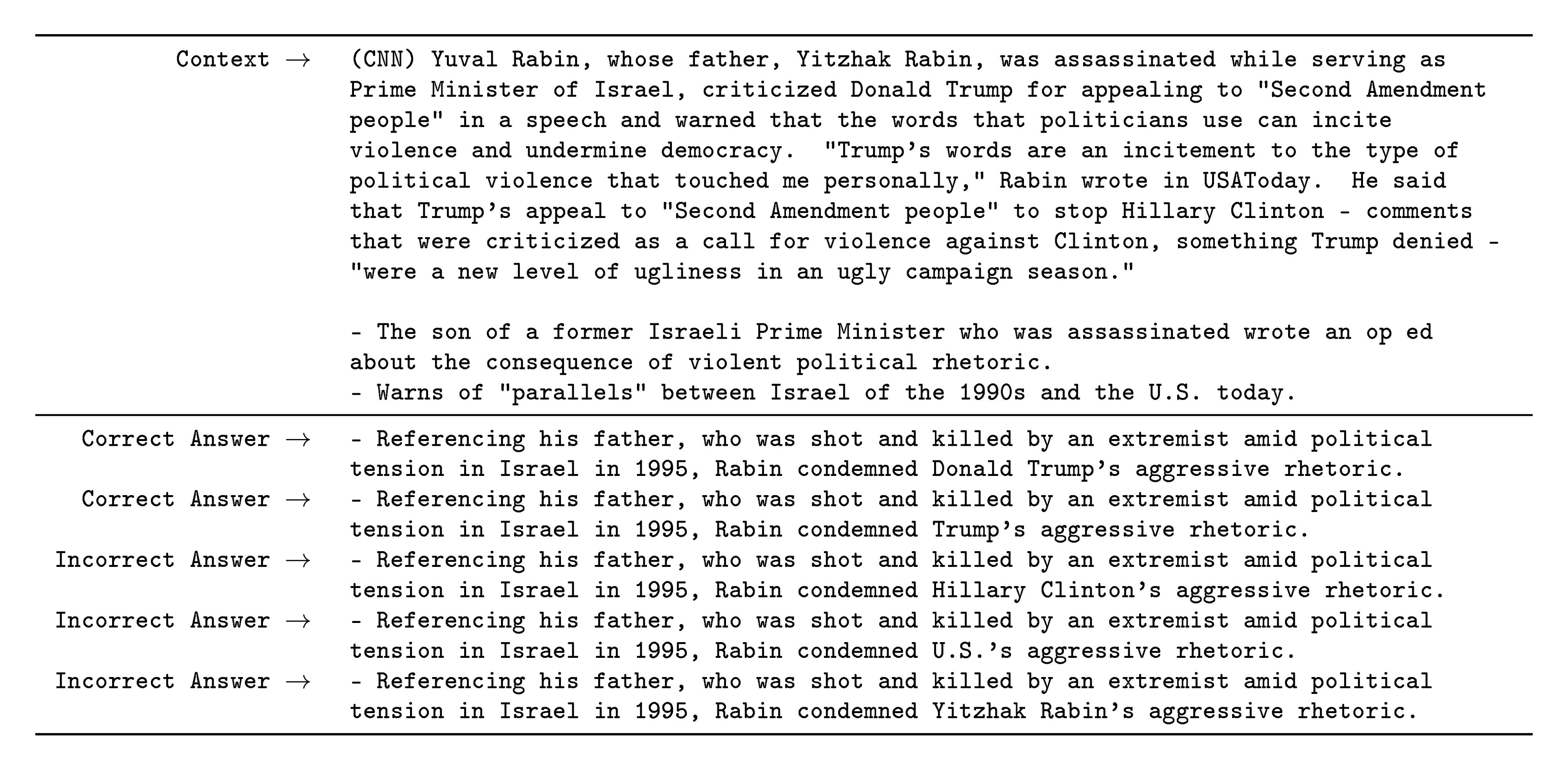
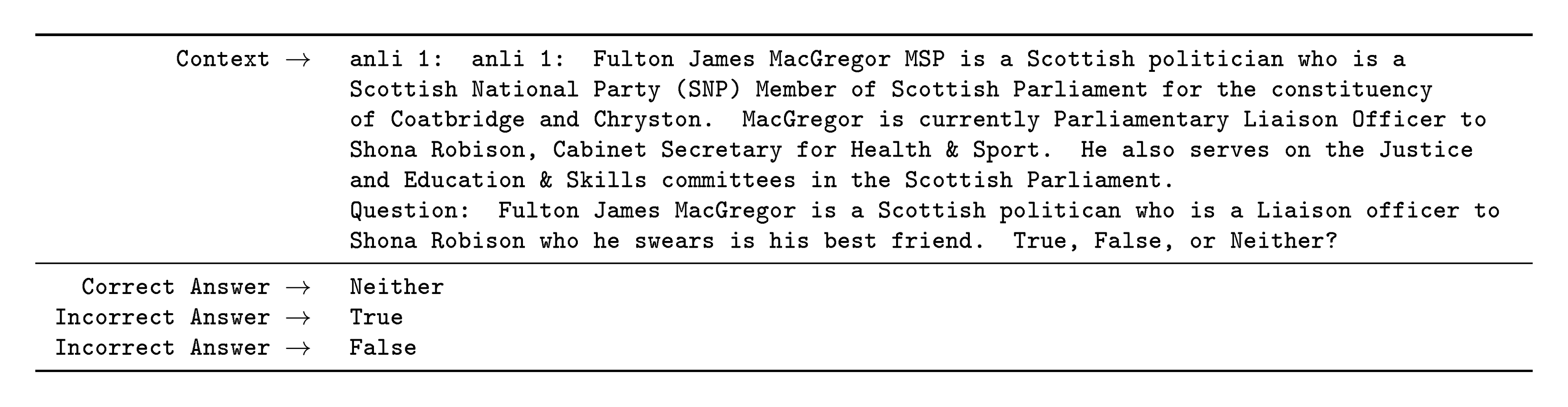


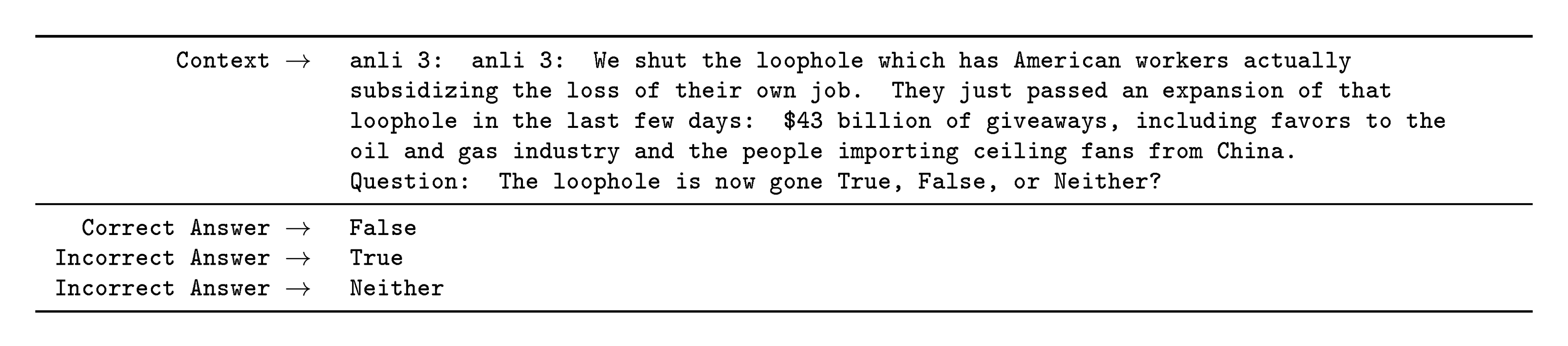
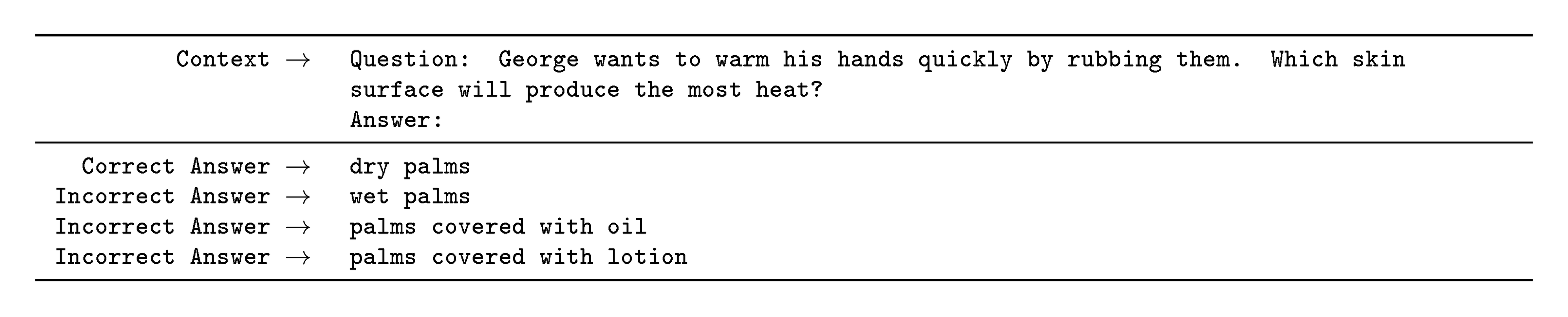






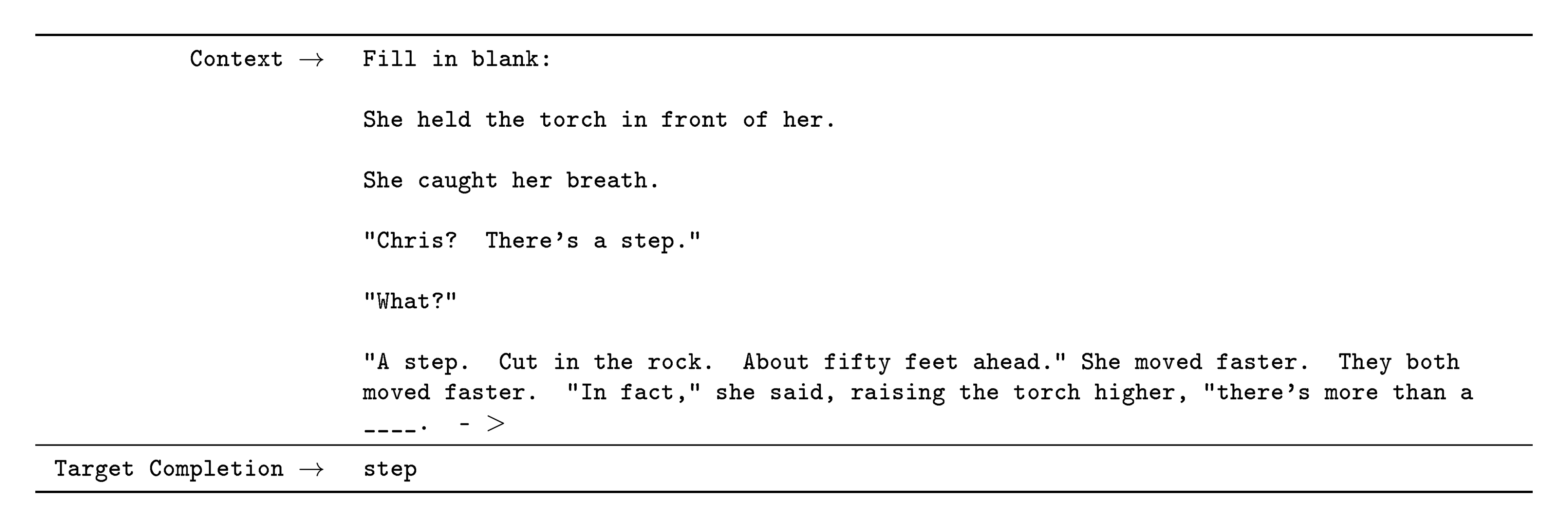







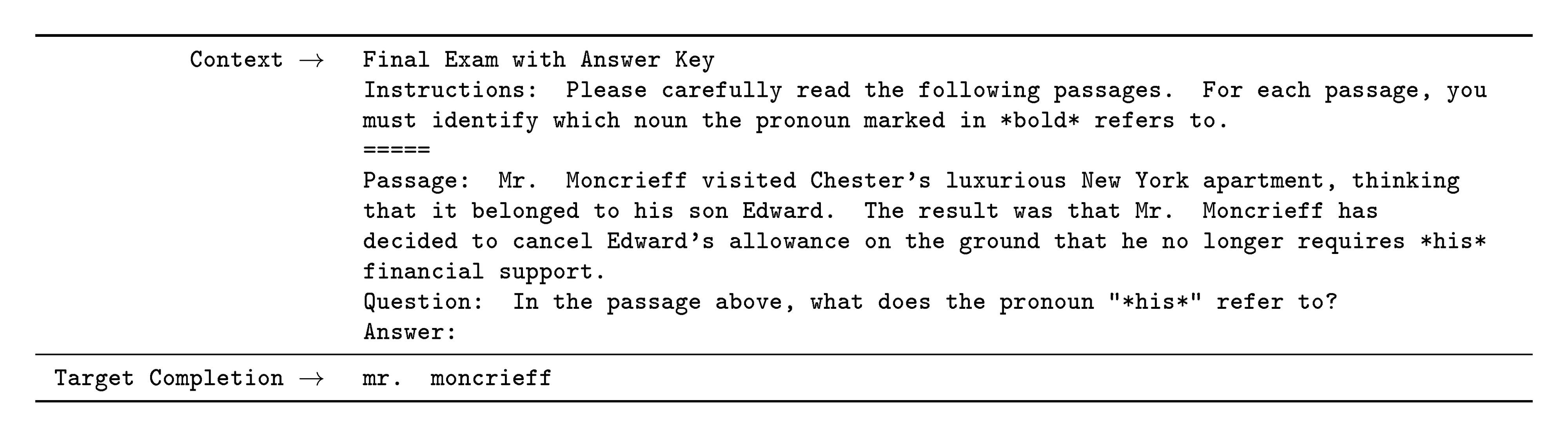
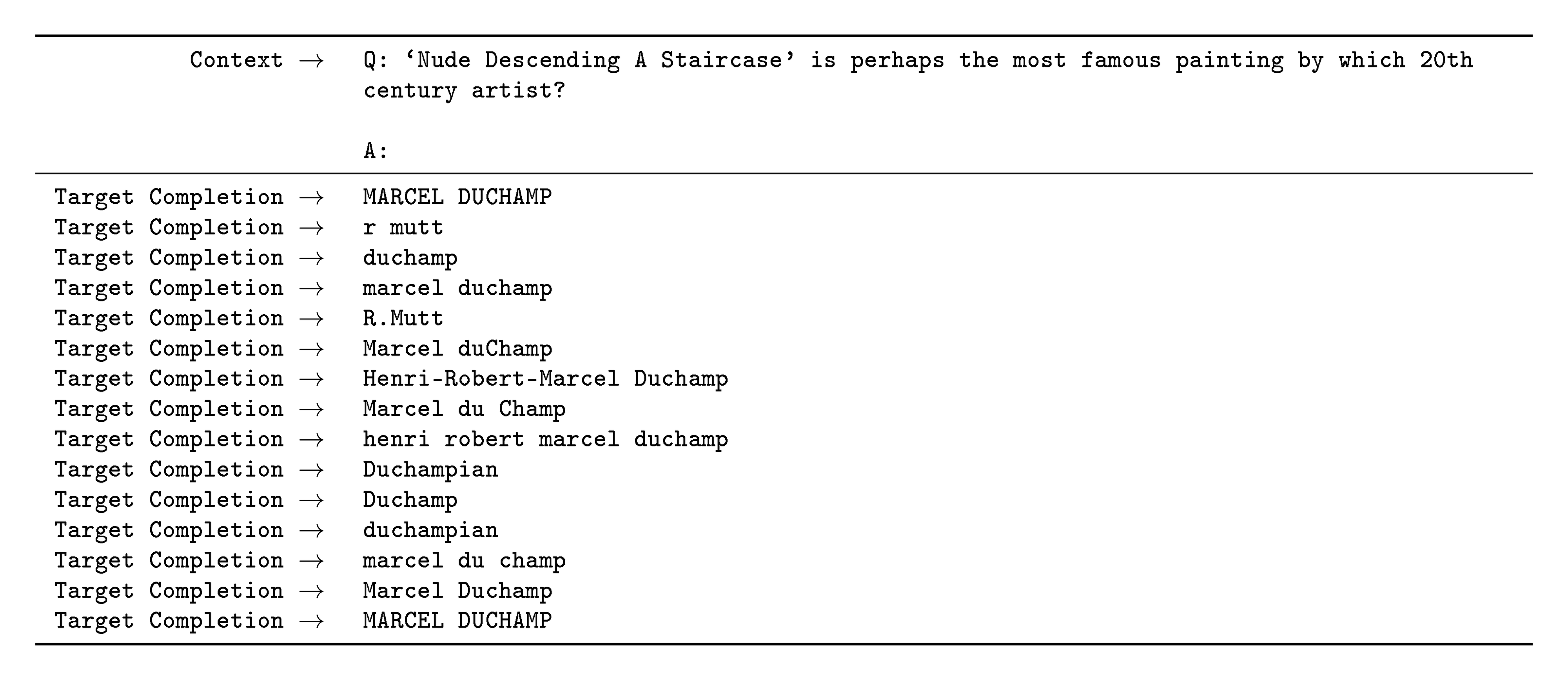



Context $\to$ Analysis of instar distributions of larval I. verticalis collected from a series of ponds also indicated that males were in more advanced instars than females. = Target Completion $\to$ L'analyse de la distribution de fréquence des stades larvaires d'I. verticalis dans une série d'étangs a également démontré que les larves mâles étaient à des stades plus avancés que les larves femelles.
Figure G.38: Formatted dataset example for En $\to$ Fr
Context $\to$ L'analyse de la distribution de fréquence des stades larvaires d'I. verticalis dans une série d'étangs a également démontré que les larves mâles étaient à des stades plus avancés que les larves femelles. = Target Completion $\to$ Analysis of instar distributions of larval I. verticalis collected from a series of ponds also indicated that males were in more advanced instars than females.
Figure G.39: Formatted dataset example for Fr $\to$ En
Context $\to$ The truth is that you want, at any price, and against the wishes of the peoples of Europe, to continue the negotiations for Turkey's accession to the European Union, despite Turkey's continuing refusal to recognise Cyprus and despite the fact that the democratic reforms are at a standstill. = Target Completion $\to$ Adevărul este că vă doriţi, cu orice preţ şi împotriva dorinţei europenilor, să continuaţi negocierile de aderare a Turciei la Uniunea Europeană, în ciuda refuzului continuu al Turciei de a recunoaşte Ciprul şi în ciuda faptului că reformele democratice au ajuns într-un punct mort.
Figure G.40: Formatted dataset example for En $\to$ Ro
Context $\to$ Adevărul este că vă doriţi, cu orice preţ şi împotriva dorinţei europenilor, să continuaţi negocierile de aderare a Turciei la Uniunea Europeană, în ciuda refuzului continuu al Turciei de a recunoaşte Ciprul şi în ciuda faptului că reformele democratice au ajuns într-un punct mort. = Target Completion $\to$ The truth is that you want, at any price, and against the wishes of the peoples of Europe, to continue the negotiations for Turkey's accession to the European Union, despite Turkey's continuing refusal to recognise Cyprus and despite the fact that the democratic reforms are at a standstill.
Figure G.41: Formatted dataset example for Ro $\to$ En










H Results on All Tasks for All Model Sizes
{ \setlength\tabcolsep{1pt} \tiny \begin{adjustwidth}{-.8in}{-.8in} \begin{center} \begin{tabular}{llccl<{\hspace{4ex}}llllllll<{\hspace{4 ex}}llllllll<{\hspace{4ex}}llllllllc} \toprule & & & & & \multicolumn{8}{c}{Zero-Shot} & \multicolumn{8}{c}{One-Shot} & \multicolumn{8}{c}{Few-Shot}\\ \cmidrule(r{4ex}){6-13} \cmidrule(r{4ex}){14-21} \cmidrule(r){22-30} Name & Metric & Split & \shortstack{Fine-tune\\SOTA} & K & Small & Med & Large & XL & 2.7B & 6.7B & 13B & 175B & Small & Med & Large & XL & 2.7B & 6.7B & 13B & 175B & Small & Med & Large & XL & 2.7B & 6.7B & 13B & 175B & \shortstack{175B \\(test server)} \\ \midrule HellaSwag & acc & dev & 85.6 & 20 & 33.7 & 43.6 & 51.0 & 54.7 & 62.8 & 67.4 & 70.9 & 78.9 & 33.0 & 42.9 & 50.5 & 53.5 & 61.9 & 66.5 & 70.0 & 78.1 & 33.5 & 43.1 & 51.3 & 54.9 & 62.9 & 67.3 & 71.3 & 79.3 & \\ LAMBADA & acc & test & 68.0 & 15 & 42.7 & 54.3 & 60.4 & 63.6 & 67.1 & 70.3 & 72.5 & 76.2 & 22.0 & 47.1 & 52.6 & 58.3 & 61.1 & 65.4 & 69.0 & 72.5 & 22.0 & 40.4 & 63.2 & 57.0 & 78.1 & 79.1 & 81.3 & 86.4 & \\ LAMBADA & ppl & test & 8.63 & 15 & 18.6 & 9.09 & 6.53 & 5.44 & 4.60 & 4.00 & 3.56 & 3.00 & 165.0 & 11.6 & 8.29 & 6.46 & 5.53 & 4.61 & 4.06 & 3.35 & 165.0 & 27.6 & 6.63 & 7.45 & 2.89 & 2.56 & 2.56 & 1.92 & \\ StoryCloze & acc & test & 91.8 & 70 & 63.3 & 68.5 & 72.4 & 73.4 & 77.2 & 77.7 & 79.5 & 83.2 & 62.3 & 68.7 & 72.3 & 74.2 & 77.3 & 78.7 & 79.7 & 84.7 & 62.3 & 70.2 & 73.9 & 76.1 & 80.2 & 81.2 & 83.0 & 87.7 & \\ & & & & & & & & & & & & & & & & & & & & & & & & & & & & & \\ NQs & acc & test & 44.5 & 64 & 0.64 & 1.75 & 2.71 & 4.40 & 6.01 & 5.79 & 7.84 & 14.6 & 1.19 & 3.07 & 4.79 & 5.43 & 8.73 & 9.78 & 13.7 & 23.0 & 1.72 & 4.46 & 7.89 & 9.72 & 13.2 & 17.0 & 21.0 & 29.9 & \\ TriviaQA & acc & dev & 68.0 & 64 & 4.15 & 7.61 & 14.0 & 19.7 & 31.3 & 38.7 & 41.8 & 64.3 & 4.19 & 12.9 & 20.5 & 26.5 & 35.9 & 44.4 & 51.3 & 68.0 & 6.96 & 16.3 & 26.5 & 32.1 & 42.3 & 51.6 & 57.5 & 71.2 & 71.2 \\ WebQs & acc & test & 45.5 & 64 & 1.77 & 3.20 & 4.33 & 4.63 & 7.92 & 7.73 & 8.22 & 14.4 & 2.56 & 6.20 & 8.51 & 9.15 & 14.5 & 15.1 & 19.0 & 25.3 & 5.46 & 12.6 & 15.9 & 19.6 & 24.8 & 27.7 & 33.5 & 41.5 & \\ & & & & & & & & & & & & & & & & & & & & & & & & & & & & & \\ Ro $\to$ En 16 & BLEU-mb & test & 39.9 & 64 & 2.08 & 2.71 & 3.09 & 3.15 & 16.3 & 8.34 & 20.2 & 19.9 & 0.55 & 15.4 & 23.0 & 26.3 & 30.6 & 33.2 & 35.6 & 38.6 & 1.25 & 20.7 & 25.8 & 29.2 & 33.1 & 34.8 & 37.0 & 39.5 & \\ Ro $\to$ En 16 & BLEU-sb & test & & 64 & 2.39 & 3.08 & 3.49 & 3.56 & 16.8 & 8.75 & 20.8 & 20.9 & 0.65 & 15.9 & 23.6 & 26.8 & 31.3 & 34.2 & 36.7 & 40.0 & 1.40 & 21.3 & 26.6 & 30.1 & 34.3 & 36.2 & 38.4 & 41.3 & \\ En $\to$ Ro 16 & BLEU-mb & test & 38.5 & 64 & 2.14 & 2.65 & 2.53 & 2.50 & 3.46 & 4.24 & 5.32 & 14.1 & 0.35 & 3.30 & 7.89 & 8.72 & 13.2 & 15.1 & 17.3 & 20.6 & 1.25 & 5.90 & 9.33 & 10.7 & 14.3 & 16.3 & 18.0 & 21.0 & \\ En $\to$ Ro 16 & BLEU-sb & test & & 64 & 2.61 & 3.11 & 3.07 & 3.09 & 4.26 & 5.31 & 6.43 & 18.0 & 0.55 & 3.90 & 9.15 & 10.3 & 15.7 & 18.2 & 20.8 & 24.9 & 1.64 & 7.40 & 10.9 & 12.9 & 17.2 & 19.6 & 21.8 & 25.8 & \\ Fr $\to$ En 14 & BLEU-mb & test & 35.0 & 64 & 1.81 & 2.53 & 3.47 & 3.13 & 20.6 & 15.1 & 21.8 & 21.2 & 1.28 & 15.9 & 23.7 & 26.3 & 29.0 & 30.5 & 30.2 & 33.7 & 4.98 & 25.5 & 28.5 & 31.1 & 33.7 & 34.9 & 36.6 & 39.2 & \\ Fr $\to$ En 14 & BLEU-sb & test & & 64 & 2.29 & 2.99 & 3.90 & 3.60 & 21.2 & 15.5 & 22.4 & 21.9 & 1.50 & 16.3 & 24.4 & 27.0 & 30.0 & 31.6 & 31.4 & 35.6 & 5.30 & 26.2 & 29.5 & 32.2 & 35.1 & 36.4 & 38.3 & 41.4 & \\ En $\to$ Fr 14 & BLEU-mb & test & 45.6 & 64 & 1.74 & 2.16 & 2.73 & 2.15 & 15.1 & 8.82 & 12.0 & 25.2 & 0.49 & 8.00 & 14.8 & 15.9 & 20.3 & 23.3 & 24.9 & 28.3 & 4.08 & 14.5 & 19.3 & 21.5 & 24.9 & 27.3 & 29.5 & 32.6 & \\ En $\to$ Fr 14 & BLEU-sb & test & 45.9 & 64 & 2.44 & 2.75 & 3.54 & 2.82 & 19.3 & 11.4 & 15.3 & 31.3 & 0.81 & 10.0 & 18.2 & 19.3 & 24.7 & 28.3 & 30.1 & 34.1 & 5.31 & 18.0 & 23.6 & 26.1 & 30.3 & 33.3 & 35.5 & 39.9 & \\ De $\to$ En 16 & BLEU-mb & test & 40.2 & 64 & 2.06 & 2.87 & 3.41 & 3.63 & 21.5 & 17.3 & 23.0 & 27.2 & 0.83 & 16.2 & 22.5 & 24.7 & 28.2 & 30.7 & 33.0 & 30.4 & 3.25 & 22.7 & 26.2 & 29.2 & 32.7 & 34.8 & 37.3 & 40.6 & \\ De $\to$ En 16 & BLEU-sb & test & & 64 & 2.39 & 3.27 & 3.85 & 4.04 & 22.5 & 18.2 & 24.4 & 28.6 & 0.93 & 17.1 & 23.4 & 25.8 & 29.2 & 31.9 & 34.5 & 32.1 & 3.60 & 23.8 & 27.5 & 30.5 & 34.1 & 36.5 & 39.1 & 43.0 & \\ En $\to$ De 16 & BLEU-mb & test & 41.2 & 64 & 1.70 & 2.27 & 2.31 & 2.43 & 12.9 & 8.66 & 10.4 & 24.6 & 0.50 & 7.00 & 12.9 & 13.1 & 18.3 & 20.9 & 22.5 & 26.2 & 3.42 & 12.3 & 15.4 & 17.1 & 20.9 & 23.0 & 26.6 & 29.7 & \\ En $\to$ De 16 & BLEU-sb & test & 41.2 & 64 & 2.09 & 2.65 & 2.75 & 2.92 & 13.7 & 9.36 & 11.0 & 25.3 & 0.54 & 7.40 & 13.4 & 13.4 & 18.8 & 21.7 & 23.3 & 27.3 & 3.78 & 12.9 & 16.1 & 17.7 & 21.7 & 24.1 & 27.7 & 30.9 & \\
& & & & & & & & & & & & & & & & & & & & & & & & & & & & & \\
Winograd & acc & test & 93.8 & 7 & 66.3 & 72.9 & 74.7 & 76.9 & 82.4 & 85.7 & 87.9 & 88.3 & 63.4 & 68.5 & 72.9 & 76.9 & 82.4 & 84.6 & 86.1 & 89.7 & 63.4 & 67.4 & 73.6 & 76.9 & 84.3 & 85.4 & 82.4 & 88.6 & \\
Winogrande & acc & dev & 84.6 & 50 & 52.0 & 52.1 & 57.4 & 58.7 & 62.3 & 64.5 & 67.9 & 70.2 & 51.3 & 53.0 & 58.3 & 59.1 & 61.7 & 65.8 & 66.9 & 73.2 & 51.3 & 52.6 & 57.5 & 59.1 & 62.6 & 67.4 & 70.0 & 77.7 & \\
& & & & & & & & & & & & & & & & & & & & & & & & & & & & & \\
PIQA & acc & dev & 77.1 & 50 & 64.6 & 70.2 & 72.9 & 75.1 & 75.6 & 78.0 & 78.5 & 81.0 & 64.3 & 69.3 & 71.8 & 74.4 & 74.3 & 76.3 & 77.8 & 80.5 & 64.3 & 69.4 & 72.0 & 74.3 & 75.4 & 77.8 & 79.9 & 82.3 & 82.8 \\
ARC (Challenge) & acc & test & 78.5 & 50 & 26.6 & 29.5 & 31.8 & 35.5 & 38.0 & 41.4 & 43.7 & 51.4 & 25.5 & 30.2 & 31.6 & 36.4 & 38.4 & 41.5 & 43.1 & 53.2 & 25.5 & 28.4 & 32.3 & 36.7 & 39.5 & 43.7 & 44.8 & 51.5 & \\
ARC (Easy) & acc & test & 92.0 & 50 & 43.6 & 46.5 & 53.0 & 53.8 & 58.2 & 60.2 & 63.8 & 68.8 & 42.7 & 48.2 & 54.6 & 55.9 & 60.3 & 62.6 & 66.8 & 71.2 & 42.7 & 51.0 & 58.1 & 59.1 & 62.1 & 65.8 & 69.1 & 70.1 & \\
OpenBookQA & acc & test & 87.2 & 100 & 35.6 & 43.2 & 45.2 & 46.8 & 53.0 & 50.4 & 55.6 & 57.6 & 37.0 & 39.8 & 46.2 & 46.4 & 53.4 & 53.0 & 55.8 & 58.8 & 37.0 & 43.6 & 48.0 & 50.6 & 55.6 & 55.2 & 60.8 & 65.4 & \\
& & & & & & & & & & & & & & & & & & & & & & & & & & & & & \\
Quac & f1 & dev & 74.4 & 5 & 21.2 & 26.8 & 31.0 & 30.1 & 34.7 & 36.1 & 38.4 & 41.5 & 21.1 & 26.9 & 31.9 & 32.3 & 37.4 & 39.0 & 40.6 & 43.4 & 21.6 & 27.6 & 32.9 & 34.2 & 38.2 & 39.9 & 40.9 & 44.3 & \\
RACE-h & acc & test & 90.0 & 10 & 35.2 & 37.9 & 40.1 & 40.9 & 42.4 & 44.1 & 44.6 & 45.5 & 34.3 & 37.7 & 40.0 & 42.0 & 43.8 & 44.3 & 44.6 & 45.9 & 34.3 & 37.0 & 40.4 & 41.4 & 42.3 & 44.7 & 45.1 & 46.8 & \\
RACE-m & acc & test & 93.1 & 10 & 42.1 & 47.2 & 52.1 & 52.3 & 54.7 & 54.4 & 56.7 & 58.4 & 42.3 & 47.3 & 51.7 & 55.2 & 56.1 & 54.7 & 56.9 & 57.4 & 42.3 & 47.0 & 52.7 & 53.0 & 55.6 & 55.4 & 58.1 & 58.1 & \\
SQuADv2 & em & dev & 90.7 & 16 & 22.6 & 32.8 & 33.9 & 43.1 & 43.6 & 45.4 & 49.0 & 52.6 & 25.1 & 37.5 & 37.9 & 47.9 & 47.9 & 51.1 & 56.0 & 60.1 & 27.5 & 40.5 & 39.2 & 53.5 & 50.0 & 56.6 & 62.6 & 64.9 & \\
SQuADv2 & f1 & dev & 93.0 & 16 & 28.3 & 40.2 & 41.4 & 50.3 & 51.0 & 52.7 & 56.3 & 59.5 & 30.1 & 43.6 & 44.1 & 54.0 & 54.1 & 57.1 & 61.8 & 65.4 & 32.1 & 45.5 & 44.9 & 58.7 & 55.9 & 62.1 & 67.7 & 69.8 & \\
CoQA & f1 & dev & 90.7 & 5 & 34.5 & 55.0 & 61.8 & 65.3 & 71.1 & 72.8 & 76.3 & 81.5 & 30.6 & 52.1 & 61.6 & 66.1 & 71.8 & 75.1 & 77.9 & 84.0 & 31.1 & 52.0 & 62.7 & 66.8 & 73.2 & 77.3 & 79.9 & 85.0 & \\
DROP & f1 & dev & 89.1 & 20 & 9.40 & 13.6 & 14.4 & 16.4 & 19.7 & 17.0 & 24.0 & 23.6 & 11.7 & 18.1 & 20.9 & 23.0 & 26.4 & 27.3 & 29.2 & 34.3 & 12.9 & 18.7 & 24.0 & 25.6 & 29.7 & 29.7 & 32.3 & 36.5 & \\
& & & & & & & & & & & & & & & & & & & & & & & & & & & & & \\
BoolQ & acc & dev & 91.0 & 32 & 49.7 & 60.3 & 58.9 & 62.4 & 67.1 & 65.4 & 66.2 & 60.5 & 52.6 & 61.7 & 60.4 & 63.7 & 68.4 & 68.7 & 69.0 & 76.7 & 43.1 & 60.6 & 62.0 & 64.1 & 70.3 & 70.0 & 70.2 & 77.5 & 76.4 \\
CB & acc & dev & 96.9 & 32 & 0.00 & 32.1 & 8.93 & 19.6 & 19.6 & 28.6 & 19.6 & 46.4 & 55.4 & 53.6 & 53.6 & 48.2 & 57.1 & 33.9 & 55.4 & 64.3 & 42.9 & 58.9 & 53.6 & 69.6 & 67.9 & 60.7 & 66.1 & 82.1 & 75.6 \\
CB & f1 & dev & 93.9 & 32 & 0.00 & 29.3 & 11.4 & 17.4 & 22.4 & 25.1 & 20.3 & 42.8 & 60.1 & 39.8 & 45.6 & 37.5 & 45.7 & 28.5 & 44.6 & 52.5 & 26.1 & 40.4 & 32.6 & 48.3 & 45.7 & 44.6 & 46.0 & 57.2 & 52.0 \\
Copa & acc & dev & 94.8 & 32 & 66.0 & 68.0 & 73.0 & 77.0 & 76.0 & 80.0 & 84.0 & 91.0 & 62.0 & 64.0 & 66.0 & 74.0 & 76.0 & 82.0 & 86.0 & 87.0 & 67.0 & 64.0 & 72.0 & 77.0 & 83.0 & 83.0 & 86.0 & 92.0 & 92.0 \\
RTE & acc & dev & 92.5 & 32 & 47.7 & 49.8 & 48.4 & 56.0 & 46.6 & 55.2 & 62.8 & 63.5 & 53.1 & 47.3 & 49.5 & 49.5 & 54.9 & 54.9 & 56.3 & 70.4 & 52.3 & 48.4 & 46.9 & 50.9 & 56.3 & 49.5 & 60.6 & 72.9 & 69.0 \\
WiC & acc & dev & 76.1 & 32 & 0.00 & 0.00 & 0.00 & 0.00 & 0.00 & 0.00 & 0.00 & 0.00 & 50.0 & 50.3 & 50.3 & 49.2 & 49.4 & 50.3 & 50.0 & 48.6 & 49.8 & 55.0 & 53.0 & 53.0 & 51.6 & 53.1 & 51.1 & 55.3 & 49.4 \\
WSC & acc & dev & 93.8 & 32 & 59.6 & 56.7 & 65.4 & 61.5 & 66.3 & 60.6 & 64.4 & 65.4 & 58.7 & 58.7 & 60.6 & 62.5 & 66.3 & 60.6 & 66.3 & 69.2 & 58.7 & 60.6 & 54.8 & 49.0 & 62.5 & 67.3 & 75.0 & 75.0 & 80.1 \\
MultiRC & acc & dev & 62.3 & 32 & 4.72 & 9.65 & 12.3 & 13.6 & 14.3 & 18.4 & 24.2 & 27.6 & 4.72 & 9.65 & 12.3 & 13.6 & 14.3 & 18.4 & 24.2 & 27.6 & 6.09 & 11.8 & 16.8 & 20.8 & 24.7 & 23.8 & 25.0 & 32.5 & 30.5 \\
MultiRC & f1a & dev & 88.2 & 32 & 57.0 & 59.7 & 60.4 & 59.9 & 60.0 & 64.5 & 71.4 & 72.9 & 57.0 & 59.7 & 60.4 & 59.9 & 60.0 & 64.5 & 71.4 & 72.9 & 45.0 & 55.9 & 64.2 & 65.4 & 69.5 & 66.4 & 69.3 & 74.8 & 75.4 \\
ReCoRD & acc & dev & 92.5 & 32 & 70.8 & 78.5 & 82.1 & 84.1 & 86.2 & 88.6 & 89.0 & 90.2 & 69.8 & 77.0 & 80.7 & 83.0 & 85.9 & 88.0 & 88.8 & 90.2 & 69.8 & 77.2 & 81.3 & 83.1 & 86.6 & 87.9 & 88.9 & 89.0 & 90.2 \\
ReCoRD & f1 & dev & 93.3 & 32 & 71.9 & 79.2 & 82.8 & 85.2 & 87.3 & 89.5 & 90.4 & 91.0 & 70.7 & 77.8 & 81.6 & 83.9 & 86.8 & 88.8 & 89.7 & 91.2 & 70.7 & 77.9 & 82.1 & 84.0 & 87.5 & 88.8 & 89.8 & 90.1 & 91.1 \\
SuperGLUE & average & dev & 89.0 & & 40.6 & 47.4 & 46.8 & 49.6 & 50.1 & 52.3 & 54.4 & 58.2 & 54.4 & 55.1 & 56.7 & 57.8 & 61.2 & 59.7 & 64.3 & 68.9 & 50.2 & 56.2 & 56.8 & 60.0 & 64.3 & 63.6 & 66.9 & 73.2 & 71.8 \\
& & & & & & & & & & & & & & & & & & & & & & & & & & & & & \\
ANLI R1 & acc & test & 73.8 & 50 & 33.4 & 34.2 & 33.4 & 33.4 & 34.2 & 32.3 & 33.2 & 34.6 & 32.1 & 31.6 & 31.9 & 34.6 & 30.6 & 31.6 & 32.7 & 32.0 & 32.1 & 32.5 & 30.9 & 32.5 & 33.5 & 33.1 & 33.3 & 36.8 & \\
ANLI R2 & acc & test & 50.7 & 50 & 33.2 & 31.9 & 33.3 & 33.3 & 33.8 & 33.5 & 33.5 & 35.4 & 35.7 & 33.7 & 33.2 & 32.7 & 32.7 & 33.9 & 33.9 & 33.9 & 35.7 & 33.8 & 32.1 & 31.4 & 32.6 & 33.3 & 32.6 & 34.0 & \\
ANLI R3 & acc & test & 48.3 & 50 & 33.6 & 34.0 & 33.8 & 33.4 & 35.3 & 34.8 & 34.4 & 34.5 & 35.0 & 32.6 & 33.0 & 33.9 & 34.1 & 33.1 & 32.5 & 35.1 & 35.0 & 34.4 & 35.1 & 36.0 & 32.7 & 33.9 & 34.5 & 40.2 & \\
& & & & & & & & & & & & & & & & & & & & & & & & & & & & & \\
2D+ & acc & n/a & & 50 & 0.70 & 0.65 & 0.70 & 0.85 & 1.10 & 2.54 & 15.4 & 76.9 & 2.00 & 0.55 & 3.15 & 4.00 & 12.1 & 19.6 & 73.0 & 99.6 & 2.00 & 4.10 & 3.50 & 4.50 & 8.90 & 11.9 & 55.5 & 100.0 & \\
2D- & acc & n/a & & 50 & 1.25 & 1.25 & 1.25 & 1.25 & 1.60 & 7.60 & 12.6 & 58.0 & 1.15 & 0.95 & 1.45 & 1.95 & 3.85 & 11.5 & 44.6 & 86.4 & 1.15 & 1.45 & 2.25 & 2.70 & 7.35 & 13.6 & 52.4 & 98.9 & \\
3D+ & acc & n/a & & 50 & 0.10 & 0.10 & 0.05 & 0.10 & 0.10 & 0.25 & 1.40 & 34.2 & 0.15 & 0.00 & 0.10 & 0.30 & 0.45 & 0.95 & 15.4 & 65.5 & 0.15 & 0.45 & 0.30 & 0.55 & 0.75 & 0.90 & 8.40 & 80.4 & \\
3D- & acc & n/a & & 50 & 0.05 & 0.05 & 0.05 & 0.05 & 0.05 & 0.45 & 1.35 & 48.3 & 0.05 & 0.15 & 0.25 & 0.30 & 0.55 & 1.60 & 6.15 & 78.7 & 0.05 & 0.10 & 0.15 & 0.35 & 0.65 & 1.05 & 9.20 & 94.2 & \\
4D+ & acc & n/a & & 50 & 0.05 & 0.05 & 0.00 & 0.00 & 0.05 & 0.05 & 0.15 & 4.00 & 0.00 & 0.00 & 0.10 & 0.00 & 0.00 & 0.10 & 0.80 & 14.0 & 0.00 & 0.05 & 0.05 & 0.00 & 0.15 & 0.15 & 0.40 & 25.5 & \\
4D- & acc & n/a & & 50 & 0.00 & 0.00 & 0.00 & 0.00 & 0.00 & 0.00 & 0.10 & 7.50 & 0.00 & 0.00 & 0.00 & 0.00 & 0.05 & 0.00 & 0.50 & 14.0 & 0.00 & 0.05 & 0.00 & 0.00 & 0.10 & 0.05 & 0.40 & 26.8 & \\
5D+ & acc & n/a & & 50 & 0.00 & 0.00 & 0.00 & 0.00 & 0.00 & 0.00 & 0.00 & 0.65 & 0.00 & 0.00 & 0.00 & 0.00 & 0.00 & 0.00 & 0.05 & 3.45 & 0.00 & 0.00 & 0.00 & 0.00 & 0.00 & 0.00 & 0.05 & 9.30 & \\
5D- & acc & n/a & & 50 & 0.00 & 0.00 & 0.00 & 0.00 & 0.00 & 0.00 & 0.00 & 0.80 & 0.00 & 0.00 & 0.00 & 0.00 & 0.00 & 0.00 & 0.05 & 3.75 & 0.00 & 0.00 & 0.00 & 0.00 & 0.00 & 0.00 & 0.00 & 9.90 & \\
2Dx & acc & n/a & & 50 & 2.20 & 2.25 & 2.65 & 2.10 & 2.55 & 5.80 & 6.15 & 19.8 & 1.35 & 2.35 & 3.35 & 2.35 & 4.75 & 9.15 & 11.0 & 27.4 & 1.35 & 2.90 & 2.70 & 2.85 & 4.25 & 6.10 & 7.05 & 29.2 & \\
1DC & acc & n/a & & 50 & 1.25 & 2.95 & 2.75 & 0.05 & 0.30 & 2.35 & 0.75 & 9.75 & 1.90 & 2.80 & 2.85 & 3.65 & 6.45 & 9.15 & 8.20 & 14.3 & 1.70 & 2.15 & 3.90 & 5.75 & 6.20 & 7.60 & 9.95 & 21.3 & \\
& & & & & & & & & & & & & & & & & & & & & & & & & & & & & \\
Cycled Letters & acc & n/a & & 100 & 0.62 & 0.71 & 2.85 & 0.00 & 0.63 & 1.35 & 2.58 & 3.66 & 1.67 & 4.36 & 5.68 & 6.46 & 6.25 & 9.41 & 15.1 & 21.7 & 4.63 & 9.27 & 10.7 & 14.5 & 16.7 & 21.9 & 27.7 & 37.9 & \\
Anagrams 1 & acc & n/a & & 100 & 0.10 & 0.14 & 0.40 & 0.00 & 0.27 & 0.69 & 1.16 & 2.28 & 0.21 & 0.61 & 1.12 & 1.27 & 1.60 & 2.72 & 3.72 & 8.62 & 0.50 & 1.27 & 2.13 & 3.05 & 3.81 & 5.49 & 8.38 & 15.1 & \\
Anagrams 2 & acc & n/a & & 100 & 0.81 & 1.21 & 2.69 & 0.01 & 1.71 & 3.75 & 4.53 & 8.91 & 1.19 & 2.62 & 4.70 & 4.77 & 6.97 & 10.2 & 14.6 & 25.9 & 1.94 & 4.80 & 7.59 & 9.87 & 12.6 & 18.9 & 25.6 & 39.7 & \\
Symbol Insertion & acc & n/a & & 100 & 0.00 & 0.00 & 0.10 & 0.00 & 0.05 & 0.42 & 0.89 & 8.26 & 0.03 & 0.05 & 0.57 & 1.18 & 1.67 & 3.46 & 6.62 & 45.4 & 0.11 & 0.28 & 2.19 & 4.18 & 6.61 & 11.0 & 27.3 & 67.2 & \\
Reversed Words & acc & n/a & & 100 & 0.00 & 0.01 & 0.01 & 0.01 & 0.02 & 0.03 & 0.03 & 0.09 & 0.02 & 0.01 & 0.01 & 0.00 & 0.05 & 0.07 & 0.11 & 0.48 & 0.00 & 0.05 & 0.00 & 0.17 & 0.24 & 0.30 & 0.42 & 0.44 & \\
& & & & & & & & & & & & & & & & & & & & & & & & & & & & & \\
SAT Analogies & acc & n/a & & 20 & 35.6 & 39.0 & 45.2 & 44.1 & 50.0 & 49.2 & 52.7 & 53.7 & 30.5 & 41.2 & 43.1 & 46.5 & 55.1 & 54.3 & 53.5 & 59.1 & 30.5 & 40.4 & 42.8 & 40.6 & 48.4 & 51.9 & 53.5 & 65.2 & \\
\bottomrule
\end{tabular}
\end{center}
\end{adjustwidth}
}
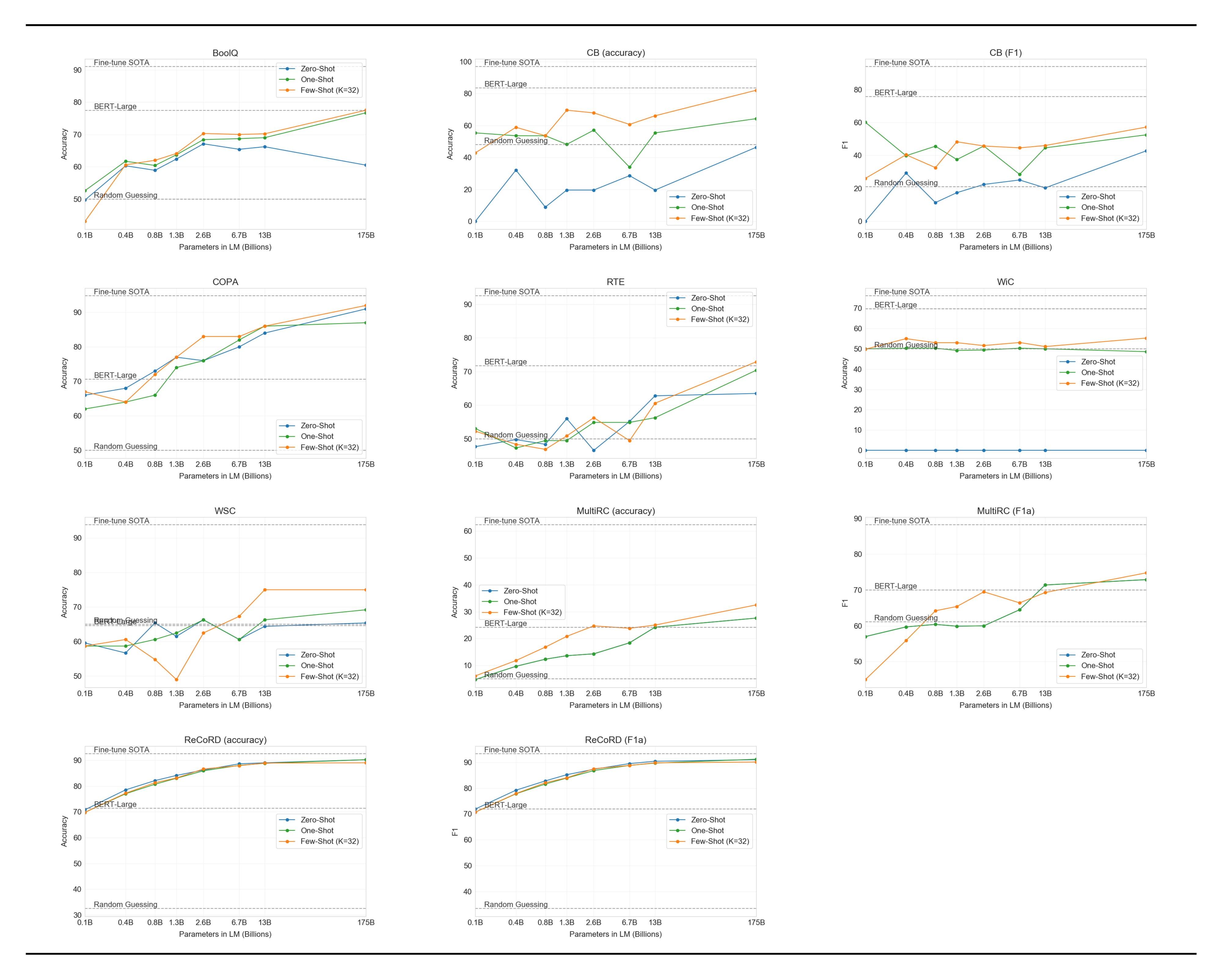
::::
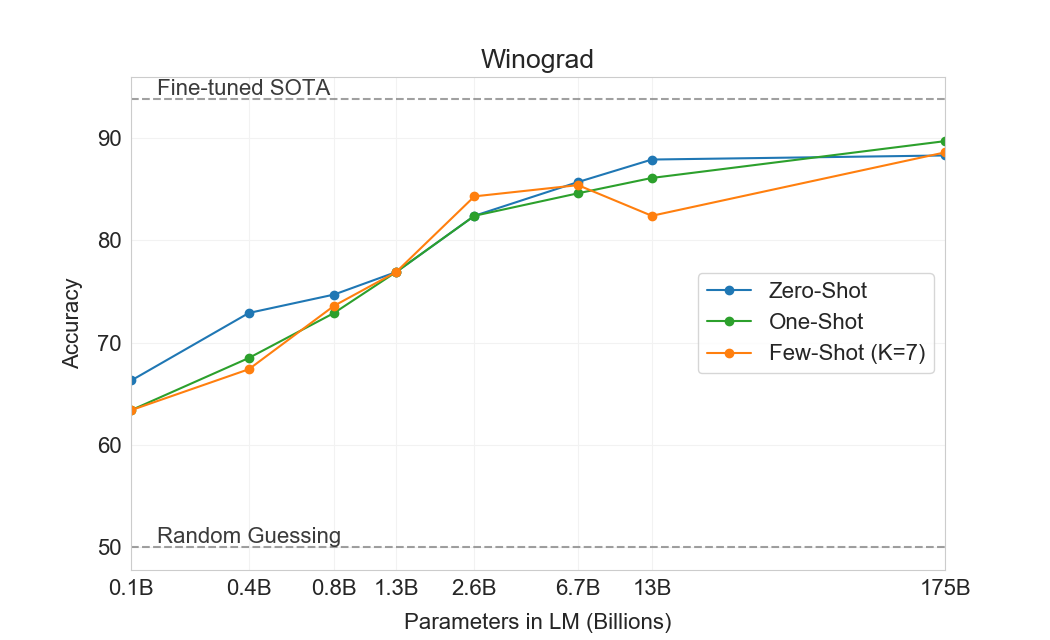
Figure 81: All results for all Winograd tasks. ::::
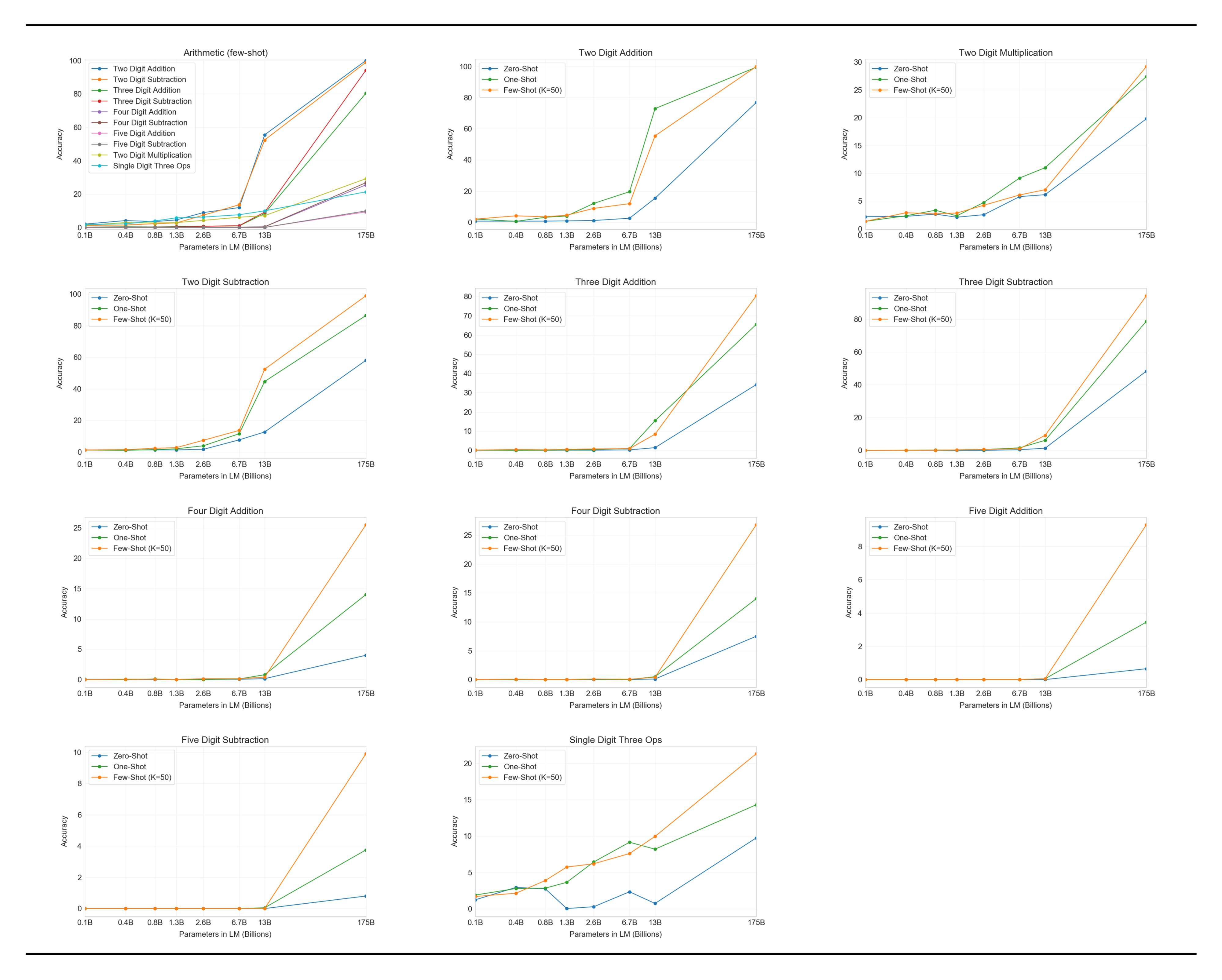
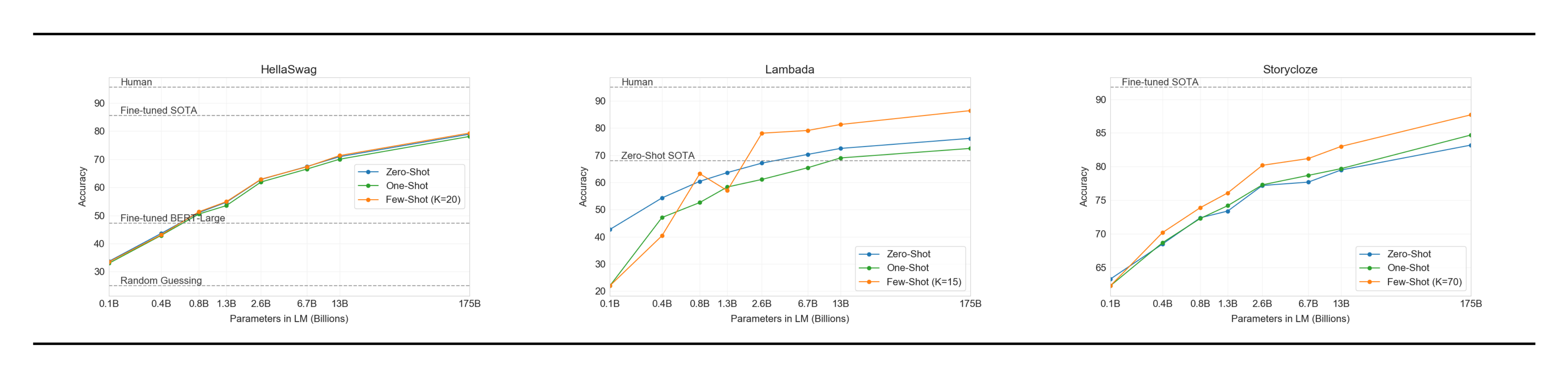
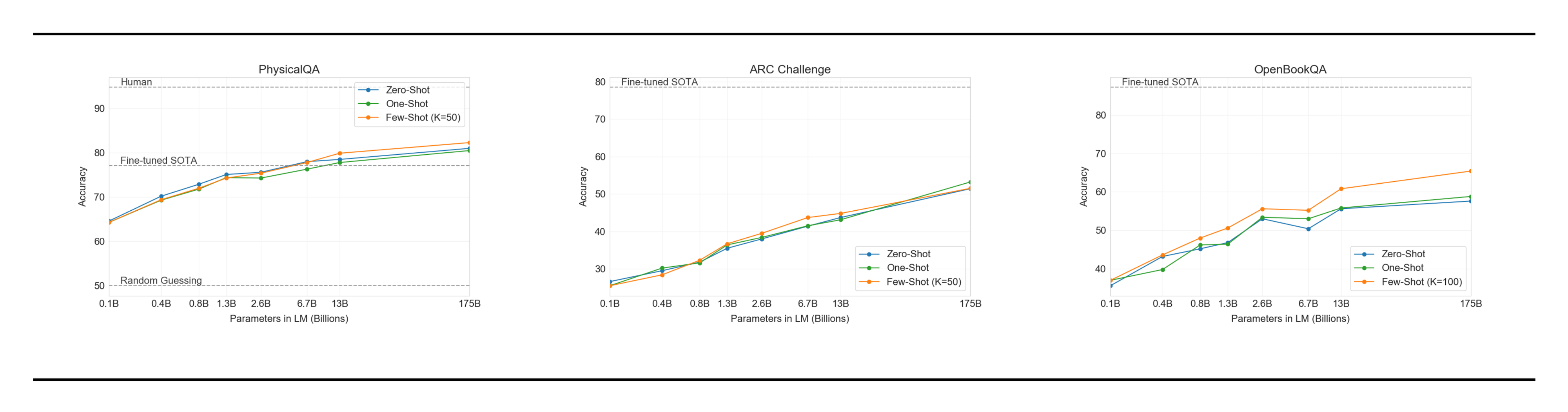
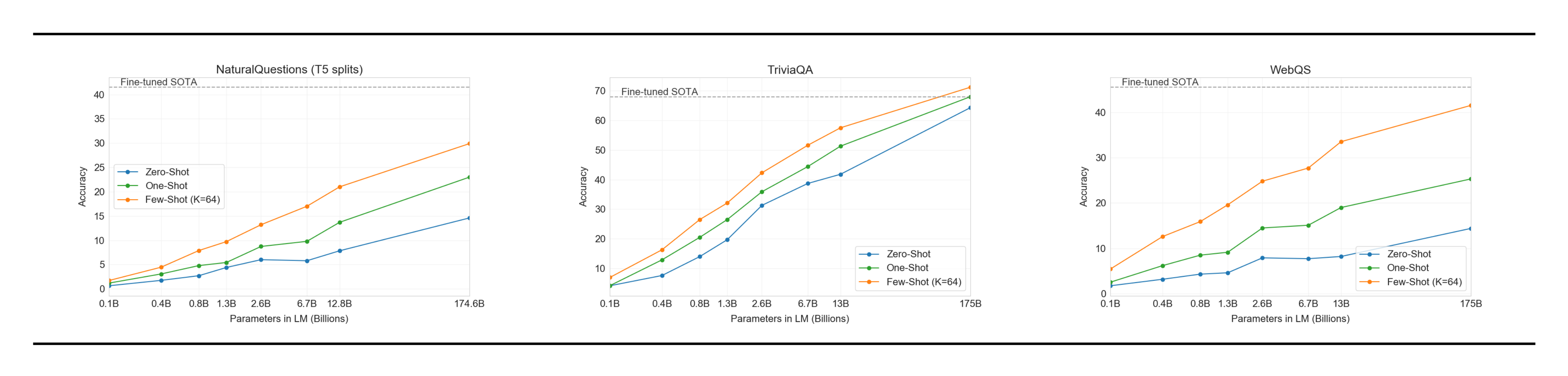
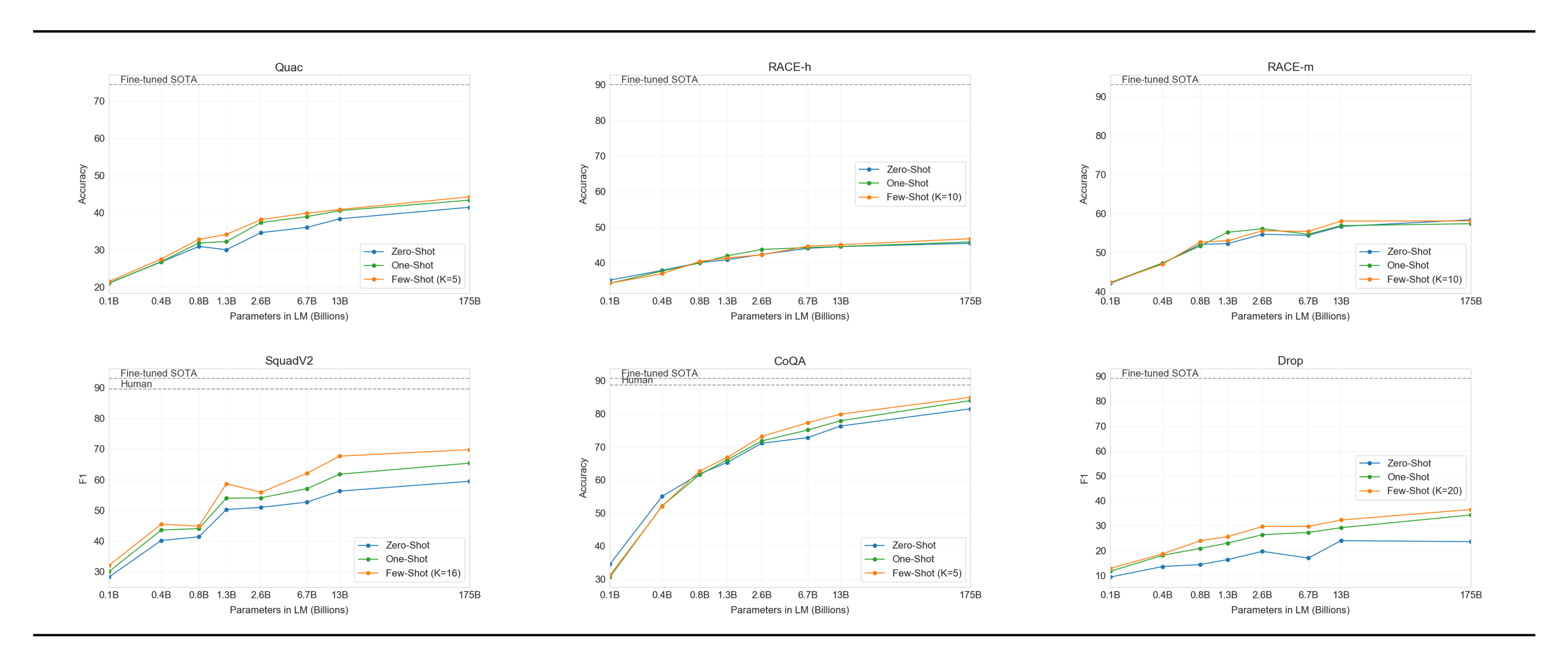
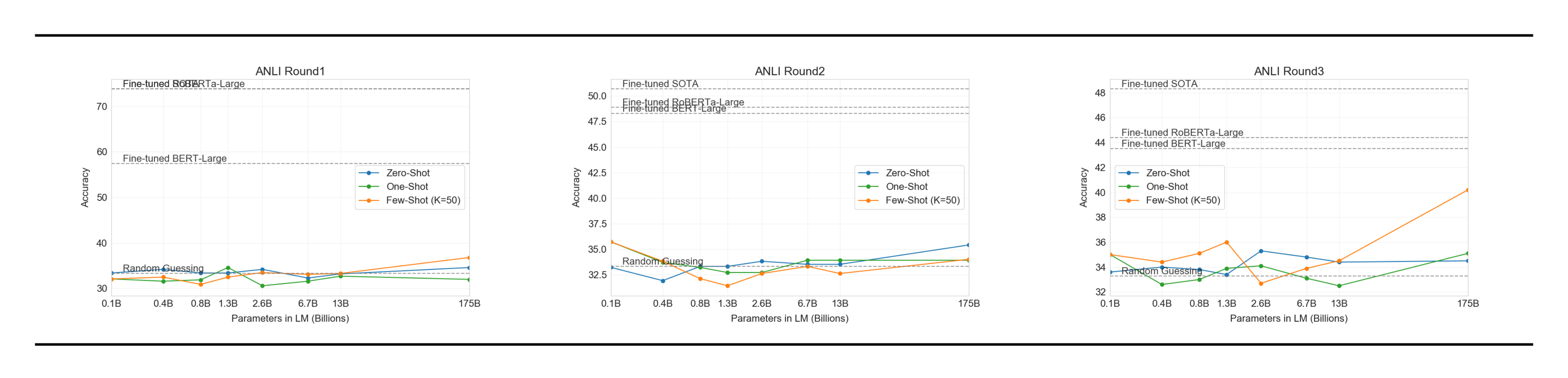
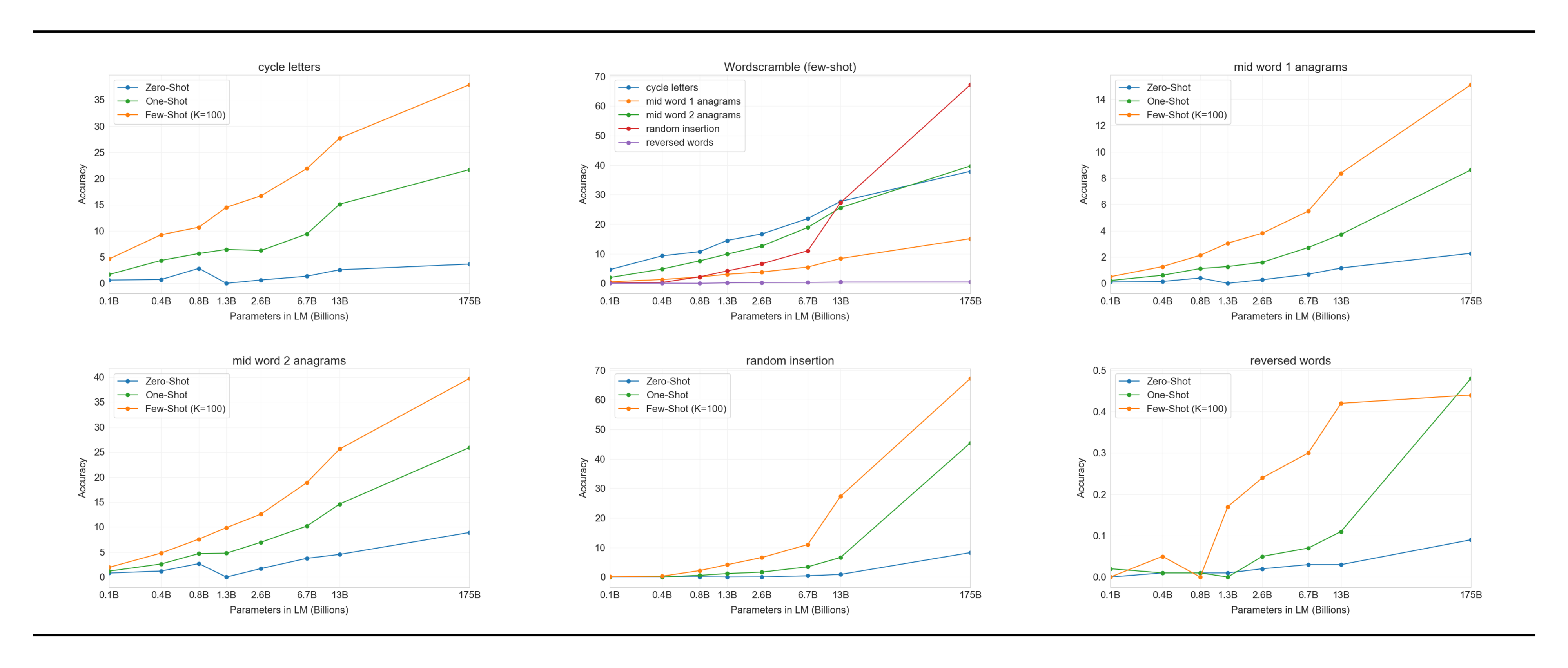
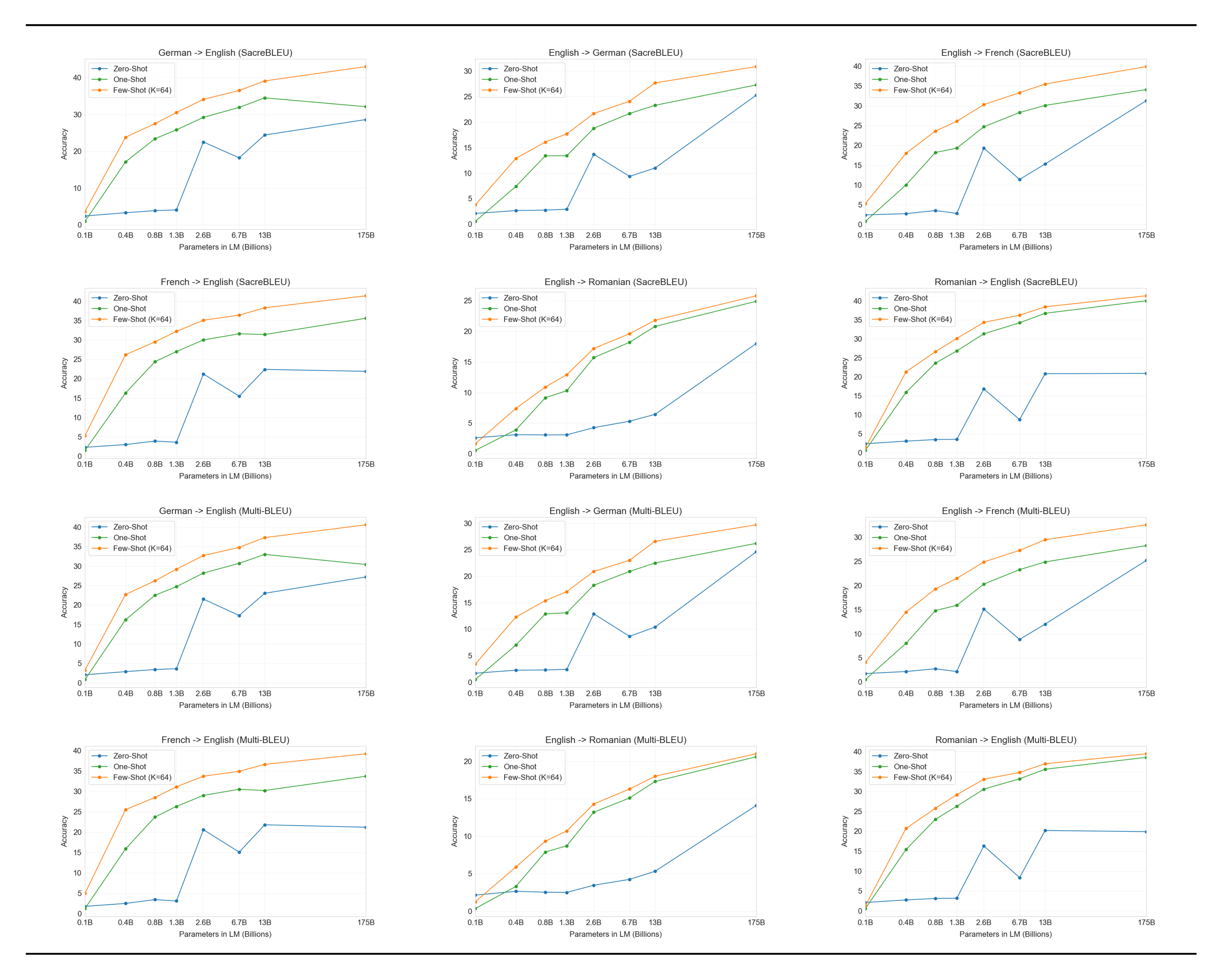
References
Section Summary: This references section compiles influential papers in natural language processing, starting with early methods for representing words as vectors, such as Word2Vec and GloVe, and advancing to more sophisticated transformer-based models like BERT, GPT, and their optimized versions including RoBERTa and XLNet. These works explore techniques for pre-training language models to better understand context, generate text, and handle tasks like translation and inference. The list also covers evaluations of model strengths and weaknesses, robustness against unusual data, scaling large models, and datasets for testing linguistic intelligence.
[1] Tomas Mikolov, Kai Chen, Greg Corrado, and Jeffrey Dean. Efficient estimation of word representations in vector space. arXiv preprint arXiv:1301.3781, 2013.
[2] Jeffrey Pennington, Richard Socher, and Christopher Manning. GloVe: Global vectors for word representation. In Proceedings of the 2014 conference on empirical methods in natural language processing (EMNLP), 2014.
[3] Andrew M. Dai and Quoc V. Le. Semi-supervised sequence learning. In Advances in neural information processing systems, 2015.
[4] Bryan McCann, James Bradbury, Caiming Xiong, and Richard Socher. Learned in translation: Contextualized word vectors. In Advances in Neural Information Processing Systems, pages 6294–6305, 2017.
[5] Matthew E. Peters, Mark Neumann, Luke Zettlemoyer, and Wen tau Yih. Dissecting contextual word embeddings: Architecture and representation, 2018.
[6] Ashish Vaswani, Noam Shazeer, Niki Parmar, Jakob Uszkoreit, Llion Jones, Aidan N. Gomez, Łukasz Kaiser, and Illia Polosukhin. Attention is all you need. In Advances in neural information processing systems, 2017.
[7] Alec Radford, Karthik Narasimhan, Tim Salimans, and Ilya Sutskever. Improving language understanding by generative pre-training, 2018.
[8] Jacob Devlin, Ming-Wei Chang, Kenton Lee, and Kristina Toutanova. BERT: Pre-training of deep bidirectional transformers for language understanding. arXiv preprint arXiv:1810.04805, 2018.
[9] Jeremy Howard and Sebastian Ruder. Universal language model fine-tuning for text classification. arXiv preprint arXiv:1801.06146, 2018.
[10] Colin Raffel, Noam Shazeer, Adam Roberts, Katherine Lee, Sharan Narang, Michael Matena, Yanqi Zhou, Wei Li, and Peter J. Liu. Exploring the limits of transfer learning with a unified text-to-text transformer, 2019.
[11] Yinhan Liu, Myle Ott, Naman Goyal, Jingfei Du, Mandar Joshi, Danqi Chen, Omer Levy, Mike Lewis, Luke Zettlemoyer, and Veselin Stoyanov. RoBERTa: A robustly optimized BERT pretraining approach. arXiv preprint arXiv:1907.11692, 2019.
[12] Zhilin Yang, Zihang Dai, Yiming Yang, Jaime Carbonell, Ruslan Salakhutdinov, and Quoc V. Le. XLNet: Generalized autoregressive pretraining for language understanding. arXiv preprint arXiv:1906.08237, 2019.
[13] Zhenzhong Lan, Mingda Chen, Sebastian Goodman, Kevin Gimpel, Piyush Sharma, and Radu Soricut. ALBERT: A lite BERT for self-supervised learning of language representations. arXiv preprint arXiv:1909.11942, 2019.
[14] Dan Hendrycks, Xiaoyuan Liu, Eric Wallace, Adam Dziedzic, Rishabh Krishnan, and Dawn Song. Pretrained transformers improve out of distribution robustness. arXiv preprint arXiv:2004.06100, 2020.
[15] Dani Yogatama, Cyprien de Masson d'Autume, Jerome Connor, Tomas Kocisky, Mike Chrzanowski, Lingpeng Kong, Angeliki Lazaridou, Wang Ling, Lei Yu, Chris Dyer, et al. Learning and evaluating general linguistic intelligence. arXiv preprint arXiv:1901.11373, 2019.
[16] R Thomas McCoy, Ellie Pavlick, and Tal Linzen. Right for the wrong reasons: Diagnosing syntactic heuristics in natural language inference. arXiv preprint arXiv:1902.01007, 2019.
[17] Suchin Gururangan, Swabha Swayamdipta, Omer Levy, Roy Schwartz, Samuel R Bowman, and Noah A Smith. Annotation artifacts in natural language inference data. arXiv preprint arXiv:1803.02324, 2018.
[18] Timothy Niven and Hung-Yu Kao. Probing neural network comprehension of natural language arguments. arXiv preprint arXiv:1907.07355, 2019.
[19] Alec Radford, Jeffrey Wu, Rewon Child, David Luan, Dario Amodei, and Ilya Sutskever. Language models are unsupervised multitask learners, 2019.
[20] Mohammad Shoeybi, Mostofa Patwary, Raul Puri, Patrick LeGresley, Jared Casper, and Bryan Catanzaro. Megatron-lm: Training multi-billion parameter language models using model parallelism, 2019.
[21] Project Turing. Microsoft research blog, Feb 2020.
[22] Jared Kaplan, Sam McCandlish, Tom Henighan, Tom B. Brown, Benjamin Chess, Rewon Child, Scott Gray, Alec Radford, Jeffrey Wu, and Dario Amodei. Scaling laws for neural language models, 2020.
[23] Sepp Hochreiter, A Steven Younger, and Peter R Conwell. Learning to Learn Using Gradient Descent. In International Conference on Artificial Neural Networks, pages 87–94. Springer, 2001.
[24] Oriol Vinyals, Charles Blundell, Timothy Lillicrap, Daan Wierstra, et al. Matching Networks for One Shot Learning. In Advances in neural information processing systems, pages 3630–3638, 2016.
[25] Rewon Child, Scott Gray, Alec Radford, and Ilya Sutskever. Generating long sequences with sparse transformers, 2019.
[26] Sam McCandlish, Jared Kaplan, Dario Amodei, and OpenAI Dota Team. An empirical model of large-batch training, 2018.
[27] Mitchell Marcus, Grace Kim, Mary Ann Marcinkiewicz, Robert MacIntyre, Ann Bies, Mark Ferguson, Karen Katz, and Britta Schasberger. The penn treebank: annotating predicate argument structure. In Proceedings of the workshop on Human Language Technology, pages 114–119. Association for Computational Linguistics, 1994.
[28] Zhongyang Li, Xiao Ding, and Ting Liu. Story ending prediction by transferable bert. arXiv preprint arXiv:1905.07504, 2019.
[29] Xiaodong Liu, Hao Cheng, Pengcheng He, Weizhu Chen, Yu Wang, Hoifung Poon, and Jianfeng Gao. Adversarial training for large neural language models. arXiv preprint arXiv:2004.08994, 2020.
[30] Denis Paperno, Germán Kruszewski, Angeliki Lazaridou, Quan Ngoc Pham, Raffaella Bernardi, Sandro Pezzelle, Marco Baroni, Gemma Boleda, and Raquel Fernández. The lambada dataset: Word prediction requiring a broad discourse context. arXiv preprint arXiv:1606.06031, 2016.
[31] Yonatan Bisk, Ari Holtzman, Jesse Thomason, Jacob Andreas, Yoshua Bengio, Joyce Chai, Mirella Lapata, Angeliki Lazaridou, Jonathan May, Aleksandr Nisnevich, et al. Experience grounds language. arXiv preprint arXiv:2004.10151, 2020.
[32] Rowan Zellers, Ari Holtzman, Yonatan Bisk, Ali Farhadi, and Yejin Choi. Hellaswag: Can a machine really finish your sentence? arXiv preprint arXiv:1905.07830, 2019.
[33] Rowan Zellers, Ari Holtzman, Hannah Rashkin, Yonatan Bisk, Ali Farhadi, Franziska Roesner, and Yejin Choi. Defending against neural fake news. arXiv preprint arXiv:1905.12616, 2019.
[34] Nasrin Mostafazadeh, Nathanael Chambers, Xiaodong He, Devi Parikh, Dhruv Batra, Lucy Vanderwende, Pushmeet Kohli, and James Allen. A corpus and evaluation framework for deeper understanding of commonsense stories. arXiv preprint arXiv:1604.01696, 2016.
[35] Patrick Lewis, Ethan Perez, Aleksandra Piktus, Fabio Petroni, Vladimir Karpukhin, Naman Goyal, Heinrich Küttler, Mike Lewis, Wen-tau Yih, Tim Rocktäschel, Sebastian Riedel, and Kiela Douwe. Retrieval-augmented generation for knowledge-intensive nlp tasks. arXiv preprint arXiv:2005.11401, 2020.
[36] Adam Roberts, Colin Raffel, and Noam Shazeer. How much knowledge can you pack into the parameters of a language model? arXiv preprint arXiv:2002.08910, 2020.
[37] Tom Kwiatkowski, Jennimaria Palomaki, Olivia Redfield, Michael Collins, Ankur Parikh, Chris Alberti, Danielle Epstein, Illia Polosukhin, Matthew Kelcey, Jacob Devlin, Kenton Lee, Kristina N. Toutanova, Llion Jones, Ming-Wei Chang, Andrew Dai, Jakob Uszkoreit, Quoc Le, and Slav Petrov. Natural questions: a benchmark for question answering research. Transactions of the Association of Computational Linguistics, 2019.
[38] Jonathan Berant, Andrew Chou, Roy Frostig, and Percy Liang. Semantic parsing on freebase from question-answer pairs. In Proceedings of the 2013 conference on empirical methods in natural language processing, pages 1533–1544, 2013.
[39] Mandar Joshi, Eunsol Choi, Daniel S. Weld, and Luke Zettlemoyer. TriviaQA: A large scale distantly supervised challenge dataset for reading comprehension. arXiv preprint arXiv:1705.03551, 2017.
[40] Rico Sennrich, Barry Haddow, and Alexandra Birch. Improving neural machine translation models with monolingual data. arXiv preprint arXiv:1511.06709, 2015.
[41] Matt Post. A call for clarity in reporting BLEU scores. arXiv preprint arXiv:1804.08771, 2018.
[42] Sergey Edunov, Myle Ott, Michael Auli, and David Grangier. Understanding back-translation at scale. arXiv preprint arXiv:1808.09381, 2018.
[43] Nadir Durrani, Barry Haddow, Philipp Koehn, and Kenneth Heafield. Edinburgh’s phrase-based machine translation systems for wmt-14. In Proceedings of the Ninth Workshop on Statistical Machine Translation, pages 97–104, 2014.
[44] Yiren Wang, Yingce Xia, Tianyu He, Fei Tian, Tao Qin, ChengXiang Zhai, and Tie-Yan Liu. Multi-agent dual learning. ICLR 2019, 2018.
[45] University of Regensburg. Fascha, 2016.
[46] Yinhan Liu, Jiatao Gu, Naman Goyal, Xian Li, Sergey Edunov, Marjan Ghazvininejad, Mike Lewis, and Luke Zettlemoyer. Multilingual denoising pre-training for neural machine translation. arXiv preprint arXiv:2001.08210, 2020.
[47] Xiaodong Liu, Pengcheng He, Weizhu Chen, and Jianfeng Gao. Multi-task deep neural networks for natural language understanding. arXiv preprint arXiv:1901.11504, 2019.
[48] Keisuke Sakaguchi, Ronan Le Bras, Chandra Bhagavatula, and Yejin Choi. Winogrande: An adversarial winograd schema challenge at scale, 2019.
[49] Sheng-Chieh Lin, Jheng-Hong Yang, Rodrigo Nogueira, Ming-Feng Tsai, Chuan-Ju Wang, and Jimmy Lin. Tttttackling winogrande schemas. arXiv preprint arXiv:2003.08380, 2020.
[50] Hector Levesque, Ernest Davis, and Leora Morgenstern. The Winograd schema challenge. In Thirteenth International Conference on the Principles of Knowledge Representation and Reasoning, 2012.
[51] Daniel Khashabi, Tushar Khot, Ashish Sabharwal, Oyvind Tafjord, Peter Clark, and Hannaneh Hajishirzi. Unifiedqa: Crossing format boundaries with a single qa system. arXiv preprint arXiv:2005.00700, 2020.
[52] Yonatan Bisk, Rowan Zellers, Ronan Le Bras, Jianfeng Gao, and Yejin Choi. Piqa: Reasoning about physical commonsense in natural language. arXiv preprint arXiv:1911.11641, 2019.
[53] Peter Clark, Isaac Cowhey, Oren Etzioni, Tushar Khot, Ashish Sabharwal, Carissa Schoenick, and Oyvind Tafjord. Think you have solved question answering? try arc, the ai2 reasoning challenge. ArXiv, abs/1803.05457, 2018.
[54] Todor Mihaylov, Peter Clark, Tushar Khot, and Ashish Sabharwal. Can a suit of armor conduct electricity? a new dataset for open book question answering. ArXiv, abs/1809.02789, 2018.
[55] Ying Ju, Fubang Zhao, Shijie Chen, Bowen Zheng, Xuefeng Yang, and Yunfeng Liu. Technical report on conversational question answering. arXiv preprint arXiv:1909.10772, 2019.
[56] Zheng Junyuan and Gamma Lab NYC. Numeric transformer - albert, March 2020.
[57] WeChat AI. Tr-mt (ensemble), December 2019.
[58] QIANXIN. Sa-net on albert (ensemble), April 2020.
[59] Siva Reddy, Danqi Chen, and Christopher D Manning. Coqa: A conversational question answering challenge. Transactions of the Association for Computational Linguistics, 7:249–266, 2019.
[60] Eunsol Choi, He He, Mohit Iyyer, Mark Yatskar, Wen-tau Yih, Yejin Choi, Percy Liang, and Luke Zettlemoyer. Quac : Question answering in context. Arxiv, 2018.
[61] Dheeru Dua, Yizhong Wang, Pradeep Dasigi, Gabriel Stanovsky, Sameer Singh, and Matt Gardner. Drop: A reading comprehension benchmark requiring discrete reasoning over paragraphs. arXiv preprint arXiv:1903.00161, 2019.
[62] Qiu Ran, Yankai Lin, Peng Li, Jie Zhou, and Zhiyuan Liu. NumNet: Machine reading comprehension with numerical reasoning. In Proceedings of EMNLP, 2019.
[63] Pranav Rajpurkar, Robin Jia, and Percy Liang. Know what you don't know: Unanswerable questions for squad. arXiv preprint arXiv:1806.03822, 2018.
[64] Guokun Lai, Qizhe Xie, Hanxiao Liu, Yiming Yang, and Eduard Hovy. Race: Large-scale reading comprehension dataset from examinations. arXiv preprint arXiv:1704.04683, 2017.
[65] Alex Wang, Yada Pruksachatkun, Nikita Nangia, Amanpreet Singh, Julian Michael, Felix Hill, Omer Levy, and Samuel Bowman. Superglue: A stickier benchmark for general-purpose language understanding systems. In Advances in Neural Information Processing Systems, pages 3261–3275, 2019.
[66] Christopher Clark, Kenton Lee, Ming-Wei Chang, Tom Kwiatkowski, Michael Collins, and Kristina Toutanova. BoolQ: Exploring the surprising difficulty of natural yes/no questions. arXiv preprint arXiv:1905.10044, 2019.
[67] Marie-Catherine De Marneffe, Mandy Simons, and Judith Tonhauser. The CommitmentBank: Investigating projection in naturally occurring discourse. 2019. To appear in proceedings of Sinn und Bedeutung 23. Data can be found at https://github.com/mcdm/CommitmentBank/.
[68] Melissa Roemmele, Cosmin Adrian Bejan, and Andrew S Gordon. Choice of plausible alternatives: An evaluation of commonsense causal reasoning. In 2011 AAAI Spring Symposium Series, 2011.
[69] Daniel Khashabi, Snigdha Chaturvedi, Michael Roth, Shyam Upadhyay, and Dan Roth. Looking beyond the surface: A challenge set for reading comprehension over multiple sentences. In Proceedings of North American Chapter of the Association for Computational Linguistics (NAACL), 2018.
[70] Sheng Zhang, Xiaodong Liu, Jingjing Liu, Jianfeng Gao, Kevin Duh, and Benjamin Van Durme. ReCoRD: Bridging the gap between human and machine commonsense reading comprehension. arXiv preprint arXiv:1810.12885, 2018.
[71] Ido Dagan, Oren Glickman, and Bernardo Magnini. The PASCAL recognising textual entailment challenge. In Machine learning challenges. evaluating predictive uncertainty, visual object classification, and recognising textual entailment, pages 177–190. Springer, 2006.
[72] Roy Bar Haim, Ido Dagan, Bill Dolan, Lisa Ferro, Danilo Giampiccolo, Bernardo Magnini, and Idan Szpektor. The second PASCAL recognising textual entailment challenge. 2006.
[73] Danilo Giampiccolo, Bernardo Magnini, Ido Dagan, and Bill Dolan. The third PASCAL recognizing textual entailment challenge. In Proceedings of the ACL-PASCAL workshop on textual entailment and paraphrasing, pages 1–9. Association for Computational Linguistics, 2007.
[74] Luisa Bentivogli, Ido Dagan, Hoa Trang Dang, Danilo Giampiccolo, and Bernardo Magnini. The fifth PASCAL recognizing textual entailment challenge. 2009.
[75] Mohammad Taher Pilehvar and Jose Camacho-Collados. WIC: 10,000 example pairs for evaluating context-sensitive representations. arXiv preprint arXiv:1808.09121, 2018.
[76] Adam Poliak, Aparajita Haldar, Rachel Rudinger, J. Edward Hu, Ellie Pavlick, Aaron Steven White, and Benjamin Van Durme. Collecting diverse natural language inference problems for sentence representation evaluation. In Proceedings of EMNLP, 2018.
[77] Yaroslav Fyodorov. A natural logic inference system, 2000.
[78] Yixin Nie, Adina Williams, Emily Dinan, Mohit Bansal, Jason Weston, and Douwe Kiela. Adversarial nli: A new benchmark for natural language understanding. arXiv preprint arXiv:1910.14599, 2019.
[79] Peter Norvig. Natural language corpus data, 2009.
[80] Peter D. Turney, Michael L. Littman, Jeffrey Bigham, and Victor Shnayder. Combining independent modules to solve multiple-choice synonym and analogy problems. CoRR, cs.CL/0309035, 2003.
[81] Peter D. Turney and Michael L. Littman. Corpus-based learning of analogies and semantic relations. CoRR, abs/cs/0508103, 2005.
[82] Sarah E. Kreps, Miles McCain, and Miles Brundage. All the news that’s fit to fabricate: Ai-generated text as a tool of media misinformation, 2020.
[83] Daphne Ippolito, Daniel Duckworth, Chris Callison-Burch, and Douglas Eck. Automatic detection of generated text is easiest when humans are fooled. arXiv preprint arXiv:1911.00650, 2019.
[84] Sebastian Gehrmann, Hendrik Strobelt, and Alexander M. Rush. Gltr: Statistical detection and visualization of generated text. arXiv preprint arXiv: 1906.04043, 2019.
[85] Susan Carey and Elsa Bartlett. Acquiring a single new word. Proceedings of the Stanford Child Language Conference, 1978.
[86] Trieu H. Trinh and Quoc V. Le. A simple method for commonsense reasoning. arXiv preprint arXiv:1806.02847, 2018.
[87] Daniel M. Ziegler, Nisan Stiennon, Jeffrey Wu, Tom B. Brown, Alec Radford, Dario Amodei, Paul Christiano, and Geoffrey Irving. Fine-tuning language models from human preferences, 2019.
[88] Yen-Chun Chen, Linjie Li, Licheng Yu, Ahmed El Kholy, Faisal Ahmed, Zhe Gan, Yu Cheng, and Jingjing Liu. Uniter: Learning universal image-text representations. arXiv preprint arXiv:1909.11740, 2019.
[89] Tal Linzen. How can we accelerate progress towards human-like linguistic generalization? arXiv preprint arXiv:2005.00955, 2020.
[90] Geoffrey Hinton, Oriol Vinyals, and Jeff Dean. Distilling the knowledge in a neural network. arXiv preprint arXiv:1503.02531, 2015.
[91] Xiaodong Liu, Pengcheng He, Weizhu Chen, and Jianfeng Gao. Improving multi-task deep neural networks via knowledge distillation for natural language understanding. arXiv preprint arXiv:1904.09482, 2019.
[92] R.S. Ross. Guide for conducting risk assessments. NIST Special Publication, 2012.
[93] Irene Solaiman, Miles Brundage, Jack Clark, Amanda Askell, Ariel Herbert-Voss, Jeff Wu, Alec Radford, Gretchen Krueger, Jong Wook Kim, Sarah Kreps, Miles McCain, Alex Newhouse, Jason Blazakis, Kris McGuffie, and Jasmine Wang. Release strategies and the social impacts of language models, 2019.
[94] Kate Crawford. The trouble with bias. NIPS 2017 Keynote, 2017.
[95] Po-Sen Huang, Huan Zhang, Ray Jiang, Robert Stanforth, Johannes Welbl, Jack Rae, Vishal Maini, Dani Yogatama, and Pushmeet Kohli. Reducing sentiment bias in language models via counterfactual evaluation. arXiv preprint arXiv:1911.03064, 2019.
[96] Moin Nadeem, Anna Bethke, and Siva Reddy. Stereoset: Measuring stereotypical bias in pretrained language models. arXiv preprint arXiv:2004.09456, 2020.
[97] Emily Sheng, Kai-Wei Chang, Premkumar Natarajan, and Nanyun Peng. The woman worked as a babysitter: On biases in language generation. arXiv preprint arXiv:1909.01326, 2019.
[98] Rachel Rudinger, Jason Naradowsky, Brian Leonard, and Benjamin Van Durme. Gender bias in coreference resolution. arXiv preprint arXiv:1804.09301, 2018.
[99] Edward Loper and Steven Bird. Nltk: The natural language toolkit, 2002.
[100] Stefano Baccianella, Andrea Esuli, and Fabrizio Sebastiani. Sentiwordnet 3.0: an enhanced lexical resource for sentiment analysis and opinion mining. In Lrec, volume 10, pages 2200–2204, 2010.
[101] Margaret Mitchell, Simone Wu, Andrew Zaldivar, Parker Barnes, Lucy Vasserman, Ben Hutchinson, Elena Spitzer, Inioluwa Deborah Raji, and Timnit Gebru. Model cards for model reporting, 2018.
[102] Yusu Qian, Urwa Muaz, Ben Zhang, and Jae Won Hyun. Reducing gender bias in word-level language models with a gender-equalizing loss function. arXiv preprint arXiv:1905.12801, 2019.
[103] Su Lin Blodgett, Solon Barocas, Hal Daumé III, and Hanna Wallach. Language (technology) is power: A critical survey of "bias" in nlp. arXiv preprint arXiv:2005.14050, 2020.
[104] Hila Gonen and Yoav Goldberg. Lipstick on a pig: Debiasing methods cover up systematic gender biases in word embeddings but do not remove them. arXiv preprint arXiv:1903.03862, 2019.
[105] Malvina Nissim, Rik van Noord, and Rob van der Goot. Fair is better than sensational: Man is to doctor as woman is to doctor. arXiv preprint arXiv:1905.09866, 2019.
[106] Roy Schwartz, Jesse Dodge, Noah A. Smith, and Oren Etzioni. Green AI. CoRR, abs/1907.10597, 2019.
[107] Daniel Hernandez and Tom Brown. Ai and efficiency, May 2020.
[108] Rafal Jozefowicz, Oriol Vinyals, Mike Schuster, Noam Shazeer, and Yonghui Wu. Exploring the limits of language modeling. arXiv preprint arXiv:1602.02410, 2016.
[109] Yoshua Bengio, Nicholas Léonard, and Aaron C. Courville. Estimating or propagating gradients through stochastic neurons for conditional computation. Arxiv, 2013.
[110] Noam Shazeer, Azalia Mirhoseini, Krzysztof Maziarz, Andy Davis, Quoc Le, Geoffrey Hinton, and Jeff Dean. Outrageously large neural networks: The sparsely-gated mixture-of-experts layer. arXiv preprint arXiv:1701.06538, 2017.
[111] Roee Aharoni, Melvin Johnson, and Orhan Firat. Massively multilingual neural machine translation. In Proceedings of the 2019 Conference of the North American Chapter of the Association for Computational Linguistics: Human Language Technologies, Volume 1 (Long and Short Papers), 2019.
[112] Alex Graves. Adaptive computation time for recurrent neural networks. Arxiv, 2016.
[113] Mostafa Dehghani, Stephan Gouws, Oriol Vinyals, Jakob Uszkoreit, and Lukasz Kaiser. Universal transformers. Arxiv, 2018.
[114] Jonathan S. Rosenfeld, Amir Rosenfeld, Yonatan Belinkov, and Nir Shavit. A constructive prediction of the generalization error across scales, 2019.
[115] Zhuohan Li, Eric Wallace, Sheng Shen, Kevin Lin, Kurt Keutzer, Dan Klein, and Joseph E. Gonzalez. Train large, then compress: Rethinking model size for efficient training and inference of transformers, 2020.
[116] Joel Hestness, Sharan Narang, Newsha Ardalani, Gregory Diamos, Heewoo Jun, Hassan Kianinejad, Md. Mostofa Ali Patwary, Yang Yang, and Yanqi Zhou. Deep learning scaling is predictable, empirically. arXiv preprint arXiv:1712.00409, 2017.
[117] Victor Sanh, Lysandre Debut, Julien Chaumond, and Thomas Wolf. DistilBERT, a distilled version of BERT: smaller, faster, cheaper and lighter. arXiv preprint arXiv:1910.01108, 2019.
[118] Xiaoqi Jiao, Yichun Yin, Lifeng Shang, Xin Jiang, Xiao Chen, Linlin Li, Fang Wang, and Qun Liu. TinyBERT: Distilling BERT for natural language understanding. arXiv preprint arXiv:1909.10351, 2019.
[119] Yoon Kim and Alexander M. Rush. Sequence-level knowledge distillation. Arxiv, 2016.
[120] Mohit Iyyer, Jordan Boyd-Graber, Leonardo Claudino, Richard Socher, and Hal Daumé III. A neural network for factoid question answering over paragraphs. In Empirical Methods in Natural Language Processing, 2014.
[121] Kelvin Guu, Kenton Lee, Zora Tung, Panupong Pasupat, and Ming-Wei Chang. Realm: Retrieval-augmented language model pre-training. arXiv preprint arXiv:2002.08909, 2020.
[122] Yan Duan, John Schulman, Xi Chen, Peter L. Bartlett, Ilya Sutskever, and Pieter Abbeel. Rl$^2$: Fast reinforcement learning via slow reinforcement learning. ArXiv, abs/1611.02779, 2016.
[123] Sachin Ravi and Hugo Larochelle. Optimization as a model for few-shot learning. ICLR 2017 (oral), 2016.
[124] Marcin Andrychowicz, Misha Denil, Sergio Gomez, Matthew W Hoffman, David Pfau, Tom Schaul, Brendan Shillingford, and Nando De Freitas. Learning to learn by gradient descent by gradient descent. In Advances in neural information processing systems, pages 3981–3989, 2016.
[125] Ke Li and Jitendra Malik. Learning to optimize neural nets. arXiv preprint arXiv:1703.00441, 2017.
[126] Chelsea Finn, Pieter Abbeel, and Sergey Levine. Model-agnostic meta-learning for fast adaptation of deep networks. ArXiv, abs/1703.03400, 2017.
[127] Scott Reed, Yutian Chen, Thomas Paine, Aäron van den Oord, SM Eslami, Danilo Rezende, Oriol Vinyals, and Nando de Freitas. Few-shot autoregressive density estimation: Towards learning to learn distributions. arXiv preprint arXiv:1710.10304, 2017.
[128] Jiatao Gu, Yong Wang, Yun Chen, Kyunghyun Cho, and Victor OK Li. Meta-learning for low-resource neural machine translation. arXiv preprint arXiv:1808.08437, 2018.
[129] Timo Schick and Hinrich Schütze. Exploiting cloze questions for few-shot text classification and natural language inference. arXiv preprint arXiv:2001.07676, 2020.
[130] Qizhe Xie, Zihang Dai, Eduard Hovy, Minh-Thang Luong, and Quoc V. Le. Unsupervised data augmentation for consistency training, 2019.
[131] Bryan McCann, Nitish Shirish Keskar, Caiming Xiong, and Richard Socher. The natural language decathlon: Multitask learning as question answering. arXiv preprint arXiv:1806.08730, 2018.
[132] Rich Caruana. Multitask learning. Machine learning, 28(1), 1997.
[133] Xiaodong Liu, Jianfeng Gao, Xiaodong He, Li Deng, Kevin Duh, and Ye-Yi Wang. Representation learning using multi-task deep neural networks for semantic classification and information retrieval. In Proceedings of the 2015 Conference of the North American Chapter of the Association for Computational Linguistics: Human Language Technologies, 2015.
[134] Peter J. Liu, Mohammad Saleh, Etienne Pot, Ben Goodrich, Ryan Sepassi, Lukasz Kaiser, and Noam Shazeer. Generating Wikipedia by summarizing long sequences. arXiv preprint arXiv:1801.10198, 2018.
[135] Jason Phang, Thibault Févry, and Samuel R. Bowman. Sentence encoders on STILTs: Supplementary training on intermediate labeled-data tasks. arXiv preprint arXiv:1811.01088, 2018.
[136] Josh Tobin, Rachel Fong, Alex Ray, Jonas Schneider, Wojciech Zaremba, and Pieter Abbeel. Domain randomization for transferring deep neural networks from simulation to the real world. In 2017 IEEE/RSJ international conference on intelligent robots and systems (IROS), pages 23–30. IEEE, 2017.
[137] Daniel M. Ziegler, Nisan Stiennon, Jeffrey Wu, Tom B. Brown, Alec Radford, Dario Amodei, Paul Christiano, and Geoffrey Irving. Fine-tuning language models from human preferences. ArXiv, abs/1909.08593, 2019.
[138] David. MacKay. Information-based objective functions for active data selection. Neural Computation, 1992.
[139] Mike Lewis, Yinhan Liu, Naman Goyal, Marjan Ghazvininejad, Abdelrahman Mohamed, Omer Levy, Ves Stoyanov, and Luke Zettlemoyer. Bart: Denoising sequence-to-sequence pre-training for natural language generation, translation, and comprehension. arXiv preprint arXiv:1910.13461, 2019.
[140] Zihang Dai, Zhilin Yang, Yiming Yang, Jaime G. Carbonell, Quoc V. Le, and Ruslan Salakhutdinov. Transformer-xl: Attentive language models beyond a fixed-length context. Arxiv, 2019.
[141] Ilya Loshchilov and Frank Hutter. Decoupled weight decay regularization. arXiv preprint arXiv:1711.05101, 2017.
[142] Ari Holtzman, Jan Buys, Maxwell Forbes, and Yejin Choi. The curious case of neural text degeneration. CoRR, abs/1904.09751, 2019.