Identifying the Human Values behind Arguments

Johannes KieselMilad AlshomaryNicolas HandkeXiaoni CaiHenning WachsmuthBenno Stein

article2022ACL117 citations

Presents a psychology-grounded taxonomy of 54 human values alongside a cross-cultural dataset of 5,270 annotated arguments to establish computational baselines for identifying the underlying ethical principles in natural language reasoning.

Listen

When people disagree on public policy or controversial issues, their differing stances often stem from conflicting human values—such as personal achievement versus tradition—rather than access to different facts. While human values provide the core persuasive foundation for arguments, natural language processing and argument analysis tools have struggled to evaluate them automatically because values are vast in variety, abstract, and frequently left implicit in text.

The article aims to define and demonstrate the first computational approach for automatically identifying the human values behind written natural language arguments across multiple levels of granularity and diverse geographic regions.

To achieve this, the article establishes a consolidated multi-level taxonomy of 54 values structured into four hierarchy tiers, building on established social science frameworks. The researchers then compiled a benchmark dataset of 5,270 arguments sourced from four regions: the United States (5,020 arguments), Africa (50), China (100), and India (100). Three crowdworkers annotated each argument across all 54 values, yielding roughly 850,000 individual judgments. The dataset was then evaluated using baseline classification models, support vector machines, and fine-tuned pre-trained language models based on bidirectional encoder representations.

The findings show that natural language models can identify specific underlying human values, outperforming baseline models on fine-grained categories with an average macro F1-score of 0.25 and reaching up to 0.81 for prominent values such as personal health. Higher-level value categories, however, proved more challenging to separate cleanly, as arguments routinely appeal to multiple broader dimensions simultaneously. Performance generally tracked label frequency, showing stronger detection for well-represented values. Furthermore, models trained predominantly on United States data demonstrated robust cross-cultural transferability, achieving comparable or superior performance on the African, Chinese, and Indian datasets.

These results demonstrate that computational value identification is feasible, providing a foundation for systems that can automatically detect why audiences accept specific claims. In practical applications, this capability can support audience-aware communication, improve automated argument quality assessments, and help bridge polarized debates by identifying shared underlying values between opposing viewpoints. However, low average precision indicates that standard language models cannot yet be deployed autonomously without substantial human review.

Organizations and researchers pursuing value-based automated reasoning should invest in hierarchical multi-label classification architectures and expand training data for less frequent values. Future initiatives must prioritize broader international datasets and recruit culturally diverse annotators to mitigate regional bias.

Confidence in these findings should be weighed against notable limitations, including an extreme class imbalance where over 95 percent of the dataset originates from the United States, as well as the reliance on Western-based crowdworkers to interpret arguments across multiple cultural contexts.

Abstract

This paper studies the (often implicit) human values behind natural language arguments, such as to have freedom of thought or to be broad-minded. Values are commonly accepted answers to why some option is desirable in the ethical sense and are thus essential both in real-world argumentation and theoretical argumentation frameworks. However, their large variety has been a major obstacle to modeling them in argument mining. To overcome this obstacle, we contribute an operationalization of human values, namely a multi-level taxonomy with 54 values that is in line with psychological research. Moreover, we provide a dataset of 5270 arguments from four geographical cultures, manually annotated for human values. First experiments with the automatic classification of human values are promising, with F₁-scores up to 0.81 and 0.25 on average.

Table of Contents

  • 1 Introduction
  • 2 Background
  • 2.1 Values in Social Science
  • 2.2 Values in Argumentation Research
  • 3 Taking Values to Argument Mining
  • 4 A Dataset of Values behind Arguments
  • 4.1 Argument Sources of Different Cultures
  • 4.2 Crowdsourcing of Value Annotations
  • 5 Identifying Values behind Arguments
  • 5.1 Results on the USA Part
  • 5.2 Results Across Culture
  • 6 Conclusion
  • 7 Ethics Statement
  • References
  • A Annotation Interface

Knowls

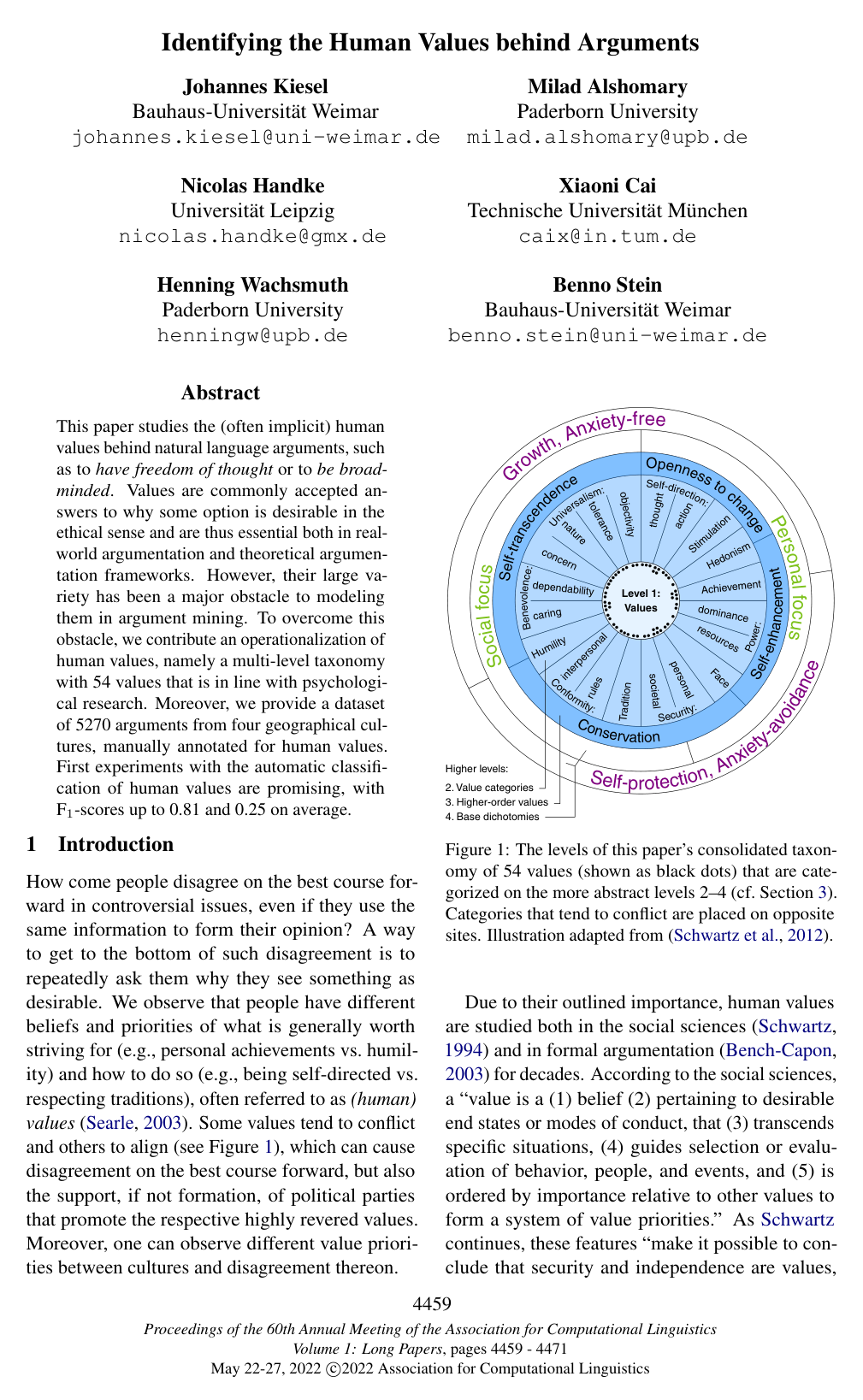
  1. Knowl 1 — A 54-value taxonomy organized across four levels

    definition

    The paper operationalizes human values behind arguments with a taxonomy whose finest level contains 54 values, grouped into 20 value categories, four higher-order values, and two pairs of broad orientations. The taxonomy is based mainly on the refined Schwartz theory and integrates nine values from other value inventories. Its category structure is:

    • Self-direction: thought: Be creative; Be curious; Have freedom of thought.
    • Self-direction: action: Be choosing own goals; Be independent; Have freedom of action; Have privacy.
    • Stimulation: Have an exciting life; Have a varied life; Be daring.
    • Hedonism: Have pleasure.
    • Achievement: Be ambitious; Have success; Be capable; Be intellectual; Be courageous.
    • Power: dominance: Have influence; Have the right to command.
    • Power: resources: Have wealth.
    • Face: Have social recognition; Have a good reputation.
    • Security: personal: Have a sense of belonging; Have good health; Have no debts; Be neat and tidy; Have a comfortable life.
    • Security: societal: Have a safe country; Have a stable society.
    • Tradition: Be respecting traditions; Be holding religious faith.
    • Conformity: rules: Be compliant; Be self-disciplined; Be behaving properly.
    • Conformity: interpersonal: Be polite; Be honoring elders.
    • Humility: Be humble; Have life accepted as is.
    • Benevolence: caring: Be helpful; Be honest; Be forgiving; Have the own family secured; Be loving.
    • Benevolence: dependability: Be responsible; Have loyalty towards friends.
    • Universalism: concern: Have equality; Be just; Have a world at peace.
    • Universalism: nature: Be protecting the environment; Have harmony with nature; Have a world of beauty.
    • Universalism: tolerance: Be broadminded; Have the wisdom to accept others.
    • Universalism: objectivity: Be logical; Have an objective view.

    The four higher-order values are Openness to change, Self-enhancement, Conservation, and Self-transcendence. The broad orientations distinguish Personal focus from Social focus, and Growth, Anxiety-free motivation from Self-protection, Anxiety-avoidance motivation. The taxonomy’s circular organization encodes value affinities and tensions: the higher-level groupings allow arguments to be analyzed more coarsely than by individual value. Most values have one label at each level; Have pleasure belongs to both Openness to change and Self-enhancement, while achievement values receive both Level 4b labels. The value names follow an instrumental/terminal pattern (for example, “Be creative” versus “Have a comfortable life”) so that they can be used as justifications in sentences.

  2. Knowl 2 — Operationalizing the value behind an argument

    model/method

    The task is to identify which human values an argument’s proponent implicitly invokes as reasons that the argument’s position is desirable. Each argument is represented by a premise, a conclusion, and a stance indicating whether the premise supports or opposes the conclusion. Values are formally associated with the premise, although the conclusion may provide useful context to an automatic classifier.

    For annotation, each candidate value is treated as a possible answer to the question, “Why is that good?” Annotators decide whether “Because it is good to [value]” could plausibly express the argument’s justification. This formulation is intended to capture implicit values, not only value terms explicitly stated in the text. A value may describe a desirable mode of conduct (instrumental) or a desirable end state (terminal).

  3. Knowl 3 — A cross-source dataset of 5,270 annotated arguments

    data/table

    The contributed dataset contains 5,270 arguments from four geographically associated sources. It was assembled to support training and robustness testing, not to represent the values or arguments of the corresponding cultures. Each argument has a premise, conclusion, and pro/con stance.

    • Africa: 50 arguments manually extracted from editorials on a pan-African debating platform; premises were often extracted from the text, while implicit conclusions were compiled from source sentences.
    • China: 100 arguments extracted from answers on a Chinese question-answering site; annotators identified premises and conclusions, then translated them into English using an automated translation draft and manual work.
    • India: 100 arguments from a blog collecting pros and cons on debate topics; premises and conclusions were used as provided.
    • USA: 5,020 arguments selected from a larger argument-quality dataset, retaining arguments with a manual quality rating of at least 0.5. The source included pro and con arguments on 71 topics, which were rephrased as conclusions.

    The parts contain, respectively, 23, 12, 40, and 71 unique conclusions, and 50, 100, 100, and 5,020 premises. Mean space-separated token counts for conclusions are 10.6, 7.3, 6.6, and 5.6; corresponding premise means are 28.1, 24.5, 30.3, and 18.5. Pro/con counts are 37/13 for Africa, 59/41 for China, 60/40 for India, and 2,619/2,401 for the USA, totaling 2,775 pro and 2,495 con arguments. The non-US portion is small relative to the US portion, and the source mix and collection procedures produce natural differences in lengths and stance distributions.

  4. Knowl 4 — Crowdsourced multi-label annotation and aggregation

    experimental setup

    Three crowdworkers annotated each of the 5,270 arguments against all 54 values, producing approximately 850,000 value judgments. For each value, workers made a yes/no decision using the justification question: could the value be the reason why the argument’s position is good? Instructions described one to five values as typical for an argument and advised against selecting more than ten. The interface presented the argument in a pro/con scenario, explained each value with examples, and allowed comments; value order was randomized per annotator and then held fixed for that annotator.

    The work was conducted on MTurk. After an initial screening and manual quality checks, 27 annotators were selected for the main annotation, with at least three annotations per argument. Workers were required to have a 98% approval rate, at least 100 approved tasks, and to be located in the US. Annotations were combined value by value with MACE to create the multi-label ground truth. The 48 arguments to which MACE assigned more than ten values were manually reviewed, with their labels reduced to the most prevalent five to seven.

  5. Knowl 5 — Annotation patterns reveal broad value coverage per argument

    empirical result

    The average value-wise inter-annotator agreement was Krippendorff’s alpha of 0.49. The authors attribute much of the disagreement to the difficulty of considering 54 candidate values at once and to annotators confusing values despite their descriptions.

    The resulting labels are multi-label: assigning a fine-grained value automatically assigns its parent labels in the taxonomy. Most arguments receive both labels in each of the two broad orientation pairs—Personal/Social focus and Growth/Anxiety-free versus Self-protection/Anxiety-avoidance. Thus, those orientations are generally not mutually exclusive when describing a single argument. For example, an argument may invoke both a comfortable life and equality, combining personal and social orientations. The paper interprets such combinations as evidence that arguments, like individual value systems, can draw on a broad range of values at once.

  6. Knowl 6 — Baseline classification experiments and evaluation design

    experimental setup

    The paper compares three multi-label classifiers. BERT is bert-base-uncased fine-tuned for 20 epochs with batch size 8 and learning rate 2×10−52\times10^{-5}. SVM uses a linear kernel and is trained separately for each label with C=18C=18. The all-values baseline assigns every candidate value to every argument, giving recall 1 by construction.

    For the within-USA experiment, the split is by unique conclusion so that test conclusions are unseen during training: 60 conclusions (4,240 arguments) for training, 4 (277) for validation, and 7 (503) for testing. The rare value Be neat and tidy, which does not occur in the test set, is excluded from that evaluation. For the cross-source experiment, the USA-trained models are applied to the Africa, China, and India test sets without retraining. Performance is reported as macro-averaged, label-wise precision, recall, F1, and accuracy; macro-averaging gives each label equal weight. Wilcoxon signed-rank tests are used for model comparisons.

  7. Knowl 7 — Within-USA classification is strongest at the finest taxonomy levels

    empirical result

    On the USA test set, BERT achieves a macro F1 of 0.25 for the 53 evaluated individual values and 0.34 for the 20 value categories. Its precision/recall/F1 are 0.40/0.19/0.25 at Level 1 and 0.39/0.30/0.34 at Level 2. At higher levels, BERT scores 0.65/0.78/0.71 for the four Level 3 labels, 0.89/0.96/0.92 for Level 4a, and 0.92/1.00/0.96 for Level 4b.

    The SVM’s F1 scores across Levels 1–4b are 0.20, 0.30, 0.67, 0.88, and 0.90; the all-values baseline scores 0.16, 0.28, 0.75, 0.92, and 0.96. BERT is significantly better in F1 than both alternatives at Level 1 (Wilcoxon p=0.007p=0.007 versus SVM and p=0.001p=0.001 versus the baseline, n=53n=53). At Level 2, its higher F1 is not statistically significant (p=0.153p=0.153 versus SVM and p=0.117p=0.117 versus the baseline, n=20n=20). At higher levels BERT is below or tied with the all-values baseline. The Level 1 F1 of 0.25 is promising for an initial out-of-the-box system, but its 0.40 precision and 0.19 recall indicate that reliable fine-grained identification remains difficult.

  8. Knowl 8 — Performance varies substantially across individual values

    empirical result

    Although USA macro performance at Level 1 is low, BERT performs well for selected labels. Its F1 is 0.81 for Have good health and 0.78 for the broader category Security: personal, which contains that value. Other Level 2 categories with BERT F1 of at least 0.5 are Universalism: concern, Self-direction: action, Achievement, and Benevolence: caring.

    The paper observes that performance across labels appears to track label frequency. It suggests, without establishing causality, that rare values may have too few examples for reliable learning, and that frequent values may have more developed vocabularies that make them easier to recognize.

  9. Knowl 9 — USA-trained models show preliminary cross-source robustness

    empirical result

    When the USA-trained classifiers are applied to the non-US test sets without retraining, BERT’s macro F1 scores are as follows; columns give Africa, China, India, and USA results in that order.

    • Level 1: BERT 0.20, 0.21, 0.30, 0.25; SVM 0.21, 0.21, 0.25, 0.20; all-values baseline 0.16, 0.13, 0.12, 0.16.
    • Level 2: BERT 0.38, 0.37, 0.41, 0.34; SVM 0.29, 0.30, 0.27, 0.30; all-values baseline 0.27, 0.23, 0.21, 0.28.
    • Level 3: BERT 0.60, 0.68, 0.71, 0.71; SVM 0.53, 0.57, 0.57, 0.67; all-values baseline 0.63, 0.65, 0.62, 0.75.
    • Level 4a: BERT 0.82, 0.88, 0.81, 0.92; SVM 0.80, 0.82, 0.74, 0.88; all-values baseline 0.80, 0.88, 0.79, 0.92.
    • Level 4b: BERT 0.92, 0.91, 0.90, 0.96; SVM 0.90, 0.87, 0.87, 0.92; all-values baseline 0.92, 0.91, 0.90, 0.96.

    BERT is significantly better than SVM and the all-values baseline for Level 1 (respectively p=0.006p=0.006 and p<0.001p<0.001, n=169n=169) and Level 2 (both p<0.001p<0.001, n=74n=74). No significant Level 3 difference is found (p=0.179p=0.179 and p=0.856p=0.856, n=16n=16). The non-US datasets are small, and about 28% of the values lack examples in those parts, so these results are preliminary evidence of robustness rather than a definitive cross-cultural validation.

  10. Knowl 10 — Cultural coverage and annotation limit the study’s claims

    limitation

    The four dataset parts are source-based approximations, not representative samples of their respective cultures; only 250 of the 5,270 arguments come from outside the USA. The annotators were all recruited from the US, so they may misinterpret values implied by texts from other cultural contexts. The moderate average agreement (alpha 0.49) also reflects the difficulty of assigning values from a 54-label inventory. The authors therefore call for broader data collection across cultures, territories, genres, modalities, and languages, and for annotators from different cultures to help identify and mitigate interpretation bias. The experiments establish initial classification baselines, not reliable general-purpose identification of values.

Coverage note — The paper’s proposed downstream applications and future research directions are omitted because they are prospective uses rather than findings or methods established in this study.

References

  1. 1.Yamen Ajjour, Milad Alshomary, Henning Wachsmuth, and Benno Stein. 2019. Modeling Frames in Argumentation. In 2019 Conference on Empirical Methods in Natural Language Processing and 9th International Joint Conference on Natural Language Processing (EMNLP 2019), pages 2922–2932. ACL.
  2. 2.Milad Alshomary and Henning Wachsmuth. 2021. Toward audience-aware argument generation. Patterns, 2(6):100253.
  3. 3.Katie Atkinson and Trevor Bench-Capon. 2021. Value-based argumentation. Journal of Applied Logics, 8(6):1543–1588.
  4. 4.Rohit Babbar, Ioannis Partalas, Eric Gaussier, and Massih-Reza Amini. 2013. On flat versus hierarchical classification in large-scale taxonomies. In 27th Annual Conference on Neural Information Processing Systems (NIPS 2013), pages 1824–1832.
  5. 5.Roy Bar-Haim, Lilach Eden, Roni Friedman, Yoav Kantor, Dan Lahav, and Noam Slonim. 2020. From arguments to key points: Towards automatic argument summarization. In Proceedings of the 58th Annual Meeting of the Association for Computational Linguistics, pages 4029–4039, Online. Association for Computational Linguistics.
  6. 6.Trevor J. M. Bench-Capon. 2003. Persuasion in practical argument using value-based argumentation frameworks. J. Log. Comput., 13(3):429–448.
  7. 7.Trevor J. M. Bench-Capon. 2021. Audiences and argument strength. In 3rd Workshop on Argument Strength (ArgStrength 2021).
  8. 8.Duane Brown and R. Kelly Crace. 2002. Life values inventory facilitator’s guide.
  9. 9.Sihao Chen, Daniel Khashabi, Wenpeng Yin, Chris Callison-Burch, and Dan Roth. 2019. Seeing things from a different angle:discovering diverse perspectives about claims. In Conference of the North American Chapter of the Association for Computational Linguistics: Human Language Technologies (NAACL-HLT 2019), pages 542–557, Minneapolis, Minnesota. Association for Computational Linguistics.
  10. 10.Wei-Fan Chen, Khalid Al Khatib, Benno Stein, and Henning Wachsmuth. 2021. Controlled neural sentence-level reframing of news articles. In Findings of the Association for Computational Linguistics: EMNLP 2021, pages 2683–2693, Punta Cana, Dominican Republic. Association for Computational Linguistics.
  11. 11.An-Shou Cheng and Kenneth R. Fleischmann. 2010. Developing a meta-inventory of human values. In 73rd ASIS&T Annual Meeting (ASIST 2010), volume 47, pages 1–10. Wiley.
  12. 12.Claes H De Vreese. 2005. News framing: Theory and typology. Information design journal & document design, 13(1).
  13. 13.Phan Minh Dung. 1995. On the acceptability of arguments and its fundamental role in nonmonotonic reasoning, logic programming and n-person games. Artificial Intelligence, 77(2):321–357.
  14. 14.Charlie Egan, Advaith Siddharthan, and Adam Z. Wyner. 2016. Summarising the points made in online political debates. In Proceedings of the Third Workshop on Argument Mining, hosted by the 54th Annual Meeting of the Association for Computational Linguistics, ArgMining@ACL 2016, August 12, Berlin, Germany. The Association for Computer Linguistics.
  15. 15.George W. England. 1967. Personal value systems of american managers. Academy of Management journal, 10(1):53–68.
  16. 16.Robert M Entman. 1993. Framing: Towards clarification of a fractured paradigm. McQuail’s reader in mass communication theory, pages 390–397.
  17. 17.Gilad Feldman. 2021. Personal values and moral foundations: Examining relations and joint prediction of moral variables. Social Psychological and Personality Science, 12(5):676–686.
  18. 18.Roni Friedman, Lena Dankin, Yoav Katz, Yufang Hou, and Noam Slonim. 2021. Overview of KPA-2021 shared task: Key point based quantitative summarization. In Proceedings of the 8th Workshop on Argumentation Mining. Association for Computational Linguistics.
  19. 19.Shai Gretz, Roni Friedman, Edo Cohen-Karlik, Assaf Toledo, Dan Lahav, Ranit Aharonov, and Noam Slonim. 2020. A large-scale dataset for argument quality ranking: Construction and analysis. In 34th AAAI Conference on Artificial Intelligence (AAAI 2020), pages 7805–7813. AAAI Press.
  20. 20.C. Haerpfer, R. Inglehart, A. Moreno, C. Welzel, K. Kizilova, Diez-Medrano J., M. Lagos, P. Norris, E. Ponarin, and B. Puranen. 2020. World values survey: Round seven - country-pooled datafile.
  21. 21.Jonathan Haidt. 2012. The righteous mind: Why good people are divided by politics and religion. Vintage.
  22. 22.Dirk Hovy, Taylor Berg-Kirkpatrick, Ashish Vaswani, and Eduard Hovy. 2013. Learning whom to trust with mace. In Conference of the North American Chapter of the Association for Computational Linguistics: Human Language Technologies (NAACL-HLT 2013), pages 1120–1130. Association for Computational Linguistics.
  23. 23.Lynn R Kahle, Basil Poulos, and Ajay Sukhdial. 1988. Changes in social values in the united states during the past decade. Journal of Advertising Research, 28(1):35–41.
  24. 24.Johannes Kiesel, Damiano Spina, Henning Wachsmuth, and Benno Stein. 2021. The Meant, the Said, and the Understood: Conversational Argument Search and Cognitive Biases. In 3rd Conference on Conversational User Interfaces (CUI 2021), New York. ACM.
  25. 25.Jonathan Kobbe, Ines Rehbein, Ioana Hulpus, , and Heiner Stuckenschmidt. 2020. Exploring morality in argumentation. In Proceedings of the 7th Workshop on Argument Mining, pages 30–40, Online. Association for Computational Linguistics.
  26. 26.Klaus Krippendorff. 2004. Measuring the reliability of qualitative text analysis data. Quality & quantity, 38:787–800.
  27. 27.Eneldo Loza Mencía and Frederik Jannsen. 2016. Learning rules for multi-label classification: a stacking and a separate-and-conquer approach. Machine Learning, 105:77–126.
  28. 28.Tushar Maheshwari, Aishwarya N. Reganti, Samiksha Gupta, Anupam Jamatia, Upendra Kumar, Björn Gambäck, and Amitava Das. 2017. A societal sentiment analysis: Predicting the values and ethics of individuals by analysing social media content. In 15th Conference of the European Chapter of the Association for Computational Linguistics (EACL 2017), pages 731–741. Association for Computational Linguistics.
  29. 29.Amita Misra, Brian Ecker, and Marilyn Walker. 2016. Measuring the similarity of sentential arguments in dialogue. In Proceedings of the 17th Annual Meeting of the Special Interest Group on Discourse and Dialogue, pages 276–287, Los Angeles. Association for Computational Linguistics.
  30. 30.Nona Naderi and Graeme Hirst. 2015. Argumentation mining in parliamentary discourse. In Principles and practice of multi-agent systems, pages 16–25. Springer.
  31. 31.Milton Rokeach. 1973. The nature of human values. New York, Free Press.
  32. 32.Benjamin Schiller, Johannes Daxenberger, and Iryna Gurevych. 2021. Aspect-controlled neural argument generation. In Proceedings of the 2021 Conference of the North American Chapter of the Association for Computational Linguistics: Human Language Technologies, pages 380–396, Online. Association for Computational Linguistics.
  33. 33.Shalom H Schwartz. 1994. Are there universal aspects in the structure and contents of human values? Journal of Social Issues, 50:19–45.
  34. 34.Shalom H Schwartz, Jan Cieciuch, Michele Vecchione, Eldad Davidov, Ronald Fischer, Constanze Beierlein, Alice Ramos, Markku Verkasalo, Jan-Erik Lönnqvist, Kursad Demirutku, et al. 2012. Refining the theory of basic individual values. Journal of personality and social psychology, 103(4).
  35. 35.John R Searle. 2003. Rationality in action. MIT press.
  36. 36.Juan Carlos Teze, Antoni Perello-Moragues, Lluís Godo, and Pablo Noriega. 2019. Practical reasoning using values: an argumentative approach based on a hierarchy of values. Annals of Mathematics and Artificial Intelligence, 87(3):293–319.
  37. 37.Dietrich Trautmann. 2020. Aspect-based argument mining. In Proceedings of the 7th Workshop on Argument Mining, pages 41–52, Online. Association for Computational Linguistics.
  38. 38.Thomas L. van der Weide, Frank Dignum, John-Jules Ch. Meyer, Henry Prakken, and Gerard Vreeswijk. 2009. Practical reasoning using values. In Argumentation in Multi-Agent Systems (ArgMAS 2009), volume 6057 of Lecture Notes in Computer Science, pages 79–93. Springer.
  39. 39.Rand R. Wilcox. 1996. Statistics for the Social Sciences. Academic Press Inc.

Citation

MLA
Kiesel, J., et al. “Identifying the Human Values Behind Arguments”. Proceedings of the 60th Annual Meeting of the Association for Computational Linguistics (Volume 1: Long Papers), 2022, pp. 4459–71, https://doi.org/10.18653/v1/2022.acl-long.306.
APA
Kiesel, J., Alshomary, M., Handke, N., Cai, X., Wachsmuth, H., & Stein, B. (2022). Identifying the Human Values behind Arguments. Proceedings of the 60th Annual Meeting of the Association for Computational Linguistics (Volume 1: Long Papers), 4459–4471. https://doi.org/10.18653/v1/2022.acl-long.306
Chicago
Kiesel, J., M. Alshomary, N. Handke, X. Cai, H. Wachsmuth, and B. Stein. 2022. “Identifying the Human Values Behind Arguments”. Proceedings of the 60th Annual Meeting of the Association for Computational Linguistics (Volume 1: Long Papers), 4459–71. https://doi.org/10.18653/v1/2022.acl-long.306.
Harvard
Kiesel, J. et al. (2022) “Identifying the Human Values behind Arguments”, Proceedings of the 60th Annual Meeting of the Association for Computational Linguistics (Volume 1: Long Papers). Association for Computational Linguistics, pp. 4459–4471. Available at: https://doi.org/10.18653/v1/2022.acl-long.306.
Vancouver
1. Kiesel J, Alshomary M, Handke N, Cai X, Wachsmuth H, Stein B (2022) Identifying the Human Values behind Arguments. In: Proceedings of the 60th Annual Meeting of the Association for Computational Linguistics (Volume 1: Long Papers). Association for Computational Linguistics, pp 4459–4471

BibTeX

@inproceedings{kiesel-etal-2022-identifying,
    title = "Identifying the Human Values behind Arguments",
    author = "Kiesel, Johannes  and
      Alshomary, Milad  and
      Handke, Nicolas  and
      Cai, Xiaoni  and
      Wachsmuth, Henning  and
      Stein, Benno",
    editor = "Muresan, Smaranda  and
      Nakov, Preslav  and
      Villavicencio, Aline",
    booktitle = "Proceedings of the 60th Annual Meeting of the Association for Computational Linguistics (Volume 1: Long Papers)",
    month = may,
    year = "2022",
    address = "Dublin, Ireland",
    publisher = "Association for Computational Linguistics",
    url = "https://aclanthology.org/2022.acl-long.306/",
    doi = "10.18653/v1/2022.acl-long.306",
    pages = "4459--4471"
}
Metadata:ACL Anthology

Source Code

This paper has an official code repository available. Click below to access the source code.

View Repository

Access the Paper

This paper is available from its original source. Click below to access the PDF.

Open PDF
License: https://creativecommons.org/licenses/by/4.0/