
keyword
human values
Human values are enduring core beliefs and ethical principles that individuals and societies use to determine what is desirable, important, and morally right. These values serve as foundational standards that motivate behavior, shape personal attitudes, and guide decision-making across diverse situations. In psychological and social frameworks, they function as broad, trans-situational goals, such as benevolence, universalism, self-direction, and security, which people rank hierarchically to justify actions, evaluate events, and navigate ethical dilemmas.
2 items
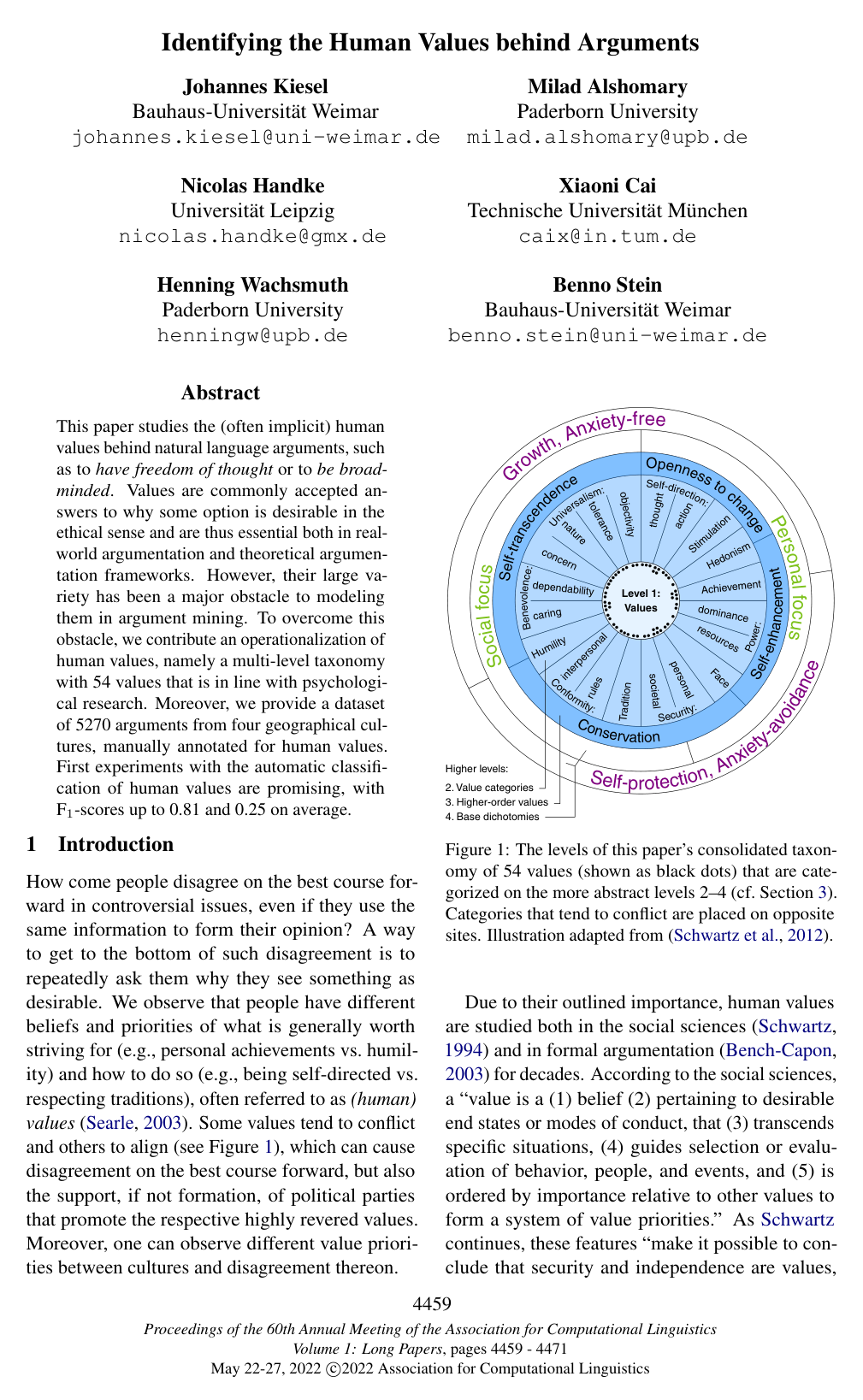
Identifying the Human Values behind Arguments
Johannes Kiesel, Milad Alshomary, Nicolas Handke, Xiaoni Cai, Henning Wachsmuth, Benno Stein
Why you should read this
Presents a psychology-grounded taxonomy of 54 human values alongside a cross-cultural dataset of 5,270 annotated arguments to establish computational baselines for identifying the underlying ethical principles in natural language reasoning.
This paper studies the (often implicit) human values behind natural language arguments, such as to have freedom of thought or to be broad-minded. Values are commonly accepted answers to why some option is desirable in the ethical sense and are thus essential both in real-world argumentation and theoretical argumentation frameworks. However, their large variety has been a major obstacle to modeling them in argument mining. To overcome this obstacle, we contribute an operationalization of human values, namely a multi-level taxonomy with 54 values that is in line with psychological research. Moreover, we provide a dataset of 5270 arguments from four geographical cultures, manually annotated for human values. First experiments with the automatic classification of human values are promising, with F₁-scores up to 0.81 and 0.25 on average.
Added
2026-10-02
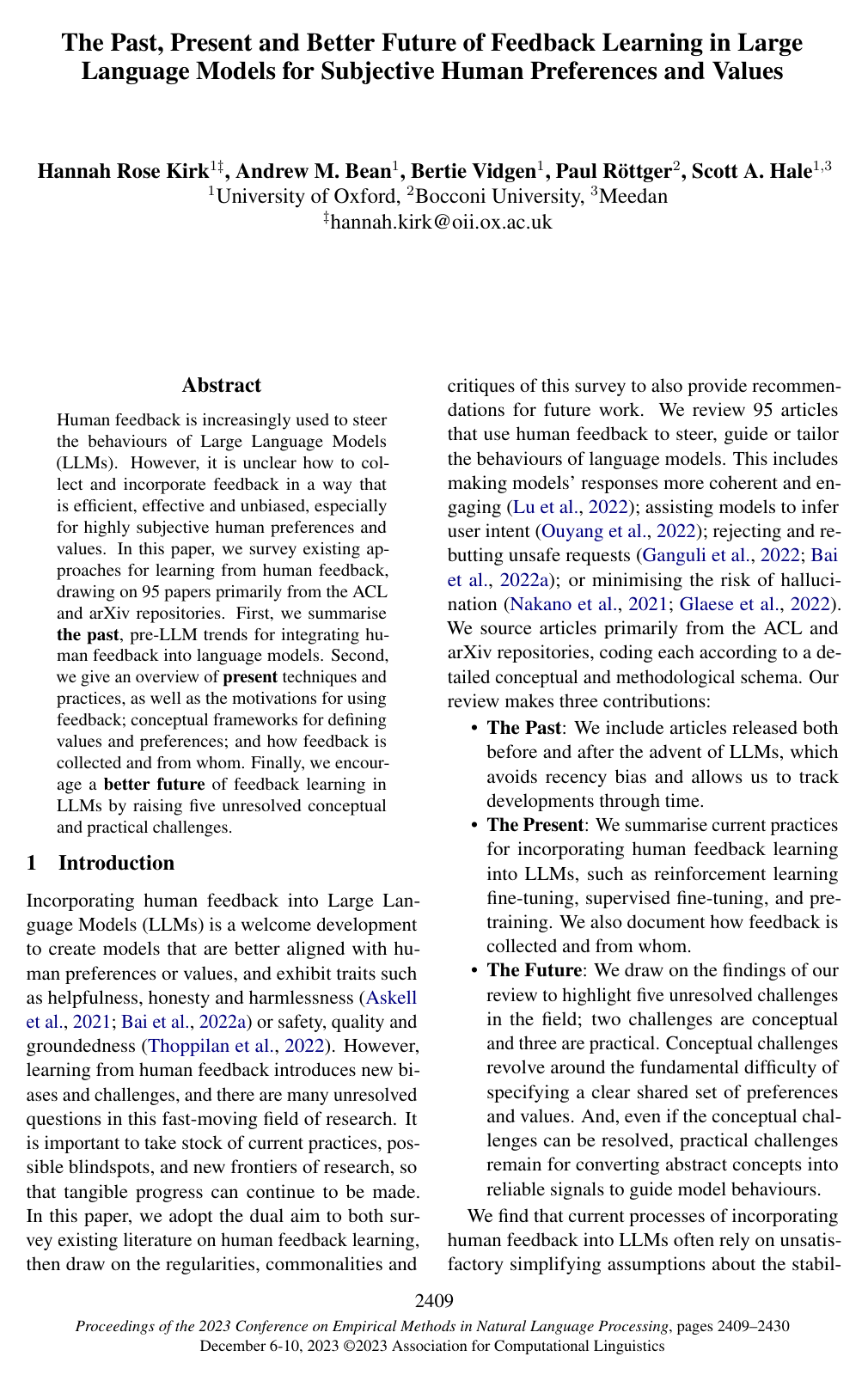
The Past, Present and Better Future of Feedback Learning in Large Language Models for Subjective Human Preferences and Values
Hannah Kirk, Andrew M. Bean, Bertie Vidgen, Paul Röttger, Scott Hale
Why you should read this
Systematizes the evolution of human feedback learning across 95 studies to identify critical conceptual and practical challenges in aligning language models with subjective preferences and values.
Human feedback is increasingly used to steer the behaviours of Large Language Models (LLMs). However, it is unclear how to collect and incorporate feedback in a way that is efficient, effective and unbiased, especially for highly subjective human preferences and values. In this paper, we survey existing approaches for learning from human feedback, drawing on 95 papers primarily from the ACL and arXiv repositories. First, we summarise the past, pre-LLM trends for integrating human feedback into language models. Second, we give an overview of present techniques and practices, as well as the motivations for using feedback; conceptual frameworks for defining values and preferences; and how feedback is collected and from whom. Finally, we encourage a better future of feedback learning in LLMs by raising five unresolved conceptual and practical challenges.
Added
2026-09-26