Robust Image Forgery Detection over Online Social Network Shared Images
Haiwei WuJiantao ZhouJinyu TianJun Liu
Proposes a training framework that decouples social network transmission artifacts into predictable and adversarial unseen noise, enabling forensic detectors to reliably identify manipulated images degraded by online compression and resizing.
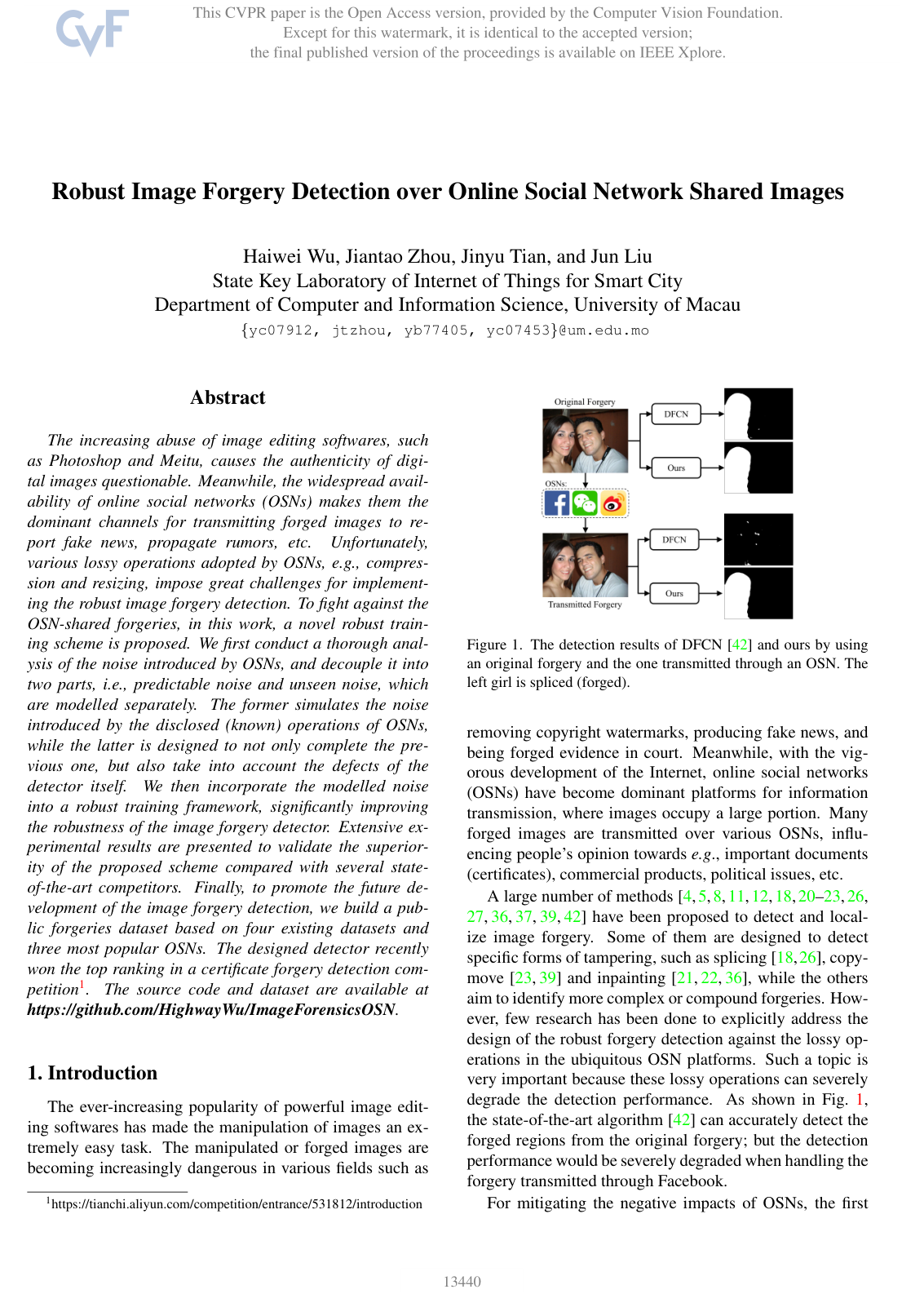
Online social networks have become the primary channels for distributing manipulated digital images, impacting legal proceedings, news integrity, and public trust. However, the automated, lossy operations used by these platforms—such as image resizing, enhancement filtering, and compression—frequently erase or distort the subtle digital artifacts needed to identify tampered content. Standard forensic detectors suffer severe performance degradation once an image is uploaded and shared across these channels.
The article develops and evaluates a robust training framework designed to maintain high-accuracy image forgery detection even when images pass through lossy online platforms.
To address this challenge without relying on restricted or opaque platform algorithms, the researchers decoupled platform-induced interference into two components: predictable noise and unseen noise. Predictable noise, such as standard JPEG compression, was modeled using a neural network paired with a specialized mathematical layer that simulates compression while allowing end-to-end model training. Unseen noise—capturing unknown filters, adaptive processing, or variations across platforms—was modeled using adversarial noise techniques, which introduce subtle worst-case perturbations to stress-test the detector. The framework was trained using platform data from Facebook and tested across 5,232 images sourced from four standard forensic datasets transmitted across Facebook, Weibo, and WeChat.
Key findings show that the proposed framework substantially outperforms existing forensic models under real-world conditions. While competitor detectors experienced severe performance drops—with overlap detection metrics falling by roughly 9% to 11% following social network transmission—the proposed method experienced minimal loss, dropping by only 0.9% on Facebook, 2.0% on Weibo, and 4.5% on WeChat. On average, across all platforms, the system achieved an area under the curve score of approximately 0.83 to 0.85 and an intersection-over-union score around 0.36 to 0.40, roughly double the accuracy of existing state-of-the-art tools. Ablation analysis confirmed that combining both predictable and unseen noise models yielded the strongest gains, improving balanced accuracy scores by over 15% on transmitted images. Furthermore, the model generalized effectively to Weibo and WeChat despite being trained exclusively on Facebook data, and it demonstrated superior resilience against common post-processing operations like blurring, cropping, and general noise addition.
These results demonstrate that forensic detectors can be hardened against real-world transmission channels without requiring inside knowledge of proprietary platform pipelines. For organizations managing digital trust, compliance, or misinformation risks, adopting noise-resilient training approaches significantly reduces the operational risk of false negatives when vetting shared media.
Decision-makers should consider integrating dual-noise training principles into their automated content moderation and forensic pipelines. Because the authors have made their benchmark dataset and codebase publicly available, technical teams can readily benchmark internal detectors. Next steps should focus on pilot implementations and evaluating performance against emerging generative media threats.
The findings are supported by consistent results across multiple standard datasets and platforms. A minor limitation is that the model exhibited slightly higher degradation on platforms with stricter compression policies, such as WeChat. Nevertheless, the methodology provides a highly reliable foundation for practical forensic detection across modern communication networks.
- Paper: FaceForensics++: Learning to Detect Manipulated Facial Images, Andreas Rössler et al. (2019). This foundational benchmark establishes how lossy compression and social-media upload pipelines degrade manipulation traces, directly motivating the source's robust noise modeling for OSN-shared imagery.
- Paper: CNN-Generated Images Are Surprisingly Easy to Spot… for Now, Sheng-Yu Wang et al. (2019). It demonstrates the crucial role of simulating real-world post-processing corruptions like blurring and compression during training to achieve robust cross-generator forgery detection.
- Paper: MesoNet: a Compact Facial Video Forgery Detection Network, Darius Afchar et al. (2018). This work introduces compact digital forensics architectures designed explicitly to resist the heavy degradation caused by internet video compression.
- Paper: Celeb-DF: A Large-Scale Challenging Dataset for DeepFake Forensics, Yuezun Li et al. (2019). It provides standard large-scale benchmarks and highlights how post-processing artifacts in wild distributions confound conventional digital forgery detectors.
- Paper: Benchmarking Neural Network Robustness to Common Corruptions and Perturbations, Dan Hendrycks et al. (2019). It formalizes benchmarking methodologies for neural network robustness against common digital corruptions such as lossy compression and noise.
- Paper: Hierarchical Fine-Grained Image Forgery Detection and Localization, Xiao Guo et al. (2023). This paper extends robust forensic analysis from binary OSN detection to simultaneous fine-grained manipulation localization and tool classification across diverse generative methods.
- Paper: DeepfakeBench: A Comprehensive Benchmark of Deepfake Detection, Zhiyuan Yan et al. (2023). It builds upon specialized detection techniques by establishing a unified, standardized evaluation platform to systematically assess deepfake detectors across varied transmission degradations.
- Paper: Frequency-Aware Deepfake Detection: Improving Generalizability through Frequency Space Domain Learning, Chuangchuang Tan et al. (2024). It advances beyond spatial noise modeling by leveraging domain-agnostic frequency space learning to preserve generalizable forensic cues against unseen generators.
- Paper: Rethinking the Up-Sampling Operations in CNN-Based Generative Network for Generalizable Deepfake Detection, Chuangchuang Tan et al. (2024). It continues the investigation into robust forgery identification by targeting generator-induced up-sampling artifacts that generalize across synthetic pipelines.
- Paper: Robustness of AI-Image Detectors: Fundamental Limits and Practical Attacks, Mehrdad Saberi et al. (2024). It provides a rigorous theoretical and empirical critique of the robustness boundaries of modern AI-image detectors facing purification attacks and perturbations.