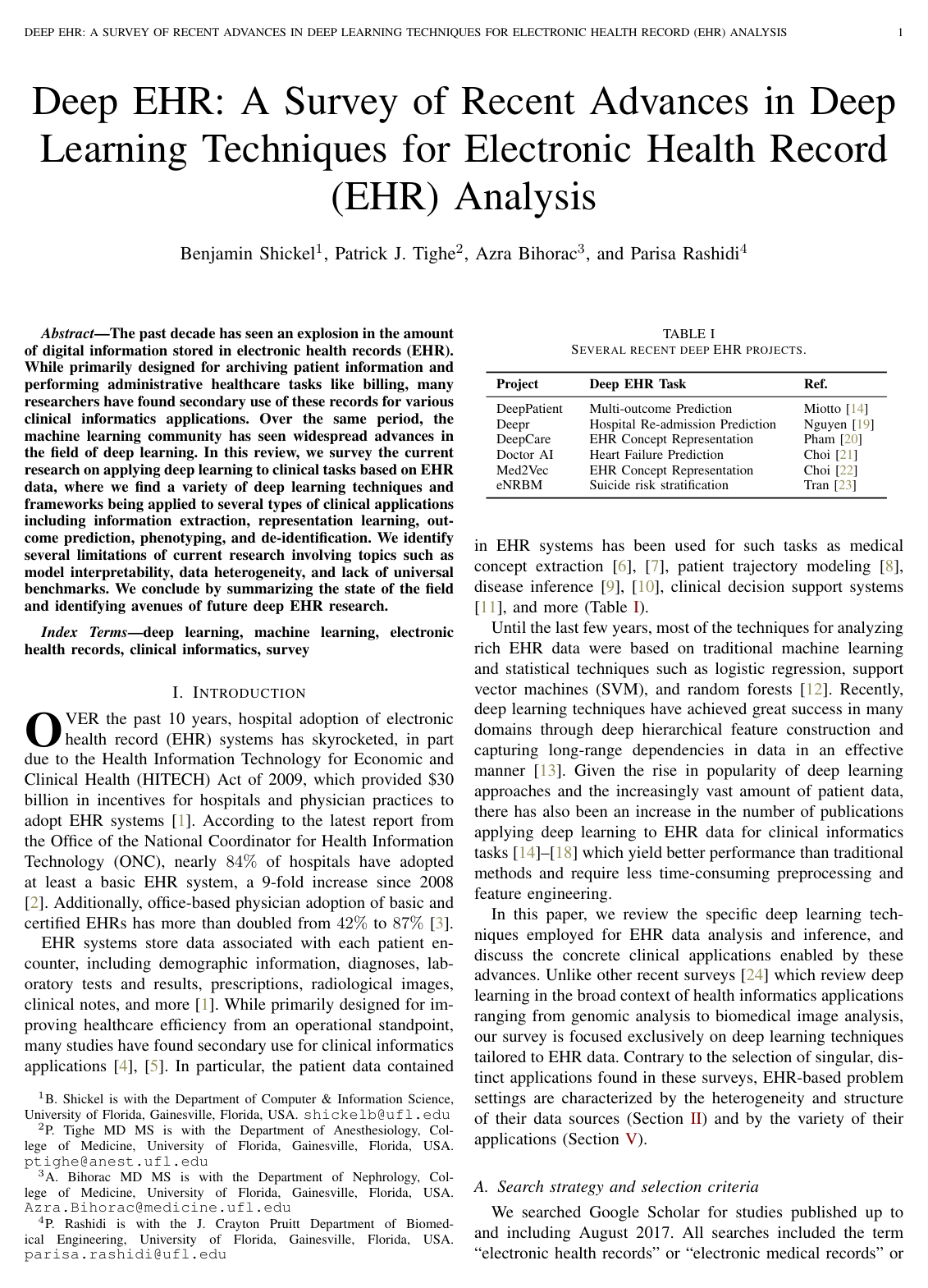
Deep EHR: A Survey of Recent Advances in Deep Learning Techniques for Electronic Health Record (EHR) Analysis

Benjamin ShickelPatrick TigheAzra BihoracParisa Rashidi

article2017IEEE journal of biomedical and health informatics1,525 citations

Systematizes deep learning architectures applied to electronic health records across diverse clinical tasks, analyzing key data representation strategies, current methodological limitations, and future research directions.

Listen

Hospital adoption of electronic health record systems has grown dramatically, generating vast repositories of digital medical data. While these systems were primarily created for billing and administrative record-keeping, secondary use of this data holds significant promise for clinical research, diagnosis, and patient care management. However, traditional statistical and machine learning models struggle to process complex, multi-modal medical records without labor-intensive manual data preparation. The article provides a comprehensive survey of recent advances in applying deep learning methods to electronic health record analysis, evaluating how modern neural network architectures extract information, represent patient histories, forecast clinical outcomes, and define illness phenotypes.

The authors conducted a structured literature review of studies published through August 2017, identifying relevant research across five primary application areas: clinical text information extraction, concept and patient representation learning, outcome prediction, computational phenotyping, and personal health information de-identification. The surveyed literature encompasses diverse deep learning architectures, including recurrent neural networks for sequential data, convolutional networks for localized patterns, and autoencoders for unsupervised data compression. The reviewed studies drew evidence from large hospital data warehouses as well as public clinical databases such as the Medical Information Mart for Intensive Care repository.

The survey highlights four primary findings regarding deep learning performance in healthcare. First, deep neural networks consistently outperform classical baseline models—such as logistic regression, support vector machines, and conditional random fields—across nearly all evaluated tasks. Second, recurrent networks excel at processing unstructured clinical text and temporal patient trajectories, achieving notable gains in concept extraction, abbreviation resolution (achieving 82.3% accuracy compared to baseline ranges of 20–30%), and medical event forecasting. Third, unsupervised techniques like stacked autoencoders and distributed embeddings successfully condense tens of thousands of sparse billing codes into compact representations, discovering latent medical relationships without human supervision. Fourth, deep learning enables data-driven computational phenotyping, identifying subtle disease subtypes and temporal patterns from continuous physiological measurements.

These findings suggest that deep learning can substantially improve clinical decision support systems, lower administrative burdens, and advance personalized medicine by automatically discovering complex diagnostic patterns. However, practical clinical adoption remains constrained because deep learning models act as opaque "black boxes." In high-stakes medical settings where errors risk patient safety, healthcare providers require transparency and clinical justification before acting on automated recommendations.

To move the field forward, healthcare organizations and researchers should focus on developing unified models that simultaneously process diverse data types—including structured codes, unstructured notes, and continuous vital signs. Technical teams must also incorporate interpretability methods, such as sparsity constraints and mimic learning frameworks that pair neural networks with transparent rule-based models. Furthermore, wider adoption of deep learning tools for automated patient de-identification is necessary to enable compliant cross-institutional data sharing.

Decision-makers should interpret current performance benchmarks with caution. The vast majority of surveyed studies were trained and validated on proprietary, single-institution datasets, resulting in a lack of universally accepted benchmarks and limited external verification. True clinical deployment requires rigorous multi-center validation on standardized public benchmarks to verify that these models generalize reliably across diverse hospital populations.

Cover for Deep EHR: A Survey of Recent Advances in Deep Learning Techniques for Electronic Health Record (EHR) Analysis

Abstract

The past decade has seen an explosion in the amount of digital information stored in electronic health records (EHR). While primarily designed for archiving patient clinical information and administrative healthcare tasks, many researchers have found secondary use of these records for various clinical informatics tasks. Over the same period, the machine learning community has seen widespread advances in deep learning techniques, which also have been successfully applied to the vast amount of EHR data. In this paper, we review these deep EHR systems, examining architectures, technical aspects, and clinical applications. We also identify shortcomings of current techniques and discuss avenues of future research for EHR-based deep learning.

Table of Contents

  • I. INTRODUCTION
  • A. Search strategy and selection criteria
  • II. ELECTRONIC HEALTH RECORD SYSTEMS (EHR)
  • III. MACHINE LEARNING OVERVIEW
  • IV. DEEP LEARNING OVERVIEW
  • A. Multilayer perceptron (MLP)
  • B. Convolutional neural networks (CNN)
  • D. Autoencoders (AE)
  • C. Recurrent neural networks
  • E. Restricted Boltzmann machine (RBM)
  • V. DEEP EHR LEARNING APPLICATIONS
  • Methods of evaluation for EHR information extraction
  • B. EHR Representation Learning
  • Methods of evaluation for EHR representation learning
  • C. Outcome Prediction
  • Methods of evaluation for EHR outcome prediction
  • D. Computational Phenotyping
  • Methods of evaluation for computational phenotyping
  • E. Clinical Data De-identification
  • Methods of evaluation for clinical data de-identification
  • VI. INTERPRETABILITY
  • VII. DISCUSSION AND FUTURE DIRECTION
  • REFERENCES

Knowls

  1. Knowl 1 — Taxonomy of Deep Learning Tasks in Electronic Health Record Analysis

    model/method

    Deep learning applications in Electronic Health Record (EHR) analysis are organized into five primary task domains based on their clinical goals, input modalities, and network architectures:

    1. Information Extraction (IE): Operates on unstructured clinical free text (e.g., admission notes, progress notes, discharge summaries). Subtasks include single concept extraction (using Long Short-Term Memory [LSTM], Bidirectional LSTM [Bi-LSTM], Gated Recurrent Unit [GRU], and Convolutional Neural Networks [CNN]), temporal event extraction (RNNs with pre-trained word embeddings), clinical relation extraction (sparse Autoencoders combined with Conditional Random Fields [CRF]), and abbreviation expansion (custom multi-source Word2Vec embeddings).
    2. Representation Learning: Derives low-dimensional vector representations from high-dimensional, sparse discrete medical codes (such as ICD, CPT, LOINC, and RxNorm) or temporal sequences. Subtasks comprise concept representation (using Restricted Boltzmann Machines [RBM], Skip-gram, Autoencoders, and LSTMs) and patient representation (using RBM, Skip-gram, GRU, CNN, and Autoencoders).
    3. Outcome Prediction: Predicts clinical events or prognoses. Categorized into static prediction from single-encounter data (using Multilayer Perceptrons [MLP], Autoencoders, LSTMs, RBMs, and Deep Belief Networks [DBN]) and temporal prediction from longitudinal trajectories (using LSTMs, GRUs, and temporal CNNs).
    4. Computational Phenotyping: Derives data-driven disease definitions. Subtasks include new phenotype discovery (unsupervised via Autoencoders, Denoising Autoencoders [DAE], RBMs, and CNNs) and refining existing disease definitions (supervised multi-label classification via LSTMs and ontology-regularized MLPs).
    5. Clinical Data De-identification: Removes Protected Health Information (PHI) to enable data sharing (using Bi-LSTMs and RNNs with character- and word-level embeddings).
  2. Knowl 2 — EHR Concept and Patient Representation Learning Frameworks

    model/method

    Modern EHR systems store discrete, heterogeneous clinical codes (diagnoses, procedures, lab tests, and medications). Representation learning transforms these sparse, high-dimensional spaces into dense real-valued vectors:

    • Medical Concept Representation: Exploits analogies between clinical encounters and natural language sentences by viewing time-stamped medical codes as "words". Skip-gram architectures (e.g., Med2Vec) learn distributed vector embeddings of discrete codes based on co-occurrence within temporal windows. Unsupervised latent encoding approaches also use energy-based models (e.g., EMR-driven non-negative restricted Boltzmann machines [eNRBM]) or sparse autoencoders to cluster related concepts in vector space.
    • Patient Representation: Aggregates or sequences medical concept vectors into unified patient-level embeddings:
      • Autoencoder-based aggregation: Stacks sparse autoencoder layers (e.g., DeepPatient) to reduce thousands of sparse clinical descriptors and topic-modeled clinical notes into dense representations that improve generalized downstream disease classification.
      • Temporal and Recurrent Modeling: DeepCare and Doctor AI pass temporal sequences of diagnosis, intervention, and time-interval vectors through gated recurrent units (GRUs) or LSTMs. The hidden state at any time step represents the patient's longitudinal health trajectory, capturing cross-encounter dynamics.
  3. Knowl 3 — Clinical Information Extraction from Unstructured EHR Text

    model/method

    Clinical free text (such as nursing notes, operative reports, and discharge summaries) provides rich narrative details not captured by administrative billing codes. Deep learning frameworks address four core information extraction (IE) subtasks:

    1. Single Concept Extraction: Formulated as sequence labeling to tag entities such as drug names, dosages, routes, adverse drug events, disease indications, and disease severity. Recurrent architectures (LSTM, Bi-LSTM, GRU, and LSTM-CRF hybrid models) significantly outperform baseline CRF models by capturing long-range contextual dependencies and nuanced attributes like treatment duration and symptom severity.
    2. Temporal Event Extraction: Assigns temporal anchors or duration expressions to clinical events using RNNs initialized with domain-specific pre-trained word embeddings (e.g., Word2Vec trained on clinical corpora).
    3. Relation Extraction: Identifies structured relations between entities (e.g., Treatment X improves Condition Y, Test X reveals Problem Y). Deep approaches utilize sparse autoencoders on top of Unified Medical Language System (UMLS) concept mappings to generate latent features that feed into a CRF classifier.
    4. Abbreviation Expansion: Disambiguates high-frequency clinical abbreviations by pre-training word embeddings on multi-source domain corpora (intensive care records, medical literature, and open encyclopedias), yielding substantial accuracy improvements over standard dictionary-lookup baselines.
  4. Knowl 4 — Static versus Temporal Clinical Outcome Prediction Paradigms

    model/method

    Deep EHR outcome prediction models are structured into two distinct operational paradigms:

    • Static Outcome Prediction: Assesses patient risk at a single static snapshot (such as during an isolated admission) without explicitly modeling longitudinal time intervals. Frameworks generate embedded patient vectors using stacked Autoencoders (e.g., DeepPatient for multi-disease risk), DBNs (e.g., for osteoporosis risk stratification), eNRBMs (for suicide risk prediction), or MLPs trained on embedded concept vectors (for heart failure onset), outperforming models trained directly on raw categorical codes.
    • Temporal Outcome Prediction: Forecasts disease onset, post-discharge readmission, or clinical deterioration over longitudinal trajectories or within bounded future prediction windows. Architectures include:
      • Temporal CNNs (e.g., Deepr): Apply 1D convolutions across ordered sequences of discrete event codes to detect local clinical motifs, using pooling layers to predict unplanned hospital readmission without requiring explicit time-gap pre-processing.
      • Gated Recurrent Networks (e.g., Doctor AI, DeepCare): Utilize GRU or LSTM networks taking sequences of (event, timestamp) tuples to predict the next clinical event, medication intervention, or multi-label diagnostic codes.
      • Missingness-aware RNNs (GRU-D): Incorporate learned decay mechanisms for continuous measurements to account directly for irregular sampling intervals and missing values in multivariate clinical time series.
  5. Knowl 5 — Deep Computational Phenotyping Paradigms

    model/method

    Computational phenotyping discovers data-driven, fine-grained disease definitions from EHR data using both unsupervised and supervised deep architectures:

    • Unsupervised Phenotype Discovery: Transforms noisy, high-dimensional patient records into compact latent representations without human labeling:
      • Denoising Autoencoders (DAE): Learn robust representations from sparse binary descriptors, showing resilience to missing clinical features and separating case versus control cohorts in low-dimensional projection spaces (e.g., t-SNE).
      • Convolutional Phenotyping: Encodes patient timelines as 2D matrices (events ×\times time) and applies one-sided convolutional filters followed by max pooling to extract sparse, interpretable temporal clinical motifs.
      • Continuous Signal Phenotyping: Applies Gaussian processes and multi-layer stacked autoencoders to continuous laboratory trajectories (e.g., uric acid time series) to discover functional trajectory patterns separating diagnostic subtypes (e.g., gout vs. acute leukemia).
    • Supervised Phenotype Definition Refinement: Formulates phenotyping as multi-label sequence classification on multivariate ICU time series. Architectures use LSTMs with target replication and auxiliary target objectives for rare diseases, or MLPs pre-trained with DAEs incorporating prior-based Laplacian graph regularization derived from structured medical ontologies.
  6. Knowl 6 — Interpretability Techniques for Deep EHR Systems

    model/method

    To address the "black box" limitation of deep networks in high-stakes clinical decision-making, four primary interpretability strategies are employed:

    1. Maximum Activation Analysis: Identifies input features, tokens, or temporal signals that maximize the activation of specific hidden units or convolutional filters (e.g., identifying diagnostic motifs or functional signal detectors like uphill/downhill ramps in physiological time series).
    2. Constrained Architecture and Regularization: Imposes domain-motivated inductive biases during training:
    • Non-negativity Constraints: Restricting weights in RBMs (eNRBM) or concept embeddings (Med2Vec) to non-negative values produces sparse, additive component representations corresponding to distinct disease clusters.
    • Sparsity Regularization: Forces latent feature layers to retain only the most prominent clinical indicators.
    • Ontology-based Graph Smoothing: Regularizes latent representations using graph Laplacian smoothing based on distances within established medical taxonomies (e.g., SNOMED CT, UMLS).
    1. Qualitative Clustering: Projects high-dimensional concept and patient representations into 2D spaces using t-Distributed Stochastic Neighbor Embedding (t-SNE) or Principal Component Analysis (PCA) to visually evaluate subtype separation and semantic relatedness.
    2. Interpretable Mimic Learning: Trains an interpretable model (e.g., Gradient Boosted Trees [GBT]) to predict the soft output probability distribution of a high-capacity deep neural network, transferring the deep model's predictive power while enabling transparent feature importance ranking.
  7. Knowl 7 — Deep Learning for Clinical Text De-identification

    model/method

    Clinical data sharing requires the removal of Protected Health Information (PHI) under HIPAA regulations, including patient names, hospital locations, geographic identifiers, and dates.

    • Model Architectures: Deep de-identification frames the task as token-level sequence classification. Models use Bidirectional LSTMs (Bi-LSTM) combined with character-level and word-level vector embeddings, as well as Bi-LSTM-CRF hybrid architectures.
    • Empirical Advantage: Deep sequence models outperform traditional CRF systems relying on hand-crafted lexical features and dictionaries. They generalize better across varied unstructured notes, although detecting location-based PHI remains the most challenging category.
    • Evaluation: Benchmarked on public corpora (such as MIMIC and i2b2 challenge datasets) using token-level precision, recall, and F1 score.
  8. Knowl 8 — Data Heterogeneity and Irregular Temporal Sampling in EHR Systems

    limitation

    A fundamental obstacle in deep learning for EHR data is extreme data heterogeneity across five distinct modalities within a single record:

    1. Continuous numerical quantities (e.g., laboratory values, body mass index),
    2. Datetime objects (e.g., admission/discharge timestamps),
    3. High-dimensional categorical codes from disparate taxonomies (ICD, CPT, LOINC, RxNorm),
    4. Unstructured natural language narratives (e.g., progress notes, radiology reports),
    5. Irregularly sampled time-series signals (e.g., vital signs, continuous monitoring).

    Most existing deep EHR models isolate a single modality (e.g., discrete billing codes only or clinical text only) using divide-and-conquer strategies, neglecting continuous measurements or cross-modal interactions. Furthermore, time-series measurements exhibit severe sampling irregularity (ranging from sub-hourly ICU vitals to yearly outpatient visits), requiring either ad-hoc heuristic binning/imputation or specialized recurrent cells (such as GRU-D with learned decay) rather than achieving a unified multi-modal patient representation.

  9. Knowl 9 — Benchmark Deficit and Reproducibility Barriers in Deep EHR Research

    limitation

    A critical impediment to advancement in deep EHR research is the acute lack of standardized, publicly reproducible benchmarks:

    • Proprietary Data Reliance: The vast majority of published studies evaluate models on proprietary institutional datasets from single health systems. Strict patient privacy regulations (such as HIPAA) and institutional data governance prevent these cohorts from being publicly shared.
    • Incomparability of Results: Because private cohorts differ in patient populations, coding practices, and pre-processing pipelines, performance metrics (such as AUC, F1 score, or precision@kk) across different publications cannot be directly compared, preventing rigorous verification of state-of-the-art claims.
    • Limited Public Corpora: Open benchmarks are largely restricted to a few datasets, predominantly MIMIC (intensive care records) and i2b2 challenge datasets (clinical text NLP), which cover only specialized clinical subsets rather than comprehensive longitudinal hospital populations.

Coverage note — Deliberately omitted introductory summaries of standard, generic deep learning building blocks (such as the basic MLP feedforward equation, standard 1D/2D convolution definitions, generic vanilla autoencoder equations, and standard RBM energy formulation) as they are textbook background rather than survey-specific contributions.

References

  1. 1.G. S. Birkhead, M. Klompas, and N. R. Shah, “Uses of Electronic Health Records for Public Health Surveillance to Advance Public Health,” Annu. Rev. Public Health, vol. 36, pp. 345–59, 2015.
  2. 2.T. O. of the National Coordinator for Health Information Technology. Adoption of Electronic Health Record Systems among U.S. Non-Federal Acute Care Hospitals: 2008-2015, year = 2016.
  3. 3.J. E and Y. N., “Electronic Health Record Adoption and Use among Office-based Physicians in the U.S., by State: 2015 National Electronic Health Records Survey.” The Office of the National Coordinator for Health Information Technology, Tech. Rep., 2016.
  4. 4.T. Botsis, G. Hartvigsen, F. Chen, and C. Weng, “Secondary Use of EHR: Data Quality Issues and Informatics Opportunities.” AMIA Joint Summits on Translational Science proceedings. AMIA Summit on Translational Science, vol. 2010, pp. 1–5, 2010.
  5. 5.P. B. Jensen, L. J. Jensen, and S. Brunak, “Translational genetics: Mining electronic health records: towards better research applications and clinical care,” Nature Reviews - Genetics, vol. 13, pp. 395–405, 2012.
  6. 6.S. M. Meystre, G. K. Savova, K. C. Kipper-Schuler, and J. F. Hurdle, “Extracting Information from Textual Documents in the Electronic Health Record: A Review of Recent Research,” IMIA Yearbook of Medical Informatics Methods Inf Med, vol. 47, no. 1, pp. 128–44, 2008.
  7. 7.M. Jiang, Y. Chen, M. Liu, S. T. Rosenbloom, S. Mani, J. C. Denny, and H. Xu, “A study of machine-learning-based approaches to extract clinical entities and their assertions from discharge summaries.” J Am Med Inform Assoc, vol. 18, no. 5, pp. 601–606, 2011.
  8. 8.S. Ebadollahi, J. Sun, D. Gotz, J. Hu, D. Sow, and C. Neti, “Predicting Patient ’ s Trajectory of Physiological Data using Temporal Trends in Similar Patients : A System for Near-Term Prognostics,” in AMIA Annu Symp Proc, 2010, pp. 192–196.
  9. 9.D. Zhao and C. Weng, “Combining PubMed knowledge and EHR data to develop a weighted bayesian network for pancreatic cancer prediction,” Journal of Biomedical Informatics, vol. 44, no. 5, pp. 859–868, 2011.
  10. 10.P. C. Austin, J. V. Tu, J. E. Ho, D. Levy, and D. S. Lee, “Using methods from the data-mining and machine-learning literature for disease classification and prediction: A case study examining classification of heart failure subtypes,” Journal of Clinical Epidemiology, vol. 66, no. 4, pp. 398–407, 2013.
  11. 11.G. J. Kuperman, A. Bobb, T. H. Payne, A. J. Avery, T. K. Gandhi, G. Burns, D. C. Classen, and D. W. Bates, “Medication-related Clinical Decision Support in Computerized Provider Order Entry Systems: A Review,” Journal of the American Medical Informatics Association, vol. 14, no. 1, pp. 29–40, 2007.
  12. 12.K. P. Murphy, Machine learning: a probabilistic perspective. MIT press, 2012.
  13. 13.I. Goodfellow, Y. Bengio, and A. Courville, Deep learning. MIT Press, 2016.
  14. 14.R. Miotto, L. Li, B. A. Kidd, and J. T. Dudley, “Deep Patient: An Unsupervised Representation to Predict the Future of Patients from the Electronic Health Records.” Scientific reports, vol. 6, no. April, p. 26094, 2016.
  15. 15.A. N. Jagannatha and H. Yu, “Structured prediction models for RNN based sequence labeling in clinical text,” in EMNLP, 2016.
  16. 16.A. Jagannatha and H. Yu, “Bidirectional Recurrent Neural Networks for Medical Event Detection in Electronic Health Records,” arXiv, pp. 473–482, 2016.
  17. 17.L. Nie, M. Wang, L. Zhang, S. Yan, B. Zhang, and T.-S. Chua, “Disease Inference from Health-Related Questions via Sparsely Connected Deep Learning,” Knowledge and Data Engineering, IEEE Transactions, vol. 27, no. 8, pp. 2107–2119, 2015.
  18. 18.E. Choi, A. Schuetz, W. F. Stewart, and J. Sun, “Medical Concept Representation Learning from Electronic Health Records and its Application on Heart Failure Prediction,” arXiv, p. 45, feb 2016.
  19. 19.P. Nguyen, T. Tran, N. Wickramasinghe, and S. Venkatesh, “Deepr: A Convolutional Net for Medical Records,” arXiv, pp. 1–9, 2016.
  20. 20.T. Pham, T. Tran, D. Phung, and S. Venkatesh, “DeepCare: A Deep Dynamic Memory Model for Predictive Medicine,” arXiv, no. i, pp. 1–27, 2016.
  21. 21.E. Choi, M. T. Bahadori, and J. Sun, “Doctor AI: Predicting Clinical Events via Recurrent Neural Networks,” arXiv, pp. 1–12, 2015.
  22. 22.E. Choi, M. T. Bahadori, E. Searles, C. Coffey, and J. Sun, “Multi-layer Representation Learning for Medical Concepts,” arXiv, pp. 1–20, 2016.
  23. 23.T. Tran, T. D. Nguyen, D. Phung, and S. Venkatesh, “Learning vector representation of medical objects via EMR-driven nonnegative restricted Boltzmann machines (eNRBM),” Journal of Biomedical Informatics, vol. 54, pp. 96–105, 2015.
  24. 24.D. Ravi, C. Wong, F. Deligianni, M. Berthelot, J. A. Perez, B. Lo, and G.-Z. Yang, “Deep learning for health informatics,” IEEE Journal of Biomedical and Health Informatics, 2016.
  25. 25.L. A. Knake, M. Ahuja, E. L. McDonald, K. K. Ryckman, N. Weathers, T. Burstain, J. M. Dagle, J. C. Murray, and P. Nadkarni, “Quality of ehr data extractions for studies of preterm birth in a tertiary care center: guidelines for obtaining reliable data,” BMC pediatrics, vol. 16, no. 1, p. 59, 2016.
  26. 26.D. Shen, G. Wu, and H.-I. Suk, “Deep learning in medical image analysis,” Annual Review of Biomedical Engineering, vol. 19, no. 1, 2017.
  27. 27.C. Angermueller, T. Parnamaa, L. Parts, and O. Stegle, “Deep learning ¨ for computational biology,” Molecular systems biology, vol. 12, no. 7, p. 878, 2016.
  28. 28.I. Goodfellow, Y. Bengio, and A. Courville, Deep Learning. MIT Press, 2016.
  29. 29.P. Domingos, “A few useful things to know about machine learning,” Communications of the ACM, vol. 55, no. 10, pp. 78–87, 2012.
  30. 30.F. van Veen, “The Neural Network Zoo,” 2016.
  31. 31.J. Cong and B. Xiao, “Minimizing Computation in Convolutional Neural Networks,” 2014.
  32. 32.P. Vincent, H. Larochelle, Y. Bengio, and P.-A. Manzagol, “Extracting and composing robust features with denoising autoencoders,” in Proceedings of the 25th international conference on Machine learning. ACM, 2008, pp. 1096–1103.
  33. 33.A. M. Sarroff and M. Casey, “Musical Audio Synthesis Using Autoencoding Neural Nets,” Proceedings of the International Computer Music Conference, no. September, pp. 14–20, 2014.
  34. 34.Y. Wu, M. Jiang, J. Lei, and H. Xu, “Named Entity Recognition in Chinese Clinical Text Using Deep Neural Network,” in Studies in Health Technology and Informatics, vol. 216, 2015, pp. 624–628.
  35. 35.J. A. Fries, “Brundlefly at SemEval-2016 Task 12: Recurrent Neural Networks vs. Joint Inference for Clinical Temporal Information Extraction,” in Proceedings of the 10th International Workshop on Semantic Evaluation (SemEval-2016), 2016, pp. 1274–1279.
  36. 36.X. Lv, Y. Guan, J. Yang, and J. Wu, “Clinical Relation Extraction with Deep Learning,” International Journal of Hybrid Information Technology, vol. 9, no. 7, pp. 237–248, 2016.
  37. 37.Y. Liu, T. Ge, K. S. Mathews, H. Ji, D. L. Mcguinness, and C. Science, “Exploiting Task-Oriented Resources to Learn Word Embeddings for Clinical Abbreviation Expansion,” in Proceedings of the 2015 Workshop on Biomedical Natural Language Processing (BioNLP 2015), 2015, pp. 92–97.
  38. 38.E. Choi, A. Schuetz, W. F. Stewart, and J. Sun, “Using recurrent neural network models for early detection of heart failure onset.” Journal of the American Medical Informatics Association : JAMIA, vol. 292, no. 3, pp. 344–350, 2016.
  39. 39.Y. Choi, C. Y.-I. Chiu, and D. Sontag, “Learning Low-Dimensional Representations of Medical Concepts Methods Background,” in AMIA Summit on Clinical Research Informatics, 2016, pp. 41–50.
  40. 40.S. Mehrabi, S. Sohn, D. Li, J. J. Pankratz, T. Therneau, J. L. S. Sauver, H. Liu, and M. Palakal, “Temporal Pattern and Association Discovery of Diagnosis Codes Using Deep Learning,” in Proceedings of 2015 International Conference on Healthcare Informatics (ICHI), 2015, pp. 408–416.
  41. 41.Z. Liang, G. Zhang, J. X. Huang, and Q. V. Hu, “Deep learning for healthcare decision making with EMRs,” in Proceedings - 2014 IEEE International Conference on Bioinformatics and Biomedicine, IEEE BIBM 2014, no. Cm, 2014, pp. 556–559.
  42. 42.O. Jacobson and H. Dalianis, “Applying deep learning on electronic health records in Swedish to predict healthcare-associated infections,” ACL 2016, p. 191, 2016.
  43. 43.H. Li, X. Li, M. Ramanathan, and A. Zhang, “Identifying informative risk factors and predicting bone disease progression via deep belief networks,” Methods, vol. 69, no. 3, pp. 257–265, 2014.
  44. 44.Y. Cheng, F. Wang, P. Zhang, H. Xu, and J. Hu, “Risk Prediction with Electronic Health Records : A Deep Learning Approach,” in SIAM International Conference on Data Mining SDM16, 2015.
  45. 45.Z. C. Lipton, D. C. Kale, C. Elkan, and R. Wetzell, “Learning to Diagnose with LSTM Recurrent Neural Networks,” arXiv, 2016.
  46. 46.P. Nickerson, P. Tighe, B. Shickel, and P. Rashidi, “Deep neural network architectures for forecasting analgesic response,” in Engineering in Medicine and Biology Society (EMBC), 2016 IEEE 38th Annual International Conference of the. IEEE, 2016, pp. 2966–2969.
  47. 47.C. Esteban, O. Staeck, Y. Yang, and V. Tresp, “Predicting Clinical Events by Combining Static and Dynamic Information Using Recurrent Neural Networks,” arXiv, 2016.
  48. 48.Z. Che, S. Purushotham, K. Cho, D. Sontag, and Y. Liu, “Recurrent neural networks for multivariate time series with missing values,” arXiv preprint arXiv:1606.01865, 2016.
  49. 49.B. K. Beaulieu-Jones and C. S. Greene, “Semi-Supervised Learning of the Electronic Health Record with Denoising Autoencoders for Phenotype Stratification,” bioRxiv, p. 039800, 2016.
  50. 50.T. A. Lasko, J. C. Denny, and M. A. Levy, “Computational Phenotype Discovery Using Unsupervised Feature Learning over Noisy, Sparse, and Irregular Clinical Data,” PLoS ONE, vol. 8, no. 6, 2013.
  51. 51.Z. Che, D. Kale, W. Li, M. Taha Bahadori, and Y. Liu, “Deep Computational Phenotyping,” in Proceedings of the 21st ACM SIGKDD International Conference on Knowledge Discovery and Data Mining, 2015, pp. 507–516.
  52. 52.F. Dernoncourt, J. Y. Lee, O. Uzuner, and P. Szolovits, “De-identification of Patient Notes with Recurrent Neural Networks,” arXiv, 2016.
  53. 53.A. E. Shweta, S. Saha, and P. Bhattacharyya, “Deep learning architecture for patient data de-identification in clinical records,” ClinicalNLP 2016, p. 32, 2016.
  54. 54.T. Mikolov, G. Corrado, K. Chen, and J. Dean, “Efficient Estimation of Word Representations in Vector Space,” Proceedings of the International Conference on Learning Representations (ICLR 2013), pp. 1–12, 2013.
  55. 55.C. De Sa, A. Ratner, C. Re, J. Shin, F. Wang, S. Wu, and C. Zhang, ´ “Incremental knowledge base construction using deepdive,” The VLDB Journal, pp. 1–25, 2016.
  56. 56.A. E. Johnson, T. J. Pollard, L. Shen, L.-w. H. Lehman, M. Feng, M. Ghassemi, B. Moody, P. Szolovits, L. A. Celi, and R. G. Mark, “Mimic-iii, a freely accessible critical care database,” Scientific data, vol. 3, 2016.
  57. 57.S. Suster, S. Tulkens, and W. Daelemans, “A short review of ethical ˇ challenges in clinical natural language processing,” EACL 2017, p. 80, 2017.
  58. 58.V. Vincze and R. Farkas, “De-identification in natural language processing,” in Information and Communication Technology, Electronics and Microelectronics (MIPRO), 2014 37th International Convention on. IEEE, 2014, pp. 1300–1303.
  59. 59.Z. Che, S. Purushotham, R. Khemani, and Y. Liu, “Interpretable deep models for icu outcome prediction,” in AMIA Annual Symposium Proceedings, vol. 2016. American Medical Informatics Association, 2016, p. 371.
  60. 60.Z. Che, S. Purushotham, and Y. Liu, “Distilling knowledge from deep networks with applications to computational phenotyping,” in Workshop on Data Science, Learning and Applications to Biomedical and Health Sciences, 2016, pp. 1–6.
  61. 61.——, “Distilling knowledge from deep networks with applications to healthcare domain,” in NIPS Workshop on Machine Learning for Healthcare, 2015.
  62. 62.H. I. Suk and D. Shen, “Deep learning-based feature representation for AD/MCI classification,” in Proceedings of 16th International Conference on Medical Image Computing and Computer Assisted Intervention, vol. 8150 LNCS, no. PART 2, 2013, pp. 583–590.
  63. 63.L. Van Der Maaten and G. Hinton, “Visualizing Data using t-SNE,” Journal of Machine Learning Research, vol. 9, pp. 2579–2605, 2008.

Access the Paper

This paper is available from its original source. Click below to access the PDF.

Open PDF