Adversarial Soft Prompt Tuning for Cross-Domain Sentiment Analysis
Hui WuXiaodong Shi
Proposes an adversarial soft prompt tuning framework that combines domain-specific continuous prompts with adversarial training to learn domain-invariant representations, setting new performance benchmarks for both single- and multi-source cross-domain sentiment classification.
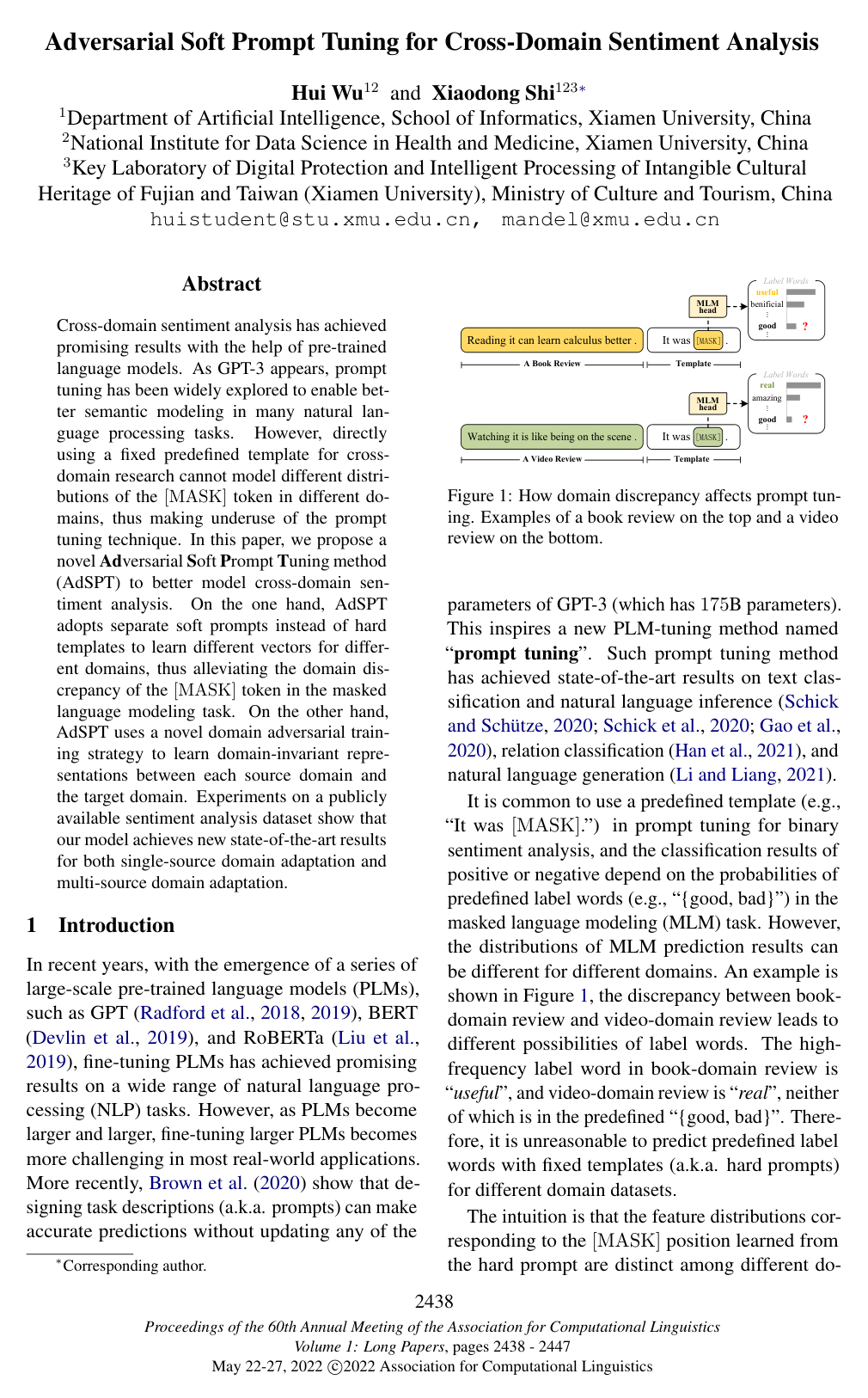
Analyzing customer sentiment across different product categories is essential for modern business intelligence. However, artificial intelligence models trained on one product domain often perform poorly when deployed to another because vocabulary and phrasing differ significantly. While prompt tuning using pre-trained language models has emerged as an efficient alternative to traditional model fine-tuning, standard fixed text templates fail across varied domains because sentiment words naturally shift across contexts (for example, "useful" in book reviews versus "real" in video reviews).
The article develops and evaluates Adversarial Soft Prompt Tuning (AdSPT), a novel framework designed to improve cross-domain sentiment analysis. The objective is to demonstrate that combining learnable, domain-specific continuous vectors ("soft prompts") with adversarial training effectively bridges the gap between source and target domains without requiring manually engineered text templates.
To test this approach, the authors conducted experiments using the benchmark Amazon review dataset spanning four distinct product domains: Books, DVDs, Electronics, and Kitchen appliances. The evaluation covered both single-source adaptation (training on one product category and testing on another) and multi-source adaptation (training on three categories to test on a fourth). The model paired continuous soft prompt vectors for individual domains with domain discriminators that engaged in a minimax game to encourage the language model to learn domain-invariant sentiment features.
The findings confirm that AdSPT delivers superior classification performance. First, AdSPT achieved new state-of-the-art results, reaching an average accuracy of 93.14% in single-source domain adaptation and 93.75% in multi-source adaptation, outperforming established baselines such as BERT-DAAT and SENTIXFix. Second, soft prompt tuning consistently outperformed fixed text templates, yielding an average performance improvement of over 1.3 percentage points. Third, multi-source adaptation generally exceeded single-source performance, except when the source and target domains were already highly similar (such as Electronics and Kitchen appliances). Finally, sensitivity testing revealed that shorter prompt lengths (specifically, three prompt tokens) yielded optimal performance, minimizing computational complexity.
These results demonstrate that organizations can reduce the labor and expertise costs associated with manual prompt engineering while maintaining high analytical accuracy across changing data domains. By combining domain-specific prompts with adversarial learning, systems can reliably extract transferable features from existing labeled datasets. Organizations implementing cross-domain text classification should adopt soft prompt architectures and leverage multi-source data where available, keeping prompt lengths minimal.
While the reported performance establishes high confidence across the tested consumer product reviews, the evaluation is limited to binary sentiment classification within standard e-commerce datasets. Stakeholders should conduct pilot validation when applying the framework to highly complex, multi-class tasks or specialized technical domains before full-scale operational deployment.
- Book: Domain-Adversarial Training of Neural Networks, Yaroslav Ganin et al. (2016). Its adversarial domain-classifier framework supplies the minimax domain-invariance foundation that AdSPT adapts to soft prompts.
- Paper: GPT Understands, Too, Xiao Liu et al. (2021). P-Tuning establishes trainable continuous prompt embeddings, the core prompt-learning mechanism that AdSPT makes domain-specific.
- Paper: Biographies, Bollywood, Boom-boxes and Blenders: Domain Adaptation for Sentiment Classification, John Blitzer et al. (2007). This Amazon-review study establishes the cross-domain sentiment adaptation problem and product-domain benchmark that contextualize AdSPT’s approach.
- Paper: Domain Adaptation for Large-Scale Sentiment Classification: A Deep Learning Approach, Xavier Glorot et al. (2011). Its deep shared-representation approach to transferring sentiment across product domains provides an earlier baseline for AdSPT’s adaptation strategy.
- Paper: The Power of Scale for Parameter-Efficient Prompt Tuning, Brian Lester et al. (2021). This work explains how frozen language models can be adapted by learning soft prompts, the parameter-efficient setup AdSPT extends.
No sufficiently relevant recommendations were found.