Learning Temporal Regularity in Video Sequences
Mahmudul HasanJonghyun ChoiJan NeumannAmit K. Roy-ChowdhuryLarry S. Davis
Develops a fully convolutional autoencoder framework that learns regular spatio-temporal patterns with minimal supervision to detect anomalies in complex video sequences.
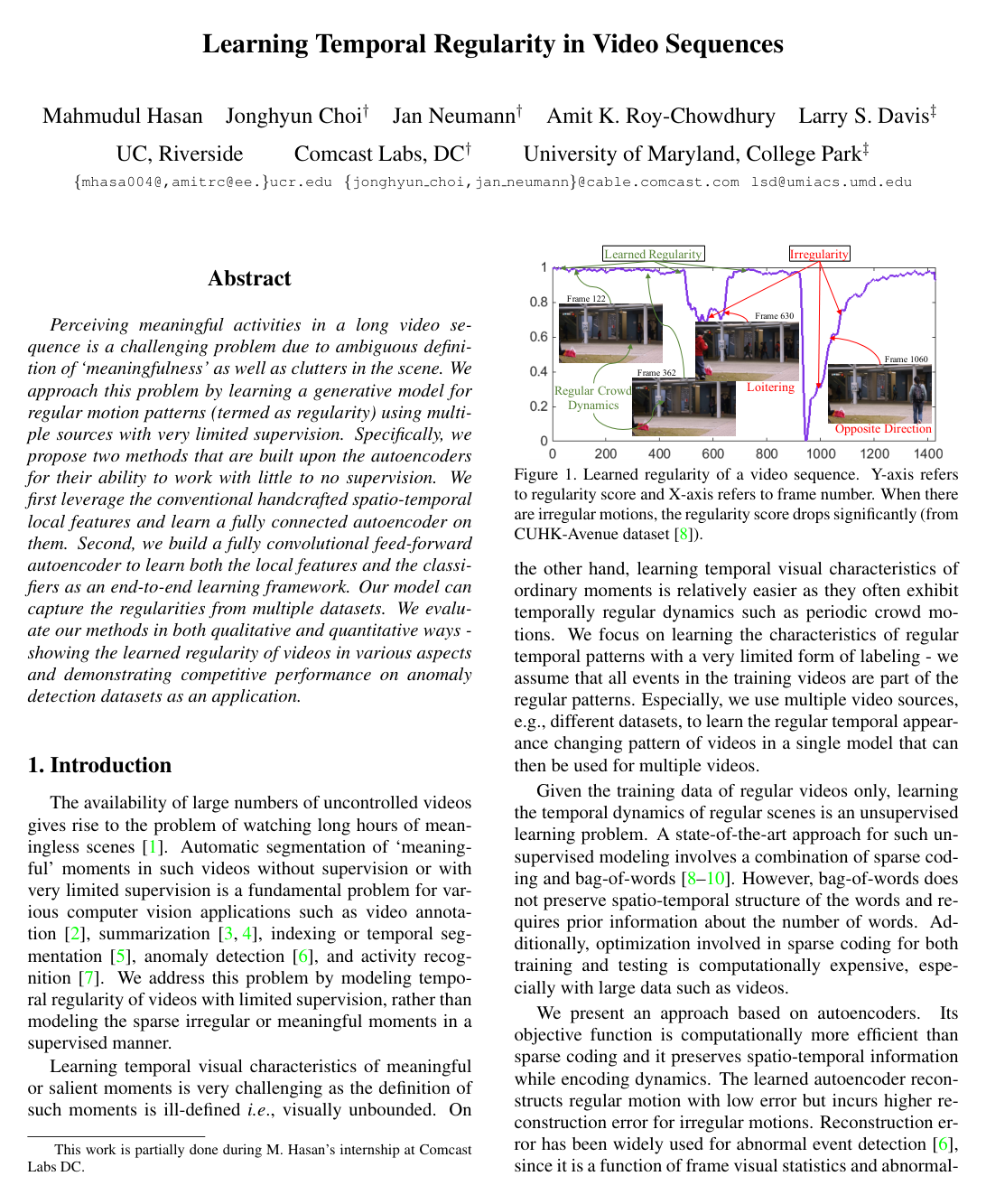
Modern video systems record vast quantities of footage, creating an operational burden where human reviewers must spend hours searching through uninformative scenes to spot critical events. Automated detection of unusual or meaningful activity remains difficult because anomalies are unpredictable and diverse, making standard supervised detection methods impractical. The article addresses this challenge by shifting the focus from identifying rare anomalies to modeling normal, recurring motion patterns—termed temporal regularity—using minimal supervision.
The main objective of the article is to demonstrate that an autoencoder framework can learn temporal regularity from ordinary video sequences and reliably detect anomalies by measuring reconstruction errors. Specifically, it evaluates two distinct architectures: a standard autoencoder trained on handcrafted motion trajectories and a fully convolutional autoencoder that learns both visual features and motion patterns directly from raw video clips.
The authors conducted experiments across several standard benchmark datasets, including CUHK Avenue, UCSD Pedestrian (Ped1 and Ped2), and Subway (Entrance and Exit) scenes, totaling nearly two hours of video. Instead of relying on manual event labeling, the models were trained under the assumption that training videos contain only regular activity. Credibility is further established by evaluating cross-dataset generalization without scene-specific fine-tuning.
The analysis produced several key findings. First, the fully convolutional autoencoder outperformed the handcrafted feature model across all benchmarks, achieving high detection rates such as 45 out of 47 anomalies on CUHK Avenue and 61 out of 66 on Subway Entrance. Second, the convolutional architecture successfully retained spatial context, enabling pixel-precise localization of irregular objects, such as vehicles on pedestrian paths or thrown items, whereas handcrafted features provided only coarse patch-level localization. Third, the model demonstrated strong generalization capabilities; training across multiple datasets simultaneously preserved performance without degrading accuracy on individual scenes. Fourth, the generative model proved capable of predicting short-range past and future regular frames from a single static image.
These findings suggest significant operational benefits for organizations managing surveillance, monitoring, or automated indexing pipelines. Shifting to an end-to-end unsupervised approach reduces the human cost and timeline associated with manual data labeling while improving computational efficiency compared to sparse-coding techniques. The system provides a unified generative model that adapts across varied surveillance camera angles and environments.
Stakeholders deploying automated surveillance should consider integrating fully convolutional autoencoders for anomaly triaging and video summarization. However, because the system flags any statistical deviation from regular motion, it generates higher false alarm rates when harmless but unusual actions occur (such as running in a subway). Decision-makers should implement these models alongside secondary filtering or human-in-the-loop validation rather than as fully autonomous alarms. Future efforts should evaluate the model on more complex, unconstrained outdoor environments and explore adaptive thresholding to mitigate false alarms.
- Paper: Unsupervised Learning of Video Representations using LSTMs, Nitish Srivastava et al. (2015). This foundational work demonstrates how encoder-decoder autoencoders can learn unsupervised representations from video sequences by reconstructing inputs and predicting future frames.
- Paper: Extracting and composing robust features with denoising autoencoders, Pascal Vincent et al. (2008). It provides the essential conceptual principles of training unsupervised reconstruction autoencoders to learn robust, underlying data representations.
- Paper: Deep multi-scale video prediction beyond mean square error, Michael Mathieu et al. (2015). It introduces deep multi-scale feed-forward convolutional networks for frame prediction in video sequences, establishing core visual architectures for temporal modeling.
- Paper: Contractive Auto-Encoders: Explicit Invariance During Feature Extraction, Salah Rifai et al. (2011). It outlines key regularization techniques for autoencoder architectures to ensure learned latent representations capture invariant, regular data structure.
- Paper: Action recognition by dense trajectories, Heng Wang et al. (2011). It introduces conventional handcrafted spatio-temporal local motion descriptors that serve as the traditional feature baseline evaluated in the source paper.
- Paper: Future Frame Prediction for Anomaly Detection - A New Baseline, Wen Liu et al. (2017). This paper builds directly upon autoencoder-based video anomaly detection by shifting from reconstruction error baselines to future frame prediction frameworks.
- Paper: Memorizing Normality to Detect Anomaly: Memory-Augmented Deep Autoencoder for Unsupervised Anomaly Detection, Dong Gong et al. (2019). It enhances autoencoder-based video normality learning by augmenting the architecture with an external memory module to prevent abnormal event reconstruction.
- Paper: Real-World Anomaly Detection in Surveillance Videos, Waqas Sultani et al. (2018). It advances video anomaly detection beyond unsupervised autoencoders by introducing a weakly supervised multiple instance learning framework for surveillance footage.
- Paper: GANomaly: Semi-Supervised Anomaly Detection via Adversarial Training, Samet Akcay et al. (2018). It extends the paradigm of normality learning and reconstruction-based anomaly detection using an adversarial encoder-decoder-encoder architecture.
- Paper: Deep Learning for Anomaly Detection, Guansong Pang et al. (2020). This comprehensive survey categorizes and contextualizes deep normality representation learning and reconstruction frameworks across broad anomaly detection domains.
- Paper: Deep Learning for Anomaly Detection: A Survey, Raghavendra Chalapathy et al. (2019). It provides a systematic review of deep learning techniques for anomaly detection, evaluating reconstruction-based autoencoders alongside emerging formulations.