Action recognition by dense trajectories

Heng WangAlexander KlaserCordelia SchmidCheng-Lin Liu

article2011CVPR2,388 citations

Proposes tracking densely sampled points using optical flow alongside motion boundary histogram descriptors to effectively capture complex video motion and improve action recognition across challenging benchmarks.

Listen

Automated human action recognition in realistic video is a critical capability for video indexing, surveillance, and automated content analysis. However, standard methods struggle with real-world complexities such as erratic camera motion, cluttered backgrounds, and abrupt movements across video frames. Traditional computer vision pipelines track only a sparse set of points or rely on heavy motion compensation techniques, which frequently miss key motion cues and degrade classification performance in uncontrolled environments.

The article evaluated a framework that extracts dense motion trajectories using optical flow fields and encodes them with motion boundary histograms to improve action classification accuracy in challenging video footage.

To conduct this evaluation, the researchers sampled grid points across eight spatial scales and tracked them frame-by-frame using dense optical flow. They described each trajectory using four distinct descriptors: trajectory shape, static appearance via image gradients, optical flow motion, and motion boundary histograms that capture relative pixel displacement. The approach was tested across four benchmark datasets of varying difficultyKTH, YouTube, Hollywood2, and UCF Sportsusing a standard bag-of-features model and support vector machine classifiers against established baseline trackers.

The experimental results demonstrated consistent performance advantages. Dense trajectories outperformed standard point-tracking baselines across all datasets, improving classification accuracy by 2% to 6%. The motion boundary histogram descriptor proved to be the most robust individual feature, outperforming traditional optical flow by 11.1% on the uncontrolled YouTube dataset because it successfully cancels out camera and background motion. Overall, the combined dense trajectory pipeline achieved state-of-the-art results across realistic datasets, reaching 84.2% accuracy on YouTube (a 9% improvement over prior art) and 58.3% mean average precision on Hollywood2 (a 5% improvement), while maintaining top-tier performance on standard benchmarks.

These findings indicate that incorporating dense trajectory tracking significantly enhances video analysis accuracy without the computational burden of complex video stabilization algorithms. By suppressing uniform background noise and capturing foreground movement directly through optical flow gradients, organizations can deploy more reliable video classification systems for complex, handheld, or film-based visual assets.

Stakeholders developing automated video analysis pipelines should consider adopting dense trajectory tracking and motion boundary descriptors as primary feature extractors. Optimal performance is achieved using trajectories bounded to 15 to 20 frames, which balances detail against track drift. Further work should focus on extending this pipeline to related application areas such as spatio-temporal action localization and large-scale video retrieval.

Confidence in these findings is high given the rigorous evaluation across diverse standard benchmarks. However, practitioners should note that the approach relies on the accuracy of the underlying optical flow field and prunes static or abruptly large displacements, meaning performance could vary in video streams with extreme compression artifacts or extreme sensor noise.

Cover for Action recognition by dense trajectories

Abstract

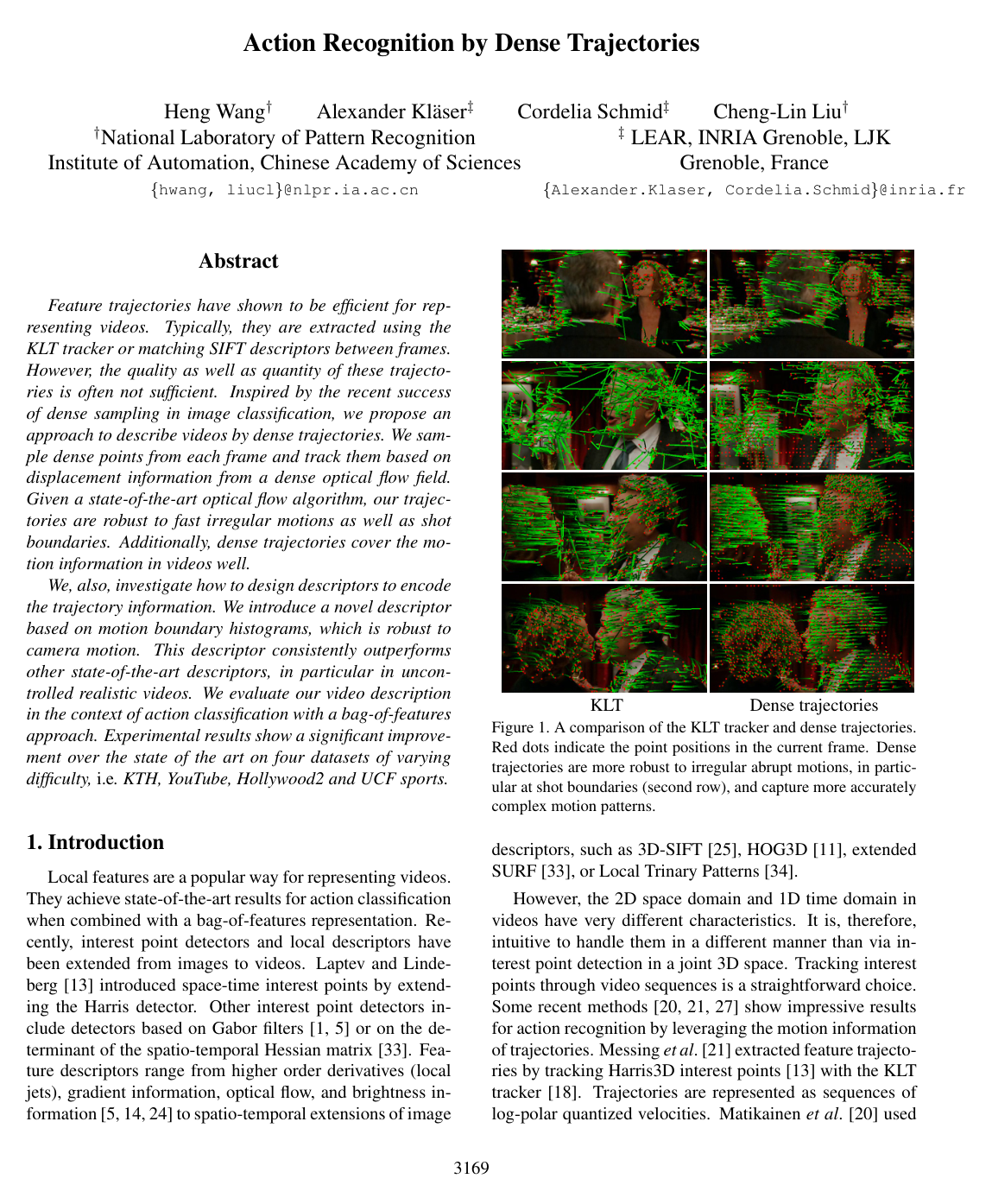
Feature trajectories have shown to be efficient for representing videos. Typically, they are extracted using the KLT tracker or matching SIFT descriptors between frames. However, the quality as well as quantity of these trajectories is often not sufficient. Inspired by the recent success of dense sampling in image classification, we propose an approach to describe videos by dense trajectories. We sample dense points from each frame and track them based on displacement information from a dense optical flow field. Given a state-of-the-art optical flow algorithm, our trajectories are robust to fast irregular motions as well as shot boundaries. Additionally, dense trajectories cover the motion information in videos well.

We, also, investigate how to design descriptors to encode the trajectory information. We introduce a novel descriptor based on motion boundary histograms, which is robust to camera motion. This descriptor consistently outperforms other state-of-the-art descriptors, in particular in uncontrolled realistic videos. We evaluate our video description in the context of action classification with a bag-of-features approach. Experimental results show a significant improvement over the state of the art on four datasets of varying difficulty, i.e. KTH, YouTube, Hollywood2 and UCF sports.

Table of Contents

  • 1. Introduction
  • 2. Dense trajectories
  • 3. Trajectory-aligned descriptors
  • 4. Experimental setup
  • 4.1. Datasets
  • 4.2. Bag of features
  • 4.3. Baseline KLT trajectories
  • 5. Experimental results
  • 5.1. Evaluation of our dense trajectory descriptors
  • 5.2. Comparison to the state of the art
  • 5.3. Evaluation of trajectory parameters
  • 6. Conclusions
  • References

Knowls

  1. Knowl 1 — Dense Trajectory Extraction Algorithm

    algorithm

    Dense trajectories track densely sampled feature points across multiple spatial scales using dense optical flow fields with median filtering.

    Input: Video sequence V=(I1,I2,,IT)V = (I_1, I_2, \dots, I_T), sampling step size W=5W = 5 pixels, scale count S=8S = 8 with scale downsampling factor 1/21/\sqrt{2}, trajectory length L=15L = 15 frames, autocorrelation eigenvalue threshold θ\theta
    Output: Set of dense trajectories T\mathcal{T}
    Initialize active trajectories set A\mathcal{A} \leftarrow \emptyset, output set T\mathcal{T} \leftarrow \emptyset
    for frame t=1t = 1 to T1T-1 do
        Compute Farnebäck dense optical flow field ωt=(ut,vt)\omega_t = (u_t, v_t) between frames ItI_t and It+1I_{t+1} at each spatial scale s{1,,S}s \in \{1, \dots, S\}
        for each spatial scale ss do
            for each active trajectory TiAT_i \in \mathcal{A} at scale ss with endpoint Pt=(xt,yt)P_t = (x_t, y_t) do
                Let (xˉt,yˉt)(\bar{x}_t, \bar{y}_t) be the rounded integer pixel position of PtP_t
                Track point: Pt+1=(xt,yt)+(Mωt)(xˉt,yˉt)P_{t+1} = (x_t, y_t) + (M * \omega_t)|_{(\bar{x}_t, \bar{y}_t)}, where MM is a 3×33 \times 3 median filtering kernel
                if Pt+1Pt\|P_{t+1} - P_t\| exceeds sudden displacement threshold then
                    Remove TiT_i from A\mathcal{A}
                else
                    Append Pt+1P_{t+1} to TiT_i
                    if length of TiT_i equals LL then
                        if TiT_i is non-static then
                            TT{Ti}\mathcal{T} \leftarrow \mathcal{T} \cup \{T_i\}
                        Remove TiT_i from A\mathcal{A}
            Identify grid positions on the regular W×WW \times W grid lacking tracked points in their W×WW \times W neighborhood
            for each unoccupied candidate point P=(x,y)P = (x, y) do
                Compute minimum eigenvalue λmin\lambda_{\min} of autocorrelation matrix at PP
                if λmin>θ\lambda_{\min} > \theta then
                    Start new trajectory Tnew=(P)T_{\text{new}} = (P) and add to A\mathcal{A} at scale ss
    return T\mathcal{T}

    Tracking points by median filtering on the dense optical flow field provides robustness against drifting near motion boundaries compared to standard bilinear interpolation. Limiting tracking length to L=15L = 15 frames prevents drifting over extended time horizons, while static trajectories and points in textureless areas are filtered out.

  2. Knowl 2 — Motion Boundary Histograms for Dense Trajectories

    model/method

    The Motion Boundary Histogram (MBH) descriptor computes spatial derivatives of dense optical flow fields along dense trajectories to separate foreground human motion from camera and background motion.

    Given a dense optical flow field Iω=(u,v)I_\omega = (u, v), where u(x,y)u(x, y) and v(x,y)v(x, y) denote the horizontal and vertical displacement components at pixel (x,y)(x, y), spatial derivatives are computed independently for both components: (u)x=ux,(u)y=uy(\nabla u)_x = \frac{\partial u}{\partial x}, \quad (\nabla u)_y = \frac{\partial u}{\partial y} (v)x=vx,(v)y=vy(\nabla v)_x = \frac{\partial v}{\partial x}, \quad (\nabla v)_y = \frac{\partial v}{\partial y}

    For each flow component uu and vv, gradient orientations are quantized into 8-bin histograms covering the full 360360^\circ range weighted by their gradient magnitudes, generating two 8-dimensional sub-descriptors: MBHx\text{MBH}_x and extMBHy ext{MBH}_y. Each sub-descriptor is normalized separately with its L2L_2 norm: vnorm=vv22+ϵ2\mathbf{v}_{\text{norm}} = \frac{\mathbf{v}}{\sqrt{\|\mathbf{v}\|_2^2 + \epsilon^2}}

    Because spatial differentiation cancels out locally constant and affine motion fields, uniform optical flow caused by camera translation, panning, or zooming is eliminated ((u)=0,(v)=0(\nabla u) = 0, (\nabla v) = 0), while relative motion boundaries between moving actors and the background are preserved. Texture in static background regions is also suppressed because static regions have zero flow.

  3. Knowl 3 — Trajectory Shape Descriptor

    equation

    A dense trajectory of length LL defined by the temporal sequence of point positions (Pt,Pt+1,,Pt+L1)(P_t, P_{t+1}, \dots, P_{t+L-1}), with Pt=(xt,yt)P_t = (x_t, y_t), is described by its sequence of consecutive displacement vectors: S=(ΔPt,ΔPt+1,,ΔPt+L2)S = (\Delta P_t, \Delta P_{t+1}, \dots, \Delta P_{t+L-2}) where each displacement step is defined as: ΔPj=Pj+1Pj=(xj+1xj,yj+1yj)\Delta P_j = P_{j+1} - P_j = (x_{j+1} - x_j, y_{j+1} - y_j)

    The normalized trajectory shape descriptor SS' is formed by concatenating the displacement vectors and dividing by the total trajectory path length: S=(ΔPt,ΔPt+1,,ΔPt+L2)j=tt+L2ΔPj2S' = \frac{(\Delta P_t, \Delta P_{t+1}, \dots, \Delta P_{t+L-2})}{\sum_{j=t}^{t+L-2} \|\Delta P_j\|_2}

    For a default trajectory length of L=15L = 15 frames, the resulting descriptor is a 28-dimensional vector (or 30-dimensional when parameterized over LL displacement steps), encoding local directional movement patterns independent of absolute displacement magnitude and action speed.

  4. Knowl 4 — Trajectory-Aligned Spatio-Temporal Descriptor Grid

    model/method

    To capture appearance, motion, and motion boundaries along a dense trajectory of length LL, local descriptors are computed within a spatio-temporal volume of size N×NN \times N pixels spatially and LL frames temporally aligned with the moving trajectory position.

    The volume is partitioned into a 3D spatio-temporal grid of size nσ×nσ×nτn_\sigma \times n_\sigma \times n_\tau, where nσn_\sigma is the number of spatial divisions per axis and nτn_\tau is the number of temporal segments. Default optimal parameters are N=32N = 32 pixels, nσ=2n_\sigma = 2, and nτ=3n_\tau = 3, creating 2×2×3=122 \times 2 \times 3 = 12 spatio-temporal cells.

    Within each grid cell, descriptors are computed and normalized with the L2L_2 norm:

    • HOG (Histograms of Oriented Gradients): Intensity gradients quantized into 8 orientation bins (12×8=9612 \times 8 = 96 dimensions).
    • HOF (Histograms of Optical Flow): Flow vectors quantized into 9 bins (8 directional bins plus 1 zero-motion bin) (12×9=10812 \times 9 = 108 dimensions).
    • MBH (Motion Boundary Histograms): Gradients of horizontal flow MBHx\text{MBH}_x (8 bins) and vertical flow MBHy\text{MBH}_y (8 bins) (12×16=19212 \times 16 = 192 dimensions).

    Concatenating the trajectory shape descriptor (30 dimensions), HOG (96 dimensions), HOF (108 dimensions), and MBH (192 dimensions) forms a 426-dimensional combined descriptor per trajectory.

  5. Knowl 5 — Multi-Channel Non-Linear SVM Bag-of-Features Pipeline

    model/method

    Action recognition with dense trajectory features uses a multi-channel bag-of-features representation classified by a non-linear Support Vector Machine (SVM).

    For each descriptor channel c{Trajectory,HOG,HOF,MBH}c \in \{\text{Trajectory}, \text{HOG}, \text{HOF}, \text{MBH}\}:

    1. A codebook of K=4000K = 4000 visual words is constructed by clustering 100,000 randomly sampled training descriptors using kk-means (initialized 8 times, retaining the partition with lowest quantization error).
    2. Descriptors in a video are assigned to the nearest visual word using Euclidean distance, forming a frequency histogram xc\mathbf{x}^c.

    Videos xix_i and xjx_j are compared using a multi-channel χ2\chi^2 RBF kernel: K(xi,xj)=exp(c1AcD(xic,xjc))K(x_i, x_j) = \exp\left(-\sum_{c} \frac{1}{A^c} D(x_i^c, x_j^c)\right) where D(xic,xjc)D(x_i^c, x_j^c) is the χ2\chi^2 distance: D(xic,xjc)=12k=1K(xikcxjkc)2xikc+xjkcD(x_i^c, x_j^c) = \frac{1}{2} \sum_{k=1}^K \frac{(x_{ik}^c - x_{jk}^c)^2}{x_{ik}^c + x_{jk}^c} and AcA^c is the mean χ2\chi^2 distance across all training video pairs for channel cc. Multi-class action classification is performed using a one-against-rest SVM scheme, assigning the class with the highest decision value.

  6. Knowl 6 — Performance Comparison of Dense Trajectories versus KLT Baseline and Descriptors

    data/table

    A comparative evaluation measures the performance of dense trajectories against the baseline KLT tracker (100 interest points detected per frame) across four action datasets: KTH (mean accuracy over 6 classes), YouTube (mean accuracy over 11 classes, 25 folds), Hollywood2 (mean Average Precision over 12 classes), and UCF sports (mean accuracy over 10 classes, leave-one-out cross-validation with horizontal flipping augmentation).

    Descriptor KTH YouTube Hollywood2 UCF sports
    KLT Dense KLT Dense KLT Dense KLT Dense
    Trajectory 88.4% 90.2% 58.2% 67.2% 46.2% 47.7% 72.8% 75.2%
    HOG 84.0% 86.5% 71.0% 74.5% 41.0% 41.5% 80.2% 83.8%
    HOF 92.4% 93.2% 64.1% 72.8% 48.4% 50.8% 72.7% 77.6%
    MBH 93.4% 95.0% 72.9% 83.9% 48.6% 54.2% 78.4% 84.8%
    Combined 93.4% 94.2% 79.9% 84.2% 54.6% 58.3% 82.1% 88.2%

    Dense trajectories outperform KLT trajectories by 2% to 6% across all datasets and descriptors. MBH consistently achieves the highest individual descriptor score, surpassing HOF by 11.1% on YouTube (83.9% vs. 72.8%) and 3.4% on Hollywood2 (54.2% vs. 50.8%) due to effective cancellation of camera motion.

  7. Knowl 7 — State-of-the-Art Action Recognition Benchmark Results

    data/table

    The combined dense trajectory representation (Trajectory + HOG + HOF + MBH) classified with a multi-channel χ2\chi^2 SVM outperforms previous state-of-the-art action recognition methods across diverse video benchmarks.

    KTH YouTube Hollywood2 UCF sports
    Method Accuracy Method Accuracy Method mAP Method Accuracy
    Laptev et al. (2008) 91.8% Liu et al. (2009) 71.2% Wang et al. (2009) 47.7% Wang et al. (2009) 85.6%
    Yuan et al. (2009) 93.3% Ikizler-Cinbis et al. (2010) 75.21% Gilbert et al. (2011) 50.9% Kovashka et al. (2010) 87.27%
    Gilbert et al. (2011) 94.5% Ullah et al. (2010) Ullah et al. (2010) 53.2% Kläser et al. (2010) 86.7%
    Kovashka et al. (2010) 94.53% Taylor et al. (2010) Taylor et al. (2010) 46.6%
    Dense Trajectories 94.2% Dense Trajectories 84.2% Dense Trajectories 58.3% Dense Trajectories 88.2%

    Key results include:

    • YouTube: 84.2% accuracy, outperforming the prior state of the art (75.21%) by 9.0% without requiring explicit video stabilization.
    • Hollywood2: 58.3% mAP, exceeding previous methods (53.2% mAP) by 5.1%.
    • UCF sports: 88.2% accuracy, improving over the prior best result of 87.27%.
    • KTH: 94.2% accuracy with combined descriptors (and 95.0% using MBH alone), matching the top performance in the literature under the standard train/test split.
  8. Knowl 8 — Influence of Trajectory and Descriptor Hyperparameters

    empirical result

    Systematic hyperparameter evaluations on YouTube and Hollywood2 reveal the following behavioral dependencies:

    • Trajectory Length LL: Classification performance improves as trajectory length increases up to L=15L = 15 or L=20L = 20 frames, beyond which performance degrades due to accumulating trajectory drift.
    • Sampling Step Size WW: Denser sampling improves performance monotonically. On Hollywood2, mAP increases from 55.5% (W=14W = 14) to 58.3% (W=5W = 5) and 58.9% (W=2W = 2). On YouTube, accuracy increases from 80.0% (W=20W = 20) to 84.2% (W=5W = 5) and 84.4% (W=2W = 2). A step size of W=5W = 5 pixels provides the best balance of speed and performance.
    • Neighborhood Patch Size NN: Results are stable across N=24N = 24 to N=48N = 48 pixels on Hollywood2 (optimal around N=32N = 32), reaching a peak of 84.7% accuracy at N=40N = 40 pixels on YouTube.
    • Spatio-Temporal Grid Subdivision (nσ×nσ×nτn_\sigma \times n_\sigma \times n_\tau): Increasing the spatial cell grid nσn_\sigma from 1 to 2 produces a large performance increase (from ~55.5% to ~58.2% mAP on Hollywood2 and ~81% to ~83.5% on YouTube). The configuration nσ=2,nτ=3n_\sigma = 2, n_\tau = 3 (12 cells) yields the optimal outcome, with no significant gains obtained by finer grids like 3×3×33 \times 3 \times 3.
  9. Knowl 9 — Per-Class Action Recognition Performance on YouTube and Hollywood2

    data/table

    Class-specific performance comparison on YouTube (per-class accuracy) and Hollywood2 (per-class average precision) benchmarks against baseline KLT tracking and prior state-of-the-art methods.

    YouTube (Accuracy) Hollywood2 (Average Precision)
    Class KLT Dense Traj. Ikizler-Cinbis Class KLT Dense Traj. Ullah
    b_shoot 34.0% 43.0% 48.48% AnswerPhone 18.3% 32.6% 25.9%
    bike 87.6% 91.7% 75.17% DriveCar 88.8% 88.0% 85.9%
    dive 99.0% 99.0% 95.0% Eat 73.4% 65.2% 56.4%
    golf 95.0% 97.0% 95.0% FightPerson 74.2% 81.4% 74.9%
    h_ride 76.0% 85.0% 73.0% GetOutCar 47.9% 52.7% 44.0%
    s_juggle 65.0% 76.0% 53.0% HandShake 18.4% 29.6% 29.7%
    swing 86.0% 88.0% 66.0% HugPerson 42.6% 54.2% 46.1%
    t_swing 71.0% 71.0% 77.0% Kiss 65.0% 65.8% 55.0%
    t_jump 93.0% 94.0% 93.0% Run 76.3% 82.1% 69.4%
    v_spike 96.0% 95.0% 85.0% SitDown 59.0% 62.5% 58.9%
    walk 76.4% 87.0% 66.67% SitUp 27.7% 20.0% 18.4%
    StandUp 63.4% 65.2% 57.4%
    Overall 79.9% 84.2% 75.21% mAP 54.6% 58.3% 51.8%

    Dense trajectories achieve higher performance on 8 of 11 classes on YouTube and 8 of 12 classes on Hollywood2 compared to both the KLT baseline and previous approaches.

Coverage note — None was omitted; all contributed algorithms, descriptor formulations, pipeline components, empirical parameter analyses, and dataset benchmark results are fully represented.

References

  1. 1.M. Bregonzio, S. Gong, and T. Xiang. Recognising action as clouds of space-time interest points. In CVPR, 2009.
  2. 2.T. Brox and J. Malik. Object segmentation by long term analysis of point trajectories. In ECCV, 2010.
  3. 3.N. Dalal and B. Triggs. Histograms of oriented gradients for human detection. In CVPR, 2005.
  4. 4.N. Dalal, B. Triggs, and C. Schmid. Human detection using oriented histograms of flow and appearance. In ECCV, 2006.
  5. 5.P. Dollár, V. Rabaud, G. Cottrell, and S. Belongie. Behavior recognition via sparse spatio-temporal features. In VS-PETS, 2005.
  6. 6.G. Farnebäck. Two-frame motion estimation based on polynomial expansion. In Scandinavian Conference on Image Analysis, 2003.
  7. 7.L. Fei-Fei and P. Perona. A Bayesian hierarchical model for learning natural scene categories. In CVPR, 2005.
  8. 8.A. Gilbert, J. Illingworth, and R.Bowden. Action recognition using mined hierarchical compound features. IEEE PAMI, 2011.
  9. 9.N. Ikizler-Cinbis and S. Sclaroff. Object, scene and actions: Combining multiple features for human action recognition. In ECCV, 2010.
  10. 10.A. Kläser, M. Marszałek, I. Laptev, and C. Schmid. Will person detection help bag-of-features action recognition? In Technical Report, INRIA Grenoble - Rhône-Alpes, 2010.
  11. 11.A. Kläser, M. Marszałek, and C. Schmid. A spatio-temporal descriptor based on 3D-gradients. In BMVC, 2008.
  12. 12.A. Kovashka and K. Grauman. Learning a hierarchy of discriminative space-time neighborhood features for human action recognition. In CVPR, 2010.
  13. 13.I. Laptev and T. Lindeberg. Space-time interest points. In ICCV, 2003.
  14. 14.I. Laptev, M. Marszałek, C. Schmid, and B. Rozenfeld. Learning realistic human actions from movies. In CVPR, 2008.
  15. 15.C. Liu, J. Yuen, and A. Torralba. Nonparametric scene parsing: label transfer via dense scene alignment. In CVPR, 2009.
  16. 16.J. Liu, J. Luo, and M. Shah. Recognizing realistic actions from videos in the wild. In CVPR, 2009.
  17. 17.W.-C. Lu, Y.-C. F. Wang, and C.-S. Chen. Learning dense optical-flow trajectory patterns for video object extraction. In IEEE Conference on Advanced Video and Signal Based Surveillance, 2010.
  18. 18.B. D. Lucas and T. Kanade. An iterative image registration technique with an application to stereo vision. In International Joint Conference on Artificial Intelligence, 1981.
  19. 19.M. Marszałek, I. Laptev, and C. Schmid. Actions in context. In CVPR, 2009.
  20. 20.P. Matikainen, M. Hebert, and R. Sukthankar. Trajectons: Action recognition through the motion analysis of tracked features. In ICCV workshop on Video-oriented Object and Event Classification, 2009.
  21. 21.R. Messing, C. Pal, and H. Kautz. Activity recognition using the velocity histories of tracked keypoints. In ICCV, 2009.
  22. 22.E. Nowak, F. Jurie, and B. Triggs. Sampling strategies for bag-of-features image classification. In ECCV, 2006.
  23. 23.M. Rodriguez, J. Ahmed, and M. Shah. Action MACH: A spatio-temporal maximum average correlation height filter for action recognition. In CVPR, 2008.
  24. 24.C. Schuldt, I. Laptev, and B. Caputo. Recognizing human actions: A local SVM approach. In ICPR, 2004.
  25. 25.P. Scovanner, S. Ali, and M. Shah. A 3-dimensional SIFT descriptor and its application to action recognition. In ACM Multimedia, 2007.
  26. 26.J. Shi and C. Tomasi. Good features to track. In CVPR, 1994.
  27. 27.J. Sun, X. Wu, S. Yan, L.-F. Cheong, T.-S. Chua, and J. Li. Hierarchical spatio-temporal context modeling for action recognition. In CVPR, 2009.
  28. 28.N. Sundaram, T. Brox, and K. Keutzer. Dense point trajectories by GPU-accelerated large displacement optical flow. In ECCV, 2010.
  29. 29.G. W. Taylor, R. Fergus, Y. LeCun, and C. Bregler. Convolutional learning of spatio-temporal features. In ECCV, 2010.
  30. 30.H. Uemura, S. Ishikawa, and K. Mikolajczyk. Feature tracking and motion compensation for action recognition. In BMVC, 2008.
  31. 31.M. M. Ullah, S. N. Parizi, and I. Laptev. Improving bag-of-features action recognition with non-local cues. In BMVC, 2010.
  32. 32.H. Wang, M. M. Ullah, A. Kläser, I. Laptev, and C. Schmid. Evaluation of local spatio-temporal features for action recognition. In BMVC, 2009.
  33. 33.G. Willems, T. Tuytelaars, and L. V. Gool. An efficient dense and scale-invariant spatio-temporal interest point detector. In ECCV, 2008.
  34. 34.L. Yeffet and L. Wolf. Local trinary patterns for human action recognition. In ICCV, 2009.
  35. 35.J. Yuan, Z. Liu, and Y. Wu. Discriminative subvolume search for efficient action detection. In CVPR, 2009.
  36. 36.J. Zhang, M. Marszałek, S. Lazebnik, and C. Schmid. Local features and kernels for classification of texture and object categories: A comprehensive study. IJCV, 73(2):213–238, 2007.

Citation

MLA
Wang, H., et al. “Action Recognition by Dense Trajectories”. CVPR 2011, 2011, pp. 3169–76, https://doi.org/10.1109/CVPR.2011.5995407.
APA
Wang, H., Klaser, A., Schmid, C., & Liu, C.-L. (2011). Action recognition by dense trajectories. CVPR 2011, 3169–3176. https://doi.org/10.1109/CVPR.2011.5995407
Chicago
Wang, H., A. Klaser, C. Schmid, and C.-L. Liu. 2011. “Action Recognition by Dense Trajectories”. CVPR 2011, 3169–76. https://doi.org/10.1109/CVPR.2011.5995407.
Harvard
Wang, H. et al. (2011) “Action recognition by dense trajectories”, CVPR 2011. IEEE, pp. 3169–3176. Available at: https://doi.org/10.1109/CVPR.2011.5995407.
Vancouver
1. Wang H, Klaser A, Schmid C, Liu C-L (2011) Action recognition by dense trajectories. In: CVPR 2011. IEEE, pp 3169–3176

BibTeX

@inproceedings{Wang_2011, title={Action recognition by dense trajectories}, url={http://dx.doi.org/10.1109/CVPR.2011.5995407}, DOI={10.1109/cvpr.2011.5995407}, booktitle={CVPR 2011}, publisher={IEEE}, author={Wang, Heng and Klaser, Alexander and Schmid, Cordelia and Liu, Cheng-Lin}, year={2011}, month=June, pages={3169–3176} }
Metadata:Crossref

Access the Paper

This paper is available from its original source. Click below to access the PDF.

Open PDF