Efficient Hierarchical Entropy Model for Learned Point Cloud Compression
Rui SongChunyang FuShan LiuGe Li
Proposes an efficient octree-based entropy model using hierarchical attention and grouped contexts to achieve linear computational complexity and fast parallel decoding without sacrificing point cloud compression performance.
Three-dimensional point clouds are essential for modern spatial computing applications, including autonomous driving navigation and immersive virtual environments. However, these datasets typically contain millions of points, creating massive data volumes that strain data storage systems and transmission bandwidth. While recent deep learning methods achieve superior compression rates by using attention mechanisms over large spatial contexts, they suffer from prohibitive computational costs and serial decoding bottlenecks, often requiring several minutes to process a single data frame.
The article develops and evaluates an efficient hierarchical entropy model (EHEM) designed to deliver high-quality point cloud compression while dramatically cutting decoding delays to practical operating speeds. The core objective is to replace computationally heavy global attention and serial dependencies with a scalable, parallel-friendly architecture that preserves global context awareness.
To achieve this, the authors designed a hierarchical attention structure that computes dependencies within localized windows and captures broader spatial context through multi-scale feature downsampling, reducing computational complexity from quadratic to linear relative to context scale. Additionally, they introduced a grouped context framework that splits occupancy sequences into two subsets, enabling parallel decoding across nodes. The approach was validated through rigorous empirical benchmarking against industry baselines and state-of-the-art learned models using standard autonomous vehicle LiDAR datasets, specifically SemanticKITTI and Ford, measuring bitrates, distortion metrics, and runtime latencies.
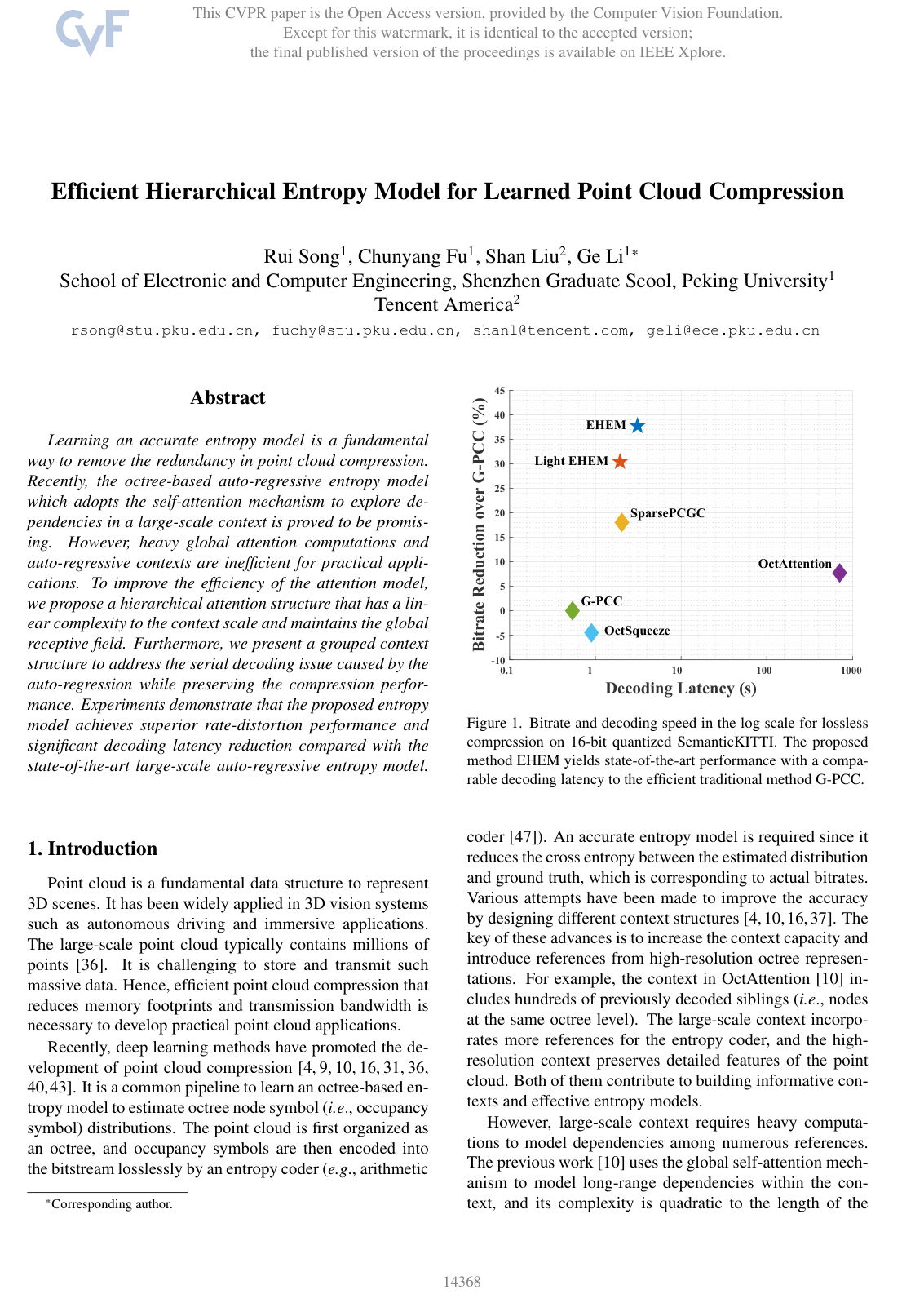
The findings demonstrate substantial improvements across compression efficiency and operational speed. The proposed model achieves an average bitrate reduction of 19.47% compared to the leading learned baseline (OctAttention) and 28.89% compared to the standard MPEG G-PCC handcrafted codec on the SemanticKITTI benchmark. Crucially, the model slashes decoding latency for high-resolution frames from approximately 708 seconds down to about 3.01 seconds—a reduction of over 99.5%—while a lightweight variant operates in 1.94 seconds. Computational operations scale linearly as context sizes expand, allowing context windows to increase to 8,192 nodes without excessive computational burden.
These results show that neural point cloud compression can achieve practical deployment viability without sacrificing state-of-the-art data reduction capabilities. For decision-makers, this translates to reduced cloud storage footprints and lower bandwidth transmission costs for spatial data workflows, alongside viable execution timelines for downstream applications. The architectural shift demonstrates that group-based parallel decoding effectively bridges the historical trade-off between compression quality and decoding throughput.
Organizations handling large volumes of 3D spatial data should consider transitioning toward hierarchical learned entropy architectures for point cloud storage and transmission pipelines. Deploying teams can evaluate the standard model for maximum bitrate savings or the lightweight configuration where lower latency and memory footprints are prioritized. Further development and pilot testing should focus on optimizing hardware acceleration and validating the model across diverse sensor modalities beyond automotive LiDAR.
Confidence in these findings is high for automotive LiDAR point cloud distributions under standardized evaluation protocols. However, decision-makers should note that the model requires specialized neural network execution environments (such as dedicated graphics processing units) and exhibits moderately higher memory usage and encoding runtimes compared to traditional rule-based codecs.
- Paper: Joint Autoregressive and Hierarchical Priors for Learned Image Compression, David Minnen et al. (2018). It introduces the core joint autoregressive and hierarchical prior framework that foundational learned entropy models adapt for probability estimation.
- Paper: ELIC: Efficient Learned Image Compression with Unevenly Grouped Space-Channel Contextual Adaptive Coding, Dailan He et al. (2022). It demonstrates grouped contextual modeling to eliminate serial decoding bottlenecks in learned compression, directly inspiring the source's parallel context strategy.
- Paper: Variational image compression with a scale hyperprior, Johannes Ballé et al. (2018). It establishes the scale hyperprior architecture that forms the baseline for hierarchical entropy modeling in learned compression systems.
- Paper: OctNet: Learning Deep 3D Representations at High Resolutions, Gernot Riegler et al. (2016). It details foundational methods for processing hierarchical octree-structured 3D data efficiently with deep neural networks.
- Paper: End-to-end Optimized Image Compression, Johannes Ballé et al. (2016). It establishes the foundational end-to-end rate-distortion optimization framework and continuous quantization relaxations used in deep compression.
No sufficiently relevant recommendations were found.