
keyword
rate-distortion performance
Rate-distortion performance is a measure of how effectively a lossy data compression system balances the amount of transmitted or stored data against the fidelity of the reconstructed output. In this context, rate represents the coding cost, typically quantified as the average number of bits per unit of data, while distortion quantifies the error, loss of information, or degradation in perceptual quality between the original and reconstructed signals. Grounded in information theory, evaluating rate-distortion performance involves analyzing the trade-off across varying bit budgets to assess how well a compression model minimizes distortion at a given bitrate, or conversely, minimizes the bitrate required to achieve a target quality level. Superior rate-distortion performance signifies that an algorithm can represent complex data structures with higher visual or statistical fidelity while consuming less storage capacity and transmission bandwidth.
3 items
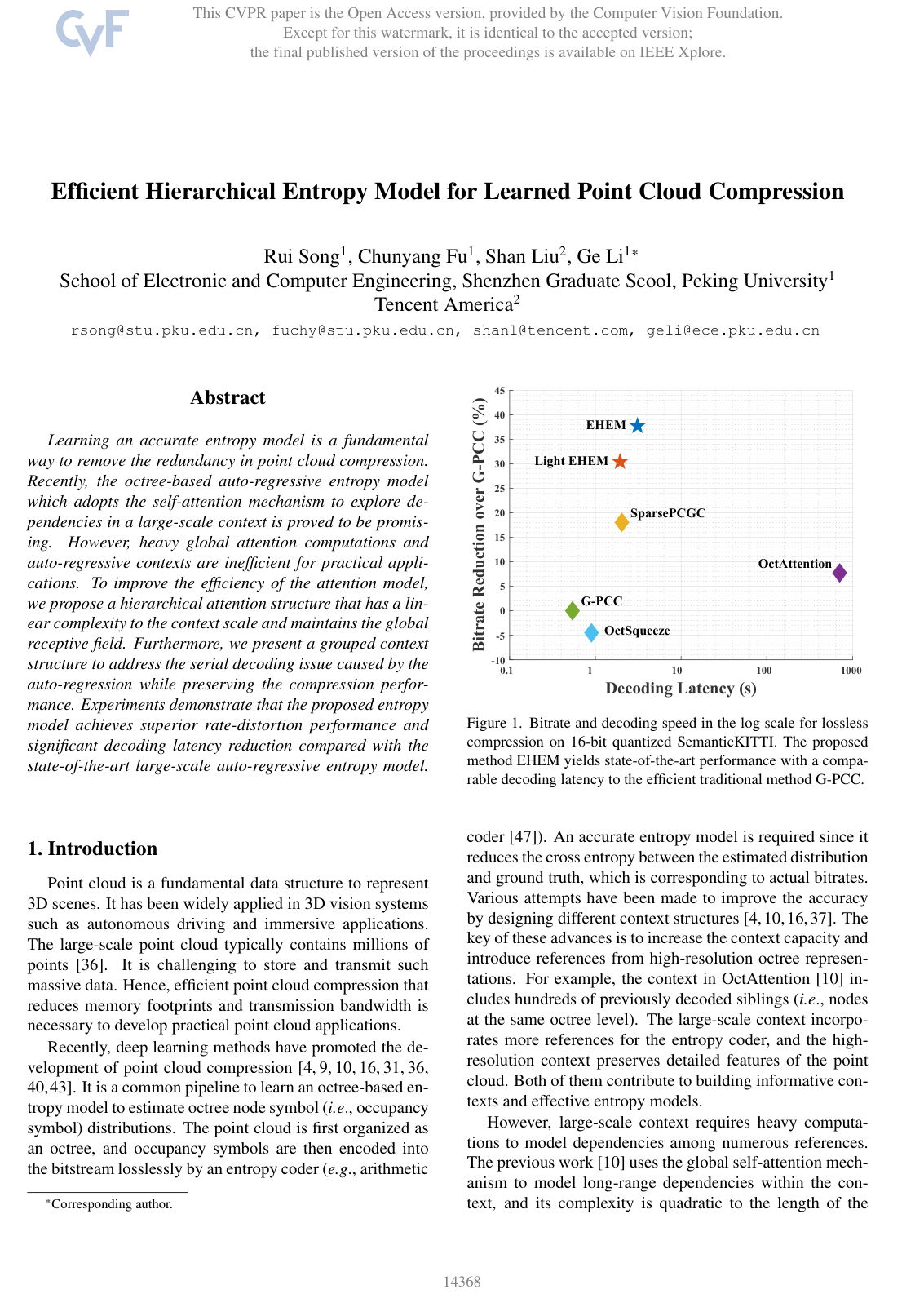
Efficient Hierarchical Entropy Model for Learned Point Cloud Compression
Rui Song, Chunyang Fu, Shan Liu, Ge Li
Why you should read this
Proposes an efficient octree-based entropy model using hierarchical attention and grouped contexts to achieve linear computational complexity and fast parallel decoding without sacrificing point cloud compression performance.
Learning an accurate entropy model is a fundamental way to remove the redundancy in point cloud compression. Recently, the octree-based auto-regressive entropy model which adopts the self-attention mechanism to explore dependencies in a large-scale context is proved to be promising. However, heavy global attention computations and auto-regressive contexts are inefficient for practical applications. To improve the efficiency of the attention model, we propose a hierarchical attention structure that has a linear complexity to the context scale and maintains the global receptive field. Furthermore, we present a grouped context structure to address the serial decoding issue caused by the auto-regression while preserving the compression performance. Experiments demonstrate that the proposed entropy model achieves superior rate-distortion performance and significant decoding latency reduction compared with the state-of-the-art large-scale auto-regressive entropy model.
Added
2026-09-26
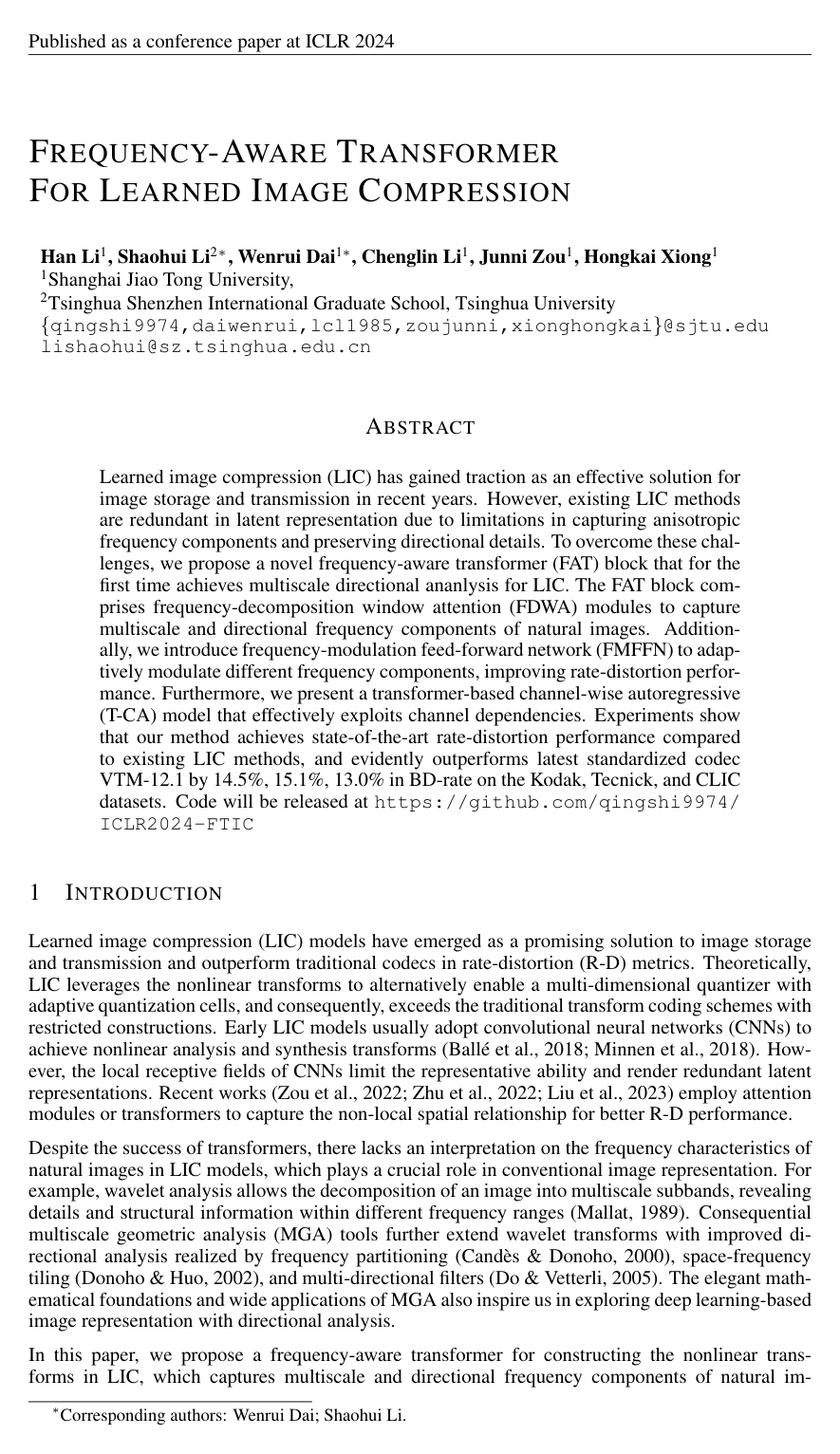
Frequency-Aware Transformer for Learned Image Compression
Han Li, Shaohui Li, Wenrui Dai, Chenglin Li, Junni Zou, Hongkai Xiong
Why you should read this
Introduces a frequency-aware transformer architecture for learned image compression that captures directional image details through multiscale frequency decomposition, outperforming the VTM-12.1 standard codec by more than 13% in BD-rate across benchmark datasets.
Learned image compression (LIC) has gained traction as an effective solution for image storage and transmission in recent years. However, existing LIC methods are redundant in latent representation due to limitations in capturing anisotropic frequency components and preserving directional details. To overcome these challenges, we propose a novel frequency-aware transformer (FAT) block that for the first time achieves multiscale directional ananlysis for LIC. The FAT block comprises frequency-decomposition window attention (FDWA) modules to capture multiscale and directional frequency components of natural images. Additionally, we introduce frequency-modulation feed-forward network (FMFFN) to adaptively modulate different frequency components, improving rate-distortion performance. Furthermore, we present a transformer-based channel-wise autoregressive (T-CA) model that effectively exploits channel dependencies. Experiments show that our method achieves state-of-the-art rate-distortion performance compared to existing LIC methods, and evidently outperforms latest standardized codec VTM-12.1 by 14.5%, 15.1%, 13.0% in BD-rate on the Kodak, Tecnick, and CLIC datasets.
Added
2026-09-26
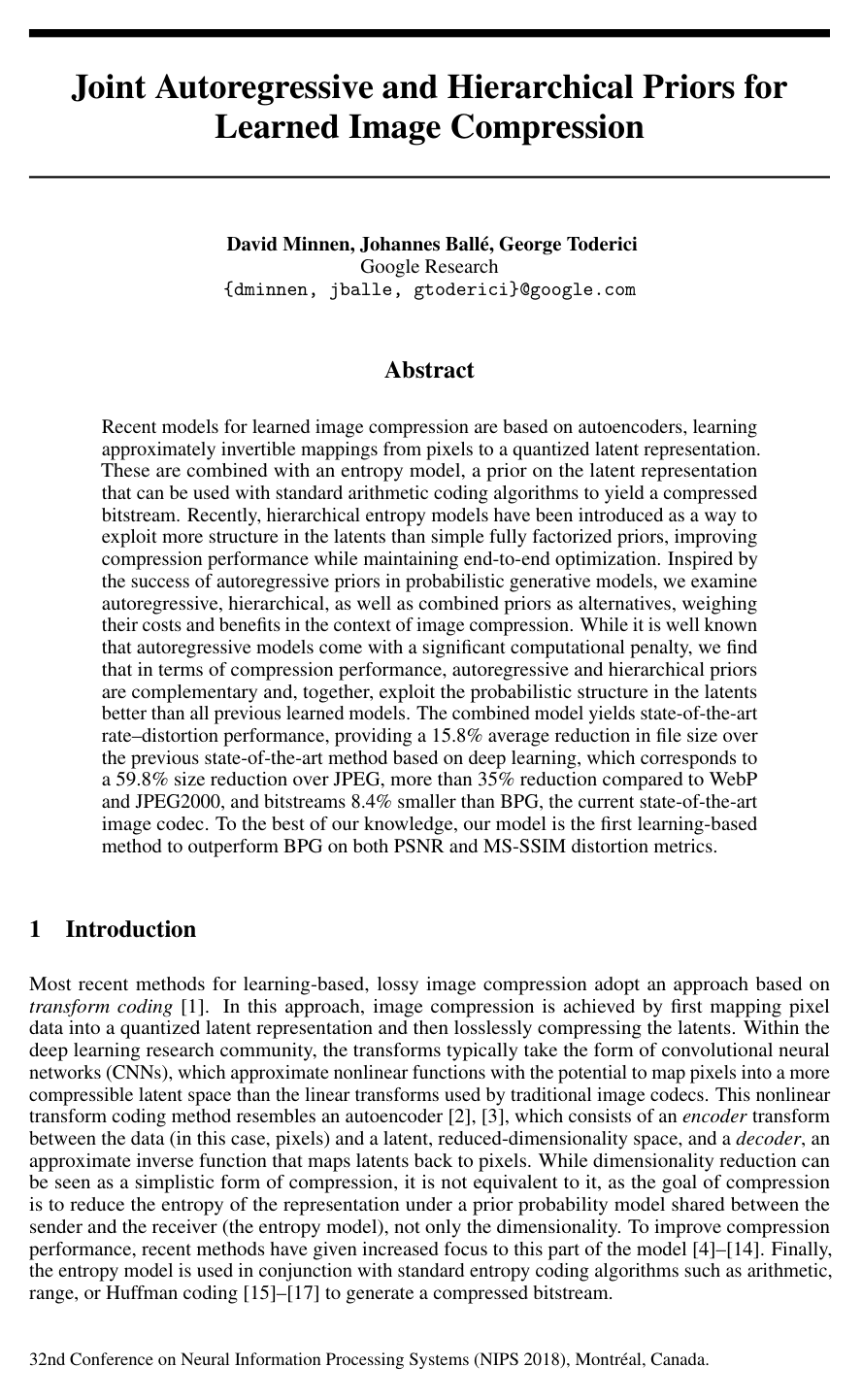
Joint Autoregressive and Hierarchical Priors for Learned Image Compression
David Minnen, Johannes Ballé, George Toderici
Why you should read this
Presents a learned image compression architecture that couples autoregressive and hierarchical priors in the entropy model, establishing the first deep learning approach to outperform traditional BPG codecs across both PSNR and MS-SSIM rate-distortion metrics.
Recent models for learned image compression are based on autoencoders, learning approximately invertible mappings from pixels to a quantized latent representation. These are combined with an entropy model, a prior on the latent representation that can be used with standard arithmetic coding algorithms to yield a compressed bitstream. Recently, hierarchical entropy models have been introduced as a way to exploit more structure in the latents than simple fully factorized priors, improving compression performance while maintaining end-to-end optimization. Inspired by the success of autoregressive priors in probabilistic generative models, we examine autoregressive, hierarchical, as well as combined priors as alternatives, weighing their costs and benefits in the context of image compression. While it is well known that autoregressive models come with a significant computational penalty, we find that in terms of compression performance, autoregressive and hierarchical priors are complementary and, together, exploit the probabilistic structure in the latents better than all previous learned models. The combined model yields state-of-the-art rate--distortion performance, providing a 15.8% average reduction in file size over the previous state-of-the-art method based on deep learning, which corresponds to a 59.8% size reduction over JPEG, more than 35% reduction compared to WebP and JPEG2000, and bitstreams 8.4% smaller than BPG, the current state-of-the-art image codec. To the best of our knowledge, our model is the first learning-based method to outperform BPG on both PSNR and MS-SSIM distortion metrics.
Added
2026-09-24