Adaptive Keyframe Sampling for Long Video Understanding
Xi TangJihao QiuLingxi XieYunjie TianJianbin JiaoQixiang Ye
Proposes a plug-and-play keyframe selection algorithm that balances prompt relevance with temporal coverage to improve long video question-answering accuracy in multimodal large language models without exceeding token limits.
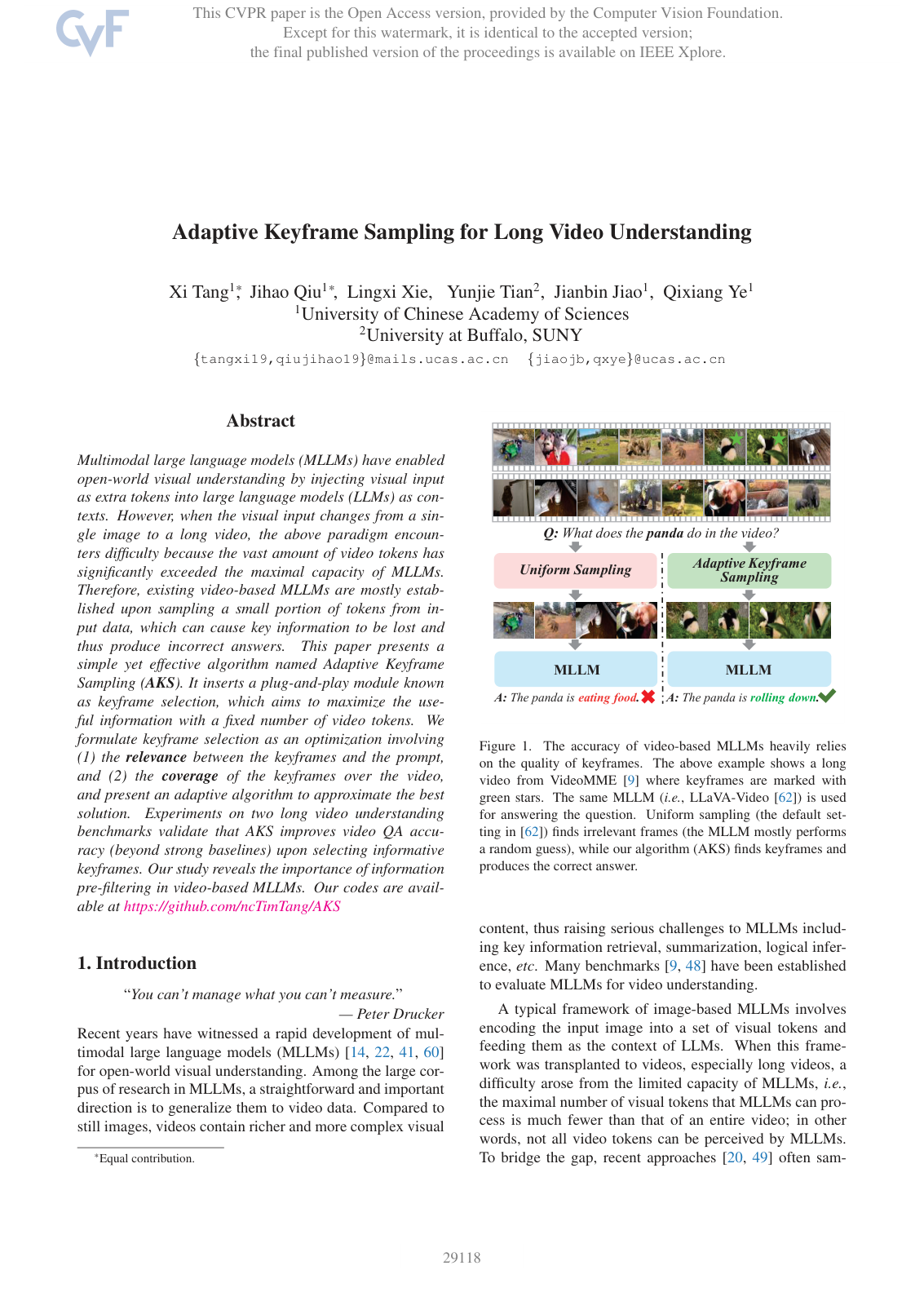
Artificial intelligence systems designed for visual and language understanding struggle to process long video files because the volume of visual data quickly exceeds their computing and context capacity. Standard industry solutions typically sample a fixed, small subset of frames at evenly spaced intervals, a practice known as uniform sampling. However, this arbitrary selection frequently skips pivotal moments, causing artificial intelligence models to miss essential visual evidence and return inaccurate answers.
The article demonstrates an optimization method called Adaptive Keyframe Sampling to overcome these processing constraints. The primary objective is to evaluate whether intelligently pre-filtering and selecting the most informative video frames before feeding them to an AI model improves overall video comprehension accuracy without requiring changes to the underlying model architecture.
To evaluate this approach, the authors integrated the method as a plug-and-play module across three standard multimodal language models and tested performance on two long-video benchmarks containing footage up to an hour long. The method uses a smaller, secondary vision-language model to score candidate frames based on two balanced criteria: prompt relevance, which assesses how well a frame relates to the user's specific query, and temporal coverage, which ensures selected frames are distributed across the video timeline to prevent clustering and redundant data capture. Candidate frames were extracted at varying sampling frequencies to evaluate computational trade-offs, and video subtitles were intentionally excluded to evaluate purely visual reasoning.
The findings show consistent performance gains across all evaluated systems. Incorporating the sampling technique improved video question-answering accuracy across the board, lifting a standard 7-billion-parameter model's baseline scores by up to 5.0 percentage points on LongVideoBench and 2.3 percentage points on VideoMME. Notably, a 7-billion-parameter open-source model enhanced with this sampling technique achieved 62.7% accuracy on LongVideoBench, outperforming larger proprietary systems such as GPT-4V and Gemini-1.5-Flash that evaluated four times as many frames. The analysis also confirmed that prompt-guided frame selection successfully adapts across diverse tasks, including video description and specific moment retrieval, while maintaining strong accuracy even when candidate frames are sampled at low frequencies down to one frame every four seconds.
These results indicate that pre-filtering visual inputs is a highly effective, cost-efficient strategy for deploying artificial intelligence on complex, high-dimensional media. Rather than expending substantial compute budget to expand model context windows or process massive video files in their entirety, organizations can achieve superior performance with smaller, faster models by improving the quality of the visual data supplied to them. This provides an immediate operational pathway to reduce computing overhead and cloud infrastructure costs.
For near-term deployment, technical teams should consider integrating lightweight pre-filtering modules before the primary vision processing pipeline in long-video applications. System architects can customize the balance between prompt relevance and temporal coverage depending on the use case, prioritizing relevance for pinpoint retrieval tasks and coverage for global video summarization. Further work should explore refining pre-filtering efficiency to lower processing latency even further when analyzing ultra-long video streams.
Confidence in these findings is supported by consistent gains across multiple benchmark datasets and model families. However, decision-makers should account for several limitations: the method introduces minor computational overhead during the initial frame scoring phase, and its effectiveness depends in part on the capability of the smaller scoring model to correctly interpret the prompt. In addition, benchmark tests relied on multiple-choice formats without audio or subtitle inputs, meaning performance under complex, multi-modal production conditions warrants targeted pilot testing.
- Paper: Video-MME: The First-Ever Comprehensive Evaluation Benchmark of Multi-modal LLMs in Video Analysis, Chaoyou Fu et al. (2025). This paper establishes the Video-MME benchmark used directly in the source to evaluate multimodal LLMs on long-duration video understanding.
- Paper: MVBench: A Comprehensive Multi-modal Video Understanding Benchmark, Kunchang Li et al. (2023). This work introduces foundational multi-modal video understanding benchmarks that define the temporal evaluation paradigms used to assess long-form video reasoning.
- Paper: HourVideo: 1-Hour Video-Language Understanding, Keshigeyan Chandrasegaran et al. (2024). This study establishes evaluation methodologies and benchmarks for hour-long video-language understanding, highlighting the exact computational and context constraints addressed by the source.
- Paper: Video-LLaVA: Learning United Visual Representation by Alignment Before Projection, Bin Lin et al. (2023). This research provides baseline multimodal large language model architectures for unified visual-language alignment that form the foundation for downstream video comprehension.
- Paper: Video-ChatGPT: Towards Detailed Video Understanding via Large Vision and Language Models, Muhammad Maaz et al. (2023). This paper establishes key baseline paradigms for conversational video understanding with large vision-language models.
- Paper: M-LLM Based Video Frame Selection for Efficient Video Understanding, Kai Hu 0010 et al. (2025). This work develops an adaptive, multimodal LLM-based frame selection module using visual compression and pseudo-label training to further optimize question-aware frame filtering.
- Paper: Streaming Video Question-Answering with In-context Video KV-Cache Retrieval, Shangzhe Di et al. (2025). This paper extends efficient long-video question answering from offline pre-sampling to continuous streaming environments using in-context key-value cache retrieval.
- Paper: TimeSuite: Improving MLLMs for Long Video Understanding via Grounded Tuning, Xiangyu Zeng 0004 et al. (2025). This study complements keyframe selection by introducing temporal grounding and token shuffle compression to improve long video understanding without losing fine-grained event timestamps.
- Paper: Filter, Correlate, Compress: Training-Free Token Reduction for MLLM Acceleration, Yuhang Han et al. (2026). This paper explores an alternative token-level acceleration paradigm by filtering, correlating, and compressing internal visual tokens inside multimodal LLMs.
- Paper: ReToken: One Token to Improve Vision-Language Models for Visual Retrieval, Yao Xiao et al.. This work applies internal token-based retrieval mechanisms to efficiently score and select informative visual inputs for vision-language models on long videos.
- Paper: XAttention: Block Sparse Attention with Antidiagonal Scoring, Ruyi Xu et al. (2025). This paper provides an attention-level acceleration method via antidiagonal scoring to reduce sequence processing overhead across long-context video models.