Multi-Grained Vision Language Pre-Training: Aligning Texts with Visual Concepts
Yan ZengXinsong ZhangHang Li
Proposes X-VLM, a vision-language pre-training framework that learns multi-grained cross-modal alignments across objects, regions, and full images without relying on object detectors, achieving state-of-the-art results on visual grounding, retrieval, and reasoning tasks.
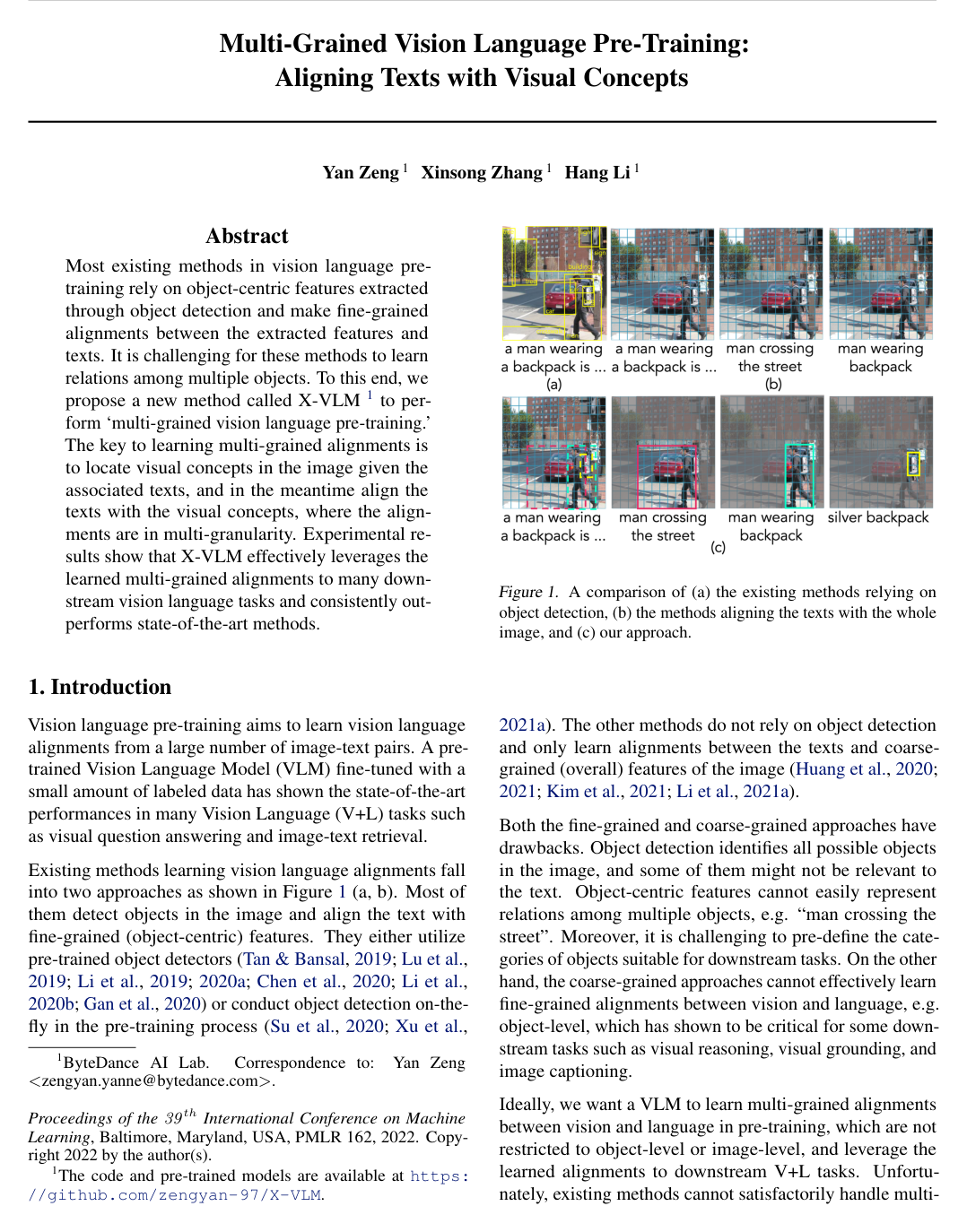
Existing vision-language models struggle to balance broad scene understanding with detailed object comprehension. Traditional methods typically rely on rigid object detectors that miss complex relationships among multiple objects, or they encode only entire images, losing critical fine-grained details needed for precise visual reasoning. This article addresses these trade-offs by introducing and evaluating X-VLM, an approach designed to learn multi-grained visual-linguistic alignments across objects, regions, and full images simultaneously.
The researchers developed a modular framework combining an image encoder, a text encoder, and a cross-modal encoder. Rather than relying on separate object detectors, the system is trained directly to locate visual concepts in images based on text descriptions while concurrently matching text to visual concepts at multiple levels of granularity. The evaluation was conducted across moderate dataset scales of 4 million and 16 million images, benchmarking the model across standard industry tasks such as image-text retrieval, visual question answering, natural language visual reasoning, visual grounding, and image captioning.
The findings demonstrate clear performance and efficiency advantages. When trained on just 4 million images, the proposed model achieved an 80.4% top-1 text retrieval score on MSCOCO, outperforming larger models like VinVL and ALIGN that were trained on billions of data points. In visual reasoning, it surpassed previous state-of-the-art benchmarks on both VQA and NLVR2 while operating roughly ten times faster during inference than detector-based models. On visual grounding benchmarks, it exceeded specialized models by up to 4.5%, directly predicting target regions rather than ranking external region proposals. Ablation studies confirmed that removing either regional concepts or bounding box prediction significantly degraded overall performance.
These results show that multi-granularity alignment delivers substantial operational benefits, including reduced computational overhead, smaller model parameter footprints (216 million parameters), and faster inference times. These characteristics lower deployment costs and energy consumption while maintaining superior accuracy. The source suggests scaling the pre-training data further and exploring different visual backbones, noting that the model's high grounding precision makes it particularly well-suited for fine-grained assistive visual applications. However, organizations should account for data quality constraints, as performance depends on dense annotations during pre-training and downstream validation across different domains.
- Paper: Align before Fuse: Vision and Language Representation Learning with Momentum Distillation, Junnan Li et al. (2021). ALBEF established the foundation of aligning unimodal image and text representations prior to multimodal fusion, which X-VLM directly adapts and expands to multi-grained visual concepts.
- Paper: Oscar: Object-Semantics Aligned Pre-training for Vision-Language Tasks, Xiujun Li et al. (2020). Oscar introduced object tags as anchor points for visual-semantic alignment, providing foundational object-centric pre-training concepts that X-VLM seeks to advance toward multi-grained relations.
- Paper: UNITER: UNiversal Image-TExt Representation Learning, Yen-Chun Chen et al. (2020). UNITER formulated universal pre-training objectives for word-region and image-text alignment that define the baseline paradigms X-VLM seeks to improve upon.
- Paper: ViLT: Vision-and-Language Transformer Without Convolution or Region Supervision, Wonjae Kim et al. (2021). ViLT showed how to remove cumbersome convolutional object detectors in favor of patch-based vision-and-language transformers, framing the architectural shift toward end-to-end multi-grained vision-language pre-training.
- Paper: VisualBERT: A Simple and Performant Baseline for Vision and Language, Liunian Harold Li et al. (2019). VisualBERT provides essential background on single-stream self-attention baselines for aligning visual region features with textual tokens.
- Paper: VL-BERT: Pre-training of Generic Visual-Linguistic Representations, Weijie Su et al. (2019). VL-BERT serves as an early landmark in pre-training generic visual-linguistic representations over detected visual elements and text.
- Paper: LXMERT: Learning Cross-Modality Encoder Representations from Transformers, Hao Tan et al. (2019). LXMERT details multi-layer cross-modality attention mechanisms that model interactions between detected visual objects and sentence structures.
- Paper: Bottom-Up and Top-Down Attention for Image Captioning and Visual Question Answering, Peter Anderson et al. (2018). Bottom-Up Attention provides the fundamental Faster R-CNN object-centric feature extraction paradigm whose relational limitations motivated X-VLM's multi-grained approach.
- Paper: HiCLIP: Contrastive Language-Image Pretraining with Hierarchy-aware Attention, Shijie Geng et al. (2023). HiCLIP builds on the concept of multi-level granularity by embedding hierarchy-aware attention mechanisms into image and text encoders to progressively aggregate visual and linguistic structures.
- Paper: Qwen-VL: A Versatile Vision-Language Model for Understanding, Localization, Text Reading, and Beyond, Jinze Bai et al. (2023). Qwen-VL extends multi-grained alignment principles to multimodal foundation models capable of fine-grained spatial localization and visual grounding.
- Paper: Vision-Language Models for Vision Tasks: A Survey, Jingyi Zhang et al. (2023). This survey contextualizes the evolution of vision-language pre-training techniques and multi-grained alignment models across visual recognition and downstream benchmarks.
- Paper: Fine-grained Image-text Matching by Cross-modal Hard Aligning Network, Zhengxin Pan et al. (2023). CHAN refines cross-modal fragment alignment by exploring hard assignment coding between word queries and visual codewords for fine-grained image-text matching.
- Paper: SoftCLIP: Softer Cross-Modal Alignment Makes CLIP Stronger, Yuting Gao et al. (2024). SoftCLIP extends visual-linguistic alignment by incorporating fine-grained region-of-interest features to soften contrastive target distributions.
- Paper: Intern VL: Scaling up Vision Foundation Models and Aligning for Generic Visual-Linguistic Tasks, Zhe Chen et al. (2024). InternVL scales up visual-linguistic alignment and foundation architectures for downstream tasks requiring generic and multi-level perception.
- Paper: Visual CoT: Advancing Multi-Modal Language Models with a Comprehensive Dataset and Benchmark for Chain-of-Thought Reasoning, Hao Shao et al. (2024). Visual CoT leverages localized visual bounding-box concepts to enable multi-step visual reasoning and chain-of-thought grounding.