CoCo: Coherence-Enhanced Machine-Generated Text Detection Under Low Resource With Contrastive Learning
Xiaoming LiuZhaohan ZhangYichen WangHang PuYu LanChao Shen
Proposes a detector that integrates entity-based coherence graphs with hard-negative contrastive learning to accurately identify machine-generated text in data-scarce settings.
Rapid advances in text generative artificial intelligence models make it easy to generate vast volumes of human-like text, increasing the risks of automated spam, forged reviews, and widespread disinformation. Distinguishing machine-generated text from human-written text has become critical, yet standard automated detectors face significant operational hurdles. Most existing solutions treat documents simply as flat word sequences without modeling high-level discourse structure, and they perform poorly in data-scarce settings where only limited human-annotated examples are available.
The article develops and evaluates an automated detection model called COCO (Coherence-Enhanced Contrastive Learning). The core objective is to determine whether incorporating document coherence structures and contrastive learning techniques can significantly improve machine-generated text detection, particularly in low-resource environments.
To achieve this, the authors model discourse coherence using entity consistency across sentences, converting documents into entity graphs that capture relationships both within and between sentences. They then combine these structural graph representations with language model sequence embeddings inside a supervised contrastive learning framework. This framework employs a dynamic memory bank and an improved loss function designed to prioritize difficult training samples over simple negative examples. The model was evaluated across multiple benchmark datasets, including news and web text generated by models such as GROVER, GPT-2, GPT-3.5, and GPT-4, testing both low-resource scenarios (500 training examples) and full dataset settings.
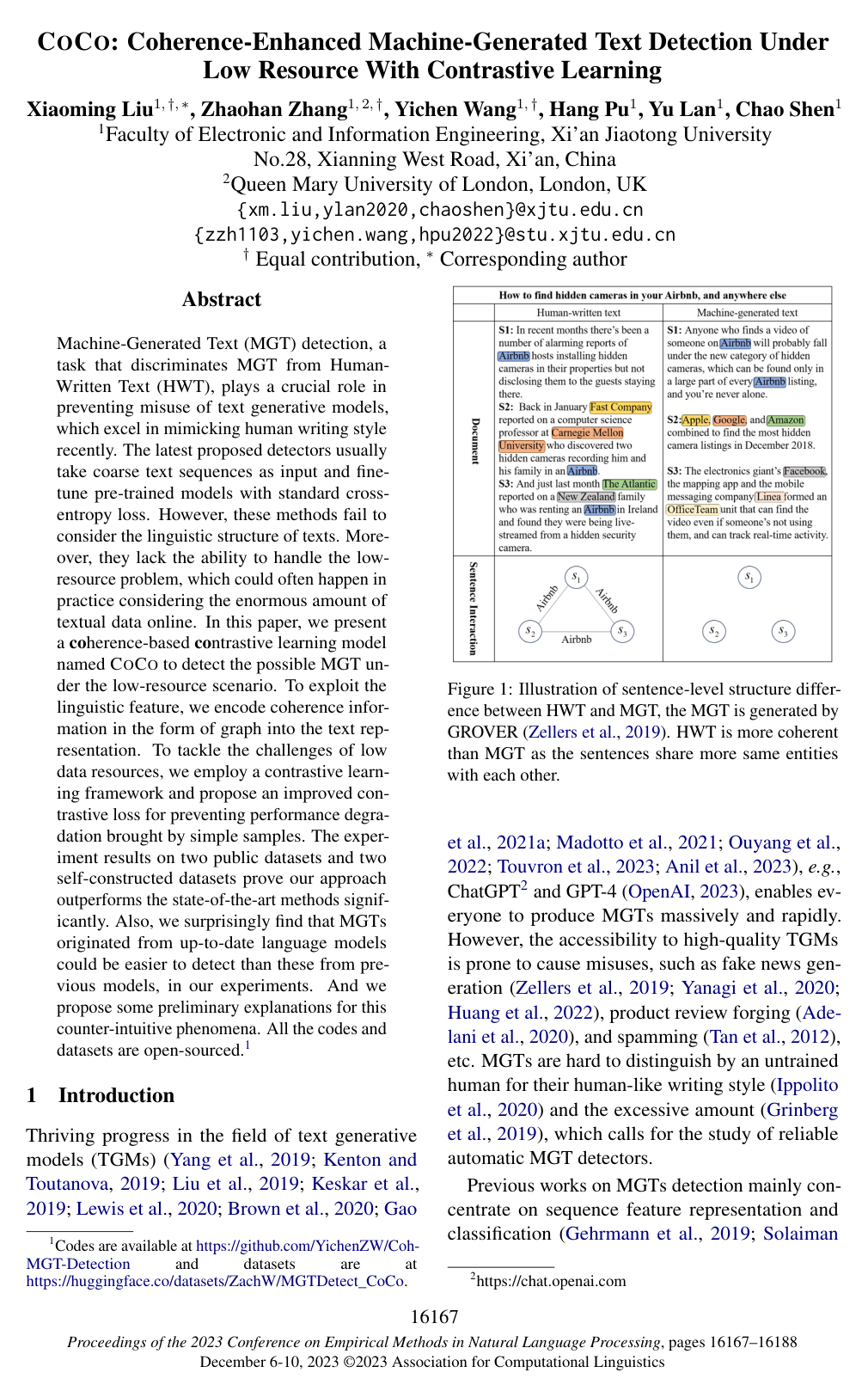
The evaluation revealed several key findings. First, in limited-data environments, COCO outperformed leading baseline detectors, improving accuracy by 1.23% to 3.07% on challenging datasets like GROVER and GPT-2, while maintaining state-of-the-art results on full datasets. Second, human-written text exhibits significantly more complex structural coherence than machine-generated text; static geometric analyses revealed human texts have roughly 35% more entity nodes, 64% more relational edges, and higher structural entropy. Third, against common expectations, modern text generated by large-scale models like GPT-3.5 is consistently easier to detect (exceeding 97% to 99% accuracy across detectors) than text from older, smaller, or adversarially trained generators like GROVER. Statistical attribution analysis indicates this ease stems from advanced models producing generalized language patterns across continuous token spans.
These findings demonstrate that discourse-level coherence provides a reliable, explainable signal for content verification systems. Organizations deploying automated content moderation or intellectual property controls can leverage graph-based coherence modeling to build robust classifiers that do not require massive labeled datasets, reducing labeling and fine-tuning costs.
Organizations should adopt coherence-aware and contrastive detection architectures rather than relying solely on simple metric-based classifiers or unaugmented sequence models. Before large-scale deployment, operational teams must conduct pilot testing under extreme class imbalances, as detector performance drops significantly when human-written text accounts for less than 30% of the training pool. Further research should also focus on developing efficient, adaptive graph-generation methods for short texts, code, and evolving instruction-tuned models.
While the findings are well supported across diverse generative architectures, confidence should be tempered by real-world operational constraints. The detector experiences high computational overhead when building graphs for large datasets, exhibits limited applicability to short texts or source code where named entities are sparse, and remains vulnerable to severely skewed data distributions where machine-generated content vastly outnumbers human text.
- Paper: RankGen: Improving Text Generation with Large Ranking Models, Kalpesh Krishna et al. (2022). Its contrastive metric-learning objective uses challenging negative examples to model coherence, providing a useful methodological precursor to COCO’s contrastive detector.
No sufficiently relevant recommendations were found.