
keyword
Machine-generated text detection
Machine-generated text detection is the computational process of determining whether a given text was authored by a human or produced by an artificial intelligence system, such as a large language model. It serves as a safeguard against the misuse of automated text generation, including academic dishonesty, automated plagiarism, and the proliferation of synthetic misinformation. Common methodologies for detection include supervised classifiers trained to recognize distinct stylistic and structural patterns, zero-shot techniques that analyze statistical and probabilistic properties of model outputs, and watermarking mechanisms that embed traceable signatures directly into text during generation.
9 items
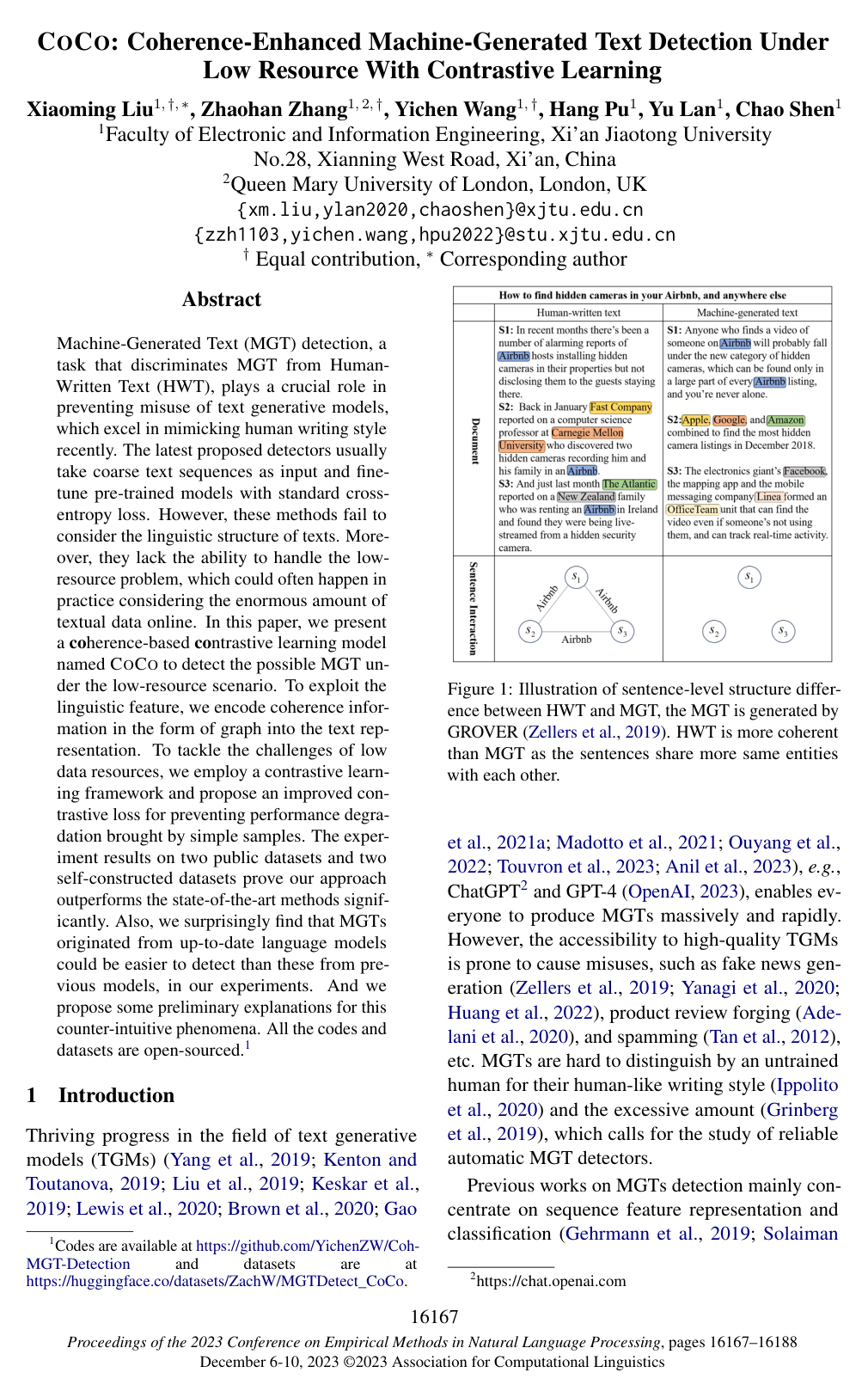
CoCo: Coherence-Enhanced Machine-Generated Text Detection Under Low Resource With Contrastive Learning
Xiaoming Liu, Zhaohan Zhang, Yichen Wang, Hang Pu, Yu Lan, Chao Shen
Why you should read this
Proposes a detector that integrates entity-based coherence graphs with hard-negative contrastive learning to accurately identify machine-generated text in data-scarce settings.
Machine-Generated Text (MGT) detection, a task that discriminates MGT from Human-Written Text (HWT), plays a crucial role in preventing misuse of text generative models, which excel in mimicking human writing style recently. The latest proposed detectors usually take coarse text sequences as input and fine-tune pre-trained models with standard cross-entropy loss. However, these methods fail to consider the linguistic structure of texts. Moreover, they lack the ability to handle the low-resource problem, which could often happen in practice considering the enormous amount of textual data online. In this paper, we present a coherence-based contrastive learning model named CoCo to detect the possible MGT under the low-resource scenario. To exploit the linguistic feature, we encode coherence information in the form of graph into the text representation. To tackle the challenges of low data resources, we employ a contrastive learning framework and propose an improved contrastive loss for preventing performance degradation brought by simple samples. The experiment results on two public datasets and two self-constructed datasets prove our approach outperforms the state-of-the-art methods significantly. Also, we surprisingly find that MGTs originated from up-to-date language models could be easier to detect than these from previous models, in our experiments. And we propose some preliminary explanations for this counter-intuitive phenomenon. All the codes and datasets are open-sourced.
Added
2026-10-05
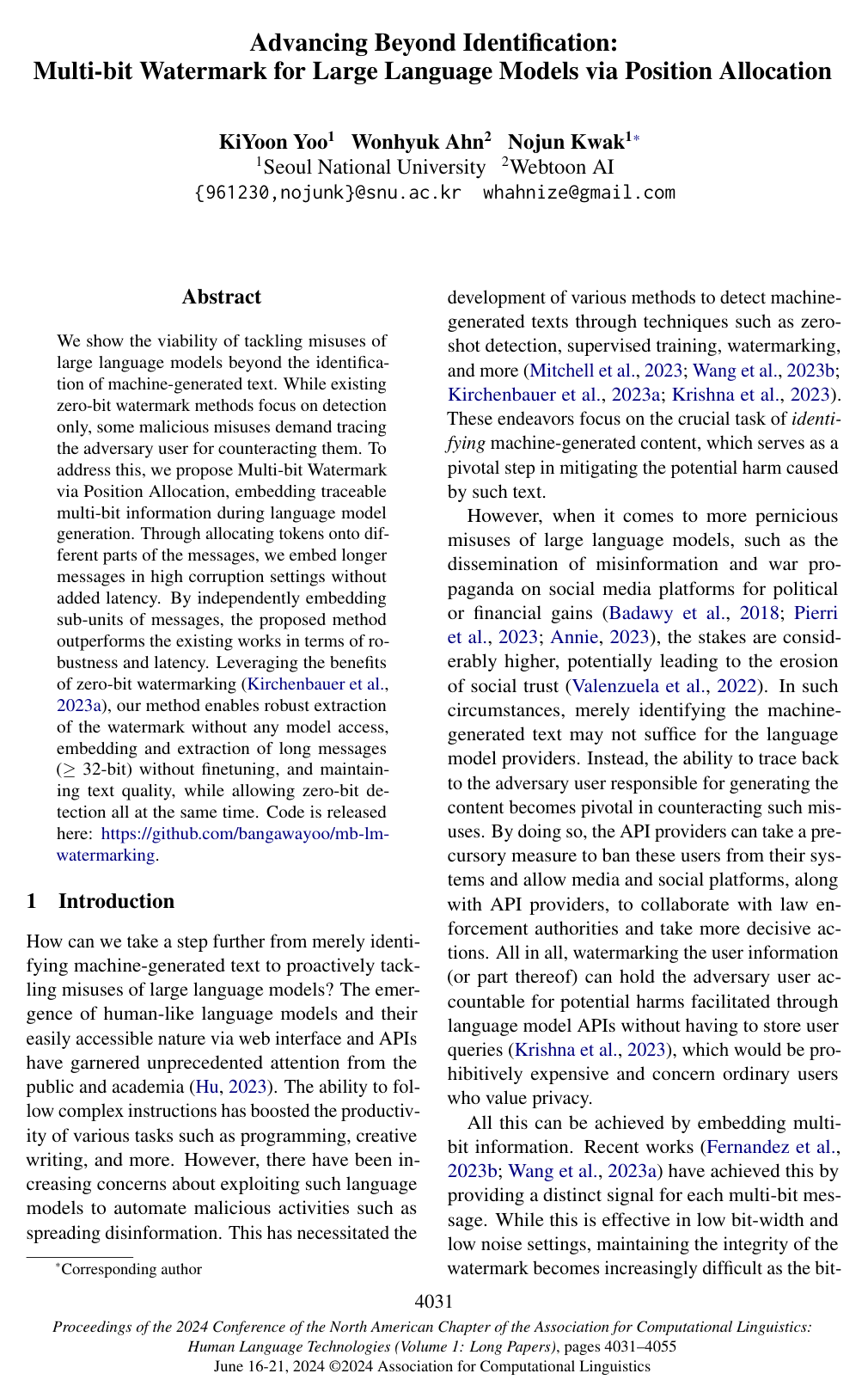
Advancing Beyond Identification: Multi-bit Watermark for Large Language Models
KiYoon Yoo, Wonhyuk Ahn, Nojun Kwak
Why you should read this
Proposes a multi-bit watermarking framework that embeds traceable user metadata into large language model outputs by allocating tokens to message sub-units, enabling resilient extraction of long messages without added latency or model fine-tuning.
We show the viability of tackling misuses of large language models beyond the identification of machine-generated text. While existing zero-bit watermark methods focus on detection only, some malicious misuses demand tracing the adversary user for counteracting them. To address this, we propose Multi-bit Watermark via Position Allocation, embedding traceable multi-bit information during language model generation. Through allocating tokens onto different parts of the messages, we embed longer messages in high corruption settings without added latency. By independently embedding sub-units of messages, the proposed method outperforms the existing works in terms of robustness and latency. Leveraging the benefits of zero-bit watermarking (Kirchenbauer et al., 2023a), our method enables robust extraction of the watermark without any model access, embedding and extraction of long messages (≥ 32-bit) without finetuning, and maintaining text quality, while allowing zero-bit detection all at the same time. Code is released here: https://github.com/bangawayoo/mb-lm-watermarking.
Added
2026-10-04
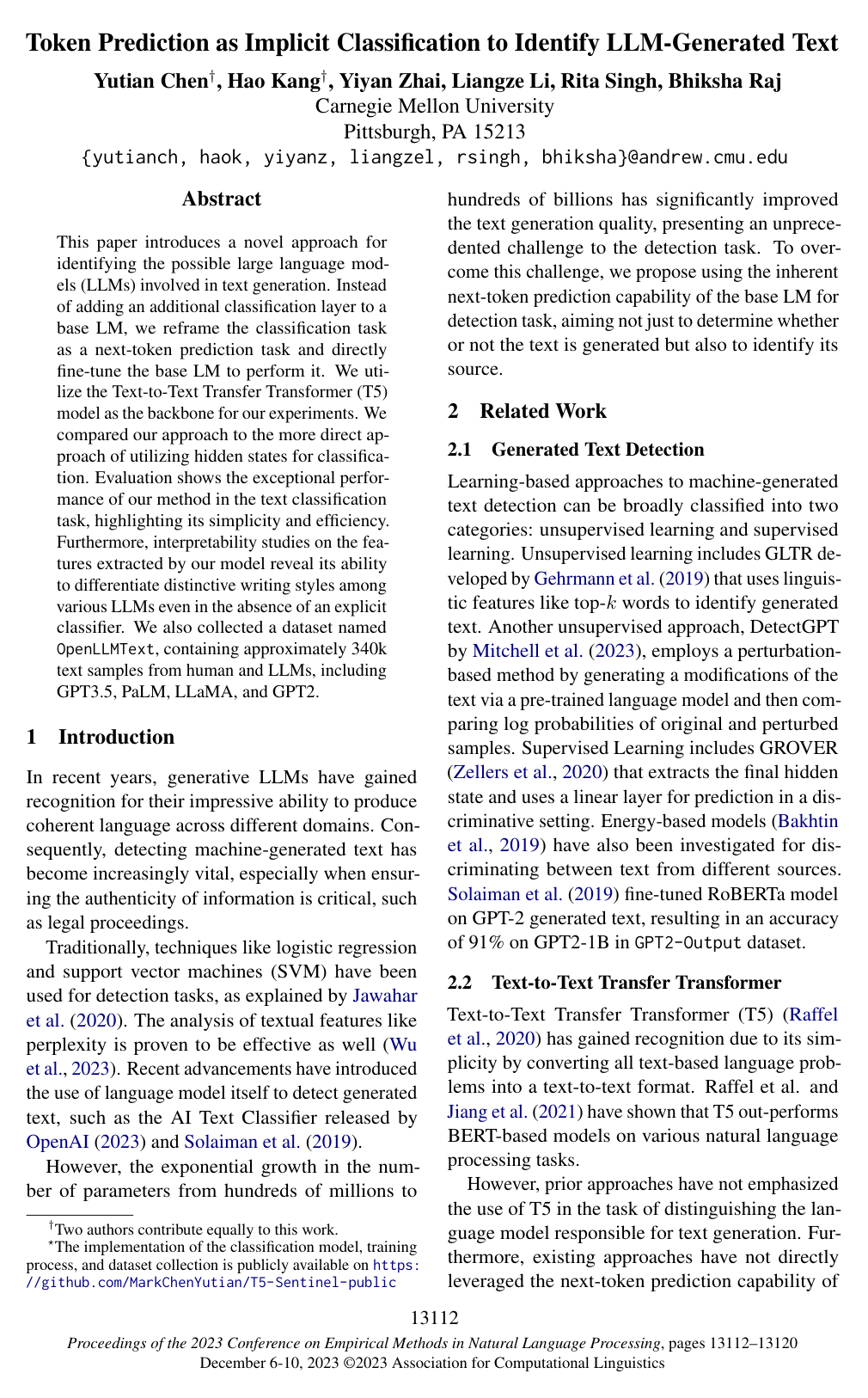
Token Prediction as Implicit Classification to Identify LLM-Generated Text
Yutian Chen, Hao Kang, Vivian Zhai, Liangze Li, Rita Singh, Bhiksha Raj
Why you should read this
Presents a method that reframes machine-generated text attribution as next-token prediction rather than explicit classification, outperforming traditional classifier heads and capturing model-specific writing styles across a 340,000-sample dataset.
This paper introduces a novel approach for identifying the possible large language models (LLMs) involved in text generation. Instead of adding an additional classification layer to a base LM, we reframe the classification task as a next-token prediction task and directly fine-tune the base LM to perform it. We utilize the Text-to-Text Transfer Transformer (T5) model as the backbone for our experiments. We compared our approach to the more direct approach of utilizing hidden states for classification. Evaluation shows the exceptional performance of our method in the text classification task, highlighting its simplicity and efficiency. Furthermore, interpretability studies on the features extracted by our model reveal its ability to differentiate distinctive writing styles among various LLMs even in the absence of an explicit classifier. We also collected a dataset named OpenLLMText, containing approximately 340k text samples from human and LLMs, including GPT3.5, PaLM, LLaMA, and GPT2.
Added
2026-10-03
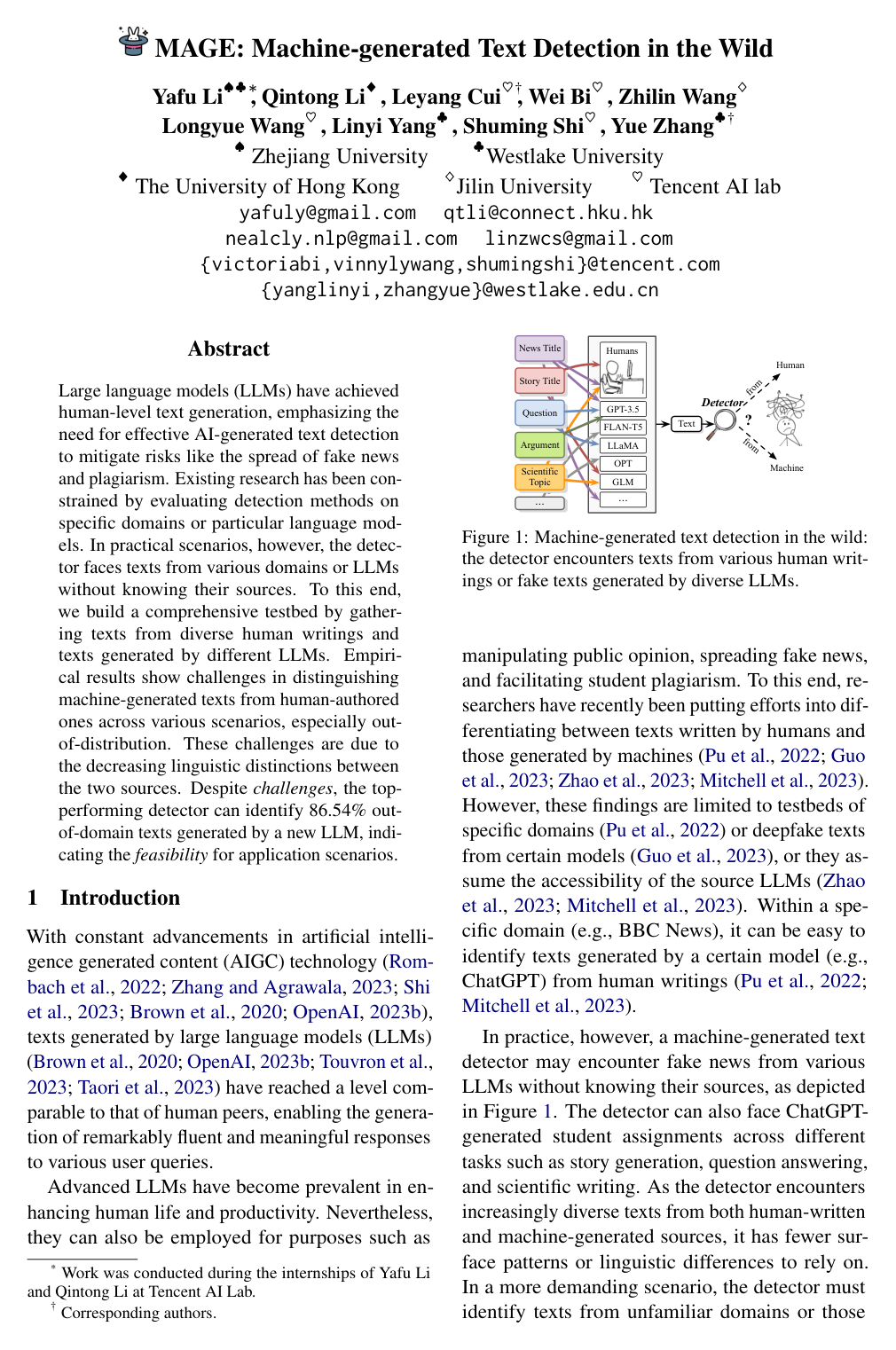
MAGE: Machine-generated Text Detection in the Wild
Yafu Li, Qintong Li, Leyang Cui, Wei Bi, Zhilin Wang, Longyue Wang, Linyi Yang, Shuming Shi, Yue Zhang
Why you should read this
Presents MAGE, a large-scale testbed spanning 7 writing tasks and 27 language models to rigorously evaluate how well existing AI text detectors generalize to unseen domains, new models, and paraphrasing attacks.
Large language models (LLMs) have achieved human-level text generation, emphasizing the need for effective AI-generated text detection to mitigate risks like the spread of fake news and plagiarism. Existing research has been constrained by evaluating detection methods on specific domains or particular language models. In practical scenarios, however, the detector faces texts from various domains or LLMs without knowing their sources. To this end, we build a comprehensive testbed by gathering texts from diverse human writings and texts generated by different LLMs. Empirical results show challenges in distinguishing machine-generated texts from human-authored ones across various scenarios, especially out-of-distribution. These challenges are due to the decreasing linguistic distinctions between the two sources. Despite challenges, the top-performing detector can identify 86.54% out-of-domain texts generated by a new LLM, indicating the feasibility for application scenarios.
Added
2026-10-01
Spotting LLMs With Binoculars: Zero-Shot Detection of Machine-Generated Text
Abhimanyu Hans, Avi Schwarzschild, Valeriia Cherepanova, Hamid Kazemi, Aniruddha Saha, Micah Goldblum, Jonas Geiping, Tom Goldstein
Why you should read this
Introduces Binoculars, a zero-shot detection method that contrasts two pre-trained language models to identify machine-generated text with over 90% accuracy at a 0.01% false positive rate without requiring any training data.
Detecting text generated by modern large language models is thought to be hard, as both LLMs and humans can exhibit a wide range of complex behaviors. However, we find that a score based on contrasting two closely related language models is highly accurate at separating human-generated and machine-generated text. Based on this mechanism, we propose a novel LLM detector that only requires simple calculations using a pair of pre-trained LLMs. The method, called Binoculars, achieves state-of-the-art accuracy without any training data. It is capable of spotting machine text from a range of modern LLMs without any model-specific modifications. We comprehensively evaluate Binoculars on a number of text sources and in varied situations. Over a wide range of document types, Binoculars detects over 90% of generated samples from ChatGPT (and other LLMs) at a false positive rate of 0.01%, despite not being trained on any ChatGPT data.
Added
2026-09-29
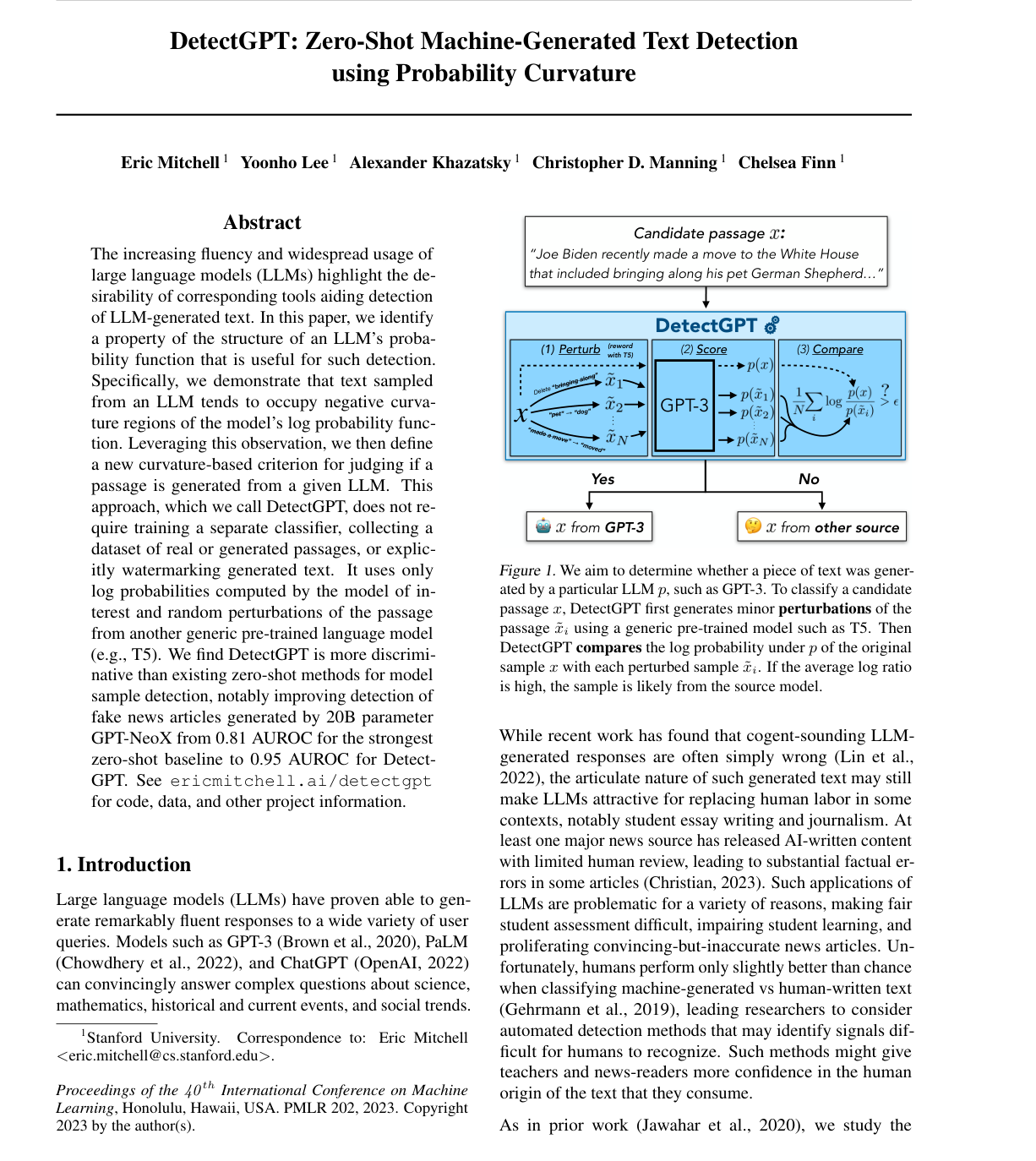
DetectGPT: Zero-Shot Machine-Generated Text Detection using Probability Curvature
Eric Mitchell, Yoonho Lee, Alexander Khazatsky, Christopher D. Manning, Chelsea Finn
Why you should read this
Introduces DetectGPT, a zero-shot method that accurately identifies machine-generated text by exploiting negative curvature regions in language model log probability spaces without requiring separate classifier training or watermarks.
The increasing fluency and widespread usage of large language models (LLMs) highlight the desirability of corresponding tools aiding detection of LLM-generated text. In this paper, we identify a property of the structure of an LLM's probability function that is useful for such detection. Specifically, we demonstrate that text sampled from an LLM tends to occupy negative curvature regions of the model's log probability function. Leveraging this observation, we then define a new curvature-based criterion for judging if a passage is generated from a given LLM. This approach, which we call DetectGPT, does not require training a separate classifier, collecting a dataset of real or generated passages, or explicitly watermarking generated text. It uses only log probabilities computed by the model of interest and random perturbations of the passage from another generic pre-trained language model (e.g., T5). We find DetectGPT is more discriminative than existing zero-shot methods for model sample detection, notably improving detection of fake news articles generated by 20B parameter GPT-NeoX from 0.81 AUROC for the strongest zero-shot baseline to 0.95 AUROC for DetectGPT. See this https URL for code, data, and other project information.
Added
2026-09-28
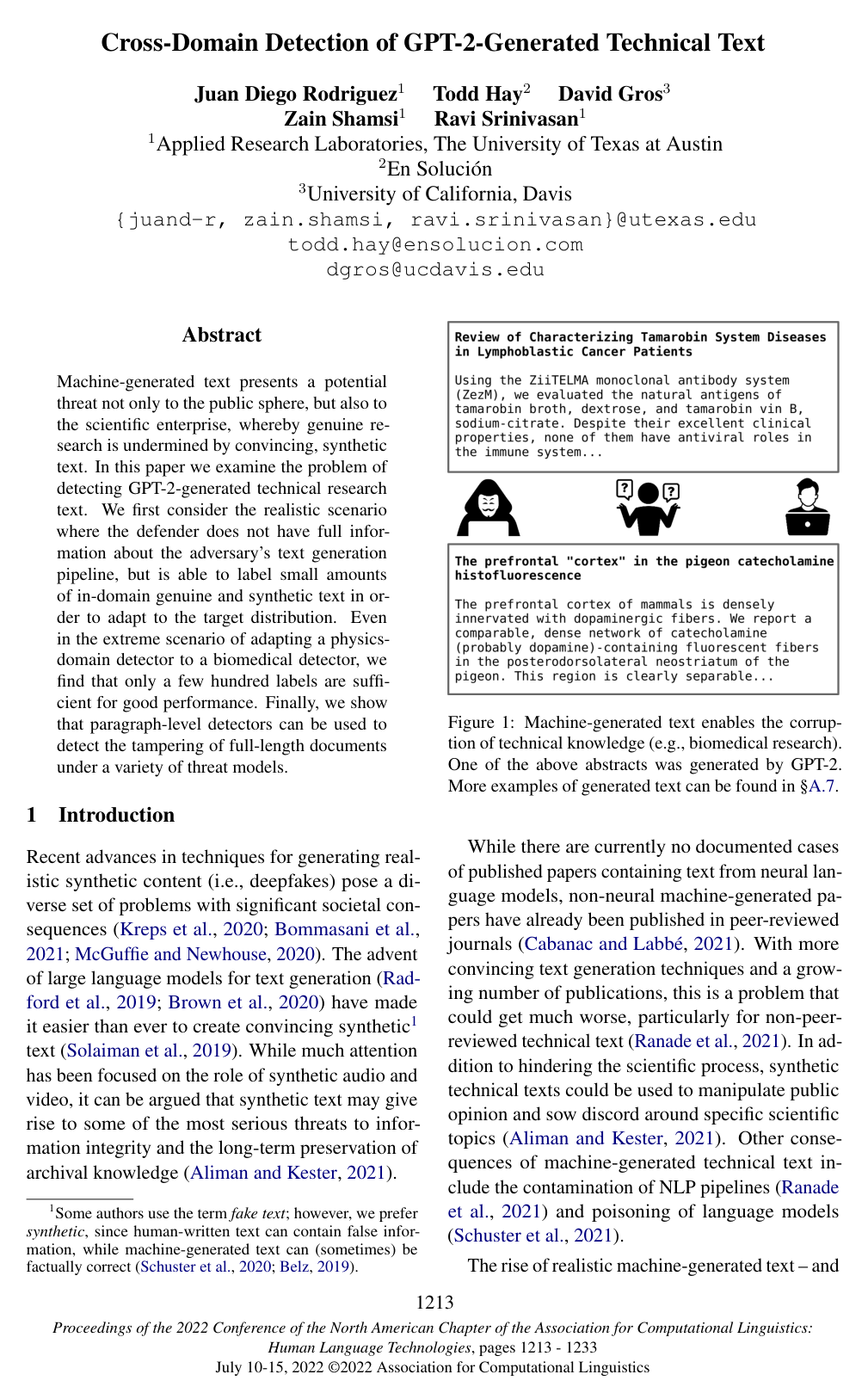
Cross-Domain Detection of GPT-2-Generated Technical Text
Juan Diego Rodriguez, Todd Hay, David Gros, Zain Shamsi, Ravi Srinivasan
Why you should read this
Demonstrates that machine-generated technical text detectors can successfully transfer across distinct scientific domains with only a few hundred labeled examples, enabling effective identification of synthetic content and paragraph tampering in full-length research papers.
Machine-generated text presents a potential threat not only to the public sphere, but also to the scientific enterprise, whereby genuine research is undermined by convincing, synthetic text. In this paper we examine the problem of detecting GPT-2-generated technical research text. We first consider the realistic scenario where the defender does not have full information about the adversary's text generation pipeline, but is able to label small amounts of in-domain genuine and synthetic text in order to adapt to the target distribution. Even in the extreme scenario of adapting a physics-domain detector to a biomedical detector, we find that only a few hundred labels are sufficient for good performance. Finally, we show that paragraph-level detectors can be used to detect the tampering of full-length documents under a variety of threat models.
Added
2026-09-26
Detecting AI-Generated Text: Factors Influencing Detectability with Current Methods
Kathleen C. Fraser, Hillary Dawkins, Svetlana Kiritchenko
Why you should read this
Presents a comprehensive review of state-of-the-art AI-generated text detection methods, datasets, and practical factors that govern how reliably machine-written content can be identified across real-world scenarios.
Large language models (LLMs) have advanced to a point that even humans have difficulty discerning whether a text was generated by another human, or by a computer. However, knowing whether a text was produced by human or artificial intelligence (AI) is important to determining its trustworthiness, and has applications in many domains including detecting fraud and academic dishonesty, as well as combating the spread of misinformation and political propaganda. The task of AI-generated text (AIGT) detection is therefore both very challenging, and highly critical. In this survey, we summarize state-of-the art approaches to AIGT detection, including watermarking, statistical and stylistic analysis, and machine learning classification. We also provide information about existing datasets for this task. Synthesizing the research findings, we aim to provide insight into the salient factors that combine to determine how “detectable” AIGT text is under different scenarios, and to make practical recommendations for future work towards this significant technical and societal challenge.
Added
2026-09-26
Can AI-Generated Text be Reliably Detected?
Vinu Sankar Sadasivan, Aounon Kumar, Sriram Balasubramanian, Wenxiao Wang, Soheil Feizi
Why you should read this
Demonstrates that current AI text detectors are remarkably vulnerable to recursive paraphrasing attacks that minimally degrade text quality, exposing critical security flaws for anyone concerned with the integrity of digital content.
Large Language Models (LLMs) perform impressively well in various applications. However, the potential for misuse of these models in activities such as plagiarism, generating fake news, and spamming has raised concern about their responsible use. Consequently, the reliable detection of AI-generated text has become a critical area of research. AI text detectors have shown to be effective under their specific settings. In this paper, we stress-test the robustness of these AI text detectors in the presence of an attacker. We introduce recursive paraphrasing attack to stress test a wide range of detection schemes, including the ones using the watermarking as well as neural network-based detectors, zero shot classifiers, and retrieval-based detectors. Our experiments conducted on passages, each approximately 300 tokens long, reveal the varying sensitivities of these detectors to our attacks. Our findings indicate that while our recursive paraphrasing method can significantly reduce detection rates, it only slightly degrades text quality in many cases, highlighting potential vulnerabilities in current detection systems in the presence of an attacker. Additionally, we investigate the susceptibility of watermarked LLMs to spoofing attacks aimed at misclassifying human-written text as AI-generated. We demonstrate that an attacker can infer hidden AI text signatures without white-box access to the detection method, potentially leading to reputational risks for LLM developers. Finally, we provide a theoretical framework connecting the AUROC of the best possible detector to the Total Variation distance between human and AI text distributions. This analysis offers insights into the fundamental challenges of reliable detection as language models continue to advance. Our code is publicly available at this https URL.
Added
2026-03-22
