MMAU: A Massive Multi-Task Audio Understanding and Reasoning Benchmark
S. SakshiUtkarsh TyagiSonal KumarAshish SethRamaneswaran SelvakumarOriol NietoRamani DuraiswamiSreyan GhoshDinesh Manocha
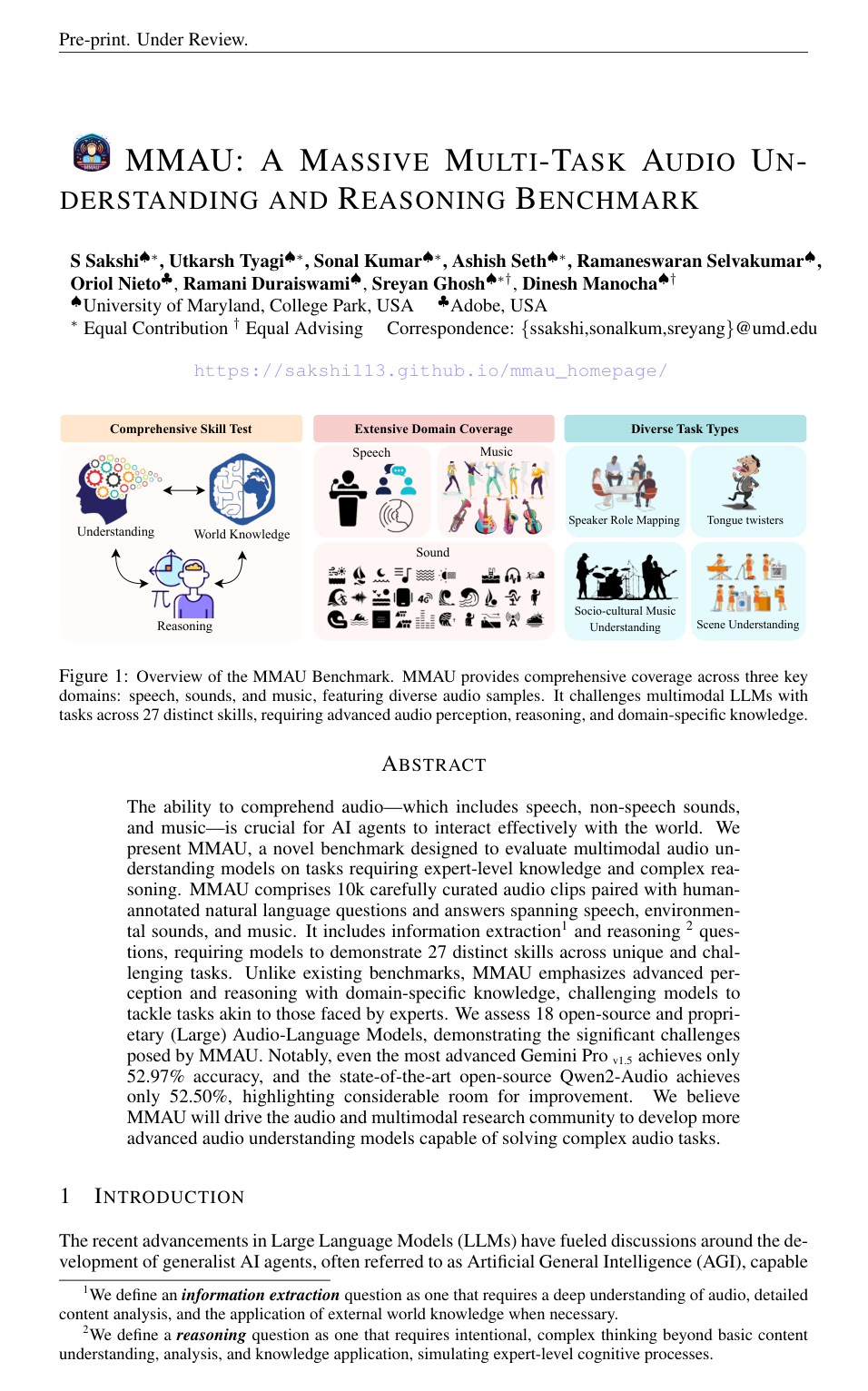
Presents MMAU, a 10,000-clip audio benchmark spanning speech, music, and environmental sounds across 27 complex reasoning skills, exposing severe capability gaps in state-of-the-art audio-language models that currently plateau near 53% accuracy.
Artificial intelligence systems increasingly excel at complex language and vision tasks, but their ability to process and reason about auditory information remains largely untested at an advanced level. Existing audio benchmarks focus primarily on basic perceptual capabilities, such as simple speech transcription or sound classification, which do not reflect the higher-order reasoning required for expert-level decision-making. Developing models that can effectively comprehend and interpret speech, environmental sounds, and music is essential for deploying reliable multimodal AI agents in real-world environments.
The article introduces and evaluates the Massive Multi-Task Audio Understanding and Reasoning Benchmark, known as MMAU. The primary objective is to evaluate the advanced audio perception, multi-step reasoning, and expert domain-knowledge retrieval capabilities of current audio-language models.
To construct this benchmark, the researchers developed a curated collection of 10,000 multiple-choice questions grounded in real-world audio recordings across speech, sound, and music domains. A rigorous seven-step curation and expert-annotation pipeline was established, assessing 27 distinct skills divided into information extraction and deliberate reasoning tasks. The study evaluated 18 proprietary and open-source models, as well as text-only models supplemented by automated captions, establishing a baseline comparison against human performance on a representative 1,000-question subset.
The evaluation revealed substantial performance gaps in leading artificial intelligence systems. Even the most capable multimodal models, such as Gemini Pro v1.5 and Qwen2-Audio-Instruct, achieved accuracy scores of only 52.97% and 52.50%, respectively, falling well behind the human benchmark of 82.23%. Cascaded approaches—which combine automated detailed audio captioning with high-performing text-only language models—slightly outperformed end-to-end audio models, reaching a top accuracy of 58.74%. When subjected to noise perturbation tests, several models exhibited minimal performance drops, demonstrating that they frequently rely on text-based language priors rather than genuinely attending to the audio input. Furthermore, an error analysis revealed that perceptual failures account for 55% to 64% of total mistakes, showing that basic misinterpretation of auditory signals is the primary bottleneck before complex reasoning can even occur.
These findings indicate that current audio-language models pose significant operational risks if deployed in high-stakes environments that require reliable acoustic interpretation, such as medical diagnostics, legal transcription, or autonomous monitoring. While automated captioning pipelines offer a practical interim solution, end-to-end architectures require fundamental improvements in acoustic feature extraction and cross-modal grounding to avoid reliance on superficial language patterns.
Organizations developing or deploying multimodal AI should focus future efforts on expanding training datasets with rich perceptual annotations and refining model architectures to better capture complex acoustic details. In the near term, teams should consider hybrid workflows that leverage high-quality captioning systems paired with large language models, while maintaining human oversight for critical audio analysis tasks.
The study's conclusions are constrained by its focus on English-language, multiple-choice formats and disjoint skill categorizations, which do not fully replicate open-ended conversational settings. Nevertheless, the rigorous multi-stage expert review and consistent testing methodology provide high confidence that current models face major perceptual hurdles that must be resolved before achieving expert-level audio intelligence.
- Paper: MMMU: A Massive Multi-Discipline Multimodal Understanding and Reasoning Benchmark for Expert AGI, Xiang Yue et al. (2023). MMMU establishes the foundational paradigm of evaluating large multimodal models on college-level, expert-domain reasoning, which directly inspires MMAU's design for expert-level multi-task audio comprehension.
- Paper: MMLU-Pro: A More Robust and Challenging Multi-Task Language Understanding Benchmark, Yubo Wang et al. (2024). MMLU-Pro establishes the benchmark framework for challenging, multi-task, expert-level reasoning evaluation that MMAU translates into the multimodal audio domain.
- Paper: MMBench: Is Your Multi-modal Model an All-around Player?, Yuanzhan Liu et al. (2023). MMBench provides the core methodological framework for hierarchical skill taxonomy and robust objective evaluation of perception and reasoning in multimodal foundation models.
- Paper: MM-Vet: Evaluating Large Multimodal Models for Integrated Capabilities, Weihao Yu et al. (2023). MM-Vet introduces the systematic methodology of assessing large multimodal models through the integration of multiple core perceptual and reasoning capabilities.
- Paper: Video-LLaMA: An Instruction-tuned Audio-Visual Language Model for Video Understanding, Hang Zhang et al. (2023). Video-LLaMA provides essential background on architecting instruction-tuned multimodal models capable of processing and understanding acoustic alongside temporal inputs.
- Paper: WavLM: Large-Scale Self-Supervised Pre-Training for Full Stack Speech Processing, Sanyuan Chen et al. (2021). WavLM presents the foundational self-supervised pre-training techniques for extracting rich, multi-task speech and acoustic representations essential for audio-language models.
- Paper: CNN architectures for large-scale audio classification, Shawn Hershey et al. (2016). This work establishes the fundamental convolutional neural architectures and acoustic spectrogram representations for large-scale audio and sound event classification.
- Paper: Qwen3.5-Omni Technical Report, Qwen Team (2026). Qwen3.5-Omni directly evaluates its unified omnimodal architecture against the MMAU benchmark to demonstrate state-of-the-art multi-task audio reasoning and understanding.
- Paper: Gemma 4 Technical Report, Gemma Team et al. (2026). Gemma 4 extends open-weight multimodal foundation models by incorporating native audio understanding and explicit thinking-mode reasoning evaluated across broad acoustic tasks.
- Paper: Video-MME: The First-Ever Comprehensive Evaluation Benchmark of Multi-modal LLMs in Video Analysis, Chaoyou Fu et al. (2025). Video-MME complements and extends MMAU's audio-centric evaluation by benchmarking multimodal reasoning across dynamic video contexts integrating synchronized audio tracks and subtitles.