Faster and Better: A Machine Learning Approach to Corner Detection

Edward RostenReid PorterTom Drummond

article2008TPAMI2,008 citations

Proposes a machine-learning-derived corner detector that achieves superior repeatability over standard methods like Harris and SIFT while consuming less than five percent of available processing time on live video.

Listen

Real-time computer vision applications, such as robotic mapping, object tracking, and augmented reality, require rapid and reliable detection of visual interest points or corners across changing camera viewpoints. Conventional corner detectors demand substantial computational power, often consuming the majority or entirety of available processing time. This computational bottleneck leaves insufficient resources for subsequent analysis and severely constrains performance on low-power devices.

The article evaluates whether machine learning techniques can optimize heuristic corner detection to achieve real-time frame rates while maintaining or exceeding the detection repeatability of established computer vision algorithms.

To address this, the authors used decision tree induction to optimize a circular segment test heuristic, identifying a contiguous sequence of bright or dark pixels around a candidate point. They generated an ultra-fast detector (FAST-9) and further combined decision tree structures with simulated annealing to create an enhanced detector (FAST-ER) directly optimized for high repeatability. Evaluation was conducted across three-dimensional scenes, bas-relief textures, and standard benchmarks encompassing 85 images and 688 image pairs under diverse viewpoint, scale, blur, lighting, and noise conditions.

The findings show that FAST-9 processes standard video using roughly 5% of the total computational budget, running nearly twice as fast as handwritten implementations and far outperforming conventional alternatives such as Harris (115%) and SIFT Difference-of-Gaussians (195%), which cannot maintain real-time frame rates on standard desktop hardware. FAST-ER achieves the highest overall repeatability score (1313.6) across the evaluation datasets, surpassing established methods including Difference-of-Gaussians (1275.6) and Harris (1195.2). While baseline FAST variants show sensitivity to image noise due to evaluating minimal pixel subsets, FAST-ER exhibits significantly improved noise resilience and maintains steady repeatability across varying feature densities.

These results demonstrate that direct optimization against repeatability criteria can outperform traditional detectors built on human geometric intuition. For engineering and product teams, adopting these machine learning-driven detectors eliminates the processing bottleneck of early-stage vision pipelines. This efficiency enables real-time computer vision on embedded and resource-constrained hardware while freeing computational capacity for downstream tracking and recognition algorithms.

Organizations developing real-time vision systems should adopt FAST-9 when raw execution speed is paramount and implement FAST-ER when maximum feature repeatability and noise robustness are required. Practitioners deploying FAST variants in high-noise environments should carefully calibrate detection thresholds or integrate lightweight pre-filtering. Further application-level benchmarking is recommended to assess downstream tracking performance across domain-specific image datasets.

  • Paper: Machine Learning for High-Speed Corner Detection, Edward Rosten et al. (2006). This paper establishes the original FAST corner detector and decision-tree learning framework that the source paper directly generalizes, optimizes, and benchmarks.
  • Paper: Scale & Affine Invariant Interest Point Detectors, K. Mikolajczyk et al. (2004). It provides foundational principles and standardized repeatability evaluation metrics for interest point detectors across geometric variations that the source adopts.
  • Paper: A Comparison of Affine Region Detectors, K. Mikolajczyk et al. (2005). It introduces standard comparative benchmarking methodologies and repeatability criteria for local feature detectors against which the source evaluates its detector.
  • Paper: Distinctive Image Features from Scale-Invariant Keypoints, David G. Lowe (2004). It defines the classical SIFT detector and keypoint evaluation baselines that serve as primary comparison points for computational efficiency and detection quality in the source.
  • Paper: SURF: Speeded Up Robust Features, Herbert Bay et al. (2006). It presents SURF, a prominent accelerated feature detector baseline evaluated in the source paper's comparative analysis of speed versus repeatability.
Cover for Faster and Better: A Machine Learning Approach to Corner Detection

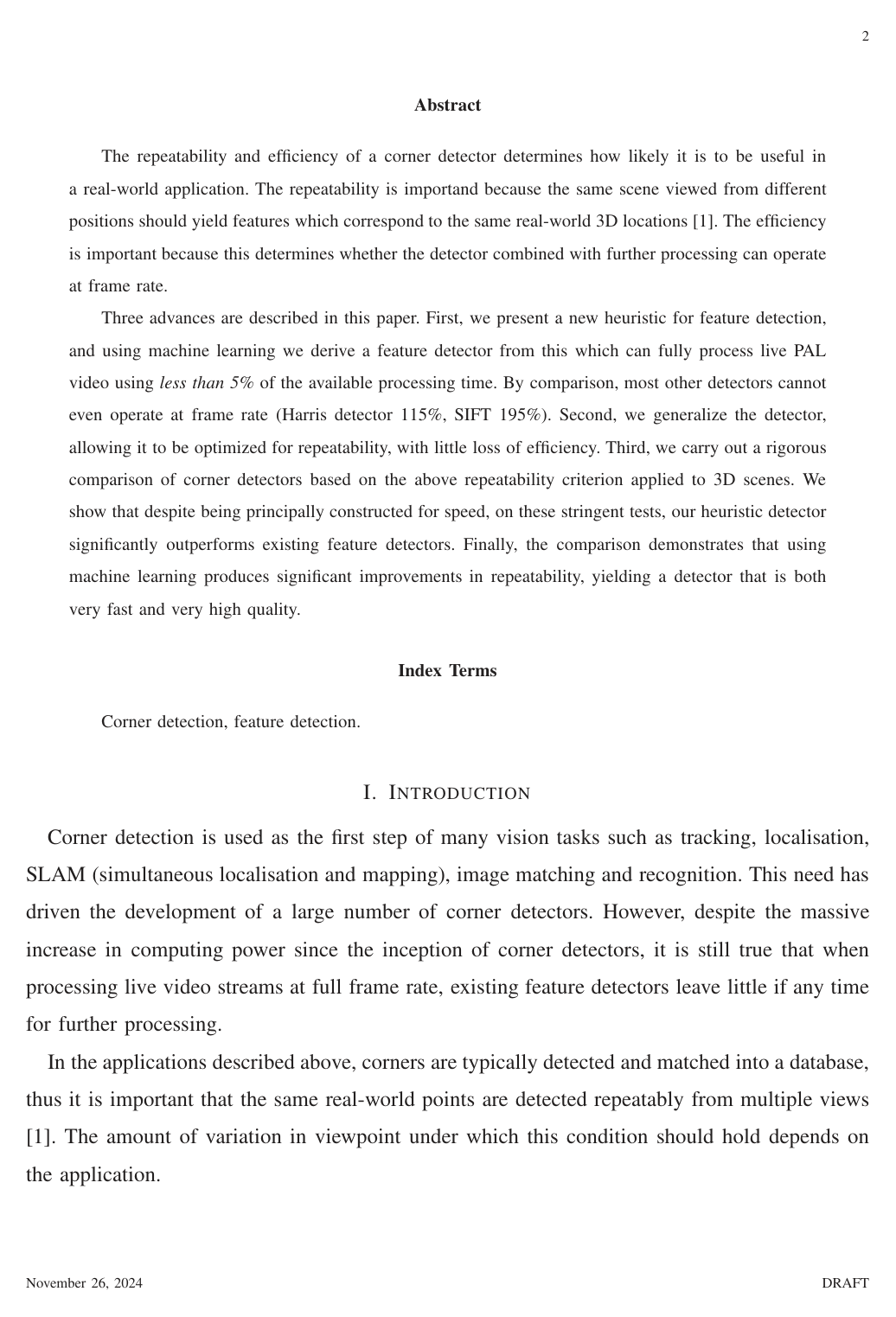
Abstract

The repeatability and efficiency of a corner detector determines how likely it is to be useful in a real-world application. The repeatability is importand because the same scene viewed from different positions should yield features which correspond to the same real-world 3D locations [Schmid et al 2000]. The efficiency is important because this determines whether the detector combined with further processing can operate at frame rate.

Three advances are described in this paper. First, we present a new heuristic for feature detection, and using machine learning we derive a feature detector from this which can fully process live PAL video using less than 5% of the available processing time. By comparison, most other detectors cannot even operate at frame rate (Harris detector 115%, SIFT 195%). Second, we generalize the detector, allowing it to be optimized for repeatability, with little loss of efficiency. Third, we carry out a rigorous comparison of corner detectors based on the above repeatability criterion applied to 3D scenes. We show that despite being principally constructed for speed, on these stringent tests, our heuristic detector significantly outperforms existing feature detectors. Finally, the comparison demonstrates that using machine learning produces significant improvements in repeatability, yielding a detector that is both very fast and very high quality.

Table of Contents

  • I Introduction
  • II Previous work
  • II-A Corner detectors
  • II-A1 Edge based corner detectors
  • II-A2 Greylevel derivative based detectors
  • II-A3 Direct greylevel detectors
  • II-B Comparison of feature detectors
  • III High-speed corner detection
  • III-A FAST: Features from Accelerated Segment Test
  • III-B Improving generality and speed with machine learning
  • III-C Non-maximal suppression
  • IV Measuring detector repeatability
  • V FAST-ER: Enhanced Repeatability
  • V-A Parameters and justification
  • VI Results
  • VI-A Repeatability
  • VI-B Speed
  • VII Conclusions
  • References

Knowls

  1. Knowl 1 — Segment Test Criterion for FAST Corner Detection

    model/method

    The Features from Accelerated Segment Test (FAST) corner detection heuristic identifies corner features in greyscale images using a discretized Bresenham circle of 16 pixels surrounding a candidate pixel pp at radius 3. Let IpI_p denote the intensity of candidate pixel pp, and let IpxI_{p \to x} denote the intensity of pixel x{1,2,,16}x \in \{1, 2, \dots, 16\} along the 16-pixel ring around pp.

    The candidate pixel pp is classified as a corner if and only if there exists a set of nn contiguous pixels on the circle that are all strictly brighter than Ip+tI_p + t or all strictly darker than IptI_p - t, where t>0t > 0 is an intensity difference threshold. Formally, pp is a corner if there exists a contiguous arc of length nn on the 16-pixel ring such that:

    xarc,IpxIp+t\forall x \in \text{arc}, \quad I_{p \to x} \ge I_p + t

    or

    xarc,IpxIpt\forall x \in \text{arc}, \quad I_{p \to x} \le I_p - t

    In the baseline FAST-12 variant (n=12n = 12), a rapid preliminary rejection test checks the 4 orthogonal cardinal pixels (positions 1, 5, 9, and 13). If candidate pixel pp is a corner, at least three of these four pixels must be simultaneously brighter than Ip+tI_p + t or darker than IptI_p - t. If not, pp is discarded immediately without evaluating the remaining 12 pixels.

  2. Knowl 2 — Decision Tree Learning for FAST Corner Detection

    algorithm

    To optimize the execution speed of FAST corner detection for arbitrary segment lengths nn, a ternary decision tree classifier is learned from image data using the ID3 decision tree induction algorithm.

    For a candidate pixel pp and a circle offset x{1,,16}x \in \{1, \dots, 16\}, the relative intensity state SpxS_{p \to x} takes one of three discrete values:

    Spx={dif IpxIpt(darker)sif Ipt<Ipx<Ip+t(similar)bif Ip+tIpx(brighter)S_{p \to x} = \begin{cases} d & \text{if } I_{p \to x} \le I_p - t \quad (\text{darker}) \\ s & \text{if } I_p - t < I_{p \to x} < I_p + t \quad (\text{similar}) \\ b & \text{if } I_p + t \le I_{p \to x} \quad (\text{brighter}) \end{cases}

    Let PP denote the training set of candidate pixels, and let Kp{0,1}K_p \in \{0, 1\} be a boolean label where Kp=1K_p = 1 if pp satisfies the FAST segment test criterion and Kp=0K_p = 0 otherwise. Choosing an offset xx partitions PP into three disjoint subsets: Pd={pP:Spx=d}P_d = \{p \in P : S_{p \to x} = d\}, Ps={pP:Spx=s}P_s = \{p \in P : S_{p \to x} = s\}, and Pb={pP:Spx=b}P_b = \{p \in P : S_{p \to x} = b\}.

    The entropy H(Q)H(Q) of corner labels in an arbitrary subset QPQ \subseteq P is defined as:

    H(Q)=(c+cˉ)log2(c+cˉ)clog2ccˉlog2cˉH(Q) = (c + \bar{c}) \log_2(c + \bar{c}) - c \log_2 c - \bar{c} \log_2 \bar{c}

    where c={pQ:Kp=1}c = |\{p \in Q : K_p = 1\}| is the number of corners and cˉ={pQ:Kp=0}\bar{c} = |\{p \in Q : K_p = 0\}| is the number of non-corners. The information gain HgH_g achieved by splitting on offset xx is:

    Hg=H(P)H(Pd)H(Ps)H(Pb)H_g = H(P) - H(P_d) - H(P_s) - H(P_b)

    Input: Training set of pixels PP, circle offset space X={1,,16}X = \{1, \dots, 16\}
    Output: Ternary decision tree TT
    function BuildTree(subset QQ):
        if H(Q)==0H(Q) == 0:
            return LeafNode(class = majority class of KpK_p in QQ)
        x=argmaxxXHg(Q,x)x^* = \arg\max_{x \in X} H_g(Q, x)
        Partition QQ into Qd,Qs,QbQ_d, Q_s, Q_b using xx^*
        Td=BuildTree(Qd)T_d = \text{BuildTree}(Q_d)
        Ts=BuildTree(Qs)T_s = \text{BuildTree}(Q_s)
        Tb=BuildTree(Qb)T_b = \text{BuildTree}(Q_b)
        if Td==Ts==TbT_d == T_s == T_b:
            return TdT_d
        return DecisionNode(offset = xx^*, dark_branch = TdT_d, similar_branch = TsT_s, bright_branch = TbT_b)

    The learned decision tree is converted into optimized C code consisting of nested if-else branches. Profile-guided compiler optimization is applied for branch prediction and block reordering. To enable SIMD vectorization (e.g., SSE-2) across pixel strips, the root node and its three direct child nodes are constrained to test identical offsets (xb=xd=xsx_b = x_d = x_s), enabling the first two pixel tests to run in parallel across multiple pixels.

  3. Knowl 3 — Corner Response Computation and Non-Maximal Suppression for FAST

    algorithm

    Because the FAST segment test outputs a binary classification rather than a continuous score, corner response values must be computed explicitly to enable non-maximal suppression.

    For a fixed segment length nn, the corner classification Kp(t){0,1}K_p(t) \in \{0, 1\} for candidate pixel pp is a monotonically decreasing function of the intensity difference threshold tt. The corner strength V(p)V(p) is defined as the maximum integer threshold tt at which pixel pp remains classified as a corner:

    V(p)=max{tZ+:Kp(t)=1}V(p) = \max \{ t \in \mathbb{Z}^+ : K_p(t) = 1 \}

    Input: Candidate pixel pp, decision tree classifier Kp(t)K_p(t), threshold range [tmin,tmax][t_{\min}, t_{\max}]
    Output: Corner strength score V(p)V(p)
    low = tmint_{\min}
    high = tmaxt_{\max}
    V(p)=0V(p) = 0
    while low <= high:
        mid = floor((low + high) / 2)
        if Kp(mid)==1K_p(\text{mid}) == 1:
            V(p)=midV(p) = \text{mid}
            low = mid + 1
        else:
            high = mid - 1
    return V(p)V(p)

    Alternatively, an iterative scheme evaluates the passing pixels on the circle, computes the minimum intensity margin by which they pass the test, increments tt by this minimum margin to force a different path through the tree, and repeats until classification fails.

    Once V(p)V(p) is calculated for all detected corners, non-maximal suppression is applied over a 3×33 \times 3 pixel spatial neighborhood: a corner candidate pp is retained if and only if V(p)>V(q)V(p) > V(q) for all adjacent neighbor pixels qq in the 3×33 \times 3 window.

  4. Knowl 4 — 3D Surface Model-Based Repeatability Evaluation Metric

    model/method

    To evaluate corner detector repeatability under arbitrary 3D camera motion, occlusions, and non-affine surface changes, detected feature locations are mapped across camera views using full 3D surface models of the scene rather than planar homographies.

    A detected feature in a source frame is defined as useful if its corresponding 3D scene point reprojects into the visible (non-occluded) field of view of a target frame. A useful feature is defined as repeated if the detector extracts a corner in the target frame within a spatial radius tolerance of ε\varepsilon pixels (typically ε=5 pixels\varepsilon = 5\text{ pixels}) from the true reprojected 3D position.

    The overall repeatability RR across an image sequence is defined as:

    R=NrepeatedNusefulR = \frac{N_{\text{repeated}}}{N_{\text{useful}}}

    where NrepeatedN_{\text{repeated}} and NusefulN_{\text{useful}} represent the total counts of repeated and useful features summed over all directed pairs of frames in the sequence. To compare detectors independently of absolute threshold settings, repeatability RR is evaluated as a function of feature density (number of corners extracted per frame, ranging from 0 to 2000 on 640×480640 \times 480 images). The aggregate quality is summarized by AA, the Area Under the Repeatability curve across this range.

  5. Knowl 5 — FAST-ER Generalized Decision Tree Architecture

    model/method

    FAST-ER (FAST - Enhanced Repeatability) generalizes corner detection by searching over an expanded 48-pixel local neighborhood (x{0,1,,47}x \in \{0, 1, \dots, 47\}) within a 7×77 \times 7 grid centered at candidate pixel pp, rather than restricting tests to a 16-pixel perimeter ring.

    The detector is structured as a ternary decision tree where each internal decision node evaluates an offset x{0,,47}x \in \{0, \dots, 47\} relative to pp and branches into brighter (bb), similar (ss), or darker (dd) subtrees. Each leaf node outputs a boolean classification K{0,1}K \in \{0, 1\}, where 1 represents a corner and 0 represents a non-corner. To enforce monotonicity with respect to threshold variation, any leaf attached to an ss branch of its direct parent node is constrained to have K=0K = 0.

    To ensure invariance under image rotations, reflections, and intensity inversions without bloating tree depth, the candidate tree is evaluated 16 separate times at runtime across:

    • 4 discrete planar rotations (0,90,180,2700^\circ, 90^\circ, 180^\circ, 270^\circ)
    • 2 reflection states (original and flipped)
    • 2 intensity inversion states (original and inverted)

    A pixel pp is classified as a corner if and only if any of the 16 transformed applications of the tree evaluates to 1 (logical OR combination). For deployment speed, this 16-way detector is distilled back into a single efficient ternary tree using ID3.

  6. Knowl 6 — FAST-ER Multi-Objective Simulated Annealing Cost Function

    equation

    To train a ternary decision tree directly for maximal repeatability while preventing trivial over-detection (detecting every pixel) and structural overfitting, the tree configuration is optimized by simulated annealing minimizing the multi-objective cost function kk:

    k=(1+(wrr)2)(1+1Ni=1N(diwn)2)(1+(sws)2)k = \left( 1 + \left( \frac{w_r}{r} \right)^2 \right) \left( 1 + \frac{1}{N} \sum_{i=1}^N \left( \frac{d_i}{w_n} \right)^2 \right) \left( 1 + \left( \frac{s}{w_s} \right)^2 \right)

    where:

    • r(0,1]r \in (0, 1] is the sequence repeatability score measured at a fixed threshold tt.
    • did_i is the number of detected corners in training frame ii.
    • NN is the total number of frames in the training dataset.
    • ss is the total number of nodes in the decision tree.
    • wr>0w_r > 0 is a weighting constant scaling the penalty for low repeatability (wr=1w_r = 1).
    • wn>0w_n > 0 is a weighting constant penalizing deviations in target corner density (wn=3500w_n = 3500).
    • ws>0w_s > 0 is a regularizing weight penalizing tree size and complexity (ws=10000w_s = 10000).
  7. Knowl 7 — FAST-ER Tree Optimization via Simulated Annealing

    algorithm

    FAST-ER decision trees are synthesized by simulated annealing over the discrete tree structure using the multi-objective repeatability cost function kk.

    Input: Training image sequence, iterations Imax=100000I_{\max} = 100000, parameters α=30\alpha = 30, β=100\beta = 100, threshold t=35t = 35, weights (wr,wn,ws)(w_r, w_n, w_s)
    Output: Optimized decision tree TT
    Initialize TT as a random ternary tree of depth 1
    Compute initial cost k=EvaluateCost(T)k = \text{EvaluateCost}(T)
    for I=1I = 1 to ImaxI_{\max}:
        Tcand=MutateTree(T)T_{\text{cand}} = \text{MutateTree}(T)
        kcand=EvaluateCost(Tcand)k_{\text{cand}} = \text{EvaluateCost}(T_{\text{cand}})
        Temperature τ=βexp(αIImax)\text{Temperature } \tau = \beta \exp\left( -\alpha \frac{I}{I_{\max}} \right)
        Δk=kcandk\Delta k = k_{\text{cand}} - k
        if Δk<0\Delta k < 0 or random(0,1)<exp(Δkτ)\text{random}(0, 1) < \exp\left( -\frac{\Delta k}{\tau} \right):
            T=TcandT = T_{\text{cand}}
            k=kcandk = k_{\text{cand}}
    return TT

    The mutation function MutateTree selects a node at random and applies one of the following operations:

    1. If a leaf node is selected (with equal probability):
      • Replace the leaf with a random depth-1 subtree (a decision node with a random offset in {0,,47}\{0, \dots, 47\} and three leaf children).
      • Flip the leaf label K{0,1}K \in \{0, 1\} (unless the leaf is constrained to 0 on an ss branch).
    2. If an internal decision node is selected (with equal probability):
      • Replace the test offset with a random offset in {0,,47}\{0, \dots, 47\}.
      • Replace the decision node with a leaf node of random class (subject to branch constraints).
      • Replace one child subtree with an exact copy of another child subtree of that node (enabling merging of redundant branches).

    Each candidate tree is compiled into machine code in memory at each step to accelerate cost evaluation across the 16 symmetry transformations. The optimization is repeated across 100 independent restarts.

  8. Knowl 8 — Optimality of 9-Point Arcs in FAST-n Segment Test Detectors

    empirical result

    Evaluating FAST-nn detectors across continuous segment lengths n{9,10,11,12,13,14,15,16}n \in \{9, 10, 11, 12, 13, 14, 15, 16\} shows that n=9n = 9 (FAST-9) consistently achieves the highest repeatability across 3D geometric, textural, and non-affine bas-relief test sequences.

    For segment lengths n8n \le 8, the segment test criterion degenerates by responding strongly to 1D straight edges rather than isolated 2D point features. For segment lengths n>9n > 9 (including the original FAST-12 heuristic), the criterion is overly strict, failing to detect valid corners under perspective warping and viewpoint changes. Consequently, FAST-9 yields strictly superior repeatability compared to all other FAST-nn variants across varying corner densities.

  9. Knowl 9 — Repeatability Comparison Across Feature Detectors

    data/table

    Corner detector repeatability was evaluated across multiple 3D and planar datasets ('box', 'maze', and 'bas-relief' sets, plus the Oxford planar homography dataset). Detectors were compared using the Area Under the Repeatability curve (AA) for feature densities ranging from 0 to 2000 detected corners per frame (640×480640 \times 480 resolution) with a spatial matching tolerance of ε=5 pixels\varepsilon = 5\text{ pixels}.

    Detector AA (Area Under Repeatability Curve)
    FAST-ER 1313.60
    FAST-9 1304.57
    Difference of Gaussians (DoG / SIFT) 1275.59
    Shi Tomasi 1219.08
    Harris 1195.20
    Harris-Laplace 1153.13
    FAST-12 (Learned) 1121.53
    SUSAN 1116.79
    Random points baseline 271.73

    FAST-ER achieved the highest overall average repeatability score (A=1313.60A = 1313.60), outperforming traditional gradient-based and scale-space detectors (DoG, Harris, Shi-Tomasi). FAST-9 achieved the second-highest score (A=1304.57A = 1304.57), demonstrating that the 9-point segment test heuristic provides superior geometric stability compared to conventional corner metrics while requiring no spatial derivative computations.

  10. Knowl 10 — Execution Speed and Processing Budget of Feature Detectors

    data/table

    Computational efficiency and pixel throughput were benchmarked on a 3.0 GHz Intel Pentium 4 processor. Feature detectors were evaluated on monochrome high-definition training fields (992×668992 \times 668) and quarter-PAL video test frames (352×288352 \times 288). The processing budget represents the percentage of available frame time consumed when processing live 640×480640 \times 480 video at full frame rate (25 fps / 30 fps) at a feature density of ~500 corners per frame, including non-maximal suppression.

    Detector Training Set Test Set
    Pixel Rate (MPix/s) % Budget Pixel Rate (MPix/s) % Budget
    FAST n=9n = 9 (with SSE-2) 188.0 4.90% 179.0 5.15%
    FAST n=12n = 12 (Learned) 158.0 5.88% 154.0 5.98%
    Original FAST (n=12n = 12) 79.0 11.7% 82.2 11.2%
    FAST-ER 75.4 12.2% 67.5 13.7%
    SUSAN 12.3 74.7% 13.6 67.9%
    Harris (with SSE-2) 8.05 115% 7.90 117%
    Shi-Tomasi 6.50 142% 6.50 142%
    Difference of Gaussians (DoG) 4.72 195% 5.10 179%

    Learned FAST-9 processed 179–188 MPix/s, consuming only ~5% of available frame time. In contrast, standard gradient and scale-space detectors exceeded the 100% budget limit (Harris at 117%, Shi-Tomasi at 142%, DoG at 179–195%), preventing real-time frame-rate operation on single-core desktop architectures.

Coverage note — None was omitted; all key algorithms (FAST tree induction, FAST-ER simulated annealing), mathematical models (segment test, repeatability metric, cost objective), and empirical benchmark datasets/tables were included.

References

  1. 1.C. Schmid, R. Mohr, and C. Bauckhage, “Evaluation of interest point detectors,” International Journal of Computer Vision, vol. 37, no. 2, pp. 151–172, 2000.
  2. 2.A. Rosenfeld and E. Johnston, “Angle detection on digital curves,” IEEE Transactions on Computers, vol. C-22, pp. 875–878, 1973.
  3. 3.A. Rosenfeld and J. S. Weszka, “An improved method of angle detection on digital curves,” IEEE Transactions on Computers, vol. C-24, no. 9, pp. 940–941, 1975.
  4. 4.H. Freeman and L. S. Davis, “A corner-finding algorithm for chain-coded curves,” IEEE Transactions on Computers, vol. C-26, no. 3, pp. 297–303, 1977.
  5. 5.H. L. Beus and S. S. H. Tiu, “An improved corner detection algorithm based on chain-coded plane curves,” Pattern Recognition, vol. 20, no. 3, pp. 291–296, 1987.
  6. 6.L. O’Gorman, “Curvilinear feature detection from curvature estimation,” in 9th International Conference on Pattern Recognition, 1988, pp. 1116–1119.
  7. 7.C.-H. Teh and R. Chin, “On the detection of dominant points on digital curves,” IEEE Transactions on Pattern Analysis and Machine Intelligence, pp. 859–872, 1989.
  8. 8.H. Ogawa, “Corner detection on digital curves based on local symmetry of the shape,” Pattern Recognition, vol. 22, no. 4, pp. 351–357, 1989.
  9. 9.A. Bandera, C. Urdiales, F. Arrebola, and E. Sandoval, “Corner detection by means of adaptively estimated curvature function,” Electronics Letters, vol. 36, no. 2, pp. 124–126, 2000.
  10. 10.C. Urdiales, C. Trazegnies, A. Bandera, and E. Sandoval, “Corner detection based on adaptively filtered curvature function,” Electronics Letters, vol. 32, no. 5, pp. 426–428, 2003.
  11. 11.K. Sohn, W. E. Alexander, J. H. Kim, Y. Kim, and W. E. Snyder, “Curvature estimation and unique corner point detection for boundary representation,” in IEEE International Conference on Robotics and Automation, vol. 2, 1992, pp. 1590–1595.
  12. 12.X. He and N. Yung, “Curvature scale space corner detector with adaptive threshold and dynamic region of support,” in 17th International Conference on Pattern Recognition, 2004, pp. 791–794.
  13. 13.N. Ansari and E. J. Delp, “On detecting dominant points,” Pattern Recognition, vol. 24, no. 5, pp. 441–451, 1991.
  14. 14.A. Rattarangsi and R. T. Chin, “Scale-based detection of corners of planar curves,” IEEE Transactions on Pattern Analysis and Machine Intelligence, vol. 14, no. 4, pp. 430–449, 1992.
  15. 15.J. Lee, Y. Sun, and C. Chen, “Wavelet transform for corner detection,” in IEEE Conference on Systems Engineering, 1992.
  16. 16.J.-S. Lee, Y.-N. Sun, and C.-H. Chen, “Multiscale corner detection by using wavelet transform,” IEEE Transactions on Image Processing, vol. 4, no. 1, pp. 100–104, 1995.
  17. 17.A. Quddus and M. Fahmy, “Fast wavelet-based corner detection technique,” Electronics Letters, vol. 35, no. 4, pp. 287–288, 1999.
  18. 18.F. Mokhtarian and R. Suomela, “Robust image corner detection through curvature scale space,” IEEE Transactions on Pattern Analysis and Machine Intelligence, vol. 20, no. 12, pp. 1376–1381, 1998.
  19. 19.P. Saint-Marc, J.-S. Chen, and G. Medioni, “Adaptive smoothing: a general tool for early vision,” IEEE Transactions on Pattern Analysis and Machine Intelligence, vol. 13, no. 6, pp. 514–529, 1991.
  20. 20.B. K. Ray and R. Pandyan, “Acord-an adaptive corner detector for planar curves,” Pattern Recognition Letters, vol. 36, no. 3, pp. 703–708, 2003.
  21. 21.D. J. Langridge, “Curve encoding and detection of discontinuities,” Computer Vision, Graphics and Image Processing, vol. 20, no. 1, pp. 58–71, 1987.
  22. 22.G. Medioni and Y. Yasumoto, “Corner detection and curve representation using cubic b-splines,” Computer Vision, Graphics and Image Processing, vol. 39, no. 3, pp. 279–290, 1987.
  23. 23.D. J. Beymer, “Finding junctions using the image gradient,” in 6th IEEE Conference on Computer Vision and Pattern Recognition, 1991, pp. 720–721.
  24. 24.U. Seeger and R. Seeger, “Fast corner detection in grey-level images,” Pattern Recognition Letters, vol. 15, no. 7, pp. 669–675, 1994.
  25. 25.F. Arrebola, A. Bandera, P. Camacho, and F. Sandoval, “Corner detection by local histograms of contour chain code,” Electronics Letters, vol. 33, no. 21, pp. 1769–1771, 1997.
  26. 26.——, “Corner detection and curve representation by circular histograms of contour chain code,” Electronics Letters, vol. 35, no. 13, pp. 1065–1067, 1999.
  27. 27.L. Li, “Corner detection and interpretation on planar curves using fuzzy reasoning,” IEEE Transactions on Pattern Analysis and Machine Intelligence, vol. 21, no. 11, pp. 1204–1210, 1999.
  28. 28.P. Sankar and C. Sharma, “A parallel procedure for the detection of dominant points on a digital curve,” Computer Graphics and Image Processing, vol. 7, no. 4, pp. 403–412, 1978.
  29. 29.F.-H. Cheng and W.-H. Hsu, “Parallel algorithm for corner finding on digital curves,” Pattern Recognition Letters, vol. 8, no. 1, pp. 47–53, 1988.
  30. 30.D. H. Ballard, “Generalizing the hough transform to detect arbitrary shapes,” Pattern Recognition, vol. 13, no. 2, pp. 111–122, 1981.
  31. 31.E. R. Davies, “Application of the generalised hough transform to corner detection,” in IEE Proceedings on Computers and Digital Techniques, vol. 135, no. 1, 1988, pp. 49–54.
  32. 32.R. M. Haralick and L. G. Shapiro, Computer and robot vision. Adison-Wesley, 1993, vol. 1.
  33. 33.R. Mehrotra, S. Nichani, and N. Ranganathan, “Corner detection,” Pattern Recognition, vol. 23, no. 11, pp. 1223–1233, 1990.
  34. 34.J. Cooper, S. Venkatesh, and L. Kitchen, “The dissimilarity corner detector,” in 5th International Conference on Advanced Robotics, 1991, pp. 1377–1382.
  35. 35.L. Kitchen and A. Rosenfeld, “Gray-level corner detection,” Pattern Recognition Letters, vol. 1, no. 2, pp. 95–102, 1982.
  36. 36.A. Singh and M. Shneier, “Grey level corner detection: A generalization and a robust real time implementation,” Computer Vision, Graphics and Image Processing, vol. 51, no. 1, pp. 54–69, 1990.
  37. 37.O. Zuniga and R. Haralick, “Corner detection using the facet model,” in 1st IEEE Conference on Computer Vision and Pattern Recognition, 1983, pp. 30–37.
  38. 38.R. Deriche and G. Giraudon, “A computational approach for corner and vertex detection,” International Journal of Computer Vision, vol. 10, no. 2, pp. 101–124, 1993.
  39. 39.H. Wang and M. Brady, “Real-time corner detection algorithm for motion estimation.” Image and Vision Computing, vol. 13, no. 9, pp. 695–703, 1995.
  40. 40.P. Beaudet., “Rotational invariant image operators.” in 4th International Conference on Pattern Recognition, 1978, pp. 579–583.
  41. 41.G. Giraudon and R. Deriche, “On corner and vertex detection,” in 6th IEEE Conference on Computer Vision and Pattern Recognition, 1991, pp. 650–655.
  42. 42.L. Dreschler and H.-H. Nagel, “Volumetric model and 3d trajectory of a moving car from monocular tv frames sequence of a street scene,” Computer Graphics and Image Processing, vol. 20, no. 3, pp. 199–228, 1982.
  43. 43.B. Luo, A. D. J. Cross, and E. R. Hancock, “Corner detection via topographic analysis of vector potential,” in 9th British Machine Vision Conference, 1998.
  44. 44.H. Moravec, “Obstacle avoidance and navigation in the real world by a seeing robot rover,” in tech. report CMU-RI-TR-80-03, Robotics Institute, Carnegie Mellon University & doctoral dissertation, Stanford University. Carnegie Mellon University, 1980, available as Stanford AIM-340, CS-80-813 and republished as a Carnegie Mellon University Robotics Institue Technical Report to increase availability.
  45. 45.C. Harris and M. Stephens, “A combined corner and edge detector,” in Alvey Vision Conference, 1988, pp. 147–151.
  46. 46.E. Rosten, “High performance rigid body tracking,” Ph.D. dissertation, University of Cambridge, Febuary 2006.
  47. 47.W. Förstner, “A feature-based correspondence algorithm for image matching,” International Archive of Photogrammetry and Remote Sensing, vol. 26, pp. 150–166, 1986.
  48. 48.C. Tomasi and T. Kanade, “Detection and tracking of point features,” Carnegie Mellon University, Tech. Rep. CMU-CS-91-132, 1991.
  49. 49.J. Shi and C. Tomasi, “Good features to track,” in 9th IEEE Conference on Computer Vision and Pattern Recognition, 1994.
  50. 50.J. A. Noble, “Descriptions of image surfaces.” Ph.D. dissertation, Department of Engineering Science, University of Oxford., 1989.
  51. 51.C. S. Kenney, B. S. Manjunath, M. Zuliani, M. G. A. Hewer, and A. V. Nevel, “A condition number for point matching with application to registration and postregistration error estimation,” IEEE Transactions on Pattern Analysis and Machine Intelligence, vol. 25, no. 11, pp. 1437–1454, 2003.
  52. 52.M. Zuliani, C. Kenney, and B. Manjunath, “A mathematical comparison of point detectors,” in Second IEEE Image and Video Registration Workshop (IVR), 2004.
  53. 53.C. Kenney, M. Zuliani, and B. Manjunath, “An axiomatic approach to corner detection,” in 18th IEEE Conference on Computer Vision and Pattern Recognition, 2005, pp. 191–197.
  54. 54.K. Rohr, “On 3d differential operators for detecting point landmarks,” Image and Vision Computing, vol. 15, no. 3, pp. 219–233, 1997.
  55. 55.J. A. Noble, “Finding corners,” Image and Vision Computing, vol. 6, no. 2, pp. 121–128, 1988.
  56. 56.B. Triggs, “Detecting keypoints with stable position, orientation and scale under illumination changes,” in 8th Euproean Conference on Computer Vision, vol. 4, 2004, pp. 100–113.
  57. 57.K. Mikolajczyk and C. Schmid, “An affine invariant interest point detector,” in European Conference on Computer Vision, 2002, pp. 128–142, copenhagen.
  58. 58.D. G. Lowe, “Distinctive image features from scale-invariant keypoints,” International Journal of Computer Vision, vol. 60, no. 2, pp. 91–110, 2004.
  59. 59.J. L. Crowley, O. Riff, and J. H. Piater, “Fast computation of characteristic scale using a half octave pyramid,” in Scale Space 03: 4th International Conference on Scale-Space theories in Computer Vision, 2003.
  60. 60.K. Mikolajczyk and C. Schmid, “Indexing based on scale invariant interest points,” in 8th IEEE International Conference on Computer Vision, vol. 1, 2001, pp. 525–531.
  61. 61.M. Brown and D. G. Lowe, “Invariant features from interest point groups.” in 13th British Machine Vision Conference, 2002, pp. 656–665.
  62. 62.F. Schaffalitzky and A. Zisserman, “Viewpoint invariant texture matching and wide baseline stereo,” in 8th IEEE International Conference on Computer Vision, 2001, pp. 636–643.
  63. 63.——, “Multi-view matching for unordered image sets, or How do I organise my holiday snaps?” in 7th Euproean Conference on Computer Vision, 2002, pp. 414–431.
  64. 64.A. Guiducci, “Corner characterization by differential geometry techniques,” Pattern Recognition Letters, vol. 8, no. 5, pp. 311–318, 1988.
  65. 65.K. Rohr, “Recognizing corners by fitting parametric models,” International Journal of Computer Vision, vol. 9, no. 3, pp. 213–230, 1992.
  66. 66.P. L. Rosin, “Measuring corner properties,” Computer Vision and Image Understanding: CVIU, vol. 73, no. 2, pp. 291–307, 1999.
  67. 67.J. Canny, “A computational approach to edge detection,” IEEE Transactions on Pattern Analysis and Machine Intelligence, vol. 8, no. 6, pp. 679–698, 1986.
  68. 68.K. Rangarajan, M. Shah, and D. van Brackle, “Optimal corner detection,” in 2nd IEEE International Conference on Computer Vision, 1988, pp. 90–94.
  69. 69.S.-T. Liu and W.-H. Tsai, “Moment-preserving corner detection,” Pattern Recognition, vol. 23, no. 5, pp. 441–460, 1990.
  70. 70.S. Ghosal and R. Mehrotra, “Zernike moment-based feature detectors,” in 1st International Conference on Image Processing, vol. 1, 1994, pp. 934–938.
  71. 71.F. Shen and H. Wang, “Real time gray level corner detector,” in 6th International Conference on Control, Automation, Robotics and Vision, 2000.
  72. 72.R. O. Duda and P. E. Hart, “Use of the hough transformation to detect lines and curves in pictures,” Communications of the ACM, vol. 15, no. 1, pp. 11–15, 1972.
  73. 73.F. Shen and H. Wang, “Corner detection based on modified hough transform,” Pattern Recognition Letters, vol. 32, no. 8, pp. 1039–1049, 2002.
  74. 74.B. Luo and D. Pycock, “Unified multi-scale corner detection,” in 4th IASTED International Conference on Visualisation, Imaging and Image Processing, 2004.
  75. 75.X. Xie, R. Sudhakar, and H. Zhuang, “Corner detection by a cost minimization approach,” Pattern Recognition, vol. 26, no. 8, pp. 1235–1243, 1993.
  76. 76.S. M. Smith and J. M. Brady, “SUSAN - a new approach to low level image processing,” International Journal of Computer Vision, vol. 23, no. 1, pp. 45–78, 1997.
  77. 77.S. C. Bae, I. S. Kweon, and C. D. Yoo, “Cop: a new corner detector,” Pattern Recognition Letters, vol. 23, no. 11, pp. 1349–1360, 2002.
  78. 78.M. Trajković and M. Hedley, “Fast corner detection.” Image and Vision Computing, vol. 16, no. 2, pp. 75–87, 1998.
  79. 79.V. Lepetit and P. Fua, “Keypoint recognition using randomized trees,” IEEE Transactions on Pattern Analysis and Machine Intelligence, vol. 28, no. 9, pp. 1465–1479, 2006.
  80. 80.Z.-Q. Wu and A. Rosenfeld, “Filtered projections as an aid in corner detection,” Pattern Recognition, vol. 16, no. 1, pp. 31–38, 1983.
  81. 81.K. Paler, J. Föglein, J. Illingworth, and J. Kittler, “Local ordered grey levels as an aid to corner detection,” Pattern Recognition, vol. 17, no. 5, pp. 535–543, 1984.
  82. 82.B. Robbins and R. Owens, “2d feature detection via local energy,” Image and Vision Computing, vol. 15, no. 5, pp. 353–368, 1997.
  83. 83.G. Loy and A. Zelinsky, “A fast radial symmetry transform for detecting points of interest,” in 7th Euproean Conference on Computer Vision, 2002, pp. 358–368.
  84. 84.P. Dias, A. Kassim, and V. Srinivasan, “A neural network based corner detection method,” in IEEE International Conference on Neural Networks, vol. 4, 1995, pp. 2116–2120.
  85. 85.W.-C. Chen and P. Rockett, “Bayesian labelling of corners using a grey-level corner image model,” in 4th International Conference on Image Processing, 1997, pp. 687–690.
  86. 86.W. Kienzle, F. A. Wichmann, B. Schölkopf, and M. O. Franz, “Learning an interest operator from human eye movements,” in 18th IEEE Conference on Computer Vision and Pattern Recognition Workshop, 2005.
  87. 87.L. Trujillo and G. Olague, “Synthesis of interest point detectors through genetic programming,” in 8th annual conference on Genetic and evolutionary computation, 2006, pp. 887–894.
  88. 88.P. Rajan and J. Davidson, “Evaluation of corner detection algorithms,” in 21th Southeastern Symposium on System Theory, 1989, pp. 29–33.
  89. 89.J. Cooper, S. Venkatesh, and L. Kitchen, “Early jump-out corner detectors,” IEEE Transactions on Pattern Analysis and Machine Intelligence, vol. 15, no. 8, pp. 823–828, 1993.
  90. 90.X. Zhang, R. Haralick, and V. Ramesh, “Corner detection using the map technique,” in 12th International Conference on Pattern Recognition, vol. 1, 1994, pp. 549–552.
  91. 91.F. Mohannah and F. Mokhtarian, “Performance evaluation of corner detection algorithms under affine and similarity transforms.” in 12th British Machine Vision Conference, T. F. Cootes and C. Taylor, Eds., 2001.
  92. 92.P. Tissainayagam and D. Suter, “Assessing the performance of corner detectors for point feature tracking applications,” Image and Vision Computing, vol. 22, no. 8, pp. 663–679, 2004.
  93. 93.K. Mikolajczyk and C. Schmid, “A performance evaluation of local descriptors,” IEEE Transactions on Pattern Analysis and Machine Intelligence, vol. 27, no. 10, pp. 1615–1630, 2005.
  94. 94.P. Moreels and P. Perona, “Evaluation of features detectors and descriptors based on 3d objects,” International Journal of Computer Vision, pp. 263–284, 2007.
  95. 95.E. Rosten and T. Drummond, “Fusing points and lines for high performance tracking,” in 10th IEEE International Conference on Computer Vision, vol. 2, 2005, pp. 1508–1515.
  96. 96.E. Rosten, G. Reitmayr, and T. Drummond, “Real-time video annotations for augmented reality,” in International Symposium on Visual Computing, 2005.
  97. 97.E. Rosten and T. Drummond, “Machine learning for high speed corner detection,” in 9th Euproean Conference on Computer Vision, vol. 1, 2006, pp. 430–443.
  98. 98.J. R. Quinlan, “Induction of decision trees,” Machine Learning, vol. 1, pp. 81–106, 1986.
  99. 99.W. H. Press, S. A. Teukolsky, W. H. Vetterling, and B. P. Flannery, Numerical Recipes in C. Cambridge University Press, 1999.
  100. 100.http://www.robots.ox.ac.uk/˜vgg/data/data-aff.html,” Accessed 2007.
  101. 101.S. M. Smith, “http://www.fmrib.ox.ac.uk/˜steve/susan/susan2l.c,” Accessed 2005.
  102. 102.C. Schmid, R. Mohr, and C. Bauckhage, “Comparing and evaluating interest points,” in 6th IEEE International Conference on Computer Vision, 1998, pp. 230–235.
  103. 103.D. G. Lowe, “Demo software: Sift keypoint detector. http://www.cs.ubc.ca/˜lowe/keypoints/,” Accessed 2005.
  104. 104.B. Sklar, Digital Communications. Prentice Hall, 1988.

Citation

MLA
Rosten, E., et al. “Faster and Better: A Machine Learning Approach to Corner Detection”. IEEE Transactions on Pattern Analysis and Machine Intelligence, vol. 32, no. 1, 2010, pp. 105–19, https://doi.org/10.1109/TPAMI.2008.275.
APA
Rosten, E., Porter, R., & Drummond, T. (2010). Faster and Better: A Machine Learning Approach to Corner Detection. IEEE Transactions on Pattern Analysis and Machine Intelligence, 32(1), 105–119. https://doi.org/10.1109/TPAMI.2008.275
Chicago
Rosten, E., R. Porter, and T. Drummond. 2010. “Faster and Better: A Machine Learning Approach to Corner Detection”. IEEE Transactions on Pattern Analysis and Machine Intelligence 32 (1): 105–19. https://doi.org/10.1109/TPAMI.2008.275.
Harvard
Rosten, E., Porter, R. and Drummond, T. (2010) “Faster and Better: A Machine Learning Approach to Corner Detection”, IEEE Transactions on Pattern Analysis and Machine Intelligence, 32(1), pp. 105–119. Available at: https://doi.org/10.1109/TPAMI.2008.275.
Vancouver
1. Rosten E, Porter R, Drummond T (2010) Faster and Better: A Machine Learning Approach to Corner Detection. IEEE Transactions on Pattern Analysis and Machine Intelligence 32:105–119

BibTeX

@article{Rosten_2010, title={Faster and Better: A Machine Learning Approach to Corner Detection}, volume={32}, ISSN={0162-8828}, url={http://dx.doi.org/10.1109/TPAMI.2008.275}, DOI={10.1109/tpami.2008.275}, number={1}, journal={IEEE Transactions on Pattern Analysis and Machine Intelligence}, publisher={Institute of Electrical and Electronics Engineers (IEEE)}, author={Rosten, E. and Porter, R. and Drummond, T.}, year={2010}, month=Jan, pages={105–119} }
Metadata:Crossref

Source Code

This paper has an official code repository available. Click below to access the source code.

View Repository

Access the Paper

This paper is available from its original source. Click below to access the PDF.

Open PDF