SuperPoint: Self-Supervised Interest Point Detection and Description
Daniel DeToneTomasz MalisiewiczAndrew Rabinovich
Proposes a self-supervised fully convolutional network that simultaneously detects keypoints and extracts descriptors in a single forward pass, using homographic adaptation to train on real images without human annotations while outperforming traditional methods like SIFT and ORB.
SuperPoint introduces a self-supervised neural network that jointly detects interest points and computes their descriptors directly from full-resolution images in a single forward pass. The work addresses a long-standing bottleneck in geometric computer vision: reliable extraction of repeatable 2-D points from raw images under varying illumination and viewpoint, which underpins tasks such as SLAM, structure-from-motion, and image matching. Traditional hand-engineered detectors such as SIFT, FAST, and Harris remain widely used because supervised learning has been hampered by the lack of unambiguous ground-truth labels for interest points in real photographs.
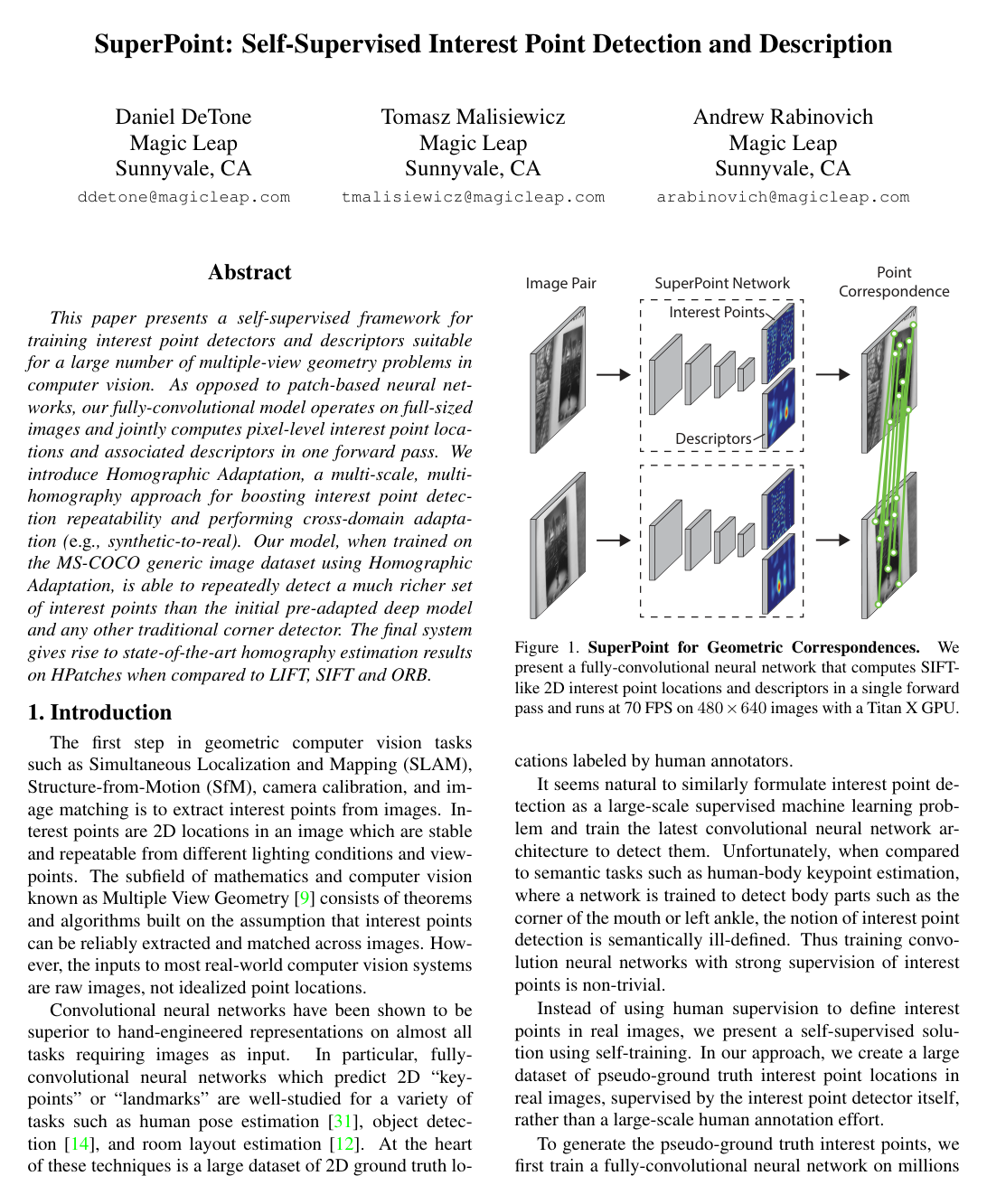
The authors first pre-train a base detector called MagicPoint on a large synthetic dataset of simple geometric shapes whose corner locations are unambiguous. They then apply a novel procedure, Homographic Adaptation, that warps each unlabeled real image through many random homographies, aggregates the detector responses, and produces high-quality pseudo-ground-truth labels. These labels are used to train the full SuperPoint model on the MS-COCO dataset; the architecture shares a VGG-style encoder between a point-detection head and a descriptor head, enabling real-time operation at approximately 70 frames per second on 480-by-640 images.
On the HPatches benchmark, SuperPoint achieves the highest repeatability under illumination change and matches or exceeds classical detectors under viewpoint change. When the detected points and descriptors are used for homography estimation, the system outperforms LIFT and ORB and performs comparably to SIFT while producing denser, more evenly distributed correspondences. The learned descriptors also score higher on nearest-neighbor matching metrics than the hand-crafted alternatives.
These results indicate that a single, efficient network can replace the traditional detect-then-describe pipeline for many geometric tasks, offering both speed and improved robustness without requiring expensive 3-D supervision. The approach therefore lowers the barrier to deploying learned features in robotics and augmented-reality pipelines that must run in real time.
The principal limitations are that performance still degrades under extreme in-plane rotations not well represented in training and that the method relies on homographies, which only approximate general 3-D motion. Further validation on broader outdoor and dynamic scenes, together with integration into complete SLAM or SfM systems, would strengthen confidence in wider deployment.
- Paper: Distinctive Image Features from Scale-Invariant Keypoints, David G. Lowe (2004). Reading the foundational SIFT paper provides essential context on scale-invariant feature extraction and keypoint description that SuperPoint builds upon and automates.
- Paper: Machine Learning for High-Speed Corner Detection, Edward Rosten et al. (2006). This paper establishes the necessity of high-speed corner detection in computer vision, framing the computational bottlenecks that SuperPoint addresses with a single-pass convolutional model.
- Paper: YOLOv9: Learning What You Want to Learn Using Programmable Gradient Information, Chien-Yao Wang et al. (2024). YOLOv9 extends the pursuit of efficient, real-time computer vision representations by addressing gradient information loss in deep architectures.