AI2-THOR: An Interactive 3D Environment for Visual AI
Eric KolveRoozbeh MottaghiWinson HanEli VanderBiltLuca WeihsAlvaro HerrastiMatt DeitkeKiana EhsaniDaniel GordonYuke Zhu
Introduces a near-photorealistic 3D indoor simulation platform that enables embodied AI agents to physically interact with objects and explore complex environments for visual reinforcement learning and task planning.
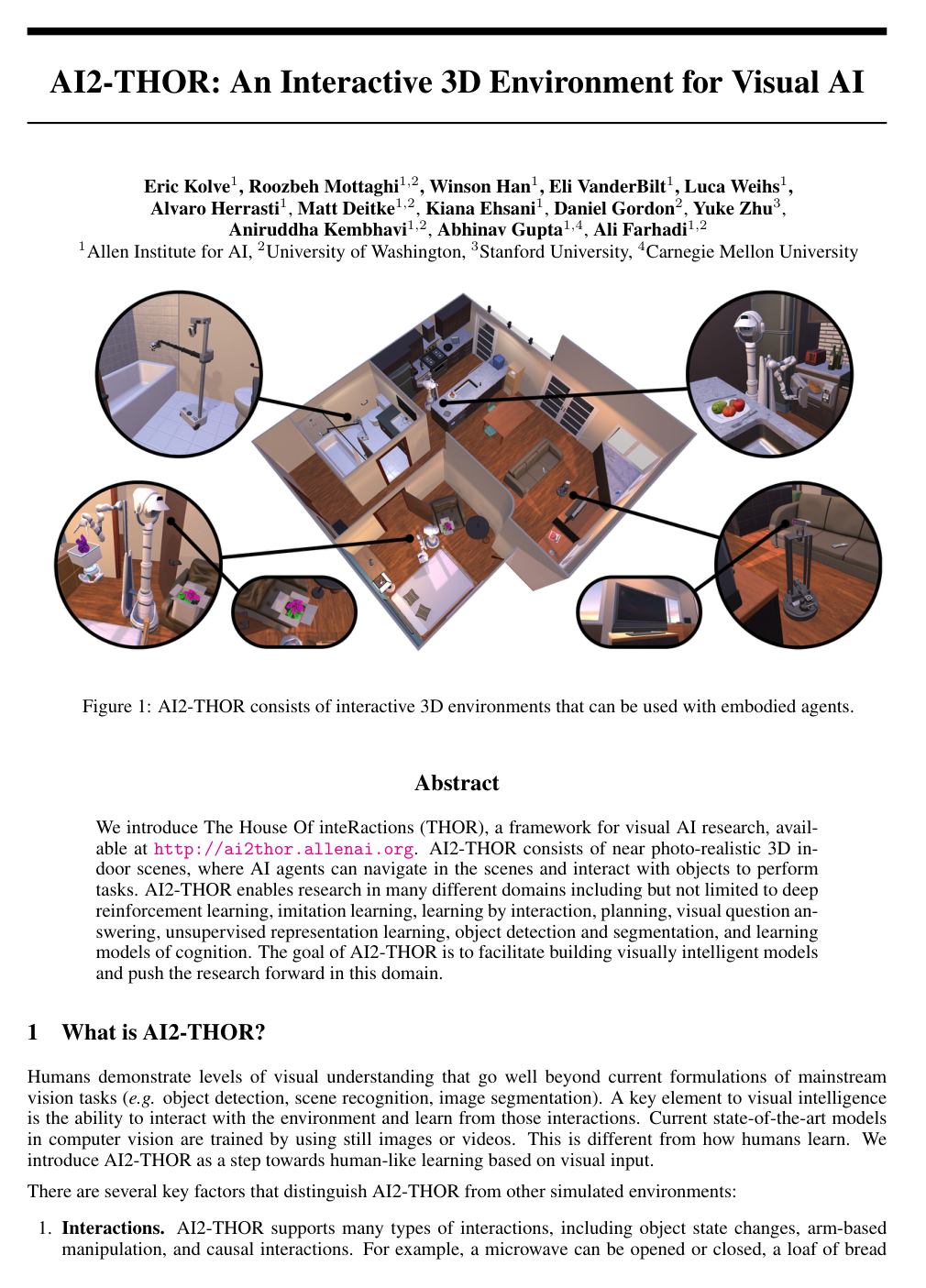
Developing artificial intelligence agents capable of complex visual understanding requires training through rich physical interactions rather than static images or video feeds. However, conducting physical robot experiments in the real world is slow, costly, potentially hazardous, and difficult to scale across varied environments. The article presents and evaluates AI2-THOR (The House Of inteRactions), an interactive, near photo-realistic 3D simulation framework designed to train embodied AI agents across diverse indoor tasks, including navigation, manipulation, and instruction following.
The system pairs a front-end Python interface with the Unity 3D game engine, enabling researchers to control multiple agent embodiments such as mobile bases, drones, and multi-joint robotic arms. It incorporates several extensive scene datasets, ranging from 120 artist-crafted rooms to 10,000 procedurally generated houses, along with an interactive object database containing 3,578 assets capable of dynamic state changes like slicing, cooking, breaking, and filling with liquids.
The article demonstrates several significant findings regarding the platform’s performance and research utility. First, AI2-THOR provides an unmatched scale of interaction, outperforming alternative simulators by supporting physical state changes, arm manipulation, audio cues, virtual reality integration, and procedural generation within a single system. Second, pre-training agents on the procedurally generated dataset achieved state-of-the-art visual navigation performance across multiple separate benchmarks without requiring extra domain-specific training data, effectively overcoming severe training overfitting. Third, in performance benchmarks, the platform demonstrated competitive training throughput, averaging 167.7 frames per second on a two-GPU machine compared to 230.5 frames per second for a less interactive alternative.
These findings indicate that highly interactive simulations can effectively serve as safe, rapid, and low-cost proxies for physical robotics research while substantially improving generalization to unseen environments. By allowing simulated models to transfer more reliably to real-world tasks, this approach reduces hardware testing expenses and accelerates development timelines across embodied AI, language grounding, and multi-agent systems.
Organizations advancing robotic AI should leverage procedural simulation environments to pre-train models at scale before physical deployment. Continued development should focus on expanding the variety of interactive physical assets, optimizing simulation speed during complex object manipulations, and further validating simulation-to-reality transfer across diverse physical robot platforms.
While the framework offers high fidelity, readers should note that simulated interactions may not capture every real-world physical nuance. Computational throughput remains constrained by complex multi-object arm collisions and environment resets during reinforcement learning. Nevertheless, extensive cross-benchmark evaluations and broad community adoption support high confidence in the platform's core conclusions.
- Paper: Target-driven visual navigation in indoor scenes using deep reinforcement learning, Yuke Zhu et al. (2016). This paper introduced the initial prototype of the AI2-THOR simulation environment to enable target-driven visual navigation with deep reinforcement learning.
- Paper: OpenAI Gym, Greg Brockman et al. (2016). This work established the standardized agent-environment interaction interface that foundationally shaped interactive 3D simulation platforms for reinforcement learning.
- Paper: Habitat: A Platform for Embodied AI Research, Manolis Savva et al. (2019). Habitat expands on the interactive 3D simulation paradigm established by AI2-THOR by delivering a high-throughput platform for training embodied agents across photorealistic environments.
- Paper: Objaverse: A Universe of Annotated 3D Objects, Matt Deitke et al. (2022). Objaverse massively scales the 3D asset repository and interactive object diversity needed to build richer, open-vocabulary embodied AI environments.
- Paper: PaLM-E: An Embodied Multimodal Language Model, Danny Driess et al. (2023). PaLM-E applies embodied sensory grounding to multimodal language models, enabling high-level planning and interaction in complex visual environments.
- Paper: Octo: An Open-Source Generalist Robot Policy, O. Team et al. (2024). Octo demonstrates generalist robot policy learning by mapping visual inputs and goal instructions directly to actions across diverse embodied manipulation settings.