Are Sparse Autoencoders Useful? A Case Study in Sparse Probing
Subhash KantamneniJoshua EngelsSenthooran RajamanoharanMax TegmarkNeel Nanda
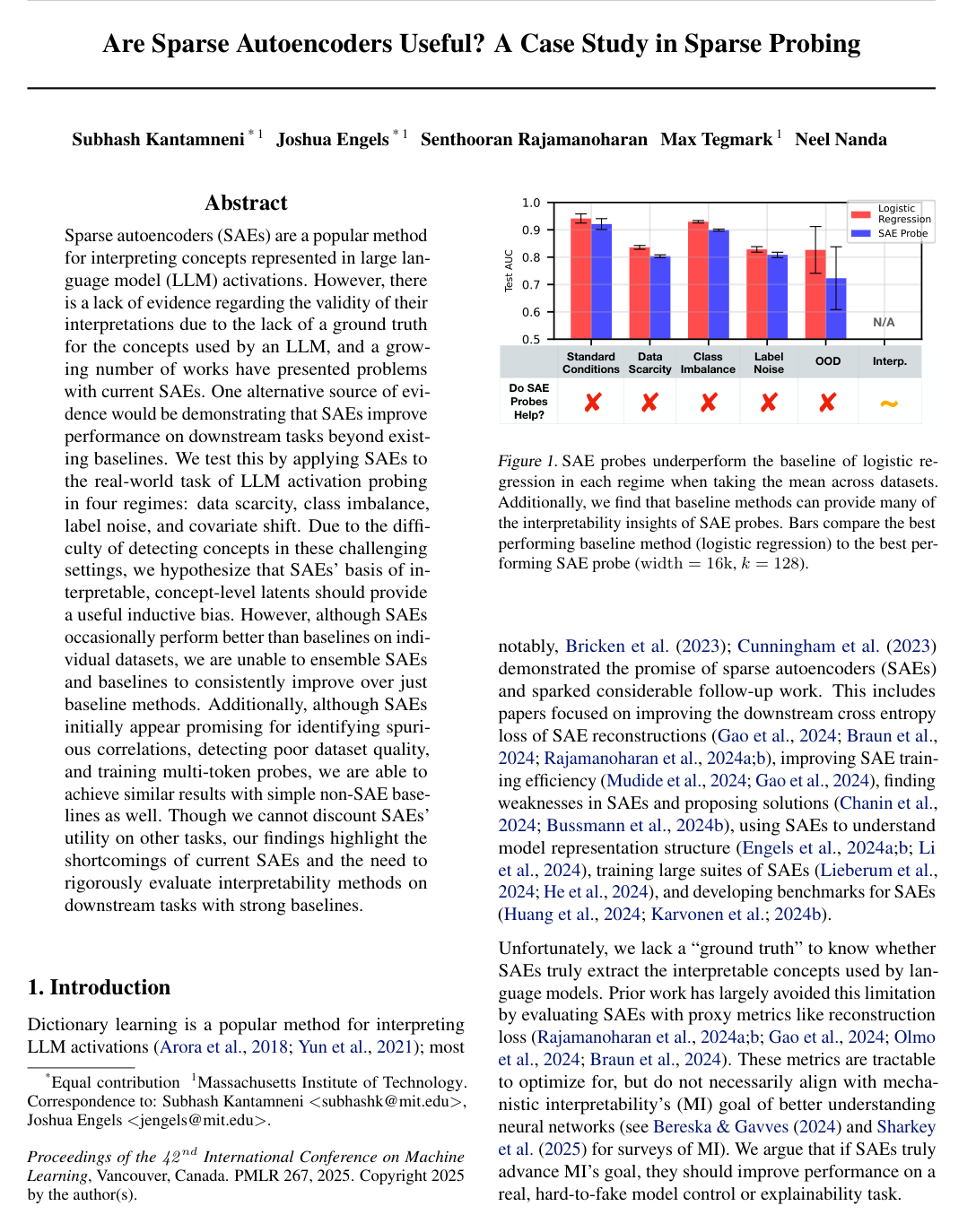
Demonstrates across 113 classification tasks that sparse autoencoder probes fail to outperform standard linear baselines in challenging regimes such as data scarcity and distribution shift, critically questioning the practical downstream utility of sparse dictionary learning in language models.
Mechanistic interpretability aims to understand how large language models represent and process information, often to enhance AI safety, model steering, and reliability. Sparse autoencoders (SAEs) have emerged as a prominent technique for decomposing complex internal model representations into interpretable, human-understandable concepts. However, validating whether SAEs extract true representations remains difficult because there is no ground-truth benchmark for internal model representations. The article systematically evaluates whether SAEs provide a practical, measurable advantage over conventional methods in the real-world downstream task of activation probing—training classifiers to predict specific concepts from internal model states.
The investigation benchmarked SAE-based probes against standard classification baselines across 113 diverse binary classification datasets using open-weight models, primarily Gemma-2-9B and Llama-3.1-8B. The evaluation examined standard operating conditions alongside four challenging operational environments where the inductive bias of interpretable features was hypothesized to provide an advantage: data scarcity, extreme class imbalance, severe label corruption, and out-of-distribution covariate shifts. To ensure a robust assessment, the authors used a portfolio selection methodology called the "Quiver of Arrows," simulating a practitioner who selects the best-performing method using validation data and evaluates the marginal test-set improvement from adding SAEs to existing tools.
The findings show that SAE probes fail to deliver a consistent performance benefit over standard baselines. In standard conditions, adding SAEs slightly reduced average test accuracy. In challenging regimes—including limited training data, unbalanced classes, noisy labels, and distribution shifts—SAEs did not meaningfully outperform simple baselines like logistic regression. Furthermore, while SAEs initially appeared uniquely capable of uncovering dataset errors, identifying spurious correlations, and pooling across multiple tokens, subsequent experiments demonstrated that standard baseline classifiers achieved equivalent insights when properly designed. Comparing eight successive SAE architectural variants released over recent years also revealed only minor, statistically insignificant performance gains.
These results carry significant implications for AI engineering, research investment, and governance. Deploying current SAE techniques as downstream classifiers or audit mechanisms adds computational overhead without improving diagnostic or predictive accuracy. The findings caution decision-makers against assuming that interpretable representations automatically enhance task performance or out-of-distribution robustness. They also underscore that interpretability techniques must be benchmarked against well-tuned baselines rather than naive comparisons to avoid misleading conclusions.
For practical applications, teams deploying linear probes should rely on established, lightweight methods such as regularized logistic regression and attention-based pooling rather than SAE latents. Organizations funding or conducting interpretability research should prioritize developing rigorous benchmarks and testing on controlled environments where underlying model features are known. While the article's conclusions are strongly supported across multiple models and extensive datasets, the authors note that probing is a proxy task; future research should continue testing whether other downstream applications, such as model steering or direct feature ablation, realize distinct benefits from SAE architectures.
- Paper: Sparse Autoencoders Find Highly Interpretable Features in Language Models, Hoagy Cunningham et al. (2023). This foundational SAE study establishes how sparse features are learned and assessed, giving essential context for the source’s comparisons of SAE-based probes with conventional methods.
- Paper: Understanding intermediate layers using linear classifier probes, Guillaume Alain et al. (2016). Its account of linear probes as passive classifiers on frozen representations clarifies the standard probing baseline that the source tests against SAE probes.
- Paper: Scaling and evaluating sparse autoencoders, Leo Gao et al. (2025). Its SAE training methods and evaluation metrics provide the technical background for the source’s comparisons across SAE architectures and probe performance.
- Paper: Steering Knowledge Selection Behaviours in LLMs via SAE-Based Representation Engineering, Yu Zhao 0043 et al. (2025). This work takes SAE features beyond probing into inference-time steering, following up on the source’s call to test whether SAEs offer distinct benefits for interventions.