
keyword
sparse autoencoders
Sparse autoencoders are a type of artificial neural network trained to reconstruct input data while enforcing a constraint that only a small fraction of their hidden units remain active at any given time. Typically featuring an overcomplete hidden layer where the latent dimension exceeds the input dimension, these networks use an encoder to map inputs, such as the dense internal activations of deep learning models, into a sparse latent space and a decoder to reconstruct the original input. By encouraging sparsity through penalties or activation thresholds, sparse autoencoders perform unsupervised dictionary learning, decomposing complex and overlapping neural activations into distinct, human-interpretable conceptual features. This makes them a widely used technique in mechanistic interpretability for analyzing, steering, and improving the transparency of deep neural networks.
9 items
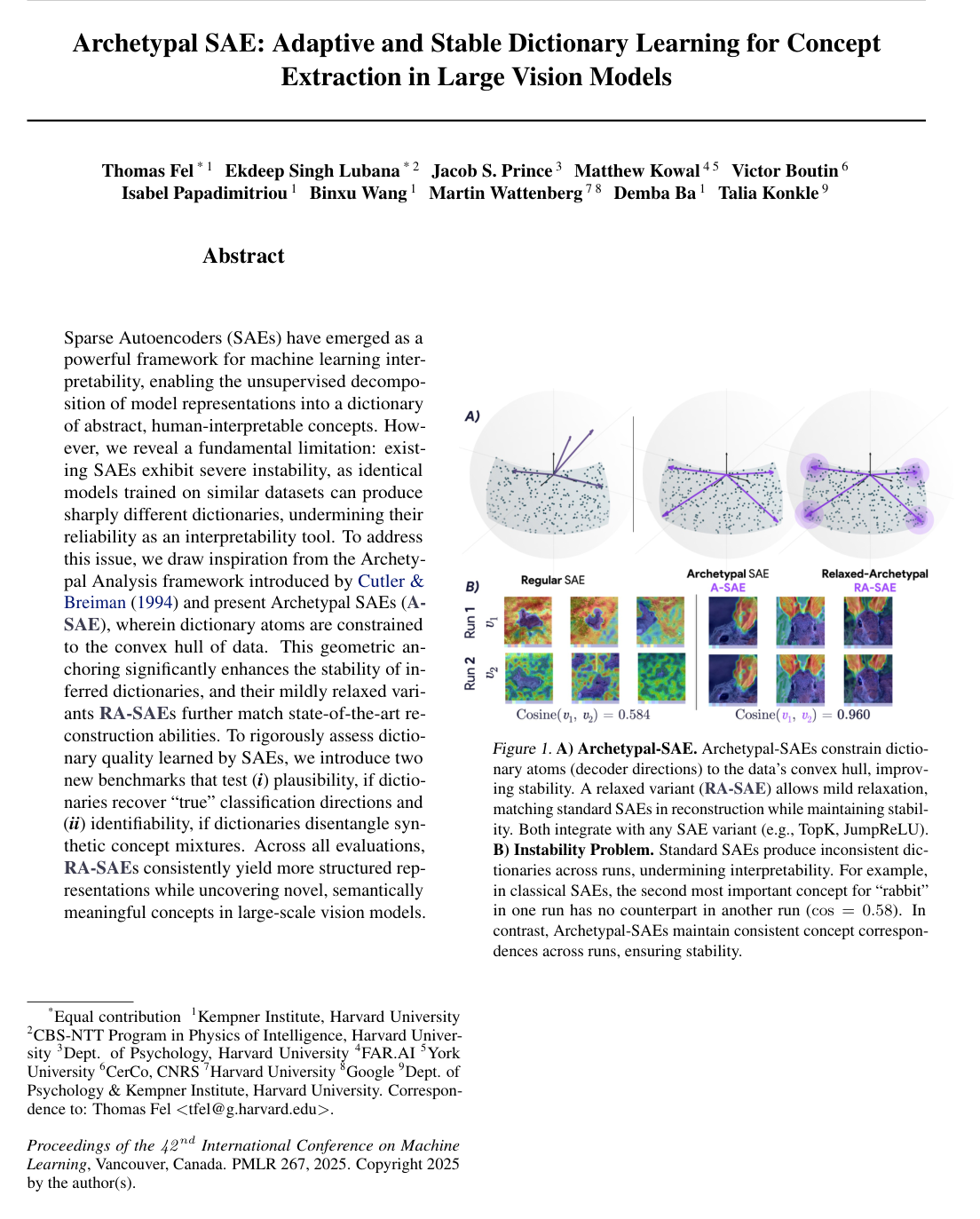
Archetypal SAE: Adaptive and Stable Dictionary Learning for Concept Extraction in Large Vision Models
Thomas Fel, Ekdeep Singh Lubana, Jacob S. Prince, Matthew Kowal, Victor Boutin, Isabel Papadimitriou, Binxu Wang, Martin Wattenberg, Demba E. Ba, Talia Konkle
Why you should read this
Proposes Archetypal Sparse Autoencoders to solve the instability of concept extraction across training runs by geometrically constraining dictionary atoms to the data's convex hull.
Sparse Autoencoders (SAEs) have emerged as a powerful framework for machine learning interpretability, enabling the unsupervised decomposition of model representations into a dictionary of abstract, human-interpretable concepts. However, we reveal a fundamental limitation: existing SAEs exhibit severe instability, as identical models trained on similar datasets can produce sharply different dictionaries, undermining their reliability as an interpretability tool. To address this issue, we draw inspiration from the Archetypal Analysis framework introduced by Cutler & Breiman (1994) and present Archetypal SAEs (A-SAE), wherein dictionary atoms are constrained to the convex hull of data. This geometric anchoring significantly enhances the stability of inferred dictionaries, and their mildly relaxed variants RA-SAEs further match state-of-the-art reconstruction abilities. To rigorously assess dictionary quality learned by SAEs, we introduce two new benchmarks that test (i) plausibility, if dictionaries recover “true” classification directions and (ii) identifiability, if dictionaries disentangle synthetic concept mixtures. Across all evaluations, RA-SAEs consistently yield more structured representations while uncovering novel, semantically meaningful concepts in large-scale vision models.
Added
2026-10-05
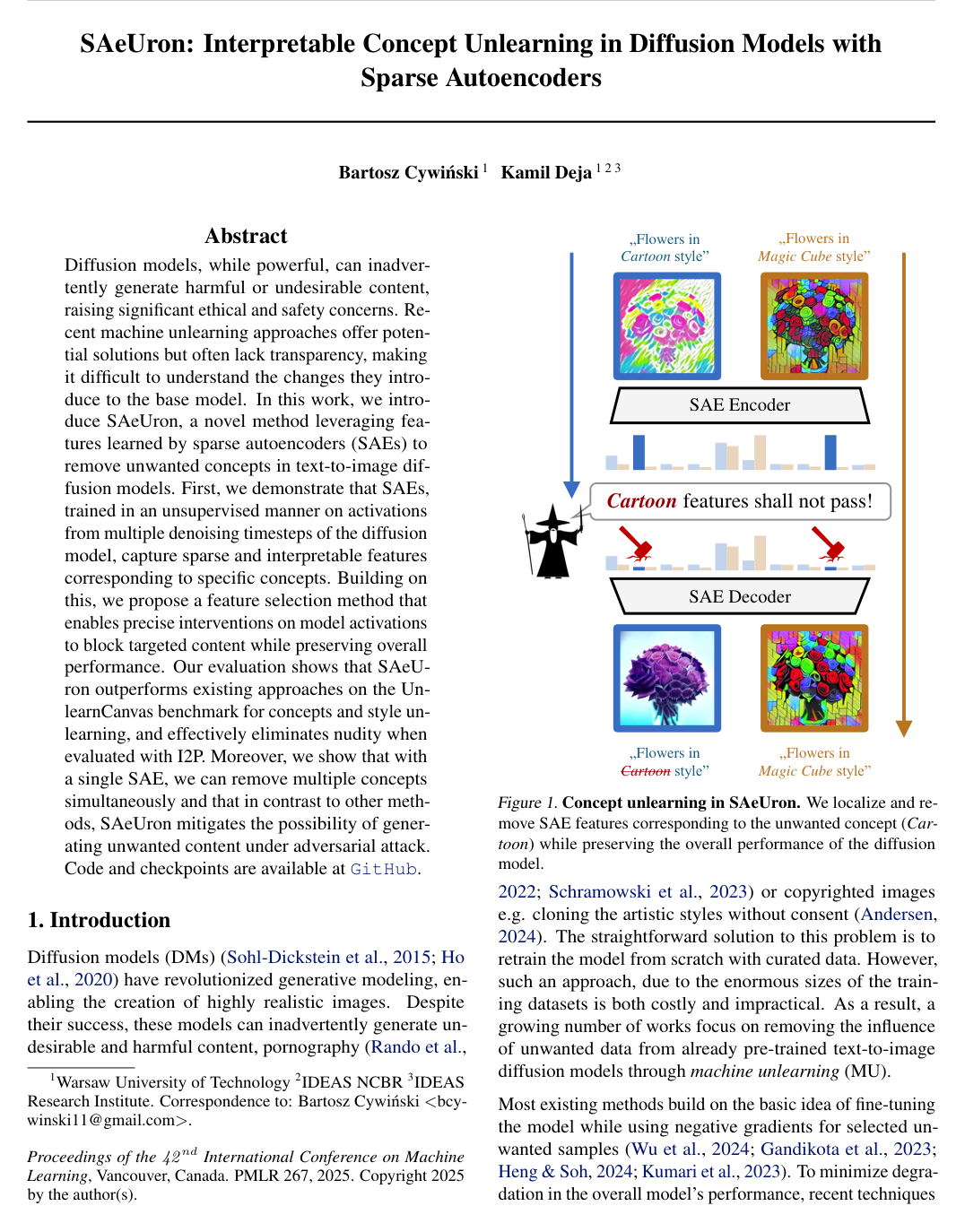
SAeUron: Interpretable Concept Unlearning in Diffusion Models with Sparse Autoencoders
Bartosz Cywinski, Kamil Deja
Why you should read this
Introduces SAeUron, a mechanistically interpretable method that trains sparse autoencoders across denoising timesteps to precisely identify and ablate unwanted visual concepts from text-to-image diffusion models without degrading overall generation quality or succumbing to adversarial attacks.
Diffusion models, while powerful, can inadvertently generate harmful or undesirable content, raising significant ethical and safety concerns. Recent machine unlearning approaches offer potential solutions but often lack transparency, making it difficult to understand the changes they introduce to the base model. In this work, we introduce SAeUron, a novel method leveraging features learned by sparse autoencoders (SAEs) to remove unwanted concepts in text-to-image diffusion models. First, we demonstrate that SAEs, trained in an unsupervised manner on activations from multiple denoising timesteps of the diffusion model, capture sparse and interpretable features corresponding to specific concepts. Building on this, we propose a feature selection method that enables precise interventions on model activations to block targeted content while preserving overall performance. Our evaluation shows that SAeUron outperforms existing approaches on the UnlearnCanvas benchmark for concepts and style unlearning, and effectively eliminates nudity when evaluated with I2P. Moreover, we show that with a single SAE, we can remove multiple concepts simultaneously and that in contrast to other methods, SAeUron mitigates the possibility of generating unwanted content under adversarial attack. Code and checkpoints are available at GitHub.
Added
2026-10-04
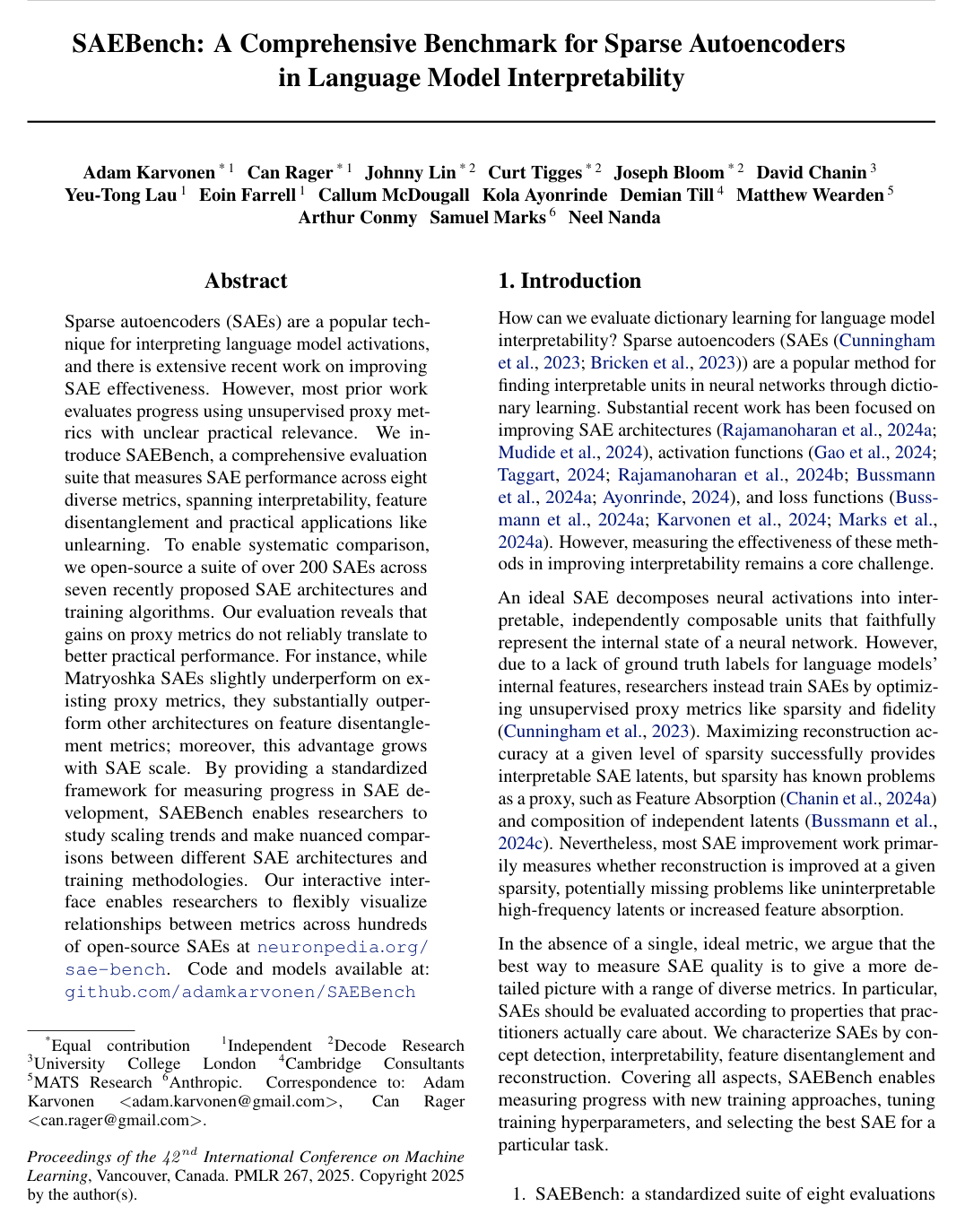
SAEBench: A Comprehensive Benchmark for Sparse Autoencoders in Language Model Interpretability
Adam Karvonen, Can Rager, Johnny Lin, Curt Tigges, Joseph Isaac Bloom, David Chanin, Yeu-Tong Lau, Eoin Farrell, Callum McDougall, Kola Ayonrinde, Demian Till, Matthew Wearden, Arthur Conmy, Samuel Marks, Neel Nanda
Why you should read this
Introduces a standardized evaluation suite of eight metrics and over 200 trained models to assess sparse autoencoder architectures on feature disentanglement, interpretability, and practical applications beyond traditional proxy loss.
Sparse autoencoders (SAEs) are a popular technique for interpreting language model activations, and there is extensive recent work on improving SAE effectiveness. However, most prior work evaluates progress using unsupervised proxy metrics with unclear practical relevance. We introduce SAEBench, a comprehensive evaluation suite that measures SAE performance across eight diverse metrics, spanning interpretability, feature disentanglement and practical applications like unlearning. To enable systematic comparison, we open-source a suite of over 200 SAEs across seven recently proposed SAE architectures and training algorithms. Our evaluation reveals that gains on proxy metrics do not reliably translate to better practical performance. For instance, while Matryoshka SAEs slightly underperform on existing proxy metrics, they substantially outperform other architectures on feature disentanglement metrics; moreover, this advantage grows with SAE scale. By providing a standardized framework for measuring progress in SAE development, SAEBench enables researchers to study scaling trends and make nuanced comparisons between different SAE architectures and training methodologies. Our interactive interface enables researchers to flexibly visualize relationships between metrics across hundreds of open-source SAEs at neuropedia.org/sae-bench. Code and models available at: github.com/adamkarvonen/SAEBench
Added
2026-10-02
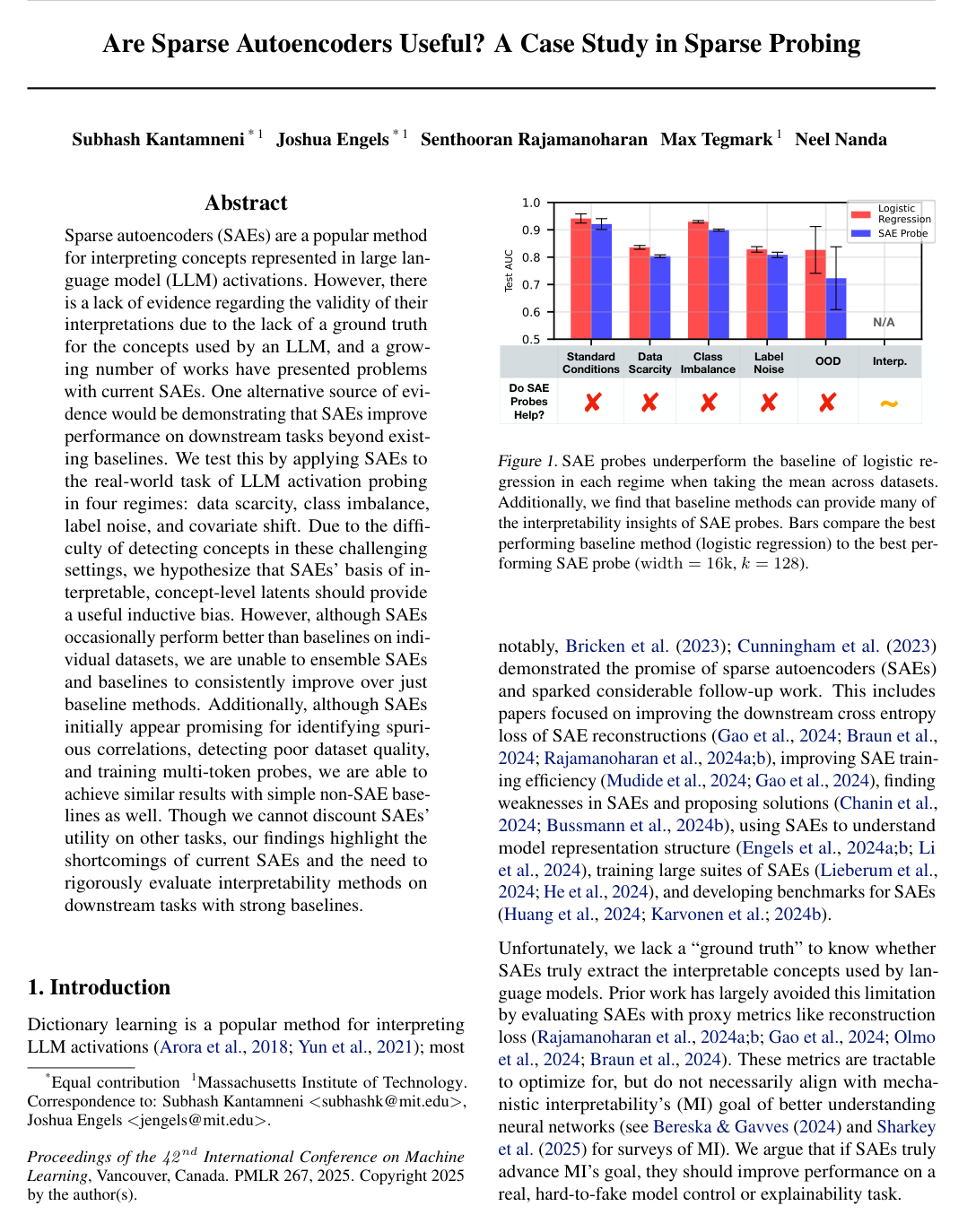
Are Sparse Autoencoders Useful? A Case Study in Sparse Probing
Subhash Kantamneni, Joshua Engels, Senthooran Rajamanoharan, Max Tegmark, Neel Nanda
Why you should read this
Demonstrates across 113 classification tasks that sparse autoencoder probes fail to outperform standard linear baselines in challenging regimes such as data scarcity and distribution shift, critically questioning the practical downstream utility of sparse dictionary learning in language models.
Sparse autoencoders (SAEs) are a popular method for interpreting concepts represented in large language model (LLM) activations. However, there is a lack of evidence regarding the validity of their interpretations due to the lack of a ground truth for the concepts used by an LLM, and a growing number of works have presented problems with current SAEs. One alternative source of evidence would be demonstrating that SAEs improve performance on downstream tasks beyond existing baselines. We test this by applying SAEs to the real-world task of LLM activation probing in four regimes: data scarcity, class imbalance, label noise, and covariate shift. Due to the difficulty of detecting concepts in these challenging settings, we hypothesize that SAEs’ basis of interpretable, concept-level latents should provide a useful inductive bias. However, although SAEs occasionally perform better than baselines on individual datasets, we are unable to ensemble SAEs and baselines to consistently improve over just baseline methods. Additionally, although SAEs initially appear promising for identifying spurious correlations, detecting poor dataset quality, and training multi-token probes, we are able to achieve similar results with simple non-SAE baselines as well. Though we cannot discount SAEs’ utility on other tasks, our findings highlight the shortcomings of current SAEs and the need to rigorously evaluate interpretability methods on downstream tasks with strong baselines.
Added
2026-10-02
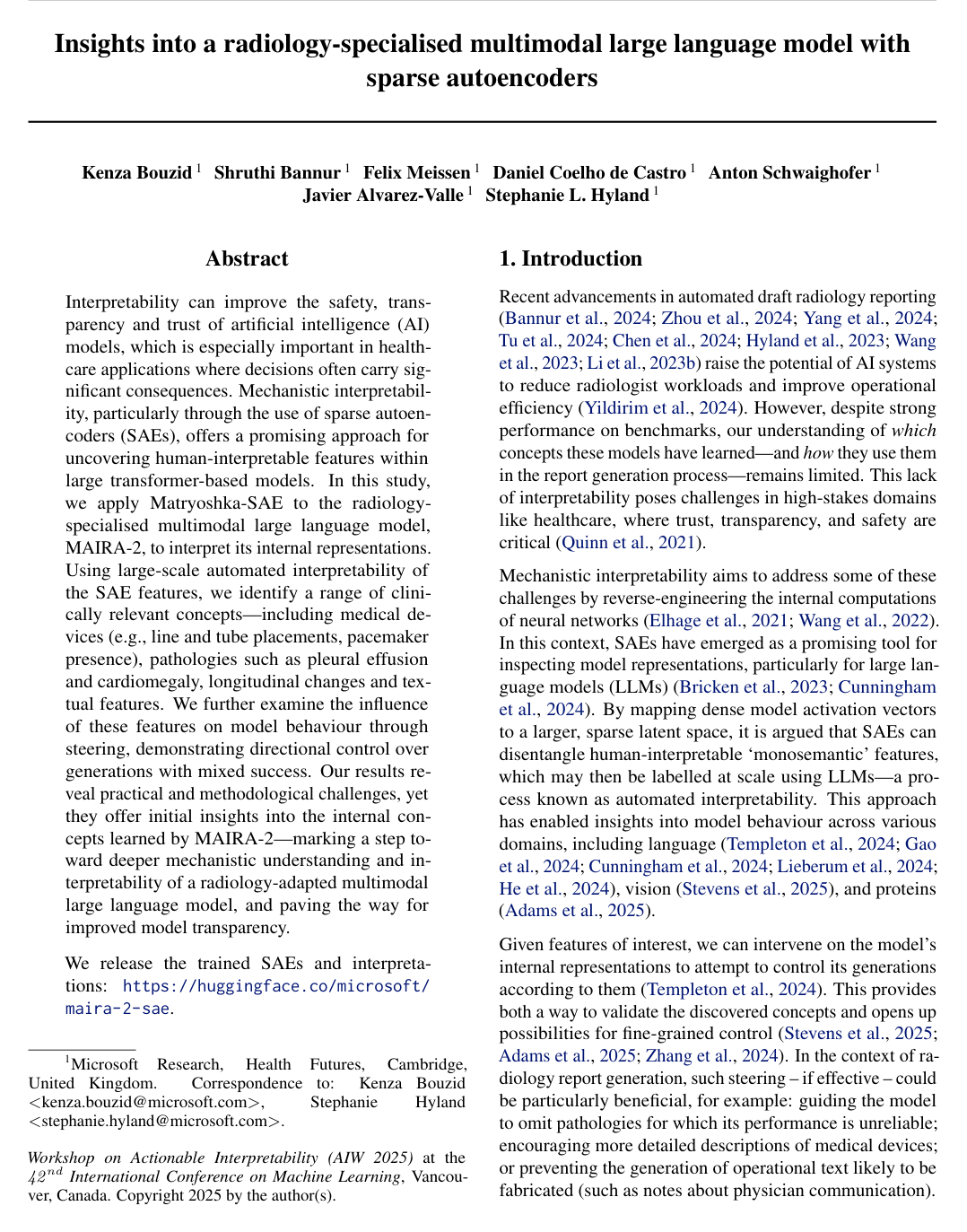
Insights into a radiology-specialised multimodal large language model with sparse autoencoders
Kenza Bouzid, Shruthi Bannur, Felix Meissen, Daniel Coelho de Castro, Anton Schwaighofer, Javier Alvarez-Valle, Stephanie Hyland
Why you should read this
Applies sparse autoencoders to the radiology multimodal model MAIRA-2 to identify human-interpretable representations of pathologies and medical devices while testing whether these internal features can steer clinical text generation.
Interpretability can improve the safety, transparency and trust of AI models, which is especially important in healthcare applications where decisions often carry significant consequences. Mechanistic interpretability, particularly through the use of sparse autoencoders (SAEs), offers a promising approach for uncovering human-interpretable features within large transformer-based models. In this study, we apply Matryoshka-SAE to the radiology-specialised multimodal large language model, MAIRA-2, to interpret its internal representations. Using large-scale automated interpretability of the SAE features, we identify a range of clinically relevant concepts - including medical devices (e.g., line and tube placements, pacemaker presence), pathologies such as pleural effusion and cardiomegaly, longitudinal changes and textual features. We further examine the influence of these features on model behaviour through steering, demonstrating directional control over generations with mixed success. Our results reveal practical and methodological challenges, yet they offer initial insights into the internal concepts learned by MAIRA-2 - marking a step toward deeper mechanistic understanding and interpretability of a radiology-adapted multimodal large language model, and paving the way for improved model transparency. We release the trained SAEs and interpretations: this https URL.
Added
2026-09-29
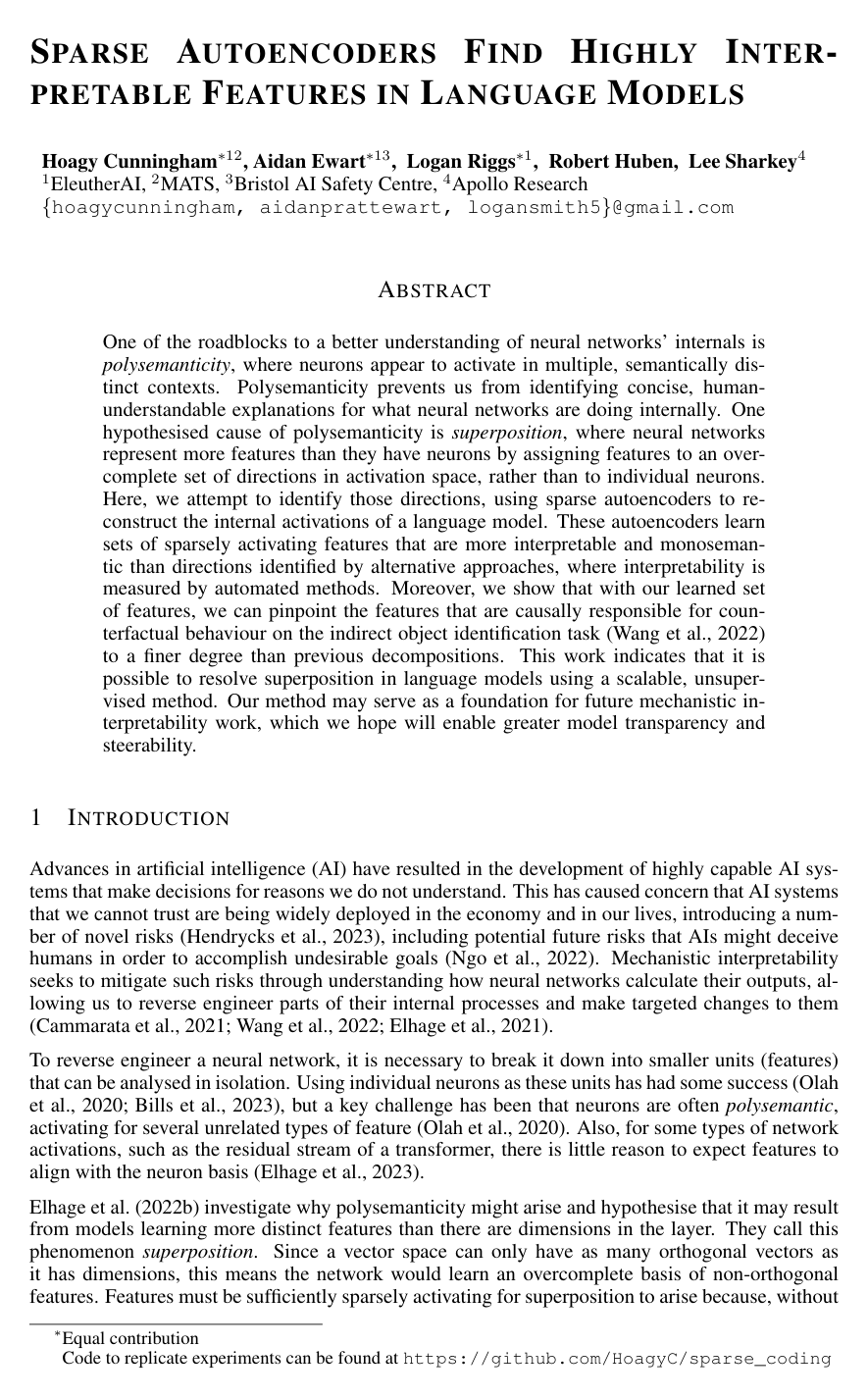
Sparse Autoencoders Find Highly Interpretable Features in Language Models
Hoagy Cunningham, Aidan Ewart, Logan Riggs, Robert Huben, Lee Sharkey
Why you should read this
Demonstrates how sparse autoencoders can extract human-interpretable, monosemantic features from language model activations, offering a scalable method to resolve superposition and isolate the exact representations driving model behavior.
One of the roadblocks to a better understanding of neural networks' internals is \textit{polysemanticity}, where neurons appear to activate in multiple, semantically distinct contexts. Polysemanticity prevents us from identifying concise, human-understandable explanations for what neural networks are doing internally. One hypothesised cause of polysemanticity is \textit{superposition}, where neural networks represent more features than they have neurons by assigning features to an overcomplete set of directions in activation space, rather than to individual neurons. Here, we attempt to identify those directions, using sparse autoencoders to reconstruct the internal activations of a language model. These autoencoders learn sets of sparsely activating features that are more interpretable and monosemantic than directions identified by alternative approaches, where interpretability is measured by automated methods. Moreover, we show that with our learned set of features, we can pinpoint the features that are causally responsible for counterfactual behaviour on the indirect object identification task \citep{wang2022interpretability} to a finer degree than previous decompositions. This work indicates that it is possible to resolve superposition in language models using a scalable, unsupervised method. Our method may serve as a foundation for future mechanistic interpretability work, which we hope will enable greater model transparency and steerability.
Added
2026-09-24
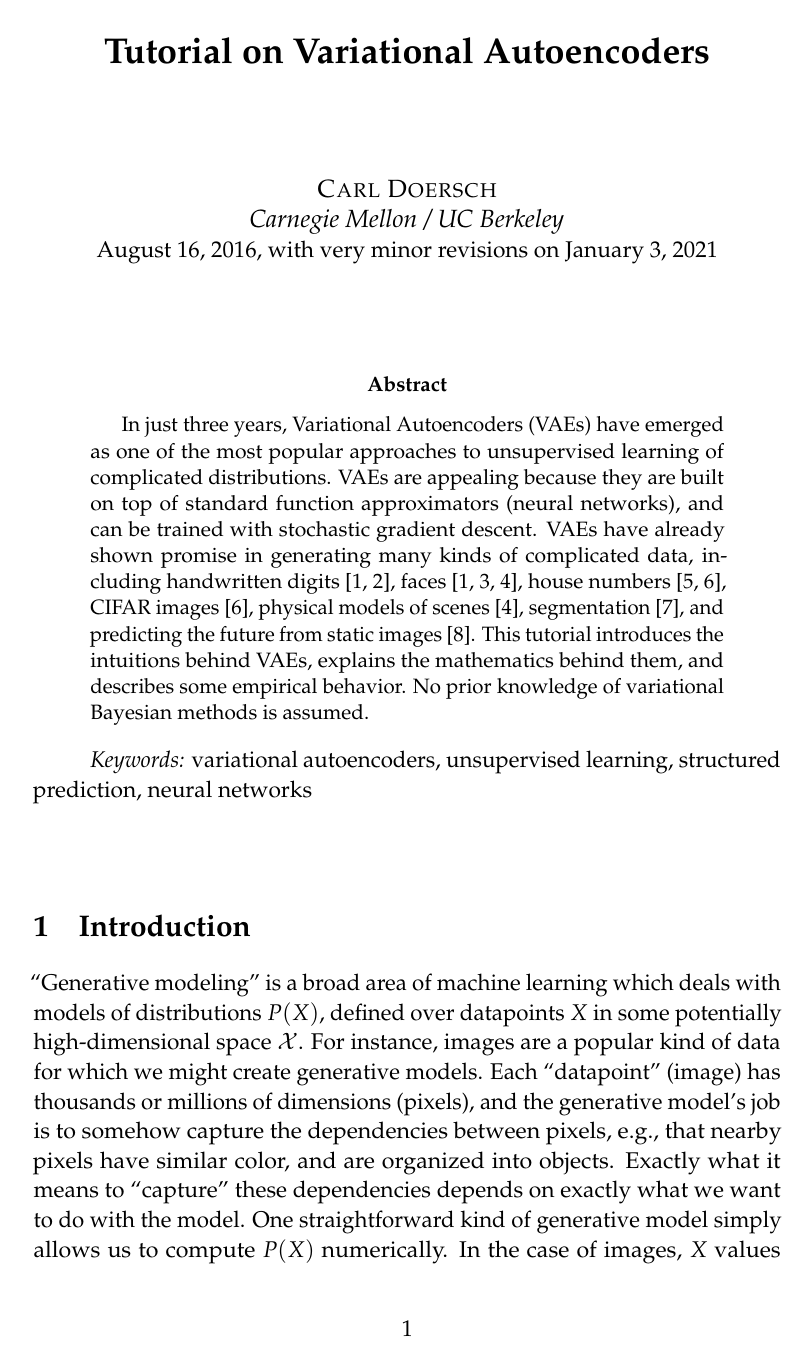
Tutorial on Variational Autoencoders
Carl Doersch
Why you should read this
Derives the mathematical foundations and practical mechanics of Variational Autoencoders from first principles, bridging deep neural networks with probabilistic latent-variable modeling for readers without an advanced Bayesian background.
In just three years, Variational Autoencoders (VAEs) have emerged as one of the most popular approaches to unsupervised learning of complicated distributions. VAEs are appealing because they are built on top of standard function approximators (neural networks), and can be trained with stochastic gradient descent. VAEs have already shown promise in generating many kinds of complicated data, including handwritten digits, faces, house numbers, CIFAR images, physical models of scenes, segmentation, and predicting the future from static images. This tutorial introduces the intuitions behind VAEs, explains the mathematics behind them, and describes some empirical behavior. No prior knowledge of variational Bayesian methods is assumed.
Added
2026-09-17
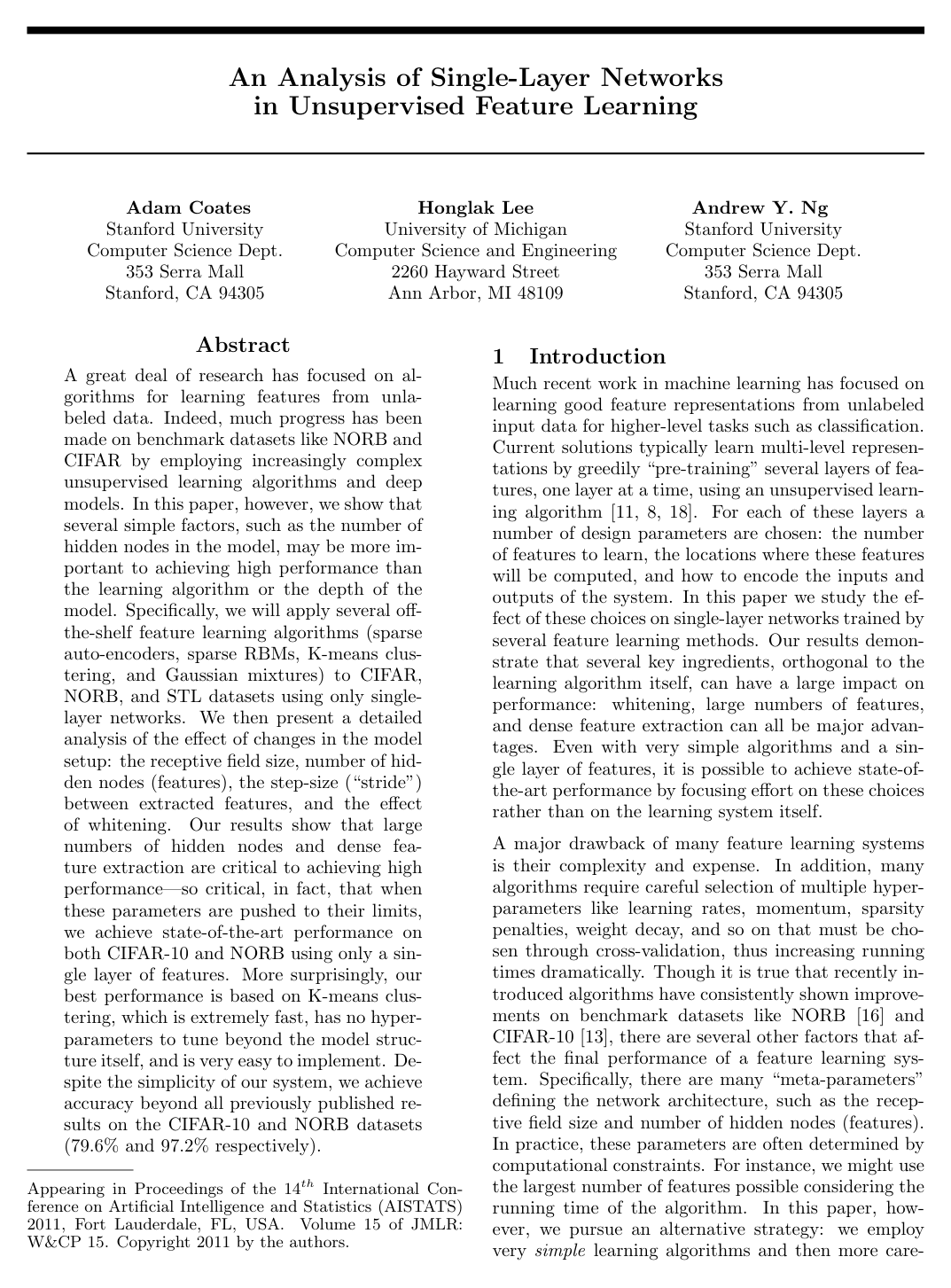
An Analysis of Single-Layer Networks in Unsupervised Feature Learning
Adam Coates, Honglak Lee, Andrew Y. Ng
Why you should read this
Demonstrates that simple network configuration choices and large feature quantities can outperform complex deep learning architectures in unsupervised feature learning tasks.
A great deal of research has focused on algorithms for learning features from unlabeled data. Indeed, much progress has been made on benchmark datasets like NORB and CIFAR by employing increasingly complex unsupervised learning algorithms and deep models. In this paper, however, we show that several simple factors, such as the number of hidden nodes in the model, may be more important to achieving high performance than the learning algorithm or the depth of the model. Specifically, we will apply several off-the-shelf feature learning algorithms (sparse auto-encoders, sparse RBMs, K-means clustering, and Gaussian mixtures) to CIFAR, NORB, and STL datasets using only single-layer networks.
Added
2026-09-10
License
Published with permission
Scaling and evaluating sparse autoencoders
Leo Gao, Tom Dupré la Tour, Henk Tillman, Gabriel Goh, Rajan Troll, Alec Radford, Ilya Sutskever, Jan Leike, Jeffrey Wu
Why you should read this
Establishes clean scaling laws for sparse autoencoders and introduces a state-of-the-art training methodology using TopK activations to successfully extract 16 million interpretable features from the residual streams of GPT-4.
Sparse autoencoders provide a promising unsupervised approach for extracting interpretable features from a language model by reconstructing activations from a sparse bottleneck layer. Since language models learn many concepts, autoencoders need to be very large to recover all relevant features. However, studying the properties of autoencoder scaling is difficult due to the need to balance reconstruction and sparsity objectives and the presence of dead latents. We propose using k-sparse autoencoders [Makhzani and Frey, 2013] to directly control sparsity, simplifying tuning and improving the reconstruction-sparsity frontier. Additionally, we find modifications that result in few dead latents, even at the largest scales we tried. Using these techniques, we find clean scaling laws with respect to autoencoder size and sparsity. We also introduce several new metrics for evaluating feature quality based on the recovery of hypothesized features, the explainability of activation patterns, and the sparsity of downstream effects. These metrics all generally improve with autoencoder size. To demonstrate the scalability of our approach, we train a 16 million latent autoencoder on GPT-4 activations for 40 billion tokens. We release training code and autoencoders for open-source models, as well as a visualizer.
Added
2026-05-20