
A Primer in BERTology: What We Know About How BERT Works
Anna Rogers
Center for Social Data Science
University of Copenhagen
[email protected]
Olga Kovaleva
Dept. of Computer Science
University of Massachusetts Lowell
[email protected]
Anna Rumshisky
Dept. of Computer Science
University of Massachusetts Lowell
[email protected]
Abstract
Transformer-based models have pushed state of the art in many areas of NLP, but our understanding of what is behind their success is still limited. This paper is the first survey of over 150 studies of the popular BERT model. We review the current state of knowledge about how BERT works, what kind of information it learns and how it is represented, common modifications to its training objectives and architecture, the overparameterization issue and approaches to compression. We then outline directions for future research.
Executive Summary: Large Transformer-based language models, most notably BERT, have become foundational infrastructure across natural language processing, driving major performance gains in enterprise applications such as search, classification, and question answering. However, despite their widespread adoption, organizations face growing challenges due to the massive computational costs, energy requirements, and operational opacity of these systems. Engineering teams often treat BERT as an uninterpretable black box, which limits principled architectural improvements and creates financial and deployment risks.
The article systematically reviews and synthesizes over 150 empirical studies to determine how BERT represents linguistic and world knowledge, evaluates technical modifications to its training and architecture, and assesses strategies for addressing overparameterization through compression.
The analysis uses an evidence-based literature review spanning probing experiments, attention weight analyses, architectural ablation benchmarks, and model compression trials across various standard language evaluation suites.
The findings reveal that BERT captures rich structural knowledge in a hierarchical manner similar to traditional processing pipelines, with basic surface features in lower layers, syntactic properties peaking in middle layers (such as layers 6 through 9 in the base model), and task-specific semantics concentrated across higher layers. However, the model exhibits severe cognitive limitations: it struggles with numbers, fails to reliably process negation, relies on superficial statistical shortcuts, and cannot perform multi-step reasoning. Crucially, BERT is heavily overparameterized; fewer than 50% of attention heads exhibit interpretable patterns, and between 30% and 40% of weights—or nearly entire attention heads—can be removed without harming task accuracy. Compression techniques such as distillation, quantization, and structured pruning consistently preserve 90% to 99% of original performance while reducing parameter size by factors between 1.5x and 13x and speeding up inference up to 4x to 9x.
These insights demonstrate that deploying full-scale, uncompressed models in production environments introduces unnecessary hardware expenses, latency, and carbon footprint. Furthermore, because BERT exploits shallow heuristics rather than genuine reasoning, relying on raw benchmark scores creates operational and safety risks in critical decision-making contexts. Pre-training primarily serves to stabilize optimization, allowing the model to find flatter, more generalizable parameter regions.
Decision-makers and engineering teams should immediately adopt compression pipelines—such as knowledge distillation and pruning—to drastically reduce operating costs before deploying models to production. When adapting models to new domains, teams should focus on parameter-efficient adapters and intermediate supervised fine-tuning rather than costly full re-training. Future development must prioritize the creation of rigorous behavioral benchmarks that test true reasoning and linguistic competence, while research should shift from passive probing to identifying the exact parameters actively used during inference.
These conclusions are bounded by current methodological limitations in the literature, where different probing techniques occasionally yield conflicting results and benchmark improvements often lack statistical significance testing. Nevertheless, confidence remains exceptionally high regarding BERT's overparameterization and the practical viability of compression for operational deployments.
1. Introduction
Section Summary: Since their launch in 2017, Transformer models such as BERT have transformed natural language processing by delivering strong results across many tasks, yet researchers still do not fully understand why they succeed. This paper surveys what has been discovered so far about the kinds of language knowledge these models capture and where that knowledge lives inside them, along with efforts to refine their design, training methods, and use. It also examines the problems caused by their large size and reviews techniques for shrinking or simplifying them.
Since their introduction in 2017, Transformers [1] have taken NLP by storm, offering enhanced parallelization and better modeling of long-range dependencies. The best known Transformer-based model is BERT [2]; it obtained state-of-the-art results in numerous benchmarks and is still a must-have baseline.
While it is clear that BERT works remarkably well, it is less clear why, which limits further hypothesis-driven improvement of the architecture. Unlike CNNs, the Transformers have little cognitive motivation, and the size of these models limits our ability to experiment with pre-training and perform ablation studies. This explains a large number of studies over the past year that attempted to understand the reasons behind BERT's performance.
In this paper, we provide an overview of what has been learned to date, highlighting the questions which are still unresolved. We first consider the linguistic aspects of it, i.e., the current evidence regarding the types of linguistic and world knowledge learned by BERT, as well as where and how this knowledge may be stored in the model. We then turn to the technical aspects of the model and provide an overview of the current proposals to improve BERT's architecture, pre-training and fine-tuning. We conclude by discussing the issue of overparameterization, the approaches to compressing BERT, and the nascent area of pruning as a model analysis technique.
2. Overview of BERT architecture
Section Summary: BERT is built as a stack of transformer encoder layers, each containing multiple attention mechanisms that process every word in an input sequence by creating weighted representations, which are then combined and normalized. The model is first pre-trained on two self-supervised tasks—predicting randomly masked words and determining whether two sentences follow each other—before being fine-tuned for specific applications by adding extra layers on top. Inputs are split into word pieces and enriched with position and segment information, using special tokens to mark classifications or sentence boundaries, with different model sizes offered by Google and Hugging Face.
Fundamentally, BERT is a stack of Transformer encoder layers [1] which consist of multiple self-attention "heads". For every input token in a sequence, each head computes key, value and query vectors, used to create a weighted representation. The outputs of all heads in the same layer are combined and run through a fully-connected layer. Each layer is wrapped with a skip connection and followed by layer normalization.
The conventional workflow for BERT consists of two stages: pre-training and fine-tuning. Pre-training uses two self-supervised tasks: masked language modeling (MLM, prediction of randomly masked input tokens) and next sentence prediction (NSP, predicting if two input sentences are adjacent to each other). In fine-tuning for downstream applications, one or more fully-connected layers are typically added on top of the final encoder layer.
The input representations are computed as follows: each word in the input is first tokenized into wordpieces [3], and then three embedding layers (token, position, and segment) are combined to obtain a fixed-length vector. Special token [CLS] is used for classification predictions, and [SEP] separates input segments.
Google^1 and HuggingFace [4] provide many variants of BERT, including the original "base" and "large" versions. They vary in the number of heads, layers, and hidden state size.
3. What knowledge does BERT have?
Section Summary: Studies have examined the knowledge stored in BERT through probing methods like masked language modeling and classifiers, revealing that its token representations capture hierarchical syntactic patterns such as parts of speech and subject-verb agreement, along with some semantic elements like entity types and roles. However, this knowledge is incomplete, as the model struggles with negation, word order variations, numbers, and consistent handling of named entities or commonsense inferences, often relying on superficial cues instead. Syntactic details appear embedded more in the representations themselves than in attention weights, though they are not always needed for strong task performance.
A number of studies have looked at the knowledge encoded in BERT weights. The popular approaches include fill-in-the-gap probes of MLM, analysis of self-attention weights, and probing classifiers with different BERT representations as inputs.
3.1 Syntactic knowledge
[5] showed that BERT representations are hierarchical rather than linear, i.e. there is something akin to syntactic tree structure in addition to the word order information. [6] and [7] also showed that BERT embeddings encode information about parts of speech, syntactic chunks and roles. Enough syntactic information seems to be captured in the token embeddings themselves to recover syntactic trees [8, 9, 10], although probing classifiers could not recover the labels of distant parent nodes in the syntactic tree [7]. [11] report evidence of hierarchical structure in three out of four probing tasks.
As far as how syntax is represented, it seems that syntactic structure is not directly encoded in self-attention weights. [12] were unable to extract full parse trees from BERT heads even with the gold annotations for the root. [13] include a brief illustration of a dependency tree extracted directly from self-attention weights, but provide no quantitative evaluation.
However, syntactic information can be recovered from BERT token representations. [14] were able to learn transformation matrices that successfully recovered syntactic dependencies in PennTreebank data from BERT's token embeddings [see also 15]. [13] experimented with transformations of the [CLS] token using Tensor Product Decomposition Networks [16], concluding that dependency trees are the best match among 5 decomposition schemes (although the reported MSE differences are very small). [17] performs a range of syntactic probing experiments with concatenated token representations as input.
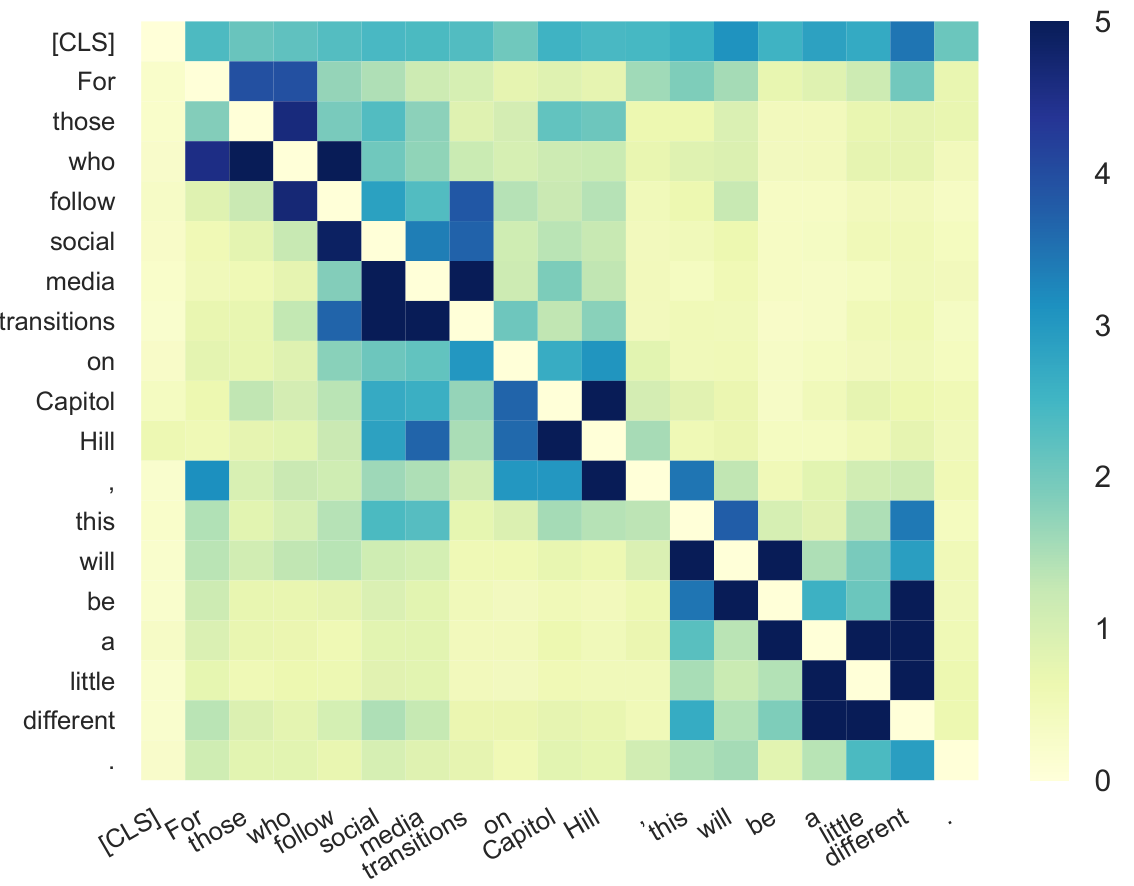
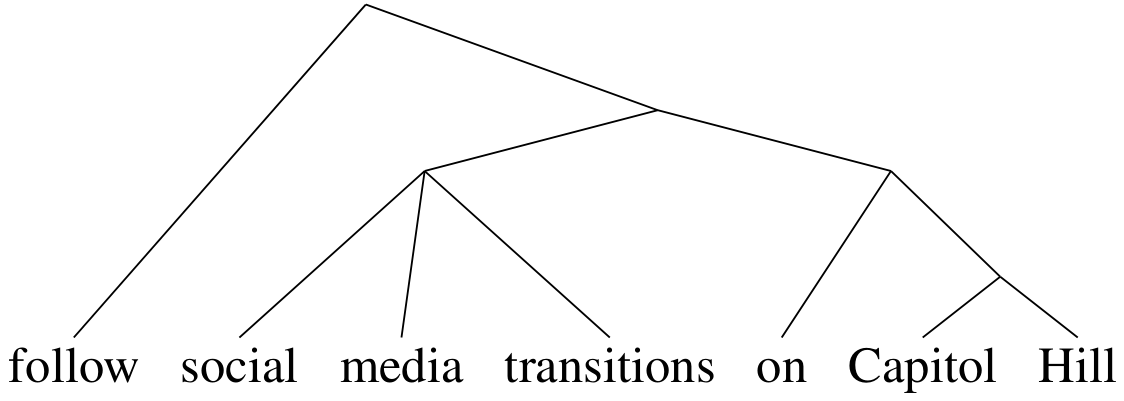
Note that all these approaches look for the evidence of gold-standard linguistic structures, and add some amount of extra knowledge to the probe. Most recently, [18] proposed a parameter-free approach based on measuring the impact that one word has on predicting another word within a sequence in the MLM task (Figure 1). They concluded that BERT "naturally" learns some syntactic information, although it is not very similar to linguistic annotated resources.
:::: {.figure cols="1"}
 {width=70%}
Figure 1: Parameter-free probe for syntactic knowledge: words sharing syntactic subtrees have larger impact on each other in the MLM prediction [18] ::::
The fill-in-the-gap probes of MLM showed that BERT takes subject-predicate agreement into account when performing the cloze task [19, 20], even for meaningless sentences and sentences with distractor clauses between the subject and the verb [19]. A study of negative polarity items (NPIs) by [21] showed that BERT is better able to detect the presence of NPIs (e.g. "ever") and the words that allow their use (e.g. "whether")
than scope violations.
The above claims of syntactic knowledge are belied by the evidence that BERT does not "understand" negation and is insensitive to malformed input. In particular, its predictions were not altered[^2] even with shuffled word order, truncated sentences, removed subjects and objects [22]. This could mean that either BERT's syntactic knowledge is incomplete, or it does not need to rely on it for solving its tasks. The latter seems more likely, since [23] report that an intermediate fine-tuning step with supervised parsing does not make much difference for downstream task performance.
[^2]: See also the recent findings on adversarial triggers, which get the model to produce a certain output even though they are not well-formed from the point of view of a human reader [24].
3.2 Semantic knowledge
To date, more studies have been devoted to BERT's knowledge of syntactic rather than semantic phenomena. However, we do have evidence from an MLM probing study that BERT has some knowledge of semantic roles [22]. BERT even displays some preference for the incorrect fillers for semantic roles that are semantically related to the correct ones, as opposed to those that are unrelated (e.g. "to tip a chef" is better than "to tip a robin", but worse than "to tip a waiter").
[6] showed that BERT encodes information about entity types, relations, semantic roles, and proto-roles, since this information can be detected with probing classifiers.
BERT struggles with representations of numbers. Addition and number decoding tasks showed that BERT does not form good representations for floating point numbers and fails to generalize away from the training data [25]. A part of the problem is BERT's wordpiece tokenization, since numbers of similar values can be divided up into substantially different word chunks.
Out-of-the-box BERT is surprisingly brittle to named entity replacements: e.g. replacing names in the coreference task changes 85% of predictions [26]. This suggests that the model does not actually form a generic idea of named entities, although its F1 scores on NER probing tasks are high [27]. [28] find that fine-tuning BERT on Wikipedia entity linking "teaches" it additional entity knowledge, which would suggest that it did not absorb all the relevant entity information during pre-training on Wikipedia.
3.3 World knowledge
The bulk of evidence about commonsense knowledge captured in BERT comes from practitioners using it to extract such knowledge. One direct probing study of BERT reports that BERT struggles with pragmatic inference and role-based event knowledge [22]. BERT also struggles with abstract attributes of objects, as well as visual and perceptual properties that are likely to be assumed rather than mentioned [29].
The MLM component of BERT is easy to adapt for knowledge induction by filling in the blanks (e.g. "Cats like to chase [\textunderscore \textunderscore \textunderscore]"). [30] showed that, for some relation types, vanilla BERT is competitive with methods relying on knowledge bases (Figure 2), and [31] show the same for open-domain QA using T5 model [32]. [33] suggest that it generalizes better to unseen data. In order to retrieve BERT's knowledge, we need good template sentences, and there is work on their automatic extraction and augmentation [34, 35].
However, BERT cannot reason based on its world knowledge. [36] show that BERT can "guess" the affordances and properties of many objects, but can not reason about the relationship between properties and affordances. For example, it "knows" that people can walk into houses, and that houses are big, but it cannot infer that houses are bigger than people. [37] and [38] also show that the performance drops with the number of necessary inference steps. Some of BERT's world knowledge success comes from learning stereotypical associations [39], e.g., a person with an Italian-sounding name is predicted to be Italian, even when it is incorrect.
![**Figure 2:** BERT world knowledge [30]](https://ittowtnkqtyixxjxrhou.supabase.co/storage/v1/object/public/public-images/3xxdbtax/asset-0003.png) {width=80%}
{width=80%}
![**Figure 3:** Attention patterns in BERT [40]](https://ittowtnkqtyixxjxrhou.supabase.co/storage/v1/object/public/public-images/3xxdbtax/asset-0004.png)
3.4 Limitations
Multiple probing studies in Section 3 and Section 4 report that BERT possesses a surprising amount of syntactic, semantic, and world knowledge. However, [27] remarks, "the fact that a linguistic pattern is not observed by our probing classifier does not guarantee that it is not there, and the observation of a pattern does not tell us how it is used." There is also the issue of how complex a probe should be allowed to be [7]. If a more complex probe recovers more information, to what extent are we still relying on the original model?
Furthermore, different probing methods may lead to complementary or even contradictory conclusions, which makes a single test (as in most studies) insufficient [21]. A given method might also favor one model over another, e.g., RoBERTa trails BERT with one tree extraction method, but leads with another [12]. The choice of linguistic formalism also matters [41].
In view of all that, the alternative is to focus on identifying what BERT actually relies on at inference time. This direction is currently pursued both at the level of architecture blocks (to be discussed in detail in Section 6.3), and at the level of information encoded in model weights. Amnesic probing [42] aims to specifically remove certain information from the model and see how it changes performance, finding, for example, that language modeling does rely on part-of-speech information.
Another direction is information-theoretic probing. [43] operationalize probing as estimating mutual information between the learned representation and a given linguistic property, which highlights that the focus should be not on the amount of information contained in a representation, but rather on how easily it can be extracted from it. [44] quantify the amount of effort needed to extract information from a given representation as minimum description length needed to communicate both the probe size and the amount of data required for it to do well on a task.
4. Localizing linguistic knowledge
Section Summary: In BERT, the contextual embeddings produced by Transformer layers vary with surrounding words and tend to form clusters that reflect distinct word senses, though later layers grow less uniform in direction and more sensitive to sentence ordering. Some self-attention heads specialize in particular syntactic relations or semantic links, yet none encodes a full grammatical structure and the attention weights themselves are often weak signals for agreement or coreference. Distillation techniques can convert these contextual vectors into static embeddings that perform well on traditional word-similarity tasks.
4.1 BERT embeddings
In studies of BERT, the term "embedding" refers to the output of a Transformer layer (typically, the final one). Both conventional static embeddings [45] and BERT-style embeddings can be viewed in terms of mutual information maximization [46], but the latter are contextualized. Every token is represented by a vector dependent on the particular context of occurrence, and contains at least some information about that context [17].
Several studies reported that distilled contextualized embeddings better encode lexical semantic information (i.e. they are better at traditional word-level tasks such as word similarity). The methods to distill a contextualized representation into static include aggregating the information across multiple contexts [47, 48], encoding "semantically bleached" sentences that rely almost exclusively on the meaning of a given word (e.g. "This is <>") [49], and even using contextualized embeddings to train static embeddings [50].
But this is not to say that there is no room for improvement. [51] measure how similar the embeddings for identical words are in every layer, reporting that later BERT layers produce more context-specific representations[^3]. They also find that BERT embeddings occupy a narrow cone in the vector space, and this effect increases from the earlier to later layers. That is, two random words will on average have a much higher cosine similarity than expected if embeddings were directionally uniform (isotropic). Since isotropy was shown to be beneficial for static word embeddings [52], this might be a fruitful direction to explore for BERT.
[^3]: [53] look at the evolution of token embeddings, showing that in the earlier Transformer layers, MLM forces the acquisition of contextual information at the expense of the token identity, which gets recreated in later layers.
Since BERT embeddings are contextualized, an interesting question is to what extent they capture phenomena like polysemy and homonymy. There is indeed evidence that BERT's contextualized embeddings form distinct clusters corresponding to word senses [54, 55], making BERT successful at word sense disambiguation task. However, [56] note that the representations of the same word depend on the position of the sentence in which it occurs, likely due to the NSP objective. This is not desirable from the linguistic point of view, and could be a promising avenue for future work.
The above discussion concerns token embeddings, but BERT is typically used as a sentence or text encoder. The standard way to generate sentence or text representations for classification is to use the [CLS] token, but alternatives are also being discussed, including concatenation of token representations [57], normalized mean [57], and layer activations [58]. See [59] for a systematic comparison of several methods across tasks and sentence encoders.
4.2 Self-attention heads
Several studies proposed classification of attention head types. [60] discuss attending to the token itself, previous/next tokens and the sentence end. [61] distinguish between attending to previous/next tokens, [CLS], [SEP], punctuation, and "attending broadly" over the sequence. [40] propose 5 patterns shown in Figure 3.
4.2.1 Heads with linguistic functions
The "heterogeneous" attention pattern shown in Figure 3 could potentially be linguistically interpretable, and a number of studies focused on identifying the functions of self-attention heads. In particular,
some BERT heads seem to specialize in certain types of syntactic relations. [12] and [61] report that there are BERT heads that attended significantly more than a random baseline to words in certain syntactic positions. The datasets and methods used in these studies differ, but they both find that there are heads that attend to words in obj role more than the positional baseline. The evidence for nsubj, advmod, and amod varies between these two studies. The overall conclusion is also supported by [62]'s study of the base Transformer in machine translation context. [63] hypothesize that even complex dependencies like dobj are encoded by a combination of heads rather than a single head, but this work is limited to qualitative analysis. [64] looked specifically for the heads encoding negation scope.
Both [61] and [12] conclude that no single head has the complete syntactic tree information, in line with evidence of partial knowledge of syntax (cf. Section 3.1). However, [61] identify a BERT head that can be directly used as a classifier to perform coreference resolution on par with a rule-based system, which by itself would seem to require quite a lot of syntactic knowledge.
[5] present evidence that
attention weights are weak indicators of subject-verb agreement and reflexive anaphora. Instead of serving as strong pointers between tokens that should be related, BERT's self-attention weights were close to a uniform attention baseline, but there was some sensitivity to different types of distractors coherent with psycholinguistic data. This is consistent with conclusions by [22].
To our knowledge, morphological information in BERT heads has not been addressed, but with the sparse attention variant by [65] in the base Transformer, some attention heads appear to merge BPE-tokenized words. For semantic relations, there are reports of self-attention heads encoding core frame-semantic relations [40], as well as lexicographic and commonsense relations [66].
The overall popularity of self-attention as an interpretability mechanism is due to the idea that "attention weight has a clear meaning: how much a particular word will be weighted when computing the next representation for the current word" [61]. This view is currently debated [67, 68, 69, 70], and in a multi-layer model where attention is followed by non-linear transformations, the patterns in individual heads do not provide a full picture. Also, while many current papers are accompanied by attention visualizations, and there is a growing number of visualization tools [71, 63], the visualization is typically limited to qualitative analysis (often with cherry-picked examples) [72], and should not be interpreted as definitive evidence.
4.2.2 Attention to special tokens
[40] show that most self-attention heads do not directly encode any non-trivial linguistic information, at least when fine-tuned on GLUE [73], since only less than 50% of heads exhibit the "heterogeneous" pattern. Much of the model produced the vertical pattern (attention to [CLS], [SEP], and punctuation tokens), consistent with the observations by [61]. This redundancy is likely related to the overparameterization issue (see Section 6).
More recently, [74] showed that the norms of attention-weighted input vectors, which yield a more intuitive interpretation of self-attention, reduce the attention to special tokens. However, even when the attention weights are normed, it is still not the case that most heads that do the "heavy lifting" are even potentially interpretable [75].
One methodological choice in in many studies of attention is to focus on inter-word attention and simply exclude special tokens (e.g. [5] and [12]). However, if attention to special tokens actually matters at inference time, drawing conclusions purely from inter-word attention patterns does not seem warranted.
The functions of special tokens are not yet well understood. [CLS] is typically viewed as an aggregated sentence-level representation (although all token representations also contain at least some sentence-level information, as discussed in Section 4.1); in that case, we may not see e.g. full syntactic trees in inter-word attention because part of that information is actually packed in [CLS].
[61] experiment with encoding Wikipedia paragraphs with base BERT to consider specifically the attention to special tokens, noting that heads in early layers attend more to [CLS], in middle layers to [SEP], and in final layers to periods and commas. They hypothesize that its function might be one of "no-op", a signal to ignore the head if its pattern is not applicable to the current case. As a result, for example, [SEP] gets increased attention starting in layer 5, but its importance for prediction drops. However, after fine-tuning both [SEP] and [CLS] get a lot of attention, depending on the task [40]. Interestingly, BERT also pays a lot of attention to punctuation, which [61] explain by the fact that periods and commas are simply almost as frequent as the special tokens, and so the model might learn to rely on them for the same reasons.
4.3 BERT layers
The first layer of BERT receives as input a combination of token, segment, and positional embeddings.
It stands to reason that
the lower layers have the most information about linear word order. [5] report a decrease in the knowledge of linear word order around layer 4 in BERT-base. This is accompanied by an increased knowledge of hierarchical sentence structure, as detected by the probing tasks of predicting the token index, the main auxiliary verb and the sentence subject.
There is a wide consensus in studies with different tasks, datasets and methodologies that syntactic information is most prominent in the middle layers of BERT.[^4] [14] had the most success reconstructing syntactic tree depth from the middle BERT layers (6-9 for base-BERT, 14-19 for BERT-large). [19] reports the best subject-verb agreement around layers 8-9, and the performance on syntactic probing tasks used by [13] also seems to peak around the middle of the model. The prominence of syntactic information in the middle BERT layers is related to [7]'s observation that the middle layers of Transformers are best-performing overall and the most transferable across tasks (see Figure 4).
[^4]: These BERT results are also compatible with findings by [76], who report the highest attention to tokens in dependency relations in the middle layers of GPT-2.
![**Figure 4:** BERT layer transferability (columns correspond to probing tasks, [7].](https://ittowtnkqtyixxjxrhou.supabase.co/storage/v1/object/public/public-images/3xxdbtax/asset-0005.png) {width=70%}
{width=70%}
There is conflicting evidence about syntactic chunks. [27] conclude that "the basic syntactic information appears earlier in the network while high-level semantic features appear at the higher layers", drawing parallels between this order and the order of components in a typical NLP pipeline – from POS-tagging to dependency parsing to semantic role labeling. [13] also report that the lower layers were more useful for chunking, while middle layers were more useful for parsing. At the same time, the probing experiments by [7] find the opposite: both POS-tagging and chunking were performed best at the middle layers, in both BERT-base and BERT-large. However, all three studies use different suites of probing tasks.
The final layers of BERT are the most task-specific. In pre-training, this means specificity to the MLM task, which explains why the middle layers are more transferable [7]. In fine-tuning, it explains why the final layers change the most [40], and why restoring the weights of lower layers of fine-tuned BERT to their original values does not dramatically hurt the model performance [77].
[27] suggest that while syntactic information appears early in the model and can be localized, semantics is spread across the entire model, which explains why certain non-trivial examples get solved incorrectly at first but correctly at the later layers. This is rather to be expected: semantics permeates all language, and linguists debate whether meaningless structures can exist at all ([78], p.166-182). But this raises the question of what stacking more Transformer layers in BERT actually achieves in terms of the spread of semantic knowledge, and whether that is beneficial. [27] compared BERT-base and BERT-large, and found that the overall pattern of cumulative score gains is the same, only more spread out in the larger model.
Note that [27]'s experiments concern sentence-level semantic relations; [66] report that the encoding of ConceptNet semantic relations is the worst in the early layers and increases towards the top. [13] place "surface features in lower layers, syntactic features in middle layers and semantic features in higher layers", but their conclusion is surprising, given that only one semantic task in this study actually topped at the last layer, and three others peaked around the middle and then considerably degraded by the final layers.
5. Training BERT
Section Summary: Researchers have explored changes to BERT's architecture and training to make it more efficient and effective. Experiments indicate that increasing model depth and hidden size tends to help more than adding attention heads, while large-batch training, recursive layer initialization, and stabilizing the classification token can speed up learning with little or no loss in quality. A wide range of alternative pre-training tasks have also been tested, focusing on new ways to mask or replace tokens and on objectives that go beyond the original next-sentence prediction.
This section reviews the proposals to optimize the training and architecture of the original BERT.
5.1 Model architecture choices
To date, the most systematic study of BERT architecture was performed by [79], who experimented with the number of layers, heads, and model parameters, varying one option and freezing the others. They concluded that the number of heads was not as significant as the number of layers. That is consistent with the findings of [62] and [80] (Section 6), and also the observation by [7] that the middle layers were the most transferable. Larger hidden representation size was consistently better, but the gains varied by setting.
All in all, changes in the number of heads and layers appear to perform different functions. The issue of model depth must be related to the information flow from the most task-specific layers closer to the classifier [7], to the initial layers which appear to be the most task-invariant [77], and where the tokens resemble the input tokens the most [70] (see Section 4.3). If that is the case, a deeper model has more capacity to encode information that is not task-specific.
On the other head, many self-attention heads in vanilla BERT seem to naturally learn the same patterns [40]. This explains why pruning them does not have too much impact. The question that arises from this is how far we could get with intentionally encouraging diverse self-attention patterns: theoretically, this would mean increasing the amount of information in the model with the same number of weights. [81] show for Transformer-based machine translation we can simply pre-set the patterns that we already know the model would learn, instead of learning them from scratch.
Vanilla BERT is symmetric and balanced in terms of self-attention and feed-forward layers, but it may not have to be. For the base Transformer, [82] report benefits from more self-attention sublayers at the bottom and more feedforward sublayers at the top.
5.2 Improvements to the training regime
[83] demonstrate the benefits of large-batch training: with 8k examples both the language model perplexity and downstream task performance are improved. They also publish their recommendations for other parameters. [84] report that with a batch size of 32k BERT's training time can be significantly reduced with no degradation in performance. [85] observe that the normalization of the trained [CLS] token stabilizes the training and slightly improves performance on text classification tasks.
[86] note that, since self-attention patterns in higher and lower layers are similar, the model training can be done in a recursive manner, where the shallower version is trained first and then the trained parameters are copied to deeper layers. Such a "warm-start" can lead to a 25% faster training without sacrificing performance.
5.3 Pre-training BERT
The original BERT is a bidirectional Transformer pre-trained on two tasks: next sentence prediction (NSP) and masked language model (MLM) (Section 2). Multiple studies have come up with alternative training objectives to improve on BERT, which could be categorized as follows:
- How to mask. [32] systematically experiment with corruption rate and corrupted span length. [83] propose diverse masks for training examples within an epoch, while [87] mask every token in a sequence instead of a random selection. [88] replace the MASK token with
[UNK]token, to help the model learn a representation for unknowns that could be useful for translation. [89] maximize the amount of information available to the model by conditioning on both masked and unmasked tokens, and letting the model see how many tokens are missing. - What to mask. Masks can be applied to full words instead of word-pieces [2, 90]. Similarly, we can mask spans rather than single tokens [91], predicting how many are missing [92]. Masking phrases and named entities [93] improves representation of structured knowledge.
- Where to mask. [94] use arbitrary text streams instead of sentence pairs and subsample frequent outputs similar to [45]. [95] combine the standard autoencoding MLM with partially autoregressive LM objective using special pseudo mask tokens.
- Alternatives to masking. [32] experiment with replacing and dropping spans, [92] explore deletion, infilling, sentence permutation and document rotation, and [96] predict whether a token is capitalized and whether it occurs in other segments of the same document. [97] train on different permutations of word order in the input sequence, maximizing the probability of the original word order (cf. the n-gram word order reconstruction task [98]). [99] detect tokens that were replaced by a generator network rather than masked.
- NSP alternatives. Removing NSP does not hurt or slightly improves performance [83, 91, 88]. [98] and [100] replace NSP with the task of predicting both the next and the previous sentences. [101] replace the negative NSP examples by swapped sentences from positive examples, rather than sentences from different documents. ERNIE 2.0 includes sentence reordering and sentence distance prediction. [102] replace both NSP and token position embeddings by a combination of paragraph, sentence, and token index embeddings. [103] experiment with utterance order prediction task for multi-party dialogue (and also MLM at the level of utterances and the whole dialogue).
- Other tasks. [96] propose simultaneous learning of 7 tasks, including discourse relation classification and predicting whether a segment is relevant for IR. [104] include a latent knowledge retriever in language model pretraining. [105] combine MLM with knowledge base completion objective. [106] replace MLM with span prediction task (as in extractive question answering), where the model is expected to provide the answer not from its own weights, but from a different passage containing the correct answer (a relevant search engine query snippet).
Another obvious source of improvement is pre-training data. Several studies explored the benefits of increasing the corpus volume [83, 107, 87] and longer training [83]. The data also does not have to be raw text: there is a number efforts to incorporate explicit linguistic information, both syntactic [108] and semantic [109]. [110] and [111] include the label for a given sequence from an annotated task dataset. [112] separately learn representations for rare words.
Although BERT is already actively used as a source of world knowledge (see Section 3.3), there is also work on explicitly supplying structured knowledge. One approach is entity-enhanced models. For example, [113, 114] include entity embeddings as input for training BERT, while [39] adapt entity vectors to BERT representations. As mentioned above, [105] integrate knowledge not through entity embeddings, but through additional pre-training objective of knowledge base completion. [93, 96] modify the standard MLM task to mask named entities rather than random words, and [115] train with MLM objective over both text and linearized table data. [116] enhance RoBERTa with both linguistic and factual knowledge with task-specific adapters.
![**Figure 5:** Pre-trained weights help BERT find wider optima in fine-tuning on MRPC (right) than training from scratch (left) [77]](https://ittowtnkqtyixxjxrhou.supabase.co/storage/v1/object/public/public-images/3xxdbtax/asset-0006.png) {width=100%}
{width=100%}
Pre-training is the most expensive part of training BERT, and it would be informative to know how much benefit it provides. On some tasks, a randomly initialized and fine-tuned BERT obtains competitive or higher results than the pre-trained BERT with the task classifier and frozen weights [40]. The consensus in the community is that pre-training does help in most situations, but the degree and its exact contribution requires further investigation. [75] found that most weights of pre-trained BERT are useful in fine-tuning, although there are "better" and "worse" subnetworks. One explanation is that pre-trained weights help the fine-tuned BERT find wider and flatter areas with smaller generalization error, which makes the model more robust to overfitting (see Figure 5 from [77]).
Given the large number and variety of proposed modifications, one would wish to know how much impact each of them has. However, due to the overall trend towards large model sizes, systematic ablations have become expensive. Most new models claim superiority on standard benchmarks, but gains are often marginal, and estimates of model stability and significance testing are very rare.
5.4 Fine-tuning BERT
Pre-training + fine-tuning workflow is a crucial part of BERT. The former is supposed to provide task-independent knowledge, and the latter would presumably teach the model to rely more on the representations useful for the task at hand.
[40] did not find that to be the case for BERT fine-tuned on GLUE tasks[^5]: during fine-tuning, the most changes for 3 epochs occurred in the last two layers of the models, but those changes caused self-attention to focus on [SEP] rather than on linguistically interpretable patterns. It is understandable why fine-tuning would increase the attention to [CLS], but not [SEP]. If [61] are correct that [SEP] serves as "no-op" indicator, fine-tuning basically tells BERT what to ignore.
[^5]: [117] suggest that fine-tuning on Universal Dependencies does result in syntactically meaningful attention patterns, but there was no quantitative evaluation.
Several studies explored the possibilities of improving the fine-tuning of BERT:
- Taking more layers into account: learning a complementary representation of the information in deep and output layers [118], using a weighted combination of all layers instead of the final one [119, 117], and layer dropout [117].
- Two-stage fine-tuning introduces an intermediate supervised training stage between pre-training and fine-tuning [120, 121, 122, 123, 23]. [124] propose a pivot-based variant of MLM to fine-tune BERT for domain adaptation.
- Adversarial token perturbations improve robustness of the model [125].
- Adversarial regularization in combination with Bregman Proximal Point Optimization helps alleviate pre-trained knowledge forgetting and therefore prevents BERT from overfitting to downstream tasks [126].
- Mixout regularization improves the stability of BERT fine-tuning even for a small number of training examples [127].
With large models, even fine-tuning becomes expensive, but [128] show that it can be successfully approximated with adapter modules. They achieve competitive performance on 26 classification tasks at a fraction of the computational cost. Adapters in BERT were also used for multi-task learning [129] and cross-lingual transfer [130]. An alternative to fine-tuning is extracting features from frozen representations, but fine-tuning works better for BERT [131].
A big methodological challenge in the current NLP is that the reported performance improvements of new models may well be within variation induced by environment factors [132]. BERT is not an exception. [133] report significant variation for BERT fine-tuned on GLUE tasks due to both weight initialization and training data order. They also propose early stopping on the less-promising seeds.
Although we hope that the above observations may be useful for the practitioners, this section does not exhaust the current research on fine-tuning and its alternatives. For example, we do not cover such topics as Siamese architectures, policy gradient training, automated curriculum learning, and others.
6. How big should BERT be?
Section Summary: BERT models contain far more parameters than needed for many tasks, with numerous attention heads and layers proving redundant or even detrimental to performance, which explains why larger versions do not always outperform smaller ones. Researchers have therefore developed effective compression methods such as knowledge distillation, weight quantization, and structured or unstructured pruning that shrink these models substantially while preserving most of their accuracy. Pruning can additionally serve as an analysis tool, revealing which internal components the network actually relies on for its predictions.
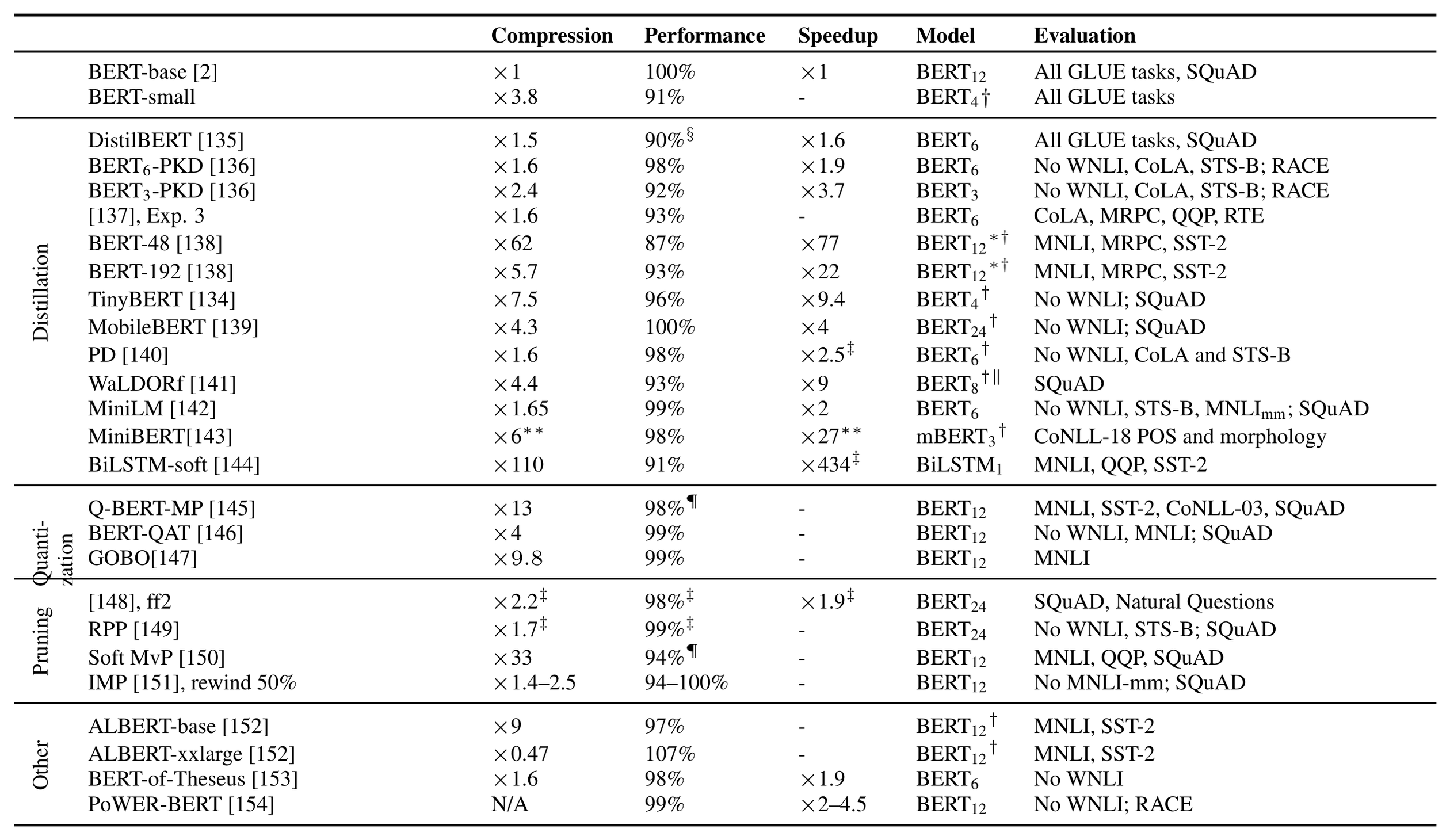
::: {caption="Table 1: Comparison of BERT compression studies. Compression, performance retention, inference time speedup figures are given with respect to BERT_base, unless indicated otherwise. Performance retention is measured as a ratio of average scores achieved by a given model and by BERT_base. The subscript in the model description reflects the number of layers used. $^{*}$Smaller vocabulary used. †The dimensionality of the hidden layers is reduced. $^{|}$Convolutional layers used. ‡Compared to BERT_large. $^{**}$Compared to mBERT. $^§$As reported in [134].$^¶$In comparison to the dev set."}
:::
6.1 Overparameterization
Transformer-based models keep growing by orders of magnitude: the 110M parameters of base BERT are now dwarfed by 17B parameters of Turing-NLG [155], which is dwarfed by 175B of GPT-3 [156]. This trend raises concerns about computational complexity of self-attention [157], environmental issues [158, 159], fair comparison of architectures [160], and reproducibility.
Human language is incredibly complex, and would perhaps take many more parameters to describe fully, but the current models do not make good use of the parameters they already have. [62] showed that all but a few Transformer heads could be pruned without significant losses in performance. For BERT, [61] observe that most heads in the same layer show similar self-attention patterns (perhaps related to the fact that the output of all self-attention heads in a layer is passed through the same MLP), which explains why [80] were able to reduce most layers to a single head.
Depending on the task, some BERT heads/layers are not only redundant [161], but also harmful to the downstream task performance. Positive effect from head disabling was reported for machine translation [80], abstractive summarization [162], and GLUE tasks [40]. Additionally, [27] examine the cumulative gains of their structural probing classifier, observing that in 5 out of 8 probing tasks some layers cause a drop in scores (typically in the final layers). [163] find that 30–40% of the weights can be pruned without impact on downstream tasks.
In general, larger BERT models perform better [7, 31], but not always: BERT-base outperformed BERT-large on subject-verb agreement [19] and sentence subject detection [5]. Given the complexity of language, and amounts of pre-training data, it is not clear why BERT ends up with redundant heads and layers. [61] suggest that one possible reason is the use of attention dropouts, which causes some attention weights to be zeroed-out during training.
6.2 Compression techniques
Given the above evidence of overparameterization, it does not come as a surprise that BERT can be efficiently compressed with minimal accuracy loss, which would be highly desirable for real-world applications. Such efforts to date are summarized in Table 1. The main approaches are knowledge distillation, quantization, and pruning.
The studies in the knowledge distillation framework [164] use a smaller student-network trained to mimic the behavior of a larger teacher-network. For BERT, this has been achieved through experiments with loss functions [165, 134], mimicking the activation patterns of individual portions of the teacher network [136], and knowledge transfer at the pre-training [140, 134, 139] or fine-tuning stage [134]. [148] suggest that distillation has so far worked better for GLUE than for reading comprehension, and report good results for QA from a combination of structured pruning and task-specific distillation.
Quantization decreases BERT's memory footprint through lowering the precision of its weights [145, 146]. Note that this strategy often requires compatible hardware.
As discussed in Section 6, individual self-attention heads and BERT layers can be disabled without significant drop in performance [80, 40, 162]. Pruning is a compression technique that takes advantage of that fact, typically reducing the amount of computation via zeroing out of certain parts of the large model. In structured pruning, architecture blocks are dropped, as in LayerDrop [166]. In unstructured, the weights in the entire model are pruned irrespective of their location, as in magnitude pruning [151] or movement pruning [150].
[75] and [151] explore BERT from the perspective of the lottery ticket hypothesis [167], looking specifically at the "winning" subnetworks in pre-trained BERT. They independently find that such subnetworks do exist, and that transferability between subnetworks for different tasks varies.
If the ultimate goal of training BERT is compression, [168] recommend training larger models and compressing them heavily rather than compressing smaller models lightly.
Other techniques include decomposing BERT's embedding matrix into smaller matrices [101], progressive module replacing [153] and dynamic elimination of intermediate encoder outputs [154]. See [169] for a more detailed discussion of compression methods.
6.3 Pruning and model analysis
There is a nascent discussion around pruning as a model analysis technique. The basic idea is that a compressed model a priori consists of elements that are useful for prediction; therefore by finding out what they do we may find out what the whole network does. For instance, BERT has heads that seem to encode frame-semantic relations, but disabling them might not hurt downstream task performance [40]; this suggests that this knowledge is not actually used.
For the base Transformer, [62] identify the functions of self-attention heads and then check which of them survive the pruning, finding that the syntactic and positional heads are the last ones to go. For BERT, [75] go in the opposite direction: pruning on the basis of importance scores, and interpreting the remaining "good" subnetwork. With respect to self-attention heads specifically, it does not seem to be the case that only the heads that potentially encode non-trivial linguistic patterns survive the pruning.
The models and methodology in these studies differ, so the evidence is inconclusive. In particular, [62] find that before pruning the majority of heads are syntactic, and [75] – that the majority of heads do not have potentially non-trivial attention patterns.
An important limitation of the current head and layer ablation studies [80, 40] is that they inherently assume that certain knowledge is contained in heads/layers. However, there is evidence of more diffuse representations spread across the full network, such as the gradual increase in accuracy on difficult semantic parsing tasks [27] or the absence of heads that would perform parsing "in general" [61, 12]. If so, ablating individual components harms the weight-sharing mechanism. Conclusions from component ablations are also problematic if the same information is duplicated elsewhere in the network.
7. Directions for further research
Section Summary: Although BERT has driven major progress in language understanding, researchers still lack a full picture of how it actually works and often find that it relies on superficial shortcuts rather than genuine reasoning. Promising next steps include creating harder benchmarks that test true verbal reasoning and broad linguistic knowledge, developing techniques to explicitly teach models logical operations, and shifting attention from what the model stores to what information it actually uses during predictions. These directions aim to move beyond current probing methods and produce more robust, trustworthy language models.
BERTology has clearly come a long way, but it is fair to say we still have more questions than answers about how BERT works. In this section, we list what we believe to be the most promising directions for further research.
Benchmarks that require verbal reasoning. While BERT enabled breakthroughs on many NLP benchmarks, a growing list of analysis papers are showing that its language skills are not as impressive as it seems. In particular, it was shown to rely on shallow heuristics in natural language inference [170, 171, 172], reading comprehension [173, 174, 175, 176, 177], argument reasoning comprehension [178], and text classification [172]. Such heuristics can even be used to reconstruct a non-publicly-available model [179]. As with any optimization method, if there is a shortcut in the data, we have no reason to expect BERT to not learn it. But harder datasets that cannot be resolved with shallow heuristics are unlikely to emerge if their development is not as valued as modeling work.
Benchmarks for the full range of linguistic competence. While the language models seem to acquire a great deal of knowledge about language, we do not currently have comprehensive stress tests for different aspects of linguistic knowledge. A step in this direction is the "Checklist" behavioral testing [180], the best paper at ACL 2020. Ideally, such tests would measure not only errors, but also sensitivity [22].
Developing methods to "teach" reasoning.
While large pre-trained models have a lot of knowledge, they often fail if any reasoning needs to be performed on top of the facts they possess ([181], see also Section 3.3). For instance, [182] propose a method to "teach" BERT quantification, conditionals, comparatives, and boolean coordination.
Learning what happens at inference time.
Most BERT analysis papers focus on different probes of the model, with the goal to find what the language model "knows". However, probing studies have limitations (Section 3.4), and to this point, far fewer papers have focused on discovering what knowledge actually gets used. Several promising directions are the "amnesic probing" [42], identifying features important for prediction for a given task [183], and pruning the model to remove the non-important components [62, 80, 75].
8. Conclusion
Section Summary: BERT has quickly become a standard starting point for experiments in natural language processing and has sparked many follow-up studies that examine the model and suggest ways to improve it. The pace of new papers on the topic continues to increase rather than slow down. The authors hope their survey will help researchers concentrate on the field's most important open questions.
In a little over a year, BERT has become a ubiquitous baseline in NLP experiments and inspired numerous studies analyzing the model and proposing various improvements. The stream of papers seems to be accelerating rather than slowing down, and we hope that this survey helps the community to focus on the biggest unresolved questions.
9. Acknowledgements
We thank the anonymous reviewers for their valuable feedback. This work is funded in part by the NSF award number IIS-1844740 to Anna Rumshisky.
References
Section Summary: This section compiles a list of academic papers and preprints focused on transformer-based language models and their linguistic capabilities. It begins with foundational works on attention mechanisms, BERT pretraining, and neural machine translation, then shifts to studies that probe these models for syntactic knowledge, grammar induction, and structural representations. Additional entries address tools like the Hugging Face library and experiments testing how neural networks acquire or represent sentence structure from data.
[1] Ashish Vaswani, Noam Shazeer, Niki Parmar, Jakob Uszkoreit, Llion Jones, Aidan N Gomez, Łukasz Kaiser, and Illia Polosukhin. 2017. Attention is All you Need. In Advances in neural information processing systems, pages 5998–6008.
[2] Jacob Devlin, Ming-Wei Chang, Kenton Lee, and Kristina Toutanova. 2019. BERT: Pre-training of Deep Bidirectional Transformers for Language Understanding. In Proceedings of the 2019 Conference of the North American Chapter of the Association for Computational Linguistics: Human Language Technologies, Volume 1 (Long and Short Papers), pages 4171–4186.
[3] Yonghui Wu, Mike Schuster, Zhifeng Chen, Quoc V Le, Mohammad Norouzi, Wolfgang Macherey, Maxim Krikun, Yuan Cao, Qin Gao, Klaus Macherey, et al. 2016. Google's Neural Machine Translation System: Bridging the Gap between Human and Machine Translation. arXiv preprint arXiv:1609.08144.
[4] Thomas Wolf, Lysandre Debut, Victor Sanh, Julien Chaumond, Clement Delangue, Anthony Moi, Pierric Cistac, Tim Rault, Rémi Louf, Morgan Funtowicz, and Jamie Brew. 2020. HuggingFace's Transformers: State-of-the-Art Natural Language Processing. arXiv:1910.03771 [cs].
[5] Yongjie Lin, Yi Chern Tan, and Robert Frank. 2019. Open Sesame: Getting inside BERT's Linguistic Knowledge. In Proceedings of the 2019 ACL Workshop BlackboxNLP: Analyzing and Interpreting Neural Networks for NLP, pages 241–253.
[6] Ian Tenney, Patrick Xia, Berlin Chen, Alex Wang, Adam Poliak, R. Thomas McCoy, Najoung Kim, Benjamin Van Durme, Samuel R. Bowman, Dipanjan Das, and Ellie Pavlick. 2019b. What do you learn from context? Probing for sentence structure in contextualized word representations. In International Conference on Learning Representations.
[7] Nelson F. Liu, Matt Gardner, Yonatan Belinkov, Matthew E. Peters, and Noah A. Smith. 2019a. Linguistic Knowledge and Transferability of Contextual Representations. In Proceedings of the 2019 Conference of the North American Chapter of the Association for Computational Linguistics: Human Language Technologies, Volume 1 (Long and Short Papers), pages 1073–1094, Minneapolis, Minnesota. Association for Computational Linguistics.
[8] David Vilares, Michalina Strzyz, Anders Søgaard, and Carlos Gómez-Rodríguez. 2020. Parsing as pretraining. In Thirty-Fourth AAAI Conference on Artificial Intelligence (AAAI-20).
[9] Taeuk Kim, Jihun Choi, Daniel Edmiston, and Sang-goo Lee. 2020. Are pre-trained language models aware of phrases? simple but strong baselines for grammar induction. In ICLR 2020.
[10] Rudolf Rosa and David Mareček. 2019. Inducing syntactic trees from BERT representations. arXiv preprint arXiv:1906.11511.
[11] Alex Warstadt and Samuel R. Bowman. 2020. Can neural networks acquire a structural bias from raw linguistic data? In Proceedings of the 42nd Annual Virtual Meeting of the Cognitive Science Society, Online.
[12] Phu Mon Htut, Jason Phang, Shikha Bordia, and Samuel R Bowman. 2019. Do attention heads in BERT track syntactic dependencies? arXiv preprint arXiv:1911.12246.
[13] Ganesh Jawahar, Benoît Sagot, Djamé Seddah, Samuel Unicomb, Gerardo Iñiguez, Márton Karsai, Yannick Léo, Márton Karsai, Carlos Sarraute, Éric Fleury, et al. 2019. What does BERT learn about the structure of language? In 57th Annual Meeting of the Association for Computational Linguistics (ACL), Florence, Italy.
[14] John Hewitt and Christopher D. Manning. 2019. A Structural Probe for Finding Syntax in Word Representations. In Proceedings of the 2019 Conference of the North American Chapter of the Association for Computational Linguistics: Human Language Technologies, Volume 1 (Long and Short Papers), pages 4129–4138.
[15] Bibliography entry for citation key "ManningClarkEtAl_202 $0_E$ mergent_linguistic_structure_in_artificial_neural_networks_trained_by_self-supervision" was not supplied with the source.
[16] R. Thomas McCoy, Tal Linzen, Ewan Dunbar, and Paul Smolensky. 2019a. RNNs implicitly implement tensor-product representations. In International Conference on Learning Representations.
[17] Alessio Miaschi and Felice Dell'Orletta. 2020. Contextual and Non-Contextual Word Embeddings: An in-depth Linguistic Investigation. In Proceedings of the 5th Workshop on Representation Learning for NLP, pages 110–119.
[18] Zhiyong Wu, Yun Chen, Ben Kao, and Qun Liu. 2020. Perturbed Masking: Parameter-free Probing for Analyzing and Interpreting BERT. In Proceedings of the 58th Annual Meeting of the Association for Computational Linguistics, pages 4166–4176, Online. Association for Computational Linguistics.
[19] Yoav Goldberg. 2019. Assessing BERT's syntactic abilities. arXiv preprint arXiv:1901.05287.
[20] Marten van Schijndel, Aaron Mueller, and Tal Linzen. 2019. Quantity doesn't buy quality syntax with neural language models. In Proceedings of the 2019 Conference on Empirical Methods in Natural Language Processing and the 9th International Joint Conference on Natural Language Processing (EMNLP-IJCNLP), pages 5831–5837, Hong Kong, China. Association for Computational Linguistics.
[21] Alex Warstadt, Yu Cao, Ioana Grosu, Wei Peng, Hagen Blix, Yining Nie, Anna Alsop, Shikha Bordia, Haokun Liu, Alicia Parrish, et al. 2019. Investigating BERT's Knowledge of Language: Five Analysis Methods with NPIs. In Proceedings of the 2019 Conference on Empirical Methods in Natural Language Processing and the 9th International Joint Conference on Natural Language Processing (EMNLP-IJCNLP), pages 2870–2880.
[22] Allyson Ettinger. 2019. What BERT is not: Lessons from a new suite of psycholinguistic diagnostics for language models. arXiv:1907.13528 [cs].
[23] Goran Glavaš and Ivan Vulić. 2020. Is Supervised Syntactic Parsing Beneficial for Language Understanding? An Empirical Investigation. arXiv:2008.06788 [cs].
[24] Eric Wallace, Shi Feng, Nikhil Kandpal, Matt Gardner, and Sameer Singh. 2019a. Universal Adversarial Triggers for Attacking and Analyzing NLP. In Proceedings of the 2019 Conference on Empirical Methods in Natural Language Processing and the 9th International Joint Conference on Natural Language Processing (EMNLP-IJCNLP), pages 2153–2162, Hong Kong, China. Association for Computational Linguistics.
[25] Eric Wallace, Yizhong Wang, Sujian Li, Sameer Singh, and Matt Gardner. 2019b. Do NLP Models Know Numbers? Probing Numeracy in Embeddings. arXiv preprint arXiv:1909.07940.
[26] Sriram Balasubramanian, Naman Jain, Gaurav Jindal, Abhijeet Awasthi, and Sunita Sarawagi. 2020. What's in a Name? Are BERT Named Entity Representations just as Good for any other Name? In Proceedings of the 5th Workshop on Representation Learning for NLP, pages 205–214, Online. Association for Computational Linguistics.
[27] Ian Tenney, Dipanjan Das, and Ellie Pavlick. 2019a. BERT Rediscovers the Classical NLP Pipeline. In Proceedings of the 57th Annual Meeting of the Association for Computational Linguistics, pages 4593–4601.
[28] Samuel Broscheit. 2019. Investigating Entity Knowledge in BERT with Simple Neural End-To-End Entity Linking. In Proceedings of the 23rd Conference on Computational Natural Language Learning (CoNLL), pages 677–685, Hong Kong, China. Association for Computational Linguistics.
[29] Jeff Da and Jungo Kasai. 2019. Cracking the Contextual Commonsense Code: Understanding Commonsense Reasoning Aptitude of Deep Contextual Representations. In Proceedings of the First Workshop on Commonsense Inference in Natural Language Processing, pages 1–12, Hong Kong, China. Association for Computational Linguistics.
[30] Fabio Petroni, Tim Rocktäschel, Sebastian Riedel, Patrick Lewis, Anton Bakhtin, Yuxiang Wu, and Alexander Miller. 2019. Language Models as Knowledge Bases? In Proceedings of the 2019 Conference on Empirical Methods in Natural Language Processing and the 9th International Joint Conference on Natural Language Processing (EMNLP-IJCNLP), pages 2463–2473, Hong Kong, China. Association for Computational Linguistics.
[31] Adam Roberts, Colin Raffel, and Noam Shazeer. 2020. How Much Knowledge Can You Pack Into the Parameters of a Language Model? arXiv preprint arXiv:2002.08910.
[32] Colin Raffel, Noam Shazeer, Adam Roberts, Katherine Lee, Sharan Narang, Michael Matena, Yanqi Zhou, Wei Li, and Peter J. Liu. 2019. Exploring the Limits of Transfer Learning with a Unified Text-to-Text Transformer. arXiv:1910.10683 [cs, stat].
[33] Joe Davison, Joshua Feldman, and Alexander Rush. 2019. Commonsense Knowledge Mining from Pretrained Models. In Proceedings of the 2019 Conference on Empirical Methods in Natural Language Processing and the 9th International Joint Conference on Natural Language Processing (EMNLP-IJCNLP), pages 1173–1178, Hong Kong, China. Association for Computational Linguistics.
[34] Zied Bouraoui, Jose Camacho-Collados, and Steven Schockaert. 2019. Inducing Relational Knowledge from BERT. arXiv:1911.12753 [cs].
[35] Zhengbao Jiang, Frank F. Xu, Jun Araki, and Graham Neubig. 2019b. How Can We Know What Language Models Know? arXiv:1911.12543 [cs].
[36] Maxwell Forbes, Ari Holtzman, and Yejin Choi. 2019. Do Neural Language Representations Learn Physical Commonsense? In Proceedings of the 41st Annual Conference of the Cognitive Science Society (CogSci 2019), page 7.
[37] Xuhui Zhou, Yue Zhang, Leyang Cui, and Dandan Huang. 2020. Evaluating Commonsense in Pre-Trained Language Models. In AAAI 2020.
[38] Kyle Richardson and Ashish Sabharwal. 2019. What Does My QA Model Know? Devising Controlled Probes using Expert Knowledge. arXiv:1912.13337 [cs].
[39] Nina Poerner, Ulli Waltinger, and Hinrich Schütze. 2019. BERT is not a knowledge base (yet): Factual knowledge vs. name-based reasoning in unsupervised qa. arXiv preprint arXiv:1911.03681.
[40] Olga Kovaleva, Alexey Romanov, Anna Rogers, and Anna Rumshisky. 2019. Revealing the Dark Secrets of BERT. In Proceedings of the 2019 Conference on Empirical Methods in Natural Language Processing and the 9th International Joint Conference on Natural Language Processing (EMNLP-IJCNLP), pages 4356–4365, Hong Kong, China. Association for Computational Linguistics.
[41] Ilia Kuznetsov and Iryna Gurevych. 2020. A Matter of Framing: The Impact of Linguistic Formalism on Probing Results. arXiv:2004.14999 [cs].
[42] Yanai Elazar, Shauli Ravfogel, Alon Jacovi, and Yoav Goldberg. 2020. When Bert Forgets How To POS: Amnesic Probing of Linguistic Properties and MLM Predictions. arXiv:2006.00995 [cs].
[43] Tiago Pimentel, Josef Valvoda, Rowan Hall Maudslay, Ran Zmigrod, Adina Williams, and Ryan Cotterell. 2020. Information-Theoretic Probing for Linguistic Structure. arXiv:2004.03061 [cs].
[44] Elena Voita and Ivan Titov. 2020. Information-Theoretic Probing with Minimum Description Length. arXiv:2003.12298 [cs].
[45] Tomas Mikolov, Ilya Sutskever, Kai Chen, Greg S. Corrado, and Jeff Dean. 2013. Distributed representations of words and phrases and their compositionality. In Advances in Neural Information Processing Systems 26 (NIPS 2013), pages 3111–3119.
[46] Lingpeng Kong, Cyprien de Masson d'Autume, Lei Yu, Wang Ling, Zihang Dai, and Dani Yogatama. 2019. A mutual information maximization perspective of language representation learning. In International Conference on Learning Representations.
[47] Alan Akbik, Tanja Bergmann, and Roland Vollgraf. 2019. Pooled Contextualized Embeddings for Named Entity Recognition. In Proceedings of the 2019 Conference of the North American Chapter of the Association for Computational Linguistics: Human Language Technologies, Volume 1 (Long and Short Papers), pages 724–728, Minneapolis, Minnesota. Association for Computational Linguistics.
[48] Rishi Bommasani, Kelly Davis, and Claire Cardie. 2020. Interpreting Pretrained Contextualized Representations via Reductions to Static Embeddings. In Proceedings of the 58th Annual Meeting of the Association for Computational Linguistics, pages 4758–4781.
[49] Chandler May, Alex Wang, Shikha Bordia, Samuel R. Bowman, and Rachel Rudinger. 2019. On Measuring Social Biases in Sentence Encoders. In Proceedings of the 2019 Conference of the North American Chapter of the Association for Computational Linguistics: Human Language Technologies, Volume 1 (Long and Short Papers), pages 622–628, Minneapolis, Minnesota. Association for Computational Linguistics.
[50] Yile Wang, Leyang Cui, and Yue Zhang. 2020d. How Can BERT Help Lexical Semantics Tasks? arXiv:1911.02929 [cs].
[51] Kawin Ethayarajh. 2019. How Contextual are Contextualized Word Representations? Comparing the Geometry of BERT, ELMo, and GPT-2 Embeddings. In Proceedings of the 2019 Conference on Empirical Methods in Natural Language Processing and the 9th International Joint Conference on Natural Language Processing (EMNLP-IJCNLP), pages 55–65, Hong Kong, China. Association for Computational Linguistics.
[52] Jiaqi Mu and Pramod Viswanath. 2018. All-but-the-top: Simple and effective postprocessing for word representations. In International Conference on Learning Representations.
[53] Elena Voita, Rico Sennrich, and Ivan Titov. 2019a. The Bottom-up Evolution of Representations in the Transformer: A Study with Machine Translation and Language Modeling Objectives. In Proceedings of the 2019 Conference on Empirical Methods in Natural Language Processing and the 9th International Joint Conference on Natural Language Processing (EMNLP-IJCNLP), pages 4387–4397.
[54] Gregor Wiedemann, Steffen Remus, Avi Chawla, and Chris Biemann. 2019. Does BERT Make Any Sense? Interpretable Word Sense Disambiguation with Contextualized Embeddings. arXiv preprint arXiv:1909.10430.
[55] Florian Schmidt and Thomas Hofmann. 2020. BERT as a Teacher: Contextual Embeddings for Sequence-Level Reward. arXiv preprint arXiv:2003.02738.
[56] Timothee Mickus, Denis Paperno, Mathieu Constant, and Kees van Deemeter. 2019. What do you mean, BERT? assessing BERT as a distributional semantics model. arXiv preprint arXiv:1911.05758.
[57] Hirotaka Tanaka, Hiroyuki Shinnou, Rui Cao, Jing Bai, and Wen Ma. 2020. Document Classification by Word Embeddings of BERT. In Computational Linguistics, Communications in Computer and Information Science, pages 145–154, Singapore. Springer.
[58] Xiaofei Ma, Zhiguo Wang, Patrick Ng, Ramesh Nallapati, and Bing Xiang. 2019. Universal Text Representation from BERT: An Empirical Study. arXiv:1910.07973 [cs].
[59] Shubham Toshniwal, Haoyue Shi, Bowen Shi, Lingyu Gao, Karen Livescu, and Kevin Gimpel. 2020. A Cross-Task Analysis of Text Span Representations. In Proceedings of the 5th Workshop on Representation Learning for NLP, pages 166–176, Online. Association for Computational Linguistics.
[60] Alessandro Raganato and Jörg Tiedemann. 2018. An Analysis of Encoder Representations in Transformer-Based Machine Translation. In Proceedings of the 2018 EMNLP Workshop BlackboxNLP: Analyzing and Interpreting Neural Networks for NLP, pages 287–297, Brussels, Belgium. Association for Computational Linguistics.
[61] Kevin Clark, Urvashi Khandelwal, Omer Levy, and Christopher D. Manning. 2019. What Does BERT Look at? An Analysis of BERT's Attention. In Proceedings of the 2019 ACL Workshop BlackboxNLP: Analyzing and Interpreting Neural Networks for NLP, pages 276–286, Florence, Italy. Association for Computational Linguistics.
[62] Elena Voita, David Talbot, Fedor Moiseev, Rico Sennrich, and Ivan Titov. 2019b. Analyzing Multi-Head Self-Attention: Specialized Heads Do the Heavy Lifting, the Rest Can Be Pruned. arXiv preprint arXiv:1905.09418.
[63] Benjamin Hoover, Hendrik Strobelt, and Sebastian Gehrmann. 2019. exBERT: A Visual Analysis Tool to Explore Learned Representations in Transformers Models. arXiv:1910.05276 [cs].
[64] Yiyun Zhao and Steven Bethard. 2020. How does BERT's attention change when you fine-tune? An analysis methodology and a case study in negation scope. In Proceedings of the 58th Annual Meeting of the Association for Computational Linguistics, pages 4729–4747, Online. Association for Computational Linguistics.
[65] Gonçalo M. Correia, Vlad Niculae, and André F. T. Martins. 2019. Adaptively Sparse Transformers. In Proceedings of the 2019 Conference on Empirical Methods in Natural Language Processing and the 9th International Joint Conference on Natural Language Processing (EMNLP-IJCNLP), pages 2174–2184, Hong Kong, China. Association for Computational Linguistics.
[66] Leyang Cui, Sijie Cheng, Yu Wu, and Yue Zhang. 2020. Does BERT Solve Commonsense Task via Commonsense Knowledge? arXiv:2008.03945 [cs].
[67] Sarthak Jain and Byron C. Wallace. 2019. Attention is not Explanation. In Proceedings of the 2019 Conference of the North American Chapter of the Association for Computational Linguistics: Human Language Technologies, Volume 1 (Long and Short Papers), pages 3543–3556.
[68] Sofia Serrano and Noah A. Smith. 2019. Is Attention Interpretable? arXiv:1906.03731 [cs].
[69] Sarah Wiegreffe and Yuval Pinter. 2019. Attention is not not Explanation. In Proceedings of the 2019 Conference on Empirical Methods in Natural Language Processing and the 9th International Joint Conference on Natural Language Processing (EMNLP-IJCNLP), pages 11–20, Hong Kong, China. Association for Computational Linguistics.
[70] Gino Brunner, Yang Liu, Damian Pascual, Oliver Richter, Massimiliano Ciaramita, and Roger Wattenhofer. 2020. On Identifiability in Transformers. In International Conference on Learning Representations.
[71] Jesse Vig. 2019. Visualizing Attention in Transformer-Based Language Representation Models. arXiv:1904.02679 [cs, stat].
[72] Yonatan Belinkov and James Glass. 2019. Analysis Methods in Neural Language Processing: A Survey. Transactions of the Association for Computational Linguistics, 7:49–72.
[73] Alex Wang, Amapreet Singh, Julian Michael, Felix Hill, Omer Levy, and Samuel R. Bowman. 2018. GLUE: A Multi-Task Benchmark and Analysis Platform for Natural Language Understanding. In Proceedings of the 2018 EMNLP Workshop BlackboxNLP: Analyzing and Interpreting Neural Networks for NLP, pages 353–355, Brussels, Belgium. Association for Computational Linguistics.
[74] Goro Kobayashi, Tatsuki Kuribayashi, Sho Yokoi, and Kentaro Inui. 2020. Attention Module is Not Only a Weight: Analyzing Transformers with Vector Norms. arXiv:2004.10102 [cs].
[75] Sai Prasanna, Anna Rogers, and Anna Rumshisky. 2020. When BERT Plays the Lottery, All Tickets Are Winning. In Proceedings of the 2020 Conference on Empirical Methods in Natural Language Processing, Online. Association for Computational Linguistics.
[76] Jesse Vig and Yonatan Belinkov. 2019. Analyzing the Structure of Attention in a Transformer Language Model. In Proceedings of the 2019 ACL Workshop BlackboxNLP: Analyzing and Interpreting Neural Networks for NLP, pages 63–76, Florence, Italy. Association for Computational Linguistics.
[77] Yaru Hao, Li Dong, Furu Wei, and Ke Xu. 2019. Visualizing and Understanding the Effectiveness of BERT. In Proceedings of the 2019 Conference on Empirical Methods in Natural Language Processing and the 9th International Joint Conference on Natural Language Processing (EMNLP-IJCNLP), pages 4143–4152, Hong Kong, China. Association for Computational Linguistics.
[78] Adele Goldberg. 2006. Constructions at Work: The Nature of Generalization in Language. Oxford University Press, USA.
[79] Zihan Wang, Stephen Mayhew, Dan Roth, et al. 2019b. Cross-Lingual Ability of Multilingual BERT: An Empirical Study. arXiv preprint arXiv:1912.07840.
[80] Paul Michel, Omer Levy, and Graham Neubig. 2019. Are Sixteen Heads Really Better than One? Advances in Neural Information Processing Systems 32 (NIPS 2019).
[81] Alessandro Raganato, Yves Scherrer, and Jörg Tiedemann. 2020. Fixed Encoder Self-Attention Patterns in Transformer-Based Machine Translation. arXiv:2002.10260 [cs].
[82] Ofir Press, Noah A. Smith, and Omer Levy. 2020. Improving Transformer Models by Reordering their Sublayers. In Proceedings of the 58th Annual Meeting of the Association for Computational Linguistics, pages 2996–3005, Online. Association for Computational Linguistics.
[83] Yinhan Liu, Myle Ott, Naman Goyal, Jingfei Du, Mandar Joshi, Danqi Chen, Omer Levy, Mike Lewis, Luke Zettlemoyer, and Veselin Stoyanov. 2019b. RoBERTa: A Robustly Optimized BERT Pretraining Approach. arXiv:1907.11692 [cs].
[84] Yang You, Jing Li, Sashank Reddi, Jonathan Hseu, Sanjiv Kumar, Srinadh Bhojanapalli, Xiaodan Song, James Demmel, and Cho-Jui Hsieh. 2019. Large Batch Optimization for Deep Learning: Training BERT in 76 Minutes. arXiv preprint arXiv:1904.00962, 1(5).
[85] Wenxuan Zhou, Junyi Du, and Xiang Ren. 2019. Improving BERT Fine-tuning with Embedding Normalization. arXiv preprint arXiv:1911.03918.
[86] Linyuan Gong, Di He, Zhuohan Li, Tao Qin, Liwei Wang, and Tieyan Liu. 2019. Efficient training of BERT by progressively stacking. In International Conference on Machine Learning, pages 2337–2346.
[87] Alexei Baevski, Sergey Edunov, Yinhan Liu, Luke Zettlemoyer, and Michael Auli. 2019. Cloze-driven Pretraining of Self-Attention Networks. In Proceedings of the 2019 Conference on Empirical Methods in Natural Language Processing and the 9th International Joint Conference on Natural Language Processing (EMNLP-IJCNLP), pages 5360–5369, Hong Kong, China. Association for Computational Linguistics.
[88] Stephane Clinchant, Kweon Woo Jung, and Vassilina Nikoulina. 2019. On the use of BERT for Neural Machine Translation. In Proceedings of the 3rd Workshop on Neural Generation and Translation, pages 108–117, Hong Kong. Association for Computational Linguistics.
[89] Kaitao Song, Xu Tan, Tao Qin, Jianfeng Lu, and Tie-Yan Liu. 2020. MPNet: Masked and Permuted Pre-training for Language Understanding. arXiv:2004.09297 [cs].
[90] Yiming Cui, Wanxiang Che, Ting Liu, Bing Qin, Ziqing Yang, Shijin Wang, and Guoping Hu. 2019. Pre-Training with Whole Word Masking for Chinese BERT. arXiv:1906.08101 [cs].
[91] Mandar Joshi, Danqi Chen, Yinhan Liu, Daniel S. Weld, Luke Zettlemoyer, and Omer Levy. 2020. SpanBERT: Improving Pre-Training by Representing and Predicting Spans. Transactions of the Association for Computational Linguistics, 8:64–77.
[92] Mike Lewis, Yinhan Liu, Naman Goyal, Marjan Ghazvininejad, Abdelrahman Mohamed, Omer Levy, Ves Stoyanov, and Luke Zettlemoyer. 2019. BART: Denoising Sequence-to-Sequence Pre-Training for Natural Language Generation, Translation, and Comprehension. arXiv:1910.13461 [cs, stat].
[93] Yu Sun, Shuohuan Wang, Yukun Li, Shikun Feng, Xuyi Chen, Han Zhang, Xin Tian, Danxiang Zhu, Hao Tian, and Hua Wu. 2019b. ERNIE: Enhanced Representation through Knowledge Integration. arXiv:1904.09223 [cs].
[94] Guillaume Lample and Alexis Conneau. 2019. Cross-Lingual Language Model Pretraining. arXiv:1901.07291 [cs].
[95] Hangbo Bao, Li Dong, Furu Wei, Wenhui Wang, Nan Yang, Xiaodong Liu, Yu Wang, Songhao Piao, Jianfeng Gao, Ming Zhou, and Hsiao-Wuen Hon. 2020. UniLMv2: Pseudo-Masked Language Models for Unified Language Model Pre-Training. arXiv:2002.12804 [cs].
[96] Yu Sun, Shuohuan Wang, Yukun Li, Shikun Feng, Hao Tian, Hua Wu, and Haifeng Wang. 2019c. ERNIE 2.0: A Continual Pre-Training Framework for Language Understanding. arXiv:1907.12412 [cs].
[97] Zhilin Yang, Zihang Dai, Yiming Yang, Jaime Carbonell, Ruslan Salakhutdinov, and Quoc V. Le. 2019. XLNet: Generalized Autoregressive Pretraining for Language Understanding. arXiv:1906.08237 [cs].
[98] Wei Wang, Bin Bi, Ming Yan, Chen Wu, Zuyi Bao, Liwei Peng, and Luo Si. 2019a. StructBERT: Incorporating Language Structures into Pre-Training for Deep Language Understanding. arXiv:1908.04577 [cs].
[99] Kevin Clark, Minh-Thang Luong, Quoc V. Le, and Christopher D. Manning. 2020. ELECTRA: Pre-Training Text Encoders as Discriminators Rather Than Generators. In International Conference on Learning Representations.
[100] Xingyi Cheng, Weidi Xu, Kunlong Chen, Wei Wang, Bin Bi, Ming Yan, Chen Wu, Luo Si, Wei Chu, and Taifeng Wang. 2019. Symmetric Regularization based BERT for Pair-Wise Semantic Reasoning. arXiv:1909.03405 [cs].
[101] Zhenzhong Lan, Mingda Chen, Sebastian Goodman, Kevin Gimpel, Piyush Sharma, and Radu Soricut. 2020a. ALBERT: A Lite BERT for Self-Supervised Learning of Language Representations. In ICLR.
[102] He Bai, Peng Shi, Jimmy Lin, Luchen Tan, Kun Xiong, Wen Gao, and Ming Li. 2020. SegaBERT: Pre-training of Segment-aware BERT for Language Understanding. arXiv:2004.14996 [cs].
[103] Changmao Li and Jinho D. Choi. 2020. Transformers to Learn Hierarchical Contexts in Multiparty Dialogue for Span-based Question Answering. In Proceedings of the 58th Annual Meeting of the Association for Computational Linguistics, pages 5709–5714, Online. Association for Computational Linguistics.
[104] Kelvin Guu, Kenton Lee, Zora Tung, Panupong Pasupat, and Ming-Wei Chang. 2020. REALM: Retrieval-Augmented Language Model Pre-Training. arXiv:2002.08909 [cs].
[105] Xiaozhi Wang, Tianyu Gao, Zhaocheng Zhu, Zhiyuan Liu, Juanzi Li, and Jian Tang. 2020c. KEPLER: A Unified Model for Knowledge Embedding and Pre-trained Language Representation. arXiv:1911.06136 [cs].
[106] Michael Glass, Alfio Gliozzo, Rishav Chakravarti, Anthony Ferritto, Lin Pan, G P Shrivatsa Bhargav, Dinesh Garg, and Avi Sil. 2020. Span Selection Pre-training for Question Answering. In Proceedings of the 58th Annual Meeting of the Association for Computational Linguistics, pages 2773–2782, Online. Association for Computational Linguistics.
[107] Alexis Conneau, Kartikay Khandelwal, Naman Goyal, Vishrav Chaudhary, Guillaume Wenzek, Francisco Guzmán, Edouard Grave, Myle Ott, Luke Zettlemoyer, and Veselin Stoyanov. 2019. Unsupervised Cross-Lingual Representation Learning at Scale. arXiv:1911.02116 [cs].
[108] Dhanasekar Sundararaman, Vivek Subramanian, Guoyin Wang, Shijing Si, Dinghan Shen, Dong Wang, and Lawrence Carin. 2019. Syntax-Infused Transformer and BERT models for Machine Translation and Natural Language Understanding. arXiv:1911.06156 [cs, stat].
[109] Zhuosheng Zhang, Yuwei Wu, Hai Zhao, Zuchao Li, Shuailiang Zhang, Xi Zhou, and Xiang Zhou. 2020. Semantics-aware BERT for Language Understanding. In AAAI 2020.
[110] Xing Wu, Shangwen Lv, Liangjun Zang, Jizhong Han, and Songlin Hu. 2019b. Conditional BERT Contextual Augmentation. In ICCS 2019: Computational Science – ICCS 2019, pages 84–95. Springer.
[111] Varun Kumar, Ashutosh Choudhary, and Eunah Cho. 2020. Data Augmentation using Pre-Trained Transformer Models. arXiv:2003.02245 [cs].
[112] Timo Schick and Hinrich Schütze. 2020. BERTRAM: Improved Word Embeddings Have Big Impact on Contextualized Model Performance. In Proceedings of the 58th Annual Meeting of the Association for Computational Linguistics, pages 3996–4007, Online. Association for Computational Linguistics.
[113] Matthew E. Peters, Mark Neumann, Robert Logan, Roy Schwartz, Vidur Joshi, Sameer Singh, and Noah A. Smith. 2019a. Knowledge Enhanced Contextual Word Representations. In Proceedings of the 2019 Conference on Empirical Methods in Natural Language Processing and the 9th International Joint Conference on Natural Language Processing (EMNLP-IJCNLP), pages 43–54, Hong Kong, China. Association for Computational Linguistics.
[114] Zhengyan Zhang, Xu Han, Zhiyuan Liu, Xin Jiang, Maosong Sun, and Qun Liu. 2019. ERNIE: Enhanced Language Representation with Informative Entities. In Proceedings of the 57th Annual Meeting of the Association for Computational Linguistics, pages 1441–1451, Florence, Italy. Association for Computational Linguistics.
[115] Pengcheng Yin, Graham Neubig, Wen-tau Yih, and Sebastian Riedel. 2020. TaBERT: Pretraining for Joint Understanding of Textual and Tabular Data. In Proceedings of the 58th Annual Meeting of the Association for Computational Linguistics, pages 8413–8426, Online. Association for Computational Linguistics.
[116] Ruize Wang, Duyu Tang, Nan Duan, Zhongyu Wei, Xuanjing Huang, Jianshu ji, Guihong Cao, Daxin Jiang, and Ming Zhou. 2020a. K-Adapter: Infusing Knowledge into Pre-Trained Models with Adapters. arXiv:2002.01808 [cs].
[117] Dan Kondratyuk and Milan Straka. 2019. 75 Languages, 1 Model: Parsing Universal Dependencies Universally. In Proceedings of the 2019 Conference on Empirical Methods in Natural Language Processing and the 9th International Joint Conference on Natural Language Processing (EMNLP-IJCNLP), pages 2779–2795, Hong Kong, China. Association for Computational Linguistics.
[118] Junjie Yang and Hai Zhao. 2019. Deepening Hidden Representations from Pre-Trained Language Models for Natural Language Understanding. arXiv:1911.01940 [cs].
[119] Ta-Chun Su and Hsiang-Chih Cheng. 2019. SesameBERT: Attention for Anywhere. arXiv:1910.03176 [cs].
[120] Jason Phang, Thibault Févry, and Samuel R. Bowman. 2019. Sentence Encoders on STILTs: Supplementary Training on Intermediate Labeled-Data Tasks. arXiv:1811.01088 [cs].
[121] Siddhant Garg, Thuy Vu, and Alessandro Moschitti. 2020. TANDA: Transfer and Adapt Pre-Trained Transformer Models for Answer Sentence Selection. In AAAI.
[122] Yuki Arase and Jun'ichi Tsujii. 2019. Transfer Fine-Tuning: A BERT Case Study. In Proceedings of the 2019 Conference on Empirical Methods in Natural Language Processing and the 9th International Joint Conference on Natural Language Processing (EMNLP-IJCNLP), pages 5393–5404, Hong Kong, China. Association for Computational Linguistics.
[123] Yada Pruksachatkun, Jason Phang, Haokun Liu, Phu Mon Htut, Xiaoyi Zhang, Richard Yuanzhe Pang, Clara Vania, Katharina Kann, and Samuel R. Bowman. 2020. Intermediate-Task Transfer Learning with Pretrained Language Models: When and Why Does It Work? In Proceedings of the 58th Annual Meeting of the Association for Computational Linguistics, pages 5231–5247, Online. Association for Computational Linguistics.
[124] Eyal Ben-David, Carmel Rabinovitz, and Roi Reichart. 2020. PERL: Pivot-based Domain Adaptation for Pre-trained Deep Contextualized Embedding Models. arXiv:2006.09075 [cs].
[125] Chen Zhu, Yu Cheng, Zhe Gan, Siqi Sun, Tom Goldstein, and Jingjing Liu. 2019. FreeLB: Enhanced Adversarial Training for Language Understanding. arXiv:1909.11764 [cs].
[126] Haoming Jiang, Pengcheng He, Weizhu Chen, Xiaodong Liu, Jianfeng Gao, and Tuo Zhao. 2019a. SMART: Robust and Efficient Fine-Tuning for Pre-trained Natural Language Models through Principled Regularized Optimization. arXiv preprint arXiv:1911.03437.
[127] Cheolhyoung Lee, Kyunghyun Cho, and Wanmo Kang. 2019. Mixout: Effective regularization to finetune large-scale pretrained language models. arXiv preprint arXiv:1909.11299.
[128] Neil Houlsby, Andrei Giurgiu, Stanislaw Jastrzebski, Bruna Morrone, Quentin de Laroussilhe, Andrea Gesmundo, Mona Attariyan, and Sylvain Gelly. 2019. Parameter-Efficient Transfer Learning for NLP. arXiv:1902.00751 [cs, stat].
[129] Asa Cooper Stickland and Iain Murray. 2019. BERT and PALs: Projected Attention Layers for Efficient Adaptation in Multi-Task Learning. In International Conference on Machine Learning, pages 5986–5995.
[130] Mikel Artetxe, Sebastian Ruder, and Dani Yogatama. 2019. On the Cross-lingual Transferability of Monolingual Representations. arXiv:1911.03310 [cs].
[131] Matthew E. Peters, Sebastian Ruder, and Noah A. Smith. 2019b. To Tune or Not to Tune? Adapting Pretrained Representations to Diverse Tasks. In Proceedings of the 4th Workshop on Representation Learning for NLP (RepL4NLP-2019), pages 7–14, Florence, Italy. Association for Computational Linguistics.
[132] Matt Crane. 2018. Questionable Answers in Question Answering Research: Reproducibility and Variability of Published Results. Transactions of the Association for Computational Linguistics, 6:241–252.
[133] Jesse Dodge, Gabriel Ilharco, Roy Schwartz, Ali Farhadi, Hannaneh Hajishirzi, and Noah Smith. 2020. Fine-Tuning Pretrained Language Models: Weight Initializations, Data Orders, and Early Stopping. arXiv:2002.06305 [cs].
[134] Xiaoqi Jiao, Yichun Yin, Lifeng Shang, Xin Jiang, Xiao Chen, Linlin Li, Fang Wang, and Qun Liu. 2019. TinyBERT: Distilling BERT for natural language understanding. arXiv preprint arXiv:1909.10351.
[135] Victor Sanh, Lysandre Debut, Julien Chaumond, and Thomas Wolf. 2019a. Distilbert, a distilled version of BERT: smaller, faster, cheaper and lighter. arXiv preprint arXiv:1910.01108.
[136] Siqi Sun, Yu Cheng, Zhe Gan, and Jingjing Liu. 2019a. Patient Knowledge Distillation for BERT Model Compression. In Proceedings of the 2019 Conference on Empirical Methods in Natural Language Processing and the 9th International Joint Conference on Natural Language Processing (EMNLP-IJCNLP), pages 4314–4323.
[137] Gustavo Aguilar, Yuan Ling, Yu Zhang, Benjamin Yao, Xing Fan, and Edward Guo. 2019. Knowledge Distillation from Internal Representations. arXiv preprint arXiv:1910.03723.
[138] Sanqiang Zhao, Raghav Gupta, Yang Song, and Denny Zhou. 2019. Extreme Language Model Compression with Optimal Subwords and Shared Projections. arXiv preprint arXiv:1909.11687.
[139] Zhiqing Sun, Hongkun Yu, Xiaodan Song, Renjie Liu, Yiming Yang, and Denny Zhou. 2020. MobileBERT: Task-Agnostic Compression of BERT for Resource Limited Devices.
[140] Iulia Turc, Ming-Wei Chang, Kenton Lee, and Kristina Toutanova. 2019. Well-Read Students Learn Better: The Impact of Student Initialization on Knowledge Distillation. arXiv preprint arXiv:1908.08962.
[141] James Yi Tian, Alexander P Kreuzer, Pai-Hung Chen, and Hans-Martin Will. 2019. WaLDORf: Wasteless Language-model Distillation On Reading-comprehension. arXiv preprint arXiv:1912.06638.
[142] Wenhui Wang, Furu Wei, Li Dong, Hangbo Bao, Nan Yang, and Ming Zhou. 2020b. MiniLM: Deep Self-Attention Distillation for Task-Agnostic Compression of Pre-Trained Transformers. arXiv preprint arXiv:2002.10957.
[143] Henry Tsai, Jason Riesa, Melvin Johnson, Naveen Arivazhagan, Xin Li, and Amelia Archer. 2019. Small and Practical BERT Models for Sequence Labeling. arXiv preprint arXiv:1909.00100.
[144] Raphael Tang, Yao Lu, Linqing Liu, Lili Mou, Olga Vechtomova, and Jimmy Lin. 2019. Distilling Task-Specific Knowledge from BERT into Simple Neural Networks. arXiv preprint arXiv:1903.12136.
[145] Sheng Shen, Zhen Dong, Jiayu Ye, Linjian Ma, Zhewei Yao, Amir Gholami, Michael W Mahoney, and Kurt Keutzer. 2019. Q-BERT: Hessian Based Ultra Low Precision Quantization of BERT. arXiv preprint arXiv:1909.05840.
[146] Ofir Zafrir, Guy Boudoukh, Peter Izsak, and Moshe Wasserblat. 2019. Q8BERT: Quantized 8bit BERT. arXiv preprint arXiv:1910.06188.
[147] Ali Hadi Zadeh and Andreas Moshovos. 2020. GOBO: Quantizing Attention-Based NLP Models for Low Latency and Energy Efficient Inference. arXiv:2005.03842 [cs, stat].
[148] J. S. McCarley, Rishav Chakravarti, and Avirup Sil. 2020. Structured Pruning of a BERT-based Question Answering Model. arXiv:1910.06360 [cs].
[149] Fu-Ming Guo, Sijia Liu, Finlay S. Mungall, Xue Lin, and Yanzhi Wang. 2019. Reweighted Proximal Pruning for Large-Scale Language Representation. arXiv:1909.12486 [cs, stat].
[150] Victor Sanh, Thomas Wolf, and Alexander M. Rush. 2020. Movement Pruning: Adaptive Sparsity by Fine-Tuning. arXiv:2005.07683 [cs].
[151] Tianlong Chen, Jonathan Frankle, Shiyu Chang, Sijia Liu, Yang Zhang, Zhangyang Wang, and Michael Carbin. 2020. The Lottery Ticket Hypothesis for Pre-trained BERT Networks. arXiv:2007.12223 [cs, stat].
[152] Zhenzhong Lan, Mingda Chen, Sebastian Goodman, Kevin Gimpel, Piyush Sharma, and Radu Soricut. 2020b. ALBERT: A Lite BERT for Self-supervised Learning of Language Representations. In ICLR 2020.
[153] Canwen Xu, Wangchunshu Zhou, Tao Ge, Furu Wei, and Ming Zhou. 2020. BERT-of-Theseus: Compressing BERT by Progressive Module Replacing. arXiv preprint arXiv:2002.02925.
[154] Saurabh Goyal, Anamitra Roy Choudhary, Venkatesan Chakaravarthy, Saurabh ManishRaje, Yogish Sabharwal, and Ashish Verma. 2020. Power-bert: Accelerating BERT inference for classification tasks. arXiv preprint arXiv:2001.08950.
[155] Microsoft. 2020. Turing-NLG: A 17-billion-parameter language model by microsoft.
[156] Tom B. Brown, Benjamin Mann, Nick Ryder, Melanie Subbiah, Jared Kaplan, Prafulla Dhariwal, Arvind Neelakantan, Pranav Shyam, Girish Sastry, Amanda Askell, Sandhini Agarwal, Ariel Herbert-Voss, Gretchen Krueger, Tom Henighan, Rewon Child, Aditya Ramesh, Daniel M. Ziegler, Jeffrey Wu, Clemens Winter, Christopher Hesse, Mark Chen, Eric Sigler, Mateusz Litwin, Scott Gray, Benjamin Chess, Jack Clark, Christopher Berner, Sam McCandlish, Alec Radford, Ilya Sutskever, and Dario Amodei. 2020. Language Models are Few-Shot Learners. arXiv:2005.14165 [cs].
[157] Felix Wu, Angela Fan, Alexei Baevski, Yann Dauphin, and Michael Auli. 2019a. Pay Less Attention with Lightweight and Dynamic Convolutions. In International Conference on Learning Representations.
[158] Emma Strubell, Ananya Ganesh, and Andrew McCallum. 2019. Energy and Policy Considerations for Deep Learning in NLP. In ACL 2019.
[159] Roy Schwartz, Jesse Dodge, Noah A. Smith, and Oren Etzioni. 2019. Green AI. arXiv:1907.10597 [cs, stat].
[160] Matthias Aßenmacher and Christian Heumann. 2020. On the comparability of Pre-Trained Language Models. arXiv:2001.00781 [cs, stat].
[161] Wei-Tsung Kao, Tsung-Han Wu, Po-Han Chi, Chun-Cheng Hsieh, and Hung-Yi Lee. 2020. Further boosting BERT-based models by duplicating existing layers: Some intriguing phenomena inside BERT. arXiv preprint arXiv:2001.09309.
[162] Joris Baan, Maartje ter Hoeve, Marlies van der Wees, Anne Schuth, and Maarten de Rijke. 2019. Understanding Multi-Head Attention in Abstractive Summarization. arXiv preprint arXiv:1911.03898.
[163] Mitchell A Gordon, Kevin Duh, and Nicholas Andrews. 2020. Compressing BERT: Studying the effects of weight pruning on transfer learning. arXiv preprint arXiv:2002.08307.
[164] Geoffrey Hinton, Oriol Vinyals, and Jeff Dean. 2014. Distilling the Knowledge in a Neural Network. In Deep Learning and Representation Learning Workshop: NIPS 2014.
[165] Victor Sanh, Lysandre Debut, Julien Chaumond, and Thomas Wolf. 2019b. DistilBERT, a distilled version of BERT: Smaller, faster, cheaper and lighter. In 5th Workshop on Energy Efficient Machine Learning and Cognitive Computing - NeurIPS 2019.
[166] Angela Fan, Edouard Grave, and Armand Joulin. 2019. Reducing Transformer Depth on Demand with Structured Dropout. In International Conference on Learning Representations.
[167] Jonathan Frankle and Michael Carbin. 2019. The Lottery Ticket Hypothesis: Finding Sparse, Trainable Neural Networks. In International Conference on Learning Representations.
[168] Zhuohan Li, Eric Wallace, Sheng Shen, Kevin Lin, Kurt Keutzer, Dan Klein, and Joseph E Gonzalez. 2020. Train large, then compress: Rethinking model size for efficient training and inference of transformers. arXiv preprint arXiv:2002.11794.
[169] Prakhar Ganesh, Yao Chen, Xin Lou, Mohammad Ali Khan, Yin Yang, Deming Chen, Marianne Winslett, Hassan Sajjad, and Preslav Nakov. 2020. Compressing large-scale transformer-based models: A case study on BERT. arXiv preprint arXiv:2002.11985.
[170] Tom McCoy, Ellie Pavlick, and Tal Linzen. 2019b. Right for the Wrong Reasons: Diagnosing Syntactic Heuristics in Natural Language Inference. In Proceedings of the 57th Annual Meeting of the Association for Computational Linguistics, pages 3428–3448, Florence, Italy. Association for Computational Linguistics.
[171] Rowan Zellers, Ari Holtzman, Yonatan Bisk, Ali Farhadi, and Yejin Choi. 2019. HellaSwag: Can a Machine Really Finish Your Sentence? In Proceedings of the 57th Annual Meeting of the Association for Computational Linguistics, pages 4791–4800.
[172] Di Jin, Zhijing Jin, Joey Tianyi Zhou, and Peter Szolovits. 2020. Is BERT Really Robust? A Strong Baseline for Natural Language Attack on Text Classification and Entailment. In AAAI 2020.
[173] Chenglei Si, Shuohang Wang, Min-Yen Kan, and Jing Jiang. 2019a. What does BERT learn from multiple-choice reading comprehension datasets? arXiv preprint arXiv:1910.12391.
[174] Anna Rogers, Olga Kovaleva, Matthew Downey, and Anna Rumshisky. 2020. Getting Closer to AI Complete Question Answering: A Set of Prerequisite Real Tasks. In AAAI, page 11.
[175] Saku Sugawara, Pontus Stenetorp, Kentaro Inui, and Akiko Aizawa. 2020. Assessing the Benchmarking Capacity of Machine Reading Comprehension Datasets. In AAAI.
[176] Chenglei Si, Shuohang Wang, Min-Yen Kan, and Jing Jiang. 2019b. What does BERT Learn from Multiple-Choice Reading Comprehension Datasets? arXiv:1910.12391 [cs].
[177] Dani Yogatama, Cyprien de Masson d'Autume, Jerome Connor, Tomas Kocisky, Mike Chrzanowski, Lingpeng Kong, Angeliki Lazaridou, Wang Ling, Lei Yu, Chris Dyer, and Phil Blunsom. 2019. Learning and Evaluating General Linguistic Intelligence. arXiv:1901.11373 [cs, stat].
[178] Timothy Niven and Hung-Yu Kao. 2019. Probing Neural Network Comprehension of Natural Language Arguments. In Proceedings of the 57th Annual Meeting of the Association for Computational Linguistics, pages 4658–4664, Florence, Italy. Association for Computational Linguistics.
[179] Kalpesh Krishna, Gaurav Singh Tomar, Ankur P. Parikh, Nicolas Papernot, and Mohit Iyyer. 2020. Thieves on Sesame Street! Model Extraction of BERT-Based APIs. In ICLR 2020.
[180] Marco Tulio Ribeiro, Tongshuang Wu, Carlos Guestrin, and Sameer Singh. 2020. Beyond Accuracy: Behavioral Testing of NLP Models with CheckList. In Proceedings of the 58th Annual Meeting of the Association for Computational Linguistics, pages 4902–4912, Online. Association for Computational Linguistics.
[181] Alon Talmor, Yanai Elazar, Yoav Goldberg, and Jonathan Berant. 2019. oLMpics – On what Language Model Pre-Training Captures. arXiv:1912.13283 [cs].
[182] Kyle Richardson, Hai Hu, Lawrence S. Moss, and Ashish Sabharwal. 2020. Probing Natural Language Inference Models through Semantic Fragments. In AAAI 2020.
[183] Ekaterina Arkhangelskaia and Sourav Dutta. 2019. Whatcha lookin'at? DeepLIFTing BERT's Attention in Question Answering. arXiv preprint arXiv:1910.06431.