Straightening Out the Straight-Through Estimator: Overcoming Optimization Challenges in Vector Quantized Networks
Minyoung HuhBrian CheungPulkit AgrawalPhillip Isola
Identifies internal codebook covariate shift as the fundamental cause of index collapse in vector-quantized networks and introduces an affine re-parameterization alongside alternating optimization to stabilize training across vision and generative architectures.
Vector-quantized neural networks convert continuous data representations into discrete codes, making them foundational for modern compressed image generation, speech processing, and decision-making systems. However, training these models is notoriously brittle and unstable due to an issue known as index collapse, where the network abandons most of its available discrete codes early in optimization. Historically, practitioners have relied on heuristic fixes like randomly resetting unused codes rather than solving the underlying mathematical failure. The article investigates the root causes of this optimization instability and develops principled techniques to stabilize vector-quantized model training.
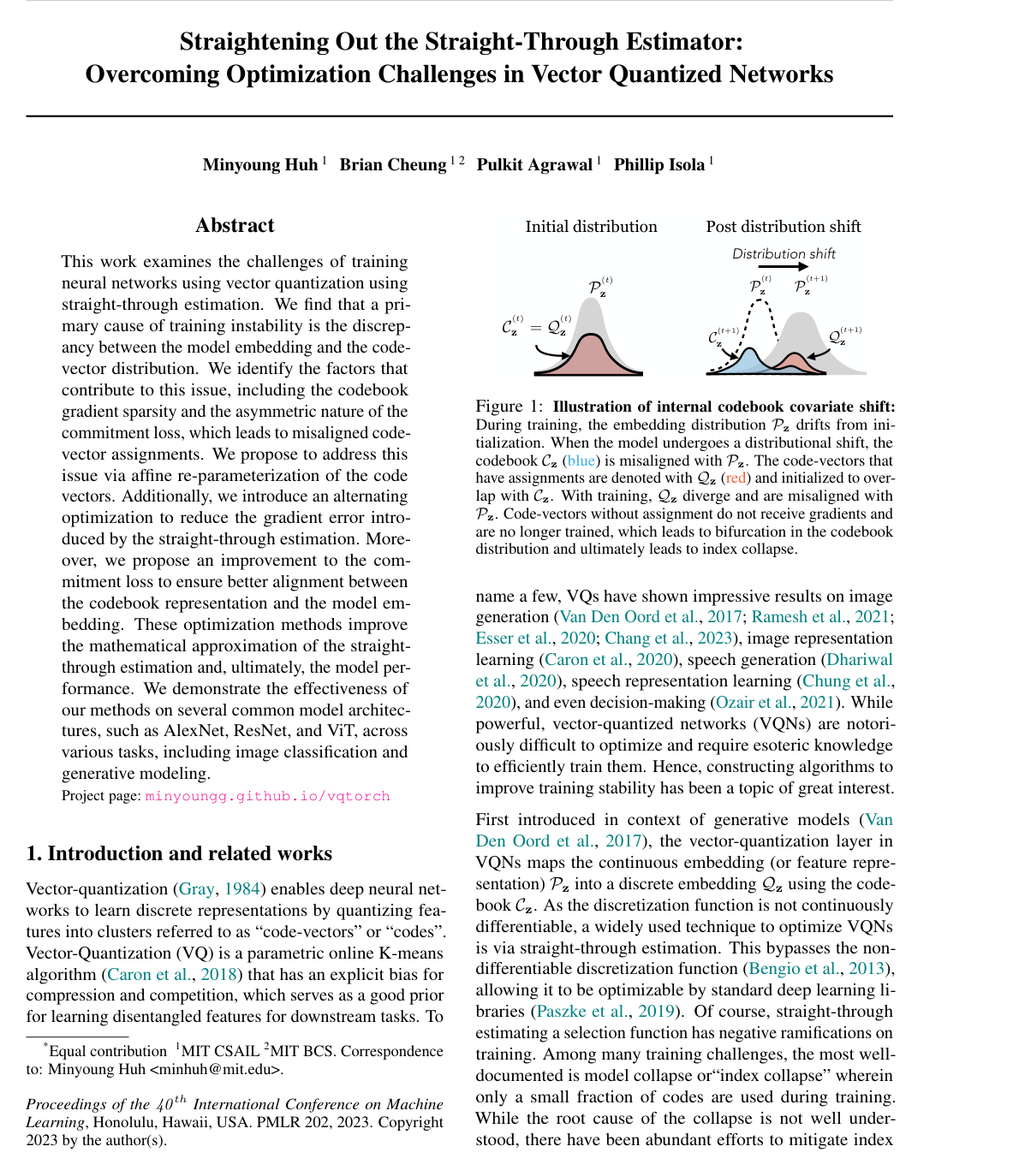
The research reveals that training instability stems from internal codebook covariate shift—a severe distributional divergence between the encoder features and the discrete codebook. Because the standard training objective uses an asymmetric distance calculation, unselected codes receive zero gradient updates and are permanently dropped. This divergence causes the straight-through estimator (the mathematical shortcut used to bypass non-differentiable code selection) to produce highly biased, inaccurate gradient updates. To resolve this, the authors propose three core interventions: an affine re-parameterization that shares global mean and variance parameters across all code vectors, an alternating optimization routine that updates code assignments before updating the network weights, and a synchronized commitment loss that accounts for immediate parameter updates rather than lagging behind.
The proposed techniques deliver consistent performance gains across both visual classification and image generation tasks using standard network architectures like AlexNet, ResNet-18, and Vision Transformers. On the ImageNet-100 classification benchmark, applying these optimizations improved absolute classification accuracy by 6.9 to 10.7 percentage points across architectures while maintaining high codebook utilization. For generative modeling on CelebA and CIFAR-10 datasets, the approach significantly improved image reconstruction and generation quality. For example, in a transformer-based generative test on CelebA, the method improved the standard image generation quality score (FID) from 90.4 down to 74.8, indicating much higher visual fidelity.
These results establish that index collapse is an optimization and gradient estimation error rather than an unavoidable property of discrete neural networks. The findings provide substantial practical value: they remove the need for memory-heavy sampling alternatives and reduce reliance on fragile heuristic resets, allowing models to train faster with minimal computational overhead (as low as 1.05 times standard training for fused passes). Teams developing discrete representation pipelines should immediately adopt the shared affine re-parameterization and synchronized loss updates, as they require minimal code modifications while substantially boosting robustness.
Users should note certain operational boundaries identified in the article. Performance remains sensitive to standard hyperparameter choices, such as warmup learning rate schedules and specific batch sizes, because sparse activations can still degrade discrete code utilization. While confidence in the experimental improvements is high across the tested image classification and generation benchmarks, the authors note that hyperparameter scales for affine updates may still require slight tuning depending on the specific model architecture.
- Paper: Neural Discrete Representation Learning, Aäron van den Oord et al. (2017). This seminal paper introduces the Vector Quantised-Variational AutoEncoder (VQ-VAE) and the straight-through estimator for discrete latent representations, establishing the foundational architecture and optimization objective that the source diagnoses and repairs.
- Paper: Taming Transformers for High-Resolution Image Synthesis, Patrick Esser et al. (2020). This work pairs vector-quantized codebooks with generative transformers to synthesize high-resolution images, providing the primary discrete representation framework that the source seeks to stabilize against codebook collapse.
- Paper: Generating Diverse High-Fidelity Images with VQ-VAE-2, Ali Razavi et al. (2019). This paper extends discrete representation learning to multi-scale hierarchical codebooks, demonstrating the architectural benefits and training sensitivities of large-scale vector-quantized generative models.
- Paper: Nonuniform-to-Uniform Quantization: Towards Accurate Quantization via Generalized Straight-Through Estimation, Zechun Liu et al. (2022). This study analyzes the mathematical biases and gradient approximations inherent to the straight-through estimator, offering critical background on STE failure modes in quantized neural networks.
- Paper: Regularized Vector Quantization for Tokenized Image Synthesis, Jiahui Zhang et al. (2023). This paper tackles the codebook collapse and representation trade-offs in discrete tokenization by introducing prior distribution regularization and stochastic masking for generative visual modeling.