
keyword
quantization error
Quantization error is the difference or distortion between an original, high-precision continuous value or vector and its mapped, discrete lower-precision representation. In data compression, digital signal processing, and machine learning, this error arises when continuous numerical quantities such as weights, activations, or feature vectors are rounded, truncated, or assigned to a finite set of grid levels or codebook centroids. The resulting discrepancy introduces information loss through effects such as rounding noise, range clipping of extreme values, or subspace approximation errors. Minimizing quantization error is essential for maintaining mathematical fidelity and task performance when compressing large data structures or neural network models for efficient storage, reduced memory bandwidth, and faster computation on resource-constrained hardware.
13 items
Outlier Suppression: Pushing the Limit of Low-bit Transformer Language Models
Xiuying Wei, Yunchen Zhang, Xiangguo Zhang, Ruihao Gong, Shanghang Zhang, Qi Zhang, Fengwei Yu, Xianglong Liu
Why you should read this
Proposes an outlier suppression framework featuring Gamma Migration and Token-Wise Clipping to eliminate activation distortion, successfully matching full-precision BERT performance at 6-bit post-training quantization without added computational overhead.
Transformer architecture has become the fundamental element of the widespread natural language processing (NLP) models. With the trends of large NLP models, the increasing memory and computation costs hinder their efficient deployment on resource-limited devices. Therefore, transformer quantization attracts wide research interest. Recent work recognizes that structured outliers are the critical bottleneck for quantization performance. However, their proposed methods increase the computation overhead and still leave the outliers there. To fundamentally address this problem, this paper delves into the inherent inducement and importance of the outliers. We discover that γ in LayerNorm (LN) acts as a sinful amplifier for the outliers, and the importance of outliers varies greatly where some outliers provided by a few tokens cover a large area but can be clipped sharply without negative impacts. Motivated by these findings, we propose an outlier suppression framework including two components: Gamma Migration and Token-Wise Clipping. The Gamma Migration migrates the outlier amplifier to subsequent modules in an equivalent transformation, contributing to a more quantization-friendly model without any extra burden. The Token-Wise Clipping takes advantage of the large variance of token range and designs a token-wise coarse-to-fine pipeline, obtaining a clipping range with minimal final quantization loss in an efficient way. This framework effectively suppresses the outliers and can be used in a plug-and-play mode. Extensive experiments prove that our framework surpasses the existing works and, for the first time, pushes the 6-bit post-training BERT quantization to the full-precision (FP) level. Our code is available at https://github.com/wimh966/outlier_suppression.
Added
2026-10-05
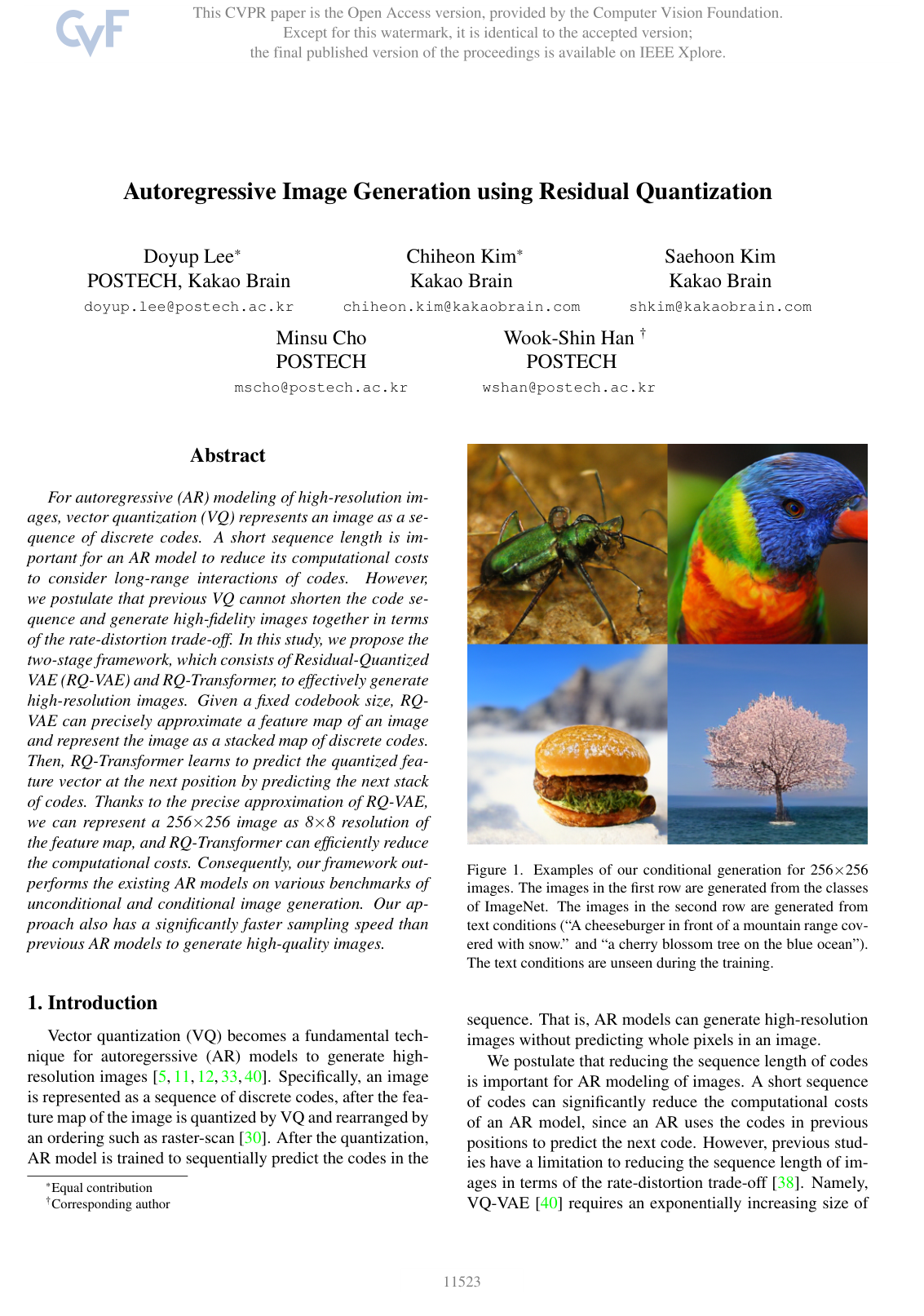
Autoregressive Image Generation using Residual Quantization
Doyup Lee, Chiheon Kim, Saehoon Kim, Minsu Cho, Wook-Shin Han
Why you should read this
Proposes a two-stage residual quantization framework, comprising RQ-VAE and RQ-Transformer, that drastically shortens discrete code sequences to achieve faster sampling and lower computational costs in high-resolution autoregressive image generation without sacrificing fidelity.
For autoregressive (AR) modeling of high-resolution images, vector quantization (VQ) represents an image as a sequence of discrete codes. A short sequence length is important for an AR model to reduce its computational costs to consider long-range interactions of codes. However, we postulate that previous VQ cannot shorten the code sequence and generate high-fidelity images together in terms of the rate-distortion trade-off. In this study, we propose the two-stage framework, which consists of Residual-Quantized VAE (RQ-VAE) and RQ-Transformer, to effectively generate high-resolution images. Given a fixed codebook size, RQ-VAE can precisely approximate a feature map of an image and represent the image as a stacked map of discrete codes. Then, RQ-Transformer learns to predict the quantized feature vector at the next position by predicting the next stack of codes. Thanks to the precise approximation of RQ-VAE, we can represent a 256256 image as 88 resolution of the feature map, and RQ-Transformer can efficiently reduce the computational costs. Consequently, our framework outperforms the existing AR models on various benchmarks of unconditional and conditional image generation. Our approach also has a significantly faster sampling speed than previous AR models to generate high-quality images.
Added
2026-10-05
FlexRound: Learnable Rounding based on Element-wise Division for Post-Training Quantization
Jung Hyun Lee, Jeonghoon Kim, Se Jung Kwon, Dongsoo Lee
Why you should read this
Proposes FlexRound, a post-training weight quantization method that uses element-wise division to adaptively scale individual weights by magnitude alongside a shared grid size, enabling uniform low-bit quantization for vision architectures and large language models with negligible accuracy loss.
Post-training quantization (PTQ) has been gaining popularity for the deployment of deep neural networks on resource-limited devices since unlike quantization-aware training, neither a full training dataset nor end-to-end training is required at all. As PTQ schemes based on reconstructing each layer or block output turn out to be effective to enhance quantized model performance, recent works have developed algorithms to devise and learn a new weight-rounding scheme so as to better reconstruct each layer or block output. In this work, we propose a simple yet effective new weight-rounding mechanism for PTQ, coined FlexRound, based on element-wise division instead of typical element-wise addition such that FlexRound enables jointly learning a common quantization grid size as well as a different scale for each pre-trained weight. Thanks to the reciprocal rule of derivatives induced by element-wise division, FlexRound is inherently able to exploit pre-trained weights when updating their corresponding scales, and thus, flexibly quantize pre-trained weights depending on their magnitudes. We empirically validate the efficacy of FlexRound on a wide range of models and tasks. To the best of our knowledge, our work is the first to carry out comprehensive experiments on not only image classification and natural language understanding but also natural language generation, assuming a per-tensor uniform PTQ setting. Moreover, we demonstrate, for the first time, that large language models can be efficiently quantized, with only a negligible impact on performance compared to half-precision baselines, achieved by reconstructing the output in a block-by-block manner.
Added
2026-10-03
LLM-FP4: 4-Bit Floating-Point Quantized Transformers
Shih-Yang Liu, Zechun Liu, Xijie Huang, Pingcheng Dong, Kwang-Ting Cheng
Why you should read this
Proposes a 4-bit floating-point post-training quantization method that searches for optimal exponent parameters and reparameterizes per-channel activation scales into weight exponent biases, enabling accurate 4-bit weight and activation compression in large transformers with minimal accuracy loss.
We propose LLM-FP4 for quantizing both weights and activations in large language models (LLMs) down to 4-bit floating-point values, in a post-training manner. Existing post-training quantization (PTQ) solutions are primarily integer-based and struggle with bit widths below 8 bits. Compared to integer quantization, floating-point (FP) quantization is more flexible and can better handle long-tail or bell-shaped distributions, and it has emerged as a default choice in many hardware platforms. One characteristic of FP quantization is that its performance largely depends on the choice of exponent bits and clipping range. In this regard, we construct a strong FP-PTQ baseline by searching for the optimal quantization parameters. Furthermore, we observe a high inter-channel variance and low intra-channel variance pattern in activation distributions, which adds activation quantization difficulty. We recognize this pattern to be consistent across a spectrum of transformer models designed for diverse tasks, such as LLMs, BERT, and Vision Transformer models. To tackle this, we propose per-channel activation quantization and show that these additional scaling factors can be reparameterized as exponential biases of weights, incurring a negligible cost. Our method, for the first time, can quantize both weights and activations in the LLaMA-13B to only 4-bit and achieves an average score of 63.1 on the common sense zero-shot reasoning tasks, which is only 5.8 lower than the full-precision model, significantly outperforming the previous state-of-the-art by 12.7 points. Code is available at: https://github.com/nbasyl/LLM-FP4.
Added
2026-10-01
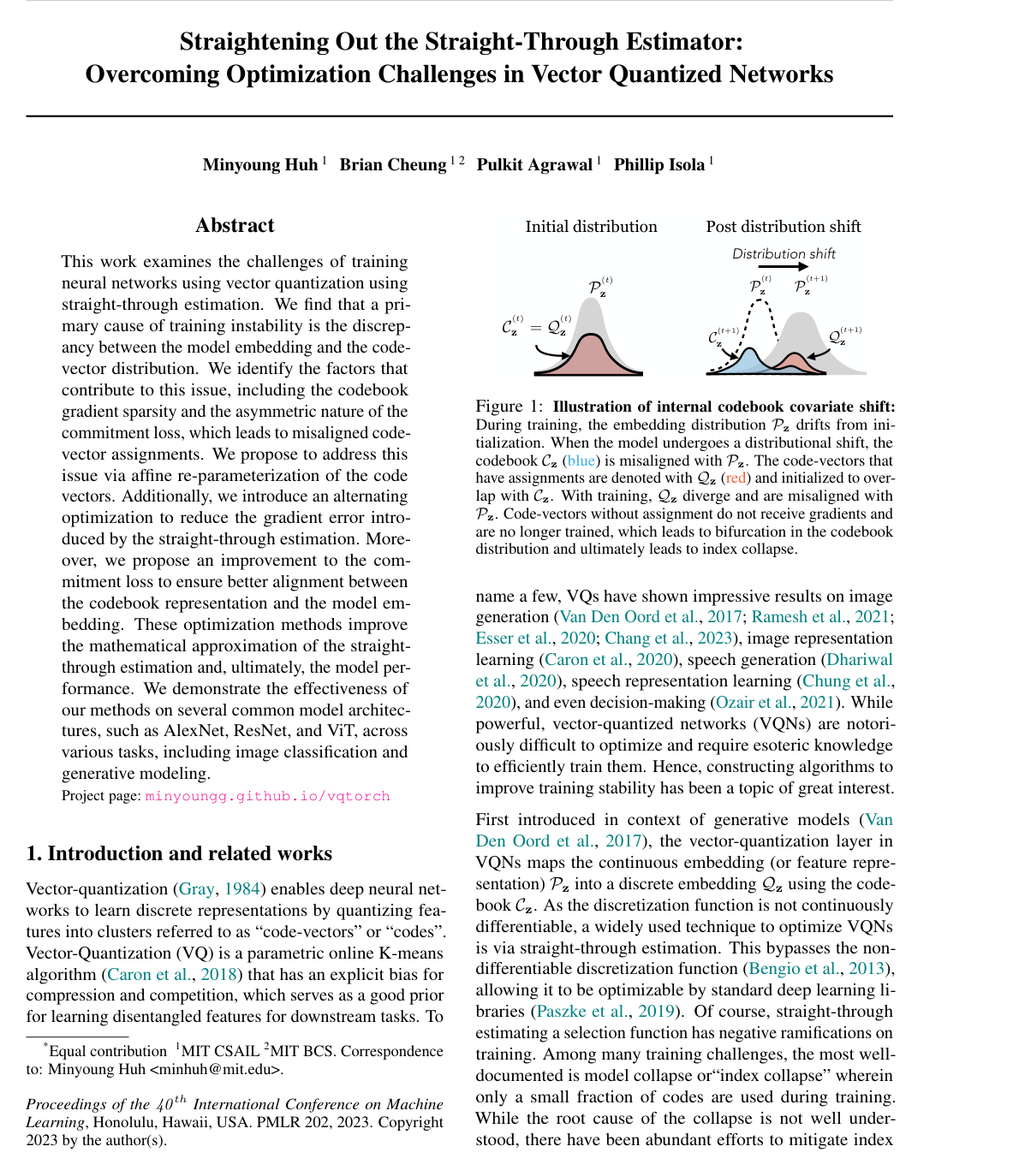
Straightening Out the Straight-Through Estimator: Overcoming Optimization Challenges in Vector Quantized Networks
Minyoung Huh, Brian Cheung, Pulkit Agrawal, Phillip Isola
Why you should read this
Identifies internal codebook covariate shift as the fundamental cause of index collapse in vector-quantized networks and introduces an affine re-parameterization alongside alternating optimization to stabilize training across vision and generative architectures.
This work examines the challenges of training neural networks using vector quantization using straight-through estimation. We find that a primary cause of training instability is the discrepancy between the model embedding and the code-vector distribution. We identify the factors that contribute to this issue, including the codebook gradient sparsity and the asymmetric nature of the commitment loss, which leads to misaligned code-vector assignments. We propose to address this issue via affine re-parameterization of the code vectors. Additionally, we introduce an alternating optimization to reduce the gradient error introduced by the straight-through estimation. Moreover, we propose an improvement to the commitment loss to ensure better alignment between the codebook representation and the model embedding. These optimization methods improve the mathematical approximation of the straight-through estimation and, ultimately, the model performance. We demonstrate the effectiveness of our methods on several common model architectures, such as AlexNet, ResNet, and ViT, across various tasks, including image classification and generative modeling. Project page: minyoungg.github.io/vqtorch
Added
2026-09-26
Towards Efficient Post-training Quantization of Pre-trained Language Models
Haoli Bai, Lu Hou, Lifeng Shang, Xin Jiang, Irwin King, Michael R. Lyu
Why you should read this
Proposes a parallel module-wise reconstruction error minimization framework that enables fast, memory-efficient post-training quantization for large language models while achieving accuracy competitive with full quantization-aware training.
Network quantization has gained increasing attention with the rapid growth of large pre-trained language models (PLMs). However, most existing quantization methods for PLMs follow quantization-aware training (QAT) that requires end-to-end training with full access to the entire dataset. Therefore, they suffer from slow training, large memory overhead, and data accessibility issues. In this paper, we study post-training quantization (PTQ) of PLMs, and propose module-wise quantization error minimization (MREM), an efficient solution to mitigate these issues. By partitioning the PLM into multiple modules, we minimize the reconstruction error incurred by quantization for each module. In addition, we design a new model parallel training strategy such that each module can be trained locally on separate computing devices without waiting for preceding modules, which brings nearly the theoretical training speed-up (e.g., 4× on 4 GPUs). Experiments on GLUE and SQuAD benchmarks show that our proposed PTQ solution not only performs close to QAT, but also enjoys significant reductions in training time, memory overhead, and data consumption.
Added
2026-09-26
Compression of Generative Pre-trained Language Models via Quantization
Chaofan Tao, Lu Hou, Wei Zhang, Lifeng Shang, Xin Jiang, Qun Liu, Ping Luo, Ngai Wong
Why you should read this
Proposes a token-level contrastive distillation framework and module-wise dynamic scaling to effectively quantize generative pre-trained language models like GPT-2 and BART down to low-bit weights while preserving generation quality.
The increasing size of generative Pre-trained Language Models (PLMs) have greatly increased the demand for model compression. Despite various methods to compress BERT or its variants, there are few attempts to compress generative PLMs, and the underlying difficulty remains unclear. In this paper, we compress generative PLMs by quantization. We find that previous quantization methods fail on generative tasks due to the homogeneous word embeddings caused by reduced capacity, and varied distribution of weights. Correspondingly, we propose a token-level contrastive distillation to learn distinguishable word embeddings, and a module-wise dynamic scaling to make quantizers adaptive to different modules. Empirical results on various tasks show that our proposed method outperforms the state-of-the-art compression methods on generative PLMs by a clear margin. With comparable performance with the full-precision models, we achieve 14.4× and 13.4× compression rates on GPT-2 and BART, respectively.
Added
2026-09-26
DAdaQuant: Doubly-adaptive quantization for communication-efficient Federated Learning
Robert Hönig, Yiren Zhao, Robert Mullins
Why you should read this
Proposes DAdaQuant, a communication-efficient federated learning algorithm that dynamically adjusts parameter quantization levels across training rounds and individual clients to achieve up to 2.8× higher uplink compression without sacrificing accuracy.
Federated Learning (FL) is a powerful technique to train a model on a server with data from several clients in a privacy-preserving manner. FL incurs significant communication costs because it repeatedly transmits the model between the server and clients. Recently proposed algorithms quantize the model parameters to efficiently compress FL communication. We find that dynamic adaptations of the quantization level can boost compression without sacrificing model quality. We introduce DAdaQuant as a doubly-adaptive quantization algorithm that dynamically changes the quantization level across time and different clients. Our experiments show that DAdaQuant consistently improves client→server compression, outperforming the strongest non-adaptive baselines by up to 2.8×.
Added
2026-09-26
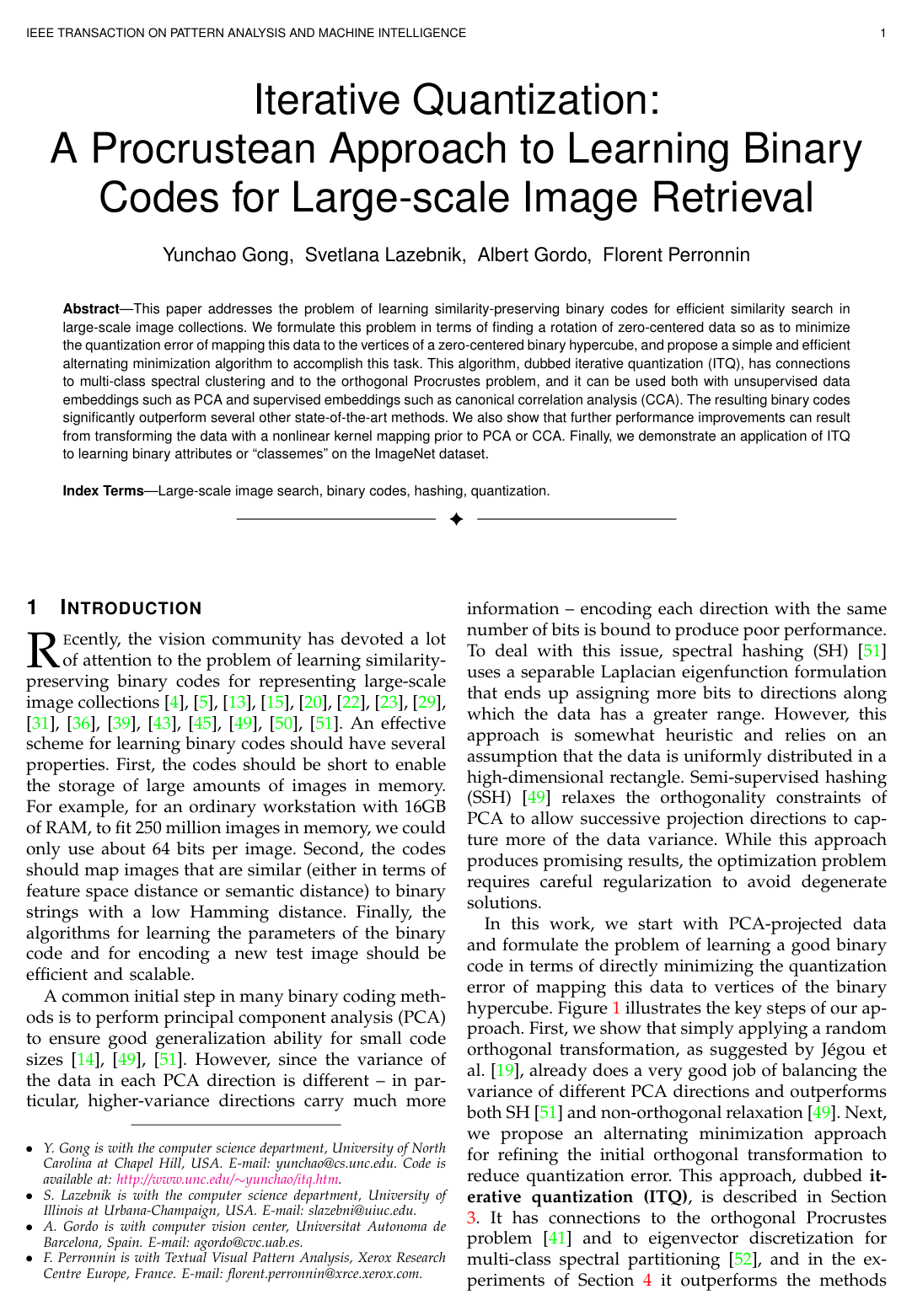
Iterative Quantization: A Procrustean Approach to Learning Binary Codes for Large-Scale Image Retrieval
Yunchao Gong, Svetlana Lazebnik, Albert Gordo, Florent Perronnin
Why you should read this
Proposes an alternating minimization method, Iterative Quantization, that finds an optimal orthogonal rotation to align dimensionally-reduced data with the vertices of a binary hypercube, significantly improving retrieval accuracy and scalability for large-scale image search.
This paper addresses the problem of learning similarity-preserving binary codes for efficient similarity search in large-scale image collections. We formulate this problem in terms of finding a rotation of zero-centered data so as to minimize the quantization error of mapping this data to the vertices of a zero-centered binary hypercube, and propose a simple and efficient alternating minimization algorithm to accomplish this task. This algorithm, dubbed iterative quantization (ITQ), has connections to multi-class spectral clustering and to the orthogonal Procrustes problem, and it can be used both with unsupervised data embeddings such as PCA and supervised embeddings such as canonical correlation analysis (CCA). The resulting binary codes significantly outperform several other state-of-the-art methods. We also show that further performance improvements can result from transforming the data with a nonlinear kernel mapping prior to PCA or CCA. Finally, we demonstrate an application of ITQ to learning binary attributes or “classemes” on the ImageNet dataset.
Added
2026-09-24
Product Quantization for Nearest Neighbor Search
Hervé Jégou, Matthijs Douze, Cordelia Schmid
Why you should read this
Formulates the mathematics of decomposing high-dimensional spaces into lower-dimensional Cartesian products to compress vectors and radically accelerate distance estimations.
This paper introduces a product quantization-based approach for approximate nearest neighbor search. The idea is to decompose the space into a Cartesian product of low-dimensional subspaces and to quantize each subspace separately. A vector is represented by a short code composed of its subspace quantization indices. The euclidean distance between two vectors can be efficiently estimated from their codes. An asymmetric version increases precision, as it computes the approximate distance between a vector and a code. Experimental results show that our approach searches for nearest neighbors efficiently, in particular in combination with an inverted file system. Results for SIFT and GIST image descriptors show excellent search accuracy, outperforming three state-of-the-art approaches. The scalability of our approach is validated on a data set of two billion vectors.
Added
2026-05-03
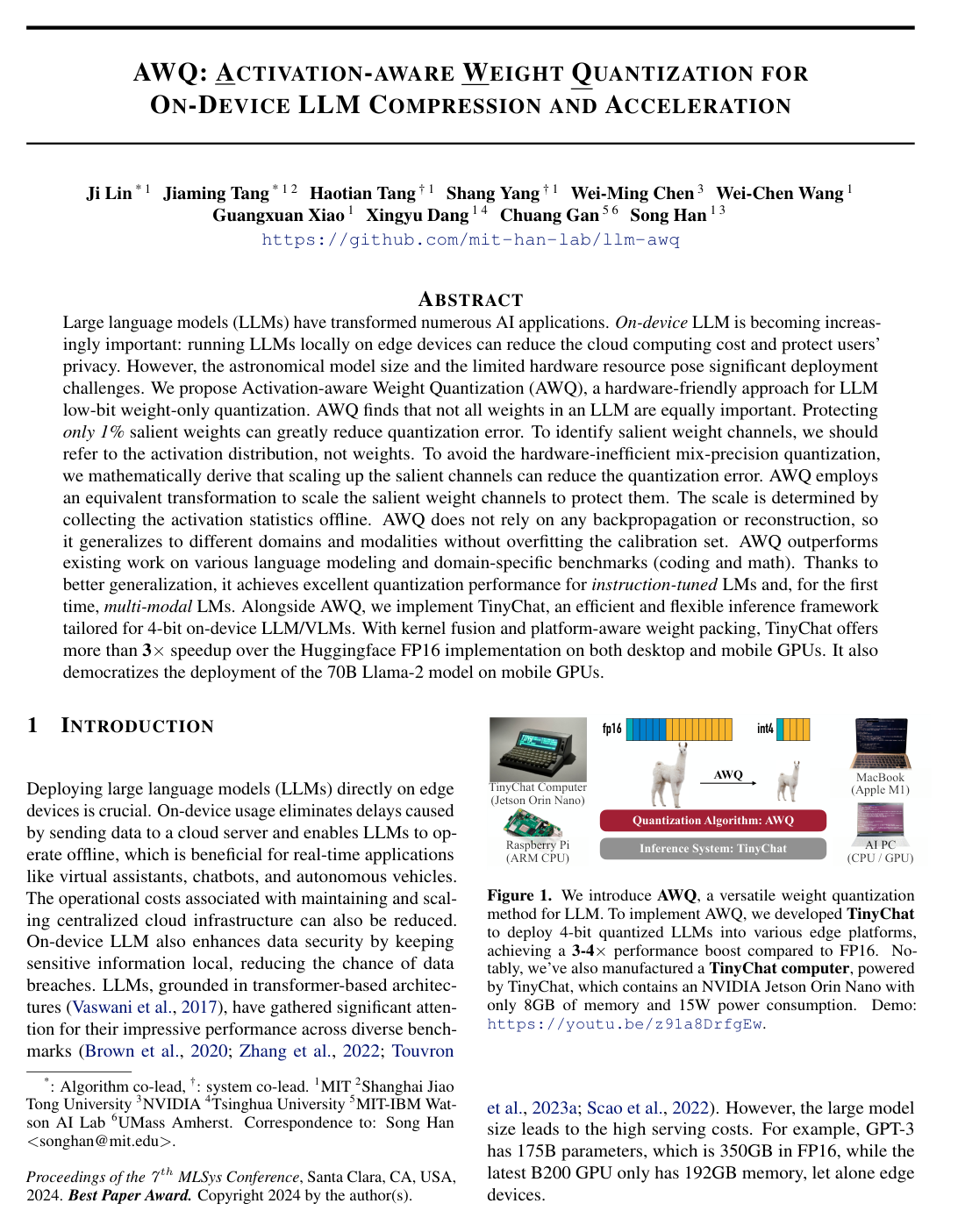
AWQ: Activation-aware Weight Quantization for On-Device LLM Compression and Acceleration
Ji Lin, Jiaming Tang, Haotian Tang, Shang Yang, Wei-Ming Chen, Wei-Chen Wang, Guangxuan Xiao, Xingyu Dang, Chuang Gan, Song Han
Why you should read this
Proves that selectively protecting the top one percent of salient weights based on activation magnitude yields superior low-bit quantization robustness compared to purely weight-based methods.
Large language models (LLMs) have transformed numerous AI applications. On-device LLM is becoming increasingly important: running LLMs locally on edge devices can reduce the cloud computing cost and protect users' privacy. However, the astronomical model size and the limited hardware resource pose significant deployment challenges. We propose Activation-aware Weight Quantization (AWQ), a hardware-friendly approach for LLM low-bit weight-only quantization. AWQ finds that not all weights in an LLM are equally important. Protecting only 1% salient weights can greatly reduce quantization error. To identify salient weight channels, we should refer to the activation distribution, not weights. To avoid the hardware-inefficient mix-precision quantization, we mathematically derive that scaling up the salient channels can reduce the quantization error. AWQ employs an equivalent transformation to scale the salient weight channels to protect them. The scale is determined by collecting the activation statistics offline. AWQ does not rely on any backpropagation or reconstruction, so it generalizes to different domains and modalities without overfitting the calibration set. AWQ outperforms existing work on various language modeling and domain-specific benchmarks (coding and math). Thanks to better generalization, it achieves excellent quantization performance for instruction-tuned LMs and, for the first time, multi-modal LMs. Alongside AWQ, we implement TinyChat, an efficient and flexible inference framework tailored for 4-bit on-device LLM/VLMs. With kernel fusion and platform-aware weight packing, TinyChat offers more than 3x speedup over the Huggingface FP16 implementation on both desktop and mobile GPUs. It also democratizes the deployment of the 70B Llama-2 model on mobile GPUs.
Added
2026-04-24
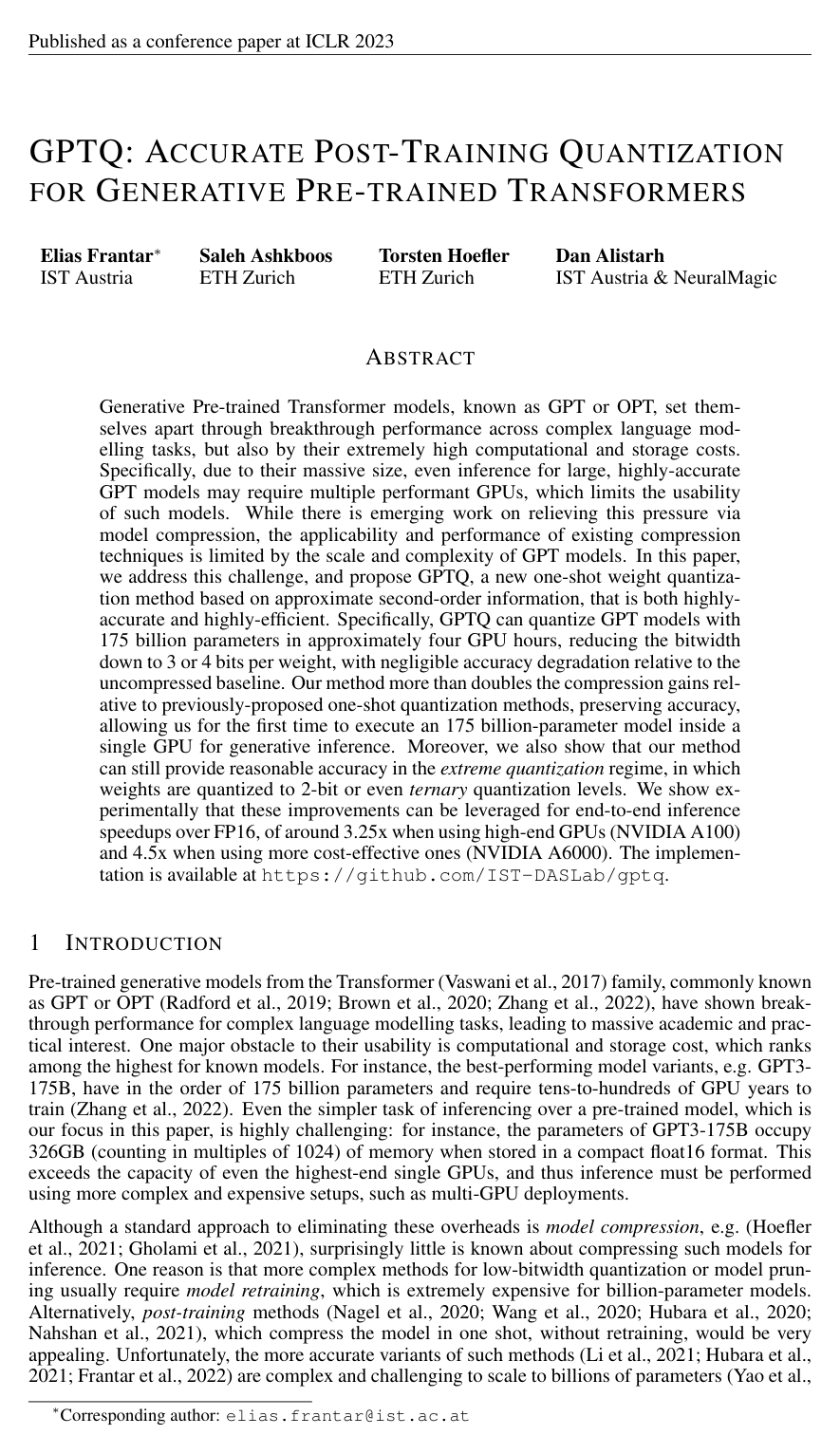
GPTQ: Accurate Post-Training Quantization for Generative Pre-trained Transformers
Elias Frantar, Saleh Ashkboos, Torsten Hoefler, Dan Alistarh
Why you should read this
Develops a layer-wise quantization scheme utilizing the inverse Hessian matrix to compress model weights to four bits with near-zero loss in predictive perplexity.
Generative Pre-trained Transformer models, known as GPT or OPT, set themselves apart through breakthrough performance across complex language modelling tasks, but also by their extremely high computational and storage costs. Specifically, due to their massive size, even inference for large, highly-accurate GPT models may require multiple performant GPUs, which limits the usability of such models. While there is emerging work on relieving this pressure via model compression, the applicability and performance of existing compression techniques is limited by the scale and complexity of GPT models. In this paper, we address this challenge, and propose GPTQ, a new one-shot weight quantization method based on approximate second-order information, that is both highly-accurate and highly-efficient. Specifically, GPTQ can quantize GPT models with 175 billion parameters in approximately four GPU hours, reducing the bitwidth down to 3 or 4 bits per weight, with negligible accuracy degradation relative to the uncompressed baseline. Our method more than doubles the compression gains relative to previously-proposed one-shot quantization methods, preserving accuracy, allowing us for the first time to execute an 175 billion-parameter model inside a single GPU for generative inference. Moreover, we also show that our method can still provide reasonable accuracy in the extreme quantization regime, in which weights are quantized to 2-bit or even ternary quantization levels. We show experimentally that these improvements can be leveraged for end-to-end inference speedups over FP16, of around 3.25x when using high-end GPUs (NVIDIA A100) and 4.5x when using more cost-effective ones (NVIDIA A6000). The implementation is available at https://github.com/IST-DASLab/gptq.
Added
2026-04-24
PolarQuant: Quantizing KV Caches with Polar Transformation
Insu Han, Praneeth Kacham, Amin Karbasi, Vahab Mirrokni, Amir Zandieh
Why you should read this
Develops PolarQuant, a novel quantization method that compresses KV caches by over x4.2 with state-of-the-art quality by uniquely quantizing polar-transformed embeddings, eliminating the need for costly normalization steps in traditional methods.
Large language models (LLMs) require significant memory to store Key-Value (KV) embeddings in their KV cache, especially when handling long-range contexts. Quantization of these KV embeddings is a common technique to reduce memory consumption. This work introduces PolarQuant, a novel quantization method employing random preconditioning and polar transformation. Our method transforms the KV embeddings into polar coordinates using an efficient recursive algorithm and then quantizes resulting angles. Our key insight is that, after random preconditioning, the angles in the polar representation exhibit a tightly bounded and highly concentrated distribution with an analytically computable form. This nice distribution eliminates the need for explicit normalization, a step required by traditional quantization methods which introduces significant memory overhead because quantization parameters (e.g., zero point and scale) must be stored in full precision per each data block. PolarQuant bypasses this normalization step, enabling substantial memory savings. The long-context evaluation demonstrates that PolarQuant compresses the KV cache by over x4.2 while achieving the best quality scores compared to the state-of-the-art methods.
Added
2026-03-25
