Cones: Concept Neurons in Diffusion Models for Customized Generation
Zhiheng LiuRuili FengKai ZhuYifei ZhangKecheng ZhengYu LiuDeli ZhaoJingren ZhouYang Cao
Identifies subject-specific concept neurons within diffusion models to enable efficient multi-subject image generation by composing neuron clusters while cutting storage requirements by ninety percent.
Text-to-image artificial intelligence models often struggle to reliably depict specific, user-provided subjects in new scenes, particularly when combining several distinct subjects into a single coherent image. Existing customization techniques typically require fine-tuning large portions of the model or storing massive parameter files for every new subject. This approach creates severe storage bottlenecks, risks forgetting previously learned subjects, and leads to visual blending or missing details when multiple subjects are requested at once.
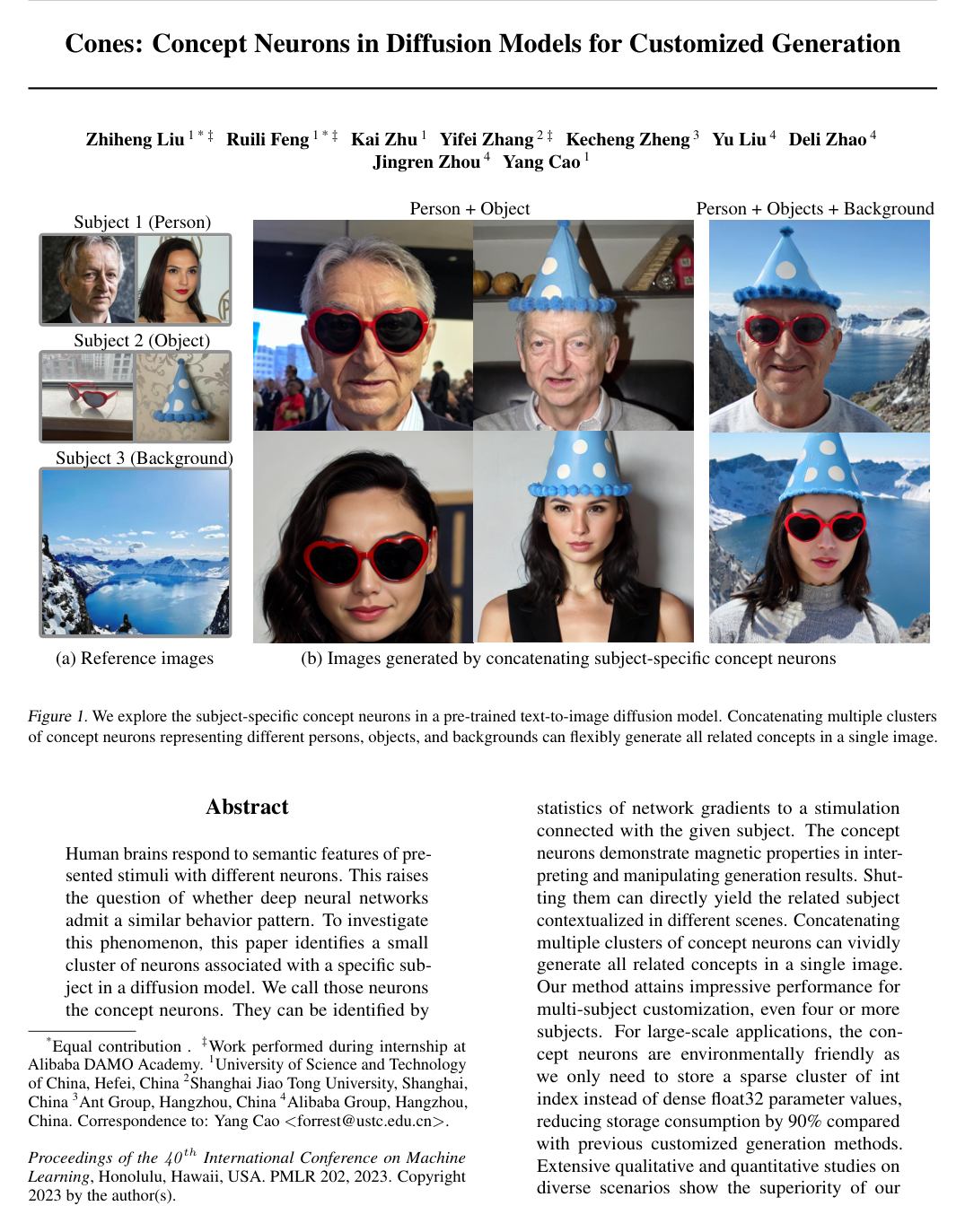
The article evaluates whether diffusion models localize individual subjects into specific network parameters, termed concept neurons, and demonstrates a method called Cones to identify and manipulate these neurons for customized image generation. The primary objective is to prove that pinpointing and deactivating these sparse, subject-specific parameters enables high-fidelity single- and multi-subject generation without requiring heavy retraining or massive storage overhead.
The authors analyze pre-trained diffusion models by measuring network gradient responses to target concepts, drawing inspiration from biological neuroscience techniques that map concept-specific brain activity. They isolate small clusters of concept neurons within the model's cross-attention layers using an adaptive sampling algorithm. The evaluation assesses visual similarity to target subjects and semantic alignment with text prompts across multiple image categories, comparing the approach against established customization baselines such as DreamBooth, Custom Diffusion, and Textual Inversion. A user study with 50 annotators further measures visual fidelity and prompt consistency.
The analysis reveals several critical findings. First, subjects are governed by highly sparse neuron clusters occupying only about 1.3% of the attention layer parameters for a single concept and roughly 7.0% for four concepts. Second, simply shutting off these identified neurons—operating at binary precision without further numerical optimization—reliably implants the target subject into newly generated scenes. Third, concept neurons exhibit strong disentanglement, sharing less than 2.5% of active neurons between distinct subjects; directly combining their neuron masks allows seamless multi-subject generation and is the first method demonstrated to composite up to four distinct subjects cleanly in a single image. Fourth, because the method only needs to store integer indices rather than dense floating-point weights, it reduces memory storage consumption by more than 90% compared to Custom Diffusion (requiring about 1.43 MB versus 72 MB) and over 99.9% compared to DreamBooth (3.3 GB).
These findings indicate that deep generative networks possess an interpretable, affine semantic structure within their parameter space. In practical applications, this translates to massive cost reductions for hosting personalized generative models and makes client-side customization viable on mobile and edge devices. Furthermore, the modularity of concept neurons avoids the catastrophic forgetting commonly encountered during sequential learning in baseline approaches.
Organizations deploying personalized image generation should consider transitioning from full-model fine-tuning to sparse neuron-masking architectures like Cones, particularly for mobile deployment and multi-subject generation pipelines. When deploying such systems, practitioners can leverage direct concatenation for fast, tuning-free composition, or apply targeted collaborative fine-tuning when higher visual precision is required.
The article notes several operational boundaries and limitations. While the technique scales reliably up to four simultaneous concepts, generating five or more subjects significantly increases failure rates. Additionally, pre-existing layout biases in underlying base models can occasionally cause positioning errors between juxtaposed subjects. Within these operating boundaries, however, the quantitative metrics and human evaluations provide high confidence in the method's ability to deliver efficient, lightweight, and high-fidelity customized generation.
- Paper: Multi-Concept Customization of Text-to-Image Diffusion, Nupur Kumari et al. (2022). Custom Diffusion establishes the parameter-efficient multi-concept customization problem that Cones addresses by locating and combining sparse concept neurons instead of tuning model weights.
- Paper: DreamBooth: Fine Tuning Text-to-Image Diffusion Models for Subject-Driven Generation, Nataniel Ruiz et al. (2023). DreamBooth provides the subject-driven fine-tuning baseline against which Cones’s neuron-based approach to preserving and recontextualizing customized subjects is best understood.
- Paper: An Image is Worth One Word: Personalizing Text-to-Image Generation using Textual Inversion, Rinon Gal et al. (2022). Textual Inversion introduces personalization through a compact learned concept representation, clarifying the customization tradeoff Cones replaces with sparse neuron indices.
- Paper: Understanding Neural Networks Through Deep Visualization, Jason Yosinski et al. (2015). Deep Visualization shows how optimization can reveal the semantic preferences of individual network units, a useful foundation for understanding Cones’s neuron identification and manipulation.
- Paper: Object Detectors Emerge in Deep Scene CNNs, Bolei Zhou et al. (2014). Object Detectors Emerge in Deep Scene CNNs demonstrates that neural units can become selective for recognizable visual concepts, motivating Cones’s search for subject-specific neurons.
No sufficiently relevant recommendations were found.