Deep reinforcement learning for robotic manipulation with asynchronous off-policy updates
Shixiang GuEthan HollyTimothy LillicrapSergey Levine
Demonstrates that parallelizing asynchronous off-policy deep Q-learning across multiple physical robots dramatically improves sample efficiency, enabling the successful training of complex 3D manipulation tasks directly on real hardware without human demonstrations.
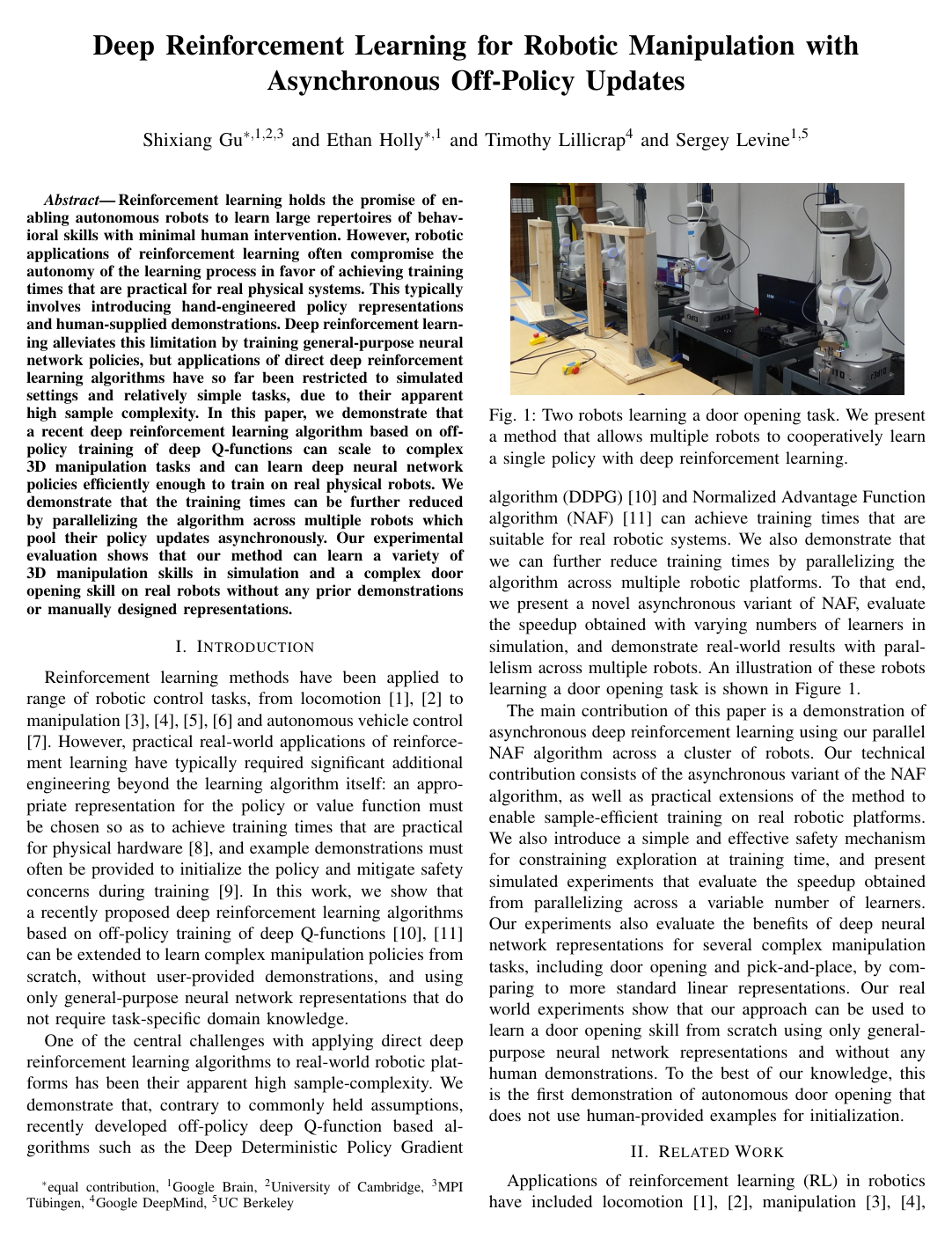
Deploying autonomous robots to perform complex manipulation tasks typically requires extensive human engineering, such as manual programming, task-specific representations, or pre-recorded demonstrations. While machine learning algorithms can theoretically allow robots to learn directly through trial and error, applying them to physical systems has historically suffered from prohibitive training times and high sample requirements. The article evaluates whether an off-policy continuous learning method called Normalized Advantage Functions can be parallelized across multiple robots to learn complex three-dimensional manipulation skills from scratch without demonstrations or manual representations.
The authors decoupled the learning process into an asynchronous architecture. A central server thread trains a deep neural network model using data stored in a shared experience buffer, while worker threads running on individual robotic arms independently collect physical interaction data and synchronize their control policies at the start of each trial. The method incorporates practical safety boundary constraints, including velocity limits and spherical workspace projections. The researchers evaluated the framework on simulated tasks (random-target reaching, door pushing and pulling, and pick-and-place) and physical 7-degree-of-freedom robotic arms tasked with reaching and door opening.
The findings demonstrate substantial improvements in learning feasibility and efficiency. Deep neural network representations successfully mastered complex multi-stage manipulation tasks, whereas traditional linear representations completely failed on door tasks. Parallelizing experience collection across multiple robots significantly reduced wall-clock training time; on physical hardware, two robots cooperatively learned a complex door-opening skill from scratch to a 100% success rate in approximately 2.5 hours, whereas a single robot required significantly more than 4 hours. Furthermore, data collection speed relative to training speed proved critical: running only one worker thread caused data starvation that degraded both learning speed and final policy quality.
These results show that collective robotic learning removes the need for manual demonstration data and specialized control representations, directly reducing deployment costs, engineering timelines, and hardware wear. However, the evaluation relies on shaped reward functions that provide continuous distance feedback rather than simple binary success indicators, and the physical setup used a fixed door pose. Decision-makers should prioritize multi-robot data collection architectures when deploying autonomous manipulation systems, while allocating future research to sparse-reward exploration and policy distillation across diverse physical environments.
- Paper: Asynchronous Methods for Deep Reinforcement Learning, Volodymyr Mnih et al. (2016). Introduces the asynchronous parallel training framework for deep reinforcement learning that the source adapts to scale off-policy manipulation updates across multiple physical robots.
- Paper: Continuous control with deep reinforcement learning, T. Lillicrap et al. (2015). Establishes deep deterministic policy gradients for continuous control, providing the foundational continuous off-policy actor-critic formulation built upon by the source.
- Paper: Deterministic Policy Gradient Algorithms, David Silver et al. (2014). Derives the deterministic policy gradient theorem, laying the theoretical groundwork for off-policy continuous action learning utilized in robotic control.
- Paper: End-to-End Training of Deep Visuomotor Policies, Sergey Levine et al. (2015). Demonstrates guided policy search for end-to-end visuomotor policies on physical robots, establishing the prior manipulation baselines that the source aims to surpass using pure off-policy RL.
- Paper: Human-level control through deep reinforcement learning, Volodymyr Mnih et al. (2015). Pioneers deep Q-networks with experience replay and target networks, establishing key value-function stabilization mechanisms adapted in continuous off-policy architectures.
- Paper: Learning hand-eye coordination for robotic grasping with deep learning and large-scale data collection, Sergey Levine et al. (2016). Presents large-scale parallel multi-robot data collection for learning grasping policies, introducing the distributed physical hardware paradigm that informs the source's asynchronous setup.
- Paper: Trust Region Policy Optimization, John Schulman et al. (2015). Introduces Trust Region Policy Optimization for continuous control benchmarks, serving as a primary benchmark and contrasting on-policy paradigm for the source's sample-efficient off-policy method.
- Paper: QT-Opt: Scalable Deep Reinforcement Learning for Vision-Based Robotic Manipulation, Dmitry Kalashnikov et al. (2018). Scales asynchronous distributed off-policy continuous Q-learning to real-world vision-based grasping across multi-robot fleets with QT-Opt.
- Paper: Soft Actor-Critic: Off-Policy Maximum Entropy Deep Reinforcement Learning with a Stochastic Actor, Tuomas Haarnoja et al. (2018). Introduces Soft Actor-Critic, extending off-policy continuous deep reinforcement learning with maximum entropy objectives for superior sample efficiency and stability.
- Paper: Reinforcement Learning with Deep Energy-Based Policies, Tuomas Haarnoja et al. (2017). Extends continuous deep Q-learning by incorporating energy-based policies and maximum entropy objectives to enable multimodal exploration.
- Paper: Hindsight Experience Replay, Marcin Andrychowicz et al. (2017). Builds on off-policy continuous control for manipulation tasks by introducing hindsight experience replay to learn effectively from sparse binary rewards.
- Paper: Sim-to-Real Transfer of Robotic Control with Dynamics Randomization, Xue Bin Peng et al. (2017). Complements real-robot reinforcement learning by demonstrating sim-to-real transfer for robotic manipulation via dynamics randomization.
- Paper: D4RL: Datasets for Deep Data-Driven Reinforcement Learning, Justin Fu et al. (2020). Provides a comprehensive offline reinforcement learning benchmark that includes continuous robotic manipulation datasets derived from policies such as those in the source.
- Paper: Offline Reinforcement Learning with Implicit Q-Learning, Ilya Kostrikov et al. (2021). Advances value-based continuous reinforcement learning by enabling stable multi-step offline Q-learning and online fine-tuning without querying out-of-distribution actions.