Scale-Recurrent Network for Deep Image Deblurring

Xin TaoHongyun GaoXiaoyong ShenJue WangJiaya Jia

article2018CVPR1,324 citations

Proposes a scale-recurrent architecture for single-image deblurring that shares network weights across coarse-to-fine scales, achieving state-of-the-art restoration quality on complex motion blur with significantly fewer parameters.

Listen

Motion and focal blur caused by camera shake and moving objects pose a major challenge for computer vision systems and digital photography. Traditional restoration methods rely on hand-crafted mathematical assumptions that often fail in real-world scenarios, while recent deep-learning approaches typically require massive models with independent parameters at every image resolution level. These multi-scale deep learning models are computationally expensive, difficult to train, and susceptible to instability.

The article demonstrates a novel deep learning framework, the Scale-recurrent Network (SRN-DeblurNet), designed to restore sharp images efficiently. The primary objective is to show that sharing model weights across different image scales while passing structural information via recurrent modules produces superior restoration quality with significantly fewer parameters and faster training times than existing methods.

The authors designed a coarse-to-fine restoration architecture where the same neural network is applied across three image resolutions. A Convolutional Long Short-Term Memory module acts as a recurrent hidden state at the bottleneck layer to pass blur and structural information from coarser to finer levels. The framework was trained and evaluated on a standard benchmark dataset of 3,214 high-speed camera blur-sharp image pairs, and further tested against both benchmark and real-world blurred photographs against existing state-of-the-art methods.

The evaluation yielded several key findings. First, the proposed model achieved state-of-the-art restoration quality, surpassing the leading previous multi-scale method on the benchmark dataset with a peak signal-to-noise ratio of 30.26 dB compared to 29.08 dB. Second, sharing network parameters across resolution scales reduced the number of trainable parameters by more than 66% compared to cascaded multi-scale alternatives. Third, the framework reduced the training time required to reach comparable image quality by approximately 75% while processing high-definition test images in about 1.87 seconds, outperforming previous approaches in execution speed. Finally, the internal recurrent mechanism and multi-scale structure proved essential, as single-scale models and architectures without recurrent memory performed substantially worse.

These findings indicate that complex multi-scale restoration tasks do not require separate, parameter-heavy neural networks for each resolution level. Reusing shared weights across scales acts as internal data augmentation, preventing model overfitting and drastically reducing computational costs and memory overhead. For engineering teams and decision-makers, this design enables the deployment of high-performing image restoration tools on tighter hardware constraints, shorter training schedules, and lower operational budgets.

Organizations developing computational photography or computer vision applications should adopt weight-sharing recurrent architectures over independent multi-stage networks for coarse-to-fine processing tasks. As next steps, the authors suggest exploring and applying the scale-recurrent strategy to other multi-scale image processing domains, such as super-resolution, video processing, and general image synthesis.

While the method shows robust performance across synthesized benchmarks and real-world examples, a primary operational constraint is that memory consumption scales with image size, meaning very large images remain bound by available graphics processing memory. Nevertheless, given the consistent quantitative gains and visual fidelity demonstrated across standard datasets and real images, confidence in the architecture's core efficiency and quality advantages remains high.

  • Paper: Multi-Stage Progressive Image Restoration, Syed Waqas Zamir et al. (2021). It advances progressive multi-scale image restoration by introducing cross-stage feature fusion and supervised attention modules to overcome scale-recurrence limitations.
  • Paper: Simple Baselines for Image Restoration, Liangyu Chen et al. (2022). It challenges the multi-scale recurrent paradigm by demonstrating that a simple, single-stage baseline without nonlinear activation functions can outperform complex deblurring networks.
  • Paper: Uformer: A General U-Shaped Transformer for Image Restoration, Zhendong Wang et al. (2021). It extends hierarchical image restoration architectures by replacing convolutional blocks with locally-enhanced window transformer modules for improved long-range context in deblurring.
  • Paper: Restormer: Efficient Transformer for High-Resolution Image Restoration, Syed Waqas Zamir et al. (2022). It builds on multi-scale restoration baselines by designing an efficient transformer architecture tailored for high-resolution motion and defocus deblurring.
Cover for Scale-Recurrent Network for Deep Image Deblurring

Abstract

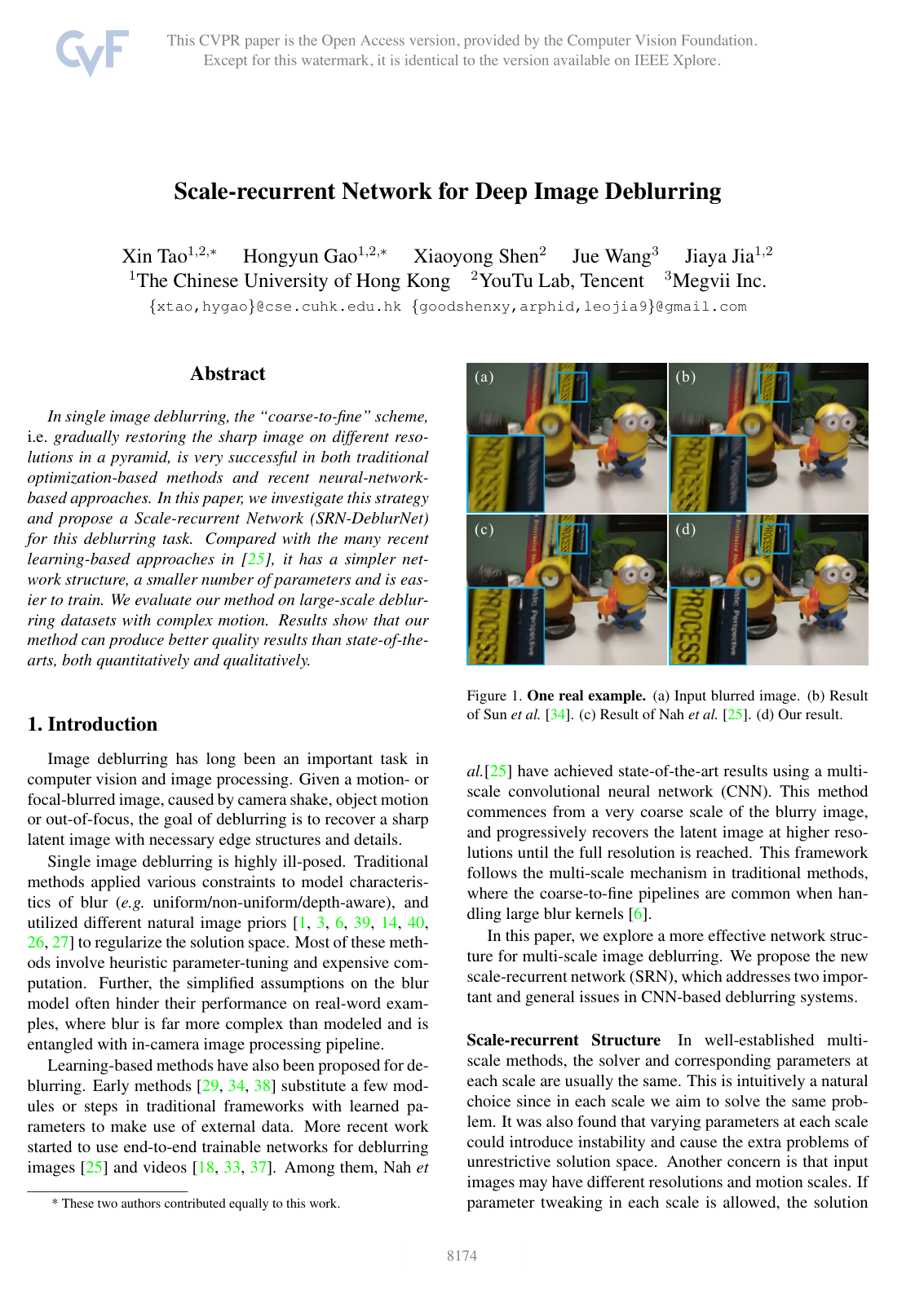
In single image deblurring, the "coarse-to-fine" scheme, i.e. gradually restoring the sharp image on different resolutions in a pyramid, is very successful in both traditional optimization-based methods and recent neural-network-based approaches. In this paper, we investigate this strategy and propose a Scale-recurrent Network (SRN-DeblurNet) for this deblurring task. Compared with the many recent learning-based approaches in [25], it has a simpler network structure, a smaller number of parameters and is easier to train. We evaluate our method on large-scale deblurring datasets with complex motion. Results show that our method can produce better quality results than state-of-the-arts, both quantitatively and qualitatively.

Table of Contents

  • 1 Introduction
  • 2 Related Work
  • 3 Network Architecture
  • 3.1 Scale-recurrent Network (SRN)
  • 3.2 Encoder-decoder with ResBlocks
  • 3.3 Losses
  • 4 Experiments
  • 4.1 Multi-scale Strategy
  • 4.2 Encoder-decoder ResBlock Network
  • 4.3 Comparisons
  • 5 Conclusion
  • References

Knowls

  1. Knowl 1 — Scale-Recurrent Network Framework for Multi-Scale Image Deblurring

    model/method

    The Scale-Recurrent Network (SRN-DeblurNet) performs single-image dynamic deblurring following a coarse-to-fine multi-scale hierarchy where network parameters are shared across all pyramid scales rather than learned independently per scale.

    Let nn denote the total number of pyramid scales, indexed by i∈{1,…,n}i \in \{1, \dots, n\} where i=1i=1 corresponds to the finest (original) resolution and i=ni=n is the coarsest resolution. For each scale ii, the input blurry image BiB^i is formed by downsampling the original blurry image by a factor of 2i−12^{i-1}. At scale ii, the network takes the current blurry image BiB^i, the bilinear upsampled sharp estimate from the coarser scale Ii+1↑I^{i+1\uparrow}, and the upsampled recurrent hidden state hi+1↑h^{i+1\uparrow} to estimate the sharp image IiI^i and new hidden state hih^i:

    Ii,hi=NetSR(Bi,Ii+1↑,hi+1↑;θSR)I^i, h^i = \text{Net}_{\text{SR}}(B^i, I^{i+1\uparrow}, h^{i+1\uparrow}; \theta_{\text{SR}})

    where θSR\theta_{\text{SR}} denotes the shared parameter set across all scales, and (⋅)↑(\cdot)^\uparrow is a bilinear upsampling operator that doubles the spatial resolution. The per-scale sub-network decomposes the computation into an encoder NetE\text{Net}_E, a Convolutional Long Short-Term Memory (ConvLSTM) bottleneck, and a decoder NetD\text{Net}_D:

    fi=NetE(Bi,Ii+1↑;θE)f^i = \text{Net}_E(B^i, I^{i+1\uparrow}; \theta_E)

    hi,gi=ConvLSTM(hi+1↑,fi;θLSTM)h^i, g^i = \text{ConvLSTM}(h^{i+1\uparrow}, f^i; \theta_{\text{LSTM}})

    Ii=NetD(gi;θD)I^i = \text{Net}_D(g^i; \theta_D)

    Here, fif^i represents the encoded feature representation at scale ii, hih^i is the recurrent hidden state retaining structure and blur pattern representations passed to finer scales, gig^i is the hidden output fed into the decoder, and θE,θLSTM,θD\theta_E, \theta_{\text{LSTM}}, \theta_D are the respective network weights.

  2. Knowl 2 — Encoder-Decoder ResBlock Sub-Network Architecture

    model/method

    The per-scale sub-network in SRN-DeblurNet uses a symmetric Encoder-Decoder structure integrated with Residual Blocks (ResBlocks) without batch normalization and large 5×55 \times 5 convolution filters to maximize the effective receptive field for large motion blurs.

    The sub-network is composed of the following sequential components:

    • Input Block (InBlock): A single convolutional layer with kernel size 5×55 \times 5 mapping the concatenated RGB blurry image and upsampled intermediate estimate (6 channels total) to a 32-channel feature map.
    • Encoder Blocks (EBlocks): Two successive EBlocks. Each EBlock begins with a stride-2 convolution with 5×55 \times 5 kernels (which halves spatial dimensions and doubles channels: 64 channels in EBlock#1, 128 channels in EBlock#2), followed by a stack of ResBlocks (3 ResBlocks in the default configuration). Each ResBlock consists of two 5×55 \times 5 convolutional layers with Rectified Linear Unit (ReLU) activations and a residual skip connection without batch normalization.
    • Recurrent Bottleneck: A ConvLSTM layer operating on the 128-channel bottleneck feature map, receiving the upsampled hidden state from the coarser scale hi+1↑h^{i+1\uparrow} and producing updated hidden state hih^i and output features gig^i.
    • Decoder Blocks (DBlocks): Two successive DBlocks symmetric to the EBlocks. Each DBlock comprises a stack of ResBlocks (3 ResBlocks in the default configuration) followed by a deconvolution (transposed convolution) layer with stride 2 and 5×55 \times 5 kernels (which doubles spatial resolution and halves channels: 128 to 64 channels in DBlock#1, 64 to 32 channels in DBlock#2). Long skip connections concatenate encoder feature maps with decoder feature maps at matching spatial resolutions.
    • Output Block (OutBlock): A single 5×55 \times 5 convolutional layer mapping 32 feature channels back to a 3-channel RGB residual sharp image output.
  3. Knowl 3 — Multi-Scale Normalized Euclidean Loss Formulation

    equation

    SRN-DeblurNet is trained end-to-end using a multi-scale normalized Euclidean (L2L_2) loss defined across all n=3n=3 pyramid resolution levels:

    L=∑i=1nκiNi∥Ii−Ii∗i∥22\mathcal{L} = \sum_{i=1}^n \frac{\kappa_i}{N_i} \|I^i - I^{i*\vphantom{i}}\|_2^2

    where:

    • n=3n=3 is the number of scales in the scale-recurrent pyramid.
    • i∈{1,2,3}i \in \{1, 2, 3\} denotes the scale index, where i=1i=1 represents the finest (full-resolution) scale and i=3i=3 represents the coarsest scale (downsampled by 4×4\times).
    • Ii∈RHi×Wi×3I^i \in \mathbb{R}^{H_i \times W_i \times 3} is the network output image at scale ii.
    • Ii∗∈RHi×Wi×3I^{i*} \in \mathbb{R}^{H_i \times W_i \times 3} is the ground-truth sharp image downsampled to the dimensions of scale ii via bilinear interpolation.
    • Ni=Hi×Wi×3N_i = H_i \times W_i \times 3 is the total number of pixel elements at scale ii, used to normalize the loss across varying image resolutions.
    • κi\kappa_i is the scale loss weight, set empirically to κi=1.0\kappa_i = 1.0 for all scales i∈{1,…,n}i \in \{1, \dots, n\}.
  4. Knowl 4 — Training and Optimization Setup for SRN-DeblurNet

    experimental setup

    The SRN-DeblurNet model is implemented in TensorFlow and trained under the following unified protocol:

    • Dataset: The GOPRO dataset consisting of 3,214 high-resolution blurry/sharp image pairs generated by averaging consecutive short-exposure frames of high-speed video. The dataset is split into 2,103 training pairs and 1,111 testing pairs.
    • Input Data: Randomly cropped 256×256256 \times 256 pixel patches from blurry images, sampled in mini-batches of size 16.
    • Optimizer: Adam solver with hyperparameters β1=0.9\beta_1 = 0.9, β2=0.999\beta_2 = 0.999, and ϵ=10−8\epsilon = 10^{-8}.
    • Learning Rate Schedule: Initial learning rate of 10−410^{-4}, exponentially decayed to 10−610^{-6} over 2,000 epochs with a power factor of 0.3.
    • Initialization & Regularization: All trainable parameters are initialized using the Xavier initialization method. Weights within the ConvLSTM module are regularized via gradient clipping capped at a global norm of 3.0.
    • Hardware & Efficiency: Training takes approximately 72 hours on a single NVIDIA Titan X GPU and Intel Xeon E5 CPU. Processing a full 720×1280720 \times 1280 test image takes 1.87 seconds.
  5. Knowl 5 — Ablation on Multi-Scale Hierarchy and Recurrent Hidden State Propagation

    data/table

    An ablation study evaluated the impact of multi-scale hierarchy, weight sharing, and recurrent hidden state mechanisms on the GOPRO test dataset (all models used 3×33 \times 3 convolution kernels for baseline comparisons):

    Model SS SC w/o R RNN SR-EDRB3
    Parameters 2.73M 8.19M 2.73M 3.03M 3.76M
    PSNR (dB) 28.40 29.05 29.26 29.35 29.98
    SSIM 0.9045 0.9166 0.9197 0.9210 0.9254

    The compared variants are:

    • SS (Single-Scale): Operates only on the full-resolution input without a multi-scale pyramid, replacing recurrent modules with a single convolution layer.
    • SC (Scale-Cascaded): Employs 3 separate stages with independent, unshared parameters across scales (analogous to cascaded multi-scale CNN architectures).
    • w/o R: A 3-scale pyramid sharing weights across scales but omitting the recurrent bottleneck module.
    • RNN: A 3-scale recurrent pyramid utilizing a standard vanilla RNN at the bottleneck.
    • SR-EDRB3: The proposed scale-recurrent network utilizing a ConvLSTM bottleneck with 3 ResBlocks per stage.

    Key observations:

    1. Multi-scale processing provides a large performance boost over single-scale restoration (28.40 dB28.40\text{ dB} for SS vs. 29.98 dB29.98\text{ dB} for SR-EDRB3).
    2. Sharing weights across scales (w/o R achieving 29.26 dB29.26\text{ dB}) outperforms learning separate weights per scale (SC achieving 29.05 dB29.05\text{ dB}), while reducing parameter count by a factor of 3.
    3. Recurrent feature propagation progressively improves restoration quality, with ConvLSTM outperforming vanilla RNN (29.98 dB29.98\text{ dB} vs. 29.35 dB29.35\text{ dB}).
  6. Knowl 6 — Ablation on Sub-Network Structural Variants and ResBlock Depth

    data/table

    An ablation study evaluated different internal sub-network configurations within the scale-recurrent (SR) framework on the GOPRO test dataset:

    Model SR-Flat SR-RB SR-ED SR-EDRB1 SR-EDRB2 SR-EDRB3
    Parameters 2.66M 2.66M 3.76M 2.21M 2.99M 3.76M
    PSNR (dB) 27.53 28.11 29.06 28.60 29.32 29.98
    SSIM 0.8886 0.8991 0.9170 0.9082 0.9204 0.9254

    The structural variants include:

    • SR-Flat: Replaces the encoder-decoder hierarchy with 43 flat convolutional layers maintaining full spatial resolution throughout.
    • SR-RB: Replaces encoder and decoder downsampling/upsampling with plain ResBlocks without strided convolutions or pooling.
    • SR-ED: A conventional encoder-decoder where ResBlocks are replaced with standard two-layer flat convolutions at each scale.
    • SR-EDRB1, SR-EDRB2, SR-EDRB3: Encoder-Decoder ResBlock sub-networks containing 1, 2, and 3 ResBlocks per EBlock and DBlock stage, respectively.

    The results demonstrate that the multiscale encoder-decoder structure is critical for expanding receptive fields (29.06 dB29.06\text{ dB} for SR-ED vs. 27.53 dB27.53\text{ dB} for SR-Flat). Incorporating ResBlocks into encoder/decoder stages further improves performance, with 3 ResBlocks (SR-EDRB3) yielding the highest PSNR (29.98 dB29.98\text{ dB}) and SSIM (0.92540.9254).

  7. Knowl 7 — Comparative Benchmark Performance on GOPRO and Köhler Datasets

    data/table

    The restoration performance of SRN-DeblurNet was benchmarked against state-of-the-art non-uniform and dynamic image deblurring methods on the GOPRO test set (1,111 pairs) and the Köhler dataset (4 images, 12 camera shake trajectories):

    Method GOPRO Köhler Dataset Time
    PSNR (dB) SSIM PSNR (dB) MSSIM
    Kim et al. 23.64 0.8239 24.68 0.7937 1 hr
    Sun et al. 24.64 0.8429 25.22 0.7735 20 min
    Nah et al. 29.08 0.9135 26.48 0.8079 3.09 s
    Ours (SRN-DeblurNet) 30.26 0.9342 26.75 0.8370 1.87 s

    SRN-DeblurNet outperforms prior deep learning and optimization-based approaches across all metrics on both datasets. On the GOPRO dataset, it exceeds the previous multi-scale CNN of Nah et al. by +1.18 dB+1.18\text{ dB} in PSNR and +0.0207+0.0207 in SSIM, while reducing runtime on 720×1280720 \times 1280 images from 3.09 s3.09\text{ s} to 1.87 s1.87\text{ s} and requiring less than one-third of the trainable parameters.

Coverage note — No substantial contributed material was omitted from the knowls.

References

  1. 1.Y. Bahat, N. Efrat, and M. Irani. Non-uniform blind deblurring by reblurring. In ICCV, pages 3286–3294. IEEE, 2017.
  2. 2.A. Chakrabarti. A neural approach to blind motion deblurring. In ECCV, pages 221–235. Springer, 2016.
  3. 3.T. F. Chan and C.-K. Wong. Total variation blind deconvolution. IEEE Trans. on Image Processing, 7(3):370–375, 1998.
  4. 4.Q. Chen and V. Koltun. Photographic image synthesis with cascaded refinement networks. In ICCV. IEEE, 2017.
  5. 5.Q. Chen, J. Xu, and V. Koltun. Fast image processing with fully-convolutional networks. In ICCV. IEEE, 2017.
  6. 6.S. Cho and S. Lee. Fast motion deblurring. In ACM Trans. on Graphics, volume 28, page 145. ACM, 2009.
  7. 7.J. Chung, C. Gulcehre, K. Cho, and Y. Bengio. Empirical evaluation of gated recurrent neural networks on sequence modeling. arXiv preprint arXiv:1412.3555, 2014.
  8. 8.M. Delbracio and G. Sapiro. Burst deblurring: Removing camera shake through fourier burst accumulation. In CVPR, pages 2385–2393. IEEE, 2015.
  9. 9.C. Dong, C. C. Loy, K. He, and X. Tang. Learning a deep convolutional network for image super-resolution. In ECCV, pages 184–199. Springer, 2014.
  10. 10.A. Dosovitskiy, P. Fischer, E. Ilg, P. Hausser, C. Hazirbas, V. Golkov, P. van der Smagt, D. Cremers, and T. Brox. Flownet: Learning optical flow with convolutional networks. In ICCV, pages 2758–2766. IEEE, 2015.
  11. 11.M. A. et. al. TensorFlow:large-scale machine learning on heterogeneous systems, 2015. Software available from tensorflow.org.
  12. 12.R. Fergus, B. Singh, A. Hertzmann, S. T. Roweis, and W. T. Freeman. Removing camera shake from a single photograph. In ACM Trans. on Graphics, volume 25, pages 787–794. ACM, 2006.
  13. 13.X. Glorot and Y. Bengio. Understanding the difficulty of training deep feedforward neural networks. In AISTATS, pages 249–256, 2010.
  14. 14.A. Goldstein and R. Fattal. Blur-kernel estimation from spectral irregularities. In ECCV, pages 622–635. Springer, 2012.
  15. 15.K. He, X. Zhang, S. Ren, and J. Sun. Deep residual learning for image recognition. In CVPR, pages 770–778. IEEE, 2016.
  16. 16.S. Hochreiter and J. Schmidhuber. Long short-term memory. Neural Computation, 9(8):1735–1780, 1997.
  17. 17.T. Hyun Kim, B. Ahn, and K. Mu Lee. Dynamic scene deblurring. In ICCV, pages 3160–3167. IEEE, 2013.
  18. 18.T. Hyun Kim, K. Mu Lee, B. Scholkopf, and M. Hirsch. Online video deblurring via dynamic temporal blending network. In ICCV, pages 4038–4047. IEEE, 2017.
  19. 19.D. P. Kingma and J. Ba. Adam: A method for stochastic optimization. In ICLR, 2014.
  20. 20.R. Kohler, M. Hirsch, B. Mohler, B. Schölkopf, and S. Harmeling. Recording and playback of camera shake: Benchmarking blind deconvolution with a real-world database. pages 27–40, 2012.
  21. 21.D. Krishnan and R. Fergus. Fast image deconvolution using hyper-laplacian priors. In NIPS, pages 1033–1041, 2009.
  22. 22.A. Levin, Y. Weiss, F. Durand, and W. T. Freeman. Understanding and evaluating blind deconvolution algorithms. In CVPR, pages 1964–1971. IEEE, 2009.
  23. 23.Z. Liu, R. Yeh, X. Tang, Y. Liu, and A. Agarwala. Video frame synthesis using deep voxel flow. In ICCV. IEEE, 2017.
  24. 24.X. Mao, C. Shen, and Y.-B. Yang. Image restoration using very deep convolutional encoder-decoder networks with symmetric skip connections. In NIPS, pages 2802–2810, 2016.
  25. 25.S. Nah, T. H. Kim, and K. M. Lee. Deep multi-scale convolutional neural network for dynamic scene deblurring. pages 3883–3891, 2017.
  26. 26.J. Pan, Z. Hu, Z. Su, and M.-H. Yang. Deblurring text images via l0-regularized intensity and gradient prior. In CVPR, pages 2901–2908. IEEE, 2014.
  27. 27.J. Pan, D. Sun, H. Pfister, and M.-H. Yang. Blind image deblurring using dark channel prior. In CVPR, pages 1628–1636. IEEE, 2016.
  28. 28.O. Ronneberger, P. Fischer, and T. Brox. U-net: Convolutional networks for biomedical image segmentation. In MICCAI, pages 234–241. Springer, 2015.
  29. 29.C. J. Schuler, M. Hirsch, S. Harmeling, and B. Scholkopf. Learning to deblur. TPAMI, 38(7):1439–1451, 2016.
  30. 30.Q. Shan, J. Jia, and A. Agarwala. High-quality motion deblurring from a single image. volume 27, page 73. ACM, 2008.
  31. 31.W. Shi, J. Caballero, F. Huszar, J. Totz, A. P. Aitken, R. Bishop, D. Rueckert, and Z. Wang. Real-time single image and video super-resolution using an efficient sub-pixel convolutional neural network. In CVPR, pages 1874–1883. IEEE, 2016.
  32. 32.X. Shi, Z. Chen, H. Wang, D.-Y. Yeung, W.-K. Wong, and W.-c. Woo. Convolutional lstm network: A machine learning approach for precipitation nowcasting. In NIPS, pages 802–810, 2015.
  33. 33.S. Su, M. Delbracio, J. Wang, G. Sapiro, W. Heidrich, and O. Wang. Deep video deblurring. pages 1279–1288, 2017.
  34. 34.J. Sun, W. Cao, Z. Xu, and J. Ponce. Learning a convolutional neural network for non-uniform motion blur removal. In CVPR, pages 769–777. IEEE, 2015.
  35. 35.X. Tao, H. Gao, R. Liao, J. Wang, and J. Jia. Detail-revealing deep video super-resolution. In ICCV. IEEE, 2017.
  36. 36.O. Whyte, J. Sivic, A. Zisserman, and J. Ponce. Non-uniform deblurring for shaken images. International Journal on Computer Vision, 98(2):168–186, 2012.
  37. 37.P. Wieschollek, M. Hirsch, B. Scholkopf, and H. P. Lensch. Learning blind motion deblurring. In ICCV. IEEE, 2017.
  38. 38.L. Xiao, J. Wang, W. Heidrich, and M. Hirsch. Learning high-order filters for efficient blind deconvolution of document photographs. In ECCV, pages 734–749. Springer, 2016.
  39. 39.L. Xu and J. Jia. Two-phase kernel estimation for robust motion deblurring. In ECCV, pages 157–170. Springer, 2010.
  40. 40.L. Xu, S. Zheng, and J. Jia. Unnatural l0 sparse representation for natural image deblurring. In CVPR, pages 1107–1114. IEEE, 2013.
  41. 41.N. Xu, B. Price, S. Cohen, and T. Huang. Deep image matting. In CVPR. IEEE, 2017.

Citation

MLA
Tao, X., et al. “Scale-recurrent Network for Deep Image Deblurring”. arXiv, 2018, http://arxiv.org/abs/1802.01770v1.
APA
Tao, X., Gao, H., Wang, Y., Shen, X., Wang, J., & Jia, J. (2018). Scale-recurrent Network for Deep Image Deblurring. arXiv. http://arxiv.org/abs/1802.01770v1
Chicago
Tao, X., H. Gao, Y. Wang, X. Shen, J. Wang, and J. Jia. 2018. “Scale-recurrent Network for Deep Image Deblurring”. arXiv. http://arxiv.org/abs/1802.01770v1.
Harvard
Tao, X. et al. (2018) “Scale-recurrent Network for Deep Image Deblurring”, arXiv [Preprint]. Available at: http://arxiv.org/abs/1802.01770v1.
Vancouver
1. Tao X, Gao H, Wang Y, Shen X, Wang J, Jia J (2018) Scale-recurrent Network for Deep Image Deblurring. arXiv

BibTeX

@article{tao2018scale,
  title = {Scale-recurrent Network for Deep Image Deblurring},
  author = {Tao, Xin and Gao, Hongyun and Wang, Yi and Shen, Xiaoyong and Wang, Jue and Jia, Jiaya},
  year = {2018},
  journal = {arXiv},
  url = {http://arxiv.org/abs/1802.01770v1},
  eprint = {1802.01770}
}
Metadata:arXiv

Source Code

This paper has an official code repository available. Click below to access the source code.

View Repository

Access the Paper

This paper is available from its original source. Click below to access the PDF.

Open PDF
License: IEEE