DeblurGAN: Blind Motion Deblurring Using Conditional Adversarial Networks

Orest KupynVolodymyr BudzanMykola MykhailychDmytro MishkinJiri Matas

article2017CVPR1,720 citations

Introduces a conditional adversarial framework for blind motion deblurring that recovers sharp visual details five times faster than competing deep methods while directly improving downstream object detection accuracy on restored images.

Listen

Motion blur caused by camera shake and moving objects frequently degrades photograph quality and impedes downstream automated vision tasks, such as automated object detection in autonomous driving and surveillance. Traditional deblurring methods rely on complex, computationally slow mathematical estimations of blur kernels, which often produce visual artifacts and struggle to process high-resolution imagery efficiently in real-world environments.

The article demonstrates an end-to-end machine learning framework, named DeblurGAN, designed to perform blind motion deblurring on single photographs directly without requiring explicit blur kernel estimation.

The authors approached the problem by treating deblurring as an image-to-image translation task. They paired a lightweight deep neural network architecture with an adversarial training strategy utilizing a specialized critic loss and a perceptual content loss based on high-level visual features. Additionally, the researchers developed an automated method to synthesize realistic motion-blurred training data from sharp images using randomized continuous motion trajectories. The system was evaluated across benchmark datasets, including the 720p GoPro dataset and the robotic camera motion Kohler dataset, as well as a newly created 410-image street-scene benchmark measuring downstream object detection performance.

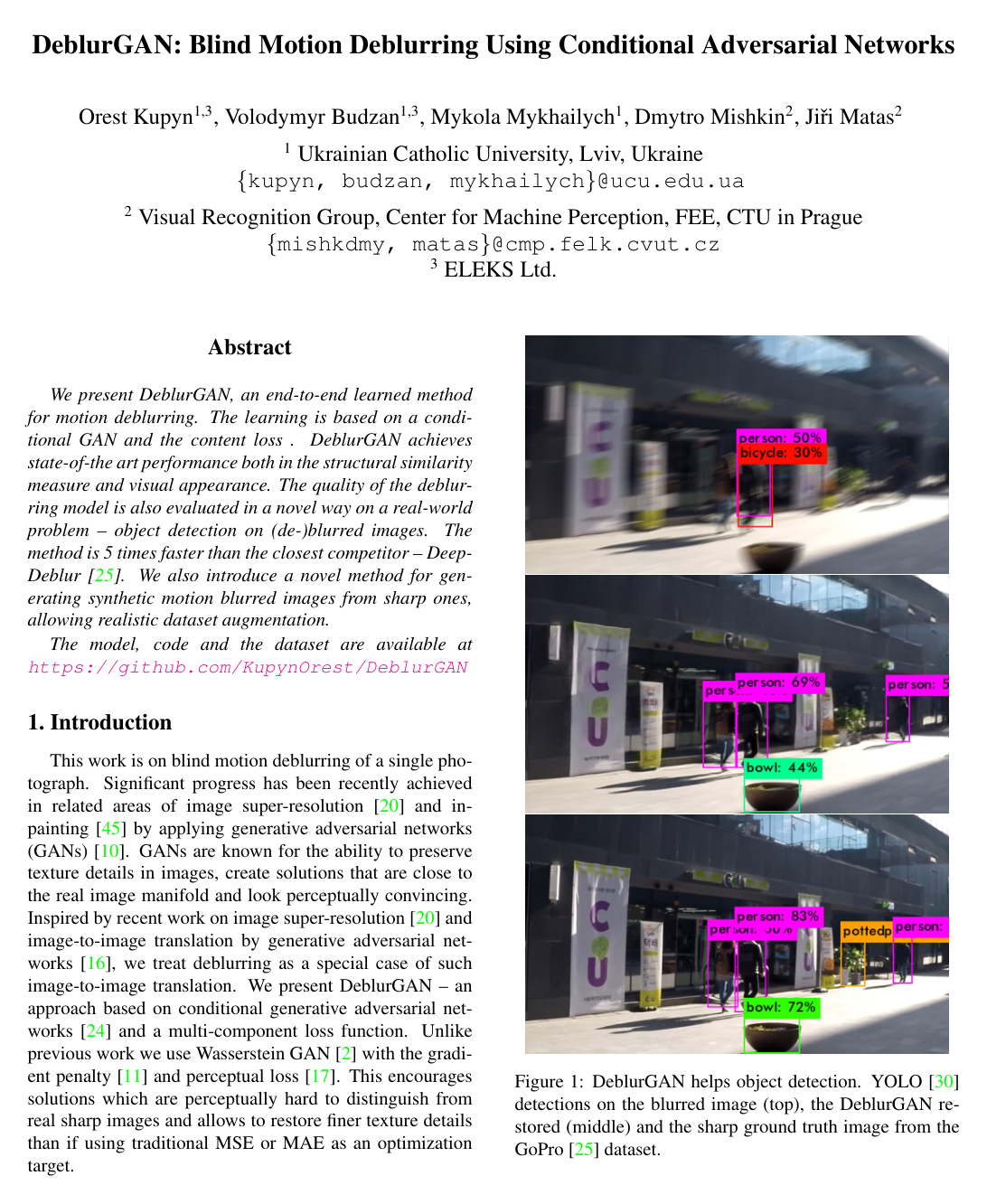
The evaluation produced several key findings. First, DeblurGAN achieved a processing speed of 0.85 seconds per image on a single graphics processing unit, operating more than five times faster than the leading deep learning competitor and orders of magnitude faster than traditional methods. Second, the model delivered superior structural similarity scores (0.958 versus 0.916 for the closest competitor on the GoPro dataset) and produced visibly sharper images without typical artifacts. Third, training on a combination of real-world and synthetically generated blur trajectories delivered better restoration performance than training on real images alone. Finally, in practical downstream evaluations using the YOLO object detection network on blurred street images, DeblurGAN improved object detection recall from 43.7% on untreated blurry images to 74.2%, outperforming alternative restoration methods and achieving the highest overall balance of precision and recall.

These results demonstrate that optimizing deblurring models for perceptual feature quality rather than simple pixel-level differences produces images that are both visually sharper and substantially more useful for automated vision pipelines. Because the architecture uses over six times fewer parameters than leading multi-scale networks, it reduces computational overhead and latency, making motion deblurring practical for time-sensitive, safety-critical applications such as autonomous vehicle perception.

Organizations implementing computer vision in dynamic environments should consider incorporating this lightweight deblurring architecture as a pre-processing stage to improve perception accuracy under rapid camera or target movement. To train such systems cost-effectively, teams should leverage synthetic trajectory-based blur generation rather than relying exclusively on slow, expensive video-frame capture.

Readers should note that while the method achieves state-of-the-art structural similarity and detection benefits, its raw signal-to-noise ratio metrics remain slightly below models optimized directly for pixel-level error. Furthermore, training the core network requires multi-day compute sessions, and downstream object detection precision reflects a trade-off as more candidate objects are resolved from previously unreadable blur.

Cover for DeblurGAN: Blind Motion Deblurring Using Conditional Adversarial Networks

Abstract

We present DeblurGAN, an end-to-end learned method for motion deblurring. The learning is based on a conditional GAN and the content loss . DeblurGAN achieves state-of-the art performance both in the structural similarity measure and visual appearance. The quality of the deblurring model is also evaluated in a novel way on a real-world problem -- object detection on (de-)blurred images. The method is 5 times faster than the closest competitor -- DeepDeblur. We also introduce a novel method for generating synthetic motion blurred images from sharp ones, allowing realistic dataset augmentation.

The model, code and the dataset are available at this https URL

Table of Contents

  • 1 Introduction
  • 2 Related work
  • 2.1 Image Deblurring
  • 2.2 Generative adversarial networks
  • 2.3 Conditional adversarial networks
  • 3 The proposed method
  • 3.1 Loss function
  • 3.2 Network architecture
  • 4 Motion blur generation
  • 5 Training Details
  • 6 Experimental evaluation
  • 6.1 GoPro Dataset
  • 6.2 Kohler dataset
  • 6.3 Object Detection benchmark on YOLO
  • 7 Conclusion
  • 8 Acknowledgements
  • References

Knowls

  1. Knowl 1 — DeblurGAN Multi-Component Loss Function

    model/method

    DeblurGAN formulates single-image blind motion deblurring as an image-to-image translation task optimized via a combination of a conditional adversarial loss and a perceptual content loss:

    L=LGAN+λLX\mathcal{L} = \mathcal{L}_{\text{GAN}} + \lambda \mathcal{L}_X

    where λ=100\lambda = 100 is a fixed weighting hyperparameter.

    The adversarial loss component LGAN\mathcal{L}_{\text{GAN}} uses the Wasserstein GAN framework with a critic network DθDD_{\theta_D} and generator GθGG_{\theta_G}. Over a batch of NN blurred input images IBI^B, the generator adversarial loss is:

    LGAN=∑n=1N−DθD(GθG(IB))\mathcal{L}_{\text{GAN}} = \sum_{n=1}^N -D_{\theta_D}(G_{\theta_G}(I^B))

    The discriminator is unconditioned on IBI^B to avoid penalizing input-output mismatch directly through the discriminator.

    The content loss LX\mathcal{L}_X is a perceptual loss defined as the Euclidean distance between feature representations extracted from a pretrained VGG-19 network:

    LX=1Wi,jHi,j∑x=1Wi,j∑y=1Hi,j(ϕi,j(IS)x,y−ϕi,j(GθG(IB))x,y)2\mathcal{L}_X = \frac{1}{W_{i,j} H_{i,j}} \sum_{x=1}^{W_{i,j}} \sum_{y=1}^{H_{i,j}} \left(\phi_{i,j}(I^S)_{x,y} - \phi_{i,j}(G_{\theta_G}(I^B))_{x,y}\right)^2

    where ϕi,j\phi_{i,j} denotes the feature map extracted after the jj-th convolutional layer before the ii-th max-pooling layer of VGG-19 pretrained on ImageNet (specifically layer conv3_3\text{conv3\_3} with i=3,j=3i=3, j=3), Wi,jW_{i,j} and Hi,jH_{i,j} are the spatial dimensions of the feature map, ISI^S is the sharp ground-truth image, and GθG(IB)G_{\theta_G}(I^B) is the restored image.

  2. Knowl 2 — DeblurGAN Generator Architecture with Global Residual Connection

    model/method

    The DeblurGAN generator GθGG_{\theta_G} is a fully convolutional neural network designed to recover a sharp image ISI_S from a blurred input IBI_B by predicting a residual correction IRI_R via a global skip connection (ResOut):

    IS=IB+IRI_S = I_B + I_R

    The generator consists of three main stages:

    1. Two strided convolutional downsampling blocks with stride 12\frac{1}{2}.
    2. Nine residual blocks (ResBlocks). Each ResBlock contains a convolutional layer, an Instance Normalization layer, a Rectified Linear Unit (ReLU) activation function, and Dropout regularization (p=0.5p = 0.5) applied after the first convolutional layer in the block.
    3. Two transposed convolutional upsampling blocks.

    Because the architecture is fully convolutional, it processes images of arbitrary input resolution. Both dropout and instance normalization layers remain active during test-time inference.

  3. Knowl 3 — DeblurGAN Critic Architecture and WGAN-GP Adversarial Objective

    model/method

    DeblurGAN trains its discriminator network DθDD_{\theta_D} as a critic using the Wasserstein GAN with Gradient Penalty (WGAN-GP) framework to enforce a 1-Lipschitz condition on the critic function. The critic adopts a PatchGAN convolutional architecture where all convolutional layers except the final output layer are followed by Instance Normalization and LeakyReLU activations with negative slope α=0.2\alpha = 0.2.

    The WGAN-GP objective optimized between the generator GG and critic DD is given by:

    min⁡Gmax⁡D∈DEx∼Pr[D(x)]−Ex~∼Pg[D(x~)]+λGPEx^∼Px^[(∥∇x^D(x^)∥2−1)2]\min_G \max_{D \in \mathcal{D}} \mathbb{E}_{x \sim \mathbb{P}_r}[D(x)] - \mathbb{E}_{\tilde{x} \sim \mathbb{P}_g}[D(\tilde{x})] + \lambda_{\text{GP}} \mathbb{E}_{\hat{x} \sim \mathbb{P}_{\hat{x}}}\left[(\|\nabla_{\hat{x}} D(\hat{x})\|_2 - 1)^2\right]

    where D\mathcal{D} is the set of 1-Lipschitz functions, Pr\mathbb{P}_r is the real sharp image distribution, Pg\mathbb{P}_g is the generated image distribution (ildex=G(IB) ilde{x} = G(I^B)), and Px^\mathbb{P}_{\hat{x}} is the distribution formed by sampling uniformly along straight lines between pairs of points from Pr\mathbb{P}_r and Pg\mathbb{P}_g.

  4. Knowl 4 — Synthetic Motion Blur Generation via Random Trajectory Markov Process

    algorithm

    Algorithm to generate realistic synthetic motion blur kernels and blurred images by simulating complex, non-linear 2D camera motion trajectories in a continuous domain using a discrete Markov process followed by sub-pixel interpolation.

    Input: Sharp image Img, total iterations M=2000M = 2000, maximum trajectory length Lmax⁡=60L_{\max} = 60, impulse shake probability ps=0.001p_s = 0.001, inertia coefficient I∼Uniform(0,0.7)I \sim \text{Uniform}(0, 0.7), big shake probability pb∼Uniform(0,0.2)p_b \sim \text{Uniform}(0, 0.2), Gaussian shake probability pg∼Uniform(0,0.7)p_g \sim \text{Uniform}(0, 0.7), initial direction angle ϕ∼Uniform(0,2π)\phi \sim \text{Uniform}(0, 2\pi)
    Output: Blurred image Imgblur\text{Img}_{\text{blur}} and blur kernel Kernel\text{Kernel}
    v0←cos⁡(ϕ)+isin⁡(ϕ)v_0 \leftarrow \cos(\phi) + i \sin(\phi)
    v←v0⋅Lmax⁡M−1v \leftarrow v_0 \cdot \frac{L_{\max}}{M - 1}
    x←array of zeros of length Mx \leftarrow \text{array of zeros of length } M
    for t←1 to M−1t \leftarrow 1 \text{ to } M - 1 do
        r←sample standard normal scalar N(0,1)r \leftarrow \text{sample standard normal scalar } \mathcal{N}(0, 1)
        if r<pb⋅psr < p_b \cdot p_s then
            nextDir←2⋅v⋅exp⁡(i⋅(π+(r−0.5)))\text{nextDir} \leftarrow 2 \cdot v \cdot \exp(i \cdot (\pi + (r - 0.5)))
        else
            nextDir←0\text{nextDir} \leftarrow 0
        end if
        g1,g2←sample independent standard normal scalars N(0,1)g_1, g_2 \leftarrow \text{sample independent standard normal scalars } \mathcal{N}(0, 1)
        dv←nextDir+ps⋅(pg⋅(g1+ig2)⋅I⋅x[t]⋅Lmax⁡M−1)dv \leftarrow \text{nextDir} + p_s \cdot \left(p_g \cdot (g_1 + i g_2) \cdot I \cdot x[t] \cdot \frac{L_{\max}}{M - 1}\right)
        v←v+dvv \leftarrow v + dv
        v←v∣v∣⋅Lmax⁡M−1v \leftarrow \frac{v}{|v|} \cdot \frac{L_{\max}}{M - 1}
        x[t+1]←x[t]+vx[t + 1] \leftarrow x[t] + v
    end for
    Kernel←sub_pixel_interpolation(x)\text{Kernel} \leftarrow \text{sub\_pixel\_interpolation}(x)
    Imgblur←conv(Kernel,Img)\text{Img}_{\text{blur}} \leftarrow \text{conv}(\text{Kernel}, \text{Img})
    return Imgblur,Kernel\text{Img}_{\text{blur}}, \text{Kernel}

    The trajectory vector xx records discrete 2D complex-valued coordinates. The kernel is synthesized by applying sub-pixel interpolation to xx, and the blurred image is generated by convolving the synthesized kernel with the input sharp image.

  5. Knowl 5 — DeblurGAN Training Setup and Optimization Protocol

    experimental setup

    DeblurGAN models are implemented in PyTorch and trained on a single Maxwell GTX Titan-X GPU. The optimization configuration is:

    • Optimizer: Adam solver.
    • Update ratio: 5 critic gradient updates for every 1 generator update.
    • Learning rate schedule: Initial learning rate of 10−410^{-4} for both generator and critic, held constant for 150 epochs and then linearly decayed to 0 over the final 150 epochs (300 total epochs).
    • Batch size: 1 image patch of size 256×256256 \times 256 pixels per step.
    • Training time: 6 days per model on a single GPU.
    • Datasets used for model variants:
      • DeblurGAN-WILD: Trained on 256×256256 \times 256 random crops from 1000 GoPro training images downscaled by a factor of 2.
      • DeblurGAN-Synth: Trained on 256×256256 \times 256 patches from the MS COCO dataset blurred using random trajectory motion kernels.
      • DeblurGAN-Comb: Trained on a combined dataset with a 2:1 ratio of synthetically blurred images to high-frame-rate real camera images.
  6. Knowl 6 — Deblurring Performance Comparison on the GoPro Dataset

    data/table

    Evaluation of DeblurGAN variants against prior blind motion deblurring methods on the GoPro test dataset of 1111 linear images at 720p resolution. Performance is assessed using Peak Signal-to-Noise Ratio (PSNR in dB), Structural Similarity Index Measure (SSIM), and inference runtime per image on a single GPU.

    Metric Sun et al. Nah et al. Xu et al. DeblurGAN WILD DeblurGAN Synth DeblurGAN Comb
    PSNR (dB) 24.6 28.3 / 29.1* 25.1 27.2 23.6 28.7
    SSIM 0.842 0.916 0.890 0.954 0.884 0.958
    Time 20 min 4.33 s 13.41 s 0.85 s 0.85 s 0.85 s

    *Note: The 29.1 dB PSNR for Nah et al. was reported on the gamma subset; all other entries were evaluated on the linear subset.

    DeblurGAN-Comb achieves an SSIM of 0.958, outperforming the multi-scale CNN of Nah et al. (0.916). DeblurGAN inference takes 0.85 seconds per image, which is over 5 times faster than Nah et al. (4.33 s), while using more than 6 times fewer parameters.

  7. Knowl 7 — Deblurring Performance Comparison on the Kohler Dataset

    data/table

    Evaluation of DeblurGAN variants against non-CNN and CNN blind deblurring algorithms on the Kohler benchmark dataset (4 sharp images subjected to 12 real 6D camera motion trajectories executed by a robot platform, totaling 48 blurred images).

    Metric Sun et al. Nah et al. Xu et al. Whyte et al. DeblurGAN WILD DeblurGAN Synth DeblurGAN Comb
    PSNR (dB) 25.22 26.48 27.47 27.03 26.10 25.67 25.86
    SSIM 0.773 0.807 0.811 0.809 0.816 0.792 0.802

    DeblurGAN-WILD achieves the highest SSIM (0.816) on the Kohler dataset across all evaluated methods. While traditional non-CNN kernel estimation methods (such as Xu et al. at 27.47 dB) achieve higher pixel-space PSNR, DeblurGAN preserves structural details and sharp boundaries more effectively.

  8. Knowl 8 — Task-Based Object Detection Benchmark for Image Deblurring

    experimental setup

    A benchmark and evaluation protocol assessing image deblurring algorithms by their ability to improve downstream object detection on degraded images:

    1. Dataset construction: 410 pairs of sharp and blurred street-scene images containing cars and street views. Blurred versions are created by averaging 5 to 25 consecutive frames from a 240 fps camera across camera shake and vehicle motion. Frames are gamma-corrected with γ=2.2\gamma = 2.2 prior to averaging, followed by inverse gamma transformation.
    2. Ground-truth generation: A pretrained YOLO object detection network is applied to the sharp images, followed by manual visual verification to assign ground-truth object bounding boxes.
    3. Model evaluation: Pretrained YOLO is executed on the untreated blurred images and on images restored by different deblurring algorithms. Precision, recall, and F1 score are computed relative to the verified sharp-image ground truth:

    Precision=TPTP+FP,Recall=TPTP+FN,F1=2⋅Precision⋅RecallPrecision+Recall\text{Precision} = \frac{\text{TP}}{\text{TP} + \text{FP}}, \quad \text{Recall} = \frac{\text{TP}}{\text{TP} + \text{FN}}, \quad \text{F1} = 2 \cdot \frac{\text{Precision} \cdot \text{Recall}}{\text{Precision} + \text{Recall}}

    where TP\text{TP}, FP\text{FP}, and FN\text{FN} represent true positive, false positive, and false negative object detections.

  9. Knowl 9 — YOLO Object Detection Performance on Deblurred Images

    data/table

    Object detection performance of a pretrained YOLO network evaluated on original blurred images and images restored by different deblurring models on the 410-image street view benchmark dataset, using verified detections on sharp images as ground truth.

    Method Precision Recall F1 score
    No deblur 0.821 0.437 0.570
    Nah et al. 0.834 0.552 0.665
    DeblurGAN WILD 0.764 0.631 0.691
    DeblurGAN synth 0.801 0.517 0.628
    DeblurGAN comb 0.671 0.742 0.704

    DeblurGAN-Comb achieves the highest recall (0.742) and F1 score (0.704), outperforming Nah et al. (0.665 F1) and untreated blurry inputs (0.570 F1). While untreated blurry images exhibit high precision due to missing small objects entirely, DeblurGAN restores edge boundaries, allowing YOLO to recover many previously undetectable objects.

  10. Knowl 10 — Impact of Content Loss and Regularization on DeblurGAN Restoration Quality

    empirical result

    Ablation experiments on the DeblurGAN training objective demonstrated the following properties:

    • Perceptual Loss vs. Pixel MSE: Training DeblurGAN without the VGG perceptual loss or with a standard Mean Squared Error (L2L_2) loss on raw pixels fails to converge to a meaningful restoration state, generating overly smooth and blurry images due to pixel-space averaging across multi-modal solutions. The VGG conv3_3\text{conv3\_3} perceptual loss guides general content recovery, while the WGAN-GP adversarial loss restores high-frequency texture details.
    • Adversarial Component: Removing the GAN adversarial loss allows optimization to converge but yields over-smoothed outputs without fine texture.
    • Total Variation Regularization: Incorporating Total Variation (TV) regularization into the total loss degrades deblurring performance, reducing PSNR on the GoPro dataset from 28.7 dB to 27.9 dB.

Coverage note — None was omitted; all primary architectural components, loss functions, synthetic blur generation algorithms, benchmark datasets, and empirical evaluations have been captured.

References

  1. 1.PyTorch. http://pytorch.org. 5
  2. 2.M. Arjovsky, S. Chintala, and L. Bottou. Wasserstein GAN. ArXiv e-prints, Jan. 2017. 1, 3, 4, 5, 7
  3. 3.S. D. Babacan, R. Molina, M. N. Do, and A. K. Katsaggelos. Bayesian blind deconvolution with general sparse image priors. In European Conference on Computer Vision (ECCV), Firenze, Italy, October 2012. Springer. 2
  4. 4.G. Boracchi and A. Foi. Modeling the performance of image restoration from motion blur. Image Processing, IEEE Transactions on, 21(8):3502 –3517, aug. 2012. 5
  5. 5.K. Bousmalis, N. Silberman, D. Dohan, D. Erhan, and D. Krishnan. Unsupervised Pixel-Level Domain Adaptation with Generative Adversarial Networks. ArXiv e-prints, Dec. 2016. 3
  6. 6.A. Chakrabarti. A neural approach to blind motion deblurring. In Lecture Notes in Computer Science (including subseries Lecture Notes in Artificial Intelligence and Lecture Notes in Bioinformatics), 2016. 3, 5
  7. 7.J. Deng, W. Dong, R. Socher, L.-J. Li, K. Li, and L. Fei-Fei. ImageNet: A Large-Scale Hierarchical Image Database. In CVPR09, 2009. 4
  8. 8.R. Fergus, B. Singh, A. Hertzmann, S. T. Roweis, and W. T. Freeman. Removing camera shake from a single photograph. ACM Trans. Graph., 25(3):787–794, July 2006. 2, 5
  9. 9.D. Gong, J. Yang, L. Liu, Y. Zhang, I. Reid, C. Shen, A. Van Den Hengel, and Q. Shi. From Motion Blur to Motion Flow: a Deep Learning Solution for Removing Heterogeneous Motion Blur. 2016. 3
  10. 10.I. J. Goodfellow, J. Pouget-Abadie, M. Mirza, B. Xu, D. Warde-Farley, S. Ozair, A. Courville, and Y. Bengio. Generative Adversarial Networks. June 2014. 1, 3
  11. 11.I. Gulrajani, F. Ahmed, M. Arjovsky, V. Dumoulin, and A. Courville. Improved Training of Wasserstein GANs. ArXiv e-prints, Mar. 2017. 1, 3, 4, 5
  12. 12.A. Gupta, N. Joshi, C. L. Zitnick, M. Cohen, and B. Curless. Single image deblurring using motion density functions. In Proceedings of the 11th European Conference on Computer Vision: Part I, ECCV’10, pages 171–184, Berlin, Heidelberg, 2010. Springer-Verlag. 3
  13. 13.K. He, X. Zhang, S. Ren, and J. Sun. Deep residual learning for image recognition. arXiv preprint arXiv:1512.03385, 2015. 3, 5
  14. 14.M. Hirsch, C. J. Schuler, S. Harmeling, and B. Scholkopf. Fast removal of non-uniform camera shake. In Proceedings of the 2011 International Conference on Computer Vision, ICCV ’11, pages 463–470, Washington, DC, USA, 2011. IEEE Computer Society. 8
  15. 15.G. Huang, Z. Liu, L. van der Maaten, and K. Q. Weinberger. Densely connected convolutional networks. 2017 IEEE Conference on Computer Vision and Pattern Recognition (CVPR), pages 2261–2269, 2017. 3
  16. 16.P. Isola, J.-Y. Zhu, T. Zhou, and A. A. Efros. Image-to-image translation with conditional adversarial networks. arxiv, 2016. 1, 3, 4, 5, 7
  17. 17.J. Johnson, A. Alahi, and L. Fei-Fei. Perceptual losses for real-time style transfer and super-resolution. In European Conference on Computer Vision, 2016. 1, 4, 5
  18. 18.D. P. Kingma and J. Ba. Adam: A method for stochastic optimization. CoRR, abs/1412.6980, 2014. 7
  19. 19.R. Kohler, M. Hirsch, B. Mohler, B. Sch ¨ olkopf, and ¨ S. Harmeling. Recording and playback of camera shake: Benchmarking blind deconvolution with a real-world database. In Proceedings of the 12th European Conference on Computer Vision - Volume Part VII, ECCV’12, pages 27–40, Berlin, Heidelberg, 2012. Springer-Verlag. 7
  20. 20.C. Ledig, L. Theis, F. Huszar, J. Caballero, A. Cunningham, A. Acosta, A. Aitken, A. Tejani, J. Totz, Z. Wang, and W. Shi. Photo-Realistic Single Image Super-Resolution Using a Generative Adversarial Network. ArXiv e-prints, Sept. 2016. 1, 3, 4
  21. 21.B. Li, X. Peng, Z. Wang, J. Xu, and D. Feng. An All-inOne Network for Dehazing and Beyond. ArXiv e-prints, July 2017. 7
  22. 22.C. Li and M. Wand. Precomputed Real-Time Texture Synthesis with Markovian Generative Adversarial Networks. ArXiv e-prints, Apr. 2016. 3, 5
  23. 23.X. Mao, Q. Li, H. Xie, R. Y. K. Lau, and Z. Wang. Least squares generative adversarial networks, 2016. cite arxiv:1611.04076. 4
  24. 24.M. Mirza and S. Osindero. Conditional generative adversarial nets. CoRR, abs/1411.1784, 2014. 1
  25. 25.S. Nah, T. Hyun, K. Kyoung, and M. Lee. Deep Multi-scale Convolutional Neural Network for Dynamic Scene Deblurring. 2016. 1, 2, 3, 4, 5, 6, 7, 8
  26. 26.V. Nair and G. E. Hinton. Rectified linear units improve restricted boltzmann machines. In International Conference on Machine Learning (ICML), pages 807–814, 2010. 5
  27. 27.M. Noroozi, P. Chandramouli, and P. Favaro. Motion Deblurring in the Wild. 2017. 3, 5, 8
  28. 28.D. Perrone and P. Favaro. Total variation blind deconvolution: The devil is in the details. In EEE Conference on Computer Vision and Pattern Recognition (CVPR), 2014. 2
  29. 29.S. Ramakrishnan, S. Pachori, A. Gangopadhyay, and S. Raman. Deep generative filter for motion deblurring. 2017 IEEE International Conference on Computer Vision Workshops (ICCVW), pages 2993–3000, 2017. 3
  30. 30.J. Redmon, S. Divvala, R. Girshick, and A. Farhadi. You Only Look Once: Unified, Real-Time Object Detection. ArXiv e-prints, June 2015. 1, 7, 8
  31. 31.O. Ronneberger, P. Fischer, and T. Brox. U-Net: Convolutional Networks for Biomedical Image Segmentation. ArXiv e-prints, May 2015. 4
  32. 32.M. S. M. Sajjadi, B. Scholkopf, and M. Hirsch. Enhancenet: ¨ Single image super-resolution through automated texture synthesis. 2017 IEEE International Conference on Computer Vision (ICCV), pages 4501–4510, 2017. 7
  33. 33.T. Salimans, I. Goodfellow, W. Zaremba, V. Cheung, A. Radford, and X. Chen. Improved Techniques for Training GANs. ArXiv e-prints, June 2016. 3
  34. 34.K. Simonyan and A. Zisserman. Very Deep Convolutional Networks for Large-Scale Image Recognition. ArXiv eprints, Sept. 2014. 4
  35. 35.N. Srivastava, G. Hinton, A. Krizhevsky, I. Sutskever, and R. Salakhutdinov. Dropout: A simple way to prevent neural networks from overfitting. J. Mach. Learn. Res., 15(1):1929–1958, Jan. 2014. 5
  36. 36.J. Sun, W. Cao, Z. Xu, and J. Ponce. Learning a Convolutional Neural Network for Non-uniform Motion Blur Removal. 2015. 3, 5, 7, 8
  37. 37.R. Szeliski. Computer Vision: Algorithms and Applications. Springer-Verlag New York, Inc., New York, NY, USA, 1st edition, 2010. 2
  38. 38.D. Ulyanov, A. Vedaldi, and V. S. Lempitsky. Instance normalization: The missing ingredient for fast stylization. CoRR, abs/1607.08022, 2016. 5
  39. 39.C. Villani. Optimal Transport: Old and New. Grundlehren der mathematischen Wissenschaften. Springer Berlin Heidelberg, 2008. 3
  40. 40.O. Whyte, J. Sivic, A. Zisserman, and J. Ponce. Non-uniform deblurring for shaken images. In Proceedings of the IEEE Conference on Computer Vision and Pattern Recognition, 2010. 2, 8
  41. 41.B. Xu, N. Wang, T. Chen, and M. Li. Empirical evaluation of rectified activations in convolutional network. arXiv preprint arXiv:1505.00853, 2015. 5
  42. 42.L. Xu and J. Jia. Two-phase kernel estimation for robust motion deblurring. In Lecture Notes in Computer Science (including subseries Lecture Notes in Artificial Intelligence and Lecture Notes in Bioinformatics), 2010. 2
  43. 43.L. Xu, J. S. J. Ren, C. Liu, and J. Jia. Deep convolutional neural network for image deconvolution. In Proceedings of the 27th International Conference on Neural Information Processing Systems - Volume 1, NIPS’14, pages 1790–1798, Cambridge, MA, USA, 2014. MIT Press. 5
  44. 44.L. Xu, S. Zheng, and J. Jia. Unnatural L0 Sparse Representation for Natural Image Deblurring. 2013. 2, 7, 8
  45. 45.R. A. Yeh, C. Chen, T. Lim, M. Hasegawa-Johnson, and M. N. Do. Semantic image inpainting with perceptual and contextual losses. CoRR, abs/1607.07539, 2016. 1
  46. 46.M. D. Zeiler and R. Fergus. Visualizing and understanding convolutional networks. CoRR, abs/1311.2901, 2013. 4
  47. 47.J.-Y. Zhu, T. Park, P. Isola, and A. A. Efros. Unpaired image-to-image translation using cycle-consistent adversarial networks. arXiv preprint arXiv:1703.10593, 2017. 4

Citation

MLA
Kupyn, O., et al. “DeblurGAN: Blind Motion Deblurring Using Conditional Adversarial Networks”. arXiv, 2017, http://arxiv.org/abs/1711.07064v4.
APA
Kupyn, O., Budzan, V., Mykhailych, M., Mishkin, D., & Matas, J. (2017). DeblurGAN: Blind Motion Deblurring Using Conditional Adversarial Networks. arXiv. http://arxiv.org/abs/1711.07064v4
Chicago
Kupyn, O., V. Budzan, M. Mykhailych, D. Mishkin, and J. Matas. 2017. “DeblurGAN: Blind Motion Deblurring Using Conditional Adversarial Networks”. arXiv. http://arxiv.org/abs/1711.07064v4.
Harvard
Kupyn, O. et al. (2017) “DeblurGAN: Blind Motion Deblurring Using Conditional Adversarial Networks”, arXiv [Preprint]. Available at: http://arxiv.org/abs/1711.07064v4.
Vancouver
1. Kupyn O, Budzan V, Mykhailych M, Mishkin D, Matas J (2017) DeblurGAN: Blind Motion Deblurring Using Conditional Adversarial Networks. arXiv

BibTeX

@article{kupyn2017deblurgan,
  title = {DeblurGAN: Blind Motion Deblurring Using Conditional Adversarial Networks},
  author = {Kupyn, Orest and Budzan, Volodymyr and Mykhailych, Mykola and Mishkin, Dmytro and Matas, Jiri},
  year = {2017},
  journal = {arXiv},
  url = {http://arxiv.org/abs/1711.07064v4},
  eprint = {1711.07064}
}
Metadata:arXiv

Source Code

This paper has an official code repository available. Click below to access the source code.

View Repository

Access the Paper

This paper is available from its original source. Click below to access the PDF.

Open PDF
License: IEEE