Generalized Preference Optimization: A Unified Approach to Offline Alignment
Yunhao TangZhaohan Daniel GuoZeyu ZhengDaniele CalandrielloRémi MunosMark RowlandPierre Harvey RichemondMichal ValkoBernardo Ávila PiresBilal Piot
Unifies offline alignment methods under a single convex-loss framework that explains how algorithms like DPO and IPO enforce implicit regularization and provides principled guidance for tuning their hyperparameters.
Aligning large language models with human preferences has traditionally relied on complex reinforcement learning workflows that require training separate reward models and repeatedly generating online model outputs. While newer offline preference optimization techniques streamline this process by training directly on pre-collected pairwise comparison datasets, the machine learning community has lacked a comprehensive theoretical framework explaining how these distinct algorithms relate to one another and how they control model drift. The article addresses this gap by introducing Generalized Preference Optimization, a unifying framework that maps offline alignment methods to established binary classification loss functions.
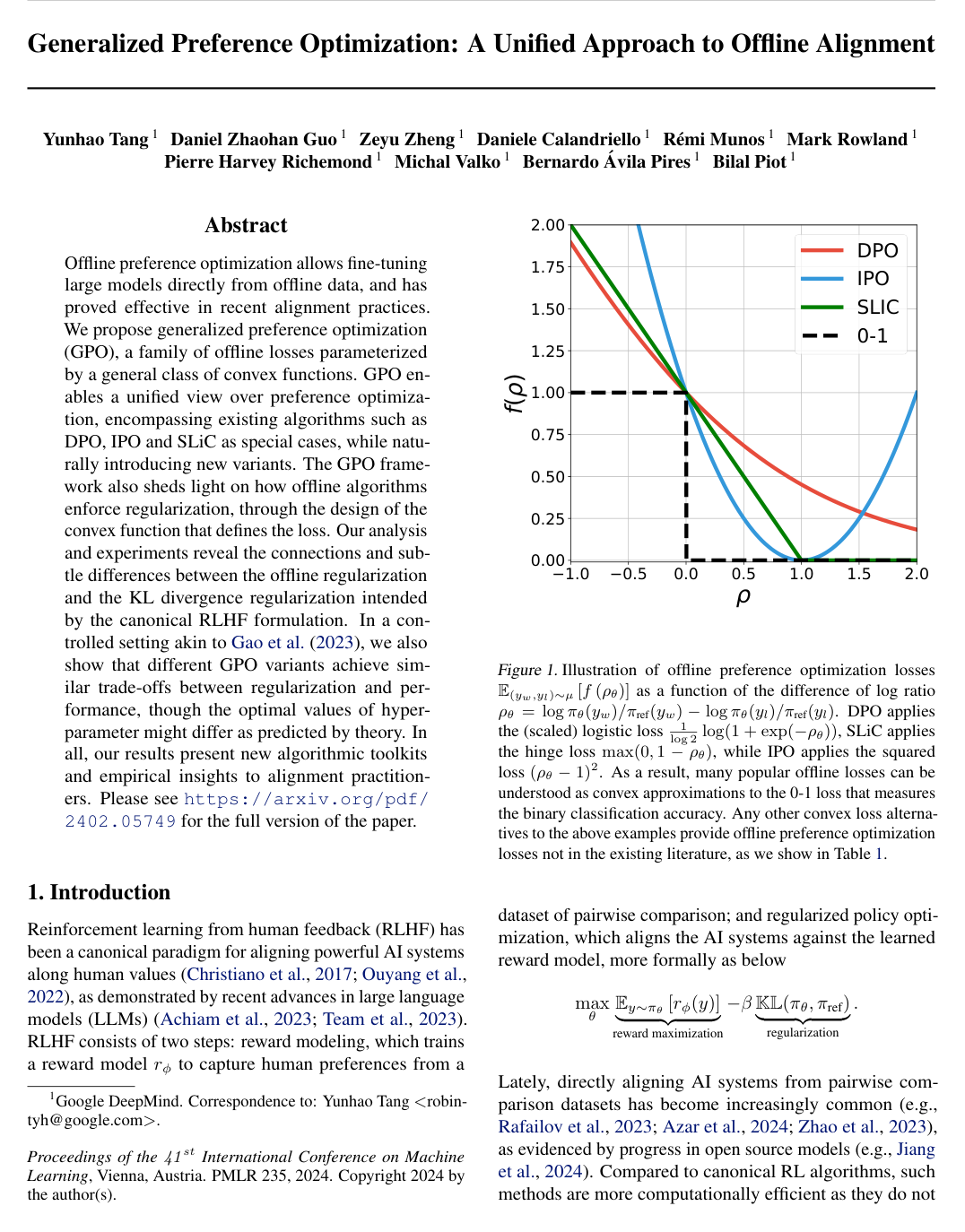
To evaluate this framework, the article proves that existing algorithms—such as Direct Preference Optimization, Identity Preference Optimization, and Sequence Likelihood Calibration—are specific instances within a broader family of convex losses, while introducing novel loss variants including exponential, truncated quadratic, and Savage losses. The authors conducted mathematical analyses of the regularization mechanisms and paired their theory with empirical testing. These tests included controlled synthetic experiments on an 11-billion-parameter text summarization setup, low-dimensional mathematical simulations, and large language model evaluations judged across 2,000 test summaries.
Across both theoretical analysis and empirical benchmarking, the article establishes four primary findings. First, all examined loss variants demonstrate remarkably similar peak performance and follow the same fundamental trade-offs between response quality and baseline model drift. Second, the mathematical shape of the chosen loss function directly determines its baseline regularization strength; squared and margin-based losses enforce tighter constraints, requiring regularization hyperparameter settings roughly an order of magnitude lower than logistic losses to achieve peak performance. Third, the implicit regularization enforced on offline data approximates online distribution constraints well near the starting model, but diverges significantly when the policy drifts too far. Fourth, in practical summarization tasks, all algorithmic variants reached their highest win rates against the baseline when the regularization parameter was set between 0.1 and 1.
These findings indicate that practitioners do not need to cycle through competing offline alignment algorithms seeking major performance breakthroughs. Instead, model performance depends almost entirely on calibrating the regularization hyperparameter to match the inherent strength of the selected loss function. Engineering teams can select the algorithm that is simplest and most numerically stable for their software stack without sacrificing output quality, reducing developmental complexity and tuning costs.
Teams implementing offline preference optimization should prioritize hyperparameter tuning and early checkpoint selection over switching loss functions. When transitioning between algorithms, engineers must adjust their regularization values according to the specific loss curve being used. Because this framework relies on the assumption that human feedback can be represented as a single scalar ranking, practitioners should exercise caution in domains with complex, intransitive human preferences. Additional research and pilot testing will be necessary to extend these unified methods to multi-turn interactions and non-ranking alignment objectives.
- Paper: Direct Preference Optimization: Your Language Model is Secretly a Reward Model, Rafael Rafailov et al. (2023). GPO treats DPO as a special case, so DPO’s derivation from preference data and its reference-policy regularization make the unified loss framework easier to follow.
- Paper: Scaling Laws for Reward Model Overoptimization, Leo Gao et al. (2023). The source explicitly compares its regularization–performance analysis with Gao et al.’s controlled setting, making that study’s reward–KL trade-off a useful prerequisite for interpreting the experiments.
- Paper: Proximal Policy Optimization Algorithms, John Schulman et al. (2017). The source contrasts offline losses with the KL regularization of canonical RLHF; PPO’s clipped policy updates provide essential context for that comparison.
- Paper: From RLHF to Direct Alignment: A Theoretical Unification of Preference Learning for Large Language Models, Tarun Raheja et al. (2026). Building on GPO’s unified treatment of offline losses, this later synthesis broadens the comparison across preference objectives, regularization choices, and offline-versus-online data regimes.