Hard Patches Mining for Masked Image Modeling
Haochen WangKaiyou SongJunsong FanYuxi WangJin XieZhaoxiang Zhang
Proposes Hard Patches Mining, an adaptive masked image modeling framework that trains a model to predict patch-wise reconstruction difficulty and mask the most challenging regions, outperforming standard masked autoencoders on ImageNet-1K with half the pre-training epochs.
Visual AI models increasingly rely on self-supervised pre-training to learn general visual representations from unannotated image datasets. A prominent technique, masked image modeling, hides parts of an image and trains the computer vision model to reconstruct the missing sections. However, conventional methods rely on pre-defined or random masking rules that act only as rigid assignments for the model to solve. Because images contain substantial repetitive background information, random masking frequently hides uninformative areas rather than the core, discriminative objects necessary for robust understanding.
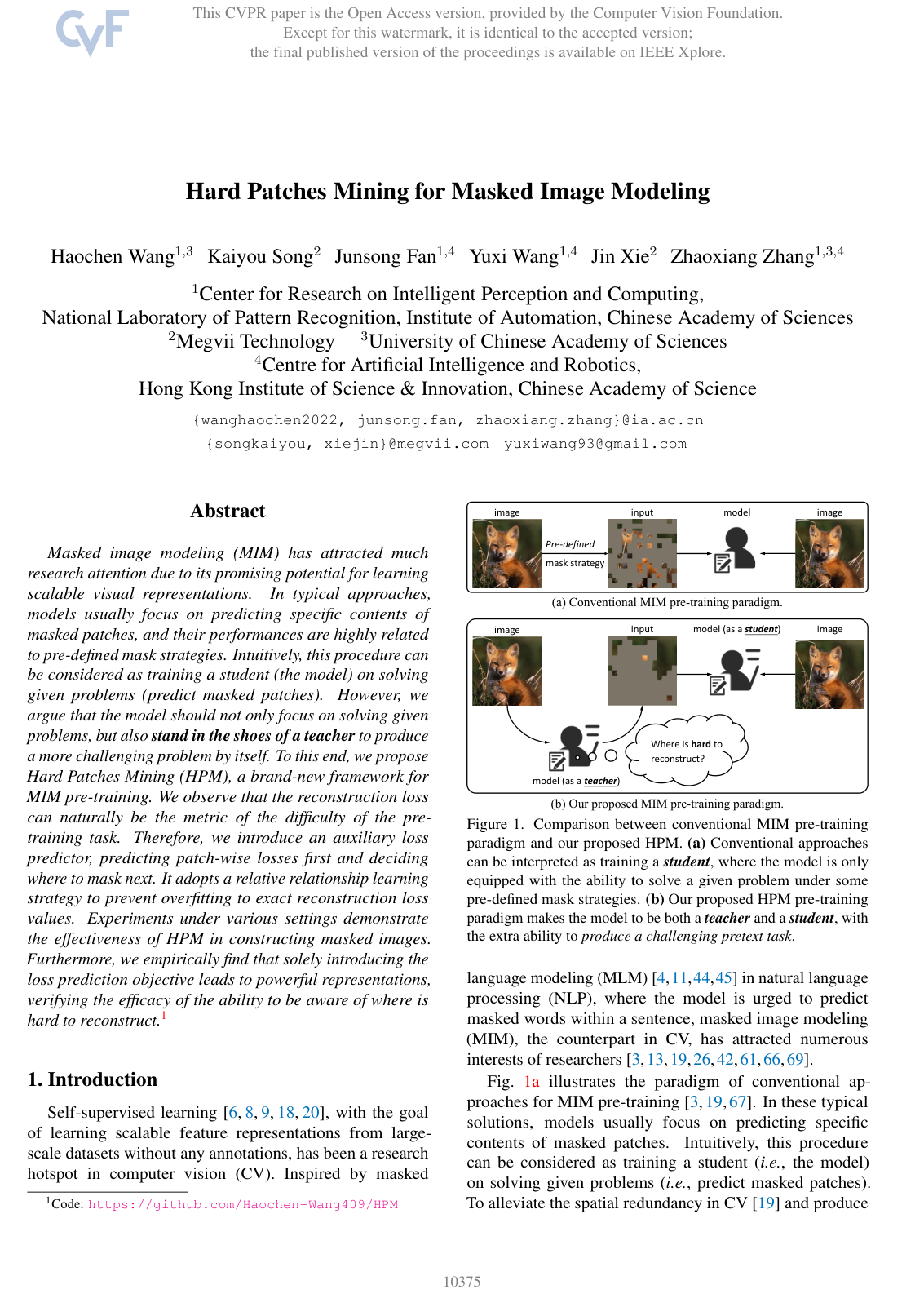
The article introduces and evaluates Hard Patches Mining, a self-supervised training framework designed to make the AI system act as both a teacher and a student. The main objective is to demonstrate that an AI model can autonomously identify which image regions are hardest to reconstruct and use that knowledge to generate progressively more demanding training tasks, ultimately improving representation quality across downstream vision applications.
To test this concept, the authors conducted extensive experiments using standard Vision Transformer backbones evaluated on established benchmarks, including ImageNet-1K classification, COCO object detection and instance segmentation, and ADE20k semantic segmentation. The system pairs a student network with a momentum-updated teacher network. The teacher predicts the relative reconstruction difficulty across image patches using a relative loss formulation, and an easy-to-hard scheduling strategy gradually increases the proportion of difficult patches hidden from the student during training.
The experimental findings show substantial performance and efficiency gains. First, Hard Patches Mining achieves 84.2% and 85.8% Top-1 fine-tuning accuracy on ImageNet-1K using standard base and large Vision Transformer models with 800 pre-training epochs, outperforming baseline Masked Autoencoders trained for twice as long (1600 epochs) by 0.6% and 0.7%, respectively. Second, under a shorter 200-epoch schedule, the method surpasses the baseline by 0.8% on the base model and 1.2% on the large model. Third, the benefits transfer strongly to downstream dense prediction tasks, improving object detection by 1.58 average precision points on COCO and semantic segmentation by 1.0 to 1.6 mean Intersection-over-Union points on ADE20k. Finally, ablation studies confirm that balancing difficult masks with a baseline degree of randomness is necessary to prevent eliminating all contextual clues.
These results indicate that teaching an AI model to identify salient, difficult image regions during pre-training significantly improves visual representation quality while reducing required training epochs. Engineering teams can integrate this approach as a flexible module into existing self-supervised pipelines—whether reconstructing raw pixels or distilling features—to achieve higher downstream task accuracy and lower pre-training compute budgets.
Organizations developing large-scale visual models should consider adopting learnable, difficulty-aware masking to enhance pre-training pipelines. Practitioners should implement the easy-to-hard schedule and retain a portion of random masking to prevent task collapse. Before large-scale production deployment, engineering teams should conduct pilot tests to optimize the framework for specific downstream workloads.
The findings are supported with high confidence across multiple architectures, pre-training objectives, and evaluation benchmarks. However, leaders should note key constraints: the framework requires an auxiliary prediction head that increases per-epoch training time by approximately 10%, and like other masked image modeling methods, it does not match contrastive learning baselines when evaluated via linear probing or nearest-neighbor classification.
- Paper: Masked Autoencoders Are Scalable Vision Learners, Kaiming He et al. (2022). Introduces the asymmetric masked autoencoder framework and standard random patch masking strategy that Hard Patches Mining actively seeks to improve via adaptive difficulty estimation.
- Paper: SimMIM: a Simple Framework for Masked Image Modeling, Zhenda Xie et al. (2021). Establishes a foundational masked image modeling framework based on direct pixel reconstruction and pre-defined masking, providing the core baseline context for HPM.
- Paper: BEiT: BERT Pre-Training of Image Transformers, Hangbo Bao et al. (2022). Introduced the masked image modeling paradigm for Vision Transformers, formalizing patch corruption and recovery as a self-supervised pre-training objective.
- Paper: Context Encoders: Feature Learning by Inpainting, Deepak Pathak et al. (2016). Pioneered representation learning through inpainting missing image regions, laying the historical foundation for reconstruction-driven visual pre-training.
No sufficiently relevant recommendations were found.