SimMIM: a Simple Framework for Masked Image Modeling
Zhenda XieZheng ZhangYue CaoYutong LinJianmin BaoZhuliang YaoQi DaiHan Hu
Demonstrates that masked image modeling achieves state-of-the-art visual representation learning through direct raw pixel regression and a simple linear prediction head, eliminating the need for complex tokenizers while scaling effectively to billion-parameter models.
Training modern, large-scale artificial intelligence models for visual recognition typically requires massive amounts of manually labeled data, which is expensive and time-consuming to create. Self-supervised learning, where models learn directly from unlabeled data by predicting masked-out portions of inputs, has transformed natural language processing. However, adapting this masked signal modeling to computer vision has historically led researchers to introduce complex, computationally heavy mechanisms such as specialized tokenizers, color clustering, and complex masking patterns to handle the continuous nature of image pixels.
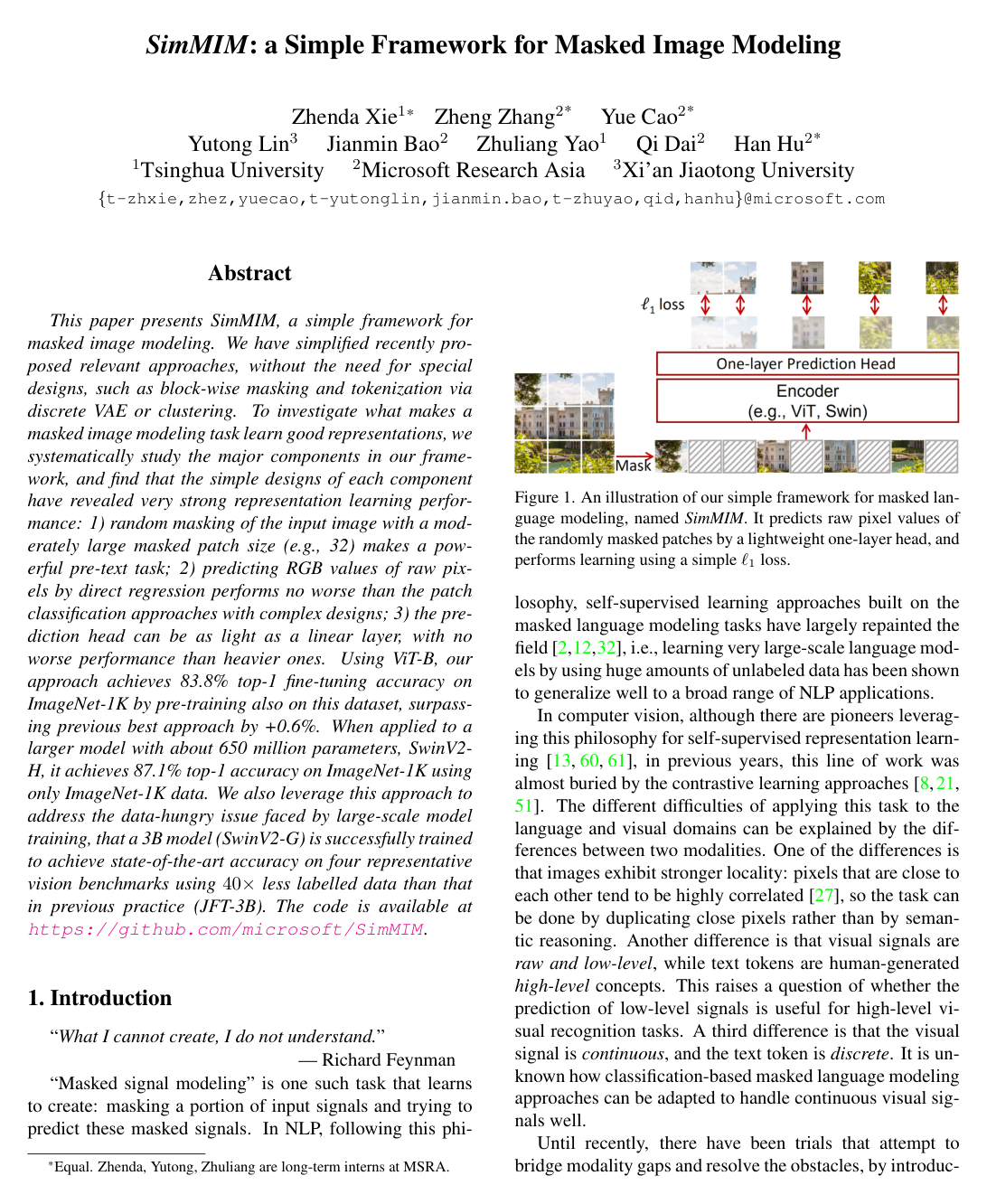
The article aims to evaluate whether a radically simplified framework—named SimMIM—can learn high-quality visual representations without these complex components. Specifically, it demonstrates that direct raw pixel regression paired with simple random masking and an extremely lightweight prediction architecture can match or exceed the performance of existing, more complex approaches.
To demonstrate this, the authors systematically evaluated the core design components across multiple standard vision Transformer architectures, including Vision Transformers and Swin Transformers, using the ImageNet-1K benchmark alongside other downstream recognition tasks. They tested various masking strategies, patch sizes, masking ratios, prediction heads, and target formulations to identify the most effective and efficient combinations for self-supervised pre-training and downstream fine-tuning.
The analysis yielded several key findings in order of importance. First, direct regression of raw pixel values using a simple loss function performs as well as or better than complex classification-based tokenization or clustering targets, while avoiding the extra computational overhead of pre-training helper networks. Second, an extremely lightweight prediction head consisting of a single linear layer matches or slightly outperforms heavy multi-layer neural network decoders, reducing pre-training compute requirements by up to 2.3 times. Third, simple random patch masking with a moderately large patch size of 32x32 pixels provides a highly robust pre-text task, maintaining strong downstream performance across a broad range of masking ratios (10% to 70%). Fourth, evaluating only the masked areas achieves significantly better downstream fine-tuning results (82.8% top-1 accuracy on ImageNet-1K) than simultaneously reconstructing both visible and masked areas (81.7%). Finally, the approach scaled effectively to massive models: a 658-million-parameter model achieved 87.1% accuracy using only ImageNet-1K data, and a 3-billion-parameter model set competitive records on multiple vision benchmarks using roughly 40 times less labeled data than standard industry baselines.
These findings indicate that masked image modeling does not need to mimic the discrete classification structures of natural language processing to be effective. For organizations developing or deploying visual AI, this simplicity directly translates into major reductions in computational costs, training times, and data acquisition budgets. The results demonstrate that allocating network capacity to the primary encoder rather than complex decoders or tokenizers yields superior transferable features for real-world downstream vision applications.
Engineering teams should adopt direct pixel regression with a single linear head and patch-aligned random masking when implementing self-supervised visual pre-training workflows. Because the approach reliably scales across both Vision Transformers and standard convolutional neural network architectures, organizations can apply this simple pipeline to large foundation models to reduce reliance on costly proprietary labeled datasets. Future development should explore applying this framework to fine-grained downstream visual tasks such as higher-resolution dense object detection and semantic segmentation.
The findings are supported by comprehensive ablation experiments and validated across standard benchmarks. However, readers should note that the 3-billion-parameter model was pre-trained on a privately collected extended dataset rather than an open benchmark, and while the learned representations deliver state-of-the-art fine-tuning accuracy, they achieve lower scores under linear probing evaluations that evaluate frozen representations without task-specific fine-tuning.
- Paper: BEiT: BERT Pre-Training of Image Transformers, Hangbo Bao et al. (2022). BEiT pioneered masked image modeling with vision transformers using discrete VAE tokenization, establishing the core paradigm that SimMIM directly aims to simplify and analyze.
- Paper: Swin Transformer: Hierarchical Vision Transformer using Shifted Windows, Ze Liu et al. (2021). This work introduces the hierarchical Swin Transformer architecture, which serves as the foundational backbone model scaled and evaluated within the SimMIM pre-training framework.
- Paper: An Image is Worth 16x16 Words: Transformers for Image Recognition at Scale, Alexey Dosovitskiy et al. (2021). This seminal paper introduces the Vision Transformer (ViT) architecture, which provides the primary token-based representation structure underlying SimMIM's masked patch prediction.
- Paper: Training data-efficient image transformers & distillation through attention, Hugo Touvron et al. (2021). DeiT establishes critical data-efficient training recipes and baseline Vision Transformer setups on ImageNet-1K that SimMIM builds upon and benchmarks against.
- Paper: Emerging Properties in Self-Supervised Vision Transformers, Mathilde Caron et al. (2021). DINO demonstrated the power of self-supervised Vision Transformers, motivating the search for alternative, non-contrastive self-supervised visual pre-text tasks like masked image modeling.
- Paper: Zero-Shot Text-to-Image Generation, Aditya Ramesh et al. (2021). This work developed the discrete VAE visual tokenizer adapted by early masked image modeling methods, which SimMIM explicitly demonstrates can be replaced by direct raw pixel regression.
- Paper: Swin Transformer V2: Scaling Up Capacity and Resolution, Ze Liu et al. (2022). Swin Transformer V2 scales vision models to 3 billion parameters by directly employing SimMIM self-supervised pre-training to overcome severe data hunger.
- Paper: Masked Autoencoders Are Scalable Vision Learners, Kaiming He et al. (2022). Masked Autoencoders (MAE) offer a complementary, highly influential masked image modeling framework that utilizes an asymmetric encoder-decoder design to optimize pixel reconstruction efficiency.
- Paper: ConvNeXt V2: Co-designing and Scaling ConvNets with Masked Autoencoders, Sanghyun Woo et al. (2023). ConvNeXt V2 extends masked autoencoding and direct pixel reconstruction principles from Vision Transformers to modern purely convolutional architectures.
- Paper: VideoMAE: Masked Autoencoders are Data-Efficient Learners for Self-Supervised Video Pre-Training, Zhan Tong et al. (2022). VideoMAE adapts masked visual modeling and raw-signal reconstruction to spatiotemporal video domains using high-ratio tube masking.
- Paper: Visual Prompt Tuning, Menglin Jia et al. (2022). Visual Prompt Tuning explores parameter-efficient downstream adaptation strategies for large vision transformers pre-trained with masked image modeling methods like SimMIM.