StreamMind: Unlocking Full Frame Rate Streaming Video Dialogue through Event-Gated Cognition
Xin DingHao WuYifan YangShiqi JiangQianxi ZhangDonglin BaiZhibo ChenTing Cao
Proposes StreamMind, an event-gated video dialogue framework that pairs state-space feature extraction with selective language model invocation to enable proactive, real-time video understanding at 100 frames per second.
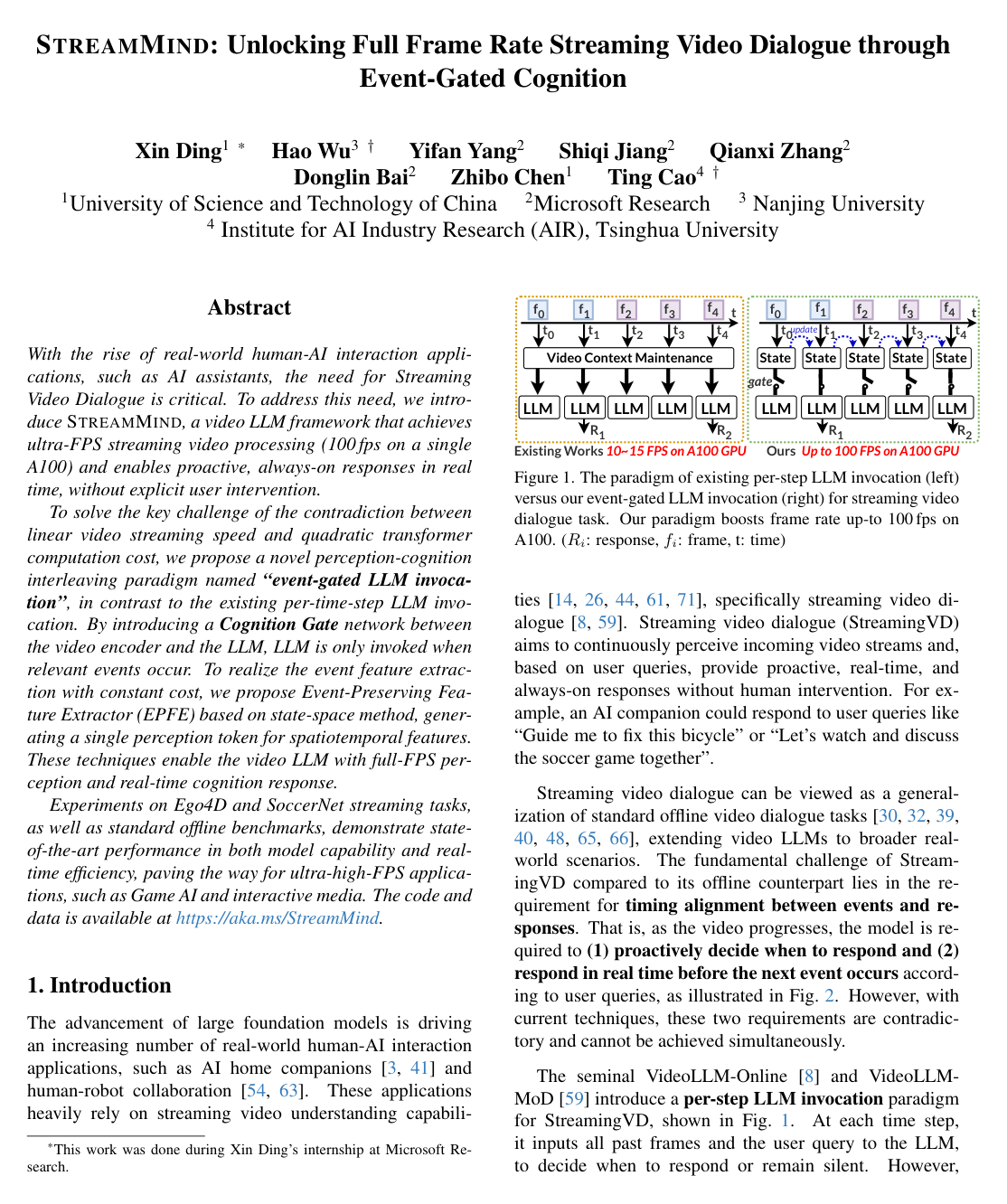
Real-time human-AI interaction systems, such as assistive AI companions and interactive media, require artificial intelligence models to continuously process live video streams and respond proactively without needing explicit user prompts at every step. However, current systems struggle with a fundamental computational bottleneck: processing incoming video frames sequentially using large language models creates severe latency, typically capping real-time performance at around 10 to 15 frames per second. This limitation prevents models from achieving true real-time alignment between ongoing real-world events and generated responses, especially in high-speed environments.
The article demonstrates and evaluates STREAMMIND, a novel video large language model framework designed to overcome this bottleneck. The objective is to achieve full-frame-rate streaming video dialogue by decoupling continuous visual perception from cognitive response generation, thereby enabling proactive, always-on AI interactions at speeds of up to 100 frames per second on a single graphics processing unit.
The approach introduces an event-gated architecture inspired by human cognition. Instead of invoking the resource-heavy large language model at every video frame, the system uses a compact, 56-million-parameter Event-Preserving Feature Extractor to process visual inputs with constant computational cost per frame. An intermediate Cognition Gate—constructed by fine-tuning the first four shallow layers of the language model—monitors the continuous perception stream against user queries and only triggers the deeper language model when a relevant event occurs. The authors evaluated the framework through extensive experiments across standard streaming and offline benchmarks, including the Ego4D and SoccerNet datasets, measuring response accuracy, timing validity, language quality, and processing throughput.
The experimental findings show substantial improvements over previous state-of-the-art systems. First, the framework processed video streams at up to 100 frames per second on modern hardware, representing roughly a tenfold throughput advantage over existing online baselines that falter past 10 frames per second. Second, the system achieved higher temporal responsiveness, improving trigger accuracy from roughly 32% to over 43% on Ego4D and from 31% to over 52% on SoccerNet. Third, the model enhanced language generation quality and correctness, boosting correctness on SoccerNet from 53.5% to 89.2% while maintaining lower perplexity and latency. Finally, the framework surpassed prior approaches across six traditional offline recognition and forecasting benchmarks.
These results imply that high-frame-rate, proactive video dialogue is computationally viable for deployment without requiring unsustainable hardware scaling. By reducing quadratic and cubic processing overheads to constant-cost perception loops, the framework substantially lowers inference latency and operational infrastructure costs. This makes real-time AI assistance practical for demanding domains such as high-refresh gaming AI, live sports commentary, and industrial human-robot collaboration.
Organizations developing interactive video and embodied AI systems should adopt decoupled, event-gated architectures rather than per-frame language model invocation. Teams implementing this architecture should utilize shallow language model layers for the gating mechanism and apply empirical loss-weighting formulas to manage the heavy data imbalance between event and non-event frames. The primary limitations include reliance on existing benchmark datasets with specific annotation densities and the necessity of tuning dataset-specific weighting parameters for optimal gating accuracy. Overall confidence in the performance gains is high across standard benchmarks, though organizations should validate the framework in domain-specific pilot environments before full production deployment.
- Paper: Video-LLaMA: An Instruction-tuned Audio-Visual Language Model for Video Understanding, Hang Zhang et al. (2023). It establishes early foundations for integrating video feature extraction with conversational large language models for video dialogue.
- Paper: Video-ChatGPT: Towards Detailed Video Understanding via Large Vision and Language Models, Muhammad Maaz et al. (2024). It introduces conversational video-language modeling and instruction tuning, providing key architectural context for video LLMs.
- Paper: Efficient Streaming Language Models with Attention Sinks, Guangxuan Xiao et al. (2023). It formalizes streaming inference and attention memory management for language models processing infinite token streams.
- Paper: Selective Structured State-Spaces for Long-Form Video Understanding, Jue Wang et al. (2023). It provides foundational principles for applying structured state-space models to linear-time, efficient long-form video processing.
- Paper: MeMViT: Memory-Augmented Multiscale Vision Transformer for Efficient Long-Term Video Recognition, Chao-Yuan Wu et al. (2022). It investigates cached memory and online token compression strategies to tackle the computational bottlenecks of processing long temporal video streams.
- Paper: MVBench: A Comprehensive Multi-modal Video Understanding Benchmark, Kunchang Li et al. (2023). It establishes standard evaluation benchmarks and models for dynamic temporal video understanding across perception and cognition tasks.
- Paper: LongVideoBench: A Benchmark for Long-context Interleaved Video-Language Understanding, Haoning Wu et al. (2024). It defines critical benchmarks and protocols for assessing long-context interleaved video-language comprehension.
- Paper: OVO-Bench: How Far is Your Video-LLMs from Real-World Online Video Understanding?, Junbo Niu et al. (2025). It presents a dedicated benchmark to evaluate video-LLMs on real-time streaming perception, retrospective retrieval, and proactive response gating.
- Paper: Streaming Video Question-Answering with In-context Video KV-Cache Retrieval, Shangzhe Di et al. (2025). It extends streaming video question-answering by decoupling continuous video encoding from query answering via in-context KV-cache retrieval.
- Paper: SparseVLM: Visual Token Sparsification for Efficient Vision-Language Model Inference, Yuan Zhang 0020 et al. (2025). It explores instruction-guided visual token sparsification to improve multimodal inference efficiency during vision-language reasoning.
- Paper: Adaptive Keyframe Sampling for Long Video Understanding, Xi Tang et al. (2025). It introduces adaptive keyframe sampling techniques to selectively filter informative video moments for efficient long-video comprehension.
- Paper: Cobra: Extending Mamba to Multi-Modal Large Language Model for Efficient Inference, Han Zhao 0008 et al. (2025). It integrates state-space architectures directly into multimodal LLMs to achieve linear computational scaling and low-latency inference.