CSRNet: Dilated Convolutional Neural Networks for Understanding the Highly Congested Scenes
Yuhong LiXiaofan ZhangDeming Chen
Proposes a dilated convolutional network architecture that expands receptive fields without pooling-induced resolution loss, achieving state-of-the-art crowd counting accuracy and high-quality density maps across congested benchmarks.
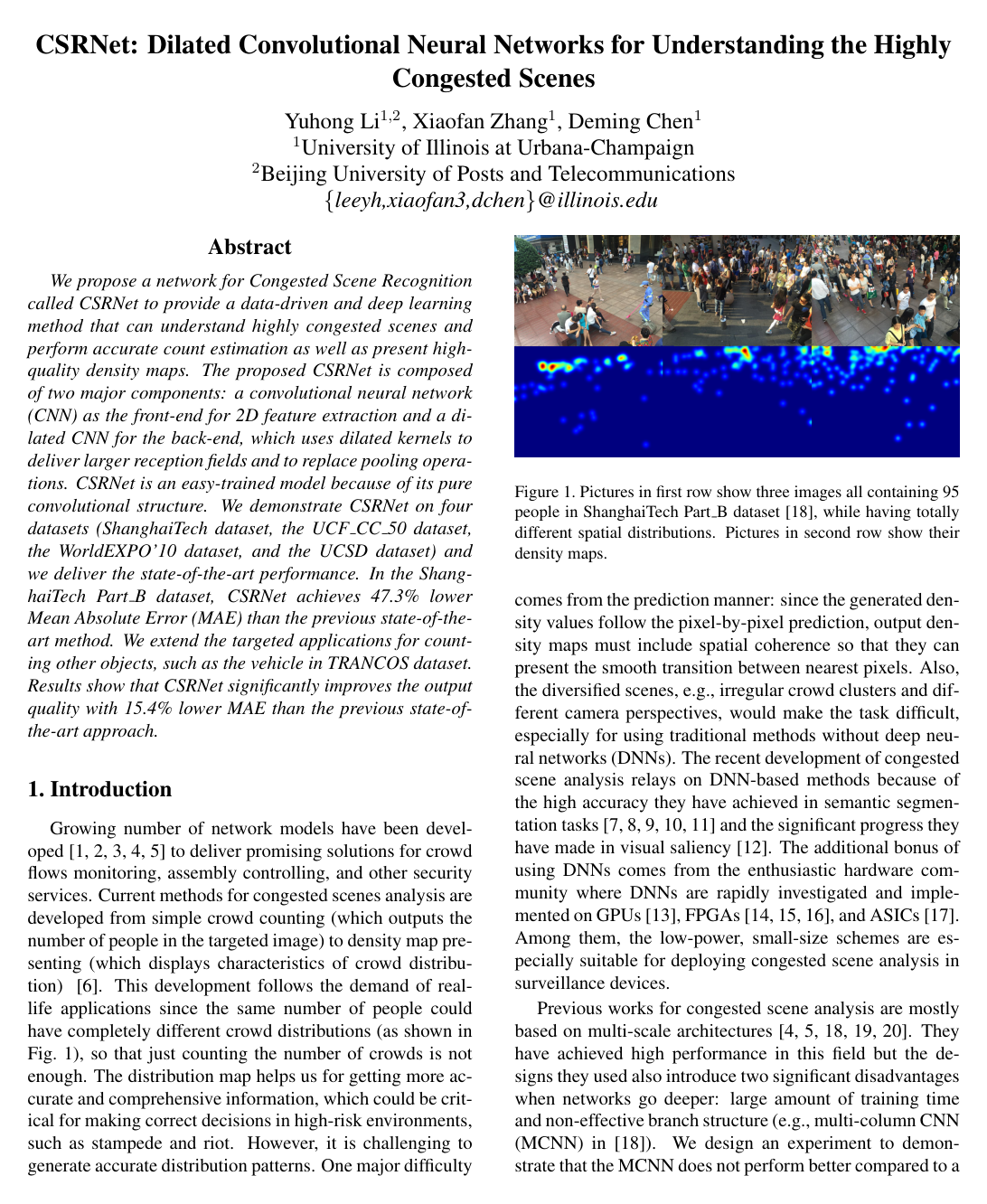
Monitoring heavily congested scenes is essential for public safety, crowd control, and emergency prevention in high-risk environments such as major public assemblies and dense traffic corridors. Simple object counts are insufficient for risk management because identical crowd numbers can exhibit drastically different spatial distributions. While deep learning visual models have advanced crowd analysis, existing state-of-the-art systems rely on complex multi-branch network designs and pre-classification steps. These multi-column architectures suffer from severe structural redundancy, prolonged training times, and reduced spatial resolution in their output maps.
The article demonstrates an alternative approach called CSRNet, a pure single-column neural network designed to accurately estimate counts and generate high-resolution spatial density maps in congested environments. The approach utilizes a standard 10-layer visual feature extraction front-end combined with a back-end of dilated convolutional layers. By using dilated layers—which space out network filters—the model broadens its field of view without using pooling operations that discard fine spatial detail or requiring complex multi-branch structures. The authors evaluated the system across four standard crowd benchmark datasets (ShanghaiTech, UCF CC 50, WorldExpo’10, and UCSD) and extended the evaluation to vehicle counting using the TRANCOS traffic dataset.
The evaluation demonstrates that the streamlined single-column architecture consistently outperforms complex multi-branch models. On the ShanghaiTech Part B benchmark, CSRNet achieved a 47.3% lower mean absolute error than the previous leading method, while reducing error by 7.0% on the densely crowded Part A dataset and 10.0% on the UCF CC 50 benchmark. The model achieved the lowest average error across multi-scene surveillance benchmarks and generated higher-quality visual density maps with superior image similarity scores. When applied to vehicle counting in congested traffic, it delivered a 15.4% lower overall counting error than the leading baseline and reduced localized sub-region error by up to 67.7%.
These results show that network depth and expanded receptive fields are significantly more effective than complex, branching structures that attempt to classify crowd densities into discrete bins. For operational deployments, this single-column design lowers computational overhead, simplifies model training, and avoids allocating critical parameters to redundant internal classifiers. High visual quality in the generated density maps improves situational awareness for safety operators, enabling more reliable early warnings for dangerous crowd buildups and traffic gridlock.
Organizations developing or deploying automated surveillance analytics should replace multi-column crowd counting architectures with single-column dilated networks to improve accuracy and training efficiency. When deploying these models on hardware-constrained edge devices such as surveillance cameras, teams should leverage the architecture's flexible input resolution support and compact structure. While the findings provide high confidence across diverse crowd and traffic benchmarks, users should note that performance on extremely low-resolution surveillance footage requires preprocessing upsampling, and specialized camera angles may still require targeted fine-tuning.
- Paper: Single-Image Crowd Counting via Multi-Column Convolutional Neural Network, Yingying Zhang et al. (2016). This foundational work introduced density map regression via multi-column CNNs and the ShanghaiTech benchmark dataset, establishing the direct baseline and evaluation framework that CSRNet was designed to improve upon.
- Paper: Multi-Scale Context Aggregation by Dilated Convolutions, Fisher Yu et al. (2016). This paper introduced dilated convolutions for multi-scale context aggregation without losing spatial resolution, providing the core architectural mechanism utilized in CSRNet's back-end.
- Paper: Fully convolutional networks for semantic segmentation, Jonathan Long et al. (2015). This paper pioneered end-to-end fully convolutional networks for dense pixel-level prediction, which forms the underlying architectural paradigm for density map regression in crowd counting.
- Paper: DeepLab: Semantic Image Segmentation with Deep Convolutional Nets, Atrous Convolution, and Fully Connected CRFs, Liang-Chieh Chen et al. (2016). This work demonstrates how to deploy atrous (dilated) convolutions in deep networks to expand receptive fields while maintaining spatial resolution for dense scene understanding.
- Paper: Understanding Convolution for Semantic Segmentation, Panqu Wang et al. (2017). This paper provides theoretical and practical analysis of dilated convolutions and hybrid dilation rates to prevent gridding artifacts in high-resolution dense prediction.
- Paper: Objects as Points, Xingyi Zhou et al. (2019). This work advances dense visual estimation by predicting keypoint heatmaps in a purely convolutional, anchor-free framework for simultaneous detection and localization.
- Paper: Encoder-Decoder with Atrous Separable Convolution for Semantic Image Segmentation, Liang-Chieh Chen et al. (2018). This paper extends dilated convolution architectures by combining atrous spatial pyramid pooling with depthwise separable convolutions in an encoder-decoder structure for high-precision dense scene parsing.
- Paper: A survey of the recent architectures of deep convolutional neural networks, Asifullah Khan et al. (2019). This comprehensive survey categorizes the evolution of deep CNN architectures, providing broader context on multi-scale feature extractors and dilated networks.