
keyword
atrous convolution
Atrous convolution, also known as dilated convolution, is an operation in convolutional neural networks where spaces or gaps are inserted between the elements of a filter kernel to expand its effective receptive field without increasing the number of learnable parameters or computational complexity. Originating from the French mathematical terminology for an algorithm with holes, this technique applies a dilation rate to define the sampling step across input feature maps. By enlarging the filter field of view while preserving feature map resolution, atrous convolution enables networks to aggregate broad, multi-scale contextual information without relying excessively on pooling or downsampling layers. As a result, it is widely utilized in dense prediction tasks, such as semantic segmentation and object detection, where maintaining precise spatial localization alongside global context is critical.
9 items
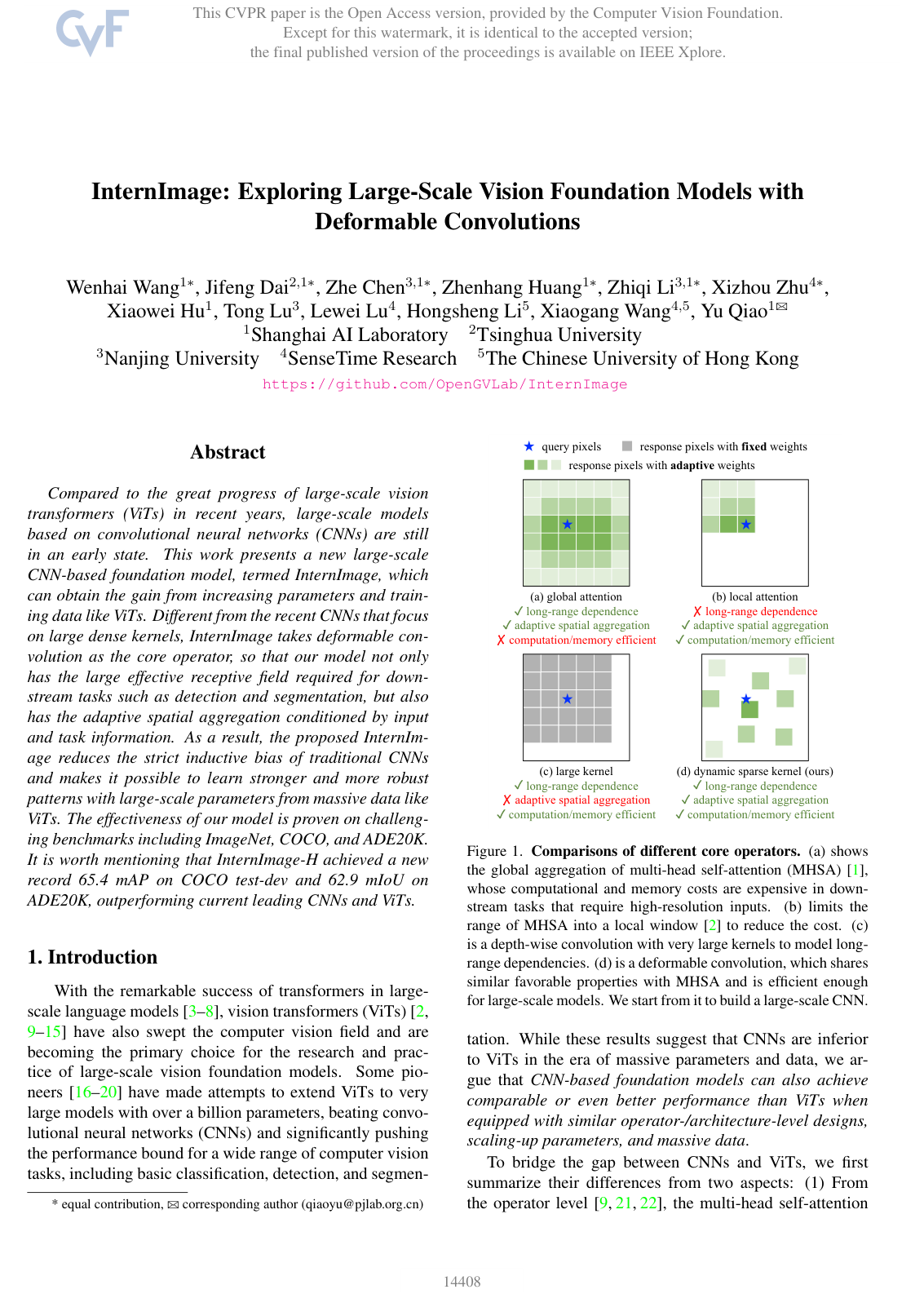
InternImage: Exploring Large-Scale Vision Foundation Models with Deformable Convolutions
Wenhai Wang, Jifeng Dai, Zhe Chen, Zhenhang Huang, Zhiqi Li, Xizhou Zhu, Xiaowei Hu, Tong Lu, Lewei Lu, Hongsheng Li, Xiaogang Wang, Yu Qiao
Why you should read this
Presents InternImage, a billion-parameter convolutional foundation model built on dynamic deformable convolutions that matches the scaling capabilities and downstream performance of state-of-the-art vision transformers across ImageNet, COCO, and ADE20K benchmarks.
Compared to the great progress of large-scale vision transformers (ViTs) in recent years, large-scale models based on convolutional neural networks (CNNs) are still in an early state. This work presents a new large-scale CNN-based foundation model, termed InternImage, which can obtain the gain from increasing parameters and training data like ViTs. Different from the recent CNNs that focus on large dense kernels, InternImage takes deformable convolution as the core operator, so that our model not only has the large effective receptive field required for downstream tasks such as detection and segmentation, but also has the adaptive spatial aggregation conditioned by input and task information. As a result, the proposed InternImage reduces the strict inductive bias of traditional CNNs and makes it possible to learn stronger and more robust patterns with large-scale parameters from massive data like ViTs. The effectiveness of our model is proven on challenging benchmarks including ImageNet, COCO, and ADE20K. It is worth mentioning that InternImage-H achieved a new record 65.4 mAP on COCO test-dev and 62.9 mIoU on ADE20K, outperforming current leading CNNs and ViTs.
Added
2026-09-26
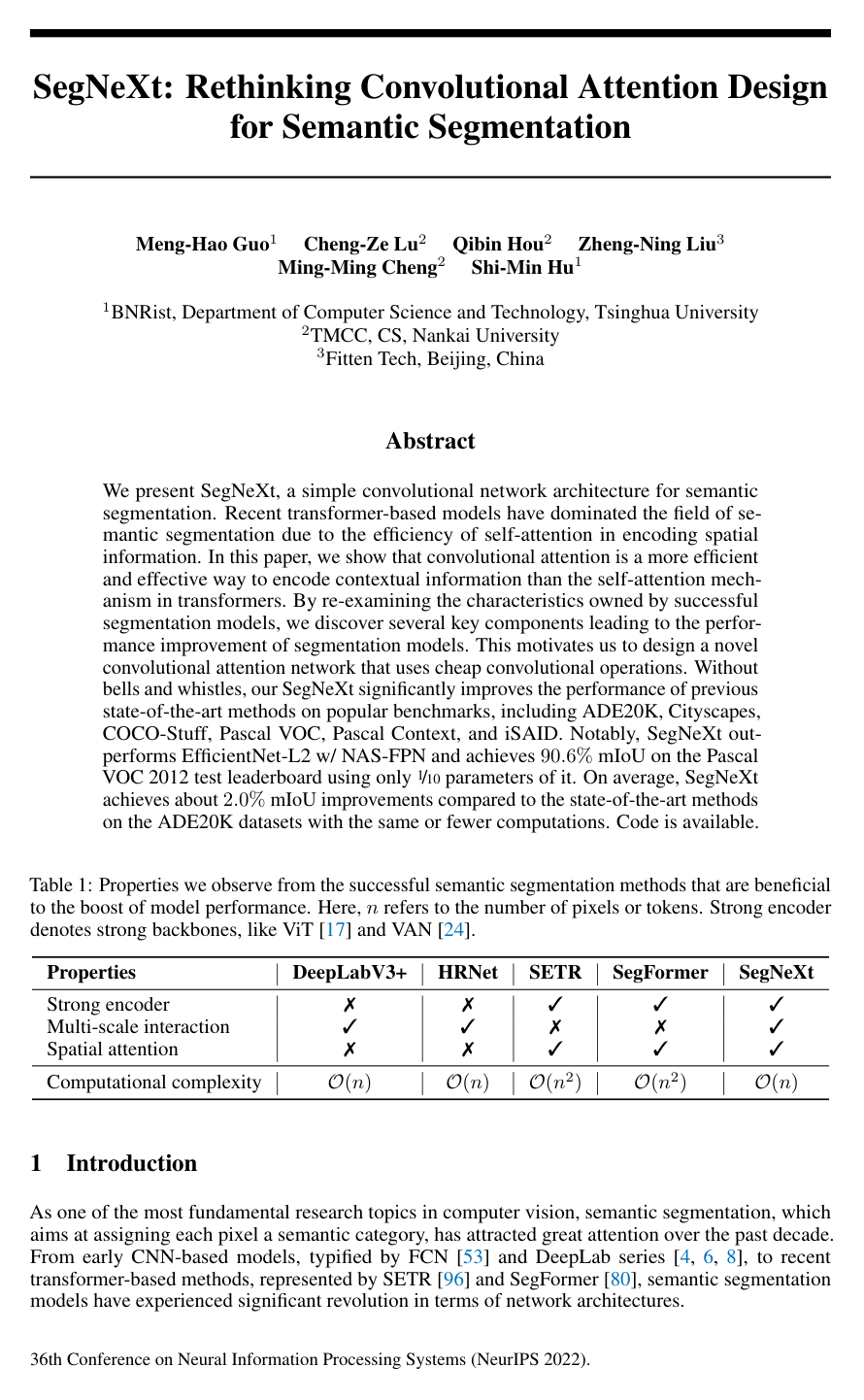
SegNeXt: Rethinking Convolutional Attention Design for Semantic Segmentation
Meng-Hao Guo, Chenggang Lu, Qibin Hou, Zheng Liu, Ming-Ming Cheng, Shiyong Hu
Why you should read this
Demonstrates that convolutional attention can surpass transformer-based models in semantic segmentation through SegNeXt, an architecture that achieves superior accuracy on standard benchmarks like ADE20K and Pascal VOC using drastically fewer parameters and computations.
We present SegNeXt, a simple convolutional network architecture for semantic segmentation. Recent transformer-based models have dominated the field of semantic segmentation due to the efficiency of self-attention in encoding spatial information. In this paper, we show that convolutional attention is a more efficient and effective way to encode contextual information than the self-attention mechanism in transformers. By re-examining the characteristics owned by successful segmentation models, we discover several key components leading to the performance improvement of segmentation models. This motivates us to design a novel convolutional attention network that uses cheap convolutional operations. Without bells and whistles, our SegNeXt significantly improves the performance of previous state-of-the-art methods on popular benchmarks, including ADE20K, Cityscapes, COCO-Stuff, Pascal VOC, Pascal Context, and iSAID. Notably, SegNeXt outperforms EfficientNet-L2 w/ NAS-FPN and achieves 90.6% mIoU on the Pascal VOC 2012 test leaderboard using only 1/10 parameters of it. On average, SegNeXt achieves about 2.0% mIoU improvements compared to the state-of-the-art methods on the ADE20K datasets with the same or fewer computations. Code is available at this https URL (Jittor) and this https URL (Pytorch).
Added
2026-09-25
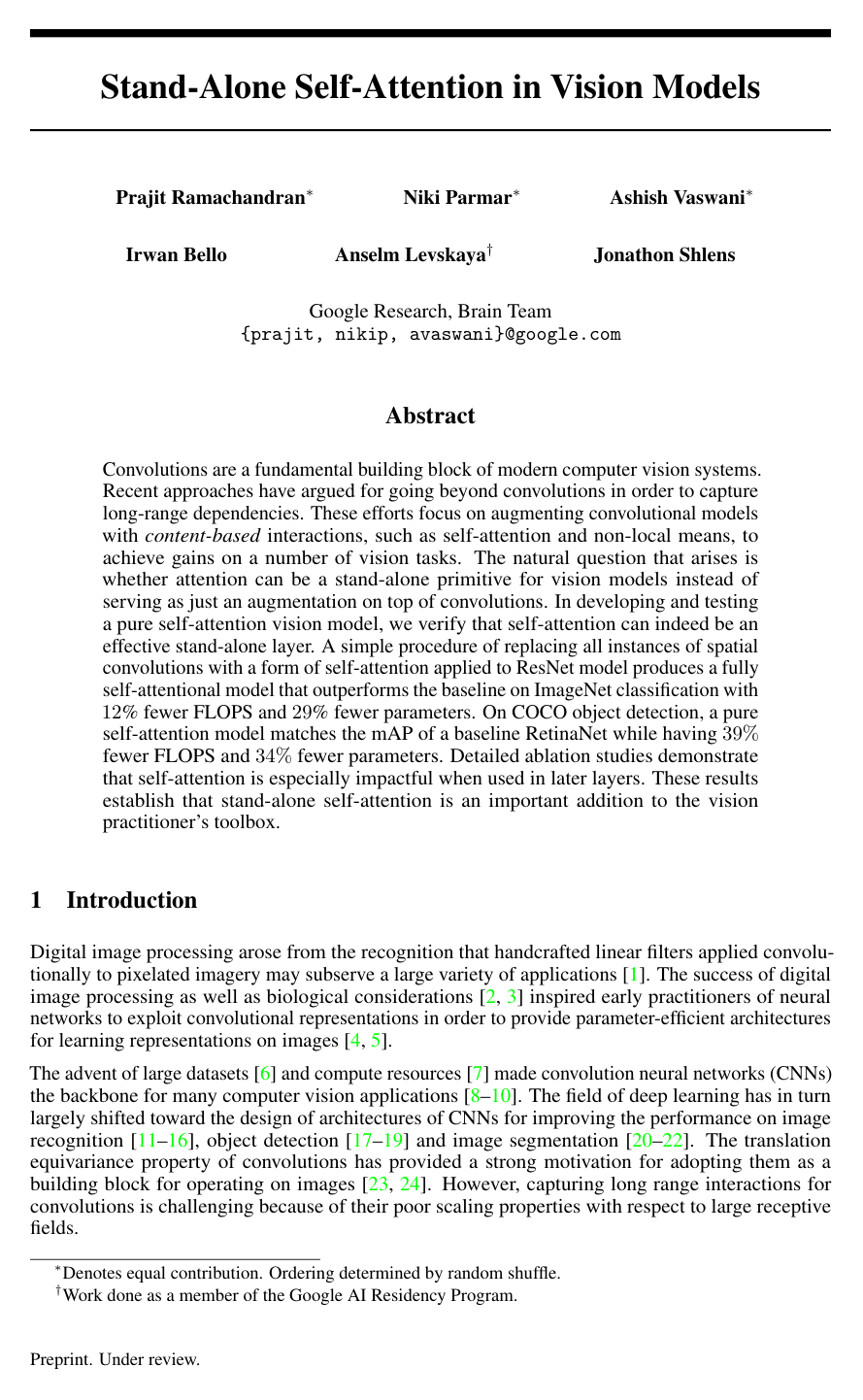
Stand-Alone Self-Attention in Vision Models
Prajit Ramachandran, Niki Parmar, Ashish Vaswani, Irwan Bello, Anselm Levskaya, Jonathon Shlens
Why you should read this
Demonstrates that replacing spatial convolutions entirely with stand-alone self-attention in ResNet models achieves superior ImageNet accuracy and competitive COCO detection performance with significantly fewer parameters and FLOPs.
Convolutions are a fundamental building block of modern computer vision systems. Recent approaches have argued for going beyond convolutions in order to capture long-range dependencies. These efforts focus on augmenting convolutional models with content-based interactions, such as self-attention and non-local means, to achieve gains on a number of vision tasks. The natural question that arises is whether attention can be a stand-alone primitive for vision models instead of serving as just an augmentation on top of convolutions. In developing and testing a pure self-attention vision model, we verify that self-attention can indeed be an effective stand-alone layer. A simple procedure of replacing all instances of spatial convolutions with a form of self-attention applied to ResNet model produces a fully self-attentional model that outperforms the baseline on ImageNet classification with 12% fewer FLOPS and 29% fewer parameters. On COCO object detection, a pure self-attention model matches the mAP of a baseline RetinaNet while having 39% fewer FLOPS and 34% fewer parameters. Detailed ablation studies demonstrate that self-attention is especially impactful when used in later layers. These results establish that stand-alone self-attention is an important addition to the vision practitioner's toolbox.
Added
2026-09-25
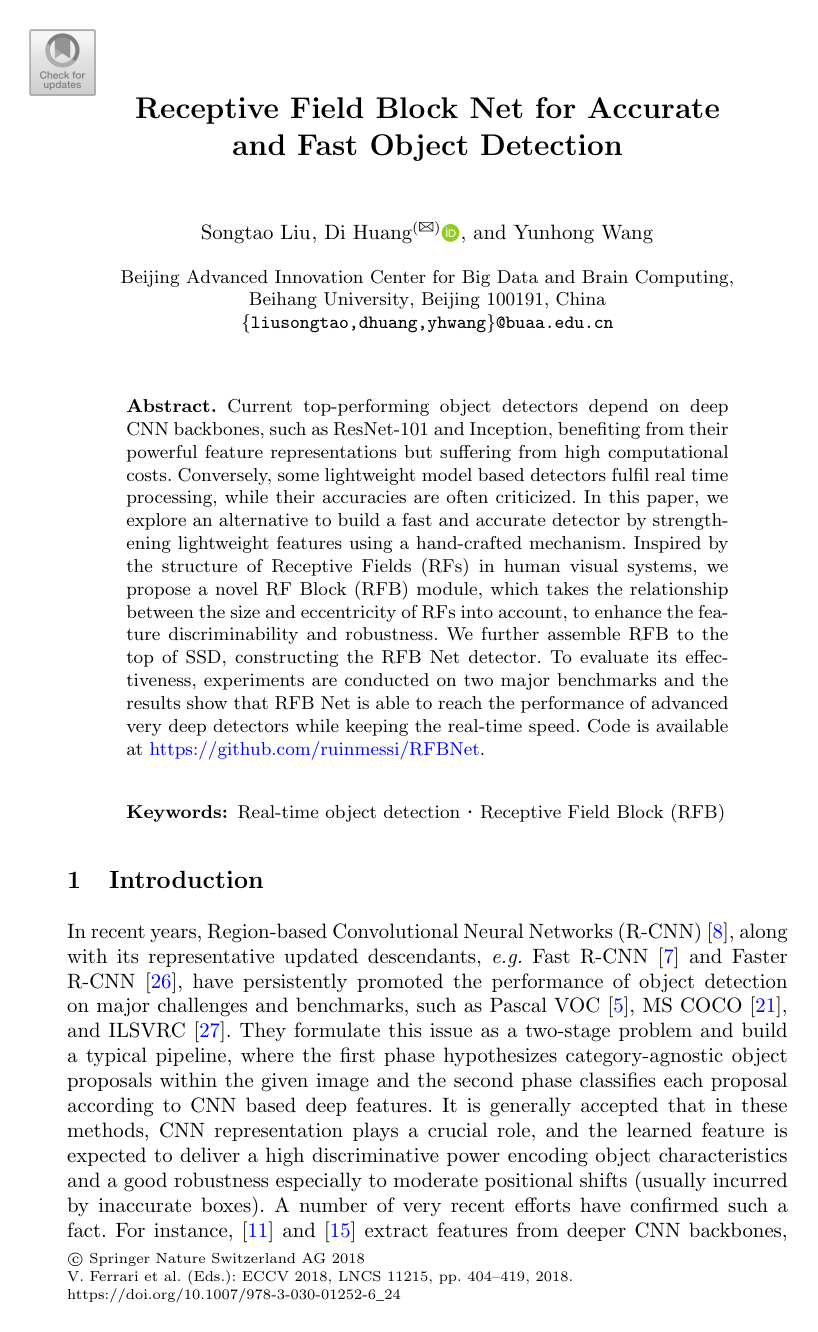
Receptive Field Block Net for Accurate and Fast Object Detection
Songtao Liu, Di Huang, Yunhong Wang
Why you should read this
Introduces RFB Net, an object detector that incorporates biologically inspired receptive field structures into lightweight networks to match the accuracy of deep models at real-time speeds.
Current top-performing object detectors depend on deep CNN backbones, such as ResNet-101 and Inception, benefiting from their powerful feature representations but suffering from high computational costs. Conversely, some lightweight model based detectors fulfil real time processing, while their accuracies are often criticized. In this paper, we explore an alternative to build a fast and accurate detector by strengthening lightweight features using a hand-crafted mechanism. Inspired by the structure of Receptive Fields (RFs) in human visual systems, we propose a novel RF Block (RFB) module, which takes the relationship between the size and eccentricity of RFs into account, to enhance the feature discriminability and robustness. We further assemble RFB to the top of SSD, constructing the RFB Net detector. To evaluate its effectiveness, experiments are conducted on two major benchmarks and the results show that RFB Net is able to reach the performance of advanced very deep detectors while keeping the real-time speed. Code is available at this https URL.
Added
2026-09-24
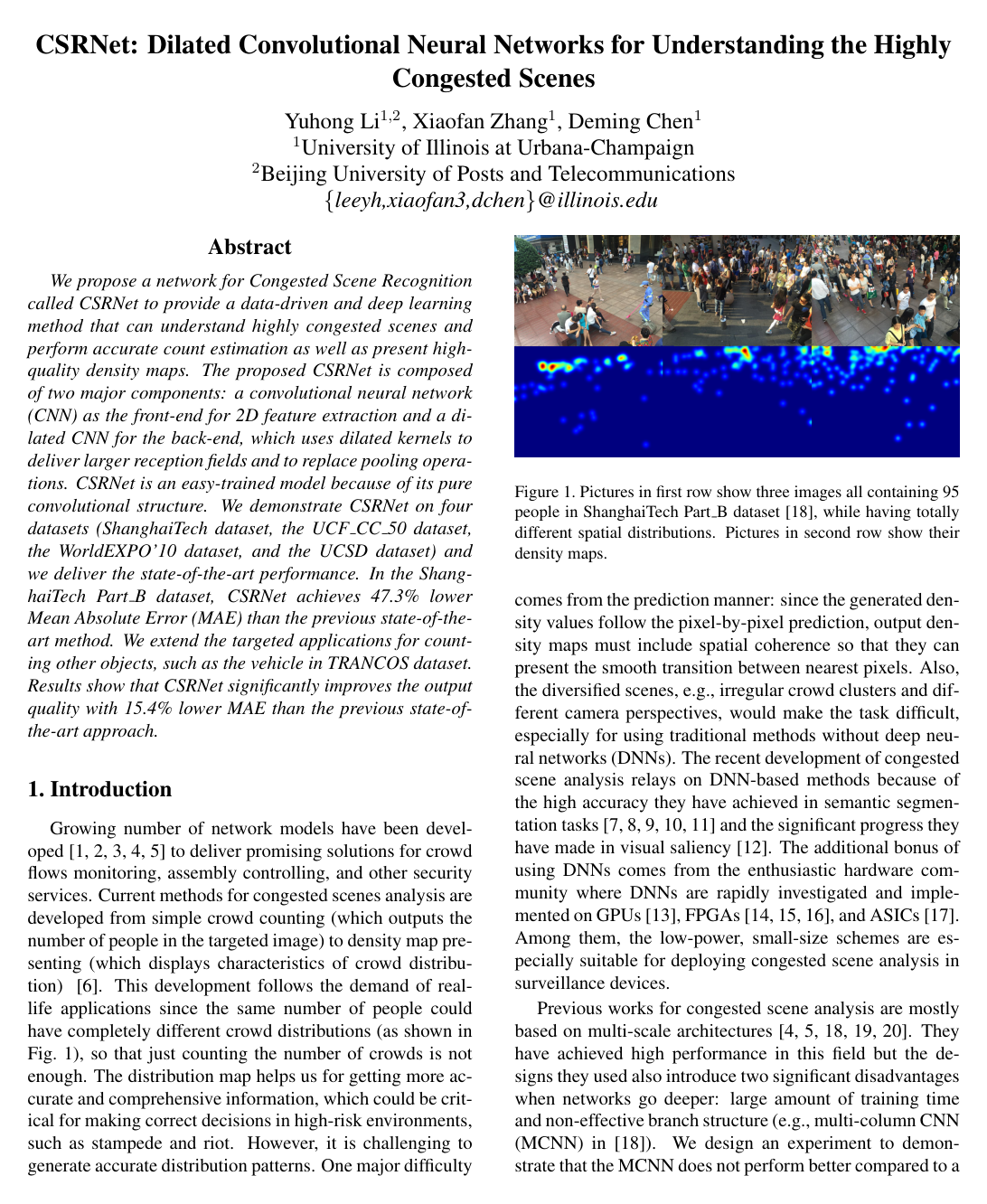
CSRNet: Dilated Convolutional Neural Networks for Understanding the Highly Congested Scenes
Yuhong Li, Xiaofan Zhang, Deming Chen
Why you should read this
Proposes a dilated convolutional network architecture that expands receptive fields without pooling-induced resolution loss, achieving state-of-the-art crowd counting accuracy and high-quality density maps across congested benchmarks.
We propose a network for Congested Scene Recognition called CSRNet to provide a data-driven and deep learning method that can understand highly congested scenes and perform accurate count estimation as well as present high-quality density maps. The proposed CSRNet is composed of two major components: a convolutional neural network (CNN) as the front-end for 2D feature extraction and a dilated CNN for the back-end, which uses dilated kernels to deliver larger reception fields and to replace pooling operations. CSRNet is an easy-trained model because of its pure convolutional structure. We demonstrate CSRNet on four datasets (ShanghaiTech dataset, the UCF_CC_50 dataset, the WorldEXPO'10 dataset, and the UCSD dataset) and we deliver the state-of-the-art performance. In the ShanghaiTech Part_B dataset, CSRNet achieves 47.3% lower Mean Absolute Error (MAE) than the previous state-of-the-art method. We extend the targeted applications for counting other objects, such as the vehicle in TRANCOS dataset. Results show that CSRNet significantly improves the output quality with 15.4% lower MAE than the previous state-of-the-art approach.
Added
2026-09-24
Vision Transformers for Dense Prediction
René Ranftl, Alexey Bochkovskiy, Vladlen Koltun
Why you should read this
Develops Dense Vision Transformers to replace convolutional backbones with vision transformers, assembling multi-stage token representations into full-resolution outputs that achieve state-of-the-art accuracy in monocular depth estimation and semantic segmentation.
We introduce dense vision transformers, an architecture that leverages vision transformers in place of convolutional networks as a backbone for dense prediction tasks. We assemble tokens from various stages of the vision transformer into image-like representations at various resolutions and progressively combine them into full-resolution predictions using a convolutional decoder. The transformer backbone processes representations at a constant and relatively high resolution and has a global receptive field at every stage. These properties allow the dense vision transformer to provide finer-grained and more globally coherent predictions when compared to fully-convolutional networks. Our experiments show that this architecture yields substantial improvements on dense prediction tasks, especially when a large amount of training data is available. For monocular depth estimation, we observe an improvement of up to 28% in relative performance when compared to a state-of-the-art fully-convolutional network. When applied to semantic segmentation, dense vision transformers set a new state of the art on ADE20K with 49.02% mIoU. We further show that the architecture can be fine-tuned on smaller datasets such as NYUv2, KITTI, and Pascal Context where it also sets the new state of the art. Our models are available at this https URL.
Added
2026-09-13
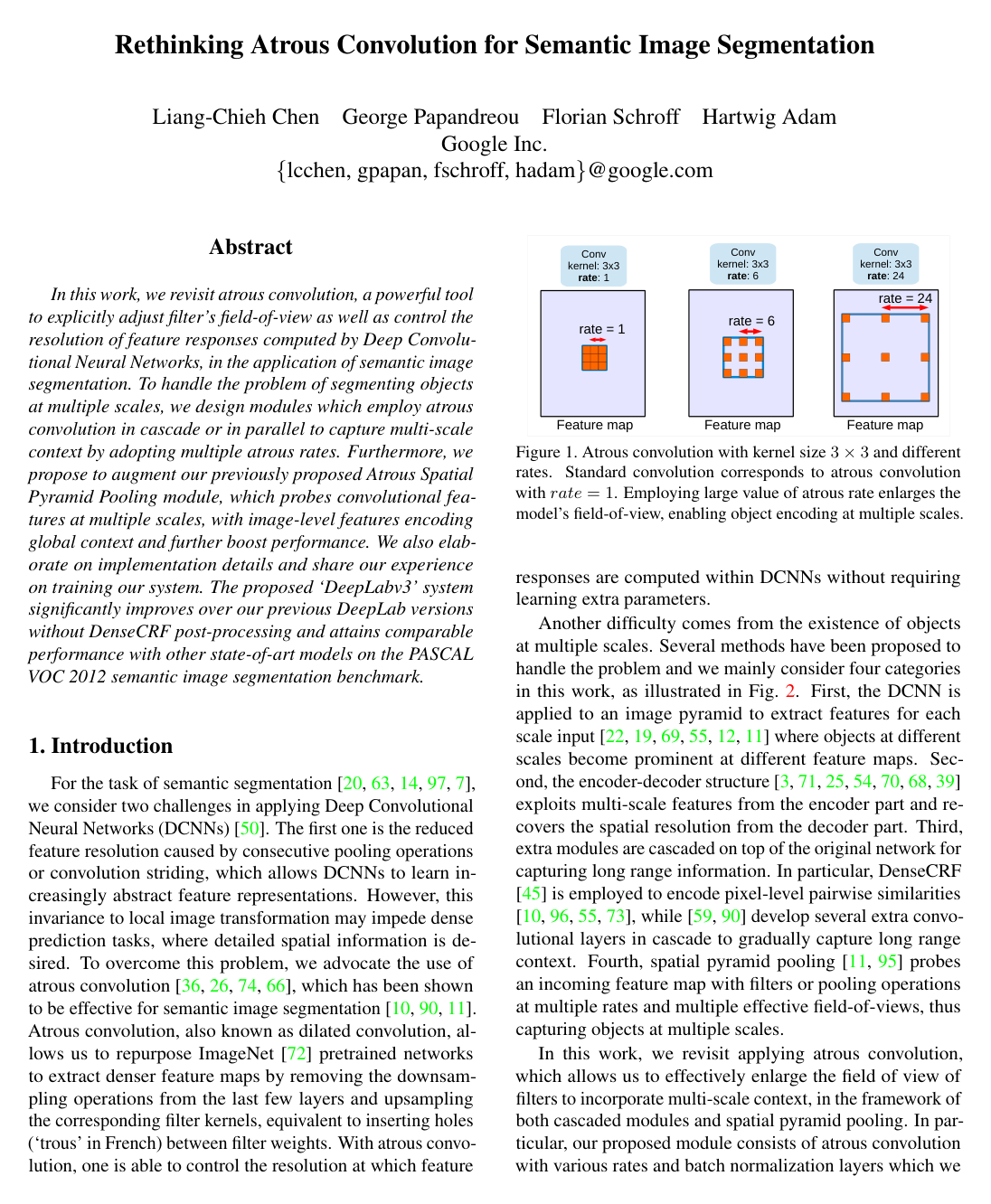
Rethinking Atrous Convolution for Semantic Image Segmentation
Liang-Chieh Chen, George Papandreou, Florian Schroff, Hartwig Adam
Why you should read this
Proposes DeepLabv3, an effective semantic segmentation framework that combines cascading atrous convolutions with an upgraded Atrous Spatial Pyramid Pooling module to capture multi-scale context without relying on conditional random field post-processing.
In this work, we revisit atrous convolution, a powerful tool to explicitly adjust filter's field-of-view as well as control the resolution of feature responses computed by Deep Convolutional Neural Networks, in the application of semantic image segmentation. To handle the problem of segmenting objects at multiple scales, we design modules which employ atrous convolution in cascade or in parallel to capture multi-scale context by adopting multiple atrous rates. Furthermore, we propose to augment our previously proposed Atrous Spatial Pyramid Pooling module, which probes convolutional features at multiple scales, with image-level features encoding global context and further boost performance. We also elaborate on implementation details and share our experience on training our system. The proposed `DeepLabv3' system significantly improves over our previous DeepLab versions without DenseCRF post-processing and attains comparable performance with other state-of-art models on the PASCAL VOC 2012 semantic image segmentation benchmark.
Added
2026-09-11
License
Published with permission
DeepLab: Semantic Image Segmentation with Deep Convolutional Nets, Atrous Convolution, and Fully Connected CRFs
Liang-Chieh Chen, George Papandreou, Iasonas Kokkinos, Kevin Murphy, Alan L. Yuille
Why you should read this
Introduces the DeepLab framework, which combines atrous convolution, atrous spatial pyramid pooling, and fully connected conditional random fields to capture multi-scale context and achieve precise boundary localization in semantic image segmentation.
In this work we address the task of semantic image segmentation with Deep Learning and make three main contributions that are experimentally shown to have substantial practical merit. First, we highlight convolution with upsampled filters, or 'atrous convolution', as a powerful tool in dense prediction tasks. Atrous convolution allows us to explicitly control the resolution at which feature responses are computed within Deep Convolutional Neural Networks. It also allows us to effectively enlarge the field of view of filters to incorporate larger context without increasing the number of parameters or the amount of computation. Second, we propose atrous spatial pyramid pooling (ASPP) to robustly segment objects at multiple scales. ASPP probes an incoming convolutional feature layer with filters at multiple sampling rates and effective fields-of-views, thus capturing objects as well as image context at multiple scales. Third, we improve the localization of object boundaries by combining methods from DCNNs and probabilistic graphical models. The commonly deployed combination of max-pooling and downsampling in DCNNs achieves invariance but has a toll on localization accuracy. We overcome this by combining the responses at the final DCNN layer with a fully connected Conditional Random Field (CRF), which is shown both qualitatively and quantitatively to improve localization performance. Our proposed "DeepLab" system sets the new state-of-art at the PASCAL VOC-2012 semantic image segmentation task, reaching 79.7% mIOU in the test set, and advances the results on three other datasets: PASCAL-Context, PASCAL-Person-Part, and Cityscapes. All of our code is made publicly available online.
Added
2026-09-09
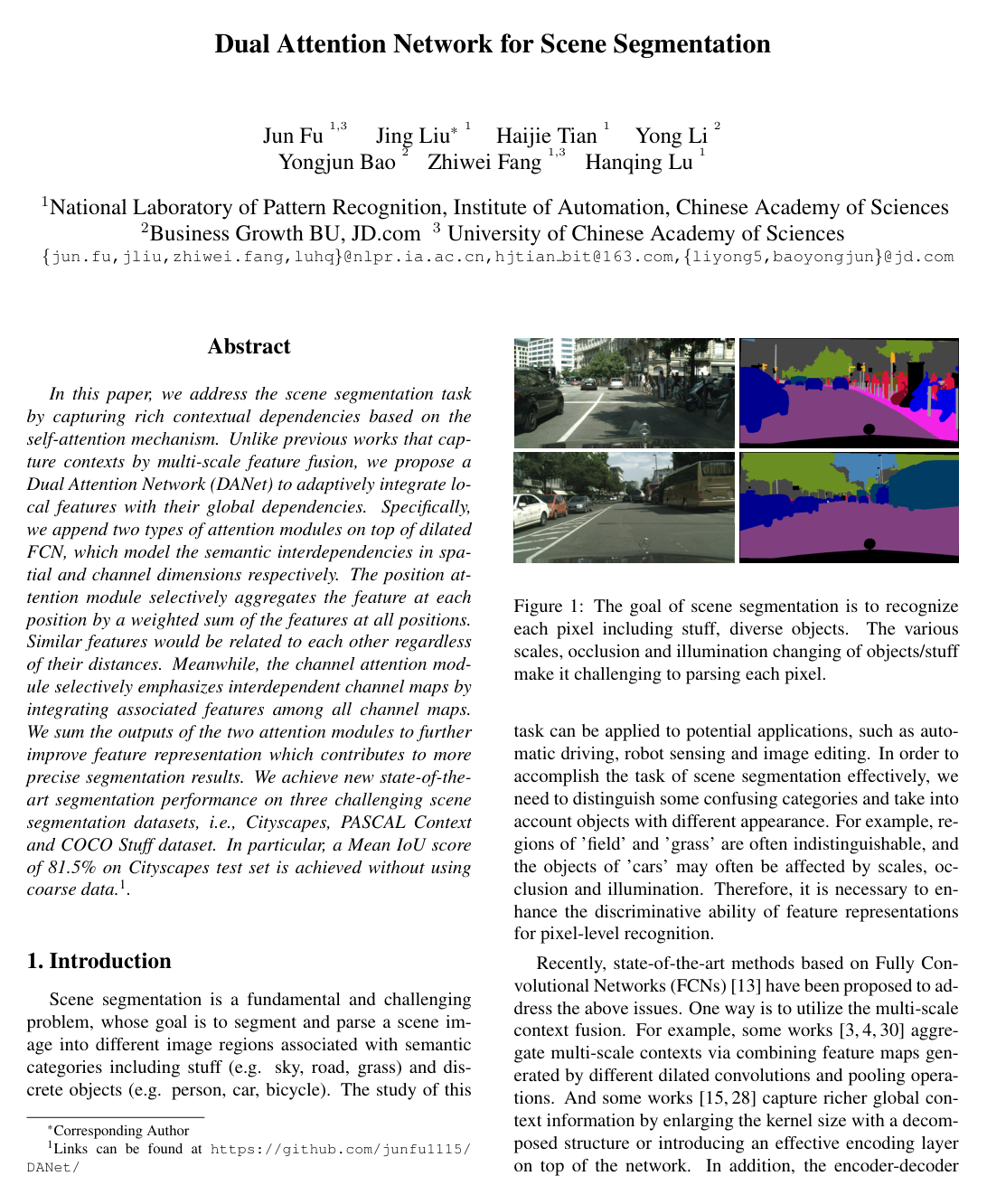
Dual Attention Network for Scene Segmentation
J. Fu, J. Liu, Haijie Tian, Zhiwei Fang, Hanqing Lu
Why you should read this
Introduces the Dual Attention Network (DANet), which combines spatial and channel self-attention mechanisms to capture global contextual dependencies and achieve state-of-the-art scene segmentation accuracy across Cityscapes, PASCAL Context, and COCO Stuff.
In this paper, we address the scene segmentation task by capturing rich contextual dependencies based on the selfattention mechanism. Unlike previous works that capture contexts by multi-scale features fusion, we propose a Dual Attention Networks (DANet) to adaptively integrate local features with their global dependencies. Specifically, we append two types of attention modules on top of traditional dilated FCN, which model the semantic interdependencies in spatial and channel dimensions respectively. The position attention module selectively aggregates the features at each position by a weighted sum of the features at all positions. Similar features would be related to each other regardless of their distances. Meanwhile, the channel attention module selectively emphasizes interdependent channel maps by integrating associated features among all channel maps. We sum the outputs of the two attention modules to further improve feature representation which contributes to more precise segmentation results. We achieve new state-of-the-art segmentation performance on three challenging scene segmentation datasets, i.e., Cityscapes, PASCAL Context and COCO Stuff dataset. In particular, a Mean IoU score of 81.5% on Cityscapes test set is achieved without using coarse data. We make the code and trained model publicly available at this https URL
Added
2026-09-09