A Toy Model of Universality: Reverse Engineering how Networks Learn Group Operations
Bilal ChughtaiLawrence ChanNeel Nanda
Reverse-engineers how neural networks learn finite group composition using mathematical representation theory, revealing that while networks share an underlying algorithmic family, the specific circuits they develop remain arbitrary.
As deep learning systems are increasingly deployed in high-stakes settings, understanding their internal mechanisms is critical for safety, auditing, and alignment. A foundational question in mechanistic interpretability is the universality hypothesis: whether different neural networks independently converge on the same internal features and algorithmic circuits when trained on similar tasks. If strong universality holds, reverse-engineering one model yields insights that directly generalize across other architectures and scales. Conversely, if models implement arbitrary solutions, analyzing individual systems in isolation cannot reliably predict the behavior of others.
The article evaluates the universality hypothesis by examining how neural networks learn group composition across various finite groups. The primary objective is to reverse-engineer the computational mechanisms models use to perform this algebraic reasoning and determine whether these learned circuits are identical across different random initializations, groups, and architectures.
To conduct this evaluation, the authors trained one-hidden-layer multilayer perceptrons and single-layer transformer models across seven distinct mathematical groups, including cyclic, dihedral, alternating, and symmetric permutation groups. The primary benchmark involved training over 50 random initializations on the symmetric group of order five (S5). Using mathematical representation theory, the authors reverse-engineered model weights, internal activations, and output predictions, validating their findings through targeted ablation experiments and continuous training-progress measures.
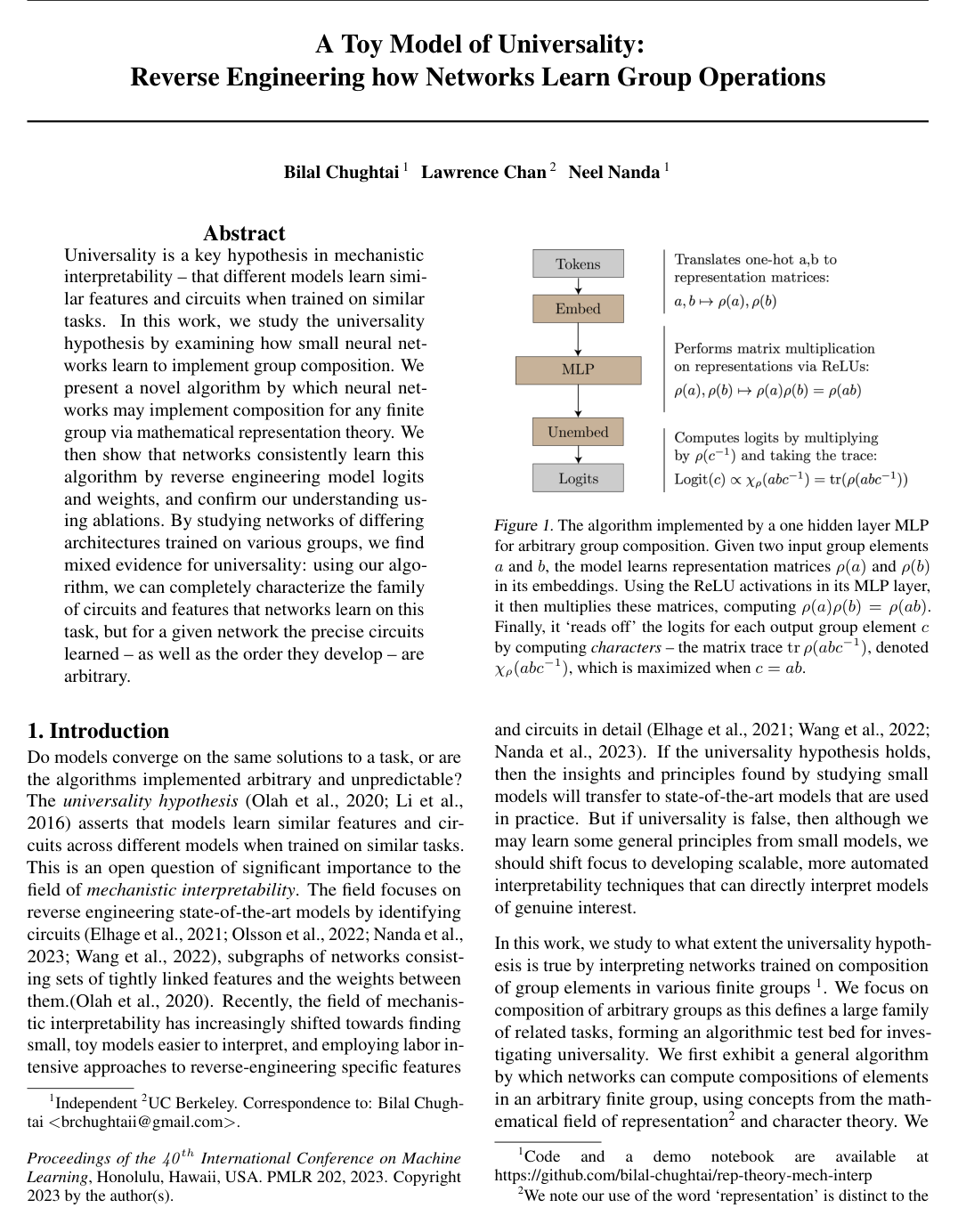
The analysis produced several key findings. First, networks universally implement a specific mathematical procedure named group composition via representations: input embeddings encode representation matrices, hidden neurons multiply these matrices using activation functions, and output layers compute matrix traces (characters) to generate predictions. Second, models achieve high accuracy while utilizing only a very sparse subset of possible mathematical representations; in the primary symmetric group model, just two out of six possible representations explained 84.8% of the output logit variance. Third, the specific representations learned, the total number of representations utilized, and the chronological order in which they developed varied significantly across random initializations. For instance, single-dimensional parity representations were learned rapidly but generalized poorly, whereas higher-dimensional representations developed later, often alongside distinct delayed-generalization ("grokking") phases.
These findings provide strong evidence for weak universality but refute strong universality. While all evaluated models converge on the same overarching algorithmic family, individual networks choose arbitrary subsets of mathematical representations to execute it. Consequently, fully reverse-engineering a single neural network is insufficient for characterizing model behavior broadly. In practical settings such as safety auditing or compliance verification, relying on mechanistic insights derived from a single trained instance introduces considerable risk, as parallel instances may rely on entirely different sub-circuits.
For practitioners and researchers, the article recommends conducting systematic multi-model robustness checks across varied random initializations before drawing broad conclusions about learned mechanisms. Interpretability workflows should aim to establish comprehensive catalogs or "periodic tables" of possible circuit implementations rather than analyzing solitary models. Furthermore, future efforts should explore whether feature emergence can be anticipated prior to training (such as through initialized sub-networks) and evaluate whether these representation-theoretic properties extend to complex real-world systems, such as large language models.
The conclusions should be interpreted within the context of the study's scope. The evaluation relied on small, synthetic algorithmic tasks and relatively compact neural architectures optimized with weight decay. While confidence in the mechanistic explanations for these specific algebraic tasks is exceptionally high due to rigorous mathematical ablations, further empirical validation is necessary to confirm how directly these principles scale to large, foundation-scale models operating on natural language and vision data.
- Paper: Group Equivariant Convolutional Networks, Taco S. Cohen et al. (2016). Its treatment of group actions and equivariant neural-network operations provides useful mathematical groundwork for following how finite-group structure can shape a network’s learned composition algorithm.
No sufficiently relevant recommendations were found.