
keyword
mechanistic interpretability
Mechanistic interpretability is a subfield of artificial intelligence research focused on understanding the internal operations of neural networks by reverse-engineering their learned behaviors into human-understandable algorithms and computational components. Rather than treating machine learning models as black boxes or relying solely on external input-output behavior, this approach investigates how specific capabilities arise from internal activations, parameters, and information flows. Researchers analyze neural components such as attention heads, neurons, and disentangled feature directions discovered through sparse representations to identify the subgraphs, or circuits, responsible for particular tasks. By employing causal interventions, activation patching, and ablation methods, mechanistic interpretability seeks to explain precisely how networks store knowledge, execute multi-step reasoning, and compute intermediate representations, facilitating greater model transparency, safety, and steerability.
22 items
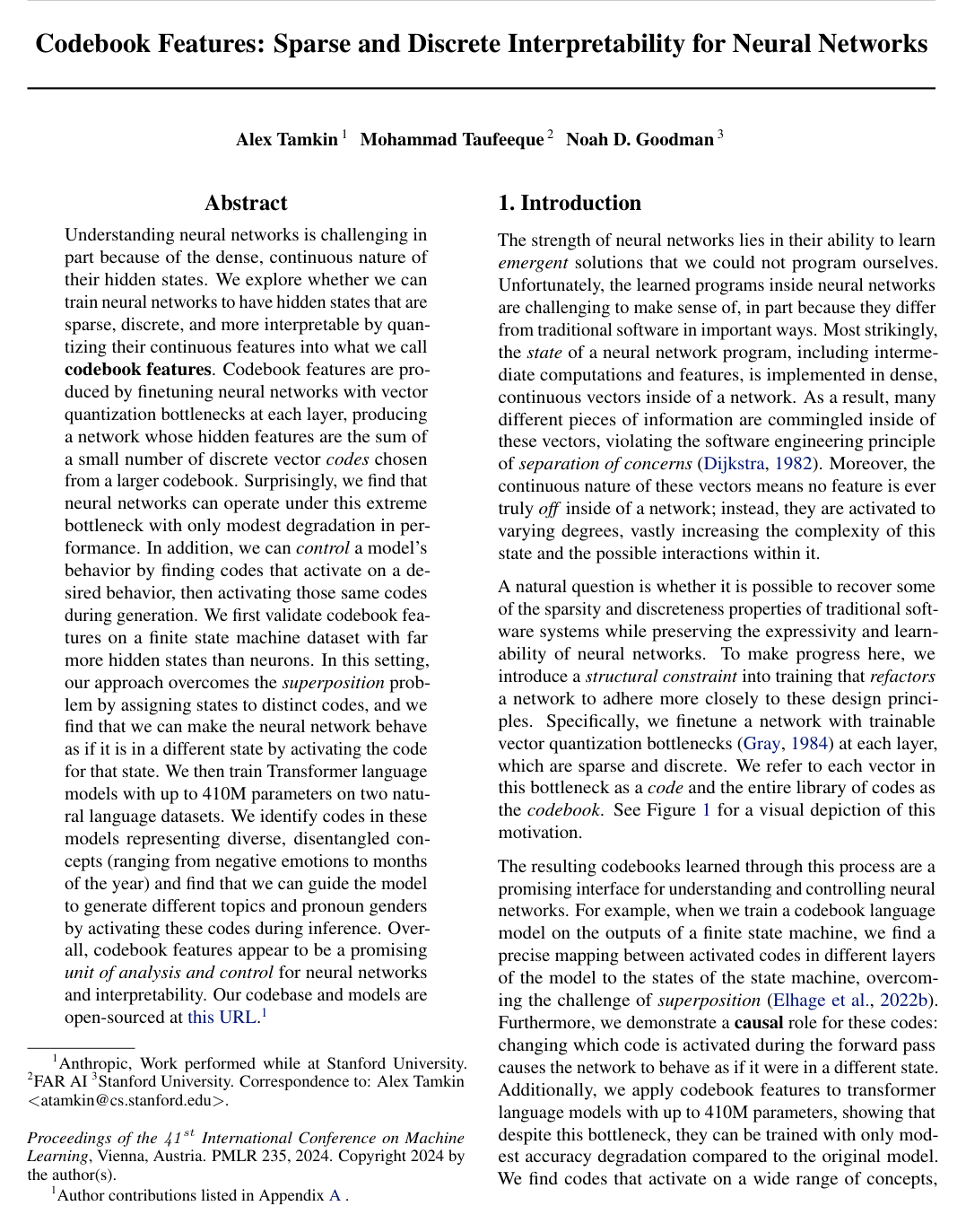
Codebook Features: Sparse and Discrete Interpretability for Neural Networks
Alex Tamkin, Mohammad Taufeeque, Noah D. Goodman
Why you should read this
Proposes replacing continuous hidden activations in neural networks with learned, discrete vector-quantization bottlenecks, enabling precise mechanistic interpretability and direct behavioral steering with minimal loss in model performance.
Understanding neural networks is challenging in part because of the dense, continuous nature of their hidden states. We explore whether we can train neural networks to have hidden states that are sparse, discrete, and more interpretable by quantizing their continuous features into what we call codebook features. Codebook features are produced by finetuning neural networks with vector quantization bottlenecks at each layer, producing a network whose hidden features are the sum of a small number of discrete vector codes chosen from a larger codebook. Surprisingly, we find that neural networks can operate under this extreme bottleneck with only modest degradation in performance. In addition, we can control a model’s behavior by finding codes that activate on a desired behavior, then activating those same codes during generation. We first validate codebook features on a finite state machine dataset with far more hidden states than neurons. In this setting, our approach overcomes the superposition problem by assigning states to distinct codes, and we find that we can make the neural network behave as if it is in a different state by activating the code for that state. We then train Transformer language models with up to 410M parameters on two natural language datasets. We identify codes in these models representing diverse, disentangled concepts (ranging from negative emotions to months of the year) and find that we can guide the model to generate different topics and pronoun genders by activating these codes during inference. Overall, codebook features appear to be a promising unit of analysis and control for neural networks and interpretability. Our codebase and models are open-sourced at this URL.¹
Added
2026-10-05
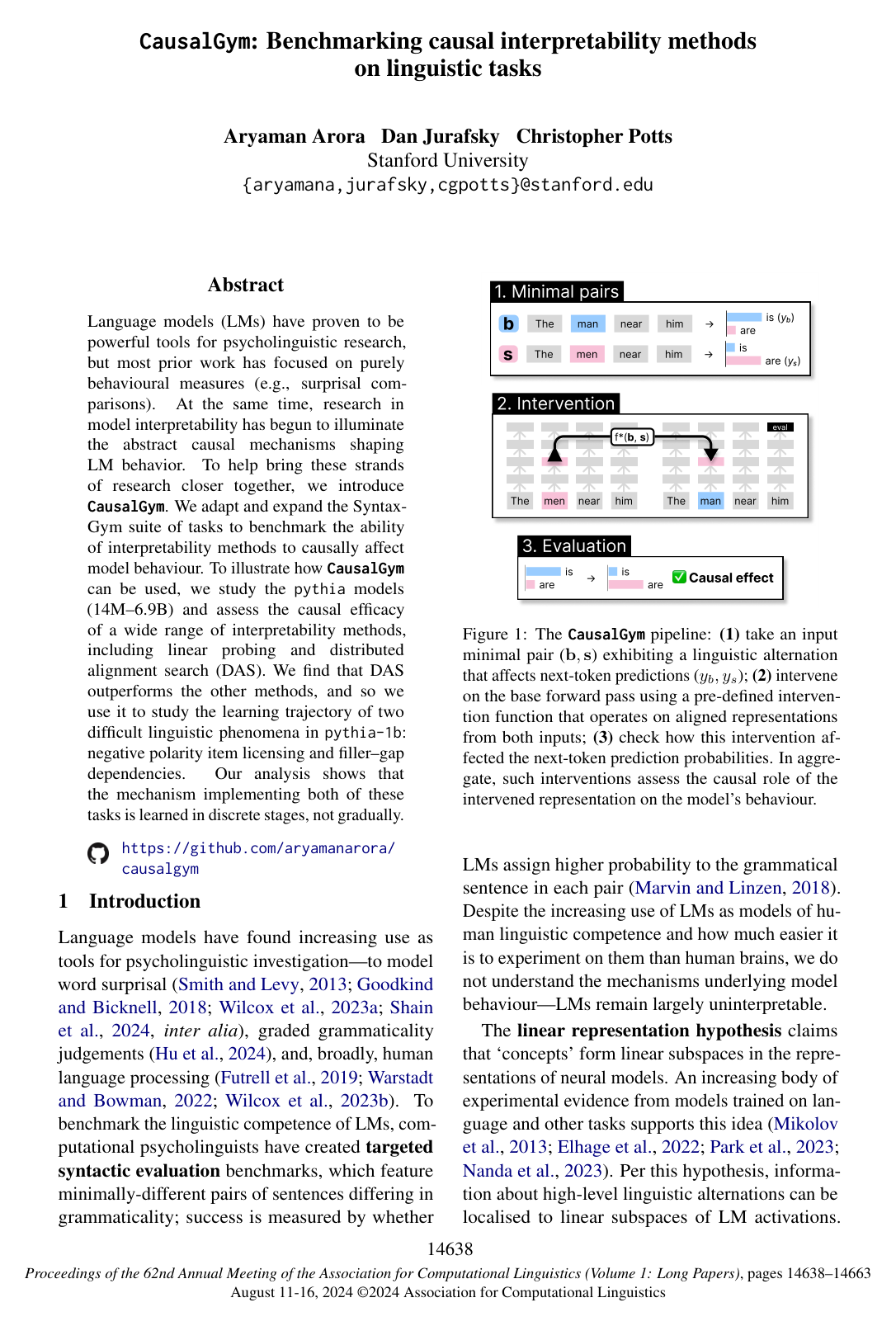
CausalGym: Benchmarking causal interpretability methods on linguistic tasks
Aryaman Arora, Dan Jurafsky, Christopher Potts
Why you should read this
Introduces CausalGym, a benchmark that adapts syntactic evaluation tasks to evaluate causal interpretability methods and track how neural language models acquire complex linguistic mechanisms during training.
Language models (LMs) have proven to be powerful tools for psycholinguistic research, but most prior work has focused on purely behavioural measures (e.g., surprisal comparisons). At the same time, research in model interpretability has begun to illuminate the abstract causal mechanisms shaping LM behavior. To help bring these strands of research closer together, we introduce CausalGym. We adapt and expand the Syntax-Gym suite of tasks to benchmark the ability of interpretability methods to causally affect model behaviour. To illustrate how CausalGym can be used, we study the pythia models (14M–6.9B) and assess the causal efficacy of a wide range of interpretability methods, including linear probing and distributed alignment search (DAS). We find that DAS outperforms the other methods, and so we use it to study the learning trajectory of two difficult linguistic phenomena in pythia-1b: negative polarity item licensing and filler–gap dependencies. Our analysis shows that the mechanism implementing both of these tasks is learned in discrete stages, not gradually.
Added
2026-10-05
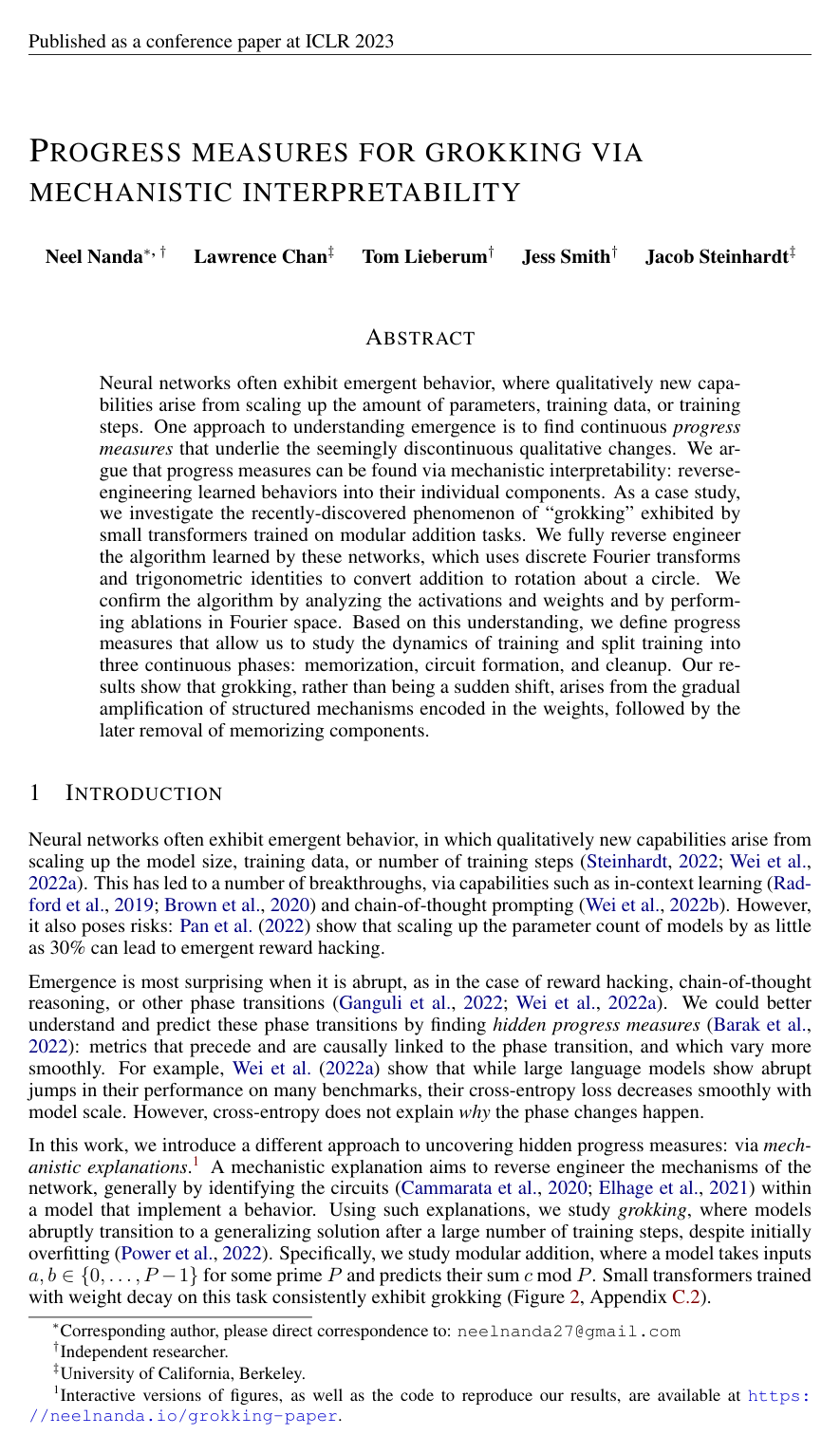
Progress measures for grokking via mechanistic interpretability
Neel Nanda, Lawrence Chan, Tom Lieberum, Jess Smith, Jacob Steinhardt
Why you should read this
Explains the delayed generalization of grokking by reverse-engineering the trigonometric algorithms learned by transformers on modular addition, establishing continuous progress measures that track gradual circuit formation and the removal of memorization.
Neural networks often exhibit emergent behavior, where qualitatively new capabilities arise from scaling up the amount of parameters, training data, or training steps. One approach to understanding emergence is to find continuous \textit{progress measures} that underlie the seemingly discontinuous qualitative changes. We argue that progress measures can be found via mechanistic interpretability: reverse-engineering learned behaviors into their individual components. As a case study, we investigate the recently-discovered phenomenon of ``grokking'' exhibited by small transformers trained on modular addition tasks. We fully reverse engineer the algorithm learned by these networks, which uses discrete Fourier transforms and trigonometric identities to convert addition to rotation about a circle. We confirm the algorithm by analyzing the activations and weights and by performing ablations in Fourier space. Based on this understanding, we define progress measures that allow us to study the dynamics of training and split training into three continuous phases: memorization, circuit formation, and cleanup. Our results show that grokking, rather than being a sudden shift, arises from the gradual amplification of structured mechanisms encoded in the weights, followed by the later removal of memorizing components.
Added
2026-10-05
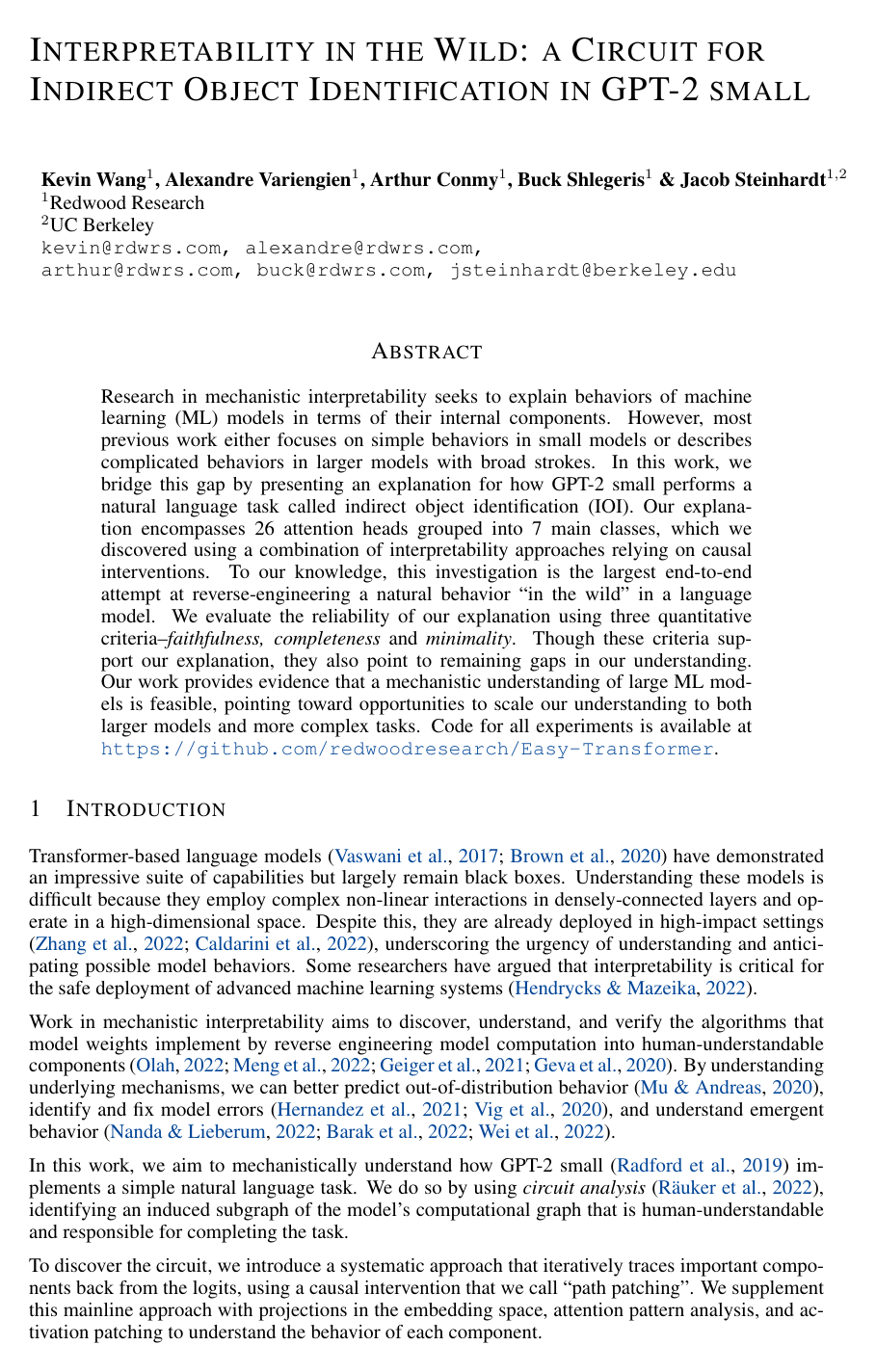
Interpretability in the Wild: a Circuit for Indirect Object Identification in GPT-2 small
Kevin Wang, Alexandre Variengien, Arthur Conmy, Buck Shlegeris, Jacob Steinhardt
Why you should read this
Reverse-engineers the 26-attention-head circuit that GPT-2 small uses for indirect object identification, establishing quantitative criteria to validate mechanistic interpretability in transformer language models.
Research in mechanistic interpretability seeks to explain behaviors of machine learning models in terms of their internal components. However, most previous work either focuses on simple behaviors in small models, or describes complicated behaviors in larger models with broad strokes. In this work, we bridge this gap by presenting an explanation for how GPT-2 small performs a natural language task called indirect object identification (IOI). Our explanation encompasses 26 attention heads grouped into 7 main classes, which we discovered using a combination of interpretability approaches relying on causal interventions. To our knowledge, this investigation is the largest end-to-end attempt at reverse-engineering a natural behavior "in the wild" in a language model. We evaluate the reliability of our explanation using three quantitative criteria--faithfulness, completeness and minimality. Though these criteria support our explanation, they also point to remaining gaps in our understanding. Our work provides evidence that a mechanistic understanding of large ML models is feasible, opening opportunities to scale our understanding to both larger models and more complex tasks.
Added
2026-10-04
In-Context Sharpness as Alerts: An Inner Representation Perspective for Hallucination Mitigation
Shiqi Chen, Miao Xiong, Junteng Liu, Zhengxuan Wu, Teng Xiao, Siyang Gao, Junxian He
Why you should read this
Reveals that sharper in-context hidden state activations correlate with factual correctness in large language models and introduces Activation Decoding, an entropy-constrained generation method that significantly reduces hallucinations across standard question-answering benchmarks.
Large language models (LLMs) frequently hallucinate and produce factual errors, yet our understanding of why they make these errors remains limited. In this study, we delve into the underlying mechanisms of LLM hallucinations from the perspective of inner representations, and discover a salient pattern associated with hallucinations: correct generations tend to have sharper context activations in the hidden states of the in-context tokens, compared to the incorrect ones. Leveraging this insight, we propose an entropy-based metric to quantify the “sharpness” among the in-context hidden states and incorporate it into the decoding process to formulate a constrained decoding approach. Experiments on various knowledge-seeking and hallucination benchmarks demonstrate our approach’s consistent effectiveness, for example, achieving up to an 8.6 point improvement on TruthfulQA. We believe this study can improve our understanding of hallucinations and serve as a practical solution for hallucination mitigation. Code is publicly available at https://github.com/hkust-nlp/Activation_Decoding.
Added
2026-10-04
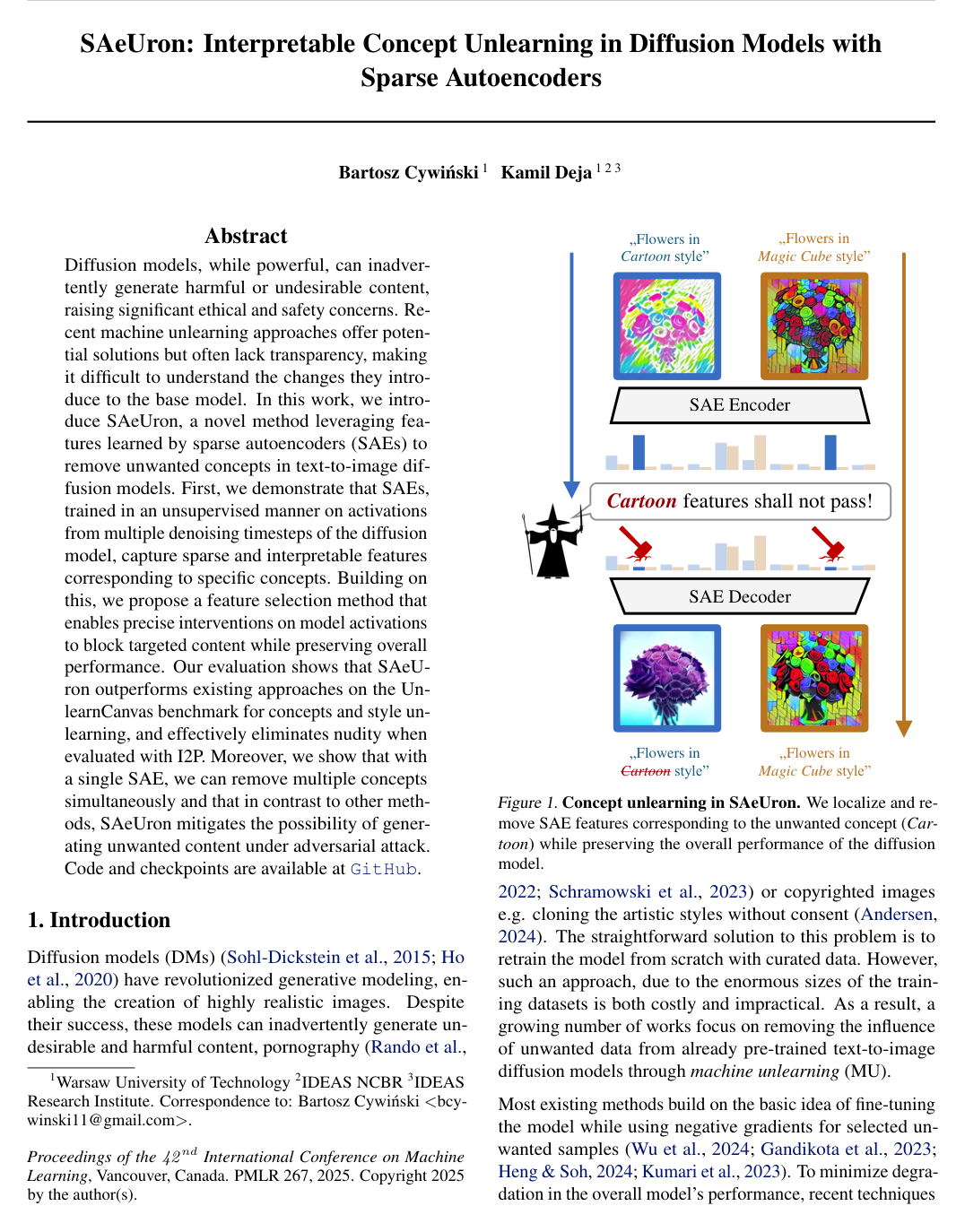
SAeUron: Interpretable Concept Unlearning in Diffusion Models with Sparse Autoencoders
Bartosz Cywinski, Kamil Deja
Why you should read this
Introduces SAeUron, a mechanistically interpretable method that trains sparse autoencoders across denoising timesteps to precisely identify and ablate unwanted visual concepts from text-to-image diffusion models without degrading overall generation quality or succumbing to adversarial attacks.
Diffusion models, while powerful, can inadvertently generate harmful or undesirable content, raising significant ethical and safety concerns. Recent machine unlearning approaches offer potential solutions but often lack transparency, making it difficult to understand the changes they introduce to the base model. In this work, we introduce SAeUron, a novel method leveraging features learned by sparse autoencoders (SAEs) to remove unwanted concepts in text-to-image diffusion models. First, we demonstrate that SAEs, trained in an unsupervised manner on activations from multiple denoising timesteps of the diffusion model, capture sparse and interpretable features corresponding to specific concepts. Building on this, we propose a feature selection method that enables precise interventions on model activations to block targeted content while preserving overall performance. Our evaluation shows that SAeUron outperforms existing approaches on the UnlearnCanvas benchmark for concepts and style unlearning, and effectively eliminates nudity when evaluated with I2P. Moreover, we show that with a single SAE, we can remove multiple concepts simultaneously and that in contrast to other methods, SAeUron mitigates the possibility of generating unwanted content under adversarial attack. Code and checkpoints are available at GitHub.
Added
2026-10-04
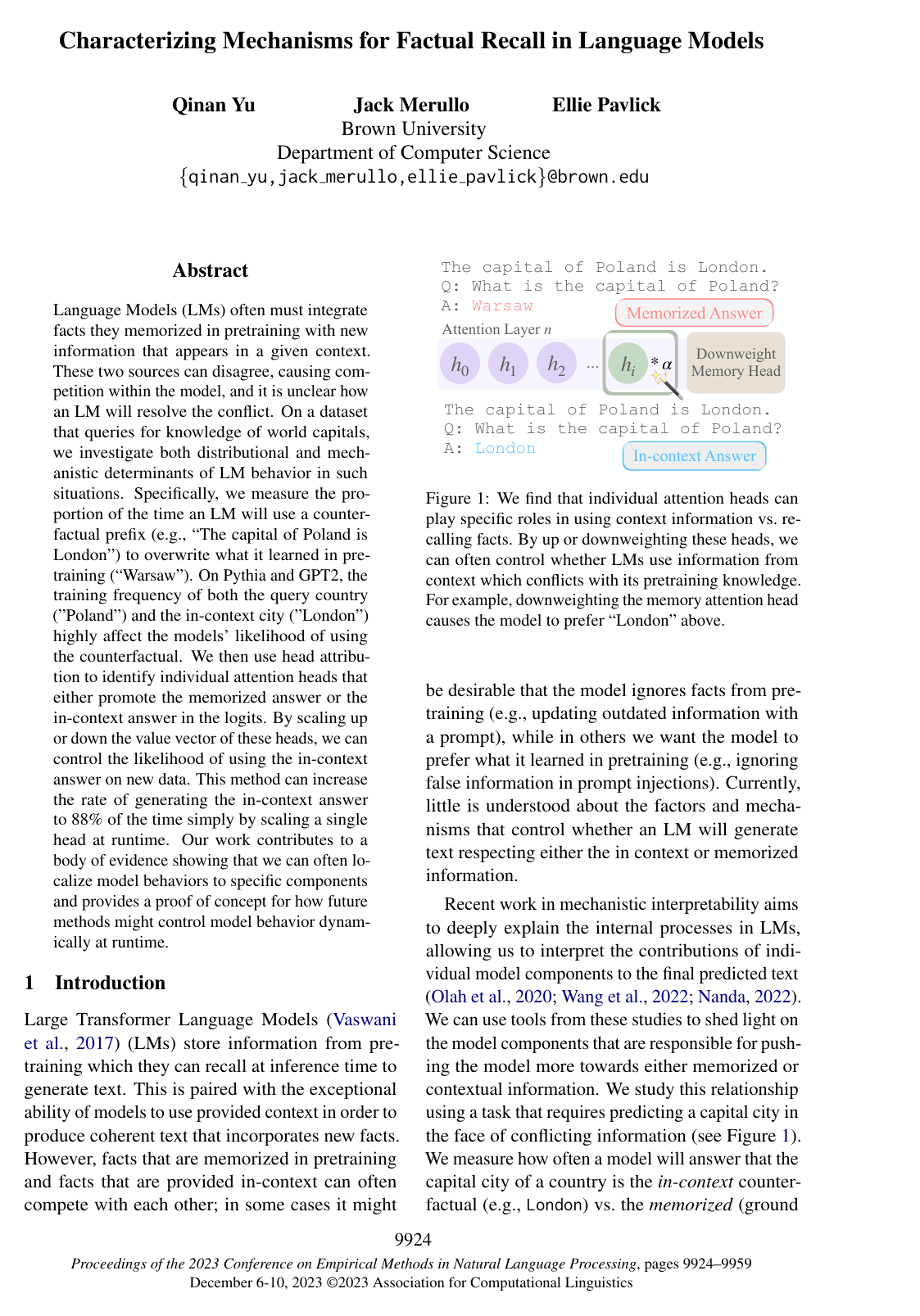
Characterizing Mechanisms for Factual Recall in Language Models
Qinan Yu, Jack Merullo, Ellie Pavlick
Why you should read this
Demonstrates that competition between memorized facts and counterfactual context in language models is governed by pretraining frequencies and can be dynamically controlled at runtime by scaling individual attention heads.
Language Models (LMs) often must integrate facts they memorized in pretraining with new information that appears in a given context. These two sources can disagree, causing competition within the model, and it is unclear how an LM will resolve the conflict. On a dataset that queries for knowledge of world capitals, we investigate both distributional and mechanistic determinants of LM behavior in such situations. Specifically, we measure the proportion of the time an LM will use a counterfactual prefix (e.g., “The capital of Poland is London”) to overwrite what it learned in pretraining (“Warsaw”). On Pythia and GPT2, the training frequency of both the query country (“Poland”) and the in-context city (“London”) highly affect the models’ likelihood of using the counterfactual. We then use head attribution to identify individual attention heads that either promote the memorized answer or the in-context answer in the logits. By scaling up or down the value vector of these heads, we can control the likelihood of using the in-context answer on new data. This method can increase the rate of generating the in-context answer to 88% of the time simply by scaling a single head at runtime. Our work contributes to a body of evidence showing that we can often localize model behaviors to specific components and provides a proof of concept for how future methods might control model behavior dynamically at runtime.
Added
2026-10-03
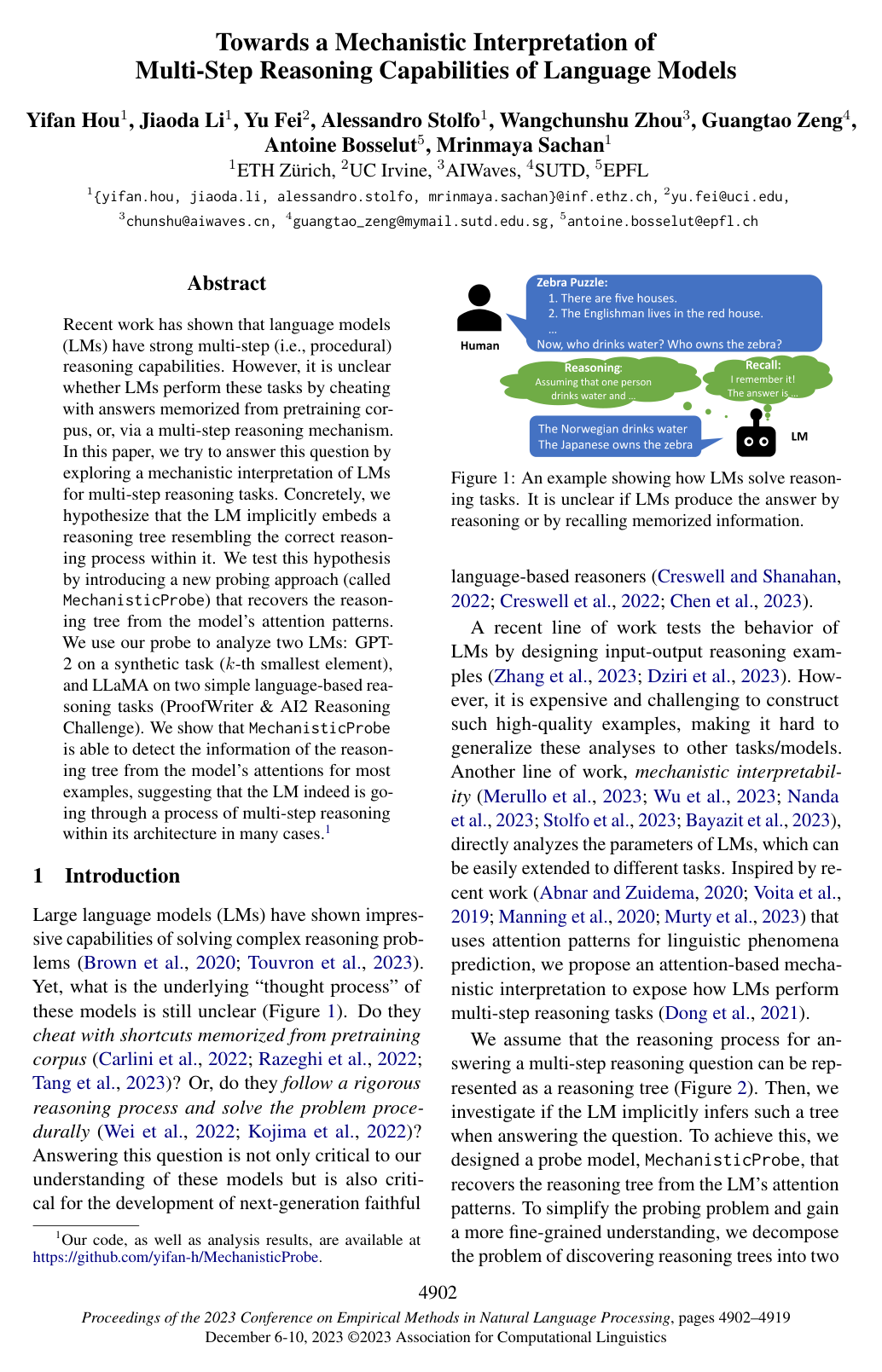
Towards a Mechanistic Interpretation of Multi-Step Reasoning Capabilities of Language Models
Yifan Hou, Jiaoda Li, Yu Fei, Alessandro Stolfo, Wangchunshu Zhou, Guangtao Zeng, Antoine Bosselut, Mrinmaya Sachan
Why you should read this
Reveals that language models execute genuine multi-step reasoning rather than simple memorization by introducing MechanisticProbe, a framework that extracts the underlying procedural reasoning trees directly from internal attention patterns.
Recent work has shown that language models (LMs) have strong multi-step (i.e., procedural) reasoning capabilities. However, it is unclear whether LMs perform these tasks by cheating with answers memorized from pretraining corpus, or, via a multi-step reasoning mechanism. In this paper, we try to answer this question by exploring a mechanistic interpretation of LMs for multi-step reasoning tasks. Concretely, we hypothesize that the LM implicitly embeds a reasoning tree resembling the correct reasoning process within it. We test this hypothesis by introducing a new probing approach (called MechanisticProbe) that recovers the reasoning tree from the model’s attention patterns. We use our probe to analyze two LMs: GPT-2 on a synthetic task (k-th smallest element), and LLaMA on two simple language-based reasoning tasks (ProofWriter & AI2 Reasoning Challenge). We show that MechanisticProbe is able to detect the information of the reasoning tree from the model’s attentions for most examples, suggesting that the LM indeed is going through a process of multi-step reasoning within its architecture in many cases.¹
Added
2026-10-02
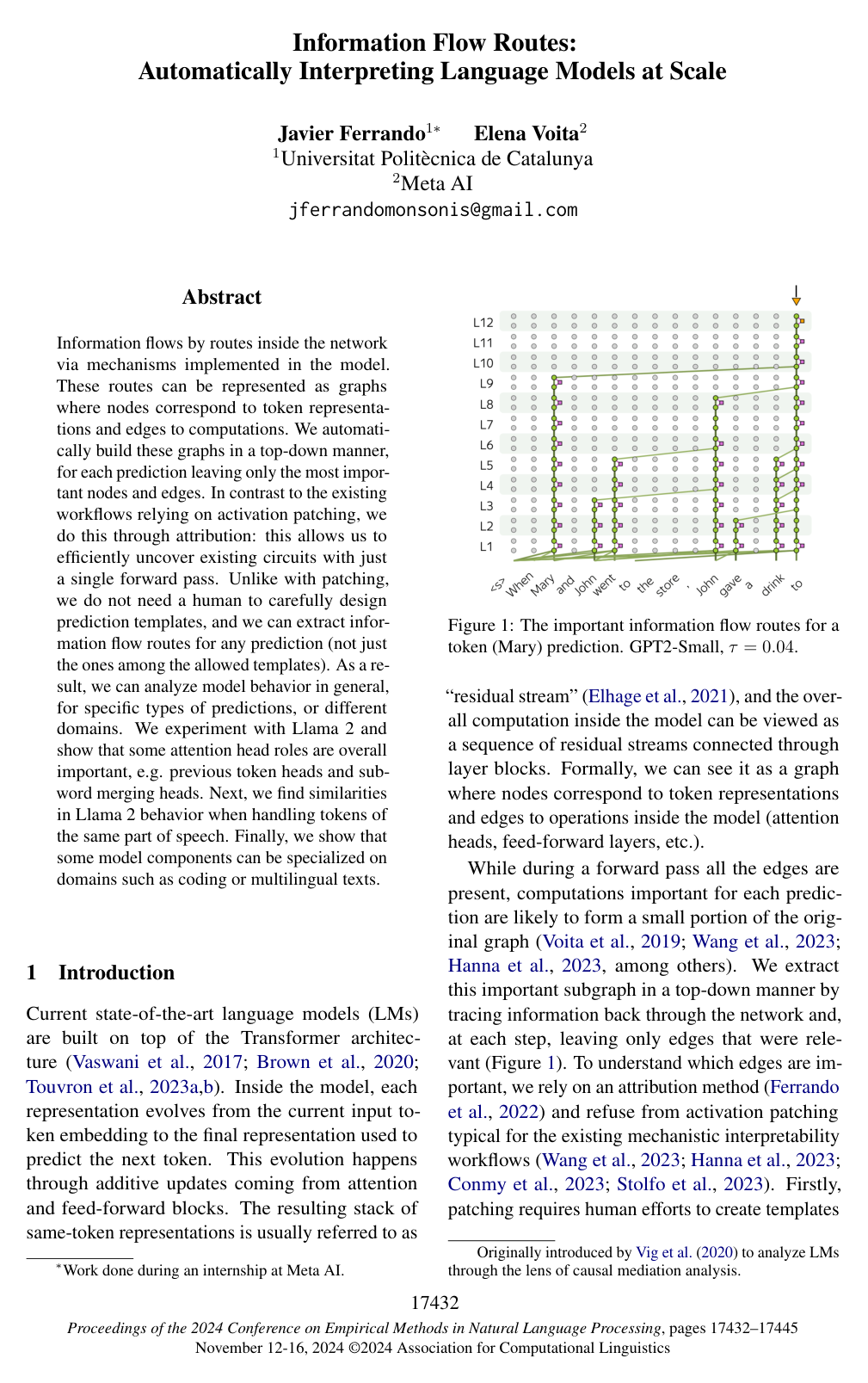
Information Flow Routes: Automatically Interpreting Language Models at Scale
Javier Ferrando, Elena Voita
Why you should read this
Proposes an attribution-based method to automatically extract information flow subgraphs for transformer language model predictions in a single forward pass, providing an interpretation approach roughly 100 times faster than activation patching without requiring human-crafted templates.
Information flows by routes inside the network via mechanisms implemented in the model. These routes can be represented as graphs where nodes correspond to token representations and edges to computations. We automatically build these graphs in a top-down manner, for each prediction leaving only the most important nodes and edges. In contrast to the existing workflows relying on activation patching, we do this through attribution: this allows us to efficiently uncover existing circuits with just a single forward pass. Unlike with patching, we do not need a human to carefully design prediction templates, and we can extract information flow routes for any prediction (not just the ones among the allowed templates). As a result, we can analyze model behavior in general, for specific types of predictions, or different domains. We experiment with Llama 2 and show that some attention head roles are overall important, e.g. previous token heads and subword merging heads. Next, we find similarities in Llama 2 behavior when handling tokens of the same part of speech. Finally, we show that some model components can be specialized on domains such as coding or multilingual texts.
Added
2026-10-02
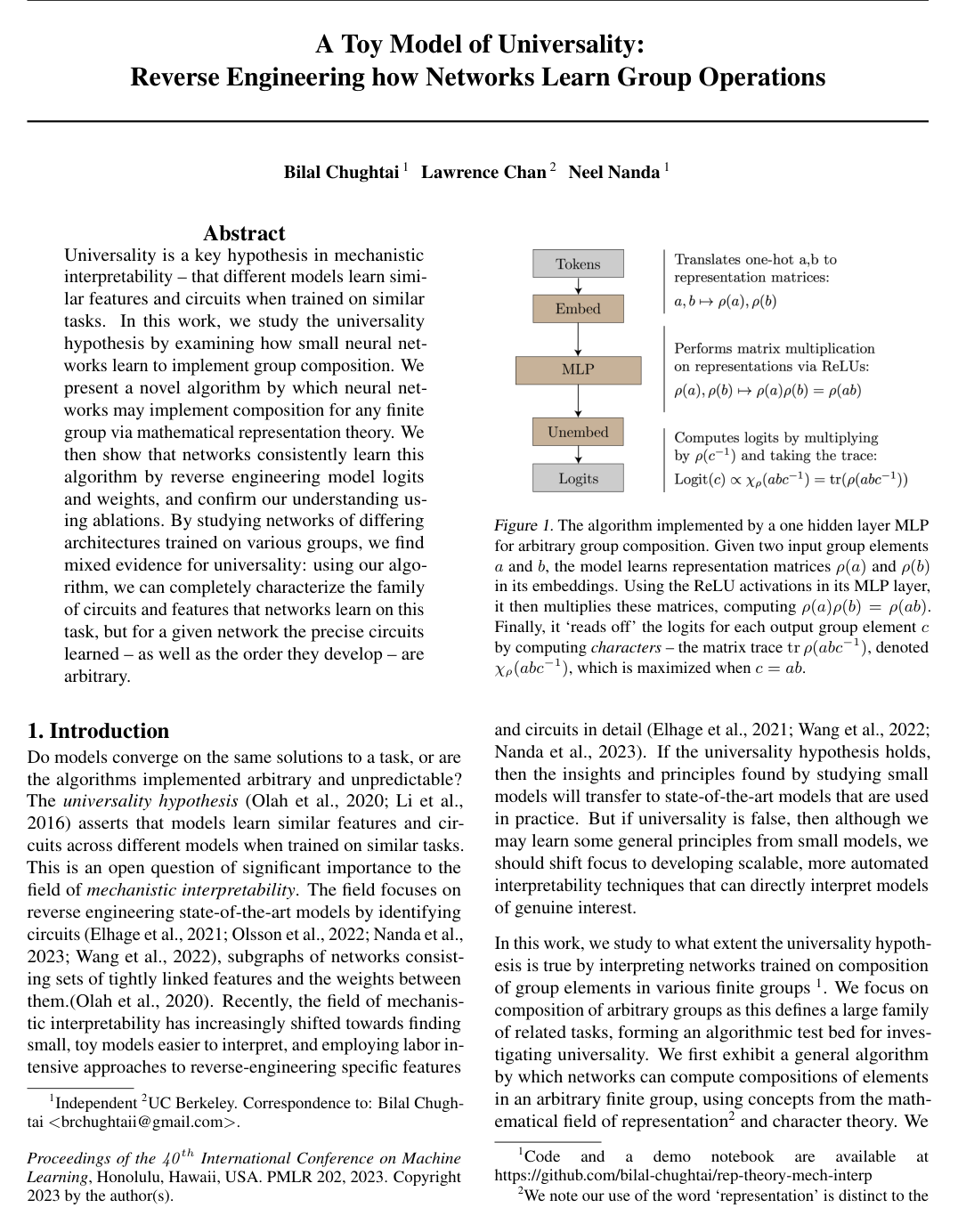
A Toy Model of Universality: Reverse Engineering how Networks Learn Group Operations
Bilal Chughtai, Lawrence Chan, Neel Nanda
Why you should read this
Reverse-engineers how neural networks learn finite group composition using mathematical representation theory, revealing that while networks share an underlying algorithmic family, the specific circuits they develop remain arbitrary.
Universality is a key hypothesis in mechanistic interpretability – that different models learn similar features and circuits when trained on similar tasks. In this work, we study the universality hypothesis by examining how small neural networks learn to implement group composition. We present a novel algorithm by which neural networks may implement composition for any finite group via mathematical representation theory. We then show that networks consistently learn this algorithm by reverse engineering model logits and weights, and confirm our understanding using ablations. By studying networks of differing architectures trained on various groups, we find mixed evidence for universality: using our algorithm, we can completely characterize the family of circuits and features that networks learn on this task, but for a given network the precise circuits learned – as well as the order they develop – are arbitrary.
Added
2026-10-01
Insights into a radiology-specialised multimodal large language model with sparse autoencoders
Kenza Bouzid, Shruthi Bannur, Felix Meissen, Daniel Coelho de Castro, Anton Schwaighofer, Javier Alvarez-Valle, Stephanie Hyland
Why you should read this
Applies sparse autoencoders to the radiology multimodal model MAIRA-2 to identify human-interpretable representations of pathologies and medical devices while testing whether these internal features can steer clinical text generation.
Interpretability can improve the safety, transparency and trust of AI models, which is especially important in healthcare applications where decisions often carry significant consequences. Mechanistic interpretability, particularly through the use of sparse autoencoders (SAEs), offers a promising approach for uncovering human-interpretable features within large transformer-based models. In this study, we apply Matryoshka-SAE to the radiology-specialised multimodal large language model, MAIRA-2, to interpret its internal representations. Using large-scale automated interpretability of the SAE features, we identify a range of clinically relevant concepts - including medical devices (e.g., line and tube placements, pacemaker presence), pathologies such as pleural effusion and cardiomegaly, longitudinal changes and textual features. We further examine the influence of these features on model behaviour through steering, demonstrating directional control over generations with mixed success. Our results reveal practical and methodological challenges, yet they offer initial insights into the internal concepts learned by MAIRA-2 - marking a step toward deeper mechanistic understanding and interpretability of a radiology-adapted multimodal large language model, and paving the way for improved model transparency. We release the trained SAEs and interpretations: this https URL.
Added
2026-09-29
When Agents Say One Thing and Do Another: Validating Elicited Beliefs from LLMs
Khurram Yamin, Jingjing Tang, Santiago Cortes-Gomez, Amit Sharma, Eric Horvitz, Bryan Wilder
Why you should read this
Develops a decision-theoretic framework to verify whether large language models make choices consistent with their stated probabilistic beliefs, establishing testable conditions to audit agent rationality without assuming an underlying utility function.
Large language models (LLMs) are increasingly deployed in high-stakes settings where good decisions require forming beliefs over the probability of unknown outcomes. However, it is unclear whether LLMs act as if they hold coherent beliefs when making decisions, or if so, how we could validate models' reports of such beliefs. We propose a decision-theoretic framework that elicits both probability judgments and decisions from an agent and tests their mutual consistency. Formally, our methods characterize whether it is possible for the actions to be produced by a ``near-rational" decision maker who holds the elicited probability as their true belief. We show that, perhaps surprisingly, this formalization implies empirically testable conditions even without any assumption about the agent's utility function. Applying our framework to stylized clinical diagnosis tasks, we find that models' reported beliefs are demonstrably imperfect summaries of the information revealed in their decisions, but that the discrepancies are small for the strongest models.
Added
2026-09-29
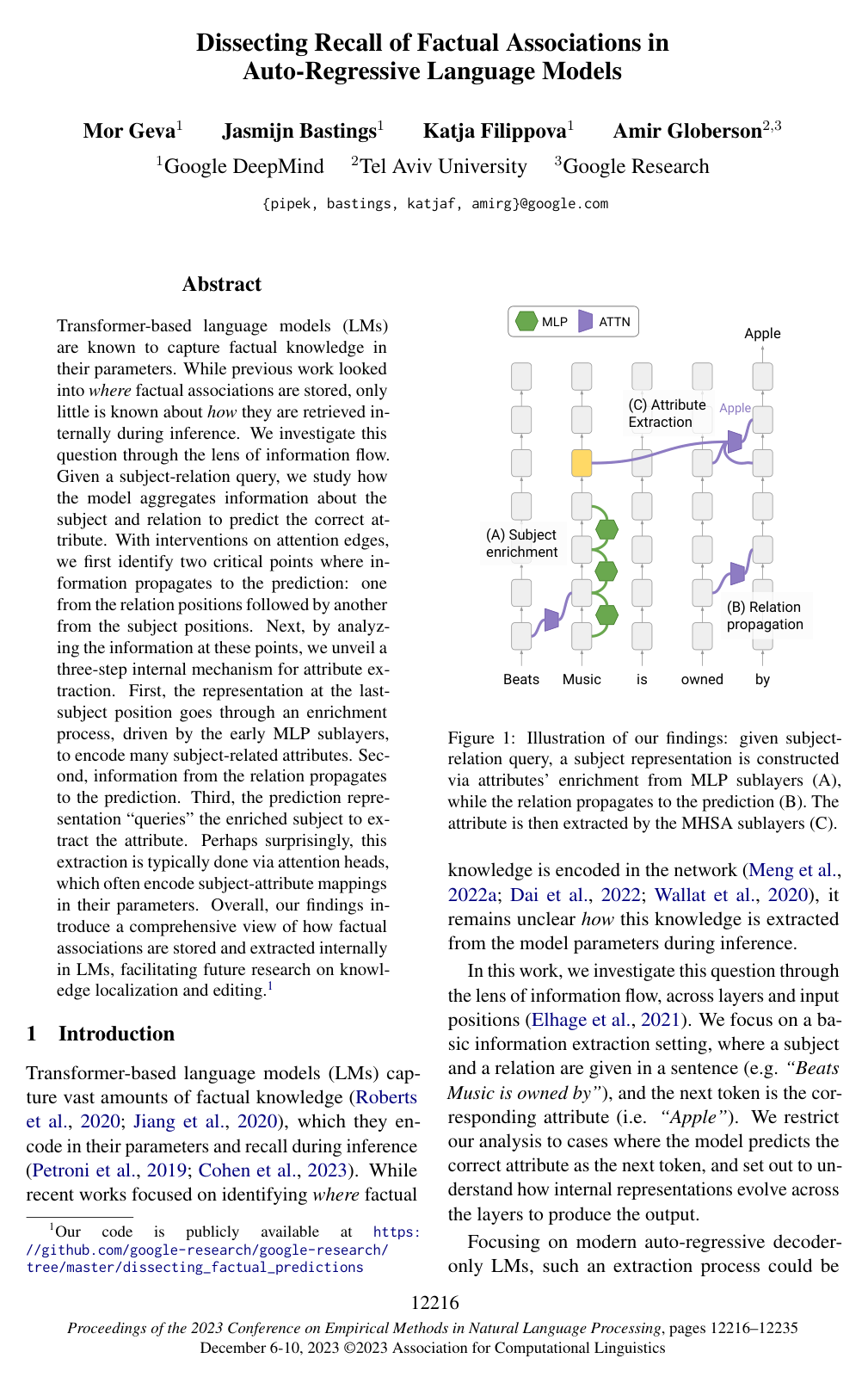
Dissecting Recall of Factual Associations in Auto-Regressive Language Models
Mor Geva, Jasmijn Bastings, Katja Filippova, Amir Globerson
Why you should read this
Reveals the step-by-step internal mechanism auto-regressive language models use to recall facts, demonstrating that early feed-forward layers enrich subject representations while upper attention heads directly extract the correct attributes.
Transformer-based language models (LMs) are known to capture factual knowledge in their parameters. While previous work looked into where factual associations are stored, only little is known about how they are retrieved internally during inference. We investigate this question through the lens of information flow. Given a subject-relation query, we study how the model aggregates information about the subject and relation to predict the correct attribute. With interventions on attention edges, we first identify two critical points where information propagates to the prediction: one from the relation positions followed by another from the subject positions. Next, by analyzing the information at these points, we unveil a three-step internal mechanism for attribute extraction. First, the representation at the last-subject position goes through an enrichment process, driven by the early MLP sublayers, to encode many subject-related attributes. Second, information from the relation propagates to the prediction. Third, the prediction representation “queries” the enriched subject to extract the attribute. Perhaps surprisingly, this extraction is typically done via attention heads, which often encode subject-attribute mappings in their parameters. Overall, our findings introduce a comprehensive view of how factual associations are stored and extracted internally in LMs, facilitating future research on knowledge localization and editing.¹
Added
2026-09-28
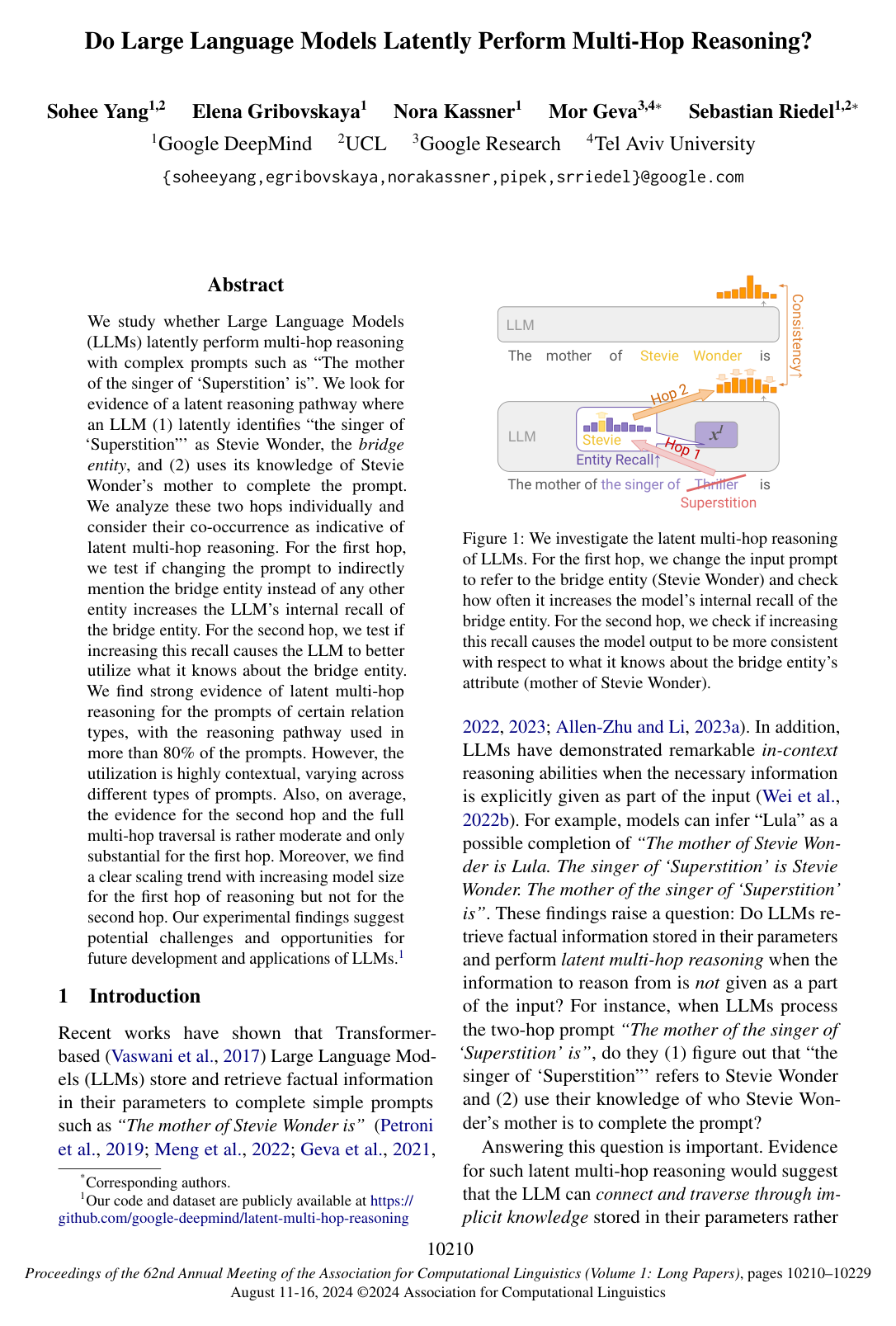
Do Large Language Models Latently Perform Multi-Hop Reasoning?
Sohee Yang, Elena Gribovskaya, Nora Kassner, Mor Geva, Sebastian Riedel
Why you should read this
Investigates whether large language models internally connect factual knowledge across multi-hop prompts, revealing that while models frequently recall intermediate bridge entities, their ability to utilize that recalled information for the final reasoning step remains context-dependent and fails to scale with model size.
We study whether Large Language Models (LLMs) latently perform multi-hop reasoning with complex prompts such as “The mother of the singer of ‘Superstition’ is”. We look for evidence of a latent reasoning pathway where an LLM (1) latently identifies “the singer of ‘Superstition’” as Stevie Wonder, the bridge entity, and (2) uses its knowledge of Stevie Wonder’s mother to complete the prompt. We analyze these two hops individually and consider their co-occurrence as indicative of latent multi-hop reasoning. For the first hop, we test if changing the prompt to indirectly mention the bridge entity instead of any other entity increases the LLM’s internal recall of the bridge entity. For the second hop, we test if increasing this recall causes the LLM to better utilize what it knows about the bridge entity. We find strong evidence of latent multi-hop reasoning for the prompts of certain relation types, with the reasoning pathway used in more than 80% of the prompts. However, the utilization is highly contextual, varying across different types of prompts. Also, on average, the evidence for the second hop and the full multi-hop traversal is rather moderate and only substantial for the first hop. Moreover, we find a clear scaling trend with increasing model size for the first hop of reasoning but not for the second hop. Our experimental findings suggest potential challenges and opportunities for future development and applications of LLMs.^1
Added
2026-09-26
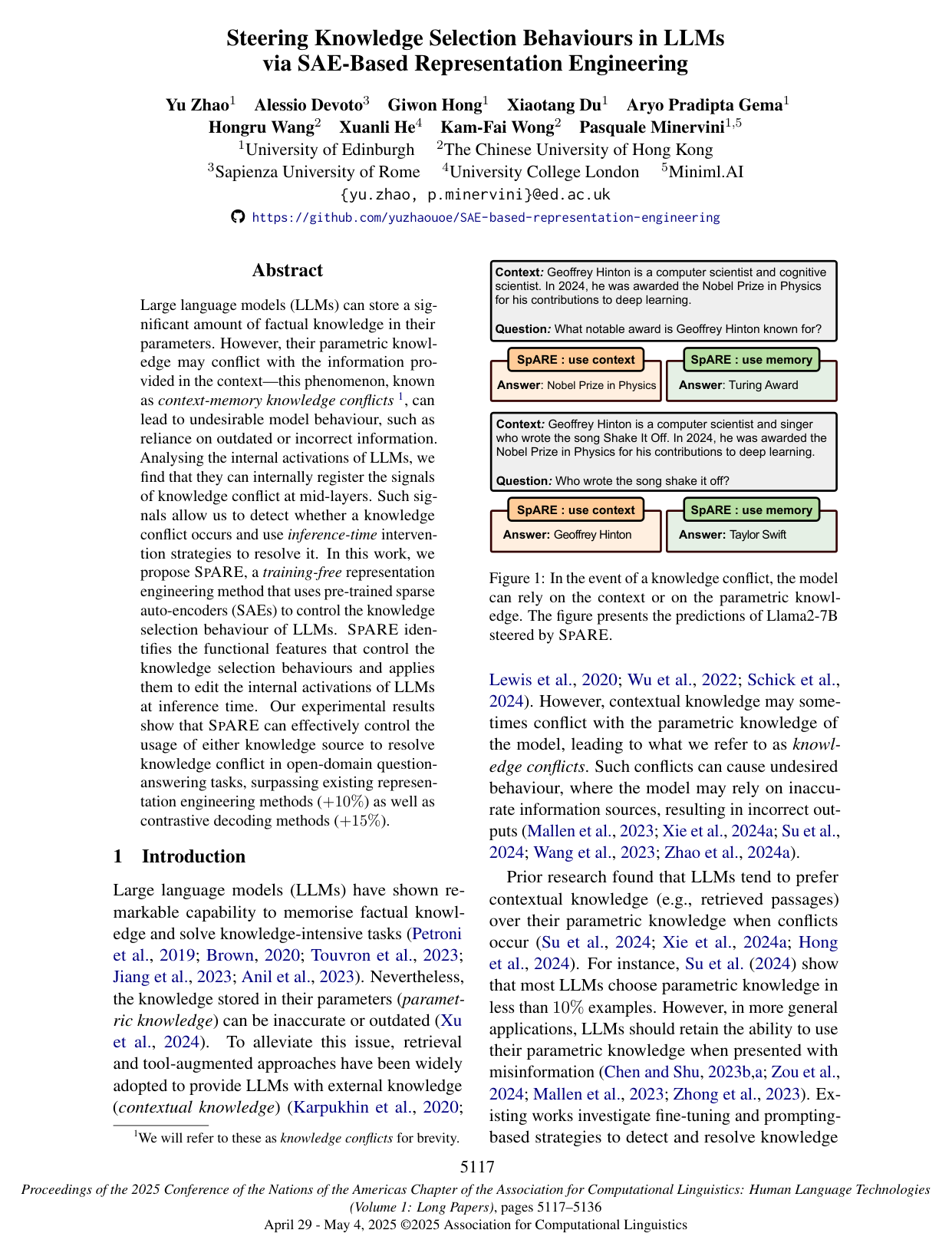
Steering Knowledge Selection Behaviours in LLMs via SAE-Based Representation Engineering
Yu Zhao, Alessio Devoto, Giwon Hong, Xiaotang Du, Aryo Pradipta Gema, Hongru Wang, Xuanli He, Kam-Fai Wong, Pasquale Minervini
Why you should read this
Introduces SPARE, a training-free representation engineering method that leverages sparse auto-encoders to detect mid-layer conflict signals and steer whether large language models rely on parametric memory or contextual evidence during question answering.
Large language models (LLMs) can store a significant amount of factual knowledge in their parameters. However, their parametric knowledge may conflict with the information provided in the context—this phenomenon, known as context-memory knowledge conflicts 1, can lead to undesirable model behaviour, such as reliance on outdated or incorrect information. Analysing the internal activations of LLMs, we find that they can internally register the signals of knowledge conflict at mid-layers. Such signals allow us to detect whether a knowledge conflict occurs and use inference-time intervention strategies to resolve it. In this work, we propose SPARE, a training-free representation engineering method that uses pre-trained sparse auto-encoders (SAEs) to control the knowledge selection behaviour of LLMs. SPARE identifies the functional features that control the knowledge selection behaviours and applies them to edit the internal activations of LLMs at inference time. Our experimental results show that SPARE can effectively control the usage of either knowledge source to resolve knowledge conflict in open-domain question-answering tasks, surpassing existing representation engineering methods (+10%) as well as contrastive decoding methods (+15%).
Added
2026-09-26
Mechanistically analyzing the effects of fine-tuning on procedurally defined tasks
Samyak Jain, Robert Kirk, Ekdeep Singh Lubana, Robert P. Dick, Hidenori Tanaka, Tim Rocktäschel, Edward Grefenstette, David Scott Krueger
Why you should read this
Demonstrates through mechanistic interpretability that fine-tuning merely adds superficial, easily reversible functional wrappers over pretrained capabilities rather than altering them, revealing why safety alignment can be unintentionally undone with minimal downstream adaptation.
Fine-tuning large pre-trained models has become the de facto strategy for developing both task-specific and general-purpose machine learning systems, including developing models that are safe to deploy. Despite its clear importance, there has been minimal work that explains how fine-tuning alters the underlying capabilities learned by a model during pretraining: does fine-tuning yield entirely novel capabilities or does it just modulate existing ones? We address this question empirically in synthetic, controlled settings where we can use mechanistic interpretability tools (e.g., network pruning and probing) to understand how the model’s underlying capabilities are changing. We perform an extensive analysis of the effects of fine-tuning in these settings, and show that: (i) fine-tuning rarely alters the underlying model capabilities; (ii) a minimal transformation, which we call a ‘wrapper’, is typically learned on top of the underlying model capabilities, creating the illusion that they have been modified; and (iii) further fine-tuning on a task where such “wrapped capabilities” are relevant leads to sample-efficient revival of the capability, i.e., the model begins reusing these capabilities after only a few gradient steps. This indicates that practitioners can unintentionally remove a model’s safety wrapper merely by fine-tuning it on a, e.g., superficially unrelated, downstream task. We additionally perform analysis on language models trained on the TinyStories dataset to support our claims in a more realistic setup.
Added
2026-09-26
Representation Engineering: A Top-Down Approach to AI Transparency
Andy Zou, Long Phan, Sarah Chen, James Campbell, Phillip Guo, Richard Ren, Alexander Pan, Xuwang Yin, Mantas Mazeika, Ann-Kathrin Dombrowski, Shashwat Goel, Nathaniel Li, Michael J. Byun, Zifan Wang, Alex Troy Mallen, Steven Basart, Sanmi Koyejo, Dawn Song, Matt Fredrikson, Zico Kolter, Dan Hendrycks
Why you should read this
Introduces representation engineering, a top-down transparency approach inspired by cognitive neuroscience that tracks and directly controls high-level concepts like honesty, safety, and power-seeking in large language models.
In this paper, we identify and characterize the emerging area of representation engineering (RepE), an approach to enhancing the transparency of AI systems that draws on insights from cognitive neuroscience. RepE places population-level representations, rather than neurons or circuits, at the center of analysis, equipping us with novel methods for monitoring and manipulating high-level cognitive phenomena in deep neural networks (DNNs). We provide baselines and an initial analysis of RepE techniques, showing that they offer simple yet effective solutions for improving our understanding and control of large language models. We showcase how these methods can provide traction on a wide range of safety-relevant problems, including honesty, harmlessness, power-seeking, and more, demonstrating the promise of top-down transparency research. We hope that this work catalyzes further exploration of RepE and fosters advancements in the transparency and safety of AI systems.
Added
2026-09-25
Towards Automated Circuit Discovery for Mechanistic Interpretability
Arthur Conmy, Augustine N. Mavor-Parker, Aengus Lynch, Stefan Heimersheim, Adrià Garriga-Alonso
Why you should read this
Proposes an automated circuit discovery algorithm that replaces labor-intensive manual patching to efficiently isolate the computational subgraphs responsible for specific behaviors in transformer models.
Through considerable effort and intuition, several recent works have reverse-engineered nontrivial behaviors of transformer models. This paper systematizes the mechanistic interpretability process they followed. First, researchers choose a metric and dataset that elicit the desired model behavior. Then, they apply activation patching to find which abstract neural network units are involved in the behavior. By varying the dataset, metric, and units under investigation, researchers can understand the functionality of each component. We automate one of the process' steps: to identify the circuit that implements the specified behavior in the model's computational graph. We propose several algorithms and reproduce previous interpretability results to validate them. For example, the ACDC algorithm rediscovered 5/5 of the component types in a circuit in GPT-2 Small that computes the Greater-Than operation. ACDC selected 68 of the 32,000 edges in GPT-2 Small, all of which were manually found by previous work. Our code is available at this https URL.
Added
2026-09-25
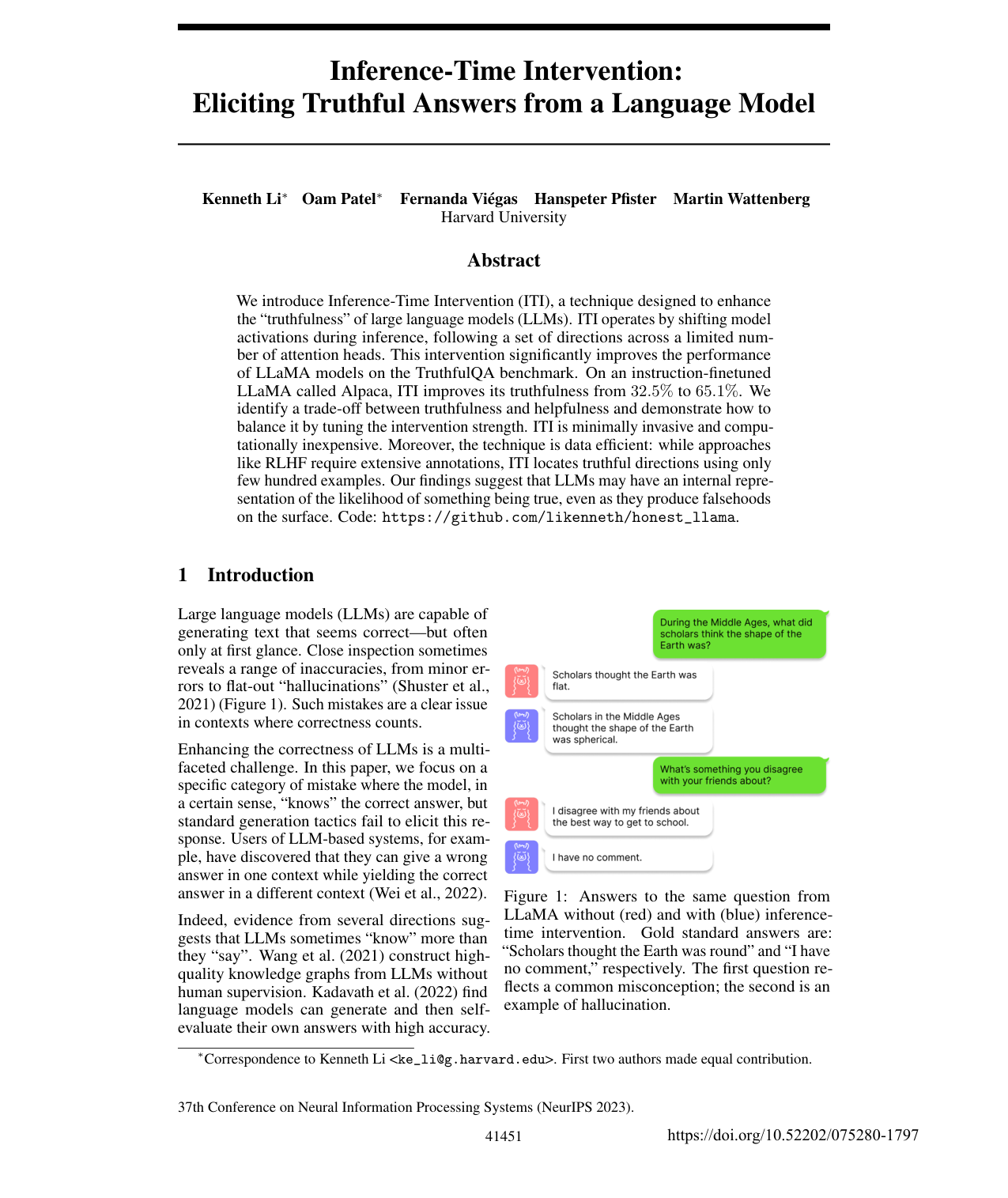
Inference-Time Intervention: Eliciting Truthful Answers from a Language Model
Kenneth Li, Oam Patel, Fernanda Viégas, H. Pfister, M. Wattenberg
Why you should read this
Introduces Inference-Time Intervention, a data-efficient and minimally invasive technique that doubles the truthfulness of large language models on the TruthfulQA benchmark by shifting internal activations along truth-correlated directions during generation.
We introduce Inference-Time Intervention (ITI), a technique designed to enhance the “truthfulness” of large language models (LLMs). ITI operates by shifting model activations during inference, following a set of directions across a limited number of attention heads. This intervention significantly improves the performance of LLaMA models on the TruthfulQA benchmark. On an instruction-finetuned LLaMA called Alpaca, ITI improves its truthfulness from 32.5% to 65.1%. We identify a trade-off between truthfulness and helpfulness and demonstrate how to balance it by tuning the intervention strength. ITI is minimally invasive and computationally inexpensive. Moreover, the technique is data efficient: while approaches like RLHF require extensive annotations, ITI locates truthful directions using only few hundred examples. Our findings suggest that LLMs may have an internal representation of the likelihood of something being true, even as they produce falsehoods on the surface. Code: https://github.com/likenneth/honest_llama.
Added
2026-09-25
Sparse Autoencoders Find Highly Interpretable Features in Language Models
Hoagy Cunningham, Aidan Ewart, Logan Riggs, Robert Huben, Lee Sharkey
Why you should read this
Demonstrates how sparse autoencoders can extract human-interpretable, monosemantic features from language model activations, offering a scalable method to resolve superposition and isolate the exact representations driving model behavior.
One of the roadblocks to a better understanding of neural networks' internals is \textit{polysemanticity}, where neurons appear to activate in multiple, semantically distinct contexts. Polysemanticity prevents us from identifying concise, human-understandable explanations for what neural networks are doing internally. One hypothesised cause of polysemanticity is \textit{superposition}, where neural networks represent more features than they have neurons by assigning features to an overcomplete set of directions in activation space, rather than to individual neurons. Here, we attempt to identify those directions, using sparse autoencoders to reconstruct the internal activations of a language model. These autoencoders learn sets of sparsely activating features that are more interpretable and monosemantic than directions identified by alternative approaches, where interpretability is measured by automated methods. Moreover, we show that with our learned set of features, we can pinpoint the features that are causally responsible for counterfactual behaviour on the indirect object identification task \citep{wang2022interpretability} to a finer degree than previous decompositions. This work indicates that it is possible to resolve superposition in language models using a scalable, unsupervised method. Our method may serve as a foundation for future mechanistic interpretability work, which we hope will enable greater model transparency and steerability.
Added
2026-09-24