HEGEL: Hypergraph Transformer for Long Document Summarization
Haopeng ZhangXiao LiuJiawei Zhang
Proposes a hypergraph transformer architecture that captures high-order cross-sentence dependencies across section structures, latent topics, and keyword coreferences to improve extractive summarization for long documents.
Automated text summarization systems perform reliably on short news articles, but they struggle with complex, long-form documents such as scientific research papers. Long texts contain thousands of words across diverse topics and intricate section structures, leading to severe computational bottlenecks and an inability to track relationships between sentences spaced far apart. Standard graph-based solutions attempt to address this by linking pairs of sentences, yet they fail to capture multi-sentence relationships or integrate diverse structural and semantic contexts simultaneously.
The article develops and evaluates HEGEL (Hypergraph transformer for Extractive Long document summarization), a new neural network architecture designed to model complex, multi-sentence dependencies and extract the most informative sentences from long documents.
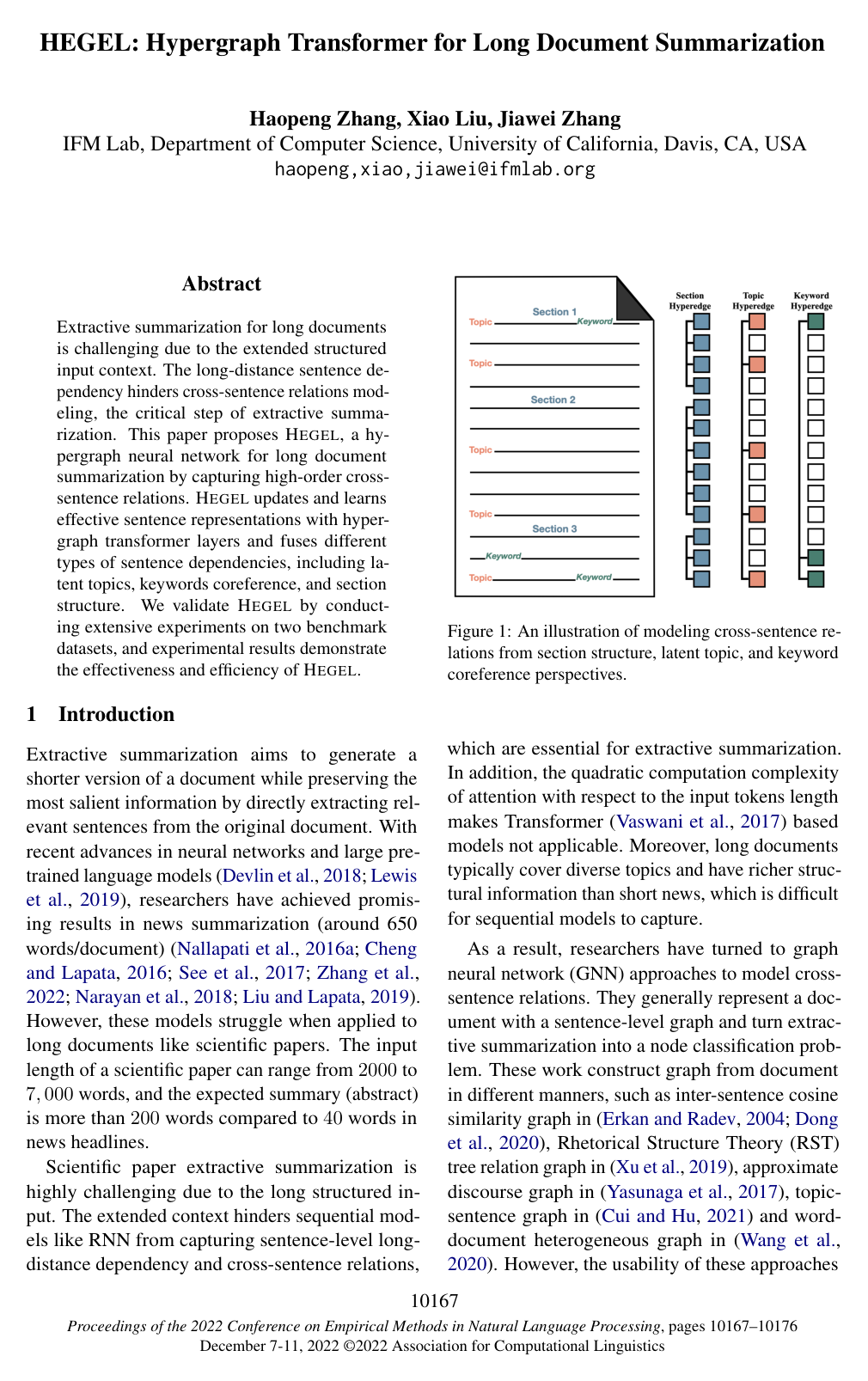
To overcome the limitations of pairwise graph models, the approach represents documents as hypergraphs—mathematical structures where a single connection, or hyperedge, can link multiple sentences at once. HEGEL integrates three distinct relation types: document section structure (local context), latent topics (global semantic themes), and shared keywords (coreference). Specialized hypergraph transformer attention layers then propagate information across these connections to score sentence importance. The article evaluates this approach across two large-scale scientific benchmarks, PubMed (over 112,000 training papers) and arXiv (over 201,000 training papers), comparing performance against standard extractive and abstractive baselines.
HEGEL consistently outperformed all unsupervised, extractive, and abstractive baseline models on both benchmark datasets in standard overlap and fluency metrics. Analysis shows that local section structure is the single most critical dependency; removing section hyperedges caused the largest performance drop, and the model allocates more than half of its attention to section-level connections. In addition, incorporating global topic and keyword connections, alongside hierarchical sentence positioning, measurably enhanced the accuracy of salient sentence selection. Crucially, the model achieved these gains while maintaining high parameter efficiency, using approximately 50% fewer parameters than standard heterogeneous graph models and 90% fewer parameters than large-scale long-document language models.
These findings demonstrate that capturing multi-sentence relationships from multiple viewpoints is more effective for summarizing long documents than relying solely on pairwise graphs or massive language models. From an operational perspective, the high parameter efficiency translates to lower computational costs, reduced infrastructure requirements, and faster processing timelines without sacrificing summarization quality.
Organizations handling high volumes of structured, long-form technical or scientific documents should consider adopting hypergraph-based architectures over traditional pairwise graph or heavy transformer models. Technical teams looking to extend this approach can incorporate additional relation types, such as syntactic dependencies or domain-specific metadata, to further refine sentence selection.
Confidence in the reported results is high for academic literature, as the evaluations are grounded in extensive testing on established public benchmarks. However, leaders should note two main limitations before deployment in broader production settings: the model relies on external keyword and topic extraction tools during data pre-processing, and evaluation has so far been restricted to scientific papers. Further pilot testing is advisable when applying the framework to other document types, such as legal or financial filings.
- Paper: Hypergraph Neural Networks, Yifan Feng et al. (2018). Introduces hypergraph neural networks and hyperedge convolution for modeling high-order correlations beyond pairwise graph connections, providing the fundamental graph formalism used in HEGEL.
- Paper: Text Summarization with Pretrained Encoders, Yang Liu et al. (2019). Establishes pretrained encoder architectures for document-level extractive summarization and inter-sentence relation modeling that HEGEL builds upon.
- Paper: Heterogeneous Graph Transformer, Ziniu Hu et al. (2020). Provides transformer architectures designed for heterogeneous relational structures, directly informing HEGEL's multi-dependency fusion mechanisms.
- Paper: Longformer: The Long-Document Transformer, Iz Beltagy et al. (2020). Presents foundational methods for scaling transformer attention over long documents, a core prerequisite challenge addressed by HEGEL.
- Paper: SummaRuNNer: A Recurrent Neural Network Based Sequence Model for Extractive Summarization of Documents, Ramesh Nallapati et al. (2016). Formulates extractive document summarization by scoring sentence salience and redundancy over structured document context.
- Paper: Graph Convolutional Networks for Text Classification, Liang Yao et al. (2018). Demonstrates how to construct graph neural representations over text corpora and documents to capture inter-word and inter-document relationships.
- Paper: Graph Attention Networks, Petar Veličković et al. (2018). Introduces masked self-attention over graph neighborhoods, underlying graph transformer message-passing mechanisms.
- Paper: LexRank: Graph-based Lexical Centrality as Salience in Text Summarization, Günes Erkan et al. (2004). Pioneers graph-based sentence centrality for extractive text summarization.
- Paper: From Local to Global: A Graph RAG Approach to Query-Focused Summarization, Darren Edge et al. (2024). Extends graph-structured text representation and summarization to hierarchical knowledge graphs for global query-focused document collection synthesis.
- Paper: SCROLLS: Standardized CompaRison Over Long Language Sequences, Uri Shaham et al. (2022). Standardizes evaluation for long-sequence reasoning and summarization models across multiple challenging long-context tasks.
- Paper: SummaReranker: A Multi-Task Mixture-of-Experts Re-ranking Framework for Abstractive Summarization, Mathieu Ravaut et al. (2022). Explores multi-task candidate re-ranking methods that can refine and optimize summarization outputs generated by long-document models.
- Paper: G-Eval: NLG Evaluation using GPT-4 with Better Human Alignment, Yang Liu et al. (2023). Introduces LLM-based reference-free evaluation metrics that offer advanced validation of generated summaries compared to traditional n-gram overlap metrics.
- Paper: A Length-Extrapolatable Transformer, Yutao Sun et al. (2023). Addresses sequence length generalization in transformers to process long contexts during inference without quadratic scaling limitations.
- Paper: Simple and Efficient Heterogeneous Graph Neural Network, Xiaocheng Yang et al. (2023). Proposes streamlined heterogeneous graph transformer architectures that optimize computational efficiency when scaling up complex relational learning.
- Paper: Harnessing Explanations: LLM-to-LM Interpreter for Enhanced Text-Attributed Graph Representation Learning, Xiaoxin He et al. (2024). Applies modern LLMs to enhance text-attributed graph representations by interpreting structural and textual relationships.