Hypergraph Neural Networks
Yifan FengHaoxuan YouZizhao ZhangRongrong JiYue Gao
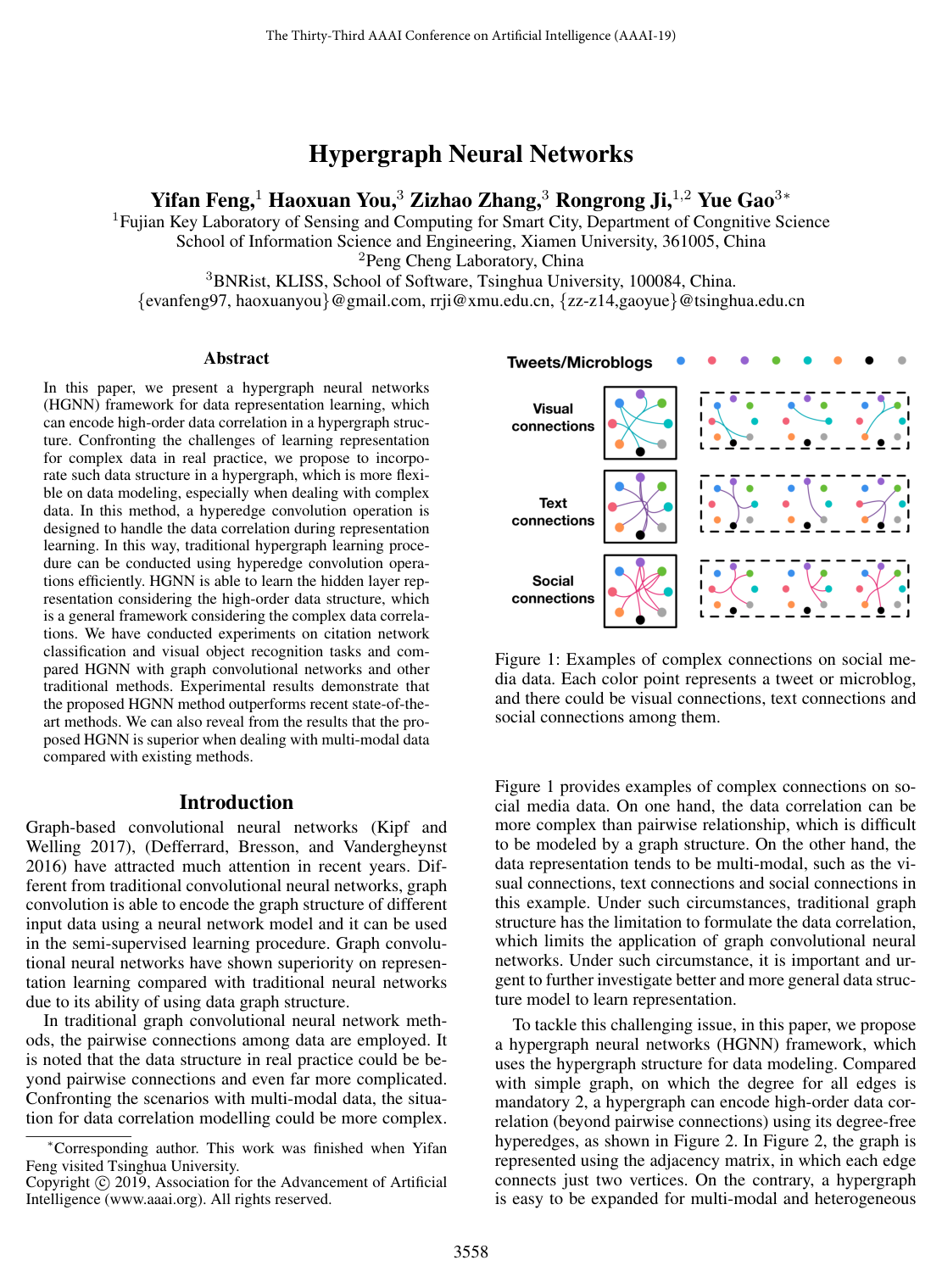
Modern data systems increasingly deal with complex, multi-modal information where relationships extend beyond simple pairwise links, such as social networks that combine text, visual content, and social ties. Standard graph convolutional networks are constrained by simple graphs that only connect two data points per edge, limiting their ability to model complex group interactions. Meanwhile, traditional hypergraph methods capture these multi-entity relationships but suffer from high computational complexity and memory demands, hindering practical use. The article addresses this gap by introducing Hypergraph Neural Networks, a framework that integrates high-order data correlation into deep learning while maintaining computational efficiency.
The main objective of the article is to formulate and demonstrate a deep learning architecture using hyperedge convolution that processes complex, multi-modal relationships for data classification. To achieve this, the authors designed a layer-wise propagation mechanism that aggregates data from nodes to hyperedges and back to nodes, approximating spectral convolutions on hypergraphs without needing expensive matrix inversions. The framework was evaluated across four standard benchmarks: two document citation networks (Cora and Pubmed) for graph-based semi-supervised classification, and two 3D visual object recognition datasets (ModelNet40 and NTU) using multiple visual feature extractors.
The evaluation produced several clear findings in order of importance. First, on visual object recognition using multi-modal feature structures, the proposed approach significantly outperformed standard graph convolutional networks, achieving accuracy gains between 8.1% and 10.4% on the NTU dataset and reaching 96.7% accuracy on ModelNet40. Second, the framework surpassed competitive 3D deep learning baselines on ModelNet40, beating point-cloud methods such as SO-Net by 3.3% and PointCNN by 4.9%. Third, when restricted to single-feature structures on visual datasets, it consistently maintained a modest performance advantage of 0.3% to 4.3% over graph convolutional networks. Finally, on standard citation networks where data relations are predominantly pairwise and simple, the model matched or slightly exceeded top baselines, achieving 81.6% accuracy on Cora and 80.1% on Pubmed (a 1.1% gain over graph convolutional networks).
These findings demonstrate that hyperedge convolutions provide a mathematically sound and scalable way to fuse heterogeneous, multi-modal data without manual feature alignment. Organizations deploying machine learning for complex data environments can achieve higher classification performance and richer representation learning, reducing errors in multi-modal retrieval and recognition tasks. The results also show that while the framework generalizes standard graph neural networks, its true performance advantages emerge in rich, multi-feature environments rather than simple pairwise network structures.
Stakeholders and engineering teams working with multi-modal recognition, classification, or retrieval should consider adopting hypergraph-based convolutional layers where standard graphs are currently used. When evaluating deployment, teams should focus implementation efforts on applications with multi-modal or complex group structures, as uniform pairwise datasets offer limited return on migration effort. Future efforts should assess performance on larger industrial-scale multi-modal graphs, refine automated hyperedge construction techniques, and evaluate runtime efficiency in latency-critical production environments.
Confidence in these findings is supported by consistent testing across multiple established benchmarks and comparisons against recent state-of-the-art models. However, limitations remain: the visual recognition experiments relied on nearest-neighbor distance metrics to construct the hypergraphs, which introduces sensitivity to metric choices, and the citation dataset evaluations showed minimal gains because the underlying data lacked complex multi-entity relationships. Readers should account for these boundary conditions when forecasting performance on simple or poorly structured datasets.
- Paper: Semi-Supervised Classification with Graph Convolutional Networks, Thomas N. Kipf et al. (2017). Provides the foundational spectral graph convolutional network formulation that Hypergraph Neural Networks adapts and generalizes from pairwise edges to higher-order hyperedge convolutions.
- Paper: Convolutional Neural Networks on Graphs with Fast Localized Spectral Filtering, Michaël Defferrard et al. (2016). Introduces fast localized spectral graph filtering using Chebyshev polynomial approximations of the graph Laplacian, establishing the mathematical groundwork for spectral convolutions in hypergraphs.
- Paper: Geometric Deep Learning: Going beyond Euclidean data, Michael M. Bronstein et al. (2016). Surveys the geometric deep learning paradigm for generalizing neural convolutions to non-Euclidean domains, which HGNN extends to high-order hypergraph structures.
- Paper: Spectral Networks and Locally Connected Networks on Graphs, Joan Bruna et al. (2014). Pioneers spectral network constructions using graph Laplacians, providing the foundational theoretical roots for spectral operations in graph and hypergraph representation learning.
- Paper: Inductive Representation Learning on Large Graphs, William L. Hamilton et al. (2017). Establishes spatial neighborhood aggregation mechanisms in graph neural networks, serving as key baseline and conceptual context for HGNN's hyperedge-based message passing.
- Paper: The Graph Neural Network Model, Franco Scarselli et al. (2009). Introduces the classic Graph Neural Network model for iterative node state propagation, defining the core relational learning problem that hypergraph networks broaden to higher-order relations.
- Paper: Weisfeiler and Leman Go Neural: Higher-Order Graph Neural Networks, Christopher Morris et al. (2019). Explores the theoretical expressiveness and limitations of higher-order graph neural networks by relating subgraphs and hyperedges to multidimensional Weisfeiler-Leman tests.
- Paper: How Powerful are Graph Neural Networks?, Keyulu Xu et al. (2019). Analyzes the foundational expressive limits of message-passing architectures, offering theoretical guidance for evaluating advanced graph and hypergraph representation learning models.
- Paper: A Comprehensive Survey on Graph Neural Networks, Zonghan Wu et al. (2019). Provides a comprehensive taxonomy and survey of advanced graph neural network architectures and learning schemes following early spectral and spatial models.
- Paper: Heterogeneous Graph Transformer, Ziniu Hu et al. (2020). Extends complex relational data modeling to heterogeneous web-scale graphs through typed attention mechanisms, building beyond homogeneous and hypergraph convolution settings.
- Paper: Simple and Deep Graph Convolutional Networks, Ming Chen et al. (2020). Addresses the over-smoothing problem inherent in multi-layer graph convolutions via initial residual connections, relevant for deepening hypergraph and graph neural networks.
- Paper: Predict then Propagate: Graph Neural Networks meet Personalized PageRank, Johannes Gasteiger et al. (2019). Decouples prediction from propagation using Personalized PageRank to mitigate over-smoothing and scale information diffusion across distant connections.
- Paper: Fast Graph Representation Learning with PyTorch Geometric, Matthias Fey et al. (2019). Supplies a standardized open-source library for implementing and scaling message-passing operators across diverse geometric, graph, and hypergraph data structures.