
keyword
web agents
Web agents are software systems that use a web browser or web interface to carry out tasks on websites and web-based applications. They interpret page content, decide what to do, and take actions such as navigating, searching, entering information, or interacting with controls, often across multiple steps and sometimes with human oversight.
11 items
CRMArena: Understanding the Capacity of LLM Agents to Perform Professional CRM Tasks in Realistic Environments
Kung-Hsiang Huang, Akshara Prabhakar, Sidharth Dhawan, Yixin Mao, Huan Wang, Silvio Savarese, Caiming Xiong, Philippe Laban, Chien-Sheng Wu
Why you should read this
Introduces CRMArena, an expert-validated benchmark featuring an interactive Salesforce environment with 16 interconnected business objects, revealing that state-of-the-art language model agents fail at more than a third of realistic customer service tasks.
Customer Relationship Management (CRM) systems are vital for modern enterprises, providing a foundation for managing customer interactions and data. Integrating AI agents into CRM systems can automate routine processes and enhance personalized service. However, deploying and evaluating these agents is challenging due to the lack of realistic benchmarks that reflect the complexity of real-world CRM tasks. To address this issue, we introduce CRMArena, a novel benchmark designed to evaluate AI agents on realistic tasks grounded on professional work environments. We worked with CRM experts to design nine customer service tasks distributed across three personas: service agent, analyst, and manager. We synthesize a large-scale simulated organization, populating 16 commonly-used industrial objects (e.g., account, order, knowledge article, case) with high interconnectivity, and uploading it into a real Salesforce CRM organization. UI and API access to the CRM is provided to systems that attempt to complete the tasks in CRMArena. Experimental results reveal that state-of-the-art LLM agents succeed in less than 58% of the tasks with ReAct prompting, and less than 65% even when provided manually-crafted function-calling tools. Our findings highlight the need for enhanced agent capabilities in function-calling and rule-following to be deployed in real-world work environment. CRMArena is an open challenge to the community: systems that can reliably complete tasks showcase direct business value in a popular work environment.
Added
2026-10-05
AutoTailor: Automatic, User-Aligned Capability Selection and Adaptation for Web Agents
Xin-Yun Cao, Adriana Szekeres, Fazle Faisal
Why you should read this
Presents AutoTailor, a meta-agentic framework that converts web interaction trajectories into a compact, dynamically adapted set of browser-automation APIs, cutting agent token costs by over 57% and latency by 29% while improving task accuracy on WebArena.
Web agents can utilize reusable tools to reduce the cost and latency of low-level browser interaction, but automatically discovered tool collections can be large, redundant, and poorly aligned with user demand. We present AutoTailor, a meta-agentic framework for constructing and maintaining a compact set of trajectory-derived Model Context Protocol (MCP) APIs. Offline, AutoTailor converts web trajectories into parameterized browser-automation programs, applies a Quality Filter to remove APIs with unsuitable granularity and redundant functionality, and applies a Usage Likelihood Filter to prioritize broadly useful capabilities while preserving semantic coverage. Online, Dynamic Reselection monitors task outcomes and API usage, identifies recurring coverage gaps, adds relevant candidates, and prunes persistently unused capabilities. We evaluate AutoTailor on 106 WebArena Postmill tasks. Offline filtering reduces the initial 1,283 unrefined APIs to 87, and Dynamic Reselection produces a 33-API set. With reasoning and acting (ReAct) fallback, this set achieves 90.6% correctness, compared with 87.5% for ReAct alone, while reducing average total request-token cost by 57.8% and latency by 29.4%. Without ReAct, it achieves 60.1% correctness, marginally matching the performance of unrefined set, while reducing request-token usage by 94.9%. Together, these results show that static filtering produces a compact inventory of APIs expected to support core, high-likelihood tasks, while dynamic reselection further tailors that inventory to observed user needs. This combination improves accuracy and latency while sharply reducing token usage and end-to-end cost, demonstrating the value of user-aligned capability management for efficient web agents.
Added
2026-10-05
Agentic Large Language Models, a Survey
Aske Plaat, Max J. van Duijn, Niki van Stein, Mike Preuss, Peter van der Putten, Kees Joost Batenburg
Why you should read this
Categorizes autonomous language models across reasoning, acting, and social interaction to explain how agentic behaviors generate new training data and overcome data scaling limits.
Background: There is great interest in agentic LLMs, large language models that act as agents. Objectives: We review the growing body of work in this area and provide a research agenda. Methods: Agentic LLMs are LLMs that (1) reason, (2) act, and (3) interact. We organize the literature according to these three categories. Results: The research in the first category focuses on reasoning, reflection, and retrieval, aiming to improve decision making; the second category focuses on action models, robots, and tools, aiming for agents that act as useful assistants; the third category focuses on multi-agent systems, aiming for collaborative task solving and simulating interaction to study emergent social behavior. We find that works mutually benefit from results in other categories: retrieval enables tool use, reflection improves multi-agent collaboration, and reasoning benefits all categories. Conclusions: We discuss applications of agentic LLMs and provide an agenda for further research. Important applications are in medical diagnosis, logistics and financial market analysis. Meanwhile, self-reflective agents playing roles and interacting with one another augment the process of scientific research itself. Further, agentic LLMs provide a solution for the problem of LLMs running out of training data: inference-time behavior generates new training states, such that LLMs can keep learning without needing ever larger datasets. We note that there is risk associated with LLM assistants taking action in the real world—safety, liability and security are open problems—while agentic LLMs are also likely to benefit society.
Added
2026-10-02
WorkArena: How Capable are Web Agents at Solving Common Knowledge Work Tasks?
Alexandre Drouin, Maxime Gasse, Massimo Caccia, Issam H. Laradji, Manuel Del Verme, Tom Marty, David Vázquez, Nicolas Chapados, Alexandre Lacoste
Why you should read this
Introduces WorkArena and the BrowserGym environment to evaluate web agents on realistic enterprise workflows in ServiceNow, revealing critical automation limitations and a wide performance gap between open- and closed-source language models.
We study the use of large language model-based agents for interacting with software via web browsers. Unlike prior work, we focus on measuring the agents' ability to perform tasks that span the typical daily work of knowledge workers utilizing enterprise software systems. To this end, we propose WorkArena, a remote-hosted benchmark of 33 tasks based on the widely-used ServiceNow platform. We also introduce BrowserGym, an environment for the design and evaluation of such agents, offering a rich set of actions as well as multimodal observations. Our empirical evaluation reveals that while current agents show promise on WorkArena, there remains a considerable gap towards achieving full task automation. Notably, our analysis uncovers a significant performance disparity between open and closed-source LLMs, highlighting a critical area for future exploration and development in the field.
Added
2026-09-30
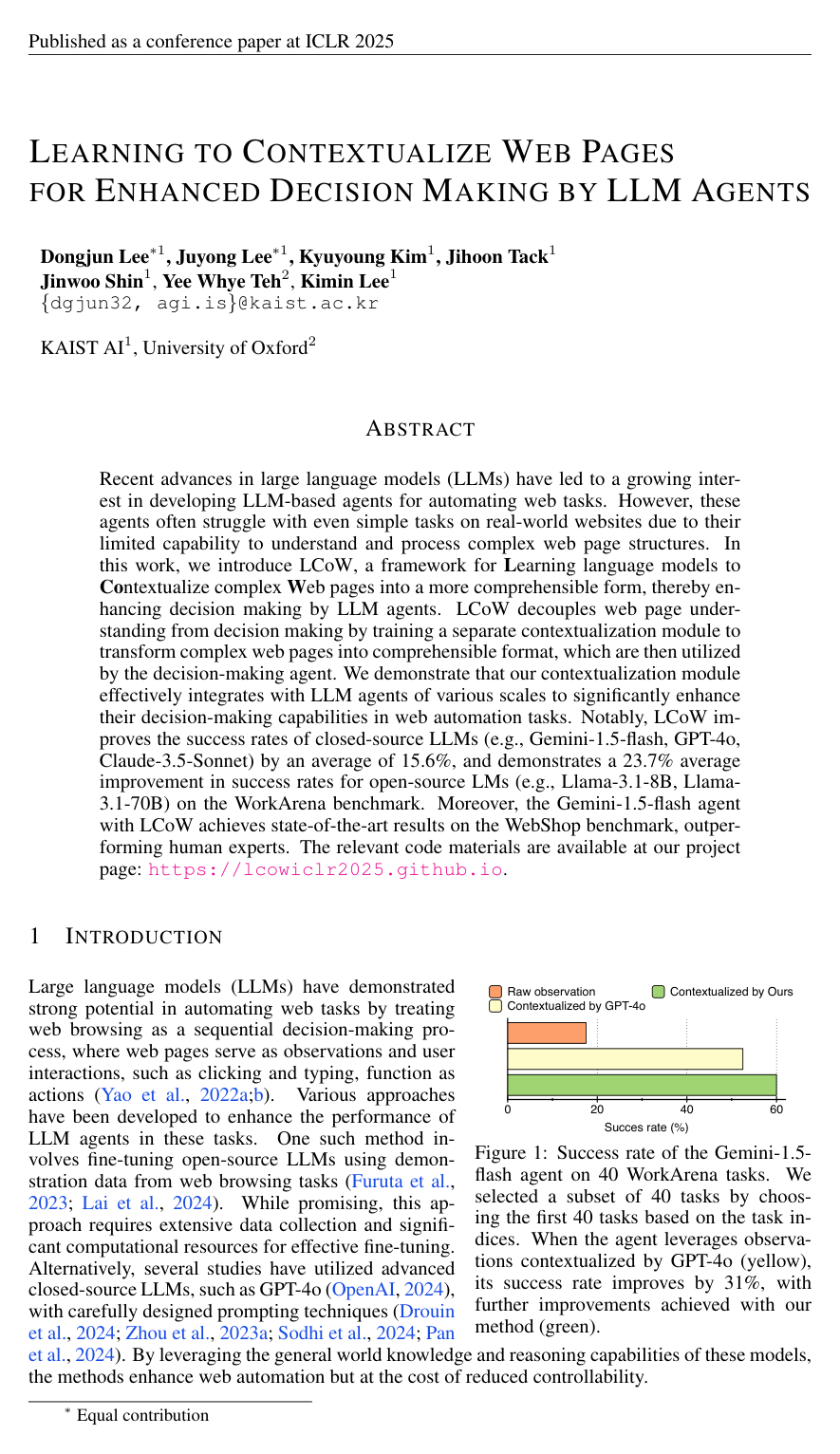
Learning to Contextualize Web Pages for Enhanced Decision Making by LLM Agents
Dongjun Lee, Juyong Lee, Kyuyoung Kim, Jihoon Tack, Jinwoo Shin, Yee Whye Teh, Kimin Lee
Why you should read this
Introduces LCoW, a framework that decouples web page comprehension from action planning by training a specialized contextualization module, boosting LLM agent success rates on WorkArena by up to 23.7% and outperforming human experts on WebShop.
Recent advances in large language models (LLMs) have led to a growing interest in developing LLM-based agents for automating web tasks. However, these agents often struggle with even simple tasks on real-world websites due to their limited capability to understand and process complex web page structures. In this work, we introduce LCoW, a framework for Learning language models to Contextualize complex Web pages into a more comprehensible form, thereby enhancing decision making by LLM agents. LCoW decouples web page understanding from decision making by training a separate contextualization module to transform complex web pages into comprehensible format, which are then utilized by the decision-making agent. We demonstrate that our contextualization module effectively integrates with LLM agents of various scales to significantly enhance their decision-making capabilities in web automation tasks. Notably, LCoW improves the success rates of closed-source LLMs (e.g., Gemini-1.5-flash, GPT-4o, Claude-3.5-Sonnet) by an average of 15.6%, and demonstrates a 23.7% average improvement in success rates for open-source LMs (e.g., Llama-3.1-8B, Llama-3.1-70B) on the WorkArena benchmark. Moreover, the Gemini-1.5-flash agent with LCoW achieves state-of-the-art results on the WebShop benchmark, outperforming human experts. The relevant code materials are available at our project page: this https URL.
Added
2026-09-29
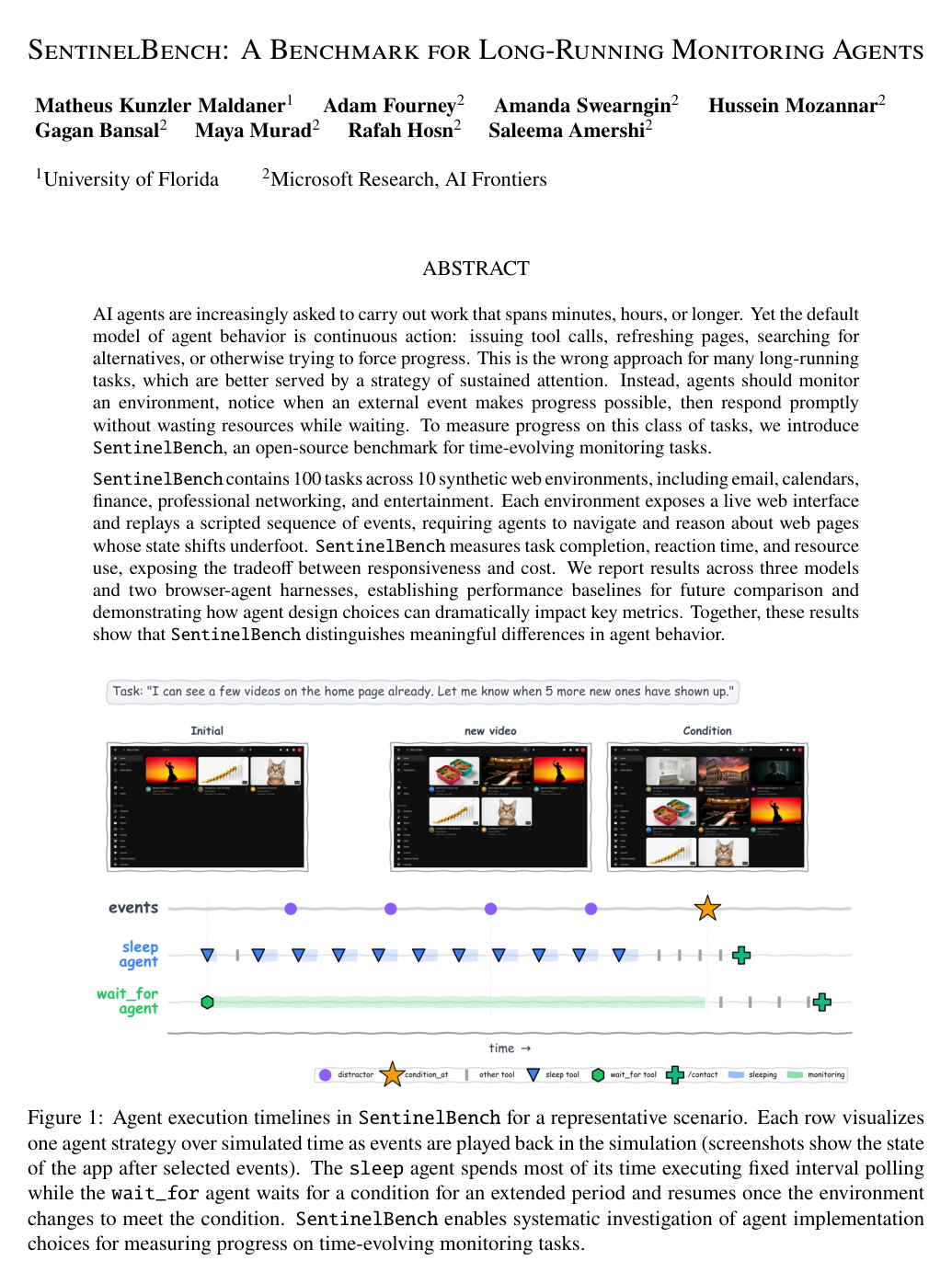
SentinelBench: A Benchmark for Long-Running Monitoring Agents
Matheus Kunzler Maldaner, Adam Fourney, Amanda Swearngin, Hussein Mozannar, Gagan Bansal, Maya Murad, Rafah Hosn, Saleema Amershi
Why you should read this
Introduces SentinelBench, an open-source benchmark of 100 dynamic web tasks that evaluates how effectively autonomous agents monitor changing interfaces and balance reaction speed against resource consumption over extended periods.
AI agents are increasingly asked to carry out work that spans minutes, hours, or longer. Yet the default model of agent behavior is continuous action: issuing tool calls, refreshing pages, searching for alternatives, or otherwise trying to force progress. This is the wrong approach for many long-running tasks, which are better served by a strategy of sustained attention. Instead, agents should monitor an environment, notice when an external event makes progress possible, then respond promptly without wasting resources while waiting. To measure progress on this class of tasks, we introduce SentinelBench, an open-source benchmark for time-evolving monitoring tasks. SentinelBench contains 100 tasks across 10 synthetic web environments, including email, calendars, finance, professional networking, and entertainment. Each environment exposes a live web interface and replays a scripted sequence of events, requiring agents to navigate and reason about web pages whose state shifts underfoot. SentinelBench measures task completion, reaction time, and resource use, exposing the tradeoff between responsiveness and cost. We report results across three models and two browser-agent harnesses, establishing performance baselines for future comparison and demonstrating how agent design choices can dramatically impact key metrics. Together, these results show that SentinelBench distinguishes meaningful differences in agent behavior.
Added
2026-09-29
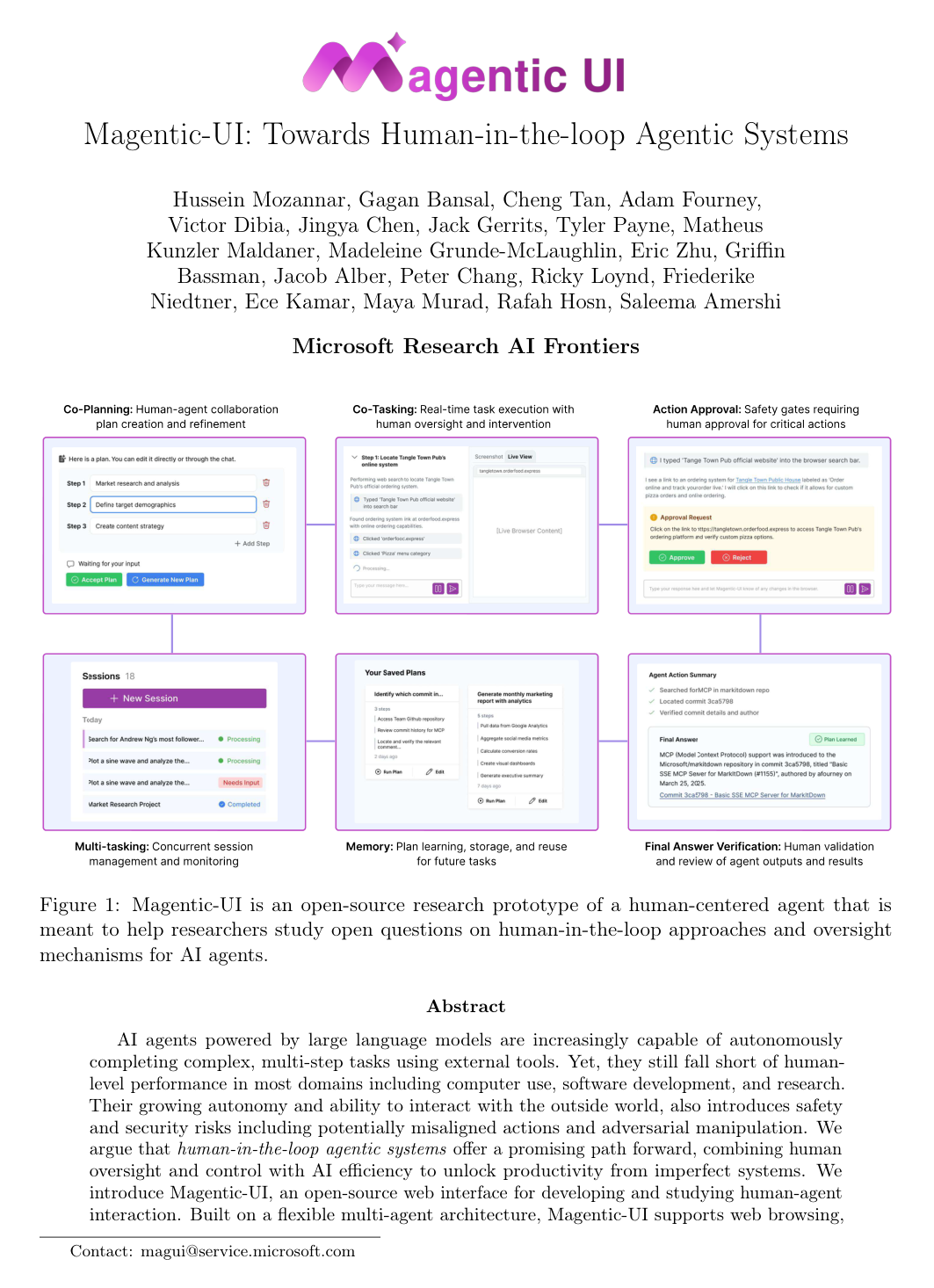
Magentic-UI: Towards Human-in-the-loop Agentic Systems
Hussein Mozannar, Gagan Bansal, Cheng Tan, Adam Fourney, Victor Dibia, Jingya Chen, Jack Gerrits, Tyler Payne, Matheus Kunzler Maldaner, Madeleine Grunde-McLaughlin, Eric Zhu, Griffin Bassman, Jacob Alber, Peter Chang, Ricky Loynd, Friederike Niedtner, Ece Kamar, Maya Murad, Rafah Hosn, Saleema Amershi
Why you should read this
Presents Magentic-UI, an open-source research platform that implements six core interaction mechanisms—such as co-planning, live intervention, and action approvals—to enable safe, cost-effective human oversight of multi-agent LLM systems performing complex web and coding tasks.
AI agents powered by large language models are increasingly capable of autonomously completing complex, multi-step tasks using external tools. Yet, they still fall short of human-level performance in most domains including computer use, software development, and research. Their growing autonomy and ability to interact with the outside world, also introduces safety and security risks including potentially misaligned actions and adversarial manipulation. We argue that human-in-the-loop agentic systems offer a promising path forward, combining human oversight and control with AI efficiency to unlock productivity from imperfect systems. We introduce Magentic-UI, an open-source web interface for developing and studying human-agent interaction. Built on a flexible multi-agent architecture, Magentic-UI supports web browsing,
Added
2026-09-29
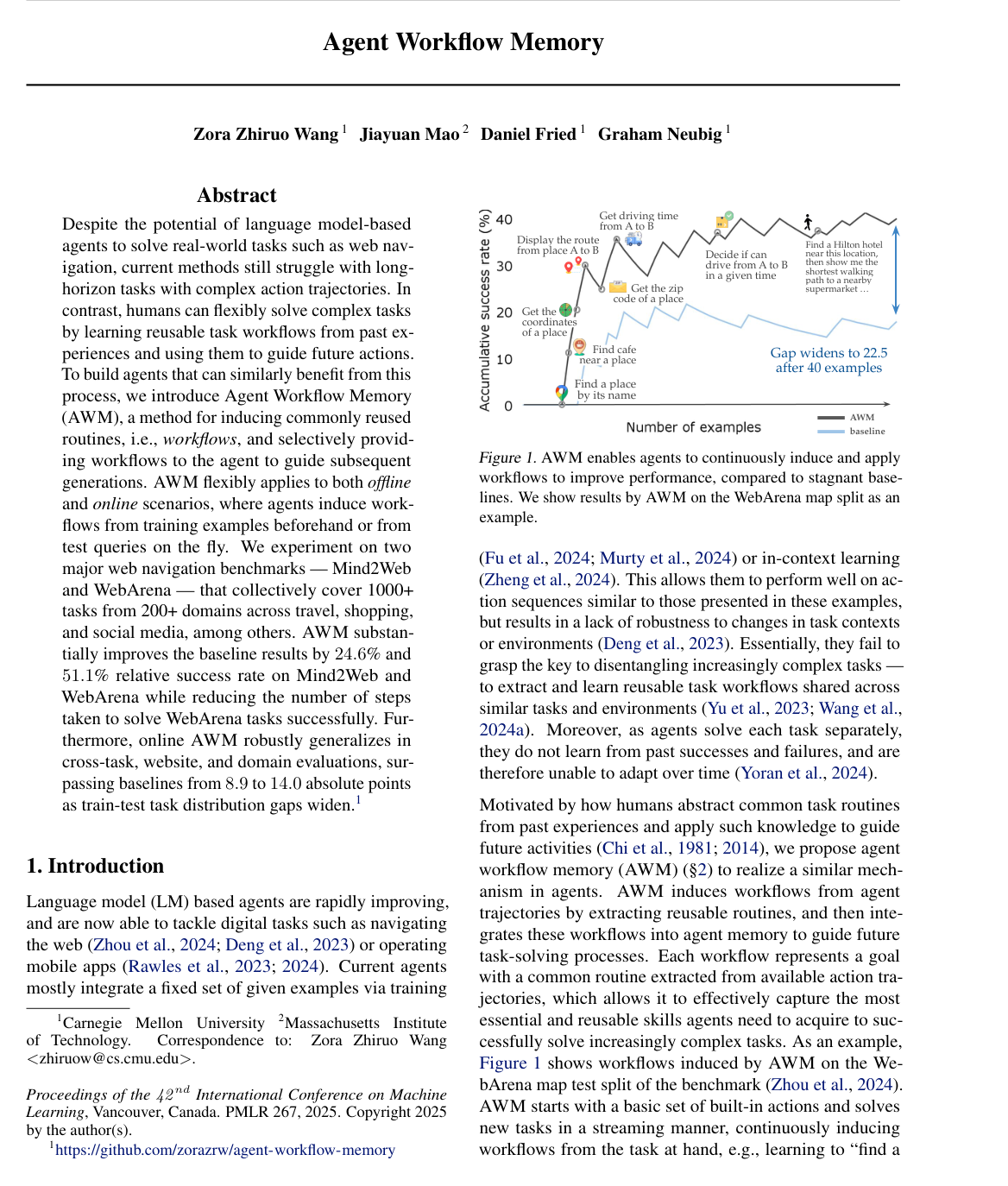
Agent Workflow Memory
Zora Zhiruo Wang, Jiayuan Mao, Daniel Fried, Graham Neubig
Why you should read this
Proposes Agent Workflow Memory, a method that extracts reusable sub-routines from past experiences to significantly boost web navigation agent performance and cross-domain generalization in both offline and streaming online settings.
Added
2026-09-26
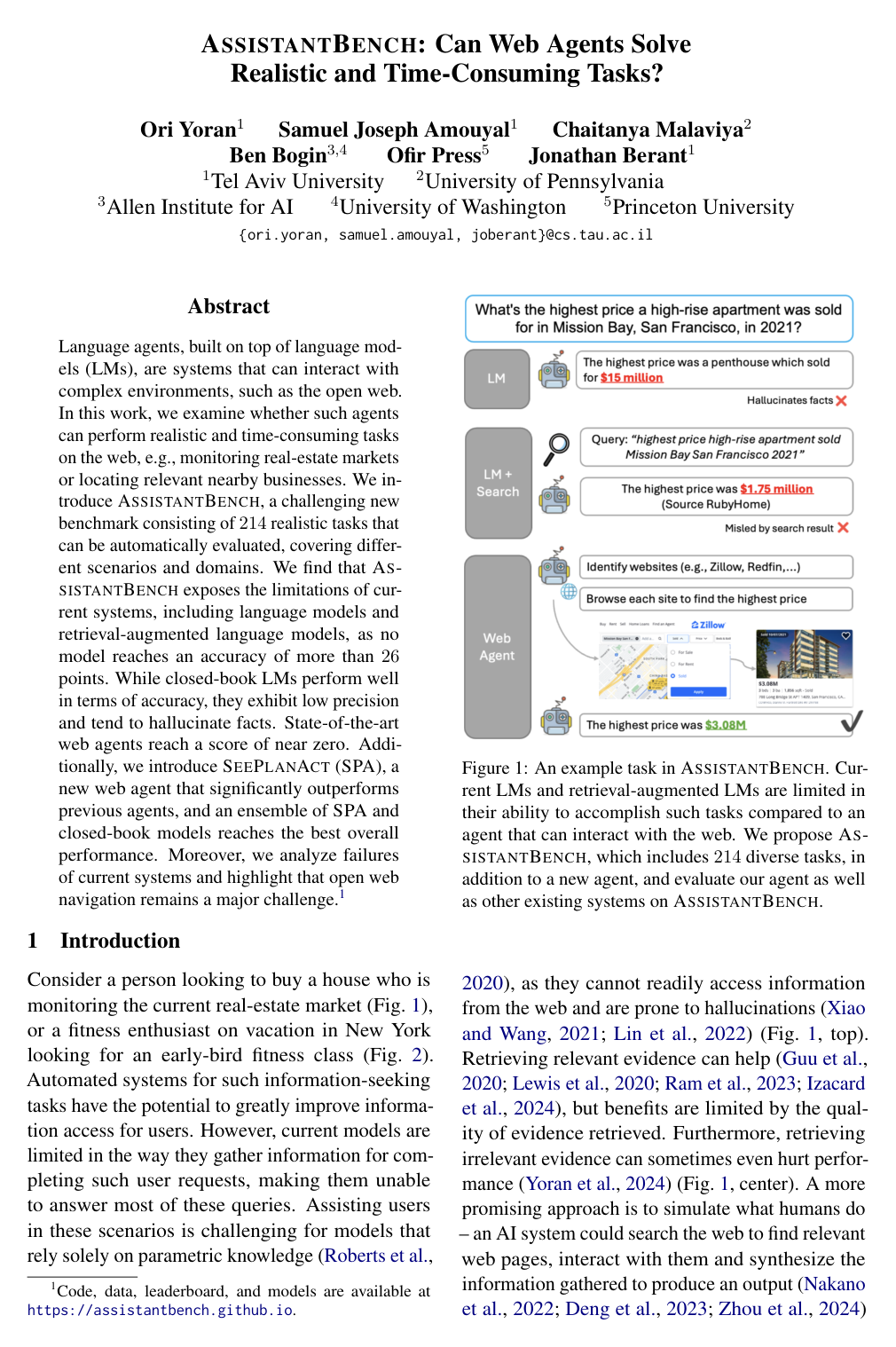
AssistantBench: Can Web Agents Solve Realistic and Time-Consuming Tasks?
Ori Yoran, Samuel Joseph Amouyal, Chaitanya Malaviya, Ben Bogin, Ofir Press, Jonathan Berant
Why you should read this
Introduces AssistantBench, an automatically evaluated benchmark of realistic and time-consuming web tasks that exposes severe limitations in existing language models, alongside SeePlanAct, a new agent architecture designed to improve multi-step web execution.
Language agents, built on top of language models (LMs), are systems that can interact with complex environments, such as the open web. In this work, we examine whether such agents can perform realistic and time-consuming tasks on the web, e.g., monitoring real-estate markets or locating relevant nearby businesses. We introduce AssistantBench, a challenging new benchmark consisting of 214 realistic tasks that can be automatically evaluated, covering different scenarios and domains. We find that AssistantBench exposes the limitations of current systems, including language models and retrieval-augmented language models, as no model reaches an accuracy of more than 26 points. While closed-book LMs perform well in terms of accuracy, they exhibit low precision and tend to hallucinate facts. State-of-the-art web agents reach a score of near zero. Additionally, we introduce SeePlanAct (SPA), a new web agent that significantly outperforms previous agents, and an ensemble of SPA and closed-book models reaches the best overall performance. Moreover, we analyze failures of current systems and highlight that open web navigation remains a major challenge.
Added
2026-09-26
CogAgent: A Visual Language Model for GUI Agents
Wenyi Hong, Weihan Wang, Qingsong Lv, Jiazheng Xu, Wenmeng Yu, Junhui Ji, Yan Wang, Zihan Wang, Yuxiao Dong, Ming Ding, Jie Tang
Why you should read this
Introduces CogAgent, an 18-billion-parameter visual language model with high-resolution image processing that operates computer and smartphone graphical user interfaces directly from raw screenshots, outperforming HTML-based methods across PC and mobile benchmarks.
People are spending an enormous amount of time on digital devices through graphical user interfaces (GUIs), e.g., computer or smartphone screens. Large language models (LLMs) such as ChatGPT can assist people in tasks like writing emails, but struggle to understand and interact with GUIs, thus limiting their potential to increase automation levels. In this paper, we introduce CogAgent, an 18-billion-parameter visual language model (VLM) specializing in GUI understanding and navigation. By utilizing both low-resolution and high-resolution image encoders, CogAgent supports input at a resolution of 1120*1120, enabling it to recognize tiny page elements and text. As a generalist visual language model, CogAgent achieves the state of the art on five text-rich and four general VQA benchmarks, including VQAv2, OK-VQA, Text-VQA, ST-VQA, ChartQA, infoVQA, DocVQA, MM-Vet, and POPE. CogAgent, using only screenshots as input, outperforms LLM-based methods that consume extracted HTML text on both PC and Android GUI navigation tasks -- Mind2Web and AITW, advancing the state of the art. The model and codes are available at this https URL, with a new version of CogAgent-9B-20241220 available at this https URL.
Added
2026-09-25
WebArena: A Realistic Web Environment for Building Autonomous Agents
Shuyan Zhou, Frank F. Xu, Hao Zhu, Xuhui Zhou, Robert Lo, Abishek Sridhar, Xianyi Cheng, Yonatan Bisk, Daniel Fried, Uri Alon, Graham Neubig
Why you should read this
Introduces WebArena, a realistic multi-domain web environment that benchmarks autonomous language agents on long-horizon tasks, revealing that top models like GPT-4 achieve only a 14.4% success rate compared to 78.2% for humans.
With advances in generative AI, there is now potential for autonomous agents to manage daily tasks via natural language commands. However, current agents are primarily created and tested in simplified synthetic environments, leading to a disconnect with real-world scenarios. In this paper, we build an environment for language-guided agents that is highly realistic and reproducible. Specifically, we focus on agents that perform tasks on the web, and create an environment with fully functional websites from four common domains: e-commerce, social forum discussions, collaborative software development, and content management. Our environment is enriched with tools (e.g., a map) and external knowledge bases (e.g., user manuals) to encourage human-like task-solving. Building upon our environment, we release a set of benchmark tasks focusing on evaluating the functional correctness of task completions. The tasks in our benchmark are diverse, long-horizon, and designed to emulate tasks that humans routinely perform on the internet. We experiment with several baseline agents, integrating recent techniques such as reasoning before acting. The results demonstrate that solving complex tasks is challenging: our best GPT-4-based agent only achieves an end-to-end task success rate of 14.41%, significantly lower than the human performance of 78.24%. These results highlight the need for further development of robust agents, that current state-of-the-art large language models are far from perfect performance in these real-life tasks, and that WebArena can be used to measure such progress.
Added
2026-09-18