
keyword
weak classifiers
A weak classifier is a simple machine learning model that performs only slightly better than random guessing at predicting the correct label of a given data instance. Typically characterized by low mathematical complexity and minimal computational cost, common examples include shallow decision trees, single-feature decision stumps, or basic thresholding functions. While an individual weak classifier lacks sufficient predictive power on its own, it serves as a foundational building block in ensemble learning frameworks, most notably boosting algorithms. In these frameworks, multiple weak classifiers are trained sequentially or in parallel, with subsequent learners often focusing on instances misclassified by earlier ones, and are combined through weighted voting to form a single, highly accurate strong classifier.
2 items

TextonBoost: Joint Appearance, Shape and Context Modeling for Multi-class Object Recognition and Segmentation
J. Shotton, J. Winn, C. Rother, A. Criminisi
Why you should read this
Introduces the TextonBoost framework, which unifies appearance, shape, and spatial context using boosted texton features within a conditional random field to achieve accurate, multi-class semantic segmentation and object recognition.
This paper proposes a new approach to learning a discriminative model of object classes, incorporating appearance, shape and context information efficiently. The learned model is used for automatic visual recognition and semantic segmentation of photographs. Our discriminative model exploits novel features, based on textons, which jointly model shape and texture. Unary classification and feature selection is achieved using shared boosting to give an efficient classifier which can be applied to a large number of classes. Accurate image segmentation is achieved by incorporating these classifiers in a conditional random field. Efficient training of the model on very large datasets is achieved by exploiting both random feature selection and piecewise training methods. High classification and segmentation accuracy are demonstrated on three different databases: i) our own 21-object class database of photographs of real objects viewed under general lighting conditions, poses and viewpoints, ii) the 7-class Corel subset and iii) the 7-class Sowerby database used in [1]. The proposed algorithm gives competitive results both for highly textured (e.g. grass, trees), highly structured (e.g. cars, faces, bikes, aeroplanes) and articulated objects (e.g. body, cow).
Added
2026-09-25
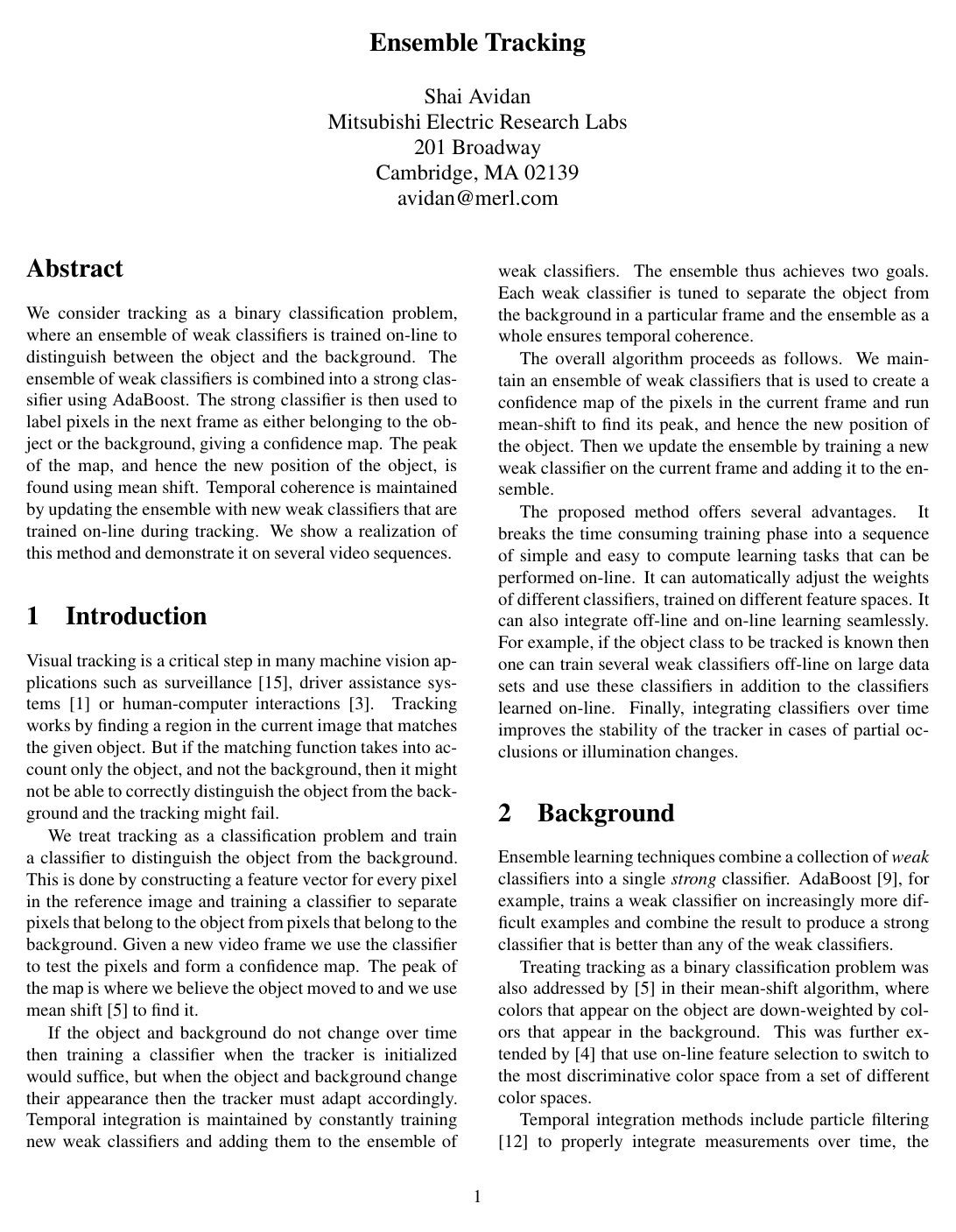
Ensemble Tracking
S. Avidan
Why you should read this
Proposes a visual tracking framework that treats tracking as an online binary classification problem by combining AdaBoost and mean-shift optimization to adaptively distinguish target objects from complex backgrounds across video frames.
We consider tracking as a binary classification problem, where an ensemble of weak classifiers is trained on-line to distinguish between the object and the background. The ensemble of weak classifiers is combined into a strong classifier using AdaBoost. The strong classifier is then used to label pixels in the next frame as either belonging to the object or the background, giving a confidence map. The peak of the map, and hence the new position of the object, is found using mean shift. Temporal coherence is maintained by updating the ensemble with new weak classifiers that are trained on-line during tracking. We show a realization of this method and demonstrate it on several video sequences.
Added
2026-09-24